Carbon Markets — UPSC Environment & Economy Notes
UPSC guide to carbon markets: Paris Article 6, ITMOs, India's CCTS, cap-and-trade, carbon tax, PAT, offset mechanisms, COP29 progress, criticisms.
Carbon markets put a price on every tonne of carbon dioxide — turning what was once a “free” externality into a tradable commodity. The logic is simple: emission reductions should happen where they are cheapest. In 2024, over 75 national and subnational carbon-pricing instruments cover about 24% of global GHG emissions. India notified its own Carbon Credit Trading Scheme (CCTS) in June 2023. For UPSC, carbon markets sit at the intersection of GS-III (environment and economy) and GS-II (international relations).
What are carbon markets?
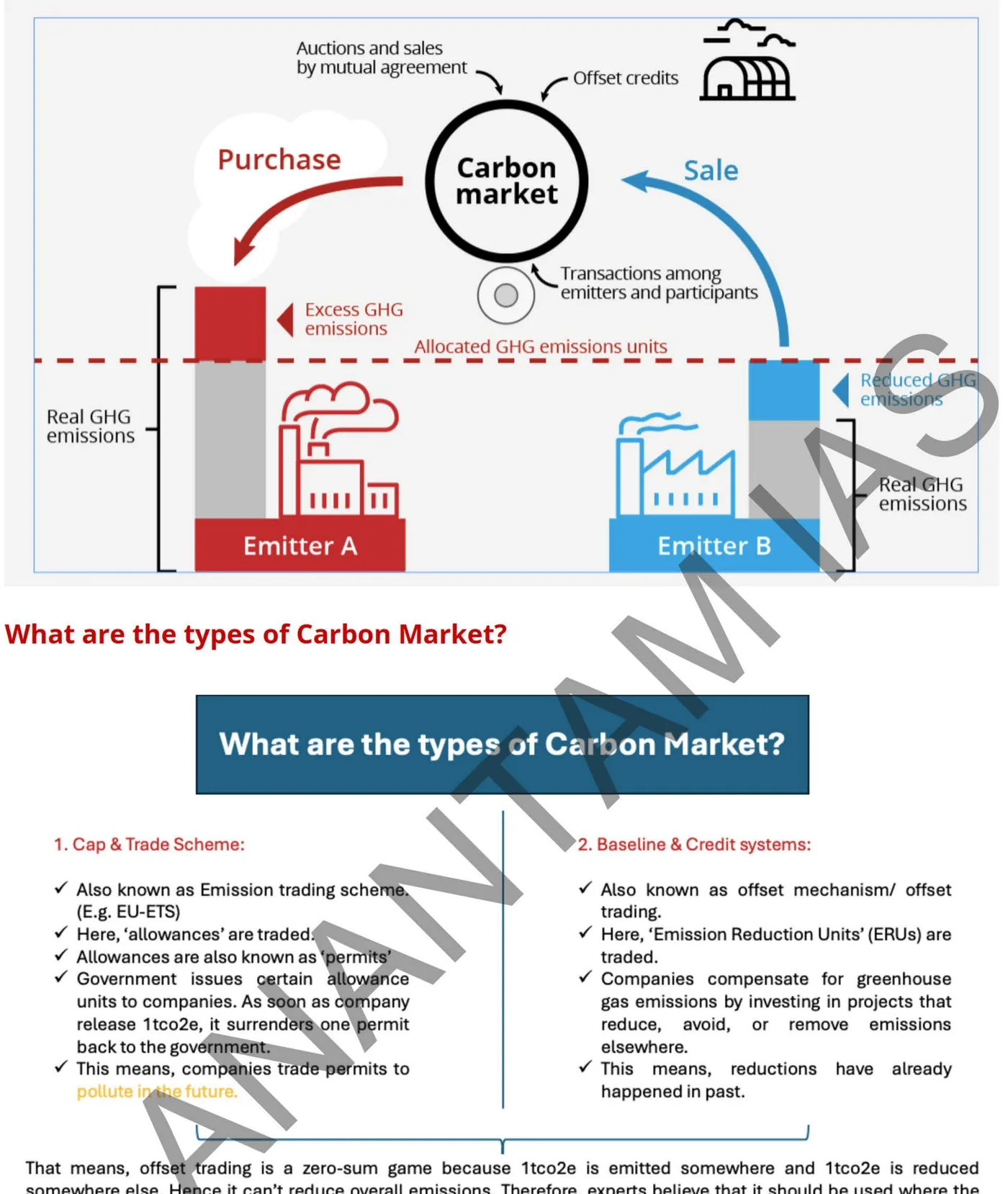
Carbon markets are systems where carbon credits or allowances — each representing one tonne of CO2 (or equivalent) — are bought and sold to meet emission reduction obligations. Two broad types:
| Type | Description |
|---|---|
| Compliance markets | Regulated emissions trading systems (ETS) with legally binding caps |
| Voluntary markets | Corporate and philanthropic offset purchases |
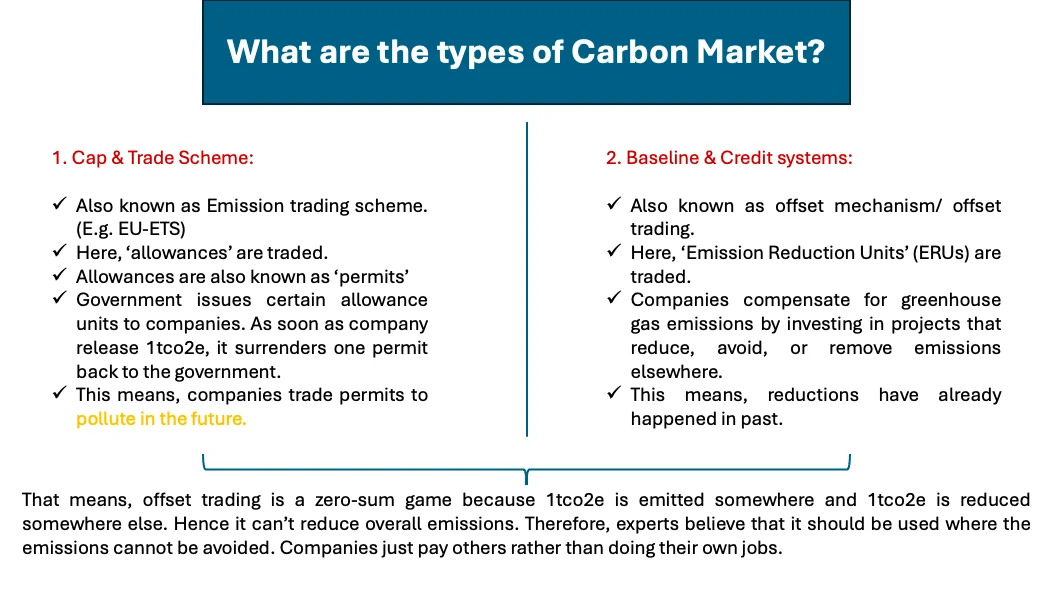
Compliance markets — cap and trade
How it works
- Regulator sets a cap on total GHG emissions for covered sectors.
- Allowances equal to the cap are distributed (auctioned or free).
- Companies that reduce emissions below their allotment can sell excess allowances.
- Heavier emitters buy allowances to meet obligations.
- The cap declines over time — raising the price and tightening emissions.
Major ETSs worldwide
- EU ETS (2005) — world's largest; covers 45% of EU emissions.
- California Cap-and-Trade — linked with Quebec.
- RGGI — Regional Greenhouse Gas Initiative (NE US states).
- China National ETS (2021) — world's largest by coverage, begins with power sector.
- South Korea, New Zealand, UK, Switzerland — all have ETSs.
Carbon tax
A direct price imposed on carbon content of fuels (or on emissions directly).
- Sweden's carbon tax: among the world's highest.
- UK, Canada, France, Argentina, Singapore have carbon taxes.
- Differs from ETS in that price is fixed but quantity (reductions) uncertain.
Combined instruments
Many countries use both ETS and carbon tax across different sectors.
Carbon markets under the Paris Agreement — Article 6
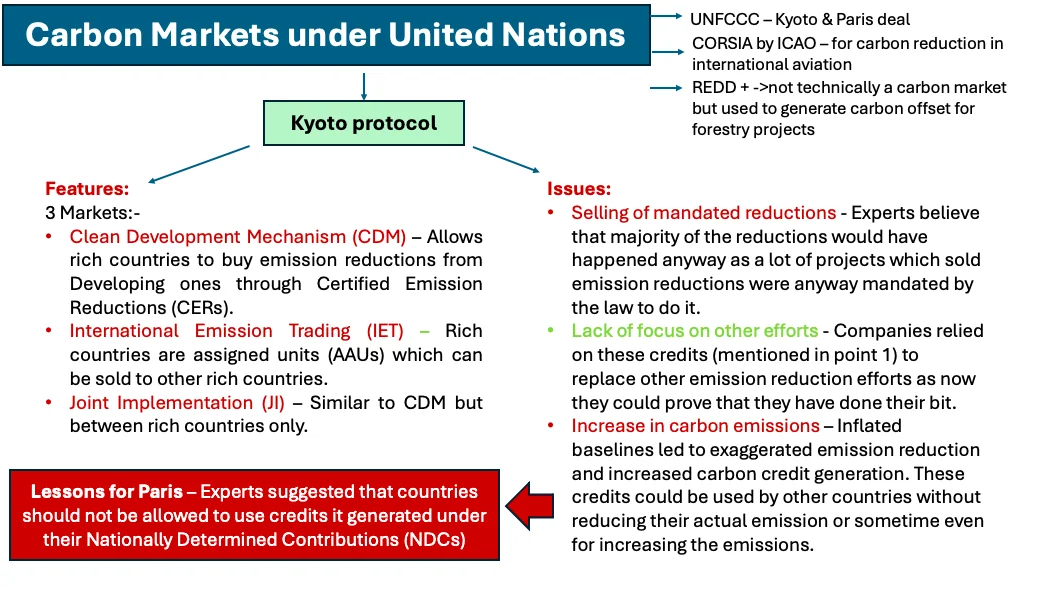
Article 6 of the Paris Agreement establishes three tools for voluntary cooperation between Parties:
Article 6.2 — Cooperative approaches
- Bilateral or multilateral deals between countries.
- Creates Internationally Transferred Mitigation Outcomes (ITMOs) — tradable units of emission reductions.
- First ITMO deal: Switzerland-Ghana (2020).
- India-UAE, India-Singapore negotiations underway.
Article 6.4 — Sustainable Development Mechanism (SDM)
- New international carbon market replacing Kyoto's Clean Development Mechanism (CDM).
- Trading of emission reductions created anywhere by public or private sector.
- Quality rules approved at COP29 Baku (2024) after years of negotiation.
Article 6.8 — Non-market approaches
- Cooperation that does not involve trading — e.g., technology transfer, capacity building, concessional finance.
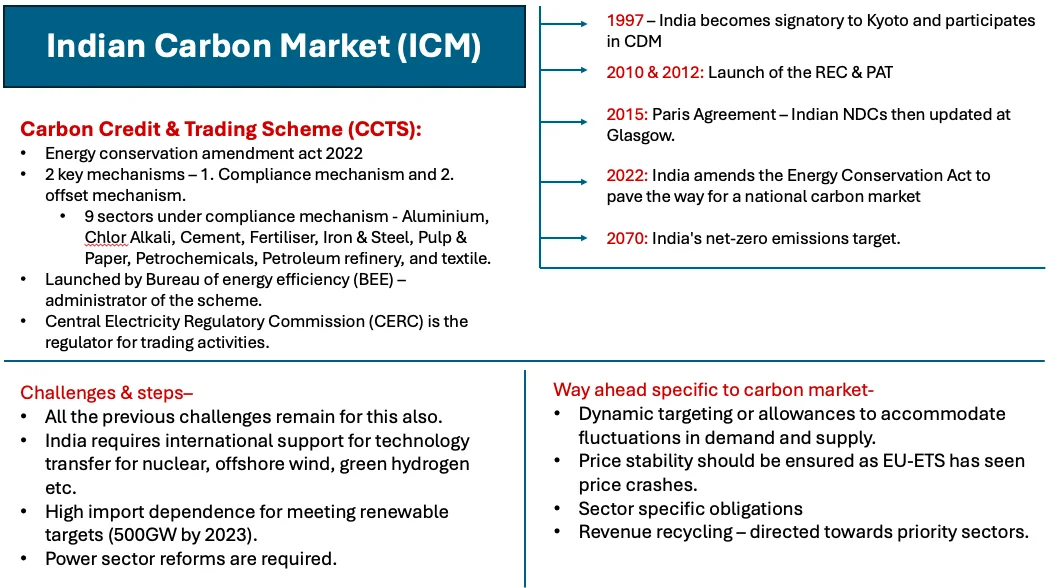
India's Carbon Credit Trading Scheme (CCTS)
Background
- Energy Conservation (Amendment) Act, 2022 enabled the scheme.
- Bureau of Energy Efficiency (BEE) as administrator.
- Builds on the existing PAT (Perform, Achieve, Trade) scheme.
Architecture
- Compliance market for designated sectors (power, iron/steel, cement, aluminium, petrochemicals, fertilisers).
- Offset mechanism for voluntary projects (renewables, afforestation, waste).
- Indian Carbon Market Governing Body oversees.
- CPCB environmental safeguards.
Timeline
- Phase 1 (2024-25): Framework rollout.
- Phase 2 (2025-26): First compliance year.
- Full operational market by 2026-28.
Existing Indian instruments
PAT — Perform, Achieve, Trade
- Under National Mission for Enhanced Energy Efficiency (NMEEE).
- Designated Consumers (DCs) — 1,000+ energy-intensive units in 13 sectors.
- Over-performers earn ESCerts tradable with under-performers.
- PAT is being absorbed into CCTS.
Renewable Energy Certificates (RECs)
- Central Electricity Regulatory Commission (CERC)-regulated.
- Enables renewables-deficit states to meet Renewable Purchase Obligations (RPOs).
Green Credit Programme (2023)
- Notified by MoEFCC.
- Eight categories — tree plantation, water, sustainable agriculture, waste management, air pollution reduction, mangrove conservation, sustainable building, ecomark.
- Market-based tradable Green Credits.
Carbon pricing — other tools
Results-Based Climate Finance (RBCF)
Payments linked to pre-determined climate outcomes (e.g., verified emissions reductions). Used in REDD+, Forest Carbon Partnership Facility.
Offset mechanisms
GHG reductions from project-based activities, registered and traded:
- Verra (VCS) — largest voluntary standard.
- Gold Standard — high environmental integrity.
- Article 6.4 — upcoming UN-verified.
Internal carbon pricing
Corporates use shadow carbon prices in investment decisions. Tata, Mahindra, Infosys, ITC have adopted internal carbon pricing.
Advantages of carbon markets
- Efficient price signal — reduces where cheapest.
- Flexibility for emitters to choose compliance path.
- Revenue generation — auctions fund clean energy.
- Innovation incentive — drives low-carbon technology.
- International cooperation — ITMOs enable North-South partnerships.
Criticisms
- Risk of "hot air" — Soviet-era baseline in Kyoto CDM.
- Double counting — same reduction claimed by multiple parties.
- Environmental integrity — offset projects often fail additionality tests.
- Social safeguards — land-based projects can displace indigenous communities.
- Carbon leakage — emissions shift to unregulated jurisdictions.
- Price volatility — EU ETS prices fluctuated from <€5 to >€100.
- Climate justice — allows rich polluters to pay poorer regions.
EU Carbon Border Adjustment Mechanism (CBAM)
- EU's 2023 regulation taxes embedded carbon in imports of cement, iron, steel, aluminium, fertilisers, hydrogen, electricity.
- Transitional phase 2023-2025; definitive from 2026.
- Affects Indian steel, aluminium exports to EU.
- India considers CBAM WTO-inconsistent and unilateral.
India's position
- Supports Article 6 provided it respects CBDR.
- Wary of unilateral measures like CBAM.
- Domestic CCTS positions India to engage with Article 6 markets.
- Pushing for adequate adaptation share of Article 6 proceeds for developing countries.
Latest developments (2024-26)
Updated context: verify details with BEE, MoEFCC, UNFCCC.
- COP29 Baku (2024) — Article 6.4 rules finalised after nine years; Article 6.2 bilateral agreements multiplying.
- CCTS operational rules (2024) — trajectory targets for first compliance cycle.
- India-Japan carbon cooperation under Article 6.2 — under negotiation.
- EU CBAM — Indian industry preparing for 2026 definitive phase.
- Carbon pricing levels — EU ETS stabilising ~€70/tonne; forecast €100+ by 2030.
- Global carbon price revenues exceeded USD 100 billion in 2023 globally.
UPSC relevance
GS-III mapping
- Environment, climate change.
- Economy — industrial competitiveness.
Prelims bullets
- Article 6 — Paris Agreement; 6.2 (ITMOs), 6.4 (SDM), 6.8 (non-market).
- CCTS notified — June 2023.
- PAT scheme under NMEEE.
- CBAM — EU border carbon adjustment.
- VCS, Gold Standard — voluntary standards.
Mains angles
- "Discuss the significance of India's Carbon Credit Trading Scheme in meeting NDC commitments."
- "Examine the CBAM and its implications for Indian exports."
- "Analyse Article 6 of the Paris Agreement and India's engagement with global carbon markets."
Essay hooks
- Making polluters pay — the carbon price principle.
- Carbon markets vs carbon justice.
- Pricing the planet — market instruments for climate.
Quick revision
| Instrument | Type | Example |
|---|---|---|
| Cap-and-trade (ETS) | Market | EU ETS, China ETS |
| Carbon tax | Price | Sweden, Canada |
| Article 6.2 | International | ITMOs (Switzerland-Ghana) |
| Article 6.4 | International | SDM (UN-verified) |
| CCTS | National | India (2023) |
| PAT | National | India (NMEEE) |
| CBAM | Unilateral border | EU (2023-26) |
Bottom line for UPSC: carbon markets are neither silver bullet nor failure — they are one tool among many for decarbonisation. For India, the CCTS + Green Credits + PAT combination creates a layered pricing architecture that complements renewables policy and international Article 6 engagement.
Watch on YouTube
Related video from the Anantam IAS YouTube channel.