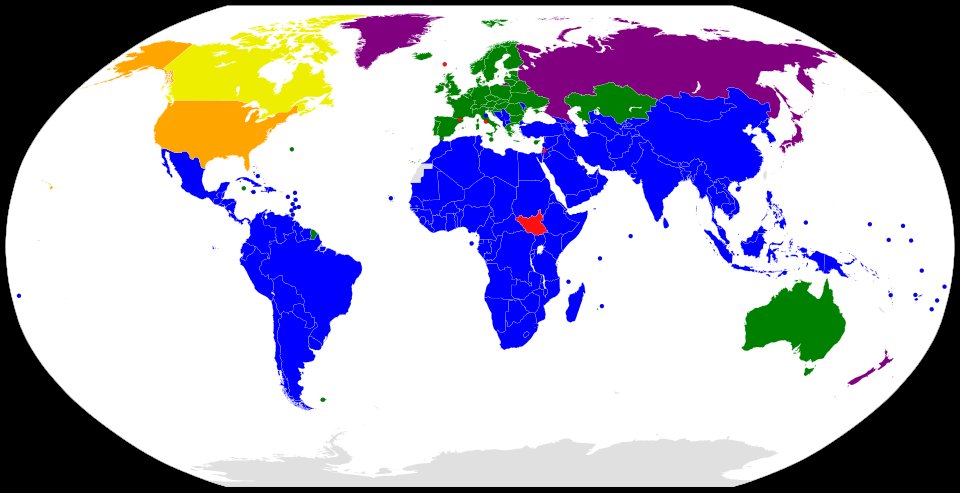
The Kyoto Protocol is the first legally binding international agreement to set quantified greenhouse gas emission reduction targets. Adopted at the third Conference of the Parties to the UN Framework Convention on Climate Change in Kyoto, Japan on 11 December 1997, it entered into force on 16 February 2005 after Russia’s ratification finally crossed the dual threshold of 55 parties accounting for at least 55 percent of 1990 Annex I emissions. The Kyoto Protocol committed 37 industrialised countries plus the European Community to reduce their collective greenhouse gas emissions by an average of 5.2 percent below 1990 levels during the first commitment period of 2008–2012.
The Kyoto Protocol marked a turning point in climate diplomacy. For the first time, developed countries accepted binding numerical limits on their emissions of carbon dioxide, methane, nitrous oxide, hydrofluorocarbons, perfluorocarbons and sulphur hexafluoride. It also introduced three “flexibility mechanisms” — emissions trading, joint implementation and the Clean Development Mechanism — that allowed countries to meet part of their targets through market-based cooperation rather than purely domestic action.
Origin: From Rio to Kyoto
The Kyoto Protocol traces back to Article 4.2 of the UNFCCC, which urged industrialised countries to return their emissions to 1990 levels by 2000 — a target that was aspirational, not binding. By 1995, it was clear that this would not be achieved.
The Berlin Mandate
At COP1 in Berlin in March–April 1995, parties adopted the Berlin Mandate, which formally launched negotiations on a binding protocol with quantified emission reduction commitments for Annex I parties only. The mandate explicitly excluded any new commitments for developing countries — a recognition of the principle of common but differentiated responsibilities and respective capabilities (CBDR-RC).
The Ad Hoc Group on the Berlin Mandate (AGBM) negotiated for 30 months and tabled the draft protocol at COP3 in Kyoto in December 1997.
Adoption Day, 11 December 1997
The Kyoto conference was scheduled to close on 10 December 1997 but ran late into the night of 11 December as ministers haggled over individual country targets. The European Union pushed for steeper cuts; the United States pressed for inclusion of flexibility mechanisms; Japan, the host, brokered the compromise on the final differentiated targets. The protocol was adopted by consensus shortly before midnight.
Annex B Targets
The Kyoto Protocol’s binding targets are listed in its Annex B, which is a subset of UNFCCC Annex I parties. The targets vary by country, reflecting different national circumstances. The European Union as a whole committed to 8 percent below 1990 levels, the United States to 7 percent, Japan and Canada to 6 percent, Russia and Ukraine to stabilisation at 1990 levels. Some countries — Australia, Iceland, Norway — were allowed to increase emissions above 1990 levels.
The collective Annex B commitment was 5.2 percent below 1990 levels during 2008–2012. Six greenhouse gases were covered: CO2, CH4, N2O, HFCs, PFCs and SF6. Emissions and removals from land use, land-use change and forestry (LULUCF) could be counted, subject to specific rules elaborated in the 2001 Marrakech Accords.
Entry into Force and the 55/55 Rule
For the Kyoto Protocol to enter into force, at least 55 parties to the UNFCCC had to ratify, and these had to include Annex I parties accounting for at least 55 percent of total Annex I CO2 emissions in 1990. The first threshold was met quickly. The second hinged on Russia, which ratified on 18 November 2004. The protocol entered into force ninety days later, on 16 February 2005.
The Three Flexibility Mechanisms
The Kyoto Protocol introduced three market-based mechanisms — collectively called flexibility mechanisms or “Kyoto mechanisms” — that allowed Annex I parties to meet part of their targets through cooperative action.
International Emissions Trading (Article 17)
Article 17 allowed Annex I parties to trade Assigned Amount Units (AAUs) between each other. A country with emissions below its assigned amount could sell the surplus to a country that had exceeded its assigned amount. The biggest seller was Russia, whose post-Soviet economic collapse had left it with “hot air” — a surplus relative to its 1990 baseline that did not reflect any new climate action.
Joint Implementation (Article 6)
Joint Implementation (JI) allowed an Annex I country to earn Emission Reduction Units (ERUs) from emission-reduction projects in another Annex I country, typically an economy in transition. JI was used primarily in Eastern Europe and Russia. Its environmental integrity was questioned because both host and investor were already subject to binding caps.
Clean Development Mechanism (Article 12)
The Clean Development Mechanism (CDM) was the protocol’s most significant institutional innovation and the one of greatest importance to India. Article 12 allowed Annex I parties to invest in emission-reduction projects in developing (non-Annex I) countries and earn Certified Emission Reductions (CERs) that could count towards their Kyoto targets. CDM had two purposes: helping developed countries meet their commitments cost-effectively, and assisting developing countries in achieving sustainable development.
By the close of the first commitment period, the CDM had registered over 7,800 projects worldwide and issued more than 2 billion CERs.
India and the Clean Development Mechanism
India did not have any emission reduction obligations under the Kyoto Protocol but was the second-largest beneficiary of the CDM after China.
CDM Project Activity in India
India hosted over 1,650 registered CDM projects between 2005 and 2020 and was issued approximately 250 million CERs. The dominant sectors were renewable energy (wind, biomass, small hydro), industrial energy efficiency, methane recovery from coal mines and landfills, and HFC-23 destruction at HCFC-22 plants.
The CDM contributed to early renewable energy capacity addition in India — wind power in Tamil Nadu, Gujarat and Maharashtra in particular — and helped seed a domestic carbon market expertise that would later support participation in Article 6 of the Paris Agreement 2015.
Designated National Authority
India’s National CDM Authority, hosted at the Ministry of Environment, Forest and Climate Change, was the Designated National Authority that approved CDM projects. By 2020, with the collapse of CER prices and the impending sunset of the CDM, the focus shifted to the Article 6.4 mechanism under the Paris Agreement.
The Doha Amendment and the Second Commitment Period
The first commitment period of the Kyoto Protocol ran from 2008 to 2012. By COP18 in Doha, Qatar in December 2012, parties adopted the Doha Amendment to establish a second commitment period from 2013 to 2020 with a target of 18 percent below 1990 levels.
The Doha Amendment was a much-weakened instrument. The United States had never ratified Kyoto. Canada formally withdrew in December 2012. Japan, Russia and New Zealand declined to take on second-period commitments. The Annex B parties bound by the Doha Amendment represented only about 14 percent of global emissions.
The Doha Amendment took eight years to gain the 144 ratifications needed for entry into force. It finally entered into force on 31 December 2020 — the very day its commitment period ended. India ratified the Doha Amendment on 8 August 2017.
The United States and Non-Ratification
The Kyoto Protocol’s most consequential non-participant was the United States. President Bill Clinton signed the protocol in November 1998 but never submitted it to the Senate for ratification, anticipating the unanimous Senate vote that had already opposed it (Byrd-Hagel Resolution, July 1997). President George W. Bush formally rejected Kyoto in March 2001, citing exemption of developing countries and damage to the US economy.
US non-ratification removed the world’s then-largest emitter from the regime and significantly reduced the protocol’s overall coverage. It also shifted the political logic of climate negotiations towards a universal framework — eventually realised in the Paris Agreement.
Achievements and Limits
The Kyoto Protocol’s record is mixed. Annex B parties collectively exceeded their first-period targets, achieving emissions about 22.6 percent below 1990 levels by 2012 — well beyond the 5.2 percent collective target. But this was driven heavily by the post-Soviet economic collapse and not by deliberate climate policy. Global emissions rose by approximately 40 percent between 1990 and 2012, driven by rapid growth in non-Annex I emissions, particularly from China.
Strengths
The Kyoto Protocol established the principle of binding international emission limits, built sophisticated reporting and review infrastructure (national inventories, expert review teams, compliance committee), demonstrated that flexibility mechanisms could mobilise private capital for emission reductions, and trained a generation of climate negotiators and project developers.
Limits
The protocol covered only Annex I emissions, leaving rapidly growing developing-country emissions outside the cap. The “hot air” surplus from economies in transition undermined environmental integrity. The CDM was criticised for additionality problems, particularly with HFC-23 destruction. And US non-ratification, plus Canada’s withdrawal and Japan/Russia/New Zealand’s refusal of a second commitment, fatally weakened the protocol’s political legitimacy.
Transition to the Paris Agreement
By the early 2010s, it was clear that the Kyoto model — binding caps on a closed list of countries — was politically unsustainable. The 2011 Durban Platform launched negotiations on a new universal framework. The result was the Paris Agreement 2015, adopted at COP21, which replaced the top-down architecture of Kyoto with a bottom-up framework of nationally determined contributions covering all parties.
The CDM has been succeeded by the Article 6.4 mechanism under the Paris Agreement. Some CDM credits may be transitioned subject to strict eligibility rules agreed at COP26 in Glasgow. The IPCC AR6 Report and the global stocktake concluded at COP 28 of UNFCCC have continued to shape the post-Kyoto climate regime.
Kyoto Protocol for UPSC
The Kyoto Protocol is a recurring topic in UPSC Prelims and Mains. Aspirants should remember: adoption at COP3 in Kyoto on 11 December 1997, entry into force on 16 February 2005, first commitment period 2008–2012, six greenhouse gases, three flexibility mechanisms (CDM, JI, ET), Doha Amendment 2012 establishing second period 2013–2020, US non-ratification, Canada withdrawal in 2012, India ratification on 26 August 2002 as a non-Annex I beneficiary of the CDM.
Frequently Asked Questions
When was the Kyoto Protocol adopted and when did it enter into force?
The Kyoto Protocol was adopted at COP3 in Kyoto, Japan on 11 December 1997. It entered into force on 16 February 2005, after Russia’s ratification brought the dual threshold of 55 parties and 55 percent of Annex I 1990 emissions over the line.
What targets did the Kyoto Protocol set?
The Kyoto Protocol committed 37 industrialised countries plus the European Community to reduce their collective greenhouse gas emissions by an average of 5.2 percent below 1990 levels during the first commitment period of 2008–2012. Individual country targets varied — for example, the EU 8 percent, the United States 7 percent, Japan and Canada 6 percent.
What are the three flexibility mechanisms under the Kyoto Protocol?
The three flexibility mechanisms are International Emissions Trading (Article 17), Joint Implementation (Article 6) and the Clean Development Mechanism (Article 12). They allowed Annex I parties to meet part of their targets through market-based cooperation rather than purely domestic action.
What is the Clean Development Mechanism?
The Clean Development Mechanism (CDM) allowed Annex I countries to invest in emission-reduction projects in developing countries and earn Certified Emission Reductions (CERs) towards their Kyoto targets. CDM had two purposes: helping developed countries meet commitments cost-effectively and helping developing countries achieve sustainable development.
How did India benefit from the Kyoto Protocol?
India was the second-largest beneficiary of the CDM after China. India hosted over 1,650 registered CDM projects and was issued approximately 250 million CERs in sectors including wind power, biomass, energy efficiency and HFC-23 destruction. The CDM contributed to early renewable energy capacity addition in India.
Why did the United States not ratify the Kyoto Protocol?
The United States signed the Kyoto Protocol in November 1998 but never submitted it to the Senate. The Byrd-Hagel Resolution of July 1997 had already established unanimous Senate opposition to any treaty exempting developing countries from binding commitments. President Bush formally rejected the protocol in March 2001.
What is the Doha Amendment?
The Doha Amendment, adopted at COP18 in December 2012, established a second commitment period of the Kyoto Protocol from 2013 to 2020 with a target of 18 percent below 1990 levels. It was a weakened instrument because Japan, Russia, New Zealand and (later) Canada did not take on second-period commitments. The amendment entered into force on 31 December 2020.
How does the Kyoto Protocol differ from the Paris Agreement?
The Kyoto Protocol set binding emission reduction targets only for Annex I (developed) countries, in a top-down structure. The Paris Agreement of 2015 applies universally to all parties through nationally determined contributions, in a bottom-up structure. Both retain the UNFCCC principle of common but differentiated responsibilities, but the Paris Agreement applies it in light of different national circumstances.
Tell Google you want more of this.
Add Anantam IAS as a preferred sourceOne tap, and this site shows up more often in your own Top Stories, AI Overviews and AI Mode. Remove it any time.