Chandragupta Maurya (322 to 297 BCE): Founder of the Mauryan Empire
Chandragupta Maurya founded the Mauryan Empire in 322 BCE with the help of Kautilya, defeated Seleucus Nicator in 305 BCE, and ended his life as a Jain monk at Shravanabelagola. Complete UPSC notes on his rise, conquests and legacy.
Chandragupta Maurya is the founder of the Mauryan Empire and the first historically attested emperor to rule almost the entire Indian subcontinent. He came to power in 322 BCE by overthrowing the unpopular Nanda dynasty of Magadha, guided by his Brahmin teacher and minister Kautilya. He then defeated the Greek successor Seleucus Nicator in 305 BCE, married into the Seleucid family, and at the end of his life abdicated, became a Jain monk under Acharya Bhadrabahu, and died by ritual fasting at Shravanabelagola in Karnataka around 297 BCE.
This article walks through what we know and what we infer about Chandragupta Maurya from Greek, Brahmanical, Buddhist and Jain sources, and from the inscriptions and archaeology of his period. He is one of the most heavily examined figures in UPSC Prelims and Mains under Ancient History, Indian Polity (for the Arthashastra), and Indian Art and Culture. His biography is also the gateway to the wider Mauryan Empire, to his teacher Kautilya, and to his grandson Ashoka the Great.
Chandragupta Maurya matters in 2026 because every modern Indian narrative of nation-building reaches back to him. He is the original example of a single Indian state built deliberately and quickly, on the strength of strategy, espionage and disciplined military force. His life is also the bridge between the Greek world of Alexander the Great and the Indian world of the Mahajanapadas.
Quick Facts About Chandragupta Maurya
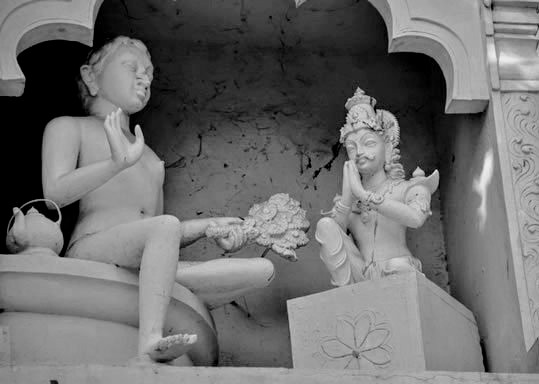
- Born: Around 340 BCE, exact origins disputed (Moriya clan, peacock-tamer family, or Nanda royal son in different sources)
- Reign: 322 to 297 BCE
- Capital: Pataliputra (modern Patna, Bihar)
- Mentor and Minister: Kautilya, also called Chanakya or Vishnugupta
- Major Achievement: Overthrow of the Nanda dynasty around 322 BCE
- War with Seleucus: 305 BCE, ended with the cession of Arachosia, Gedrosia and Paropamisadae
- Greek Sources: Megasthenes’ Indica, Strabo, Justin, Plutarch (call him Sandrokottos)
- Religion at Death: Jainism
- Place of Death: Shravanabelagola, Karnataka, around 297 BCE
- Successor: His son Bindusara
Early Life and Disputed Origins
The early life of Chandragupta Maurya is contested between four traditions, each with its own agenda.
The Buddhist tradition (Mahavamsa, Mahabodhivamsa) calls him a Kshatriya of the Moriya clan of Pippalivana, an obscure republican community on the foothills of the Himalayas. His father is said to have been killed in battle, and his mother to have fled to Pataliputra where he was raised in obscurity.
The Brahmanical tradition (Vishnu Purana, Mudrarakshasa of Vishakhadatta) considers him low-born, possibly the son of a Shudra Nanda king and a maid called Mura, from whom the name “Maurya” is sometimes derived. Other Brahmanical sources call him a son of Mahapadma Nanda’s youngest queen Mura.
The Jain tradition (Parishishtaparvan of Hemachandra) places him in the Moriya kshatriya line, and is especially important because it preserves the story of his final years and Jain death at Shravanabelagola.
The Greek tradition is the most contemporary. Megasthenes, Greek ambassador at his court, called him Sandrokottos. Plutarch records that Chandragupta met Alexander the Great in 326 BCE, possibly as a young man at the camp on the Beas. Whatever the truth, Chandragupta Maurya emerges from obscurity sometime in the 320s BCE as the protege of Kautilya.
Chandragupta and Kautilya
Kautilya, also called Chanakya or Vishnugupta, was a Brahmin teacher of political science. Tradition (Mudrarakshasa, Buddhist sources) records a personal humiliation. The Nanda king Dhana Nanda insulted Kautilya at court in Pataliputra. Kautilya, in revenge, swore to destroy the Nanda line. He found Chandragupta as a boy of military aptitude, took him to Takshashila (Taxila) for training in arms, statecraft, philosophy and the Vedas, and groomed him to overthrow the Nandas.
The two operated as a team. Kautilya was the strategist, the propagandist and the administrator. Chandragupta was the military and political face. The Mudrarakshasa, a 4th-century CE Sanskrit drama, dramatises this partnership and the political intrigues that followed the conquest. The principles Kautilya later wrote down in the Arthashastra are presumed to be the principles by which the Mauryan state was actually run during Chandragupta Maurya’s reign.
Overthrow of the Nanda Dynasty
The Nanda dynasty of Magadha, founded by Mahapadma Nanda in the mid-4th century BCE, was the dominant power in northern India. It had a huge army (Megasthenes reports 200,000 infantry, 80,000 cavalry, 8,000 chariots and 6,000 elephants), an oppressive tax system, and a deeply unpopular ruler, Dhana Nanda.
Chandragupta’s strategy followed Kautilya’s advice. He raised an army in the north-west, possibly using the chaos left by Alexander’s retreat in 325 BCE. The earliest campaign may have been a failure (Buddhist tradition records a defeat). The classical Sanskrit playwright Vishakhadatta’s Mudrarakshasa preserves the strategy: attack the periphery first, then move to the centre. By around 322 BCE Chandragupta and Kautilya had captured Pataliputra, killed Dhana Nanda, and taken the Nanda capital.
The Mauryan state was now in being. Within the next fifteen years Chandragupta would extend it from the Hindu Kush to Bengal, and from the Himalayas down to the Vindhyas and possibly beyond.
War with Seleucus Nicator, 305 BCE
The most documented event of Chandragupta Maurya’s reign is his war with Seleucus Nicator, one of Alexander the Great’s generals who had inherited the eastern provinces of the Macedonian empire. Around 305 BCE Seleucus crossed the Indus and attempted to recover the territories Alexander had passed through.
The war is poorly documented in detail but well documented in outcome. Seleucus made peace. He ceded four satrapies to Chandragupta: Arachosia (modern Kandahar in Afghanistan), Gedrosia (Balochistan), Paropamisadae (the Kabul valley) and parts of Aria. In return Seleucus received 500 war elephants, which he used decisively at the Battle of Ipsus in 301 BCE against Antigonus.
A marriage alliance accompanied the deal. Seleucus gave a daughter (possibly Helena or a princess from his household) to Chandragupta, formally recognising the Mauryan dynasty as an equal among the Hellenistic kingdoms. Seleucus also sent the Greek ambassador Megasthenes to live at Pataliputra. Megasthenes’ lost work Indica survives only in fragments quoted by later Greek writers (Strabo, Diodorus, Arrian), and is the principal foreign source on Chandragupta Maurya’s empire.
Megasthenes and Indica
Megasthenes describes Pataliputra as a city nine miles long and one and a half miles wide on the south bank of the Sone-Ganga confluence. He describes the seven-fold division of society (not strictly the four-varna scheme), the army of 600,000 infantry, the six-membered war office, the public works system, the espionage corps, and the absence of slavery in the Greek sense. He also gives us the only Greek-language description of Indian customs from the 4th century BCE: the eating habits, marriage customs, asceticism and so on.
Administration Under Chandragupta
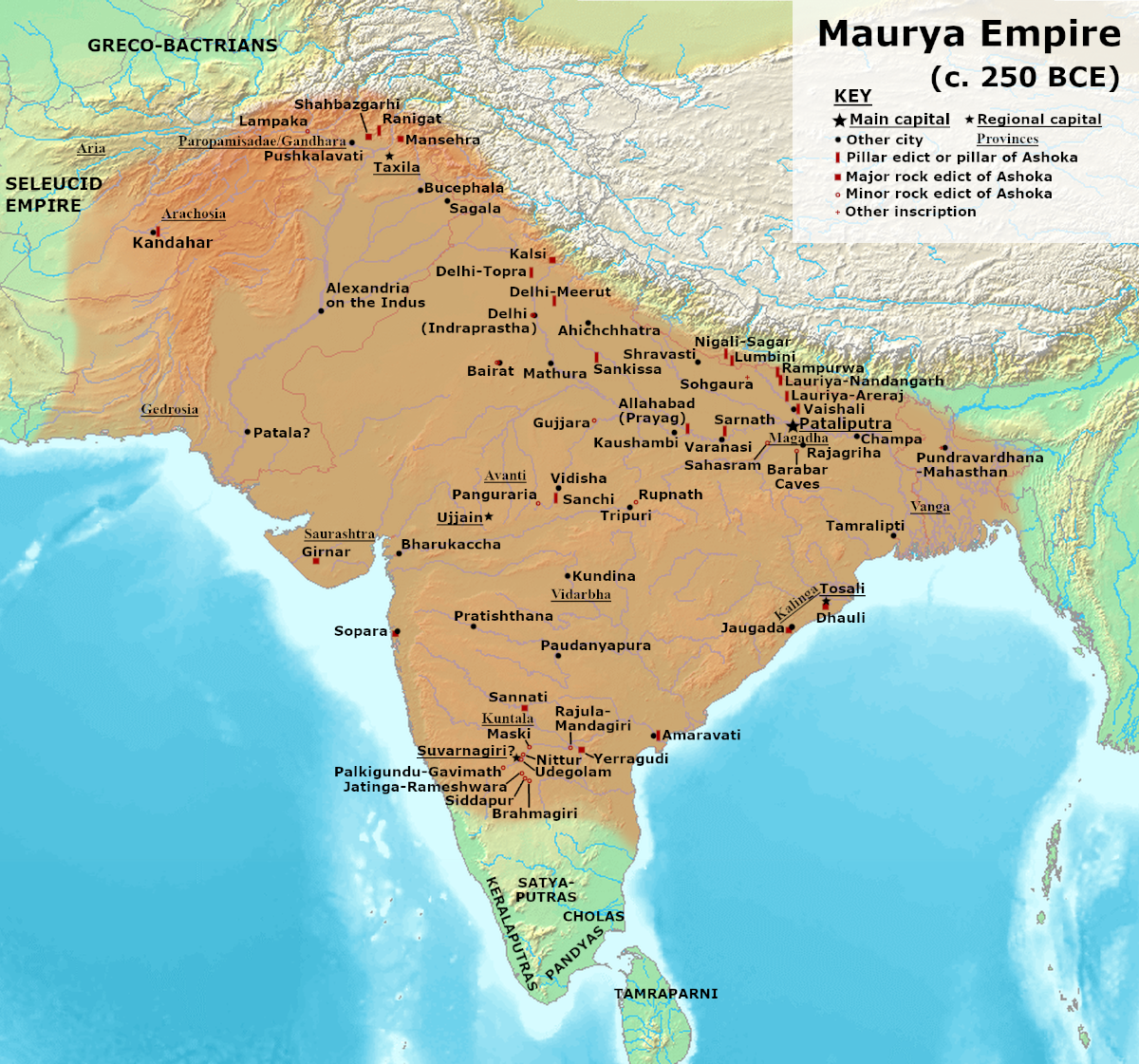
Chandragupta Maurya inherited and consolidated a Magadhan administrative tradition and overlaid on it a far more centralised imperial system. The principles are those laid out in the Arthashastra. The king (raja) was the apex. Below him were a small council of ministers (mantriparishad), heads of departments (adhyakshas) running everything from agriculture and mining to weights and measures and prostitution, and a large bureaucracy. The empire was divided into provinces under royal princes, districts under Pradeshikas, and villages under Gramikas.
The defining features were three. First, a standing army of unprecedented scale (Megasthenes gives 600,000 infantry, 30,000 cavalry, 9,000 elephants, 8,000 chariots). Second, an espionage network of disguised informants reporting directly to the king. Third, an elaborate revenue and public works system, including roads, irrigation tanks like the Sudarshana Lake at Girnar (originally built by Chandragupta’s Vaishya governor Pushyagupta), customs houses and royal monopolies on salt, mining and shipbuilding.
For comparison with later Indian imperial systems, see our coverage of the Mauryan Empire, the long-running Battles of Panipat, and the later south Indian state under Rajaraja Chola I.
Jain Conversion and Death at Shravanabelagola
The final phase of Chandragupta Maurya’s life is preserved most fully in Jain tradition. Around 297 BCE, after a 25-year reign, Chandragupta abdicated in favour of his son Bindusara. He had become a disciple of the Jain monk Acharya Bhadrabahu. When Bhadrabahu predicted a twelve-year famine in north India, he led a migration of Jain monks south to Karnataka.
Chandragupta accompanied him. Bhadrabahu settled at the twin hills of Chandragiri and Vindhyagiri at Shravanabelagola, in modern Hassan district of Karnataka. There Chandragupta lived as a monk, and at the end of his life took up the Jain practice of sallekhana, a ritual fast unto death. He is believed to have died around 297 BCE on Chandragiri hill.
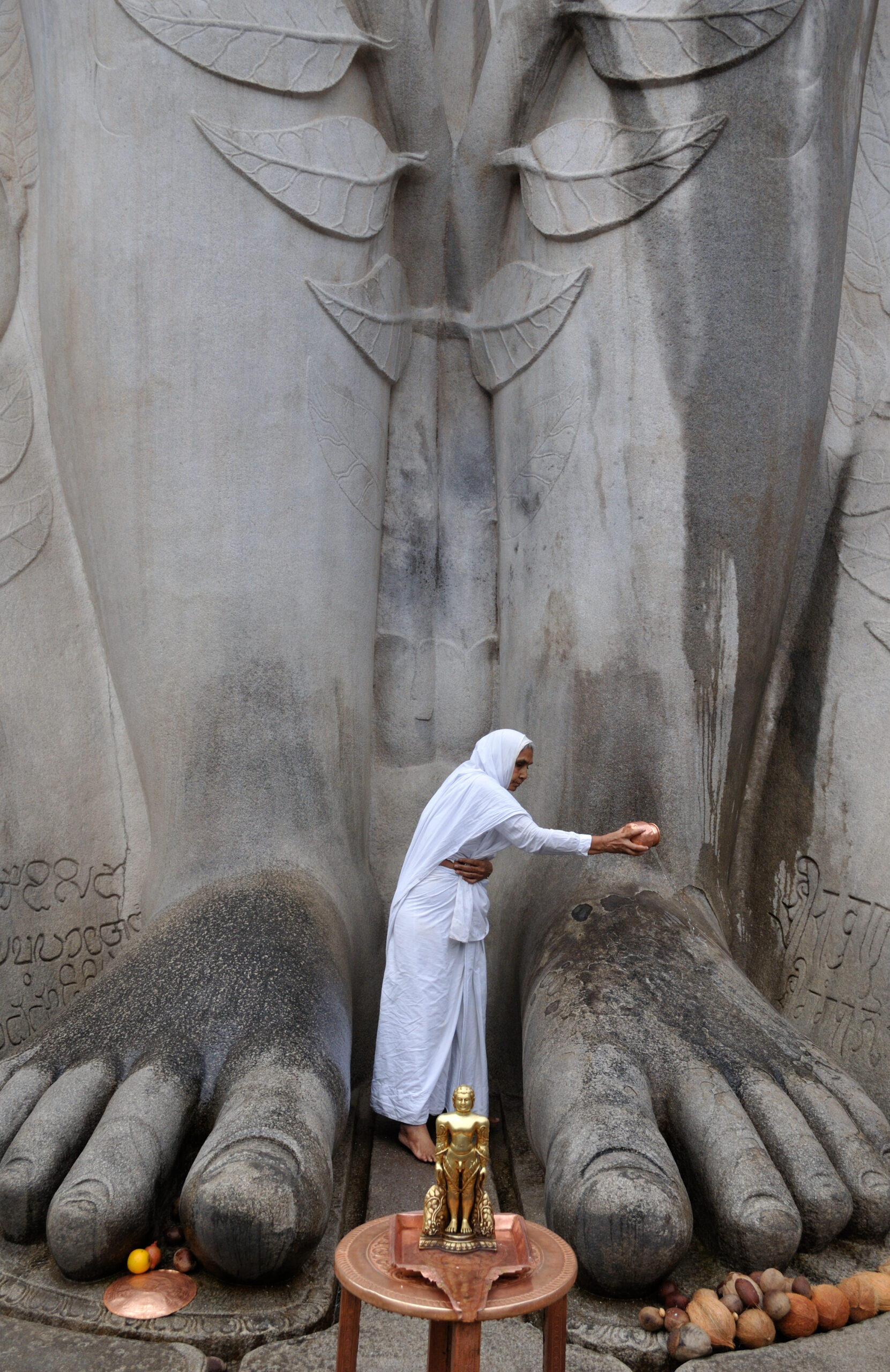
Several pieces of evidence converge on this story. The Chandragiri hill at Shravanabelagola is still associated with Chandragupta. There is a small cave there called the Bhadrabahu cave, with footprints (paduka) said to be those of Bhadrabahu. Jain inscriptions at the site, although dating to the 6th to 10th centuries CE, consistently refer to the migration of “Bhadrabahu and Chandragupta.” The colossal monolithic statue of Gomateshwara (Bahubali) at Vindhyagiri, raised in 981 CE under the Ganga dynasty, sits in the same complex.
The Jain death of Chandragupta Maurya is one of the most striking endings in the history of any major empire. Hardly any of the great founders of ancient world states (Cyrus the Great, Alexander, Qin Shi Huang, Augustus) ended in monastic withdrawal. Chandragupta did.
Why Jainism?
Jainism in the 4th century BCE was already a well-established sramana (renouncer) tradition, with strong patronage in Magadha and the western Deccan. The Jain doctrine of ahimsa (non-violence) and the practice of sallekhana would have appealed to a king who had spent two decades in continuous warfare. The Brahmanical orthodoxy of the Nandas, against whom Chandragupta had built his power, may have made an alternative religious affiliation natural. Whatever the motivation, the choice set a pattern. His grandson Ashoka would also turn to a sramana tradition after the carnage of Kalinga, this time Buddhism.
Legacy of Chandragupta Maurya
Chandragupta Maurya is the founder of the first pan-Indian empire and the founder of a model of statecraft that dominated Indian political thought for the next two thousand years. His legacy can be summed up in three points.
First, the unification of north India under a single authority. Before Chandragupta, the subcontinent was a patchwork of sixteen mahajanapadas, several Greek satrapies in the north-west, and various tribal republics. After him, the default expectation in Indian political imagination is a single dharmic state.
Second, the partnership with Kautilya, and the Arthashastra tradition. Chandragupta’s reign is the empirical case study for the Arthashastra. The seven-limbed (sapta anga) theory of the state, the mandala theory of inter-state relations, and the doctrine of yogakshema (welfare and security) all entered Indian political vocabulary through this period.
Third, his personal example of renunciation. By dying as a Jain monk at Shravanabelagola, Chandragupta linked the imperial role to the ideal of moksha. The model of a king who renounces at the end of life was followed by Ashoka, by some later Gupta and Pratihara kings, and remained a powerful trope in Indian kingship.
The Indian Navy commissioned INS Chakra and INS Arihant in his lineage of strategic naming, and the central commemorative coin issued by the Government of India in 2001 carried his image. He is part of the national symbolic vocabulary.
Frequently Asked Questions
Who was Chandragupta Maurya?
Chandragupta Maurya was the founder of the Mauryan Empire, the first pan-Indian state. He reigned from 322 to 297 BCE, with his capital at Pataliputra. He overthrew the Nanda dynasty of Magadha with the help of his minister Kautilya, defeated Seleucus Nicator in 305 BCE, and ended his life as a Jain monk at Shravanabelagola in Karnataka.
How did Chandragupta Maurya come to power?
Chandragupta Maurya came to power in 322 BCE by overthrowing the unpopular Nanda dynasty of Magadha. He was guided by his Brahmin teacher Kautilya (also called Chanakya), who had been personally humiliated by the Nanda king Dhana Nanda. Their strategy, as preserved in the play Mudrarakshasa, was to attack the periphery of the Nanda kingdom first and move to the centre.
What was the relationship between Chandragupta and Chanakya?
Kautilya, also called Chanakya or Vishnugupta, was Chandragupta Maurya’s teacher, mentor and chief minister. The two formed a working partnership in which Kautilya designed the strategy of the conquest, the administrative system and the espionage network, while Chandragupta provided the military and political leadership. Kautilya is the presumed author of the Arthashastra, the manual of Mauryan statecraft.
Why did Chandragupta fight Seleucus Nicator?
Chandragupta Maurya fought Seleucus Nicator around 305 BCE because Seleucus, one of Alexander the Great’s generals, tried to recover the eastern territories Alexander had passed through. The war ended in a peace settlement: Seleucus ceded the satrapies of Arachosia, Gedrosia, Paropamisadae and parts of Aria to Chandragupta in exchange for 500 war elephants, and a marriage alliance was concluded.
Why did Chandragupta Maurya convert to Jainism?
Chandragupta Maurya became a Jain disciple of Acharya Bhadrabahu in the last years of his reign. The reasons are believed to include disillusionment with continuous warfare, the strong Jain presence in Magadha and the Deccan, and the appeal of the doctrine of ahimsa. He abdicated around 297 BCE, accompanied Bhadrabahu south to Karnataka during a twelve-year famine, and died by sallekhana (ritual fast) at Shravanabelagola.
Where is Shravanabelagola and what is its significance?
Shravanabelagola is a small town in Hassan district of Karnataka, set between two granite hills, Chandragiri and Vindhyagiri. It is one of the holiest sites of Digambara Jainism. It is the traditional site of Chandragupta Maurya’s sallekhana around 297 BCE, marked by the Bhadrabahu cave and footprints on Chandragiri hill. It is also the site of the colossal Gomateshwara statue raised in 981 CE.
What did Megasthenes write about Chandragupta?
Megasthenes was the Greek ambassador sent by Seleucus Nicator to the Mauryan court at Pataliputra around 302 BCE. His book Indica, surviving only in fragments, describes the empire of Chandragupta Maurya: the city of Pataliputra (nine miles long, surrounded by 64 gates and 570 towers), the army of 600,000 infantry, the seven-fold division of society, the espionage corps, the absence of slavery in the Greek sense, and the customs of the people.
What is Chandragupta Maurya’s legacy?
Chandragupta Maurya left three lasting legacies. First, the model of a single pan-Indian state, the template every later Indian empire has measured itself against. Second, the Kautilyan tradition of statecraft, codified in the Arthashastra and built around the seven-limb (sapta anga) theory of the state. Third, the personal example of imperial renunciation, by dying as a Jain monk at Shravanabelagola, which became a recurring ideal in Indian kingship.