Chief Justice of India: Role, Appointment & Powers
Complete guide to the Chief Justice of India — appointment process, collegium system, administrative and judicial powers, tenure, NJAC debate, and list of recent CJIs for UPSC.
Chief Justice of India: Role, Appointment & Powers
The Chief Justice of India (CJI) is the highest judicial officer of India — head of the Supreme Court and the entire Indian judiciary. The CJI presides over the Supreme Court, leads the collegium that appoints judges across India, and performs several constitutional and ceremonial functions. As of 2025, Justice Sanjiv Khanna serves as the 51st Chief Justice of India. This is one of the most-tested constitutional positions in UPSC — expect questions on appointment, collegium, powers, and the NJAC controversy.
Constitutional Basis: Where Does the CJI Come From?
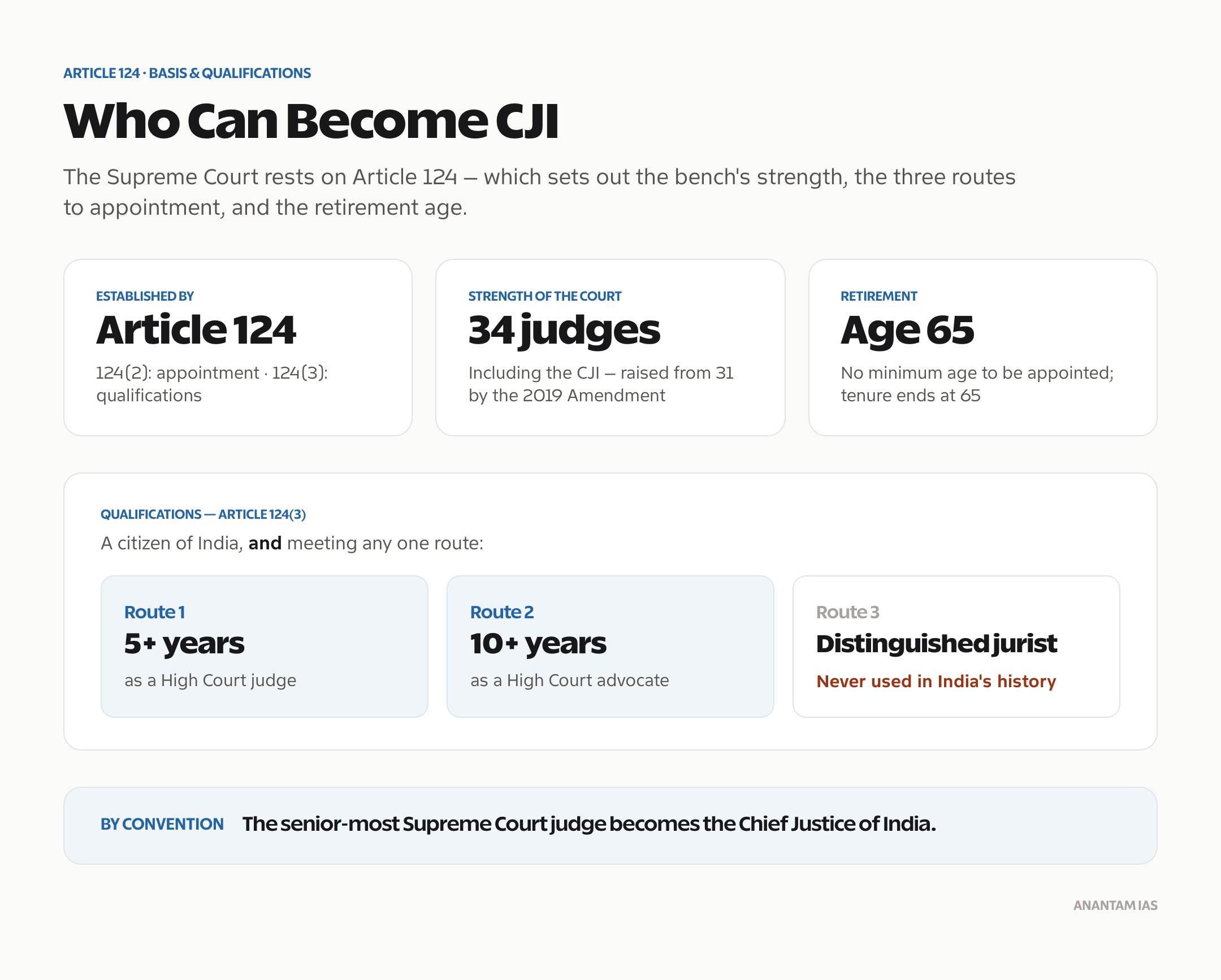
The Supreme Court of India is established by Article 124 of the Constitution. This article states that there shall be a Supreme Court consisting of a Chief Justice of India and such number of other judges as Parliament may prescribe. Currently, the Supreme Court has 34 judges including the CJI (raised from 31 by the Supreme Court (Number of Judges) Amendment Act, 2019).
Article 124(1): Establishes the Supreme Court. Article 124(2): Governs appointment of CJI and Supreme Court judges. Article 124(3): Qualifications for appointment. Article 126: Appointment of acting CJI. Article 127: Appointment of ad hoc judges.
Qualifications to Become Chief Justice of India
Under Article 124(3), to be appointed as a Supreme Court judge (including CJI), a person must be:
- A citizen of India
- Either a Judge of a High Court (or two or more High Courts in succession) for at least 5 years, OR
- An Advocate of a High Court (or two or more in succession) for at least 10 years, OR
- A “distinguished jurist” in the opinion of the President
The “distinguished jurist” category has never been used in India’s constitutional history. Every CJI has come through the judicial route — High Court judge, then Supreme Court judge, then elevation to CJI.
There is no minimum age for appointment. But retirement is fixed: Article 124(2) — every judge holds office until they attain the age of 65 years.
Appointment Process: The Collegium System
The Constitutional Text vs The Reality
Article 124(2) says every judge of the Supreme Court shall be appointed by the President after consultation with the CJI (and other judges as the President deems necessary). For the CJI, the President’s appointment is typically based on convention — the senior-most judge of the Supreme Court is appointed CJI.
But “consultation” in the Constitution doesn’t mean what it literally says. The collegium system has completely transformed the appointment process.
Three Judges Cases: How the Collegium Was Born
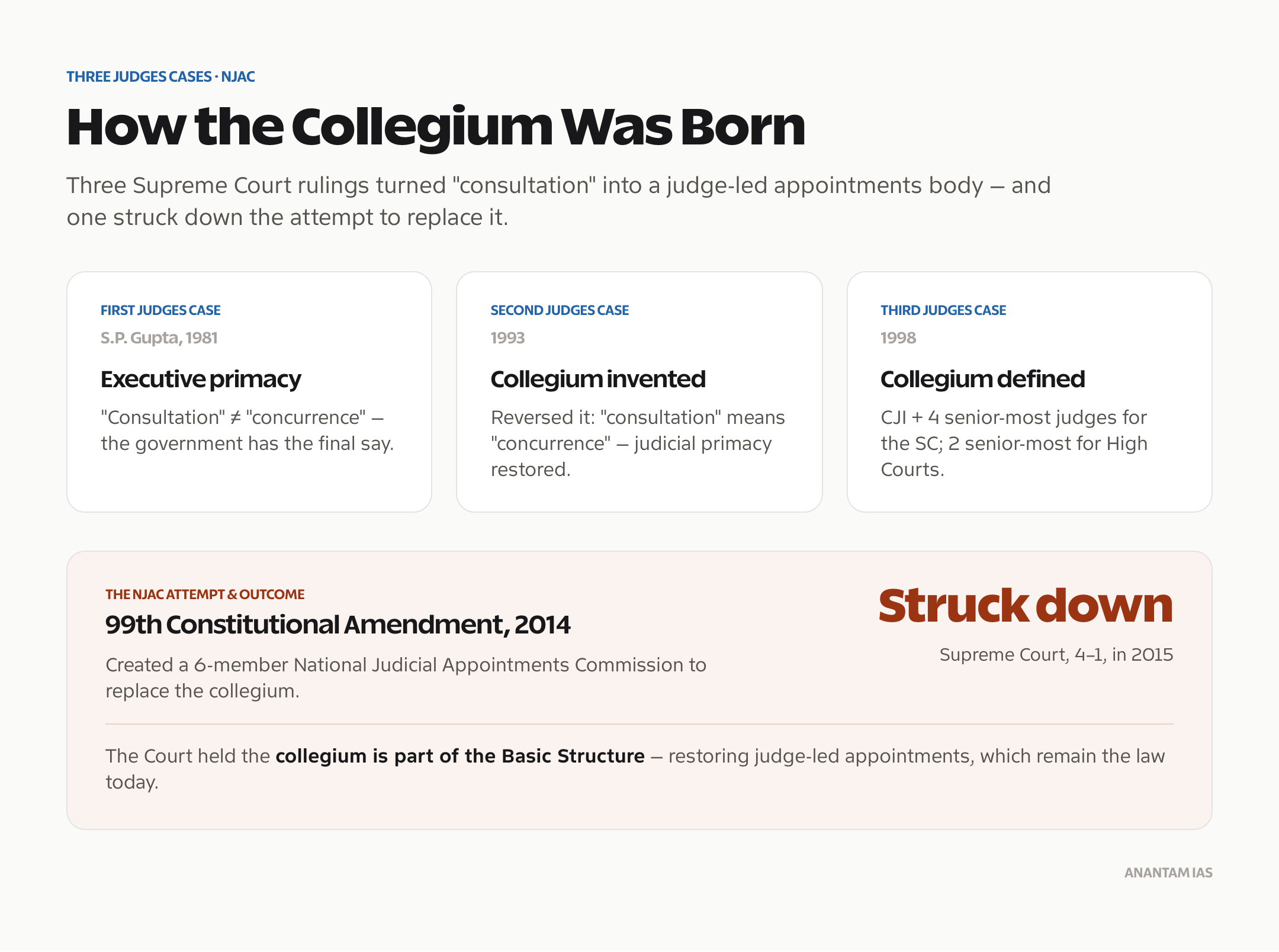
First Judges Case (S.P. Gupta v. Union of India, 1981): The Supreme Court held that “consultation” doesn’t mean “concurrence.” The executive (President) has the final say. This gave government primacy over judicial appointments.
Second Judges Case (Supreme Court Advocates-on-Record Association v. Union of India, 1993): Reversed the First Judges Case. “Consultation” means “concurrence” — the CJI’s recommendation is binding. The Court invented the collegium concept: a body of senior judges collectively deciding appointments. Individual CJI opinion is not enough; a collegium of 2 senior-most judges (for SC appointments) must recommend.
Third Judges Case (Re: Special Reference, 1998): Presidential reference sought clarification. The Court ruled the collegium for Supreme Court appointments must consist of the CJI and 4 senior-most judges. For High Court appointments, the collegium has 2 senior-most judges.
The Collegium in Practice
The collegium of 5 (CJI + 4 senior judges) recommends:
- Appointment of new Supreme Court judges
- Elevation of CJI (seniority principle applies)
- Transfer of High Court judges
- Elevation of High Court judges to Supreme Court
The government can return a recommendation once with its objections. But if the collegium reiterates the recommendation, the government must accept it. This is the binding nature of collegium recommendations post-1993.
The NJAC Controversy: Government’s Attempt to Reclaim Appointments
The National Judicial Appointments Commission (NJAC)
The 99th Constitutional Amendment Act, 2014 and the National Judicial Appointments Commission Act, 2014 replaced the collegium with a 6-member NJAC:
- CJI (Chairperson)
- 2 senior-most Supreme Court judges
- Union Law Minister
- 2 eminent persons (chosen by a committee of CJI, PM, and Leader of Opposition)
Any 2 members could veto an appointment. This gave effective veto power to the Law Minister and the 2 eminent persons — breaking judicial primacy in appointments.
Supreme Court Strikes Down NJAC
Supreme Court Advocates-on-Record Association v. Union of India (2015) — the NJAC judgment.
The Supreme Court, 4-1, struck down the 99th Amendment and the NJAC Act. The Court held:
- The collegium system is part of the Basic Structure of the Constitution
- Independence of the judiciary is part of the Basic Structure
- NJAC allowed executive interference that violated judicial independence
- The veto power of non-judicial members was particularly objectionable
The sole dissent by Justice J. Chelameswar supported NJAC as a legitimate reform.
The collegium system was restored — and remains the law today, despite widespread criticism of its opacity and lack of accountability.
Powers of the Chief Justice of India
Judicial Powers
Master of Roster: The CJI has the exclusive prerogative to constitute benches and allocate cases. This power was at the centre of controversy in January 2018 when four senior judges — Justices Chelameshwar, Gogoi, Lokur, and Joseph — held a press conference alleging the CJI was using roster powers to selectively assign sensitive cases.
Constitution of Benches: The CJI decides which judges sit on which benches, including Constitution Benches (5 or more judges for substantial questions of constitutional law under Article 145(3)).
Casting Vote: In case of an equal division on a bench, the CJI (if on the bench) may have a determinative role in reconstitution.
Administrative Powers
Head of the Supreme Court: The CJI manages the Supreme Court’s administration, including allocation of court numbers, administrative staff, and internal governance.
Chief Justice of India as Appointing Authority (via Collegium): The CJI leads the collegium that recommends all Supreme Court and High Court judges, and transfers of High Court judges.
Administrative Head of Indian Judiciary: Superintendence over High Courts under Article 235 flows partly through the CJI for policy matters.
Constitutional and Ceremonial Functions
- Administers oath to the President under Article 60 (along with the Chief Justice)
- Administers oath to judges of the Supreme Court
- Acting President: When neither the President nor Vice President can discharge functions, the CJI serves as Acting President (this has actually happened — CJI M. Hidayatullah served as acting President in 1969)
- Part of various statutory bodies and selection committees
Tenure and Removal of CJI
Tenure
No fixed tenure is prescribed by the Constitution. The CJI holds office until age 65. Since appointments follow seniority, and different judges reach the CJI position at different ages, tenures vary wildly.
Some CJIs have served less than a month. Some have served over 3 years.
Removal: An Almost Impossible Process
Article 124(4): A judge of the Supreme Court (including CJI) can be removed only by an order of the President, passed after an address by each House of Parliament, supported by a special majority (majority of total membership AND 2/3 of members present and voting).
The Judges (Inquiry) Act, 1968 governs the removal process:
- Motion for removal must be signed by 100 Lok Sabha or 50 Rajya Sabha members
- Speaker/Chairman refers it to a 3-member committee (one Supreme Court judge, one High Court CJ, one distinguished jurist)
- If committee finds the judge guilty, Parliament addresses the President
- President removes the judge
No judge in India’s history has ever been removed. An impeachment motion against Justice V. Ramaswami in 1993 failed in the Lok Sabha.
Recent Chief Justices of India
| No. | Name | Tenure | Notable Contributions |
|---|---|---|---|
| 48 | Justice N.V. Ramana | April 2021 – August 2022 | Judicial infrastructure reforms, spoke on government’s use of sedition law |
| 49 | Justice U.U. Lalit | August 2022 – November 2022 | Shortest-serving CJI; attempted listing reforms |
| 50 | Justice D.Y. Chandrachud | November 2022 – November 2024 | Article 370 judgment; Same-sex marriage case; expanded Supreme Court transparency |
| 51 | Justice Sanjiv Khanna | November 2024 – May 2025 | Electoral bonds judgment (as SC judge); continues judicial reforms |
| 52 | Justice B.R. Gavai | May 2025 – November 2025 | First Dalit CJI from Maharashtra |
Note for UPSC: The current CJI changes frequently. Always verify the current incumbent close to your exam. Focus on appointment process, powers, and collegium debates — these are perennial topics.
Critical Issues: Collegium System Debates
Arguments Against the Collegium
Opacity: Collegium deliberations are secret. No formal record of why candidates are selected or rejected. No accountability mechanism.
Nepotism allegations: Critics argue the collegium system can perpetuate insider networks — judges recommending people known to them.
Government deadlock: When the government and collegium disagree, appointments stall. Hundreds of High Court vacancies persist because of collegium-government friction.
No diversity criteria: The collegium has no formal process for ensuring gender, caste, regional, or religious diversity on the bench.
Arguments For the Collegium
Judicial independence: The collegium keeps executive influence out of judicial appointments — a critical protection in a democracy where the executive controls Parliament.
Expertise: Judges know who the best lawyers and lower court judges are. Government officials may not.
Basic Structure protection: NJAC case confirmed that judicial primacy in appointments is non-negotiable.
The debate continues. The Supreme Court itself has acknowledged that the collegium needs reform — but on its own terms, not through executive legislation.
Frequently Asked Questions
1. Who appoints the Chief Justice of India?
The President of India appoints the CJI under Article 124(2). By convention, the senior-most judge of the Supreme Court is appointed CJI. The collegium doesn’t formally recommend the CJI — seniority determines it automatically.
2. What is the retirement age of the Chief Justice of India?
65 years, as prescribed by Article 124(2).
3. What is the Master of the Roster power?
The CJI has the exclusive right to decide which judges sit on which cases and how benches are constituted. This is an administrative power that drew controversy in 2018 when senior judges alleged its misuse.
4. Can the Chief Justice of India be removed?
Yes, but the process is extremely difficult — it requires a special majority in both Houses of Parliament and a Presidential order under Article 124(4). No CJI or Supreme Court judge has ever been successfully removed.
5. What was the NJAC and why was it struck down?
The National Judicial Appointments Commission was created by the 99th Amendment (2014) to replace the collegium with a body including the Law Minister and eminent persons. The Supreme Court struck it down in 2015, holding that it violated judicial independence — a basic structure element.