Coniferous Forest — Taiga, Himalayan Belts, Species & Conservation
UPSC guide to coniferous forests — characteristics, global taiga belt, Indian Himalayan coniferous forests, key species, ecology, and conservation.
Coniferous forests are cone-bearing, needle-leaved, evergreen forests that dominate the sub-arctic and high-altitude regions of the world. Known globally as the taiga or boreal forest, these forests form the largest terrestrial biome on Earth, stretching as a continuous belt across Canada, Alaska, Scandinavia and Russia. In India, coniferous forests occur primarily in the Himalayan region, between altitudes of 1,500 m and 3,500 m, and are a critical topic for UPSC Prelims and GS Paper I (Geography) and GS Paper III (Environment).
Defining Characteristics
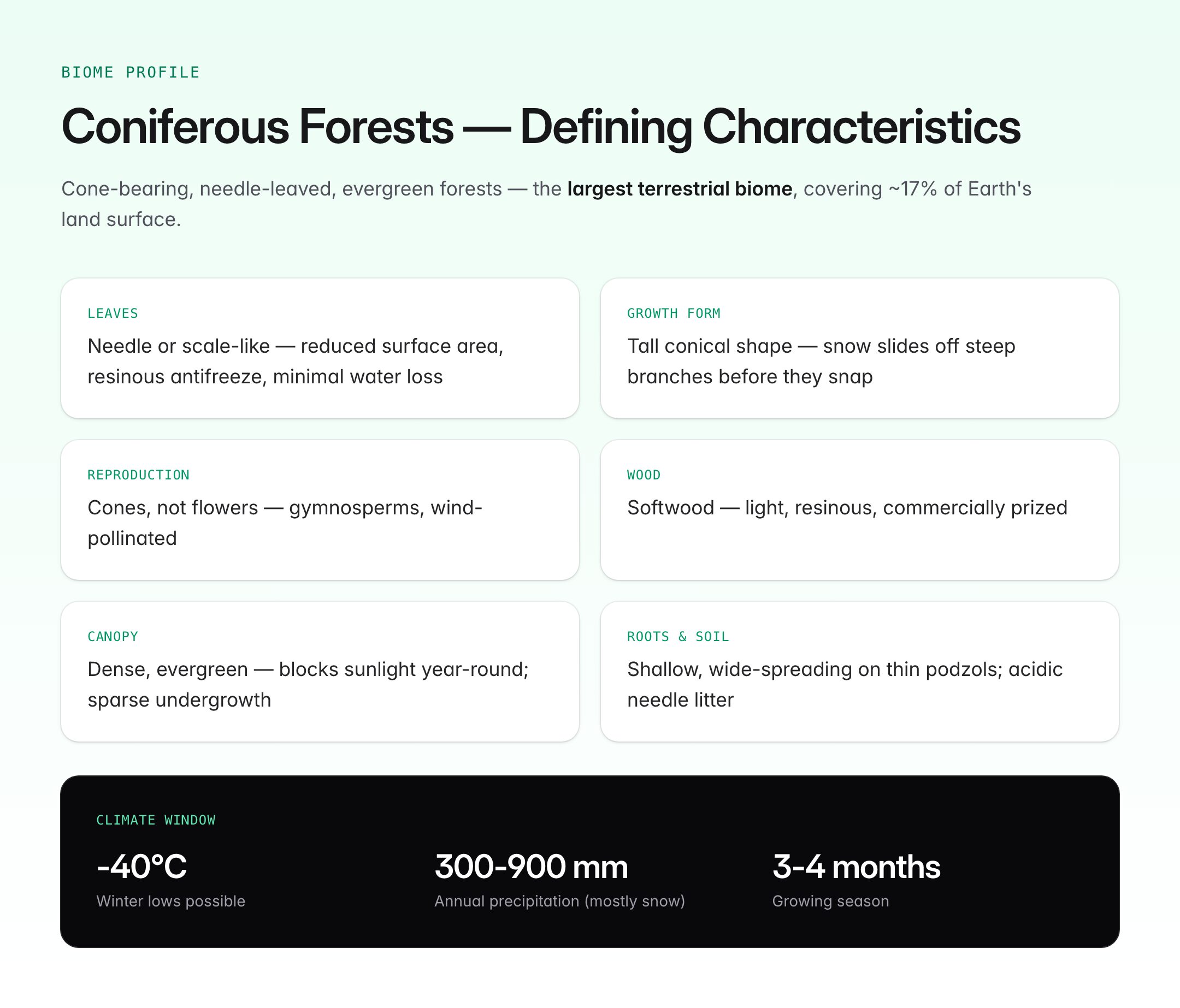
Coniferous forests share a distinctive set of features that distinguish them from tropical and deciduous forests.
| Feature | Description |
|---|---|
| Leaves | Needle-like or scale-like; reduced surface area to minimise water loss and withstand snow |
| Growth form | Tall, conical shape — allows snow to slide off without breaking branches |
| Reproduction | Cones (not flowers); gymnosperms; wind-pollinated |
| Wood | Softwood — light, resinous, easy to work with; high commercial value |
| Canopy | Dense, evergreen — blocks sunlight year-round |
| Undergrowth | Sparse due to low light, acidic soils (podzols), and needle litter |
| Root system | Shallow, wide-spreading — anchors in thin soils |
The conical architecture is an adaptation to heavy snow loads — snow slides off steep branches before they snap. The needle leaves contain resin that acts as an antifreeze and reduces transpiration.
Global Distribution — The Taiga Biome
The boreal forest (taiga) is the world's largest land biome, covering nearly 17% of Earth's land surface. It forms a continuous belt across the Northern Hemisphere.
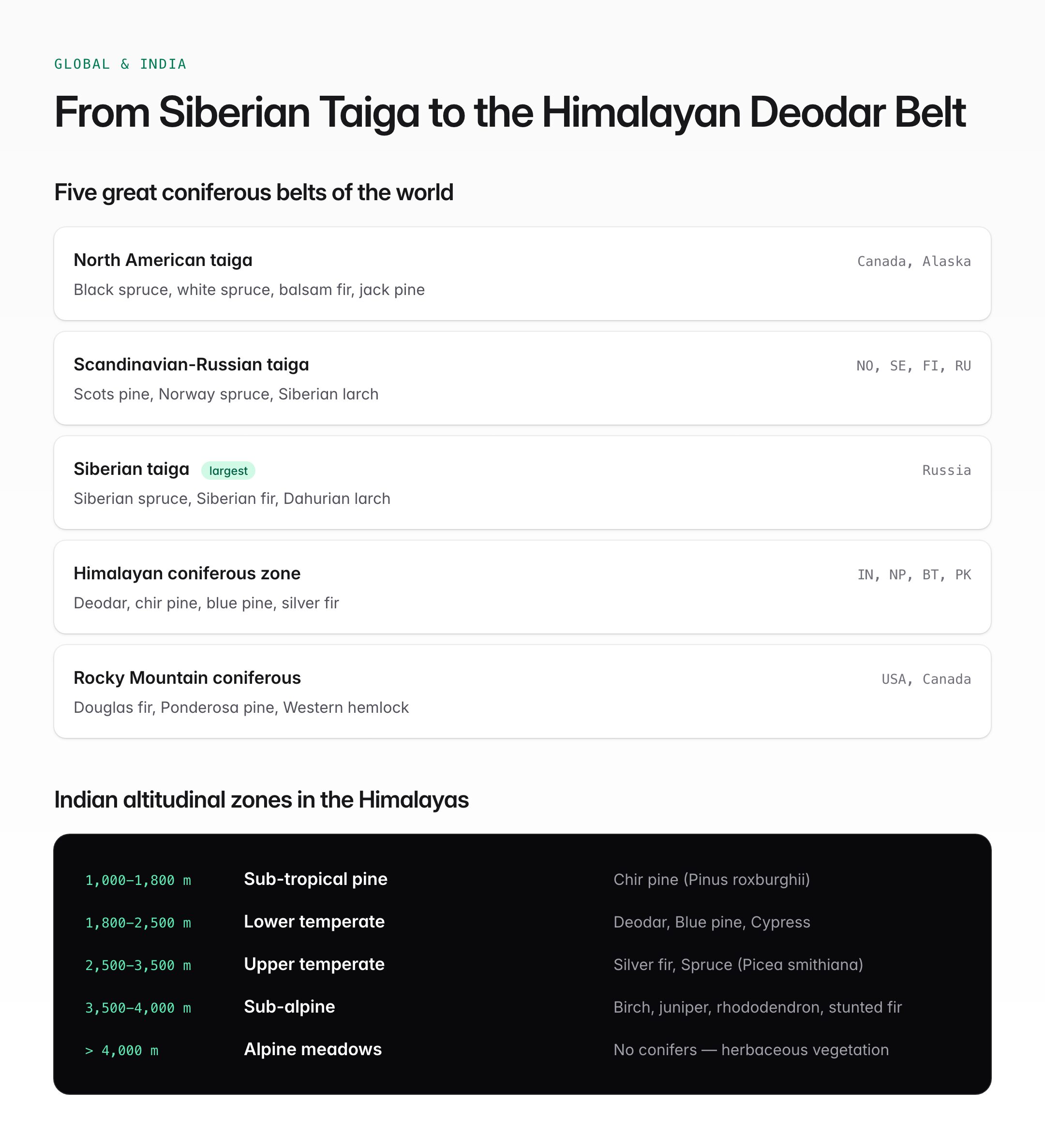
| Region | Countries | Dominant Species |
|---|---|---|
| North American taiga | Canada, Alaska (USA) | Black spruce, white spruce, balsam fir, jack pine |
| Scandinavian-Russian taiga | Norway, Sweden, Finland, Russia | Scots pine, Norway spruce, Siberian larch |
| Siberian taiga | Russia (world's largest) | Siberian spruce, Siberian fir, Dahurian larch |
| Himalayan coniferous zone | India, Nepal, Bhutan, Pakistan | Deodar, chir pine, blue pine, silver fir |
| Rocky Mountain coniferous | USA, Canada | Douglas fir, Ponderosa pine, Western hemlock |
Climatic Conditions
- Temperature: Long, cold winters (−40°C possible); short, mild summers
- Precipitation: 300–900 mm annually, mostly as snow
- Growing season: 3–4 months
- Permafrost: Present in parts of Siberian taiga
Coniferous Forests in India
Indian coniferous forests occupy the Himalayan mountain belt and are classified by altitude.
Altitudinal Zones in the Himalayas
| Altitude (m) | Forest Type | Key Species |
|---|---|---|
| 1,000–1,800 | Sub-tropical pine forest | Chir pine (Pinus roxburghii) |
| 1,800–2,500 | Lower temperate coniferous | Deodar (Cedrus deodara), Blue pine (Pinus wallichiana), Cypress |
| 2,500–3,500 | Upper temperate coniferous | Silver fir (Abies pindrow), Spruce (Picea smithiana) |
| 3,500–4,000 | Sub-alpine | Birch, juniper, rhododendron, stunted fir |
| Above 4,000 | Alpine meadows | No coniferous forests — herbaceous vegetation |
Geographic Distribution in India
- Western Himalayas: Jammu & Kashmir, Himachal Pradesh, Uttarakhand — most extensive coniferous cover
- Eastern Himalayas: Sikkim, Arunachal Pradesh, Darjeeling hills — more hemlock and fir
- North-East: Higher altitudes in Nagaland, Manipur
- Nilgiri & Anamalai hills (South India) — small pockets of shola-grassland with some conifers at higher elevations (minor)
Key Indian Species Profile
| Species | Scientific Name | Features | Uses |
|---|---|---|---|
| Deodar | Cedrus deodara | India's national heritage tree; sacred | Railway sleepers, construction |
| Chir pine | Pinus roxburghii | Dominant in foothills; yields resin | Turpentine, rosin, pulp |
| Blue pine | Pinus wallichiana | Blue-green needles | Timber, resin |
| Silver fir | Abies pindrow | High altitude | Packing cases, matchwood |
| Spruce | Picea smithiana | Grows with fir | Plywood, paper pulp |
| Himalayan cypress | Cupressus torulosa | Slow-growing | Decorative timber |
| Yew | Taxus wallichiana | Source of anti-cancer drug taxol | Medicinal |
Ecological Importance
Climate Regulation
- Boreal and Himalayan coniferous forests sequester ~30% of the world's terrestrial carbon
- Act as massive carbon sinks
- Albedo effect — snow-covered conifers reflect solar radiation
Watershed Value
- Himalayan coniferous forests regulate the flow of Indus, Ganga, Brahmaputra river systems
- Prevent soil erosion on steep slopes
- Maintain glacier-fed river discharge
Biodiversity Habitat
Indian coniferous forests shelter:
- Snow leopard, Himalayan brown bear, musk deer
- Western tragopan, Himalayan monal, cheer pheasant
- Sacred species like the yew, source of taxol (anti-cancer compound)
Coniferous vs Other Forest Types — Quick Comparison
| Parameter | Coniferous | Tropical Evergreen | Deciduous |
|---|---|---|---|
| Leaves | Needle-like, evergreen | Broadleaf, evergreen | Broadleaf, shed seasonally |
| Climate | Cold (sub-arctic/alpine) | Hot and wet | Hot with dry season |
| Wood type | Softwood | Hardwood | Hardwood |
| Canopy layers | Single-layered | Multi-layered, dense | Two-layered |
| Species diversity | Low (few dominants) | Very high | Moderate |
| India distribution | Himalayas (1,500–3,500 m) | Western Ghats, NE India | Most of peninsular India |
Conservation Concerns
Threats to Coniferous Forests
- Climate change — warming shifts species upslope; spruce bark beetle outbreaks kill millions of hectares in boreal regions
- Deforestation for timber — high commercial value of softwood
- Forest fires — chir pine needles are highly flammable; Uttarakhand forest fires a recurrent issue
- Unplanned tourism and construction in Himachal and Uttarakhand
- Hydropower projects — reservoir submergence
- Overgrazing — affects regeneration in Himalayas
- Invasive species — Lantana, Ageratum
- Illegal felling of deodar and yew (for taxol)
Conservation Framework in India
- Forest (Conservation) Act, 1980 — restricts diversion of forest land
- Wildlife (Protection) Act, 1972 — protects species and habitats
- Indian Forest Act, 1927 — classification of reserved, protected forests
- National Mission for Green India (GIM) — afforestation focus
- CAMPA (Compensatory Afforestation Fund) — offsets for diverted forest
- Protected Areas: Great Himalayan National Park (UNESCO WHS), Valley of Flowers, Nanda Devi Biosphere Reserve, Khangchendzonga National Park
Global Conservation Initiatives
- Boreal Forest Agreement (Canada, 2010) — industry-NGO accord on sustainable logging
- Russian Forest Code — regulates taiga logging
- REDD+ programme (Reducing Emissions from Deforestation and Forest Degradation) covers boreal sinks
- UN Strategic Plan for Forests 2017–2030 — global targets
UPSC Relevance
GS Paper Mapping
- GS Paper I — Physical Geography (Biomes), Indian Geography (Natural vegetation)
- GS Paper III — Environment and Biodiversity, Conservation, Climate change
- Essay — Forests and climate; ecological conservation
Prelims Pointers
- Taiga = world's largest terrestrial biome (~17% of land area)
- India's coniferous zone = Himalayas between 1,500–3,500 m altitude
- Deodar = Cedrus deodara — India's national heritage tree, sacred
- Chir pine dominates sub-tropical pine belt (1,000–1,800 m)
- Silver fir and spruce dominate upper temperate zone (2,500–3,500 m)
- Yew (Taxus wallichiana) — source of anti-cancer drug taxol
- Coniferous wood = softwood; resinous; low density
- Shola forests (South India) are not coniferous — they are montane evergreen
- Great Himalayan National Park — UNESCO WHS in HP, protects coniferous ecosystems
- Coniferous leaves = needles; reproductive structure = cones
- Boreal forest is also called taiga (Russian origin)
The coniferous forest is not merely a vegetation type — it is a critical carbon sink, a biodiversity refuge, and a cultural landscape in the Himalayas. Its conservation is inseparable from India's climate resilience.