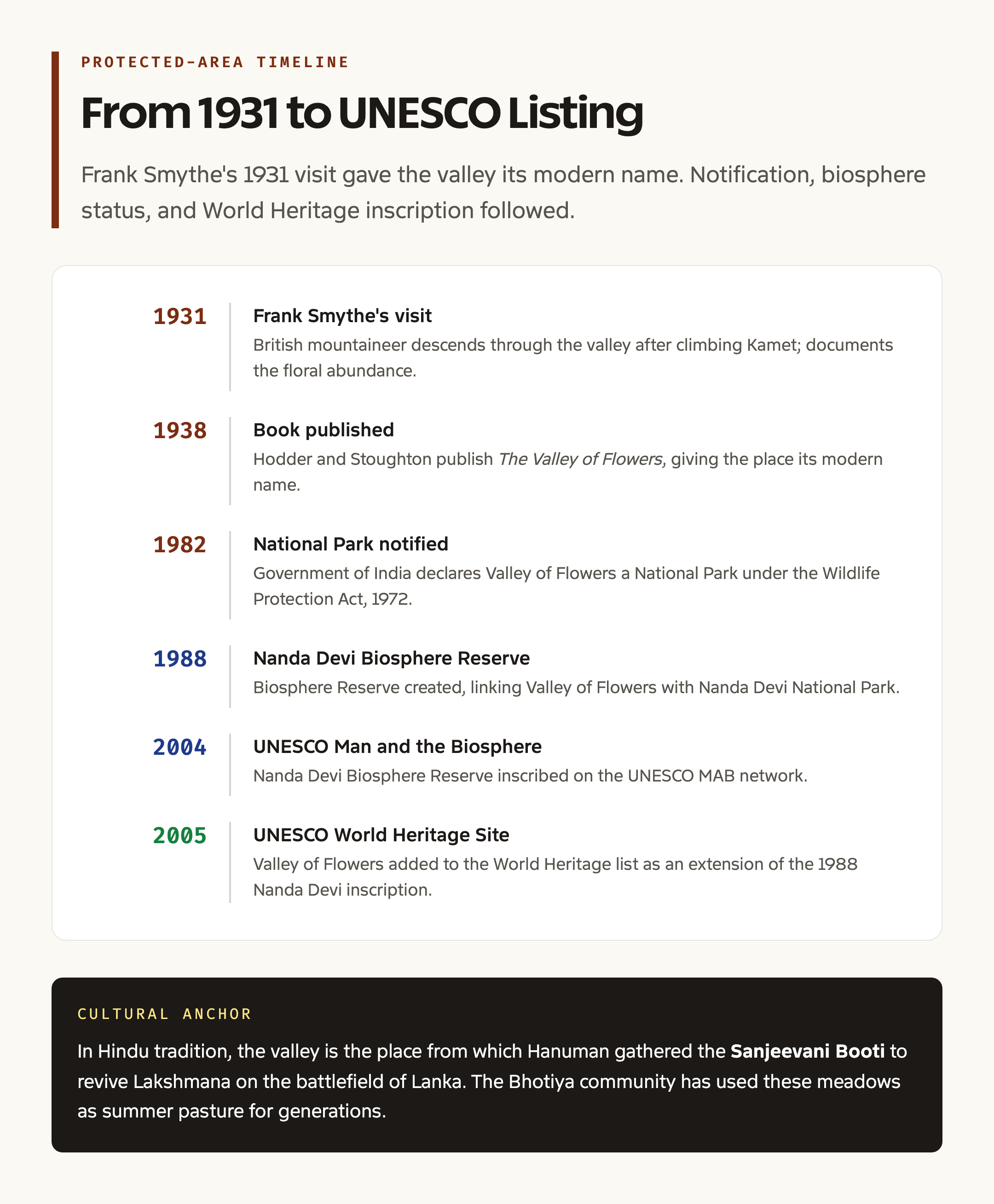
In the summer of 1931, a British mountaineer named Frank Smythe was descending from a successful climb of Kamet, the second-highest peak in the Garhwal Himalaya. Returning through a small side valley north of Joshimath, he and his companions wandered for two days in what he later described as “a paradise of flowers.” The book that resulted, published in 1938 under the title The Valley of Flowers, gave the place its modern name and put it on the global map of high-altitude wilderness. Today the valley is a notified national park, a UNESCO World Heritage Site, and one of the most ecologically distinctive habitats in the Himalaya.
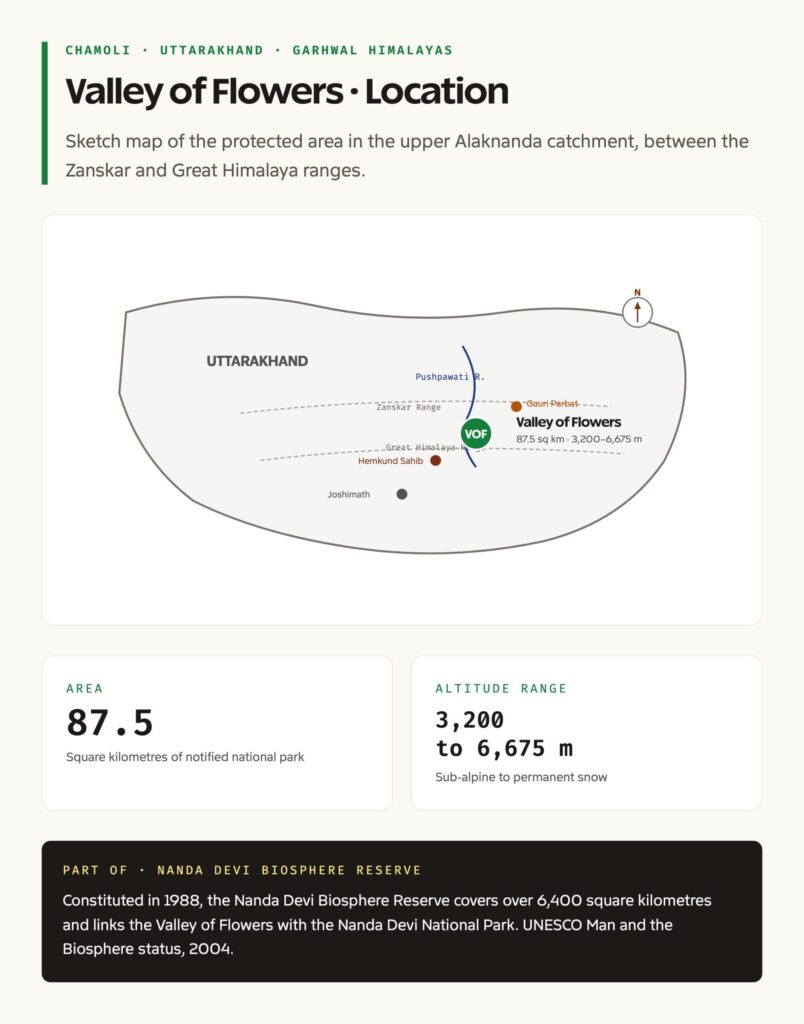
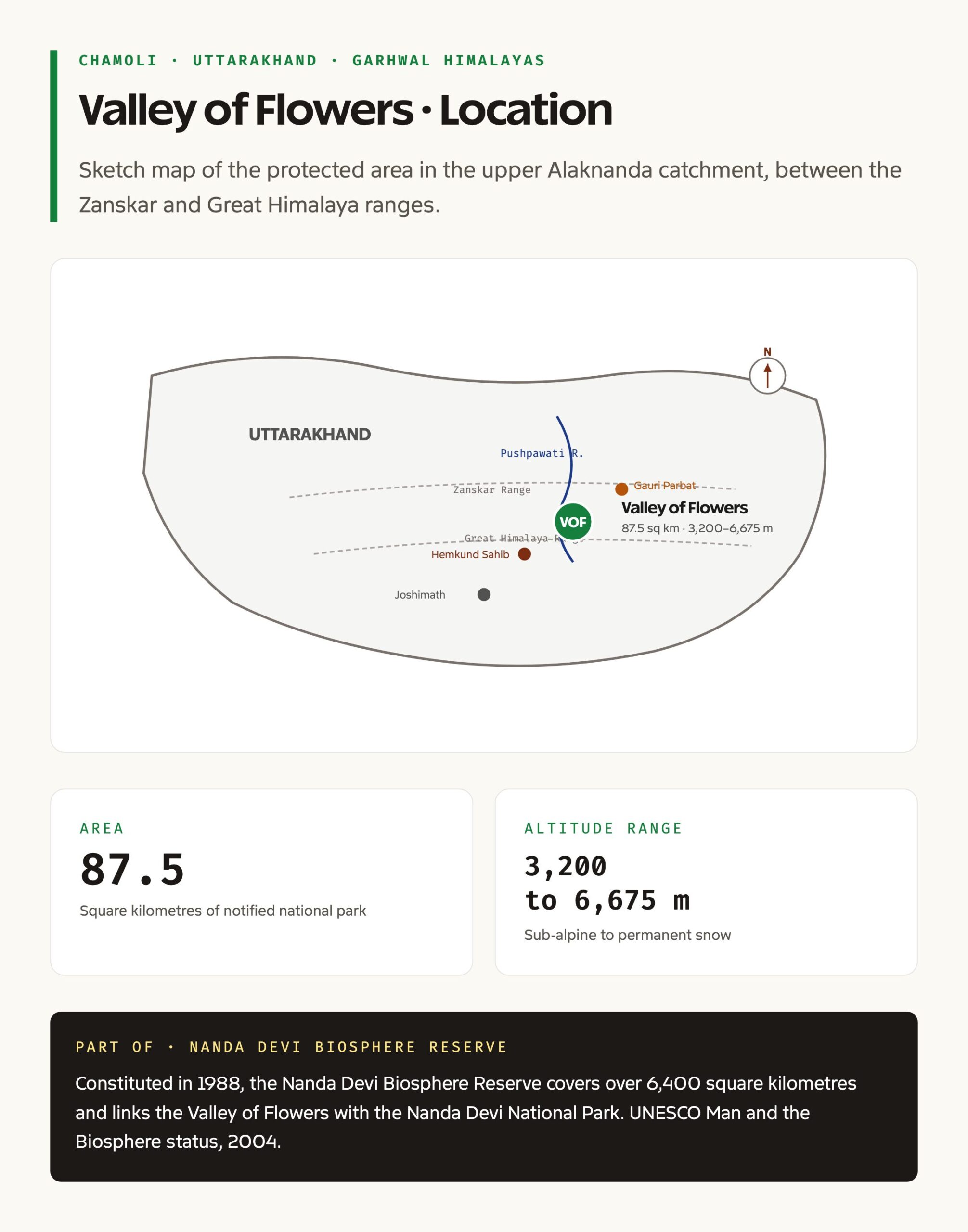
The Valley of Flowers National Park is small, only about 87 square kilometres, but it punches far above its area. It sits in the transition zone between the Zanskar and Great Himalaya ranges, in Chamoli district of Uttarakhand. Its altitudinal range runs from roughly 3,200 to 6,675 metres, capturing the full sweep of the alpine biome. Within that small footprint, more than 600 species of flowering plants have been recorded, including the Brahmakamal, the state flower of Uttarakhand, and the blue poppy, an icon of high Himalayan botany.
For UPSC, the Valley of Flowers comes up frequently in prelims through location-based stems and habitat-classification questions. It is also part of the larger geography of the Nanda Devi Biosphere Reserve and the protected-area network of Uttarakhand. This guide walks through what the park is, how it became one, what it protects, and what an aspirant must know.
Quick Facts
- Location: Chamoli district, Uttarakhand, Garhwal Himalayas
- Notified as National Park: 1982
- UNESCO World Heritage Site: 2005 (extension of 1988 Nanda Devi listing)
- Area: Approximately 87.5 square kilometres
- Altitude range: 3,200 to 6,675 metres
- Part of: Nanda Devi Biosphere Reserve (created 1988)
- State flower (Uttarakhand): Brahmakamal (Saussurea obvallata)
- River flowing through: Pushpawati
- Nearest landmarks: Hemkund Sahib (Sikh shrine), Gauri Parbat
- Major flora: Brahmakamal, Blue Poppy, Cobra Lily, Himalayan Rhubarb
- Major fauna: Snow Leopard, Asiatic Black Bear, Brown Bear, Musk Deer, Blue Sheep, Red Fox
- Best visited: July to August, peak bloom
- Origin of name: Frank Smythe’s 1938 book The Valley of Flowers
- Local community: Bhotiya tribe
- Mythological reference: Hanuman’s Sanjeevani Booti to revive Lakshmana
What Is the Valley of Flowers National Park
The Valley of Flowers is a high-altitude alpine valley enclosed by glacier-fed slopes and ridge lines that hold snow into late summer. It is shaped by the Pushpawati river, which drains the valley northward and joins the Bhyundar Ganga, eventually feeding into the Alaknanda system. The valley floor sits between roughly 3,200 and 3,600 metres, with the surrounding peaks rising to over 6,000 metres. This altitudinal range, combined with the south-facing aspect that catches the summer monsoon, creates the conditions for the floral richness that defines the park.
The park is part of the Nanda Devi Biosphere Reserve, which was constituted in 1988 to bring together the Nanda Devi National Park and the Valley of Flowers under a single conservation framework. The biosphere reserve was further expanded to integrate buffer zones and transition areas where regulated human activity is permitted. The combined area covers over 6,400 square kilometres, of which the two national parks form the inviolate core.
What distinguishes the Valley of Flowers from other alpine valleys in the Himalaya is the density and diversity of its herbaceous vegetation. Most Himalayan valleys at this altitude carry sparse alpine meadows. The Valley of Flowers, owing to a combination of soil moisture, monsoon exposure, glacial enrichment, and topographic shelter, supports a dense, multi-coloured flowering carpet from late June to September. The bloom peaks in July and August, when more than 300 species are simultaneously in flower.
Background and Historical Context
The valley had been known to local Bhotiya communities for centuries before Smythe’s 1931 visit. Bhotiya pastoralists drove sheep and goats through these meadows during the summer months, and the Sikh pilgrimage to Hemkund Sahib, the high-altitude lake gurdwara at over 4,300 metres, traversed the same approach route. Local mythology connected the valley to the Ramayana, identifying it as the spot where Hanuman is said to have collected the Sanjeevani Booti, the herb that revived Lakshmana on the battlefield of Lanka.
Frank Smythe’s contribution was to give the place a global name and a written record. The Valley of Flowers, published by Hodder and Stoughton in 1938, brought British and European naturalists to the region. Through the 1940s and 1950s, occasional botanical expeditions added to the species inventory but the area remained unprotected.
The first major institutional step came in 1982, when the Government of India notified the Valley of Flowers as a National Park under the Wildlife Protection Act, 1972. Notification gave it inviolate status, restricted livestock grazing inside the park boundary, and brought it under the formal protected-area network. The grazing restriction was contentious. Bhotiya communities argued that summer pasture had been their customary practice for generations, and the eventual settlement allowed regulated transit through the buffer rather than free grazing inside the core.
The 1988 creation of the Nanda Devi Biosphere Reserve linked the Valley of Flowers with the Nanda Devi National Park, which had been notified in 1982 and inscribed on the UNESCO World Heritage List in 1988. The Valley of Flowers itself was added to the World Heritage listing in 2005, making the combined Nanda Devi and Valley of Flowers National Parks a serial UNESCO site. The biosphere reserve was inscribed on the UNESCO Man and the Biosphere network in 2004.
Key Geographic and Ecological Provisions
The park sits in the transition zone between the Zanskar Range to the north and the Great Himalaya Range to the south. The Pushpawati river is the dominant hydrological feature, draining the valley over a length of about ten kilometres. The river takes its name, which translates as “flowing through flowers,” from the meadows it traverses.
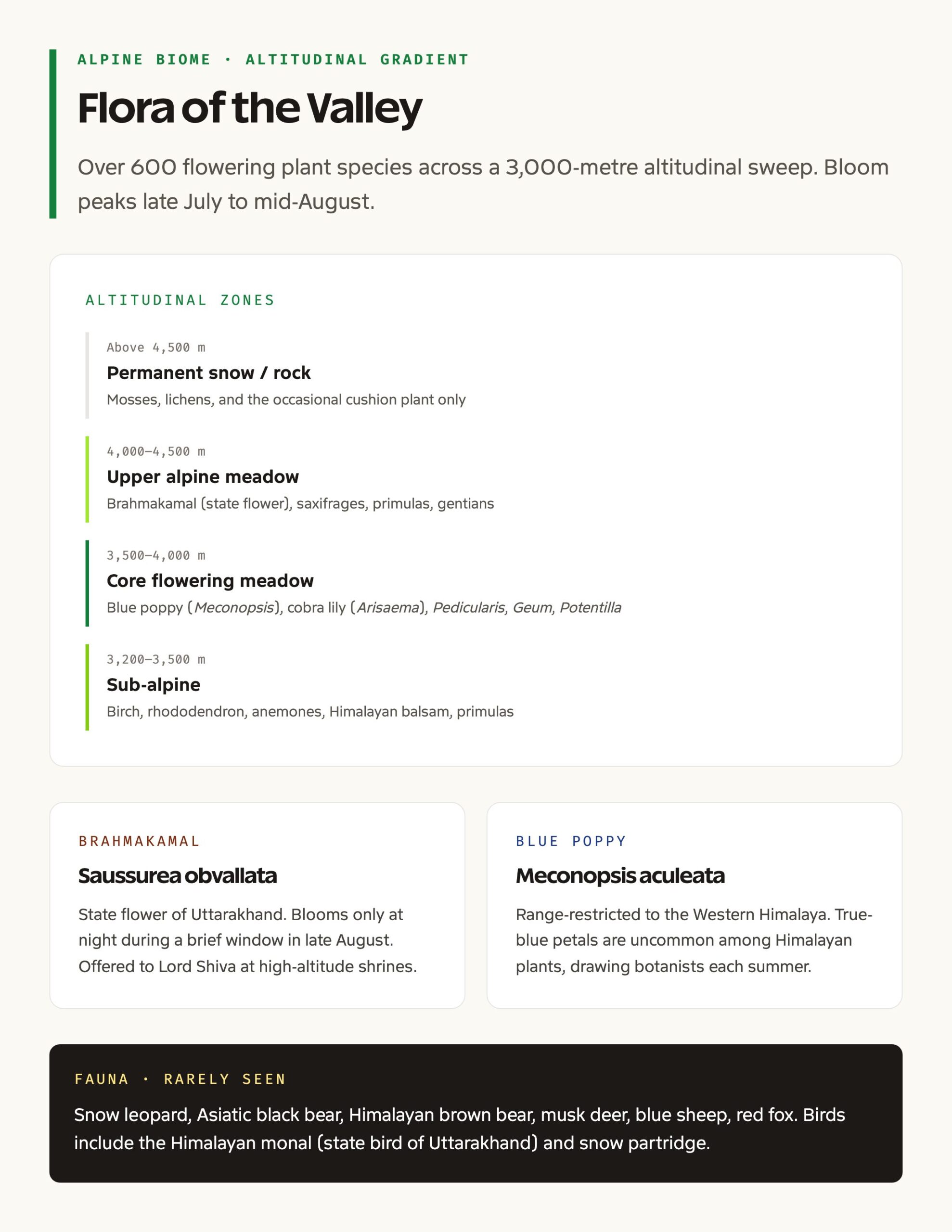
The vegetation is structured by altitude and aspect. Below 3,500 metres, the flora is dominated by sub-alpine birch and rhododendron, with a herbaceous understory that includes Himalayan balsam, anemones, and primulas. Between 3,500 and 4,000 metres lies the core flowering meadow, with species including the blue poppy (Meconopsis aculeata), cobra lily (Arisaema), Brahmakamal (Saussurea obvallata), and dozens of species of Pedicularis, Geum, Potentilla, and Polygonum. Above 4,000 metres the flora thins out into alpine cushion plants, mosses, and lichens, before giving way to permanent snow and ice.
The fauna is typical of the Himalayan alpine biome but rarely seen because of the steep terrain. The snow leopard (Panthera uncia) is the apex predator, although sightings are exceptionally rare. The Asiatic black bear and the Himalayan brown bear both occur, with the brown bear ranging into the upper meadows in summer. The musk deer, listed as Endangered, uses the wooded slopes below the valley. Blue sheep (Pseudois nayaur), red fox, and Himalayan tahr round out the larger mammals. Avian life includes the Himalayan monal, the state bird of Uttarakhand, the snow partridge, and several species of accentor and finch.
Why the Valley Matters
The case for the Valley of Flowers operates at three levels. Ecologically, the valley is a reservoir of high-altitude botanical diversity that has not been replicated elsewhere in the Indian Himalaya. The 600-plus flowering plant species packed into 87 square kilometres make it one of the densest concentrations of alpine flora in the world. Several species are endemic or range-restricted, and several others are medicinal plants under pressure from over-collection elsewhere.
Culturally, the valley sits at the intersection of Hindu, Sikh, and local Garhwali traditions. The proximity to Hemkund Sahib makes the entire approach route a major pilgrimage corridor in summer. The Sanjeevani association ties the valley to one of the most evocative episodes of the Ramayana. The Bhotiya community’s traditional ecological knowledge, particularly its understanding of medicinal plants, has been documented in part by botanists and forest officers but remains under-recorded.
Symbolically, the valley is one of the visual icons of the Indian Himalaya. The bloom imagery has become a marker of high-altitude beauty in tourism brochures, postage stamps, and Doordarshan documentaries. UNESCO World Heritage status reinforces this global visibility and ties the park into the wider protected-area network of the national parks of India and the biosphere reserves in India framework.
Detailed Analysis: Flora and the Bloom Cycle
The flowering cycle in the Valley of Flowers is tightly compressed. Snow cover persists into late June. The thaw releases ground moisture and triggers rapid germination from a seed and rhizome bank that has been dormant for nine months. Through July the early bloomers, primulas and anemones, give way to the mid-season species, with poppies, balsams, and lilies dominating. The peak bloom in late July and early August presents the visual carpet that draws thousands of visitors. By September the higher meadows have set seed and begun yellowing, and by October the first snowfall closes the valley to all but the most hardy fauna.
The Brahmakamal, declared the state flower of Uttarakhand in 1990, is a particularly significant species. Botanically known as Saussurea obvallata, it grows at altitudes of 3,800 to 4,500 metres, blooms only at night during a brief window in late August, and is associated in local Hindu tradition with offerings to Lord Shiva. Over-collection at religious sites has put pressure on Brahmakamal populations across the Western Himalaya, although Valley of Flowers and the surrounding biosphere reserve remain a stronghold.
The blue poppy, Meconopsis aculeata, is another iconic species. Its true blue petals are uncommon among Himalayan plants, and the species is range-restricted to the Western Himalaya. It is one of the principal botanical attractions for plant enthusiasts visiting the valley.
Comparative Perspective
The Valley of Flowers is one of two UNESCO World Heritage Sites in Uttarakhand, the other being the Nanda Devi National Park with which it is linked. Together they form the only serial natural heritage site in the Indian Himalaya, although Khangchendzonga in Sikkim has also been inscribed.
Internationally, the valley invites comparison with the Skardu valley flora in Gilgit-Baltistan, the alpine meadows of the Hindu Kush, and the high pastures of the Tibetan plateau, although the monsoon influence on the southern slopes of the Garhwal Himalaya gives the Valley of Flowers a denser herbaceous cover than its more arid northern neighbours. Among Indian protected areas, the closest analogues are the Khangchendzonga alpine zones in Sikkim and the high meadows of the Great Himalayan National Park in Himachal Pradesh, although neither matches the floral diversity per unit area of the Valley of Flowers.
Challenges and Issues
The challenges facing the park are characteristic of high-altitude protected areas in a warming world. Climate change is the dominant slow-moving threat. Studies of Himalayan glaciers around the Bhyundar Ganga catchment indicate retreat over the past three decades, and the timing of the bloom appears to be advancing earlier in the season. Both shifts have implications for species composition and visitor planning.
Tourism pressure has grown rapidly since UNESCO inscription. The forest department restricts daily entry numbers and prohibits camping inside the park, but trail erosion, litter, and disturbance to flowering plants remain visible during the peak season. Pilgrimage traffic to Hemkund Sahib uses the same approach route through Ghangaria, putting concentrated foot pressure on the valley entrance.
Natural disasters are a recurring concern. The 2013 Kedarnath disaster, although geographically distinct, demonstrated the vulnerability of the upper Alaknanda catchment to cloudbursts and glacial-lake outburst floods. The Valley of Flowers itself has seen periodic landslides on the approach trail. Local livelihood issues persist. Bhotiya graziers continue to negotiate access to summer pasture in the buffer zones, and the broader question of forest rights under the Forest Rights Act, 2006, remains relevant for the surrounding villages.
Prelims Pointers
- State: Uttarakhand. District: Chamoli.
- Range: Garhwal Himalayas, transition zone between Zanskar and Great Himalaya.
- River: Pushpawati (tributary of Bhyundar Ganga, eventually Alaknanda).
- National Park notified: 1982.
- UNESCO World Heritage Site: 2005.
- Part of: Nanda Devi Biosphere Reserve (1988).
- Area: Approximately 87.5 sq km.
- Altitude: 3,200 to 6,675 metres.
- Origin of name: Frank Smythe’s 1938 book.
- Iconic flora: Brahmakamal (state flower of Uttarakhand), blue poppy.
- Iconic fauna: Snow leopard, Asiatic black bear, brown bear, musk deer, blue sheep.
- Mythological reference: Hanuman’s Sanjeevani Booti for Lakshmana.
- Best season: July to August (peak bloom).
- Local community: Bhotiya tribe.
Probable Mains Questions
- The Valley of Flowers National Park represents a model of integrating biodiversity conservation, cultural heritage, and tourism. Discuss with reference to its UNESCO inscription. (250 words)
- Examine the impact of climate change on Himalayan alpine ecosystems, with specific reference to the Valley of Flowers and Nanda Devi Biosphere Reserve. (250 words)
- Discuss the significance of the Nanda Devi Biosphere Reserve in the larger framework of protected-area management in the Indian Himalayas. (150 words)
Way Forward
The Valley of Flowers needs management interventions on several fronts. Visitor management should move from blanket daily caps to a permit-based system that distributes visitors across the season, eases pressure on peak-bloom days, and funds maintenance through entry fees. The Forest Department’s experience in similar high-altitude parks should feed into a revised tourism plan.
Climate-adaptive monitoring should be scaled up. Long-term ecological plots are run by the Wildlife Institute of India and the Botanical Survey of India, but the data series remains short. Integrating phenological monitoring with flyway-level work in collaboration with the BirdLife International network on Himalayan species would strengthen the analytical base.
Community engagement with the Bhotiya communities and the surrounding villages should formalise their role in monitoring, anti-poaching patrols, and visitor guiding. Their traditional ecological knowledge on medicinal plants, alpine seasonal rhythms, and weather signals is undocumented and at risk of fading.
Glacial and disaster risk monitoring needs integration with the Disaster Management Authority’s Uttarakhand strategy. The 2013 Kedarnath disaster offered lessons that have only partially been applied. Combined with the broader frameworks of environmental laws in India and biosphere reserves in India, these steps can keep the Valley of Flowers as a working ecosystem rather than a museum-piece UNESCO site.
Frequently Asked Questions
Where is the Valley of Flowers National Park located?
The park is in Chamoli district of Uttarakhand, in the Garhwal Himalayas. It sits in the transition zone between the Zanskar and Great Himalaya ranges, and is approached from Joshimath via Govindghat and Ghangaria.
When was Valley of Flowers declared a national park?
The Valley of Flowers was notified as a National Park in 1982 under the Wildlife Protection Act, 1972. It was inscribed on the UNESCO World Heritage List in 2005, as an extension of the 1988 Nanda Devi inscription.
What is the origin of the name Valley of Flowers?
The name comes from the 1938 book The Valley of Flowers by British mountaineer Frank Smythe, who visited the area in 1931 while descending from a climb of Kamet. Local communities had known the valley for centuries before this.
What is Brahmakamal?
Brahmakamal (Saussurea obvallata) is the state flower of Uttarakhand. It is a high-altitude flowering plant that blooms at night during a brief window in late August. It is offered at temples to Lord Shiva and is found in the upper meadows of the Valley of Flowers.
Which river flows through the Valley of Flowers?
The Pushpawati river drains the valley over about ten kilometres, joining the Bhyundar Ganga and ultimately feeding the Alaknanda system. The name Pushpawati translates as u0022flowing through flowers.u0022
Is the Valley of Flowers a UNESCO World Heritage Site?
Yes. It was inscribed in 2005 as part of a serial natural property along with the Nanda Devi National Park, which was inscribed earlier in 1988. Together they form one of India’s most significant Himalayan World Heritage sites.
What is the best time to visit?
The peak bloom runs from mid-July to mid-August. The park is open from June to October each year. Snow cover prevents access for the rest of the year, and the bloom diminishes after early September.
Which biosphere reserve does the park belong to?
The Valley of Flowers is part of the Nanda Devi Biosphere Reserve, constituted in 1988 and inscribed on the UNESCO Man and the Biosphere network in 2004. The biosphere covers over 6,400 square kilometres in Uttarakhand.
What animals are found in the Valley of Flowers?
The park supports the snow leopard (rarely seen), Asiatic black bear, Himalayan brown bear, musk deer, blue sheep, red fox, and Himalayan tahr. Bird life includes the Himalayan monal, the state bird of Uttarakhand, and several species of high-altitude finches and accentors.
What is the connection with the Ramayana?
Local mythology identifies the Valley of Flowers as the place from which Hanuman collected the Sanjeevani Booti, the medicinal herb used to revive Lakshmana on the battlefield of Lanka. The association links the area to one of the most evocative episodes of the Ramayana and is part of the cultural identity of the region.
Tell Google you want more of this.
Add Anantam IAS as a preferred sourceOne tap, and this site shows up more often in your own Top Stories, AI Overviews and AI Mode. Remove it any time.