Coral Reefs in India: Distribution, Types and Conservation
Complete UPSC guide to coral reefs in India. Covers types (fringing, barrier, atoll), distribution in Gulf of Kutch, Gulf of Mannar, Andaman & Nicobar, and Lakshadweep, coral bleaching causes, threats, and conservation efforts.
Coral Reefs in India: Distribution, Types and Conservation
Coral reefs are sometimes called the “rainforests of the sea.” They cover less than 1% of the ocean floor but support about 25% of all marine species. India has four major coral reef zones — each unique in type, ecology, and conservation challenge.
For UPSC, coral reefs appear in both Prelims (factual questions on distribution, bleaching) and Mains (GS Paper 3 on environment, conservation). This guide covers it all.
What Are Coral Reefs?
Corals are marine invertebrates belonging to the class Anthozoa (phylum Cnidaria). Each coral animal is called a polyp — a tiny, soft-bodied organism that secretes a hard calcium carbonate (limestone) skeleton. Over thousands of years, these skeletons accumulate to form coral reefs.
Coral-Algae Symbiosis
The key to coral survival is the relationship between corals and photosynthetic algae called zooxanthellae:
- Zooxanthellae live inside coral tissues
- They provide 90% of the coral’s energy through photosynthesis
- They give corals their characteristic colours
- This symbiosis only works in warm, shallow, clear, nutrient-poor water — which is why coral reefs exist in a narrow tropical band
Optimal conditions for coral growth:
- Temperature: 20–32°C (ideal: 25–29°C)
- Salinity: 32–40 ppt
- Depth: Mostly <50 m (sunlight requirement)
- pH: 8.0–8.3
- Clear, low-turbidity water
Types of Coral Reefs
Charles Darwin classified coral reefs into three types based on their relationship to land and sea level change. This classification remains standard.
1. Fringing Reefs
- Grow directly from the shoreline or very close to it
- No significant lagoon between reef and shore
- Most common type of reef globally
- Form in shallow water as coral grows outward from the coast
- India examples: Gulf of Mannar, Gulf of Kutch, parts of Andaman coast
2. Barrier Reefs
- Separated from the mainland or island by a lagoon
- Parallel to the coastline but offshore
- Much larger and older than fringing reefs (lagoon indicates subsidence)
- India: No classic barrier reef, but some reef structures near Andaman Islands have barrier-reef characteristics
- World famous: Great Barrier Reef (Australia) — world’s largest (~2,300 km)
3. Atolls
- Ring-shaped reefs (or horseshoe-shaped) enclosing a lagoon
- Form when a volcanic island subsides and the fringing reef continues to grow upward
- Found in deep water, far from continents
- India example: Lakshadweep Islands — classic atolls
- Also: Minicoy, Agatti, Kavaratti
| Reef Type | Structure | Lagoon | India Example |
|---|---|---|---|
| Fringing | Attached to shore, narrow | None or very narrow | Gulf of Mannar, Gulf of Kutch |
| Barrier | Offshore, parallel to coast | Wide, deep lagoon | Parts of Andaman |
| Atoll | Ring-shaped, open water | Central lagoon | Lakshadweep |
Darwin’s theory of reef evolution: fringing reef → barrier reef → atoll (as volcanic island gradually subsides).
Coral Reef Distribution in India
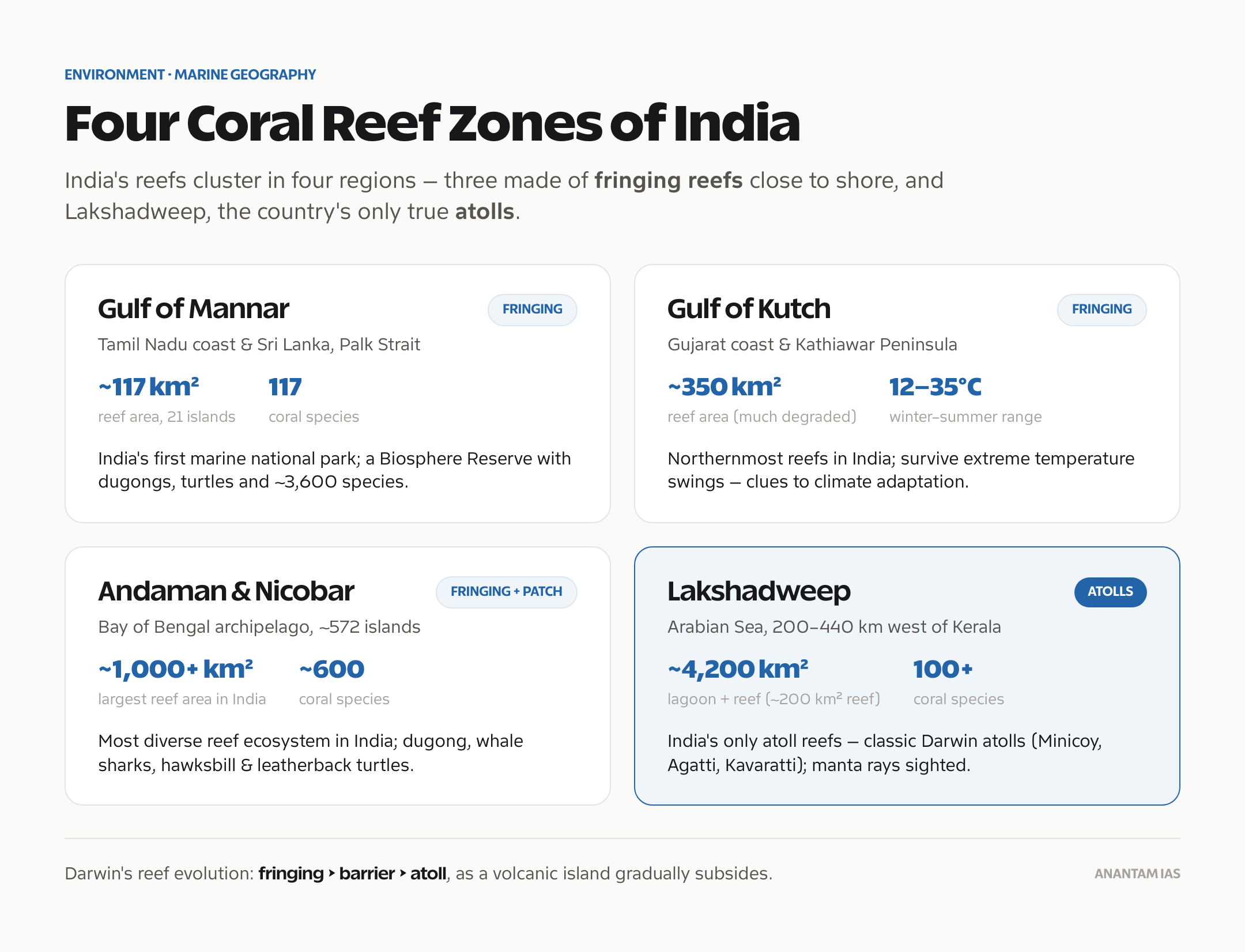
India’s coral reefs are distributed across four major zones:
1. Gulf of Mannar
- Location: Between Tamil Nadu coast and Sri Lanka; part of the Palk Strait region
- Type: Fringing reefs
- Area: ~117 km² of reef area across 21 islands
- Protection: Gulf of Mannar Marine National Park (1980) — India’s first marine national park; also a Biosphere Reserve
- Importance:
– High biodiversity: dugongs, sea turtles, dolphins, seahorses – About 3,600 species of plants and animals – 117 species of corals – Important seagrass beds
- Threats: Mechanized bottom trawling, coral mining for lime production (historically), sedimentation from Tamiraparani and Vaigai rivers, climate change
2. Gulf of Kutch
- Location: Between Gujarat coast and Kathiawar Peninsula
- Type: Fringing reefs (the northernmost reefs in India)
- Area: ~350 km² (though much is degraded)
- Protection: Gulf of Kutch Marine National Park and Sanctuary (largest in India by area for marine protected areas)
- Importance:
– Northernmost reefs in India and among the northernmost in the world – Adapted to extreme temperature variations (12°C in winter to 35°C in summer) – Home to puffer fish, sea snakes, rays, sharks – Green sea turtle nesting sites
- Threats: Industrial pollution (Jamnagar has a massive oil refinery complex, and the region has one of India’s most industrialized coastlines), tanker spills, coastal construction, temperature extremes
The Gulf of Kutch reefs are unusual for surviving in such extreme temperature and salinity conditions — they may hold insights into reef adaptation to climate change.
3. Andaman and Nicobar Islands
- Location: Bay of Bengal archipelago (~572 islands)
- Type: Fringing reefs along island shores, some patch reefs and near-atoll structures
- Area: ~1,000+ km² (estimated) — largest reef area in India
- Importance:
– Most diverse coral reef ecosystem in India – ~600 species of corals – Home to Dugong (sea cow), green and hawksbill sea turtles, whale sharks – Leatherback sea turtles nest in Great Nicobar – Outstanding fringing reefs around North Andaman, Neil Island, Havelock (Swaraj Dweep) – Coral gardens accessible to divers at Elephant Beach, Havelock
- Threats: 2004 Indian Ocean Tsunami caused massive damage to reefs around Andaman — some areas uplifted by 2 m, exposing reefs; others submerged. Crown-of-thorns starfish (Acanthaster planci) outbreaks, anchor damage from tourism, bleaching events
4. Lakshadweep Islands
- Location: Arabian Sea, 200–440 km west of Kerala
- Type: Atolls — classic examples of Darwin’s atoll theory
- Area: ~4,200 km² (lagoon + reef area); about 200 km² of actual reef
- Importance:
– Only atoll reefs in India – Over 100 coral species, 600+ fish species – Pristine reefs with high coral cover – Whale sharks and manta rays are regularly sighted – Migratory birds use the islands
- Threats: Mass bleaching (2016 bleaching killed significant portions of Lakshadweep reefs), sea level rise (low-lying atolls extremely vulnerable — average elevation <2 m), freshwater lens disruption, tourism pressure
Coral Bleaching: Causes and Consequences
Coral bleaching is the most significant threat to coral reefs worldwide. It’s directly linked to climate change.
What Happens During Bleaching
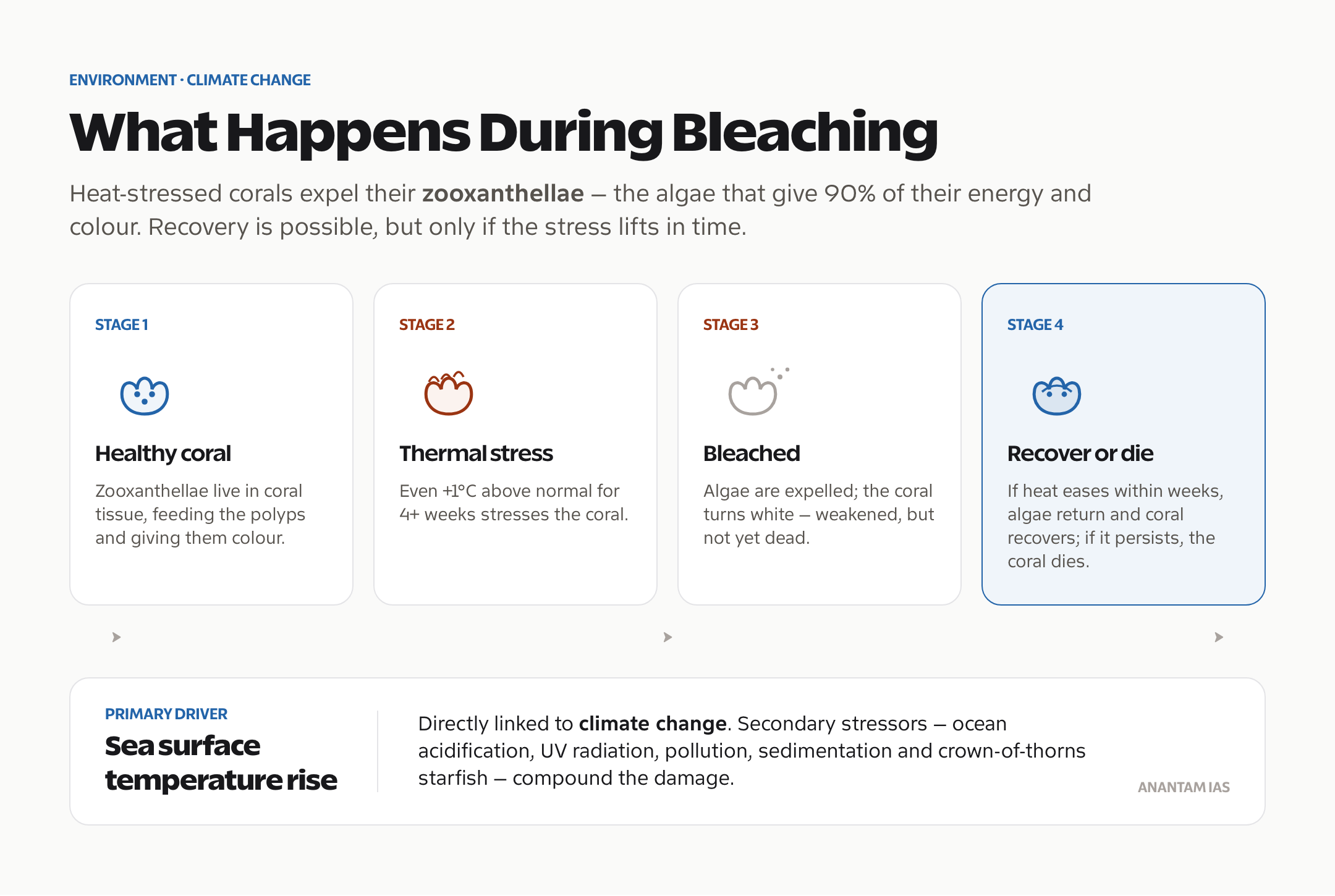
When corals are stressed — usually by elevated sea temperatures (even 1°C above normal for 4+ weeks) — they expel the zooxanthellae algae from their tissues. Without the algae:
- Corals turn white (“bleached”)
- Corals are weakened but not immediately dead
- If temperatures return to normal within weeks, zooxanthellae can return and coral recovers
- If thermal stress persists, corals die
Causes of Coral Bleaching
| Cause | Mechanism |
|---|---|
| Sea surface temperature rise (primary) | Even +1°C above normal for prolonged period causes zooxanthellae expulsion |
| Ocean acidification | CO₂ dissolves in seawater → carbonic acid → lowers pH → erodes calcium carbonate skeletons |
| UV radiation | Extreme sunlight events (La Niña-driven clear water + heat) |
| Pollution | Runoff with fertilizers, sewage increases algal growth; turbidity blocks sunlight |
| Sedimentation | Sediment smothers and kills corals |
| Disease | Various coral diseases (White Band, Black Band) |
| Crown-of-thorns starfish | Predator that eats coral polyps; population explosions are linked to eutrophication |
Mass Bleaching Events in India
- 1998: First major mass bleaching event in India coinciding with the El Niño-Southern Oscillation; severe bleaching in Gulf of Mannar, Lakshadweep, Andaman
- 2010: Second major bleaching event; Gulf of Mannar reefs suffered significant mortality
- 2016: Worst bleaching event globally (coinciding with the 3rd Global Coral Bleaching Event, 2015–2017); Lakshadweep lost 60–70% coral cover; Andaman reefs severely affected
- 2020: Another bleaching event
- 2024: Fourth Global Coral Bleaching Event confirmed; Indian reefs were in high alert
Ocean Acidification
Beyond bleaching, ocean acidification poses an existential threat to coral reefs:
- The ocean absorbs about 30% of CO₂ emitted by human activities
- CO₂ + H₂O → H₂CO₃ (carbonic acid) → lowers ocean pH
- Ocean pH has dropped from ~8.2 to ~8.1 since pre-industrial times (seemingly small but represents a 30% increase in acidity due to logarithmic scale)
- Lower pH reduces availability of carbonate ions that corals need to build their skeletons
- Aragonite saturation — below a critical level, coral skeletons begin to dissolve
Threats to Coral Reefs: Summary
| Threat | Global Significance | India Specifics |
|---|---|---|
| Climate change (temperature rise) | Critical | All 4 reef zones affected |
| Ocean acidification | Critical | Long-term structural threat |
| Pollution (runoff, sewage) | High | Gulf of Mannar, Gulf of Kutch |
| Destructive fishing | High | Bottom trawling in Gulf of Mannar |
| Coastal development | High | Andaman tourism |
| Mining (coral, sand) | Moderate | Historically Gulf of Mannar |
| Invasive species | Moderate | Crown-of-thorns starfish |
| Sedimentation | Moderate | Near river mouths |
| Tourism overuse | Moderate | Andaman, Lakshadweep |
| Tsunami/physical damage | Low frequency | 2004 Andaman tsunami |
Conservation Measures for Coral Reefs in India
Legal and Policy Framework
- Wildlife (Protection) Act, 1972: Corals listed under Schedule I; harvesting prohibited
- Environment (Protection) Act, 1986: Coastal regulation powers
- Coastal Regulation Zone (CRZ) Notification: Restricts development within 500 m of coast (now modified to tiered distances)
- Marine Protected Areas (MPAs): Gulf of Mannar MNP, Gulf of Kutch MNP, Mahatma Gandhi Marine NP (Wandoor, Andaman)
- Convention on Biological Diversity (CBD): India is a signatory
- CITES: Trade in corals controlled
Active Conservation Programs
- Coral Reef Recovery Program — Gulf of Mannar Biosphere Reserve Trust runs coral rehabilitation and fishing community engagement
- Coral transplantation experiments — ZSI (Zoological Survey of India) has conducted coral transplantation in Gulf of Mannar
- Coral gardening — Small-scale coral cultivation on underwater frames, used in Lakshadweep and Andaman
- Restricted entry zones — No-take zones around most sensitive reef areas
- Satellite monitoring — ISRO and NCSCM (National Centre for Sustainable Coastal Management) use satellite imagery to track reef health and bleaching
- NIOT (National Institute of Ocean Technology) — monitors sea surface temperature in reef areas
- Global Coral Triangle Initiative — India participates in international coral conservation frameworks
Community-Based Conservation
In the Gulf of Mannar, traditional fishing communities called Meenavar have ancestral knowledge of reef ecology. Conservation efforts increasingly involve local communities as reef watchkeepers — giving them stake in healthy reefs since their livelihoods depend on it.
Coral Reefs and Climate Change Projections
Scientists project that if global temperatures rise 1.5°C above pre-industrial levels (the Paris Agreement target), coral reefs will decline by 70–90%. At 2°C, more than 99% of coral reefs could be destroyed.
India’s SSTs (Sea Surface Temperatures) around its coral zones have risen by approximately 0.5°C over the past 50 years. The frequency and intensity of bleaching events are increasing.
There is significant concern about Lakshadweep’s atolls — they sit barely 1–2 m above sea level. Sea level rise of even 30–50 cm would make them uninhabitable and submerge the reefs.
Frequently Asked Questions
Q1. Where are coral reefs found in India?
India has four major coral reef zones: (1) Gulf of Mannar — fringing reefs between Tamil Nadu and Sri Lanka; (2) Gulf of Kutch — northernmost fringing reefs, off Gujarat; (3) Andaman and Nicobar Islands — largest and most diverse reef area in India, with fringing reefs around the archipelago; (4) Lakshadweep Islands — classic atoll reefs in the Arabian Sea. The Andaman reefs are the most biodiverse, while the Lakshadweep atolls are the most pristine and geologically distinctive.
Q2. What is coral bleaching and why does it happen?
Coral bleaching is the whitening of corals that occurs when they expel the symbiotic zooxanthellae algae from their tissues due to stress. The primary cause is
elevated sea surface temperature — even 1°C above normal for 4 or more weeks can trigger bleaching. Without the algae, corals turn white and are severely weakened. If conditions return to normal quickly, corals can recover. If stress persists, the corals die. Climate change is making bleaching events more frequent and severe globally.nnQ3. What is the difference between fringing reefs, barrier reefs, and atolls?
Fringing reefs grow directly from the shoreline or close to it, with no significant lagoon. Barrier reefs are offshore, separated from the coast by a wide lagoon. Atolls are ring-shaped reefs in the open ocean, surrounding a central lagoon, formed when a volcanic island subsides and the reef grows upward. India has primarily fringing reefs (Gulf of Mannar, Gulf of Kutch) and atolls (Lakshadweep), with no classic barrier reefs.
Q4. What are the major threats to coral reefs in India?
The biggest threats to Indian coral reefs are climate change (rising sea surface temperatures causing bleaching), ocean acidification (CO₂ absorption making oceans more acidic, dissolving coral skeletons), destructive fishing practices (especially bottom trawling in Gulf of Mannar), coastal pollution (runoff, sewage, sedimentation), unsustainable tourism (Andaman Islands), and past coral mining for lime production. The 2016 global bleaching event severely damaged Lakshadweep reefs.