Cryptocurrency in India: Regulation & UPSC Perspective
Understand cryptocurrency regulation in India — digital rupee (CBDC), RBI stance, taxation, blockchain technology, and UPSC-relevant policy debates.
Cryptocurrency in India: Regulation & UPSC Perspective
Cryptocurrency in India occupies a grey zone — neither fully legal nor explicitly banned. While the government taxes crypto gains at 30% and the RBI has launched its own Central Bank Digital Currency (CBDC), a comprehensive regulatory framework is still awaited. For UPSC, cryptocurrency connects to themes of digital economy, monetary policy, financial regulation, and technology governance — making it relevant across GS-III and Essay.
What Is Cryptocurrency?
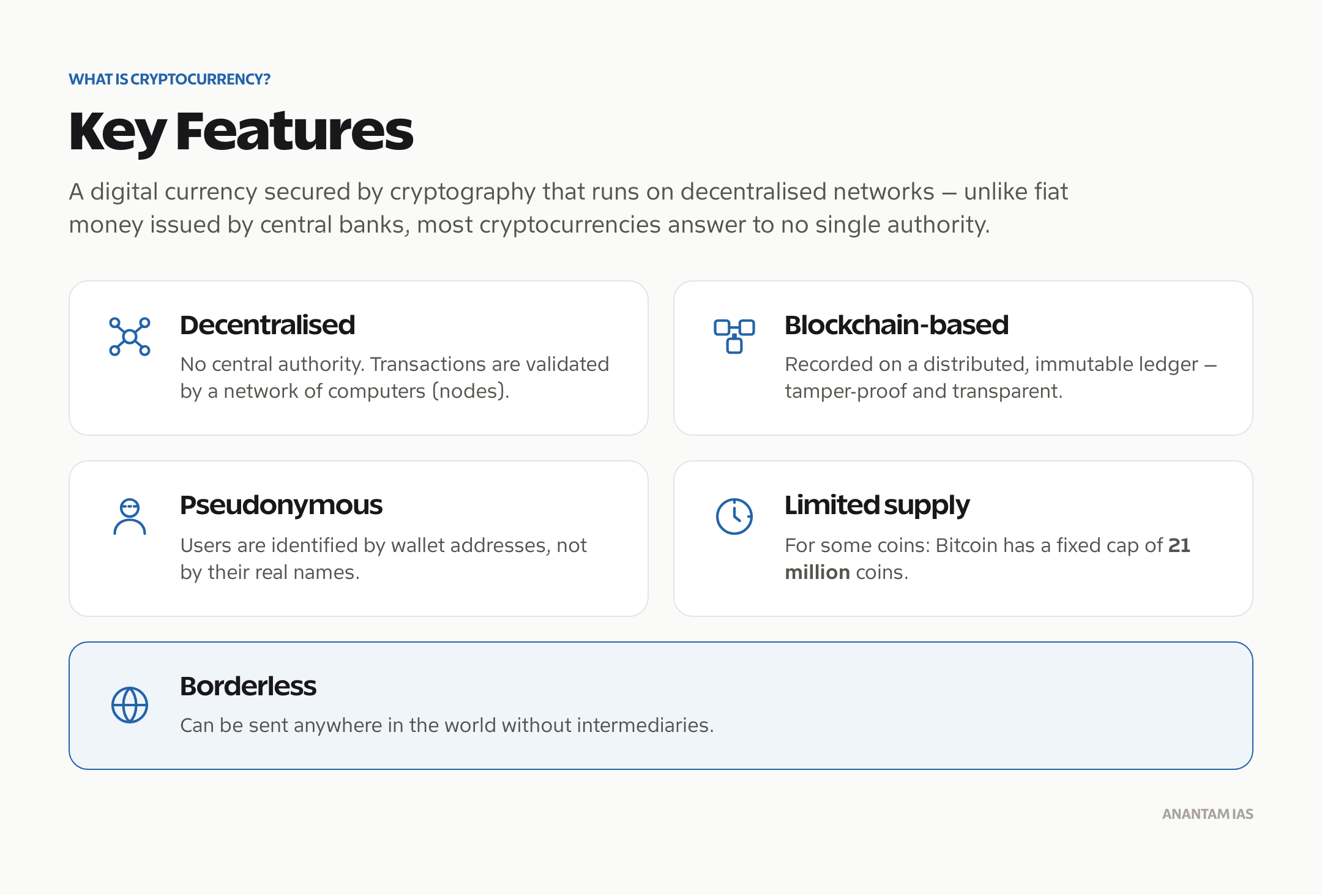
Cryptocurrency is a digital or virtual currency that uses cryptography for security and operates on decentralised networks, typically based on blockchain technology. Unlike traditional currencies issued by central banks (fiat money), most cryptocurrencies aren’t controlled by any single authority.
Key characteristics:
- Decentralised: No central authority — transactions validated by a network of computers (nodes)
- Blockchain-based: Transactions recorded on a distributed, immutable ledger
- Pseudonymous: Users identified by wallet addresses, not names
- Limited supply (for some): Bitcoin has a fixed cap of 21 million coins
- Borderless: Can be sent anywhere in the world without intermediaries
Major Cryptocurrencies
| Cryptocurrency | Creator | Key Feature |
|---|---|---|
| Bitcoin (BTC) | Satoshi Nakamoto (2009) | First and largest; store of value |
| Ethereum (ETH) | Vitalik Buterin (2015) | Smart contracts; programmable blockchain |
| Tether (USDT) | Tether Ltd | Stablecoin pegged to US dollar |
| Ripple (XRP) | Ripple Labs | Cross-border payments focus |
| Solana (SOL) | Anatoly Yakovenko | High-speed, low-cost transactions |
Blockchain Technology
Blockchain is the underlying technology powering most cryptocurrencies. It is a distributed ledger that records transactions across multiple computers, making the record tamper-proof and transparent.
How Blockchain Works
- A transaction is initiated
- The transaction is broadcast to a peer-to-peer network
- Network nodes validate the transaction using consensus algorithms (Proof of Work, Proof of Stake)
- Verified transactions are combined into a “block”
- The new block is added to the existing chain — permanently and chronologically
- The transaction is complete
Applications Beyond Cryptocurrency
- Supply chain management: Tracking goods from origin to consumer
- Land records: Tamper-proof property registration (Andhra Pradesh, Telangana pilots)
- Healthcare: Secure sharing of medical records
- Voting: Transparent, verifiable electronic voting
- Smart contracts: Self-executing contracts on blockchain (Ethereum)
The NITI Aayog has explored blockchain for various government applications through its “National Strategy on Blockchain” document.
Cryptocurrency Regulation in India: Timeline
India’s approach to cryptocurrency has oscillated between hostility and cautious acceptance.
Key Milestones
2013: RBI issues first advisory cautioning users about risks of virtual currencies.
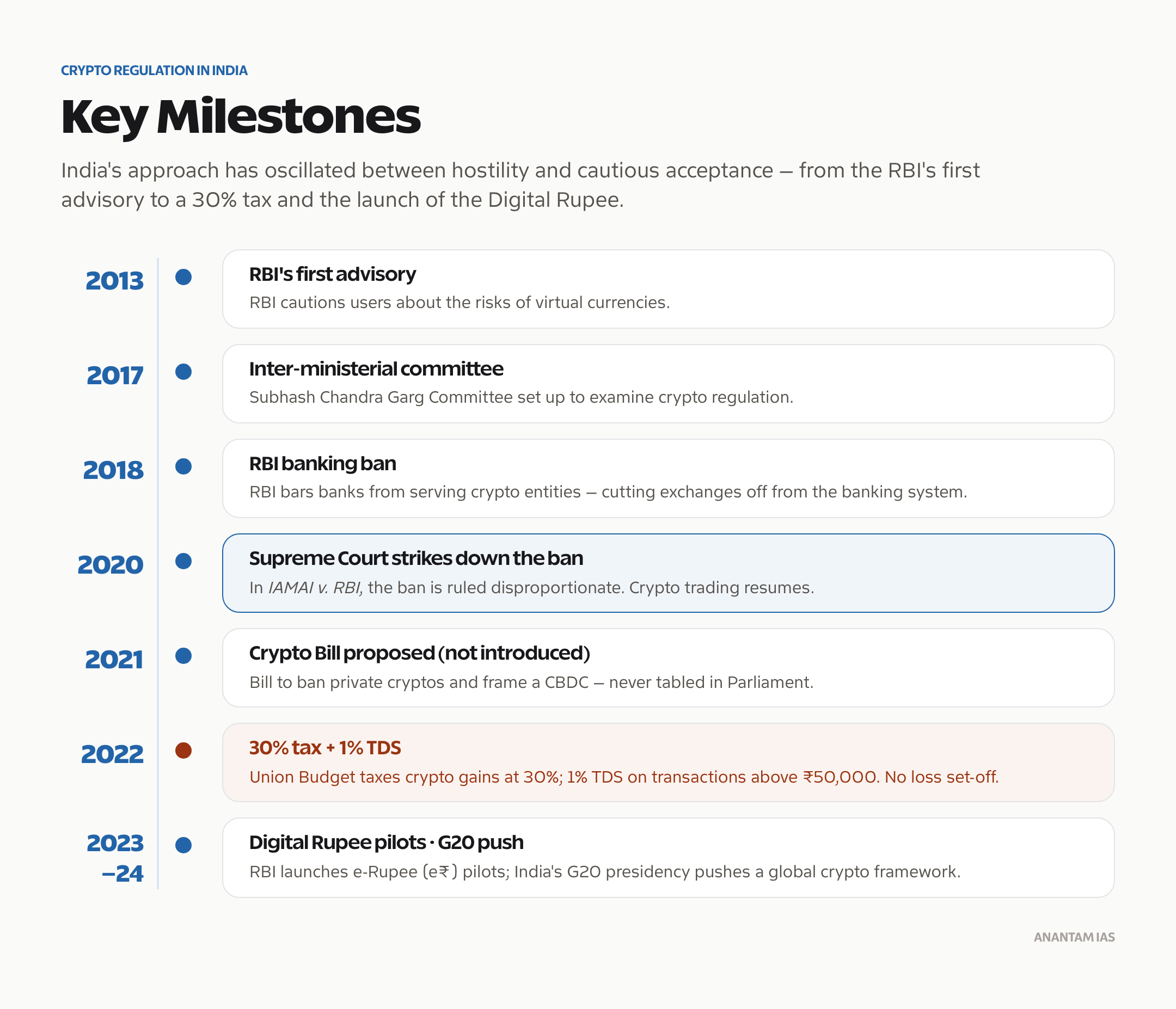
2017: An inter-ministerial committee (Subhash Chandra Garg Committee) constituted to examine crypto regulation.
2018: RBI bans banks from providing services to crypto entities — effectively blocking crypto exchanges from the banking system.
2020: Supreme Court strikes down RBI ban in Internet and Mobile Association of India vs RBI, ruling the ban as disproportionate. Crypto trading resumes.
2021: The government proposes the Cryptocurrency and Regulation of Official Digital Currency Bill, 2021 — to ban all private cryptocurrencies and create a framework for CBDC. The bill hasn’t been introduced.
2022: Union Budget introduces 30% tax on crypto gains and 1% TDS on crypto transactions above Rs 50,000. No deduction for expenses except cost of acquisition. Losses cannot be set off against other income.
2023–24: RBI launches Digital Rupee (e-Rupee) pilots. G20 presidency under India pushes for global crypto regulation framework.
Current Legal Status
Cryptocurrency isn’t illegal in India — owning, buying, and selling crypto is permitted. However:
- No specific regulatory framework exists
- Banks and financial institutions are cautious about crypto dealings
- Heavy taxation (30% + 1% TDS) has dampened trading volumes
- The RBI remains opposed to private cryptocurrencies
- A comprehensive crypto bill is still pending
RBI’s Position on Cryptocurrency
The RBI has consistently opposed private cryptocurrencies, citing multiple concerns:
RBI’s Concerns
- Monetary policy threat: Crypto could undermine the RBI’s ability to manage money supply and inflation
- Financial stability: Crypto volatility can cause massive losses for retail investors
- Money laundering: Pseudonymous nature facilitates illicit transactions
- Capital flight: Unregulated cross-border crypto flows bypass exchange controls (FEMA)
- Consumer protection: No deposit insurance or regulatory recourse for crypto investors
- Environmental concerns: Proof-of-Work mining consumes enormous energy (Bitcoin)
RBI Governor Shaktikanta Das has described cryptocurrencies as a “clear danger” to macroeconomic and financial stability, comparing them to tulip mania.
Counter-Arguments
- Blockchain technology offers genuine innovation in financial services
- Banning crypto may push activity underground rather than eliminating it
- Many countries (US, UK, EU, Japan) are developing regulatory frameworks rather than banning
- Crypto can improve financial inclusion and reduce remittance costs
Digital Rupee: India’s CBDC
The Central Bank Digital Currency (CBDC) — branded as the Digital Rupee (e₹) — is the RBI’s answer to private cryptocurrencies. It is a digital form of the Indian rupee issued by the RBI.
Key Features
- Legal tender — accepted everywhere like physical currency
- Issued by the RBI (sovereign-backed, unlike private crypto)
- Not based on decentralised blockchain — uses a centralised/partially distributed ledger
- No mining required
- Value is stable (it IS the rupee, not pegged to it)
Two Variants
Wholesale CBDC (e₹-W): For interbank transactions and settlement of government securities. Piloted from November 2022.
Retail CBDC (e₹-R): For general public use — person-to-person and person-to-merchant payments. Piloted from December 2022 through select banks.
CBDC vs Cryptocurrency
| Parameter | Digital Rupee (CBDC) | Private Cryptocurrency |
|---|---|---|
| Issuer | RBI (central bank) | Decentralised / private entity |
| Legal tender | Yes | No |
| Value stability | Stable (= INR) | Highly volatile |
| Privacy | Controlled anonymity | Pseudonymous |
| Supply | Controlled by RBI | Fixed (Bitcoin) or variable |
| Technology | Centralised/hybrid ledger | Decentralised blockchain |
| Regulation | RBI-regulated | Largely unregulated |
Why CBDC Matters
- Reduces cost of printing, transporting, and managing physical cash
- Provides a government-backed digital payment alternative
- Improves monetary policy transmission — direct channel to the public
- Can be programmed for targeted subsidies (e.g., money that can only be spent on food)
- Reduces settlement risk in wholesale markets
- Counters the appeal of private cryptocurrencies
Monetary Policy of RBI: Tools & Objectives
Taxation of Cryptocurrency
The Finance Act, 2022 introduced a clear (if harsh) taxation framework:
- 30% flat tax on profits from transfer of virtual digital assets (VDA)
- 1% TDS (Tax Deducted at Source) on transactions above Rs 50,000 (Rs 10,000 for specified persons)
- No deduction for expenses except cost of acquisition
- Losses cannot be offset against any other income
- No carry-forward of losses
- Gift tax applies if crypto is received as a gift
This taxation framework treats crypto like speculative income — discouraging trading while generating tax revenue. Trading volumes on Indian exchanges dropped sharply after implementation.
Global Regulatory Approaches
| Country/Region | Approach |
|---|---|
| El Salvador | Legal tender (Bitcoin) |
| China | Complete ban on crypto trading and mining |
| USA | Regulation through SEC and CFTC; ETFs approved |
| EU | MiCA (Markets in Crypto-Assets) regulation — comprehensive framework |
| Japan | Licensed and regulated as payment method |
| India | Taxed but not banned; no comprehensive law yet |
India’s G20 presidency (2023) pushed for a global framework for crypto regulation. The IMF-FSB Synthesis Paper on crypto policy, prepared during India’s presidency, recommended regulation over outright bans.
UPSC Mains Perspective
For GS-III, crypto questions typically examine:
- Balancing innovation with financial stability
- RBI vs market autonomy debate
- CBDC and its potential for financial inclusion
- Privacy concerns vs regulatory oversight
- International coordination challenges
- Technology vs regulation — the broader digital governance question
A strong answer should acknowledge both sides — the innovation potential of blockchain technology and the legitimate monetary/financial stability concerns raised by the RBI.
Banking System in India: Types & Structure
Frequently Asked Questions
Is cryptocurrency legal in India?
Cryptocurrency isn’t illegal in India but exists in a regulatory grey zone. The Supreme Court struck down the RBI’s banking ban in 2020. The government taxes crypto gains at 30% with 1% TDS. However, no comprehensive regulatory framework exists. Owning, buying, selling, and trading crypto is permitted, but there’s no consumer protection framework or regulatory oversight of exchanges.
What is the Digital Rupee (e-Rupee)?
The Digital Rupee is India’s Central Bank Digital Currency (CBDC) issued by the RBI. Unlike private cryptocurrencies, it is legal tender backed by the sovereign. Available in wholesale (interbank) and retail (public) variants, it operates on a centralised ledger controlled by the RBI. The pilot was launched in late 2022 through select banks in major cities.
How is cryptocurrency taxed in India?
Virtual digital assets (including crypto) are taxed at a flat 30% on profits, with 1% TDS on transactions above Rs 50,000. No deductions are allowed except cost of acquisition. Losses from crypto cannot be set off against any other income or carried forward. This framework, introduced in Budget 2022, is among the most stringent globally and has significantly reduced trading volumes on Indian exchanges.
What are the risks of cryptocurrency?
Key risks include extreme price volatility (Bitcoin has lost 50%+ value multiple times), absence of regulatory protection, use in money laundering and terrorism financing, threat to monetary sovereignty, potential for market manipulation, and environmental impact of mining operations. For retail investors, the lack of deposit insurance or dispute resolution mechanisms makes crypto a high-risk asset class.