Daily Digest
UPSC · Civil Services Examination
Current Affairs · Friday, 1 May 2026
Current affairs curated and edited by Anantam IAS faculty — pulled from The Hindu, PIB, IDSA, Foreign Affairs and the ministries. Read, annotate, revise.
Old Rajinder Nagar · Delhi 110005 · anantamias.com
Mizoram declared Insurgency-Free
Why in News?
On April 30, 2026, the Chief Minister of Mizoram declared the state completely insurgency-free after the last active ethnic armed group, Lalhmingthanga Sanate-led faction of the Hmar People’s Convention (Democratic), laid down its arms at a formal ceremony.
| UPSC Relevance: GS-3 Internal Security: Insurgency and linkages with organised crime. Prelims: Key Constitutional & Statutory Provisions; Mizo Accord. Mains: Internal Security issue in North-East India. |
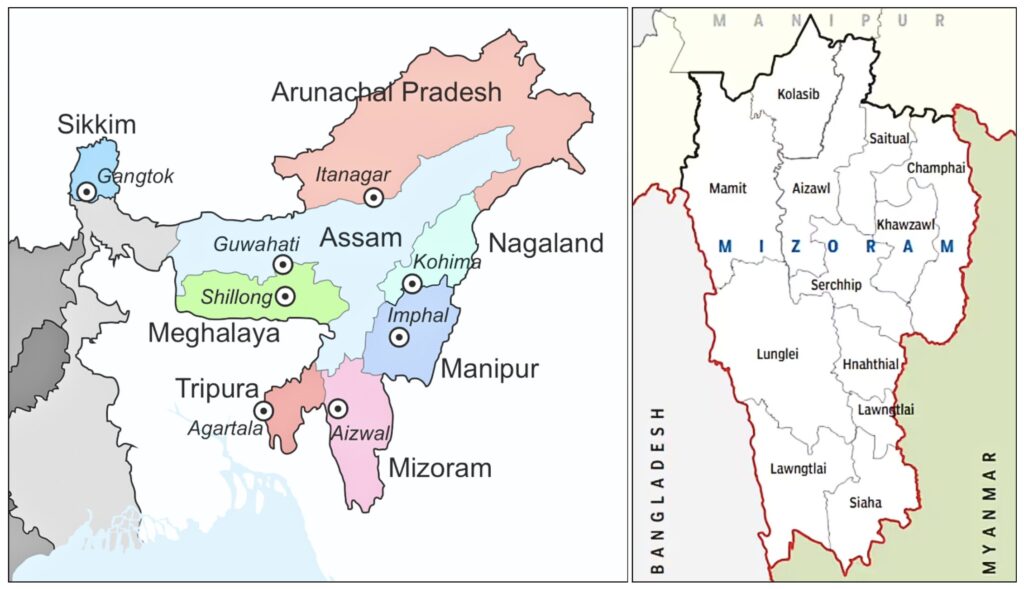
Insurgency in Mizoram: Historical Background
1. The MNF Insurgency and Mizo Accord (1966-1986):
- The Mizo National Front (MNF), under Laldenga, launched an armed insurgency in 1966, demanding secession from India.
- Root cause: Government’s alleged neglect during the devastating Mautam famine (bamboo flowering + rodent plague) in 1959-60.
- The Indian Air Force conducted airstrikes in Aizawl in 1966 — the only instance of India using airstrikes against its own civilian territory.
- After two decades of conflict, the Mizo Peace Accord was signed in 1986 between the Government of India and the MNF, widely regarded as India’s most successful peace accord post-Independence.
- MNF agreed to surrender arms and join mainstream politics.
- Mizoram was granted full statehood in 1987 (the 23rd state of India).
- Laldenga became Chief Minister.
2. Origin of the Hmar Insurgency (1986-2026):
- The 1986 Mizo Accord left aspirations of the Hmar community (a minority tribal group spread across Mizoram, Assam and Manipur) unaddressed.
- In 1986, Hmar leaders formed the Hmar People’s Convention (HPC) as a political platform demanding an Autonomous District Council (ADC) under the Sixth Schedule of the Constitution.
- When these demands were not met, HPC turned militant in 1987.
Mizoram had signed peace accords with Hmar militant groups in 1994, 2018 and now 2026, culminating in the end of insurgency.
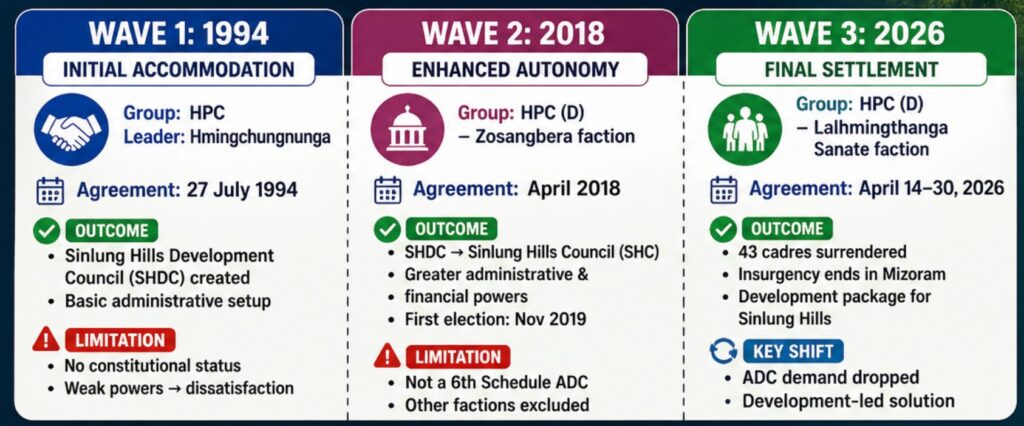
Peace Accord: Mizoram state government and the HPC (D) Lalhmingthanga Sanate Faction:
A Memorandum of Settlement was signed between the state government and HPC (D) Lalhmingthanga Sanate Faction on April 14, 2026. Key Highlights:
- Final Group Surrenders: A total of 43 cadres, including Sanate himself, surrendered their weapons. Mizoram is now free of active underground ethnic insurgent groups.
- Focus on Development:
- Administrative changes for the Sinlung Hills Council (SHC), including shifting its control from the General Administration Department to the District Council and Minority Affairs Department. Setting up key offices under the Rural Development and Agriculture Department.
- Increased budgetary allocation from 2027-28, a special development package, construction of internal roads, establishment of an Eklavya Model Residential School, and a Netaji Subhas Chandra Bose residential hostel.
- Official recognition of Sikpui Ruoi, the largest Hmar festival celebrated on December 5.
Significance of the Peace Accord:
- Mizoram becomes the first state in North-East India with zero active insurgent groups. Reinforces Mizoram’s status as the most peaceful state in the NE, with high literacy, low crime, and a strong civil society.
- Development-centred peace: Replacing political demands (Autonomous District Councils) with targeted development packages represents a significant shift to a development-centred, pragmatic model. Demonstrates that ethnic aspirations can be addressed without territorial bifurcation.
- Multi-level governance model: The peace deal creates a layered structure: (i) Sinlung Hills Council for Hmar areas (local autonomy), (ii) State legislature (regional governance), and (iii) Constitutional safeguards under Part XXI (Article 371G). Thus, balancing tribal autonomy with regional and national integration.
- State government-led negotiation: Unlike many NE peace processes mediated by the Centre, this was negotiated by the Mizoram state government, demonstrating effective federalism.
- Demonstrates Moral leadership & Dialogue over deterrence: CM Lalduhoma’s personal commitment and history with the peace process provided trust and credibility to negotiations. Sustained backchannel diplomacy from 2024 through four formal rounds of talks demonstrates that political will and patience can achieve what force cannot.
- Collective Mizo identity & social cohesion: CM Lalduhoma’s call for sub-tribes to embrace the shared ‘Mizo’ identity over narrow tribal affiliations is significant for long-term social cohesion.
Associated Challenges:
- Effective implementation of the ‘special development package’ for the Sinlung Hills region.
- Rehabilitation and skill development of 43 surrendered cadres.
- Preventing spillover from neighbouring Manipur’s ongoing ethnic conflicts.
- Addressing cross-border Hmar community aspirations in Assam and Manipur.
The declaration marks a historic milestone in India’s internal security landscape and a guiding model for the NE Peace Process. Mizoram’s journey demonstrates that patient negotiation, inclusive development, and recognising tribal identity aspirations can resolve insurgency.
Location in News: Unity Bridge over Tuivai River: Tangible infrastructure connecting Hmar areas in Mizoram and Manipur.
Key Constitutional & Statutory Provisions:
| Sixth Schedule of the Constitution (Articles 244(2) and 275(1)) provides for tribal self-governance via Autonomous District Councils (ADCs) in Assam, Meghalaya, Tripura, and Mizoram. These councils have legislative, judicial, and executive powers over land, forests, and customary laws, protecting tribal rights and culture in the Northeast. |
| Sinlung Hills Council (SHC): The 14-member autonomous council created post-2018 accord, now governs Hmar-dominated areas. Distinct from a full ADC but provides enhanced administrative autonomy. |
| Special provisions under Article 371G: No Act of Parliament applies to Mizoram’s religious/social practices, customary law, or land ownership without the state legislature’s resolution. |
| Inner Line Permit (ILP) System: Mizoram is among the states protected by the ILP under the Bengal Eastern Frontier Regulation, 1873, restricting the entry of outsiders. |
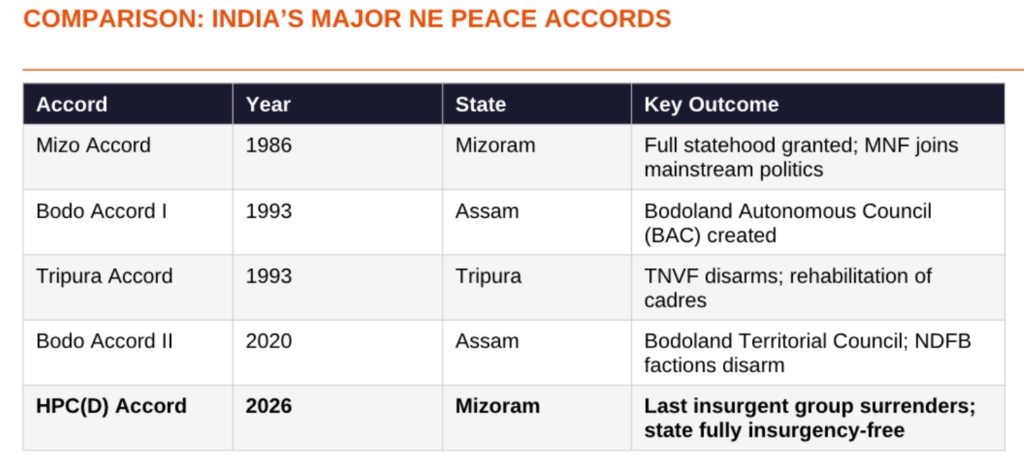
UPSC Mains PYQ 2025
Q. What are the major challenges to internal security and the peace process in the North-Eastern States? Map the various peace accords and agreements initiated by the government in the past decade. (15 M)
Source: https://anantamias.com/current-affairs/mizoram-declared-insurgency-free/
Lift the Abortion Time Limit for Minor Rape Survivors: SC
Why in News?
The Supreme Court of India has directed the Union Government to amend the Medical Termination of Pregnancy (MTP) Act to remove the time limit on medical termination of unwanted pregnancies in the case of minor rape survivors.
In a landmark order, the SC allowed a 15-year-old rape survivor to terminate a 30-week pregnancy.
| UPSC Relevance: GS-2 Social Justice: Vulnerable Sections; Health Prelims: Medical Termination of Pregnancy (MTP) Amendment Act, 2021 |
Key Directives of the Supreme Court:
- Proposed Amendments:
- Remove the gestational time limit under the MTP Act for termination of pregnancies caused by the rape of a minor — no upper limit should apply in such cases.
- Amend the penal law (BNS/POCSO) to mandate completion of trials in minor rape cases within one week.
- Transfer the entire property of the accused to the rape survivor as compensation.
- Decision-Making Authority: The Court stated that the state and doctors cannot make decisions for minor rape survivors. The decision must be left to the survivor herself and her parents/guardians.
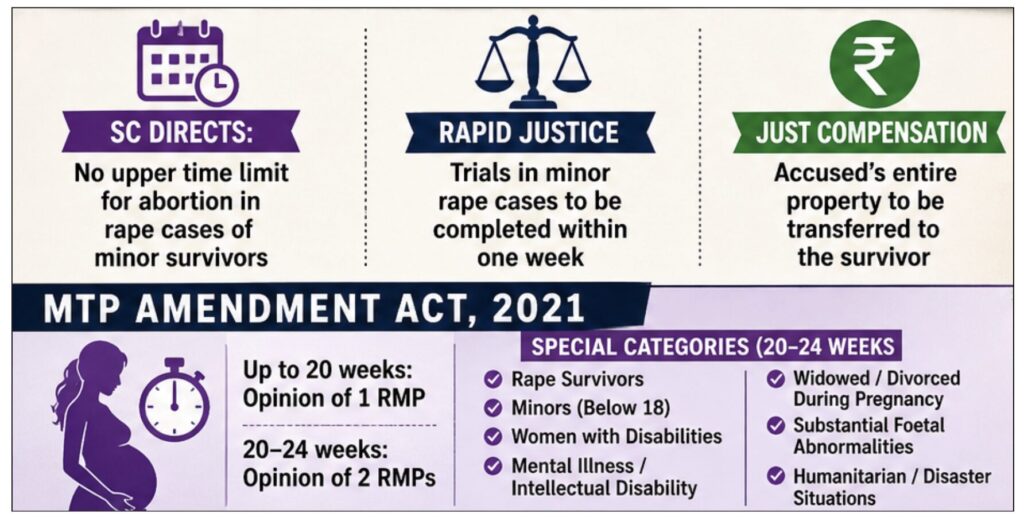
Medical Termination of Pregnancy (MTP) Amendment Act, 2021:
The Amendment Act has revised the permissible gestational limits for termination of pregnancy:
- Termination of pregnancy is allowed up to 20 weeks on the opinion of one Registered Medical Practitioner (RMP).
- For certain specified categories of women, termination is permitted between 20-24 weeks on the opinion of two RMPs. These special categories include:
- Survivors of sexual assault, rape, or incest
- Minors (below 18 years)
- Women with physical disabilities (under the RPD Act, 2016)
- Women with mental illness or intellectual disability
- Women who are widowed or divorced during pregnancy
- Pregnancies with substantial foetal abnormalities
- Pregnancies in humanitarian or disaster situations
- Recognises changing social realities: Replaces the term “pregnant married woman” with “pregnant woman.” This change legally recognises unmarried women & live-in relationships.
- Constitution of Medical Boards: The Act mandates that every State and Union Territory must constitute a Medical Board. Functions of the Medical Board:
- To decide on the termination of pregnancy beyond 24 weeks
- Applicable only in cases of substantial foetal abnormalities
- Privacy and Confidentiality: The identity and personal details of the woman cannot be disclosed. However, this provision often comes into conflict with mandatory reporting requirements under laws like the POCSO Act.
Critical Legal and Constitutional Issues:
- Conflict between Bodily Autonomy and Statutory Time Limits:
- Reproductive autonomy is a part of the right to dignity and personal liberty under Article 21. In the X v. NCT of Delhi (2022) case, the SC held: It is the woman alone who has the right over her body.
- However, the statutory 24-week cap under the MTP Act continues to override this in practice for many women.
- POCSO Act and Confidentiality issue: Under the POCSO Act, 2012, doctors are mandatorily required to report any sexual activity involving a minor to the police. The obligation to report conflicts directly conflicts with the MTP Act’s confidentiality guarantee. As a result, many minors are pushed towards unsafe, illegal terminations.
- Medical Board Delays: The requirement of Medical Board approval for late-term cases leads to extreme delay. The pregnancy may progress by several additional weeks while the survivor awaits judicial and board decisions.
- Judicial and Legislative Gaps:
- The MTP Act does not distinguish between adult women and minors in setting gestational caps.
- No statutory provision currently mandates fast-track completion of rape trials involving minors.
- The absence of district-level Medical Boards forces survivors to travel to state capitals and face prolonged delays.
- Foetal Viability Paradox: Medical science has advanced to the point that foetuses at 24-26 weeks can survive with intensive neonatal care. This creates a medico-legal dilemma: the right to terminate vs. obligations towards a potentially viable foetus.
Way Forward:
- Amend the MTP Act to remove all gestational caps for minor rape survivors, as directed by the Supreme Court.
- Introduce a specific exemption in POCSO for healthcare providers seeking to provide MTP services to minors, without mandatory police reporting being a barrier.
- Amend BNS/POCSO to mandate fast-track completion of minor rape trials within a defined period.
- Decentralise Medical Boards to the district level, reducing travel time and delays for vulnerable women.
- The Supreme Court should issue a binding, consolidated ruling on the hierarchy of rights in foetal-viability cases, resolving the doctrinal inconsistency across benches.
UPSC PYQ 2019
Q. Which of the following statements is/arc correct regarding the Maternity Benefit (Amendment) Act, 2017?
1. Pregnant women are entitled for three months pre-delivery and three months post-delivery paid leave.
2. Enterprises with creches must allow the mother minimum six creche visits daily.
3. Women with two children get reduced entitlements.
Select the correct answer using the code given below.
(a) 1 and 2 only
(b) 2 only
(c) 3 only
(d) 1, 2 and 3
Answer: (c)
Source: https://anantamias.com/current-affairs/lift-the-abortion-time-limit-for-minor-rape-survivors-sc/
Scaling climate adaptation from policy to grassroots
Why in News?
India is increasingly focusing on climate adaptation, with its updated climate commitments highlighting the need to move from policy-level intent to grassroots implementation amid rising climate risks.
UPSC Relevance
GS-II: Governance, Welfare Delivery, Local Governance
GS-III: Environment, Climate Change, Disaster Management, Agriculture
Background: India’s Climate Vulnerability
India is among the most climate-vulnerable countries, facing:
- Frequent extreme weather events (floods, droughts, cyclones, heatwaves)
- Large-scale economic and human losses
- High dependence on climate-sensitive sectors like agriculture
Between 1995–2024:
- Over 430 extreme weather events recorded
- Losses estimated at $170 billion
- Around 1.3 billion people affected
This highlights that adaptation is no longer optional but essential for development.
Climate Adaptation in India: Policy Framework
1. National Commitments (NDCs)
India’s updated climate targets under the UNFCCC framework emphasise:
- Mainstreaming climate resilience into development planning
- Focus on:
- Coastal resilience
- Climate-resilient infrastructure
- Disaster preparedness
- Heat mitigation
- Biodiversity conservation
- Sustainable livelihoods
2. National-Level Initiatives
a) NICRA Programme
Implemented by Indian Council of Agricultural Research:
- Covers climate-vulnerable agricultural regions
- Focuses on:
- Climate-resilient farming practices
- Risk mapping across districts
- Farmer capacity-building
This strengthens agricultural resilience, which is crucial for food security.
b) State-Level Innovation: Tamil Nadu Model
The Climate Resilient Villages (CRV) programme under Tamil Nadu Climate Change Mission is a notable example:
- Covers vulnerable districts
- Uses a holistic approach, including:
- Water conservation
- Flood and drought management
- Renewable energy
- Waste management
- Biodiversity protection
- Alternative livelihoods
Its key strength lies in community participation and local planning, making it a replicable model.
What are the Key Challenges in Climate Adaptation?
1. Fragmented & Top-Down Approach
- The Issue: Adaptation is treated as a “side-project” within existing schemes (like MGNREGA or PMKSY) rather than a core objective.
- Consequence: A “siloed” approach prevents holistic landscape-level management (e.g., managing a river basin across three states).
2. The Finance Gap & Taxonomy Issues
- The Issue: Adaptation is often seen as a “public good” with no immediate Return on Investment (ROI), making it unattractive for private capital compared to solar or wind (Mitigation).
- India lacks a Green Taxonomy that specifically labels “Adaptation” projects, leading to “greenwashing” or missed funding opportunities from Global Climate Funds.
3. Institutional & Capacity Constraints
- SAPCCs 2.0: While many states are updating their State Action Plans (SAPCCs), they remain “wishlists” without dedicated legislative backing or separate budgets.
- The “Last Mile” Gap: Gram Panchayats are the actual implementers but lack the technical expertise to interpret climate models or risk maps.
4. The “Data Poverty” in Localized Contexts
- The Issue: India has excellent macro-data (IMD), but lacks Hyper-local/Block-level vulnerability mapping.
- Consequence: We cannot predict how a 1.5°C rise affects a specific district’s specific crop variety, leading to generic, ineffective adaptation strategies.
5. Maladaptation Risks
- Definition: Actions taken to avoid climate change impacts that inadvertently increase vulnerability in the long term.
- Example: Building massive sea walls might protect a coast today but destroy local ecosystems and increase erosion further down the coast.
6. Social Inequity & Intersectionality
- Climate change is not a “great equaliser”; it hits the marginalized hardest.
- Challenge: Adaptation strategies often fail to account for gender, caste, and landless labourers. If adaptation isn’t inclusive, it isn’t successful.
7. Implementation Lag (The Policy-to-Action Gap)
- India has great policies (NAPCC, Missions on Water, Agriculture), but implementation is hampered by the “Three Fs”: Funds, Functions, and Functionaries at the local level.
8. The “Transboundary” Challenge
- Climate impacts (like glacial melts in the Himalayas) are transboundary, but adaptation policies are strictly national.
- Challenge: Lack of regional cooperation (e.g., with Nepal, Bhutan, or Bangladesh) makes local adaptation in North/East India incomplete.
Need for Locally Led Adaptation
Global discussions (including COP processes) emphasise Locally Led Adaptation (LLA).
Adaptation must be:
- Community-driven
- Context-specific
- Participatory
Local communities:
- Understand their vulnerabilities best
- Can ensure better implementation and sustainability
Way Forward
1. Institutionalising Adaptation Planning
Adaptation must be integrated into governance at all levels — national, state, district, and local. Regular climate vulnerability assessments should guide planning, incorporating socio-economic and livelihood dimensions to ensure targeted interventions.
2. Strengthening Climate Finance Architecture
India needs a clear framework to classify and prioritise adaptation investments. Developing a robust climate finance taxonomy will help attract private and international funding while ensuring efficient allocation of domestic resources.
3. Mainstreaming Climate Budgeting
Tracking adaptation-related expenditure within Union and State budgets is essential. Climate budgeting should be institutionalised through finance departments, enabling better planning, transparency, and accountability in adaptation spending.
4. Scaling Successful Models
Programmes like Tamil Nadu’s Climate Resilient Villages should be adapted and replicated across different ecological regions. Scaling such models can build resilience at the grassroots while ensuring local participation.
5. Strengthening Local Institutions
Panchayati Raj Institutions and Urban Local Bodies must be empowered with:
- Technical capacity
- Financial resources
- Decision-making authority
This will enable effective implementation of adaptation strategies at the grassroots level.
6. Expanding Adaptation Beyond Infrastructure
Adaptation strategies must go beyond physical infrastructure to include:
- Skill development
- Alternative livelihoods
- Social protection measures
This ensures long-term resilience, especially for vulnerable populations.
7. Enhancing Data Systems and Monitoring
Robust data collection and monitoring systems should be developed for:
- Climate risks
- Adaptation outcomes
Regular evaluation will improve policy effectiveness and ensure timely course correction.
8. Promoting Community Participation
Adaptation planning should actively involve communities at every stage — from design to implementation and monitoring. This improves ownership, relevance, and sustainability of interventions.
Conclusion
India’s climate challenge is not just about reducing emissions but also about adapting to unavoidable changes. The real test lies in translating national commitments into effective local action. A shift towards integrated, well-financed, and community-driven adaptation strategies will be essential to build a climate-resilient future.
Practice Questions
Prelims
Q1. With reference to climate adaptation in India, consider the following statements:
- India’s climate finance taxonomy currently focuses more on mitigation than adaptation.
- NICRA programme is implemented by the Ministry of Environment, Forest and Climate Change.
- Locally Led Adaptation emphasises community participation in climate action.
Which of the statements given above are correct?
(a) 1 and 3 only
(b) 2 and 3 only
(c) 1 only
(d) 1, 2 and 3
Answer: (a) 1 and 3 only
Mains
Q1. Discuss the importance of climate adaptation in India. Examine the challenges in scaling adaptation from policy to grassroots level.
Q2. “Locally led adaptation is key to building climate resilience in India.” Analyse.
Source: https://anantamias.com/current-affairs/scaling-climate-adaptation-from-policy-to-grassroots/
India among countries where Meta ‘automatically’ blocks flagged content
Why in News?
India has been identified among a limited set of countries where Meta (parent of Facebook and Instagram) automatically restricts flagged online content at scale based on government or law enforcement notices, raising concerns about free speech, intermediary liability, and digital governance.
UPSC Relevance
GS-II: Governance, Fundamental Rights, Judiciary
GS-III: Science & Technology, Cyber Security
Background: Legal Framework for Content Regulation
1. Intermediary Liability under IT Act
- Governed by Section 79 of the Information Technology Act, 2000
- Provides “safe harbour” protection to intermediaries (social media platforms)
Meaning of Safe Harbour:
Platforms are not held liable for user-generated content, provided they:
- Do not initiate or modify content
- Act upon receiving “actual knowledge” of unlawful content
2. Section 79(3)(b): Key Provision
- If a platform receives notice of unlawful content and fails to act, it may lose safe harbour
- This creates pressure on platforms to comply quickly with takedown requests
3. IT Rules, 2021 (and amendments)
- Mandate time-bound removal of content
- Recent changes reduced compliance time:
- From 36 hours to as low as 3 hours in certain cases
This has significantly increased the urgency and volume of takedown compliance.
What is the Sahyog Portal?
- A government-backed system allowing authorised police officials to send takedown notices directly to platforms
- Operates under Section 79(3)(b)
- Enables rapid content restriction through an online mechanism
Key Issue: Automatic Content Blocking
Platform Behaviour
- Platforms like Meta:
- Automatically restrict content upon receiving notices
- Often without independent legal scrutiny
- Require government approval to restore content
This creates a system where:
- Content removal becomes immediate and large-scale
- Restoration is uncertain and delayed
What are the Concerns Raised?
1. Risk of Over-Censorship
Since notices are acted upon quickly:
- Even legally valid content may be removed
- Platforms may prefer compliance over legal challenge
This results in a “chilling effect” on free speech.
2. Weak Due Process
- Notices may not always:
- Clearly establish illegality
- Provide detailed justification
Yet, they lead to immediate content blocking, raising concerns about procedural fairness.
3. Dilution of Judicial Safeguards
The landmark case of
Shreya Singhal v. Union of India
had established:
- Content takedown should follow judicial order or proper legal process
- Platforms should not act solely on private or arbitrary complaints
However, current practices suggest:
- Increasing reliance on executive notifications rather than judicial scrutiny
4. Platform Accountability Issues
- Platforms are:
- More accountable to government authorities
- Less accountable to users
This raises questions about:
- Transparency
- Corporate responsibility
- Protection of user rights
5. Lack of Transparency
- No public disclosure of:
- Number of takedown requests
- Nature of content removed
- Success rate of appeals
This limits:
- Public oversight
- Democratic accountability
Comparative Perspective
- Platforms like X have:
- Challenged government mechanisms legally
- Shown selective compliance
This highlights variation in intermediary responses, reflecting:
- Different risk strategies
- Different interpretations of legal obligations
Broader Issues in Digital Governance
1. Balance Between Regulation and Freedom
State regulation aims to:
- Prevent unlawful content
- Maintain public order
But excessive control may:
- Restrict freedom of expression
- Undermine democratic discourse
2. Scale of Digital Ecosystem
India has:
- Over 800 million internet users
Managing such a large ecosystem creates:
- Administrative challenges
- Pressure to rely on automated systems
3. Shift of Responsibility
- Government increasingly shifts content regulation responsibility to platforms
- Platforms act as private regulators of speech
This raises concerns about:
- Legitimacy of private censorship
- Lack of constitutional safeguards
Way Forward
1. Strengthening Due Process
Content takedown should follow clear legal standards, including proper justification and adherence to principles laid down by courts. Judicial oversight must remain central to prevent arbitrary censorship.
2. Enhancing Transparency
Platforms should publish all takedown requests and actions taken. A public repository of notices can improve accountability and enable independent scrutiny.
3. Balancing Speed with Scrutiny
While quick action is necessary in certain cases, mechanisms must allow platforms to assess the legality of content instead of enforcing automatic compliance.
4. Clearer Guidelines for Authorities
Law enforcement agencies should issue well-reasoned and specific notices, clearly identifying unlawful content rather than broad or vague requests.
5. Strengthening User Rights
Users should have access to:
- Appeal mechanisms
- Notification of takedowns
- Timely restoration if content is wrongly removed
6. Defining Platform Responsibility
Intermediaries should not act merely as passive actors. They must balance:
- Legal compliance
- Protection of user rights
- Freedom of expression
Conclusion
India’s evolving digital governance framework reflects the challenge of regulating a vast online ecosystem. However, efficiency in content control must not come at the cost of constitutional freedoms. A balanced approach—grounded in transparency, accountability, and rule of law—is essential to ensure that digital platforms remain spaces for both innovation and democratic expression.
Practice Questions
Prelims
Q1. With reference to intermediary liability in India, consider the following statements:
- Section 79 of the IT Act provides safe harbour protection to intermediaries.
- Intermediaries are required to remove content only after a court order.
- Failure to comply with takedown notices may lead to loss of safe harbour protection.
Which of the statements given above are correct?
(a) 1 and 3 only
(b) 2 and 3 only
(c) 1 only
(d) 1, 2 and 3
Answer: (a) 1 and 3 only
Mains
Q1. Discuss the challenges associated with intermediary liability and content regulation in India. How can a balance be achieved between regulation and freedom of expression?