
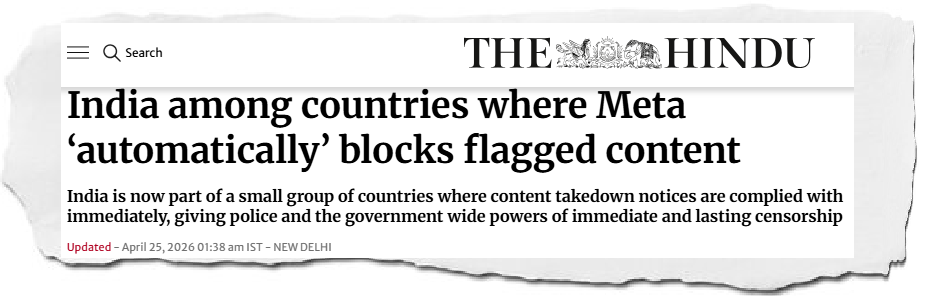
Why in News?
India has been identified among a limited set of countries where Meta (parent of Facebook and Instagram) automatically restricts flagged online content at scale based on government or law enforcement notices, raising concerns about free speech, intermediary liability, and digital governance.
UPSC Relevance
GS-II: Governance, Fundamental Rights, Judiciary
GS-III: Science & Technology, Cyber Security
Background: Legal Framework for Content Regulation
1. Intermediary Liability under IT Act
- Governed by Section 79 of the Information Technology Act, 2000
- Provides “safe harbour” protection to intermediaries (social media platforms)
Meaning of Safe Harbour:
Platforms are not held liable for user-generated content, provided they:
- Do not initiate or modify content
- Act upon receiving “actual knowledge” of unlawful content
2. Section 79(3)(b): Key Provision
- If a platform receives notice of unlawful content and fails to act, it may lose safe harbour
- This creates pressure on platforms to comply quickly with takedown requests
3. IT Rules, 2021 (and amendments)
- Mandate time-bound removal of content
- Recent changes reduced compliance time:
- From 36 hours to as low as 3 hours in certain cases
This has significantly increased the urgency and volume of takedown compliance.
What is the Sahyog Portal?
- A government-backed system allowing authorised police officials to send takedown notices directly to platforms
- Operates under Section 79(3)(b)
- Enables rapid content restriction through an online mechanism
Key Issue: Automatic Content Blocking
Platform Behaviour
- Platforms like Meta:
- Automatically restrict content upon receiving notices
- Often without independent legal scrutiny
- Require government approval to restore content
This creates a system where:
- Content removal becomes immediate and large-scale
- Restoration is uncertain and delayed
What are the Concerns Raised?
1. Risk of Over-Censorship
Since notices are acted upon quickly:
- Even legally valid content may be removed
- Platforms may prefer compliance over legal challenge
This results in a “chilling effect” on free speech.
2. Weak Due Process
- Notices may not always:
- Clearly establish illegality
- Provide detailed justification
Yet, they lead to immediate content blocking, raising concerns about procedural fairness.
3. Dilution of Judicial Safeguards
The landmark case of
Shreya Singhal v. Union of India
had established:
- Content takedown should follow judicial order or proper legal process
- Platforms should not act solely on private or arbitrary complaints
However, current practices suggest:
- Increasing reliance on executive notifications rather than judicial scrutiny
4. Platform Accountability Issues
- Platforms are:
- More accountable to government authorities
- Less accountable to users
This raises questions about:
- Transparency
- Corporate responsibility
- Protection of user rights
5. Lack of Transparency
- No public disclosure of:
- Number of takedown requests
- Nature of content removed
- Success rate of appeals
This limits:
- Public oversight
- Democratic accountability
Comparative Perspective
- Platforms like X have:
- Challenged government mechanisms legally
- Shown selective compliance
This highlights variation in intermediary responses, reflecting:
- Different risk strategies
- Different interpretations of legal obligations
Broader Issues in Digital Governance
1. Balance Between Regulation and Freedom
State regulation aims to:
- Prevent unlawful content
- Maintain public order
But excessive control may:
- Restrict freedom of expression
- Undermine democratic discourse
2. Scale of Digital Ecosystem
India has:
- Over 800 million internet users
Managing such a large ecosystem creates:
- Administrative challenges
- Pressure to rely on automated systems
3. Shift of Responsibility
- Government increasingly shifts content regulation responsibility to platforms
- Platforms act as private regulators of speech
This raises concerns about:
- Legitimacy of private censorship
- Lack of constitutional safeguards
Way Forward
1. Strengthening Due Process
Content takedown should follow clear legal standards, including proper justification and adherence to principles laid down by courts. Judicial oversight must remain central to prevent arbitrary censorship.
2. Enhancing Transparency
Platforms should publish all takedown requests and actions taken. A public repository of notices can improve accountability and enable independent scrutiny.
3. Balancing Speed with Scrutiny
While quick action is necessary in certain cases, mechanisms must allow platforms to assess the legality of content instead of enforcing automatic compliance.
4. Clearer Guidelines for Authorities
Law enforcement agencies should issue well-reasoned and specific notices, clearly identifying unlawful content rather than broad or vague requests.
5. Strengthening User Rights
Users should have access to:
- Appeal mechanisms
- Notification of takedowns
- Timely restoration if content is wrongly removed
6. Defining Platform Responsibility
Intermediaries should not act merely as passive actors. They must balance:
- Legal compliance
- Protection of user rights
- Freedom of expression
Conclusion
India’s evolving digital governance framework reflects the challenge of regulating a vast online ecosystem. However, efficiency in content control must not come at the cost of constitutional freedoms. A balanced approach—grounded in transparency, accountability, and rule of law—is essential to ensure that digital platforms remain spaces for both innovation and democratic expression.
Practice Questions
Prelims
Q1. With reference to intermediary liability in India, consider the following statements:
- Section 79 of the IT Act provides safe harbour protection to intermediaries.
- Intermediaries are required to remove content only after a court order.
- Failure to comply with takedown notices may lead to loss of safe harbour protection.
Which of the statements given above are correct?
(a) 1 and 3 only
(b) 2 and 3 only
(c) 1 only
(d) 1, 2 and 3
Answer: (a) 1 and 3 only
Mains
Q1. Discuss the challenges associated with intermediary liability and content regulation in India. How can a balance be achieved between regulation and freedom of expression?
Tell Google you want more of this.
Add Anantam IAS as a preferred sourceOne tap, and this site shows up more often in your own Top Stories, AI Overviews and AI Mode. Remove it any time.