Why in News?
On April 30, 2026, the Chief Minister of Mizoram declared the state completely insurgency-free after the last active ethnic armed group, Lalhmingthanga Sanate-led faction of the Hmar People’s Convention (Democratic), laid down its arms at a formal ceremony.
| UPSC Relevance: GS-3 Internal Security: Insurgency and linkages with organised crime. Prelims: Key Constitutional & Statutory Provisions; Mizo Accord. Mains: Internal Security issue in North-East India. |
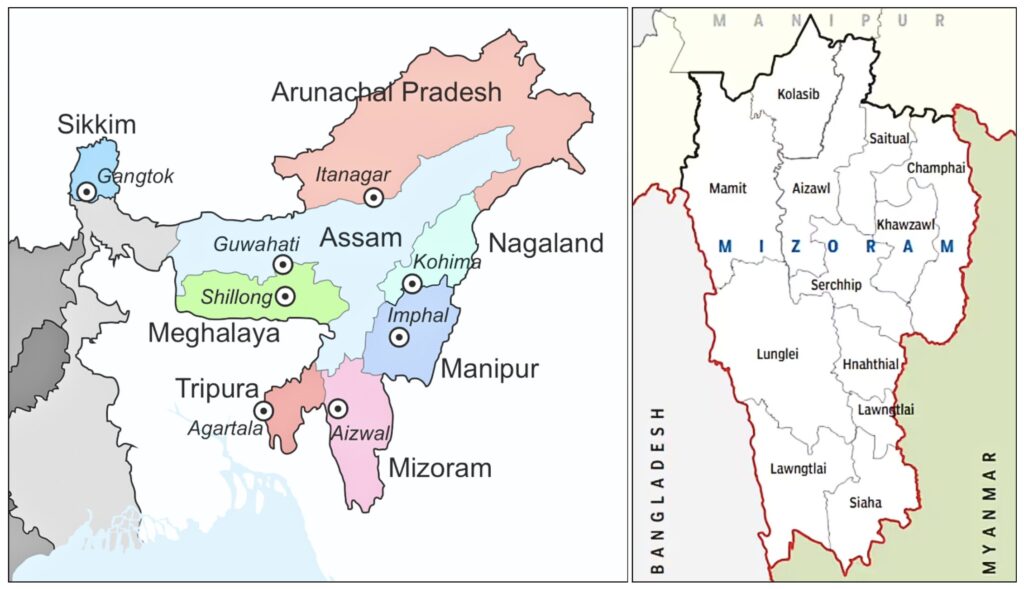
Insurgency in Mizoram: Historical Background
1. The MNF Insurgency and Mizo Accord (1966-1986):
- The Mizo National Front (MNF), under Laldenga, launched an armed insurgency in 1966, demanding secession from India.
- Root cause: Government’s alleged neglect during the devastating Mautam famine (bamboo flowering + rodent plague) in 1959-60.
- The Indian Air Force conducted airstrikes in Aizawl in 1966 — the only instance of India using airstrikes against its own civilian territory.
- After two decades of conflict, the Mizo Peace Accord was signed in 1986 between the Government of India and the MNF, widely regarded as India’s most successful peace accord post-Independence.
- MNF agreed to surrender arms and join mainstream politics.
- Mizoram was granted full statehood in 1987 (the 23rd state of India).
- Laldenga became Chief Minister.
2. Origin of the Hmar Insurgency (1986-2026):
- The 1986 Mizo Accord left aspirations of the Hmar community (a minority tribal group spread across Mizoram, Assam and Manipur) unaddressed.
- In 1986, Hmar leaders formed the Hmar People’s Convention (HPC) as a political platform demanding an Autonomous District Council (ADC) under the Sixth Schedule of the Constitution.
- When these demands were not met, HPC turned militant in 1987.
Mizoram had signed peace accords with Hmar militant groups in 1994, 2018 and now 2026, culminating in the end of insurgency.
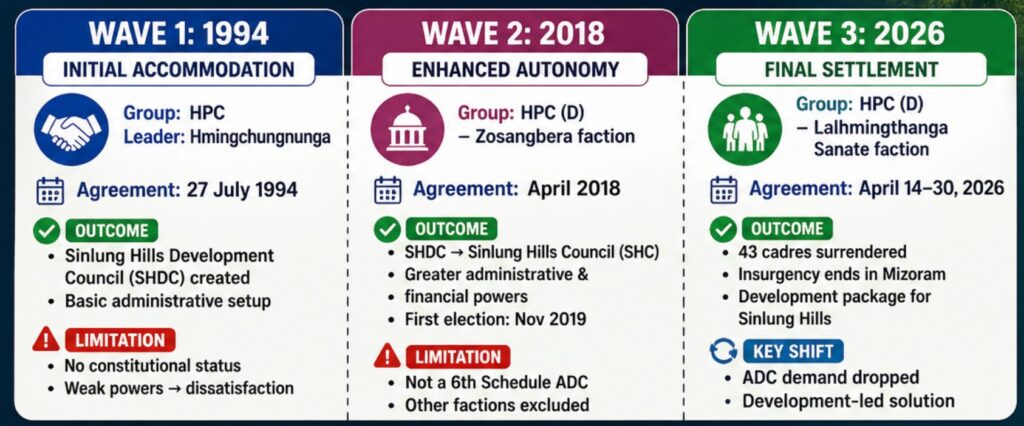
Peace Accord: Mizoram state government and the HPC (D) Lalhmingthanga Sanate Faction:
A Memorandum of Settlement was signed between the state government and HPC (D) Lalhmingthanga Sanate Faction on April 14, 2026. Key Highlights:
- Final Group Surrenders: A total of 43 cadres, including Sanate himself, surrendered their weapons. Mizoram is now free of active underground ethnic insurgent groups.
- Focus on Development:
- Administrative changes for the Sinlung Hills Council (SHC), including shifting its control from the General Administration Department to the District Council and Minority Affairs Department. Setting up key offices under the Rural Development and Agriculture Department.
- Increased budgetary allocation from 2027-28, a special development package, construction of internal roads, establishment of an Eklavya Model Residential School, and a Netaji Subhas Chandra Bose residential hostel.
- Official recognition of Sikpui Ruoi, the largest Hmar festival celebrated on December 5.
Significance of the Peace Accord:
- Mizoram becomes the first state in North-East India with zero active insurgent groups. Reinforces Mizoram’s status as the most peaceful state in the NE, with high literacy, low crime, and a strong civil society.
- Development-centred peace: Replacing political demands (Autonomous District Councils) with targeted development packages represents a significant shift to a development-centred, pragmatic model. Demonstrates that ethnic aspirations can be addressed without territorial bifurcation.
- Multi-level governance model: The peace deal creates a layered structure: (i) Sinlung Hills Council for Hmar areas (local autonomy), (ii) State legislature (regional governance), and (iii) Constitutional safeguards under Part XXI (Article 371G). Thus, balancing tribal autonomy with regional and national integration.
- State government-led negotiation: Unlike many NE peace processes mediated by the Centre, this was negotiated by the Mizoram state government, demonstrating effective federalism.
- Demonstrates Moral leadership & Dialogue over deterrence: CM Lalduhoma’s personal commitment and history with the peace process provided trust and credibility to negotiations. Sustained backchannel diplomacy from 2024 through four formal rounds of talks demonstrates that political will and patience can achieve what force cannot.
- Collective Mizo identity & social cohesion: CM Lalduhoma’s call for sub-tribes to embrace the shared ‘Mizo’ identity over narrow tribal affiliations is significant for long-term social cohesion.
Associated Challenges:
- Effective implementation of the ‘special development package’ for the Sinlung Hills region.
- Rehabilitation and skill development of 43 surrendered cadres.
- Preventing spillover from neighbouring Manipur’s ongoing ethnic conflicts.
- Addressing cross-border Hmar community aspirations in Assam and Manipur.
The declaration marks a historic milestone in India’s internal security landscape and a guiding model for the NE Peace Process. Mizoram’s journey demonstrates that patient negotiation, inclusive development, and recognising tribal identity aspirations can resolve insurgency.
Location in News: Unity Bridge over Tuivai River: Tangible infrastructure connecting Hmar areas in Mizoram and Manipur.
Key Constitutional & Statutory Provisions:
| Sixth Schedule of the Constitution (Articles 244(2) and 275(1)) provides for tribal self-governance via Autonomous District Councils (ADCs) in Assam, Meghalaya, Tripura, and Mizoram. These councils have legislative, judicial, and executive powers over land, forests, and customary laws, protecting tribal rights and culture in the Northeast. |
| Sinlung Hills Council (SHC): The 14-member autonomous council created post-2018 accord, now governs Hmar-dominated areas. Distinct from a full ADC but provides enhanced administrative autonomy. |
| Special provisions under Article 371G: No Act of Parliament applies to Mizoram’s religious/social practices, customary law, or land ownership without the state legislature’s resolution. |
| Inner Line Permit (ILP) System: Mizoram is among the states protected by the ILP under the Bengal Eastern Frontier Regulation, 1873, restricting the entry of outsiders. |
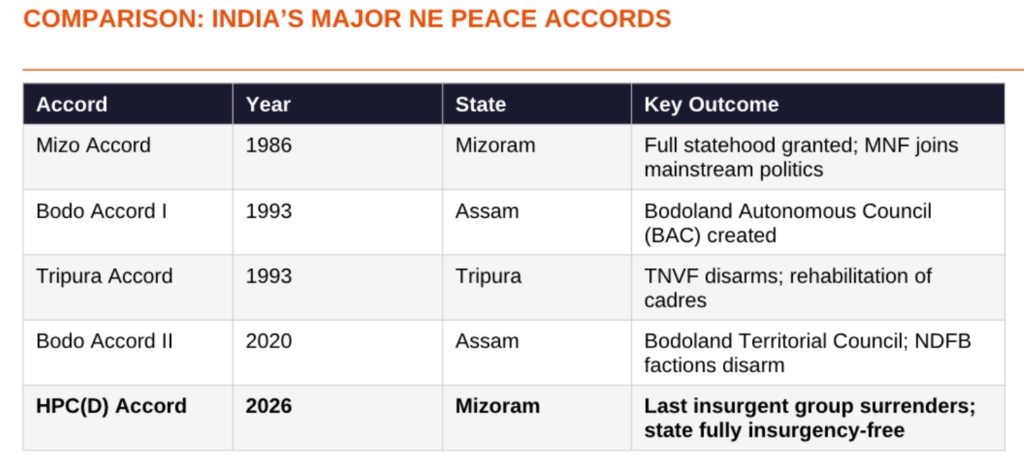
UPSC Mains PYQ 2025
Q. What are the major challenges to internal security and the peace process in the North-Eastern States? Map the various peace accords and agreements initiated by the government in the past decade. (15 M)
Tell Google you want more of this.
Add Anantam IAS as a preferred sourceOne tap, and this site shows up more often in your own Top Stories, AI Overviews and AI Mode. Remove it any time.