
Why in News?
The Supreme Court of India has directed the Union Government to amend the Medical Termination of Pregnancy (MTP) Act to remove the time limit on medical termination of unwanted pregnancies in the case of minor rape survivors.
In a landmark order, the SC allowed a 15-year-old rape survivor to terminate a 30-week pregnancy.
| UPSC Relevance: GS-2 Social Justice: Vulnerable Sections; Health Prelims: Medical Termination of Pregnancy (MTP) Amendment Act, 2021 |
Key Directives of the Supreme Court:
- Proposed Amendments:
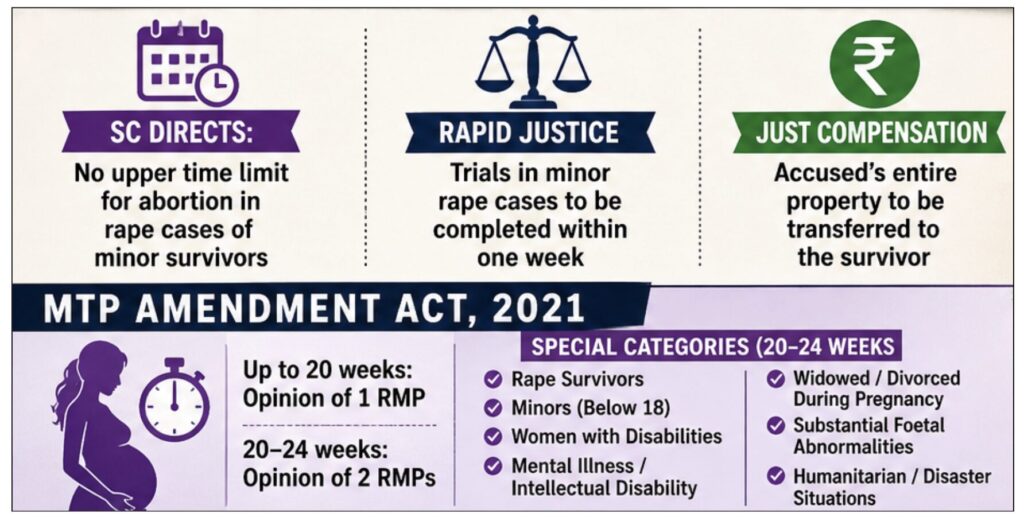
- Remove the gestational time limit under the MTP Act for termination of pregnancies caused by the rape of a minor — no upper limit should apply in such cases.
- Amend the penal law (BNS/POCSO) to mandate completion of trials in minor rape cases within one week.
- Transfer the entire property of the accused to the rape survivor as compensation.
- Decision-Making Authority: The Court stated that the state and doctors cannot make decisions for minor rape survivors. The decision must be left to the survivor herself and her parents/guardians.
Medical Termination of Pregnancy (MTP) Amendment Act, 2021:
The Amendment Act has revised the permissible gestational limits for termination of pregnancy:
- Termination of pregnancy is allowed up to 20 weeks on the opinion of one Registered Medical Practitioner (RMP).
- For certain specified categories of women, termination is permitted between 20-24 weeks on the opinion of two RMPs. These special categories include:
- Survivors of sexual assault, rape, or incest
- Minors (below 18 years)
- Women with physical disabilities (under the RPD Act, 2016)
- Women with mental illness or intellectual disability
- Women who are widowed or divorced during pregnancy
- Pregnancies with substantial foetal abnormalities
- Pregnancies in humanitarian or disaster situations
- Recognises changing social realities: Replaces the term “pregnant married woman” with “pregnant woman.” This change legally recognises unmarried women & live-in relationships.
- Constitution of Medical Boards: The Act mandates that every State and Union Territory must constitute a Medical Board. Functions of the Medical Board:
- To decide on the termination of pregnancy beyond 24 weeks
- Applicable only in cases of substantial foetal abnormalities
- Privacy and Confidentiality: The identity and personal details of the woman cannot be disclosed. However, this provision often comes into conflict with mandatory reporting requirements under laws like the POCSO Act.
Critical Legal and Constitutional Issues:
- Conflict between Bodily Autonomy and Statutory Time Limits:
- Reproductive autonomy is a part of the right to dignity and personal liberty under Article 21. In the X v. NCT of Delhi (2022) case, the SC held: It is the woman alone who has the right over her body.
- However, the statutory 24-week cap under the MTP Act continues to override this in practice for many women.
- POCSO Act and Confidentiality issue: Under the POCSO Act, 2012, doctors are mandatorily required to report any sexual activity involving a minor to the police. The obligation to report conflicts directly conflicts with the MTP Act’s confidentiality guarantee. As a result, many minors are pushed towards unsafe, illegal terminations.
- Medical Board Delays: The requirement of Medical Board approval for late-term cases leads to extreme delay. The pregnancy may progress by several additional weeks while the survivor awaits judicial and board decisions.
- Judicial and Legislative Gaps:
- The MTP Act does not distinguish between adult women and minors in setting gestational caps.
- No statutory provision currently mandates fast-track completion of rape trials involving minors.
- The absence of district-level Medical Boards forces survivors to travel to state capitals and face prolonged delays.
- Foetal Viability Paradox: Medical science has advanced to the point that foetuses at 24-26 weeks can survive with intensive neonatal care. This creates a medico-legal dilemma: the right to terminate vs. obligations towards a potentially viable foetus.
Way Forward:
- Amend the MTP Act to remove all gestational caps for minor rape survivors, as directed by the Supreme Court.
- Introduce a specific exemption in POCSO for healthcare providers seeking to provide MTP services to minors, without mandatory police reporting being a barrier.
- Amend BNS/POCSO to mandate fast-track completion of minor rape trials within a defined period.
- Decentralise Medical Boards to the district level, reducing travel time and delays for vulnerable women.
- The Supreme Court should issue a binding, consolidated ruling on the hierarchy of rights in foetal-viability cases, resolving the doctrinal inconsistency across benches.
UPSC PYQ 2019
Q. Which of the following statements is/arc correct regarding the Maternity Benefit (Amendment) Act, 2017?
1. Pregnant women are entitled for three months pre-delivery and three months post-delivery paid leave.
2. Enterprises with creches must allow the mother minimum six creche visits daily.
3. Women with two children get reduced entitlements.
Select the correct answer using the code given below.
(a) 1 and 2 only
(b) 2 only
(c) 3 only
(d) 1, 2 and 3
Answer: (c)
Tell Google you want more of this.
Add Anantam IAS as a preferred sourceOne tap, and this site shows up more often in your own Top Stories, AI Overviews and AI Mode. Remove it any time.