Daily Digest
UPSC · Civil Services Examination
Current Affairs · Monday, 10 August 2026
Current affairs curated and edited by Anantam IAS faculty — pulled from The Hindu, PIB, IDSA, Foreign Affairs and the ministries. Read, annotate, revise.
Old Rajinder Nagar · Delhi 110005 · anantamias.com
Nurses Registration and Tracking System: Why the 31-Lakh Enrolment Gap Matters
Why in News?
An analysis published by The Hindu reported that more than 31 lakh nursing personnel recorded with State nursing councils were not reflected in the Nurses Registration and Tracking System, or NRTS, exposing uneven implementation across States.
- The Indian Nursing Council created NRTS as a national, computerised system to bring State Nursing Registration Councils onto an integrated platform and build a live register.
- The INC Annual Report 2024-2025 says NRTS enrolment had reached 13,20,926 by 31 March 2025, up from 11,76,375 a year earlier.
- The same annual report separately lists 42,94,688 registered nursing personnel: 10,74,556 auxiliary nurse midwives, 31,62,956 registered nurses and registered midwives, and 57,176 lady health visitors.
- Those two March 2025 tables produce a simple difference of 29,73,762, while The Hindu’s newer comparison of government data reports a gap exceeding 31 lakh. The series are not a single synchronized census, and several.
- The gap must not be read as proof that 31 lakh people are unqualified, unemployed or practising illegally. It measures non-coverage in a national digital register relative to State-level registration records.
- A registry can support policy only when its records are complete, current, comparable and deduplicated; a large coverage gap weakens every estimate derived from it.
- Health is primarily a State subject, while nursing education standards and national coordination involve the Union and the INC. NRTS is a case study in cooperative digital federalism.
- Aadhaar-based identity checks can reduce duplicate identities, but identity verification is not a substitute for checking current licence status, qualifications, place of work and availability.
UPSC Relevance
Prelims Relevance
- The full form of NRTS is Nurses Registration and Tracking System.
- NRTS was initiated by the Indian Nursing Council and developed with the National Informatics Centre to support a live register of nursing personnel.
- The INC annual report describes NRTS as a fully computerised interactive system launched in 2016-17.
- A nurse enrolled in NRTS receives a Nurse Unique Identity Number, commonly called NUID, after the prescribed verification process.
- NRTS covers enrolment of previously registered nurses as well as workflows such as primary registration, reciprocal registration and additional qualification through participating State councils.
- The State Nursing Registration Councils, not the INC merely through NRTS enrolment, issue the legal registration or licence to practise within their jurisdiction.
Mains Relevance
GS Paper 2
- Examine the NRTS gap as a problem of health governance, regulatory capacity and Centre-State coordination rather than a narrow portal-adoption issue.
- Discuss how a reliable live register can improve workforce planning while preserving the licensing authority and accountability of State councils.
GS Paper 3
- Use NRTS to illustrate the difference between digitising a form and creating interoperable, high-quality public data infrastructure.
- Connect accurate workforce information with resilience during epidemics, disasters and regional shortages, without treating registry counts as automatic proof of deployment capacity.
Essay
- What the State cannot count accurately, it cannot plan fairly; yet counting citizens and professionals also creates duties of privacy, correction and accountability.
Background and Context
What NRTS Is Designed to Do
NRTS is meant to convert fragmented State registration records into an authenticated and continuously useful national view of the nursing workforce.
- The platform supports the goal of a live register, meaning records can be updated for new registration, reciprocal registration, added qualifications and other changes rather than remaining a periodic aggregate.
- A NUID provides a nationally verifiable identifier intended to reduce ambiguity when a nurse studies, registers, works or seeks reciprocal registration across jurisdictions.
- The INC states that all State Nursing Councils were brought onto the platform, but onboarding a council does not ensure that every legacy record has been migrated, verified and kept current.
- A useful live register needs status fields beyond identity: current registration validity, qualifications, speciality, employment setting and location must be accurate enough for the intended policy use.
Reading the 31-Lakh Gap Carefully
The headline gap is evidence of weak national coverage, but the underlying datasets should not be treated as perfectly synchronized or conceptually identical.
- The Hindu reported a gap of more than 31 lakh from government data comparing State-level registration with NRTS enrolment and highlighted large interstate differences.
- The latest published INC annual report gives a dated cross-check: 13,20,926 NRTS enrolments by 31 March 2025 against 42,94,688 personnel across three State-register categories, a numerical difference of 29,73,762.
- The INC table itself marks several State totals as being from 2020, 2021, 2022, 2023 or January 2023. A national total assembled from different reference dates is not a clean active-workforce census.
- The reported 31-lakh figure is best used as a coverage warning, not as an exact estimate of currently practising nurses missing from the database.
Registration, NRTS Enrolment and Employment Are Different
Three administrative concepts are often collapsed into one, producing false conclusions about workforce availability.
- Professional registration with the relevant State Nursing Registration Council is the legal route connected to the right to practise; NRTS integrates and verifies data but does not replace that State authority.
- NRTS enrolment means a record has entered the national system and completed the applicable workflow. It does not prove that the person is currently employed in nursing or available in a particular district.
- Employment data must distinguish public and private facilities, clinical and non-clinical roles, domestic and overseas work, full-time and inactive personnel, and specialities such as critical care or midwifery.
- A credible workforce denominator should remove deceased, retired, migrated, duplicated and long-inactive records while retaining an auditable history of changes.
Why State-Level Implementation Is Uneven
The platform depends on the administrative capacity and workflows of many State councils, so a national technical system can still reproduce local institutional differences.
- Legacy registers vary in format, completeness, spelling conventions and digitisation quality, making record matching and migration difficult.
- Nurses may face practical barriers such as outdated mobile details, document mismatch, Aadhaar authentication problems, limited help desks or uncertainty about the relationship between NUID and their State licence.
- Councils differ in staffing, verification backlogs, renewal practice, fee systems and integration of primary and reciprocal registration with NRTS.
- Uneven adoption creates a feedback problem: States with incomplete data receive weaker planning insights, while weak perceived value can reduce institutional incentive to finish migration.
Way Forward
Publish a Time-Bound State Coverage Plan
- Publish State-wise denominators, verified NRTS records, pending cases, rejected cases and monthly progress using a common reference date and clear category definitions.
- Prioritise high-volume lagging States and older legacy registers through funded migration teams, standard data templates and monitored service-level timelines.
- Integrate primary registration, renewal, reciprocal registration and added qualifications with NRTS so that an approved State transaction updates the national record once.
- Use open standards and validated APIs, with human review for mismatches, instead of repeated manual uploads to disconnected portals.
Conclusion
- The reported 31-lakh NRTS gap is a warning about the distance between national digital ambition and federated regulatory practice.
- India needs a register that is complete enough for planning, current enough for emergencies and fair enough that a data mismatch cannot erase a professional.
UPSC Practice Questions
Prelims MCQ 1
With reference to the Nurses Registration and Tracking System (NRTS), consider the following statements:
- It was initiated by the Indian Nursing Council to support a live register of nurses.
- Enrolment in NRTS by itself constitutes a licence to practise nursing issued by the Indian Nursing Council.
- The system supports workflows including primary and reciprocal registration through participating State councils.
How many of the above statements are correct?
(a) Only one (b) Only two (c) All three (d) None
Answer: (b) Only two
Explanation:
Statements 1 and 3 are correct. NRTS supports an integrated live register and registration workflows, but the licence to practise remains the responsibility of the relevant State Nursing Registration Council; NRTS enrolment alone is not an INC-issued licence.
Prelims MCQ 2
Which institution is primarily responsible for issuing a nurse’s professional registration or licence to practise within a State?
(a) National Informatics Centre (b) Indian Council of Medical Research (c) State Nursing Registration Council (d) National Health Authority
Answer: (c) State Nursing Registration Council
Explanation:
State Nursing Registration Councils register and license nursing personnel in their jurisdictions. The INC sets national education standards and facilitates NRTS, while NIC provides the technology platform.
UPSC Mains Questions
- The enrolment gap in the Nurses Registration and Tracking System is a challenge of cooperative federalism as much as digital governance. Discuss. (150 words)
- A national professional register is useful only when identity, licence status and active employment are not confused. Examine this statement with reference to health-workforce planning in India. (250 words)
Sources: Indian Nursing Council Annual Report 2024-2025 and The Hindu.
Frequently Asked Questions
What is the Nurses Registration and Tracking System?
NRTS is an Indian Nursing Council initiative, developed with the National Informatics Centre, to create an integrated live register of nursing personnel. It supports verified enrolment and State-council workflows such as primary registration, reciprocal registration and recording additional qualifications.
What does the reported 31-lakh gap mean?
It refers to nursing personnel appearing in State-level registration data but not represented in the national NRTS comparison reported by The Hindu. It is a registry-coverage gap, not automatically a workforce shortage, unemployment count or estimate of people practising without.
How many NRTS enrolments did the INC officially report?
The INC Annual Report 2024-2025 reported 13,20,926 enrolled registered nurses as of 31 March 2025. This is a dated official figure, not a live August 2026 total. The preceding annual report recorded 11,76,375 as of 31 March 2024.
Does a NUID give a nurse the legal right to practise anywhere in India?
No. A NUID is a nationally verifiable identity within NRTS. The relevant State Nursing Registration Council remains responsible for professional registration and licensing. Reciprocal registration or transfer requirements may still apply when a nurse moves between jurisdictions.
Why cannot State registration totals be treated as the active nursing workforce?
Registers may include retired, deceased, migrated, inactive or duplicated records, and some State totals are updated at different times. An active-workforce estimate also needs current licence status, employment setting, location and availability, with transparent definitions and data-quality notes.
Source: https://anantamias.com/current-affairs/nurses-registration-tracking-system-enrolment-gap/
EVEREST Methalox Engine: What Astrobase Has Built and What Remains Untested
Why in News?
Bengaluru-based Astrobase Space Technologies unveiled EVEREST , an integrated 80-tonne-class liquid-rocket engine designed around the full-flow staged-combustion cycle and liquid oxygen-methane propellants.
- IN-SPACe’s 2026 industry-delegation profile identifies Astrobase’s project as a privately built high-thrust FFSC engine for reusable launch systems.
- The official profile lists liquid oxygen and methane, or methalox, as the propellant combination and gives a planned vacuum thrust of 800 kN.
- The same IN-SPACe document lists a 50%-110% throttle range; these are design or advertised performance specifications, not results of a completed full-scale qualification campaign.
- The unveiled hardware was described as fully integrated, meaning major engine assemblies had been brought together. Integration alone does not establish ignition reliability, stable combustion, rated thrust, endurance, restart capability or reuse life.
- Reports on the programme refer to earlier sub-scale hot-fire work and turbopump trials. Those tests reduce technical risk, but they do not substitute for firing the complete full-scale EVEREST engine under representative conditions.
- The development links advanced propulsion with India’s post-2020 policy of allowing non-government entities to build launch vehicles, satellites and space infrastructure.
- For UPSC, the useful distinction is between a technology announcement, a component test, a sub-scale hot-fire, an integrated engine hot-fire, qualification, and flight heritage. Each is a different rung of evidence.
- Methalox propulsion is attractive for reusable launchers because methane can burn with less soot than kerosene and can support repeat operations, but operational reusability still depends on thermal margins, inspection needs, turnaround systems and demonstrated engine.
UPSC Relevance
Prelims Relevance
- Full-flow staged combustion is a closed liquid-rocket engine cycle in which fuel-rich and oxidiser-rich preburners separately drive the fuel and oxidiser turbopumps.
- In an FFSC system, the propellant streams pass through the preburner-turbomachinery paths before entering the main combustion chamber; the turbine exhaust is not dumped overboard as in an open gas-generator cycle.
- Methalox means methane used as fuel with liquid oxygen, or LOX, as oxidiser. Methane and oxygen must be stored at cryogenic temperatures.
- A preburner produces hot gas to drive a turbine, while a turbopump raises propellant pressure before injection into the main chamber.
- A fuel-rich preburner operates with excess fuel; an oxidiser-rich preburner operates with excess oxidiser. FFSC must manage both demanding chemical environments.
- Thrust, measured in newtons, is not the same as specific impulse. Thrust measures force, while specific impulse indicates propellant efficiency under stated conditions.
Mains Relevance
GS Paper 3
- Explain how advanced liquid propulsion, additive manufacturing, test infrastructure and reusable-launch engineering can deepen India’s strategic technology base.
- Assess the advantages and engineering risks of FFSC methalox engines without treating an unveiling as a qualification or flight milestone.
GS Paper 2
- Discuss the institutional role of IN-SPACe in balancing promotion of private space activity with authorisation, safety oversight and international obligations.
- Connect space-sector reform with transparent milestone reporting, public support for high-risk technology and accountable use of state-backed facilities or funds.
Essay
- Technological sovereignty is built through patient testing and institutional learning, not by announcements alone.
Background and Context
How a liquid rocket engine produces thrust
A liquid engine must store, pressurise, mix and burn propellants while controlling extreme heat, pressure and vibration.
- The fuel and oxidiser are carried in separate tanks. Turbopumps raise their pressure so injectors can feed them into the combustion chamber against the chamber’s high pressure.
- Combustion creates high-temperature, high-pressure gas. The nozzle expands and accelerates this gas, producing thrust in the opposite direction under Newton’s third law.
- An engine cycle describes how energy is supplied to the turbopumps and what happens to the turbine-driving gas. Cycle choice shapes efficiency, complexity, chamber pressure, thermal load and maintainability.
- A complete engine demonstration must prove stable ignition, combustion stability, control response, shutdown, structural margins and repeatability across the intended operating envelope.
What makes full-flow staged combustion different
FFSC seeks high performance by sending both propellant streams through separate preburner and turbine paths before final combustion.
- One preburner runs fuel-rich and drives the fuel-side turbine; another runs oxidiser-rich and drives the oxidiser-side turbine. Their gas streams later meet in the main chamber.
- Because turbine power can be distributed across two propellant paths, designers can pursue high mass flow and chamber pressure while keeping turbine inlet temperatures more manageable than a single-stream arrangement might require.
- Separate turbopump shafts can reduce the need for a dynamic seal separating fuel and oxidiser on one shaft, addressing one important hazard path. The architecture still creates major sealing, ignition, materials and control challenges elsewhere.
- FFSC is not automatically superior for every launcher. Its gains must justify two preburners, complex plumbing, precise mixture control, demanding start transients and a larger test programme.
Why methane and liquid oxygen are paired
Methalox offers a practical compromise among performance, handling, cleanliness and reusable-engine ambitions.
- Methane generally produces less soot than kerosene-based rocket fuel. Lower carbon deposition can ease inspection and help protect cooling channels and injectors during repeated firing.
- Liquid oxygen supplies the oxidiser because rockets cannot rely on atmospheric oxygen throughout ascent. Both propellants are cryogenic, so insulation, tank management and pre-launch operations remain demanding.
- Methane is denser and easier to contain than liquid hydrogen, though hydrogen can offer higher specific impulse in suitable engines. Methane’s characteristics can support more compact tanks than hydrogen for a given propellant mass.
- Cleaner combustion helps reusability, but reuse is a system result. Engine durability, vehicle structures, landing loads, heat protection, health monitoring and ground turnaround must all work together.
The EVEREST evidence ladder
The strongest way to assess the announcement is to separate what exists from what the programme still has to prove.
- Demonstrated at announcement: Astrobase displayed integrated full-scale hardware designed and manufactured for an 80-tonne-class FFSC methalox engine.
- Reported earlier work: the development programme had conducted sub-scale combustion testing and high-speed turbopump trials. These validate parts of the design and test approach, not the integrated engine’s rated performance.
- Not yet demonstrated publicly: a full-scale integrated hot-fire at rated conditions, the advertised 800 kN vacuum thrust, stable throttling across 50%-110%, repeated starts, long-duration endurance and multiple-use life.
- Still further away: clustered-engine operation, stage-level static firing, vertical take-off and landing, orbital insertion, recovery and rapid turnaround.
- A credible answer should call EVEREST a major integration milestone, not an operational engine or a flown reusable-launch capability.
Way Forward
Publish a milestone-based test record
- Separate component, sub-scale, integrated, qualification and flight tests in public communication.
- Report test duration, operating point, thrust class and whether a result was a design target or measured outcome, subject to legitimate commercial and security limits.
- Use independent technical review for state-supported milestones and avoid country-rank claims that mix designs, ground-tested engines and flight-proven systems.
Conclusion
- EVEREST matters because a young Indian private company has reached the difficult stage of integrating a high-thrust FFSC methalox engine.
- The correct assessment is deliberately measured: integration is real progress, while full-scale hot-fire performance, qualification, reuse and flight remain to be proved.
UPSC Practice Questions
Prelims MCQ 1
With reference to full-flow staged-combustion rocket engines, consider the following statements:
- They use separate fuel-rich and oxidiser-rich preburner paths to drive turbopumps.
- Their turbine-driving gases are necessarily discarded without entering the main combustion chamber.
- A fully integrated engine assembly can be treated as flight-qualified even before a full-scale hot-fire test.
How many of the above statements are correct?
(a) Only one (b) Only two (c) All three (d) None
Answer: (a) Only one
Explanation:
Statement 1 is correct. FFSC is a closed cycle: turbine-driving propellant streams proceed to the main chamber rather than being dumped overboard. Integration is a manufacturing milestone, not hot-fire, qualification or flight proof.
Prelims MCQ 2
Which one of the following best describes methalox propulsion?
(a) Liquid hydrogen fuel with methane as oxidiser (b) Methane fuel with liquid oxygen as oxidiser (c) Kerosene fuel with nitrous oxide as oxidiser (d) Solid methane mixed with ammonium perchlorate
Answer: (b) Methane fuel with liquid oxygen as oxidiser
Explanation:
Methalox combines methane as the fuel and liquid oxygen, or LOX, as the oxidiser. The combination is studied for reusable launch systems because of its performance and relatively cleaner combustion compared with kerosene.
UPSC Mains Questions
- The unveiling of an integrated engine is not the same as demonstrating an operational propulsion system. Using the EVEREST methalox engine as context, explain the technology-readiness ladder for a reusable rocket engine. (150 words)
- Discuss the potential and limitations of full-flow staged-combustion methalox engines for reusable launch vehicles. Why must reusability be evaluated at the vehicle and operations level? (250 words)
Sources: IN-SPACe, Department of Space and The Hindu Science.
Frequently Asked Questions
What is the EVEREST rocket engine?
EVEREST is Astrobase Space Technologies’ integrated 80-tonne-class liquid rocket engine designed to use liquid oxygen and methane in a full-flow staged-combustion cycle. IN-SPACe material lists a planned 800 kN vacuum thrust and 50%-110% throttle capability. At unveiling, those were programme.
Has EVEREST completed a full-scale hot-fire test?
No public evidence cited with the unveiling established a completed full-scale integrated hot-fire. Reports refer to earlier sub-scale hot-fire work and turbopump trials, while the complete engine’s firing remained a future milestone. This distinction matters because only an integrated test.
What does full-flow staged combustion mean?
FFSC uses two preburner paths: one fuel-rich and one oxidiser-rich. They drive separate turbopumps, and the resulting propellant-rich gases then enter the main chamber for final combustion. The cycle can support high performance and reusable-engine goals, but it demands difficult.
Why is methane considered useful for reusable rockets?
Methane generally burns with less soot than kerosene, which can reduce deposits in injectors and cooling passages. It also offers practical density and handling advantages over liquid hydrogen. These benefits can help repeated operation, but they do not by themselves.
What is the role of IN-SPACe in private space activity?
IN-SPACe is an autonomous agency under the Department of Space. It promotes, enables, authorises and supervises space activities by non-government entities and coordinates access to public space infrastructure where applicable. Its role makes it central to both commercial growth and.
Source: https://anantamias.com/current-affairs/everest-private-ffsc-methalox-rocket-engine/
One Health Surveillance: Uttar Pradesh Targets Emerging Zoonotic Diseases
Why in News?
The Hindu reported that Uttar Pradesh is strengthening the early identification and reporting of emerging zoonotic diseases through a One Health initiative associated with the RISE Global Health Security project .
- The initiative places the Animal Husbandry Department inside a public-health preparedness framework instead of treating animal outbreaks only as a livestock-productivity issue.
- Its stated priorities include stronger disease surveillance, early reporting, laboratory capacity and rapid multisectoral response.
- Jhpiego describes its India global-health-security work as supporting One Health approaches, laboratory systems, disease surveillance and antimicrobial-resistance containment.
- The development complements India’s existing National One Health Mission and NCDC’s National One Health Programme for Prevention and Control of Zoonoses rather than replacing them.
- The immediate governance challenge is interoperability: a warning from a veterinarian, clinician, wildlife official or environmental monitor must trigger a defined process for verification, data sharing and joint action.
- A zoonosis is an infection naturally transmissible between vertebrate animals and humans. Transmission may be direct or occur through food, water, vectors or contaminated environments.
- The One Health approach recognizes that the health of humans, domestic and wild animals, plants and ecosystems is closely linked.
- Early animal or environmental signals can create a lead-time advantage before human cases become widespread, but only when field reporting is connected to diagnostics and decision-making.
UPSC Relevance
Prelims Relevance
- The Quadripartite on One Health comprises the Food and Agriculture Organization, United Nations Environment Programme, World Health Organization and World Organisation for Animal Health.
- The One Health Joint Plan of Action 2022-2026 is the Quadripartite framework for coordinated action at the human-animal-plant-environment interface.
- India’s National One Health Mission seeks an integrated disease-control and pandemic-preparedness system connecting human, animal and environmental sectors.
- The National Centre for Disease Control under the Directorate General of Health Services runs the National One Health Programme for Prevention and Control of Zoonoses.
- The NCDC programme aims to institutionalize coordination from the national to village level and strengthen joint surveillance, diagnostics, training and outbreak investigation.
- The Department of Animal Husbandry and Dairying is under the Ministry of Fisheries, Animal Husbandry and Dairying, not the Union Health Ministry.
Mains Relevance
GS Paper 2
- Cooperative and interdepartmental governance for public health, including clear roles for health, animal husbandry, forests, local bodies, laboratories and disaster-management institutions.
- The need to connect frontline reporting, referral laboratories, risk communication and district-level decisions instead of building isolated digital dashboards.
GS Paper 3
- Zoonotic spillover as an environmental and biosecurity risk shaped by land-use change, wildlife-livestock-human contact, climate-sensitive vectors and unsafe food systems.
- The role of integrated surveillance, genomic and conventional diagnostics, joint risk assessment and rapid response in pandemic preparedness.
Essay
- Public health begins before the hospital: prevention depends on the condition of animals, food systems, water, land and ecosystems.
Background and Context
What One Health means
One Health is an integrated and unifying approach to balance and optimize the health of people, animals and ecosystems.
- The approach starts from interdependence. Human exposure can be shaped by animal infection, food production, vector ecology, land use, water quality and environmental contamination.
- It does not merge every department into one agency. It creates shared priorities, interoperable information, joint assessment and coordinated interventions while sectors retain their expertise.
- The environmental pillar is essential. Monitoring only patients and livestock may miss changes in wildlife mortality, vectors, water or habitat that provide an earlier warning.
- The Quadripartite gives the approach global institutional form through FAO, UNEP, WHO and WOAH. Their Joint Plan of Action links prevention, detection, preparedness and response.
- A One Health label has little value without operational rules: who reports, which event crosses a threshold, where a sample travels, who can see the result and who leads the response.
From a field signal to an early warning
Integrated surveillance should turn scattered observations into a verified and actionable warning.
- Signals may begin with unusual illness or death in animals, a cluster of fever among exposed people, an unexpected laboratory result, a change in vector abundance or contamination detected in food or water.
- Frontline workers need simple case and event definitions, safe sampling methods, reporting channels and feedback. Reporting falls when workers submit alerts but never learn what happened next.
- District teams should triage and verify the signal, connect epidemiological and laboratory evidence, assess exposure and decide whether joint investigation is required.
- A joint investigation may include public-health doctors, veterinarians, laboratory specialists, entomologists, wildlife or forest personnel, food-safety officials and local-government staff depending on the hazard.
- The response can include clinical care, animal-health measures, vaccination where applicable, vector control, safe carcass or waste management, food-safety action, community advice and protection of exposed workers.
Why the animal-health system matters
Animal-health surveillance protects livelihoods, food systems and human health at the same time.
- Veterinarians and livestock workers may observe a disease event before hospitals see a recognizable human cluster. That makes animal reporting an upstream component of health security.
- Farmers may hesitate to report illness if isolation, culling or market restrictions create uncompensated loss. A trusted system needs proportionate controls, transparent communication and timely support where law and policy provide it.
- Animal samples and human samples may move through different laboratory networks. Comparable identifiers, timestamps and location data can support joint analysis without collapsing separate legal and professional responsibilities.
- The Union Department of Animal Husbandry and Dairying’s Livestock Health and Disease Control Programme supports vaccination, veterinary services, surveillance and infrastructure for important, zoonotic, exotic and emerging animal diseases.
- Wildlife surveillance also matters because separation between animal and human monitoring can allow cross-species spillover signals to pass unnoticed. Surveillance should be risk-based and scientifically designed, not indiscriminate disturbance of wildlife.
India's One Health architecture
The Uttar Pradesh initiative sits within a wider national architecture that already assigns roles to research, surveillance and field programmes.
- NCDC’s National One Health Programme for Prevention and Control of Zoonoses seeks coordination at national, state, district, block and village levels.
- Its stated work includes regional coordination, sentinel surveillance, diagnostic support, workforce training, joint outbreak investigation, community outreach and stronger wildlife-pathogen surveillance.
- The National One Health Mission has a broader vision: integrated disease control and pandemic preparedness through human, animal and environmental collaboration.
- ICMR is strengthening infectious-disease research and diagnostic laboratories and has supported surveillance models for higher-risk interfaces such as bird sanctuaries, wetlands and slaughterhouses.
- State initiatives should map themselves to these systems. Parallel portals, competing reporting formats or donor-dependent units can deepen fragmentation if they are not institutionalized inside government workflows.
Way Forward
Create one operational protocol
- Define priority signals, notification timelines, nodal officers, verification steps and authority for joint investigation across relevant departments.
- Use common minimum fields and secure exchange standards so existing sectoral systems can share alerts without forcing duplicate data entry.
- Map field collection points, transport routes, district laboratories and reference laboratories; publish expected turnaround for each stage.
- Invest in biosafety, quality assurance, trained staff and referral logistics alongside newer diagnostic technology.
Conclusion
- Uttar Pradesh’s initiative matters because zoonotic threats do not respect departmental boundaries.
- The strongest One Health model is not the largest dashboard.
- If the RISE collaboration strengthens that chain inside permanent state institutions, it can improve routine disease control and pandemic preparedness together.
UPSC Practice Questions
Prelims MCQ 1
With reference to the One Health approach, consider the following statements:
- The Quadripartite collaboration includes FAO, UNEP, WHO and the World Organisation for Animal Health.
- One Health is limited to diseases transmitted directly from domestic animals to humans.
- Environmental surveillance can contribute to the early detection and prevention of zoonotic threats.
How many of the above statements are correct?
(a) Only one (b) Only two (c) All three (d) None
Answer: (b) Only two
Explanation:
Statements 1 and 3 are correct. One Health addresses interconnected human, animal, plant and ecosystem health and is wider than direct transmission from domestic animals. It also covers risks such as antimicrobial resistance, food safety and environmental drivers.
Prelims MCQ 2
Which one of the following institutions runs India’s National One Health Programme for Prevention and Control of Zoonoses?
(a) National Centre for Disease Control (b) National Biodiversity Authority (c) Central Pollution Control Board (d) Food Corporation of India
Answer: (a) National Centre for Disease Control
Explanation:
The National Centre for Disease Control, under the Directorate General of Health Services in the Union Health Ministry, runs the programme. It seeks intersectoral coordination, surveillance, diagnostic support, capacity building and joint action on zoonoses.
UPSC Mains Questions
- One Health surveillance is primarily a governance reform, not merely a technological upgrade. Discuss with reference to coordination among human-health, animal-health and environmental institutions. (15 marks, 250 words)
- Explain how integrated zoonotic-disease surveillance can create an early-warning advantage. What institutional, laboratory and community-level gaps must states address to convert signals into timely action? (15 marks, 250 words)
Sources: The Hindu and Jhpiego India.
Frequently Asked Questions
What is One Health surveillance?
One Health surveillance connects information about human, animal and environmental health to detect and assess shared threats. It combines routine case and laboratory data with unusual-event reporting, then supports joint verification, risk assessment and response. It does not require every.
What is a zoonotic disease?
A zoonotic disease is an infection naturally transmissible between vertebrate animals and humans. Transmission may occur through direct contact, food, water, vectors or contaminated environments. Rabies, brucellosis, leptospirosis and zoonotic influenza are examples, although each has a different reservoir, route.
What is the RISE Global Health Security project doing in Uttar Pradesh?
The reported collaboration involving Uttar Pradesh’s Animal Husbandry Department and Jhpiego aims to strengthen zoonotic-disease surveillance, early identification and reporting, laboratory systems and multisectoral outbreak response through a One Health approach. Publicly stated priorities establish the direction; operational coverage and.
Which organizations form the One Health Quadripartite?
The Quadripartite comprises the Food and Agriculture Organization of the United Nations, the United Nations Environment Programme, the World Health Organization and the World Organisation for Animal Health. It developed the One Health Joint Plan of Action 2022-2026 to support.
How does India’s National One Health Mission differ from the NCDC zoonoses programme?
The National One Health Mission provides a broad national vision for integrated disease control and pandemic preparedness across human, animal and environmental sectors. NCDC’s National One Health Programme for Prevention and Control of Zoonoses is a health-programme mechanism focused on.
Source: https://anantamias.com/current-affairs/one-health-zoonotic-surveillance-uttar-pradesh/
VB-G RAM G: July Person-Days Fall 49.94% in First Month
Why in News?
Official data available on 9 August showed that 7.67 crore person-days were generated under VB-G RAM G in July 2026, its first month of nationwide operation.
- The comparison is year-on-year for the same calendar month: July 2026 against July 2025, which limits distortion from the strong seasonality of rural public works.
- The decline equals about 7.66 crore fewer person-days, but it does not by itself reveal how many households sought work, how many were offered it, or how many days each household completed.
- VB-G RAM G came into force on 1 July 2026, replacing the Mahatma Gandhi National Rural Employment Guarantee Act framework and increasing the statutory guarantee from 100 to 125 days per eligible rural household.
- The Ministry of Rural Development said in a 24 July parliamentary reply that a comprehensive online Management Information System had been established for real-time monitoring and that officers had been deputed to States for handholding.
- The first-month fall must be treated as an implementation outcome requiring diagnosis, not automatic proof either that rural demand collapsed or that every missing person-day represents denial of work.
- A person-day is one person working for one day. Total person-days combine the number of workers employed with the duration of employment and are not the same as the number of jobs or households.
- A demand-driven employment guarantee must be evaluated as a chain: demand registered, work offered, work opened, attendance recorded, person-days generated and wages paid.
- July 2026 was also a legal and administrative transition month. Existing e-KYC-verified job cards were to remain valid while new Gramin Rozgar Guarantee Cards were issued, and ongoing works were officially expected to continue without interruption.
UPSC Relevance
Prelims Relevance
- The VB-G RAM G Act, 2025 is administered by the Ministry of Rural Development and came into force across rural India on 1 July 2026.
- It provides a statutory guarantee of up to 125 days of wage employment in a financial year to every eligible rural household whose adult members volunteer for unskilled manual work.
- The guarantee is expressed per rural household, not as 125 days for every individual adult member.
- A person-day means one person’s work for one day; ten people working for six days generate 60 person-days.
- The Act contains provisions on wage employment, peak agricultural seasons, unemployment allowance, Gram Panchayat responsibilities, social audits, technology-enabled accountability and grievance redressal.
- The Ministry said the programme uses NeFMS and Direct Benefit Transfer for wage disbursal and an online MIS for monitoring implementation and payment pendency.
Mains Relevance
GS Paper 2
- Evaluate welfare delivery through the distinction between legal entitlement and effective access for vulnerable rural households.
- Examine transparency, social audit, grievance redressal and the responsibilities of Gram Panchayats and States during a nationwide scheme transition.
GS Paper 3
- Analyse rural public employment as a consumption-smoothing and counter-cyclical safety net, especially during agrarian stress or weak local labour demand.
- Assess how Centre-State financing, administrative capacity and the timely opening of productive works affect actual employment generation.
Essay
- The strength of a right is measured not only by the promise written in law, but by the ease with which the least powerful person can claim it.
Background and Context
What the 49.94% Decline Measures
The headline number is a realised-work indicator, not a complete diagnosis of the rural labour market.
- July 2026 generated 7.67 crore person-days, compared with 15.33 crore in July 2025 under MG-NREGS.
- The arithmetic decline is about 7.66 crore person-days, or 49.94% relative to the previous July.
- Person-days can fall because fewer households demand work, fewer applicants receive or join work, fewer worksites operate, workers complete fewer days, or records enter the MIS late.
- National totals can conceal large State and district differences; the aggregate should be decomposed by geography, gender, social category and stage of delivery.
- Two States may record the same person-day total through very different combinations of participating households and average days worked, so both measures are essential for judging the depth and reach of support.
Why One Month Requires Cautious Interpretation
The first month is important enough to trigger scrutiny but too limited to establish a durable causal trend.
- Using the same month a year earlier controls partly for seasonality, yet rainfall, crop operations, local wage opportunities and the timing of public works may still differ.
- The changeover began on 1 July 2026, so administrative migration, work approvals, staff readiness and reporting practices may have affected measured output.
- A lower person-day total could reflect lower genuine demand, constrained access, implementation friction or a mixture of these; the aggregate alone cannot separate them.
- The correct policy response is to test competing explanations against granular data rather than present either demand collapse or administrative denial as established fact.
- Because July overlaps agricultural operations in many regions, district-level rainfall and crop calendars should accompany the administrative indicators when analysts compare demand and work generation.
From Demand to Paid Employment
A rights-based scheme succeeds only when every link between a request for work and wage receipt functions on time.
- The first measure is the number of households and persons who registered demand, including written and digitally recorded requests at Gram Panchayat level.
- The next measures are demand accepted, employment offered, worksite opened, worker attendance and muster roll completion; each can expose a different bottleneck.
- Generated person-days should then be connected with wage orders, payment timeliness, rejected transactions and pending liabilities through the public MIS.
- An offer rate can look high even when recorded demand is artificially low, so both the denominator and the conversion rate need public examination.
Transition Commitments and First-Month Reality
The Union government had explicitly promised continuity, making July delivery a measurable administrative test.
- PIB stated before rollout that ongoing works would continue without interruption and existing e-KYC-verified job cards would remain valid until new cards were issued.
- The Ministry reported that a comprehensive online MIS, NeFMS, DBT and standard operating procedures were available for monitoring and timely wage processing.
- It also said officers were sent to States to review implementation and provide handholding, recognising that a national transition needs intensive field support.
- The July decline should lead to a State-wise transition audit covering card continuity, staff access, work sanctions, muster rolls, payment systems and grievance desks.
Way Forward
Publish the Complete Employment Funnel
- Release daily and monthly State, district and Gram Panchayat data on demands, offers, work starts, attendance, person-days, wage orders and payments.
- Show unique households and workers alongside person-days so that participation and duration are not collapsed into one total.
- Identify districts with the sharpest year-on-year declines and audit job-card validity, work sanctions, staffing, MIS access, muster rolls and fund availability.
- Publish causes and corrective deadlines, while preserving an offline route to demand work wherever connectivity or authentication fails.
Conclusion
- The 49.94% fall in July person-days is a serious first-month delivery signal because it coincided with the start of a law promising a larger employment guarantee.
- The strongest response is transparent diagnosis: publish the demand-to-payment funnel, repair transition bottlenecks, protect workers’ ability to claim employment and judge the programme by access, timeliness and livelihood outcomes , not entitlement size alone.
UPSC Practice Questions
Prelims MCQ 1
With reference to the VB-G RAM G rural employment framework, consider the following statements:
- It guarantees up to 125 days of wage employment in a financial year to every eligible rural household.
- A person-day means one household receiving employment for one day, irrespective of the number of members working.
- The Ministry of Rural Development uses an online MIS for monitoring implementation.
How many of the above statements are correct?
(a) Only one (b) Only two (c) All three (d) None
Answer: (b) Only two
Explanation:
Statements 1 and 3 are correct. The guarantee is up to 125 days per eligible rural household, and the Ministry has established an online MIS. Statement 2 is incorrect because a person-day is one person working for one day; two members working for one day generate two person-days.
Prelims MCQ 2
Which one of the following is the most valid inference from a decline in total person-days under a demand-driven public employment programme?
(a) Rural unemployment has necessarily declined by the same percentage (b) Every missing person-day necessarily represents a rejected work demand (c) Realised work fell, but demand, access and execution data are needed to identify the cause (d) The statutory employment guarantee has automatically ceased to apply
Answer: (c) Realised work fell, but demand, access and execution data are needed to identify the cause
Explanation:
Person-days measure realised work. They can change with demand, the number of workers, days completed, work availability, attendance and reporting. The aggregate does not independently prove a fall in unemployment, denial of every missing day or suspension of the legal guarantee.
UPSC Mains Questions
- A larger statutory employment guarantee does not automatically produce more employment. Analyse with reference to the 49.94% year-on-year fall in person-days during the first month of VB-G RAM G.
- What indicators should be publicly disclosed to distinguish weak demand from implementation failure in a demand-driven rural employment programme?
Sources: VB-G RAM G Management Information System and Ministry of Rural Development and The Indian Express.
Frequently Asked Questions
What happened to rural employment person-days in July 2026?
Official data available on 9 August showed 7.67 crore person-days under VB-G RAM G in July 2026. July 2025 had recorded 15.33 crore person-days under MG-NREGS. The year-on-year decline was 49.94%, equal to roughly 7.66 crore fewer days of realised.
What is a person-day in a rural employment scheme?
One person working for one day generates one person-day. If 20 workers each work for five days, they generate 100 person-days. The measure combines participation and duration, so it is different from the number of households, workers, worksites or work.
Does the 49.94% fall prove that rural demand for work halved?
No. The fall proves that recorded, realised work was lower. Identifying the cause requires separate data on demands registered, employment offered, worksites opened, attendance, days completed and MIS timing. Genuine demand, implementation constraints and transition effects may all influence the.
Why is July 2026 a special comparison month?
VB-G RAM G came into force on 1 July 2026, making July its first nationwide month. Existing verified job cards and ongoing works were officially meant to continue, but a legal, financial and digital transition can still create administrative friction.
How many days of work does VB-G RAM G guarantee?
The Act provides up to 125 days of guaranteed wage employment in a financial year to every eligible rural household whose adult members volunteer for unskilled manual work. The entitlement belongs to the household, not separately to every adult member.
Source: https://anantamias.com/current-affairs/vb-g-ram-g-rural-employment-person-days-decline/
UPI Charges: Government Reaffirms Free User Transactions
Why in News?
The Union government clarified in August 2026 that UPI transactions will remain free for users and that the vast majority of merchant transactions will also remain free.
- No transaction fee has been imposed on ordinary users merely because the legal framework has changed.
- Any future merchant-side charge would require a separate policy decision or notification specifying its scope, rate and exemptions.
- The government indicated that person-to-person transfers and ordinary user payments will stay free, while protection for small merchants keeps most retail acceptance outside a charge.
- The debate concerns the cost of operating UPI, including switching, settlement, cybersecurity, fraud monitoring, dispute handling and customer support.
- A Merchant Discount Rate, if introduced for a defined merchant segment, is a charge on merchant acceptance infrastructure; it is not the same as a fee collected from every payer.
- UPI has become a foundational layer of India’s digital public infrastructure, so a pricing change can affect inclusion, merchant acceptance and confidence at national scale.
- A zero-price experience encouraged rapid adoption, but banks, payment service providers, app providers and NPCI still incur real operating costs.
- The policy challenge is to preserve free, interoperable everyday payments while building a transparent and sustainable way to fund reliability, security and innovation.
UPSC Relevance
Prelims Relevance
- Unified Payments Interface is an instant payment system developed and operated by the National Payments Corporation of India.
- NPCI is an RBI-regulated entity, and UPI operates within the framework of the Payment and Settlement Systems Act, 2007.
- UPI is built over the Immediate Payment Service infrastructure and permits real-time transfer between participating bank accounts.
- A P2P transaction transfers money between persons; a P2M transaction is a payment from a person to a merchant.
- MDR is the merchant-side rate charged for payment-processing services; it is conceptually different from a direct consumer transaction fee.
- Section 10A of the Payment and Settlement Systems Act was used in the zero-MDR framework for prescribed electronic modes, including UPI and RuPay debit cards.
Mains Relevance
GS Paper 3
- Digital public infrastructure, formalisation, financial inclusion and the economics of interoperable payment networks.
- Trade-off between a zero-price adoption strategy and sustainable funding for payment security, resilience and innovation.
GS Paper 2
- Transparent delegated rule-making, regulatory accountability and clear public communication before changing charges on a mass-use service.
- Protection of consumers and small merchants through exemptions, disclosure rules, grievance redress and monitoring of indirect surcharges.
Essay
- Digital public goods become durable only when access, trust and financial sustainability are designed together.
Background and Context
What UPI Is and How the Network Works
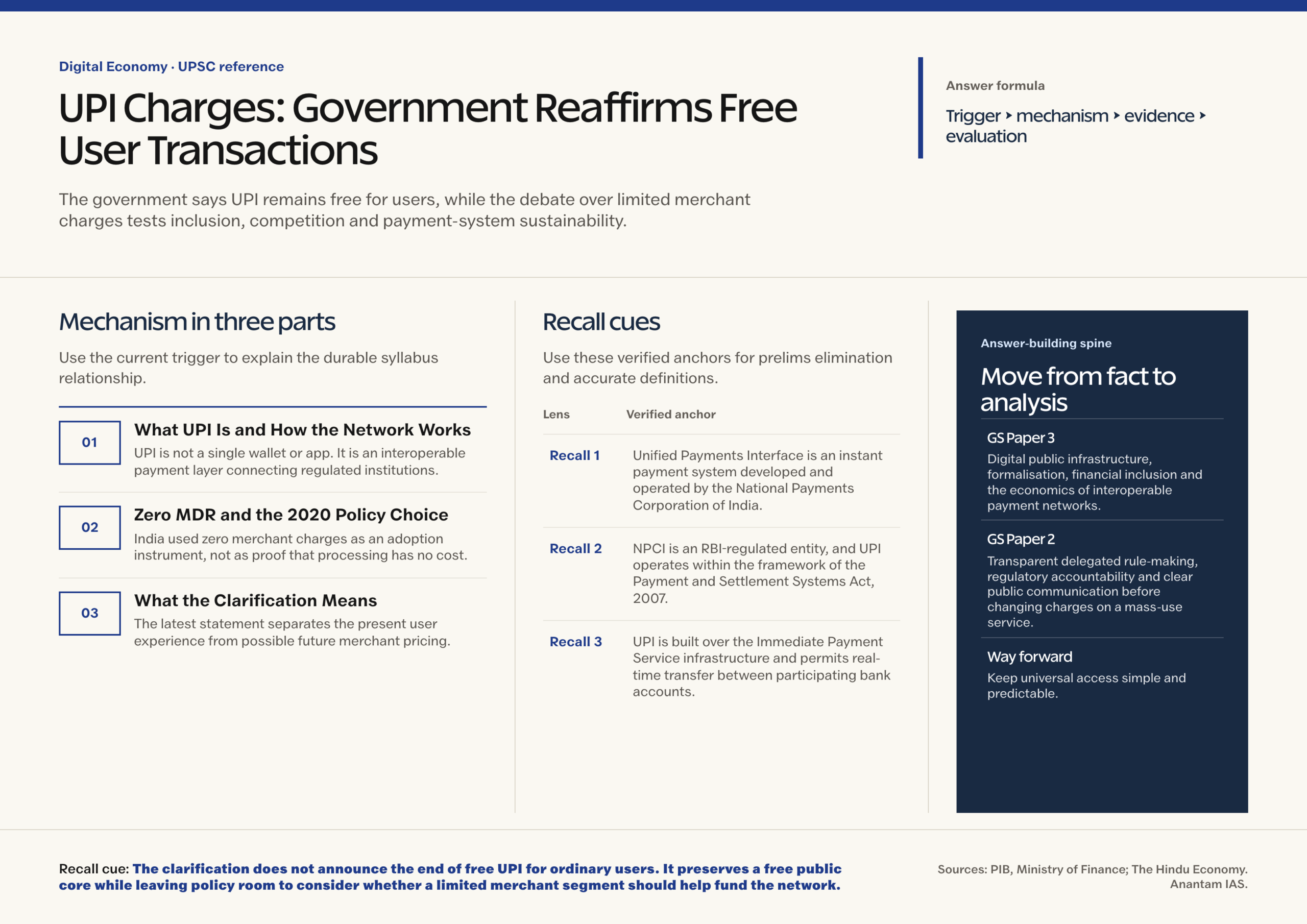
UPI is not a single wallet or app. It is an interoperable payment layer connecting regulated institutions.
- NPCI operates the UPI switch, while the RBI regulates the payment-system framework under the Payment and Settlement Systems Act, 2007.
- A user can access UPI through a bank app or a third-party application provider. The app connects through a payment service provider bank, and the user’s bank debits or credits the linked account.
- On the merchant side, an acquiring institution onboards the merchant and enables QR, intent, collect or application-based acceptance. Multiple entities may participate in a single successful payment.
- Interoperability lets a customer of one bank or app pay a recipient using another bank or app. This reduces closed-network barriers and expands acceptance.
- UPI supports both P2P transfers and P2M payments. These uses can have different policy treatment because a commercial merchant receives payment-processing services as part of business activity.
Zero MDR and the 2020 Policy Choice
India used zero merchant charges as an adoption instrument, not as proof that processing has no cost.
- From 1 January 2020, the government directed that MDR should not be collected on prescribed UPI and RuPay debit-card payments. The framework rested on Section 10A of the Payment and Settlement Systems Act and related tax-law.
- The policy lowered the acceptance cost for merchants and made QR-based payments attractive for small and low-margin businesses.
- A simple and predictable zero-charge user experience reduced friction. Users did not have to calculate whether a small payment was worth making digitally.
- Zero MDR also removed a direct revenue stream that card networks and acquiring institutions normally use to fund acceptance infrastructure.
- The government partly addressed this gap through incentive schemes for specified low-value BHIM-UPI merchant transactions, with payments distributed across ecosystem participants.
What the 2026 Clarification Means
The latest statement separates the present user experience from possible future merchant pricing.
- Users remain protected: the government has said that ordinary UPI transactions will continue to be free for the payer.
- The vast majority of merchant transactions are also expected to remain free because the stated policy preserves protection for small merchants and everyday payments.
- Legal authority to permit or calibrate a charge does not itself specify who must pay, how much they must pay or when payment begins.
- A charge would arise only after the competent authority issues an operative instrument with defined coverage. Reports about possible rates or turnover thresholds should not be treated as settled policy without such a notification.
- The change keeps room for a differentiated model under which a limited commercial segment could contribute without dismantling universal free access for individuals.
MDR, Interchange and User Fees Are Different
Clear terminology prevents a merchant-pricing debate from turning into a false claim that every UPI scan carries a tax.
- MDR is the rate paid by a merchant to the acquiring side for enabling and processing a payment. It can be shared across participants according to the payment arrangement.
- An interchange fee is a payment between participating institutions. For example, interoperable wallet-based UPI merchant payments can have a different interchange framework from ordinary bank-account-to-bank-account UPI.
- A consumer fee is an amount directly charged to the payer for initiating or completing a transaction. The government has ruled out such a charge for ordinary UPI users in the present clarification.
- GST applies to a taxable payment service charge, not to the value transferred through UPI. When no MDR or similar service charge exists, the transferred amount does not become subject to GST merely because UPI was.
- Merchants may try to pass a processing cost into prices or add a surcharge. Consumer-protection rules and clear disclosure become important even when the formal levy falls on the merchant side.
Way Forward
Protect the Free Public Core
- Retain zero direct charges for P2P transfers, ordinary users, small merchants and low-value retail payments.
- Define protected categories in clear, technology-neutral language so the same economic activity receives the same treatment across apps and banks.
- Prohibit hidden user surcharges and require any permitted merchant fee to be shown separately in acquiring contracts and settlement reports.
Conclusion
- The August 2026 clarification does not announce the end of free UPI for ordinary users.
- India’s task is to avoid a false choice between inclusion and sustainability.
UPSC Practice Questions
Prelims MCQ 1
With reference to the Unified Payments Interface (UPI), consider the following statements:
- UPI is operated by the National Payments Corporation of India.
- UPI is built over the Immediate Payment Service infrastructure.
- A Merchant Discount Rate is, by definition, a tax on the full value transferred by a customer.
How many of the above statements are correct?
(a) Only one (b) Only two (c) All three (d) None
Answer: (b) Only two
Explanation:
Statements 1 and 2 are correct. NPCI operates UPI, which is built over IMPS infrastructure. MDR is a payment-processing charge associated with merchant acceptance; it is not a tax on the full transaction value.
Prelims MCQ 2
Which one of the following best describes the immediate effect of the government’s August 2026 clarification on UPI charges?
(a) Every UPI user must pay a fee above a fixed transaction value (b) GST is levied on every amount transferred through UPI (c) User transactions remain free, and any future merchant charge needs a separately defined policy instrument (d) NPCI can impose a consumer fee without regulatory approval
Answer: (c) User transactions remain free, and any future merchant charge needs a separately defined policy instrument
Explanation:
The clarification preserves free UPI use for ordinary users. Legal flexibility does not by itself create an operative charge, rate or merchant category.
UPSC Mains Questions
- UPI is free at the point of use but not costless to operate. Discuss how India can finance digital payment infrastructure without weakening financial inclusion. (150 words)
- Differentiate between a user fee, Merchant Discount Rate and interchange fee in digital payments. Why does this distinction matter for public policy communication? (150 words)
Sources: PIB, Ministry of Finance and The Hindu Economy.
Frequently Asked Questions
Will ordinary users now have to pay for UPI transactions?
No. The government’s August 2026 clarification says ordinary UPI transactions will remain free for users. A change that gives the government flexibility over payment charges does not itself impose a fee. Any operative charge would need a separate instrument identifying.
What is Merchant Discount Rate in UPI?
Merchant Discount Rate is a merchant-side payment-processing charge linked to acceptance infrastructure. It is paid within the acquiring arrangement and may be shared among ecosystem participants. It is different from a fee directly debited from a customer and different from.
Does the new policy mean every merchant will pay MDR?
No such universal charge follows from the clarification. The government says the vast majority of merchant transactions will remain free, with individuals and small merchants protected. A future levy, if adopted, must define eligible merchant categories and other conditions through.
Why would the government consider any merchant charge?
UPI requires spending on switching, cybersecurity, fraud controls, settlement, customer support and dispute resolution. A limited merchant charge is one possible way to fund these services and reduce dependence on budget incentives, but it must be weighed against acceptance, inclusion.
Is GST charged on the amount paid through UPI?
No. The amount transferred does not attract GST merely because the payer used UPI. GST can apply to a taxable payment-processing service charge when such a charge exists. This distinction is why a reported merchant fee should not be described.
Source: https://anantamias.com/current-affairs/upi-user-charges-government-policy-clarification/
Milk Traceability: Maharashtra Plans Farm-to-Market Adulteration Control
Why in News?
The Maharashtra Food and Drug Administration plans an end-to-end traceability system for milk, linking its movement from procurement and collection to processing, transport, distribution and sale.
- The plan follows a statewide compliance push covering milk collection centres, dairy plants, transporters, distributors, wholesalers and retailers.
- Operators are expected to maintain records that connect milk suppliers, collection lots, test results, processing batches, transport movements and points of sale.
- The wider compliance framework stresses cold-chain control, food-grade handling equipment, food-safety management systems and sealed, labelled, tamper-evident packaging for pasteurised milk.
- Raw milk sold to consumers is to carry a boil-before-use warning, while food handlers are expected to meet hygiene and medical-fitness requirements.
- The immediate policy concern is adulteration and synthetic milk, but traceability can also help investigate contamination, antibiotic residues, hygiene failures and breaks in temperature control.
- Milk passes through many small farms, village collection points, bulk coolers, tankers, processors and retailers. Each transfer creates an information gap that can hide dilution, substitution or unsafe handling.
- Traceability makes a lot or batch the unit of accountability. Regulators can identify where a failure entered the chain, which other lots may be affected and what stock should be isolated or recalled.
- A credible system also protects compliant farmers and dairies from unfair competition by operators who reduce costs through adulteration, mislabelling or neglect of the cold chain.
UPSC Relevance
Prelims Relevance
- The Food Safety and Standards Authority of India was established under the Food Safety and Standards Act, 2006 to lay down science-based food standards.
- FSSAI and State Food Authorities jointly implement and enforce the Act; state Food Safety Commissioners, Designated Officers and Food Safety Officers conduct much of the field enforcement.
- Section 26 places the primary responsibility on a food business operator to ensure compliance at all stages under its control, including production, processing, distribution and sale.
- Section 28 concerns withdrawal of non-compliant food from the market, while the Food Safety and Standards (Food Recall Procedure) Regulations, 2017 define traceability as the ability to follow a food article through specified stages.
- Section 31 requires food businesses to be licensed or registered, subject to the categories and conditions in the licensing framework.
- Maharashtra’s licensing requirements for milk-processing units include the source of milk or procurement plan and locations of milk collection centres.
Mains Relevance
GS Paper 2
- Use the case to explain cooperative federalism in food regulation: FSSAI sets national standards while State authorities handle licensing, inspection, sampling and enforcement on the ground.
- Assess traceability as a governance reform that joins records, laboratories, grievance redressal and risk-based inspection instead of relying only on periodic raids.
GS Paper 3
- Connect milk safety with food processing, cold-chain infrastructure, dairy livelihoods, consumer confidence and fair competition.
- Explain how batch-level provenance can reduce the time and scope of recalls, identify repeated high-risk nodes and protect genuine producers from market distortion.
Essay
- Trust in a food system depends not only on abundance but also on the ability to prove origin, safety and responsibility.
Background and Context
How the Milk Supply Chain Creates Traceability Gaps
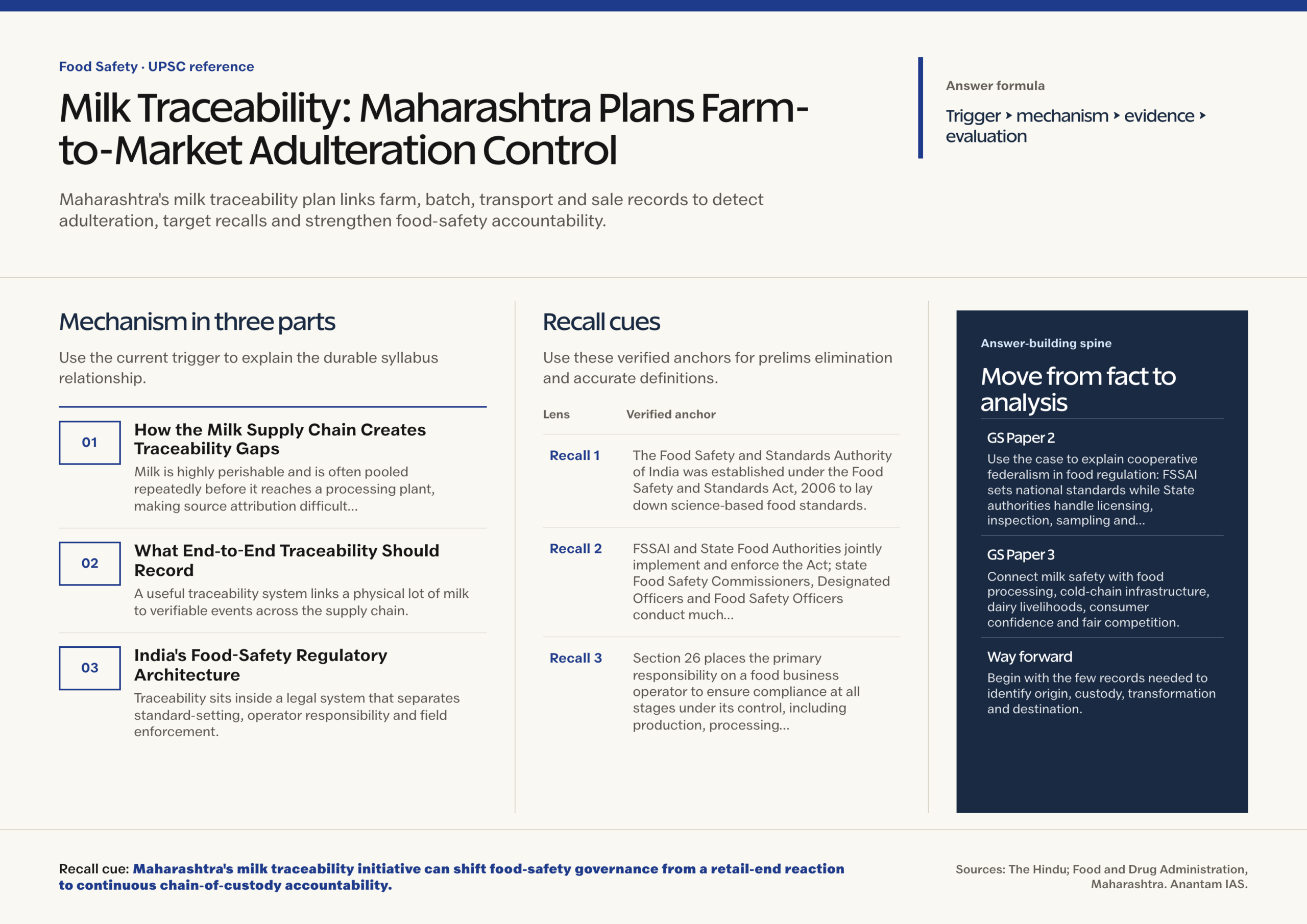
Milk is highly perishable and is often pooled repeatedly before it reaches a processing plant, making source attribution difficult without disciplined lot records.
- A typical chain may include a farmer, village collector or cooperative, chilling centre, tanker, dairy processor, distributor and retailer. Milk from many animals and farms can be combined at an early stage.
- Dilution or substitution at one node may be hidden after pooling. A failed retail sample cannot automatically reveal whether the problem arose at the farm, collection point, tanker, plant or shop.
- Temperature abuse can raise microbial risk even when no chemical adulterant is added. A complete record must connect custody, time, temperature and test status, not only ownership.
- Informal procurement and handwritten ledgers can create missing, inconsistent or easily altered data. Small operators also face real costs in devices, connectivity, training and record retention.
- The policy challenge is to preserve last-mile participation while creating a reliable chain of custody. Excluding small suppliers can shift trade into less visible channels.
What End-to-End Traceability Should Record
A useful traceability system links a physical lot of milk to verifiable events across the supply chain.
- At procurement, the record should identify the supplier or collection unit, date and time, quantity, lot number and basic quality-test results such as fat and solids-not-fat.
- At chilling and processing, it should preserve reception tests, pooling or transformation events, cleaning records, processing batch numbers and release decisions.
- During transport, it should connect the source and destination, vehicle or tanker identity, seal status, dispatch and receipt times and relevant temperature records.
- At packaging and sale, the batch should link to production details, labelled identity, distribution destinations and stock movement. A code may improve retrieval, but the code is only an access key to the underlying record.
- The system must support both backward tracing to find the likely source of a failure and forward tracing to locate every destination that received the affected batch.
India's Food-Safety Regulatory Architecture
Traceability sits inside a legal system that separates standard-setting, operator responsibility and field enforcement.
- The Food Safety and Standards Act, 2006 created FSSAI and consolidated the regulation of manufacture, storage, distribution, sale and import of food.
- FSSAI sets science-based standards and regulations. State Food Authorities undertake surveillance, inspections, sampling and enforcement through the Commissioner of Food Safety, Designated Officers and Food Safety Officers.
- The food business operator bears primary responsibility for food under its control. Manufacturers, distributors and sellers may have distinct liabilities when a product does not conform to the law.
- Food Safety Officers can inspect premises, draw samples and seize food or adulterants subject to the Act and procedure. Laboratory results and the statutory process determine the nature of enforcement action.
- The licensing system creates an entry point for compliance. Maharashtra already asks milk-processing applicants for a source or procurement plan and locations of collection centres, which can form the base layer for stronger traceability.
Adulteration, Contamination and Substandard Milk
UPSC answers should distinguish deliberate fraud from accidental contamination and compositional non-compliance.
- Adulteration commonly implies deliberate addition, substitution, abstraction or concealment that changes the nature, substance or quality of food. Dilution with water can reduce nutritional quality and may introduce microbial risk if the water is unsafe.
- Contamination may arise from poor hygiene, equipment, animal feed, residues or failures in storage and transport. It can occur without an intent to defraud.
- Substandard milk may fail a prescribed compositional parameter such as fat or solids-not-fat while not necessarily being unsafe. Enforcement must classify the violation on evidence rather than treating every failure alike.
- FSSAI’s National Milk Safety and Quality Survey 2018 found 12 of 6,432 samples adulterated in a manner that made them unsafe. It also found aflatoxin M1 above permissible limits in 368 samples and antibiotic residues above.
- The same survey found 5,976 samples, above 93%, absolutely safe for human consumption, while roughly 41% fell short on one or more quality parameters. The findings support targeted surveillance instead of unsupported blanket claims.
Way Forward
Define a Minimum Traceability Dataset
- Standardise supplier, lot, batch, test, seal, time, temperature and dispatch fields across collection centres, tankers, plants and sellers.
- Assign persistent lot identifiers and record every pooling or split event so that physical milk and digital history remain linked.
- Publish clear data standards and allow interoperable tools instead of locking every operator into one vendor.
Conclusion
- Maharashtra’s milk traceability initiative can shift food-safety governance from a retail-end reaction to continuous chain-of-custody accountability .
- The reform will succeed only if accurate records, physical inspections, accredited testing, due process and support for small suppliers advance together.
UPSC Practice Questions
Prelims MCQ 1
With reference to food-safety regulation in India, consider the following statements:
- FSSAI and State Food Authorities are jointly responsible for implementing and enforcing the Food Safety and Standards Act, 2006.
- The primary responsibility for ensuring compliance at stages under its control rests with the food business operator.
- Traceability by itself is a laboratory method for establishing whether a milk sample meets compositional standards.
How many of the above statements are correct?
(a) Only one (b) Only two (c) All three (d) None
Answer: (b) Only two
Explanation:
Statements 1 and 2 are correct. FSSAI and State authorities share enforcement responsibility, and Section 26 places primary responsibility on food business operators for food under their control. Statement 3 is incorrect: traceability links movement and custody; testing establishes conformity with safety or quality standards.
Prelims MCQ 2
Which one of the following best describes the main regulatory value of end-to-end milk traceability?
(a) It replaces all physical sampling with digital declarations (b) It guarantees that every recorded batch is free from contamination (c) It links origin, custody and destination so a suspect batch can be investigated and recalled (d) It transfers food-standard-setting from FSSAI to dairy cooperatives
Answer: (c) It links origin, custody and destination so a suspect batch can be investigated and recalled
Explanation:
Traceability makes backward investigation and forward recall faster by linking events and actors associated with a lot or batch. It complements sampling and laboratory analysis; it does not establish purity by itself or transfer FSSAI’s standard-setting role.
UPSC Mains Questions
- Milk traceability is as much an institutional reform as a technology project. Discuss with reference to India’s food-safety architecture and Maharashtra’s proposed farm-to-market system. (150 words)
- Explain how end-to-end traceability can curb milk adulteration and improve recall efficiency. What safeguards are needed to prevent exclusion of small dairy producers? (250 words)
Sources: The Hindu and Food and Drug Administration, Maharashtra.
Frequently Asked Questions
What is end-to-end milk traceability?
It is the ability to follow a milk lot through procurement, collection, chilling, transport, processing, packaging, distribution and sale. A working system links supplier identity, test results, custody changes, batch transformations and destinations, allowing regulators to trace a failed batch.
Does traceability prove that milk is pure?
No. Traceability records where a batch came from, how it moved and where it went. Purity, safety and compositional conformity require representative sampling and accredited laboratory analysis. Strong enforcement uses both: records locate responsibility and exposure, while testing establishes the.
Who enforces milk-safety rules in India?
FSSAI lays down national science-based food standards, while FSSAI and State Food Authorities jointly implement and enforce the Food Safety and Standards Act. State Food Safety Commissioners, Designated Officers and Food Safety Officers carry out licensing, surveillance, inspection, sampling and.
How can traceability help during a food recall?
Backward records can identify the supplier, collection centre, tanker or processing event associated with a suspect batch. Forward records show which distributors and retailers received it. This can make withdrawal faster, improve recall completeness and reduce unnecessary destruction of unaffected.
What is the difference between adulterated and substandard milk?
Adulteration usually involves deliberate addition, substitution, abstraction or concealment that changes a food’s nature or quality. Substandard milk may fail a prescribed parameter, such as fat or solids-not-fat, without necessarily being unsafe. Contamination may arise without fraud through hygiene, feed.
Source: https://anantamias.com/current-affairs/maharashtra-milk-traceability-adulteration-control/
Arunachal Pradesh Place Names: India Standardises 27 Geographic Features
Why in News?
On 7 August 2026, the Government of India, in consultation with the Government of Arunachal Pradesh, formally identified 27 places and geographic features by standard names on official Survey of India maps.
- The Ministry of Home Affairs announcement was issued through the Press Information Bureau and directs readers to the Survey of India State Maps portal for the official map.
- The list consists of 21 land areas, four passes, one lake and one monument; it is not a list of 27 towns or newly created administrative units.
- The four passes are Dzo La, Riza La, Pukur La and Thag La; the lake is Sambho Sarovar and the monument is Sher-e-Thapa Memorial.
- China criticised the move on 9 August, according to The Hindu, and linked it to the wider atmosphere surrounding the unresolved India-China boundary question.
- The step follows repeated Chinese attempts to issue its own names for places in Arunachal Pradesh, which India regards as an integral and inalienable part of the country.
- A geographic name is an administrative and informational identifier: it connects maps, databases, public communication, emergency response and local usage to the same feature.
- In a disputed borderland, naming also becomes a form of symbolic state practice, but a name alone does not create title or settle a boundary under international law.
- For UPSC answers, separate three layers: technical standardisation by the national mapping agency, sovereign assertion by the State, and diplomatic negotiation over the boundary.
UPSC Relevance
Prelims Relevance
- The Survey of India is India’s national mapping agency and functions under the Department of Science and Technology.
- The 27 names were identified by the Government of India in consultation with the Government of Arunachal Pradesh.
- The official list classifies the features as 21 land areas, four passes, one lake and one monument.
- Dzo La, Riza La, Pukur La and Thag La are the four mountain passes in the notified list.
- Sambho Sarovar is classified as a lake, while Sher-e-Thapa Memorial is classified as a monument.
- The remaining named features include Longju, Maja, Bisa, Bara Kundun, Chhota Kundun, Dhan Bari, Pritnagar, Buddhamandir, Jairampur, Teritnagar, Ramnagar, Jaswant Garh, Sagar, Padma, Jyotinagar, Baisakhi, Chhota Ropuk, Bara Ropuk, Shivaji Nagar, Sunpura and Kamlang Nagar.
Mains Relevance
GS Paper 2
- Use the episode to examine how territorial sovereignty, bilateral diplomacy and boundary management interact in India-China relations.
- Assess why symbolic disputes over names can affect the political climate even when they do not alter the legal merits of competing territorial claims.
GS Paper 1
- Explain the practical role of toponymy, mountain passes and official cartography in understanding Himalayan borderlands.
- Show how local place names preserve cultural memory and help connect physical geography with administrative knowledge.
Essay
- Maps are not merely pictures of territory; they are instruments through which societies organise memory, authority and public knowledge.
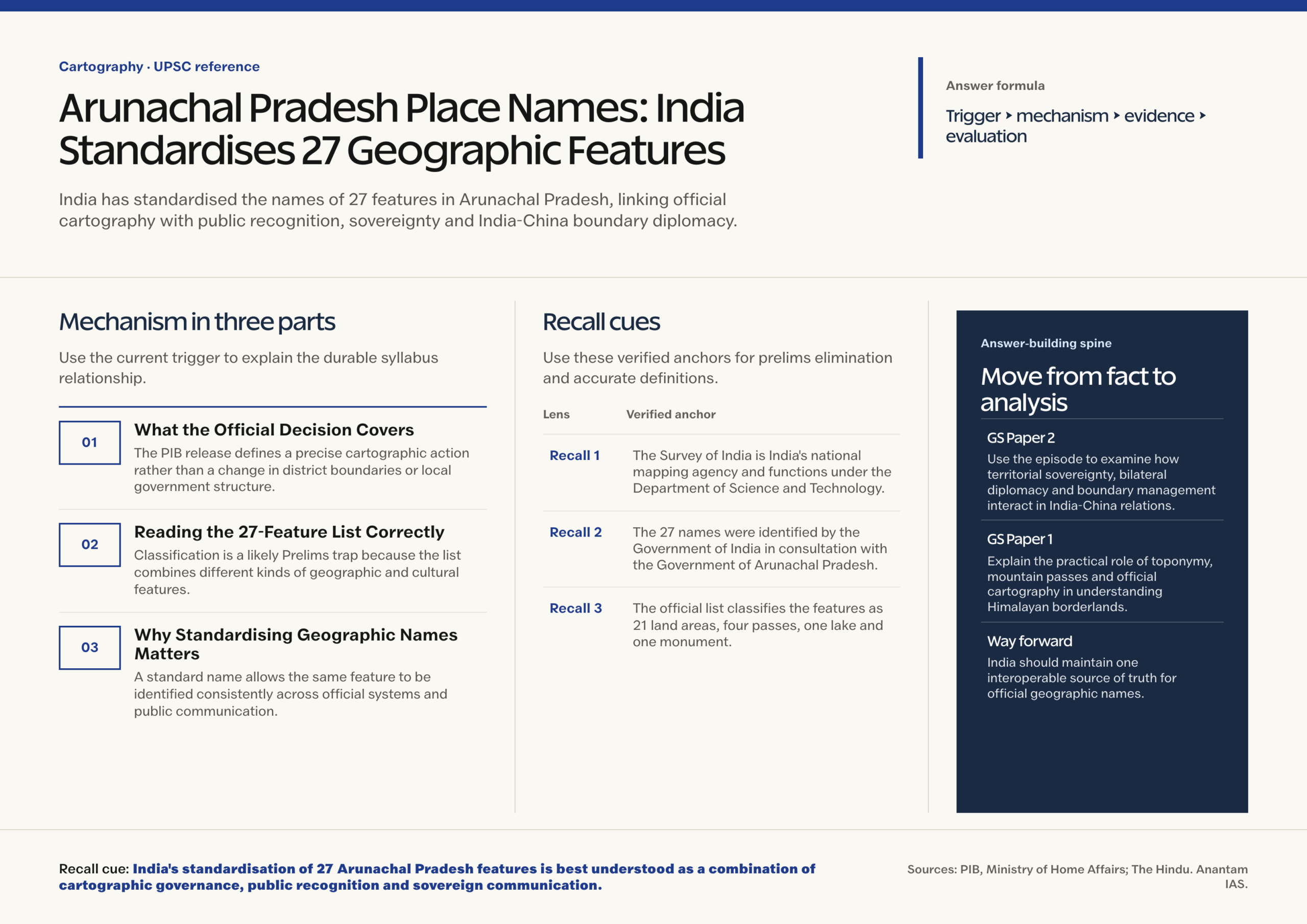
Background and Context
What the Official Decision Covers
The PIB release defines a precise cartographic action rather than a change in district boundaries or local government structure.
- The Union government and Arunachal Pradesh government identified standard place and feature names for inclusion on Survey of India maps.
- The stated purpose is to facilitate accurate recognition and better public awareness of the places and features.
- The release does not describe the exercise as creating new villages, renaming districts or changing the State’s administrative divisions.
- The official map, rather than a media illustration or an AI-generated map, remains the authoritative spatial reference for the listed features.
Reading the 27-Feature List Correctly
Classification is a likely Prelims trap because the list combines different kinds of geographic and cultural features.
- The largest category is land area, containing 21 entries such as Longju, Maja, Bisa, Jairampur, Jaswant Garh and Sunpura.
- The pass category contains exactly four entries: Dzo La, Riza La, Pukur La and Thag La.
- The two singular categories are Sambho Sarovar as the lake and Sher-e-Thapa Memorial as the monument.
- The classification shows why ’27 places’ is shorthand; the official description is places/features, and not every entry is a settlement.
Why Standardising Geographic Names Matters
A standard name allows the same feature to be identified consistently across official systems and public communication.
- Toponymic standardisation reduces ambiguity across maps, gazetteers, databases, signage and government records.
- Reliable names support emergency services, infrastructure planning, census work, logistics, navigation and the exchange of geospatial information.
- Standardisation should document local pronunciation, language and historical usage so that technical consistency does not erase indigenous cultural knowledge.
- Digital systems also need stable identifiers and metadata because a single place may have spelling variants across scripts, datasets and historical records.
Survey of India and Cartographic Authority
Institutional authority is central to the story because official names acquire practical force through an official mapping system.
- The Survey of India is the country’s national mapping agency under the Department of Science and Technology.
- Its maps and geospatial products serve public administration, development, scientific work and national requirements; they are distinct from informal web maps or private illustrations.
- Consultation with the State government matters because local administration and communities hold essential knowledge about usage, language and feature identity.
- An accountable naming process needs a source ledger, revision history and public correction route so that errors can be fixed without weakening confidence in the dataset.
Way Forward
Build an Authoritative Toponymic Register
- Link every approved name to a stable feature identifier, classification, language, transliteration, provenance and revision date.
- Synchronise the register across Survey of India maps, State records, disaster-management systems and other public geospatial platforms.
- Record oral history, pronunciation and customary usage with village institutions, scholars and relevant State bodies.
- Create a transparent correction process for spelling, duplication and feature classification without politicising routine technical revisions.
Conclusion
- India’s standardisation of 27 Arunachal Pradesh features is best understood as a combination of cartographic governance, public recognition and sovereign communication .
- The wider lesson is one of calibrated statecraft: strengthen authoritative maps and local participation, answer unilateral claims clearly, and keep the boundary-management and diplomatic channels capable of preventing symbolic disputes from becoming security crises.
UPSC Practice Questions
Prelims MCQ 1
With reference to the 27 places/features standardised on official maps of Arunachal Pradesh in August 2026, consider the following statements:
- The list includes four passes.
- Sambho Sarovar is classified as a lake.
- Sher-e-Thapa Memorial is classified as a monument.
How many of the above statements are correct?
(a) Only one (b) Only two (c) All three (d) None
Answer: (c) All three
Explanation:
All three statements match the PIB list. Dzo La, Riza La, Pukur La and Thag La are the four passes; Sambho Sarovar is the sole lake and Sher-e-Thapa Memorial the sole monument. The other 21 entries are classified as land areas.
Prelims MCQ 2
The Survey of India, which carries the standard names on its official maps, functions under which Union ministry?
(a) Ministry of Home Affairs (b) Ministry of Earth Sciences (c) Ministry of Science and Technology (d) Ministry of Housing and Urban Affairs
Answer: (c) Ministry of Science and Technology
Explanation:
The Survey of India is the national mapping agency under the Department of Science and Technology, Ministry of Science and Technology. The August 2026 announcement itself was issued by the Ministry of Home Affairs after consultation with Arunachal Pradesh.
UPSC Mains Questions
- Official geographic names are instruments of governance as well as expressions of sovereignty. Discuss with reference to India’s standardisation of 27 places and features in Arunachal Pradesh.
- Unilateral renaming neither settles a boundary dispute nor leaves bilateral relations unaffected. Analyse this statement in the context of India-China relations.
Sources: PIB, Ministry of Home Affairs and The Hindu.
Frequently Asked Questions
What did India do regarding 27 places in Arunachal Pradesh?
On 7 August 2026, the Government of India, in consultation with Arunachal Pradesh, identified standard names for 27 places and features on official Survey of India maps. PIB said the purpose was accurate recognition and better public awareness. The step.
What types of features are included in the list?
The official list contains 21 land areas, four passes, one lake and one monument. The passes are Dzo La, Riza La, Pukur La and Thag La. Sambho Sarovar is the lake, and Sher-e-Thapa Memorial is the monument. This classification is.
Why is the Survey of India important in this matter?
The Survey of India is India’s national mapping agency under the Department of Science and Technology. Placing standard names on its official maps gives government departments and the public an authoritative reference for geography, databases and administration, unlike an informal.
Why did China object to India’s naming exercise?
China claims Arunachal Pradesh and portrayed India’s move as a unilateral action affecting the climate of bilateral relations. India rejects that claim and has repeatedly stated that Arunachal Pradesh is an integral and inalienable part of India. The dispute makes.
Does naming a place establish sovereignty under international law?
A name can demonstrate administration, public communication and a State’s asserted position, but it does not by itself settle territorial title or move a boundary. Boundary claims are evaluated through a wider body of legal, historical and administrative evidence, effective.
Source: https://anantamias.com/current-affairs/arunachal-pradesh-27-standard-place-names/
Homeopathy and Modern Medicine: Maharashtra’s Bridge-Course Rule
Why in News?
Maharashtra has moved ahead with separate registration of eligible homeopathic practitioners who have completed the Certificate Course in Modern Pharmacology, or CCMP, enabling practice of modern medicine within the course-defined competencies.
- The Maharashtra Medical Council, or MMC, has a dedicated CCMP registration portal and maintains the course-qualified practitioners in a separate register rather than treating the CCMP certificate as an MBBS qualification.
- A 2025 Lok Sabha answer recorded Maharashtra’s position that CCMP is a one-year course for registered homeopathic practitioners and that treatment using modern medicines must be limited to need and to what the course teaches.
- The same parliamentary answer said a CCMP practitioner must remain registered with the Maharashtra Council of Homoeopathy while also being placed in the MMC’s separate register.
- The Bombay High Court’s interim order of 17 September 2025 allowed registration to proceed but made it subject to the final outcome of the pending petitions and barred registrants from claiming an irreversible right merely from.
- The Court also required CCMP-qualified practitioners to remain within specified competencies, with serious conditions and cases requiring surgery to be referred to an appropriate medical facility.
- States face a genuine last-mile health-access problem, but workforce expansion is safe only when training, licensing, supervision, referral and liability rules form one coherent system.
- Registration tells patients and employers what a practitioner is legally authorised to do. If the title or register is ambiguous, patients may mistake a limited scope for full modern-medicine competence.
- The dispute also tests the balance between a state’s public-health policy space and nationally coordinated standards for medical education and professional registration.
UPSC Relevance
Prelims Relevance
- CCMP stands for Certificate Course in Modern Pharmacology; Maharashtra began conducting the course in 2016.
- The policy concerns registered homeopathic practitioners who complete CCMP; it does not convert the BHMS degree into an MBBS degree.
- The Maharashtra Medical Council is constituted under the Maharashtra Medical Council Act, 1965 and regulates registration and professional conduct in modern medicine within the state framework.
- The Maharashtra Council of Homoeopathy is the separate state body with which the underlying homeopathic practitioner must also be registered.
- Maharashtra Act XIX of 2014 amended both the Maharashtra Homoeopathic Practitioners’ Act, 1960 and the Maharashtra Medical Council Act, 1965.
- The National Medical Commission regulates modern medical education and recognised medical qualifications under the National Medical Commission Act, 2019; homeopathy education is regulated separately under the National Commission for Homoeopathy Act, 2020.
Mains Relevance
GS Paper 2
- Governance of health professions: transparent licensing, clearly bounded scope of practice, informed patient choice, grievance redress and professional accountability.
- Social-sector delivery: using a mixed health workforce for rural primary care without diluting quality, referral discipline or continuity of care.
GS Paper 4
- Medical ethics requires non-maleficence, competence, honest disclosure of qualifications, informed consent and timely referral.
- A public employer’s duty to fill vacancies cannot displace its duty to give rural patients the same safety protections expected in urban care.
Essay
- The right to health is not fulfilled by physical availability alone; quality, trust and accountability decide whether access is meaningful.
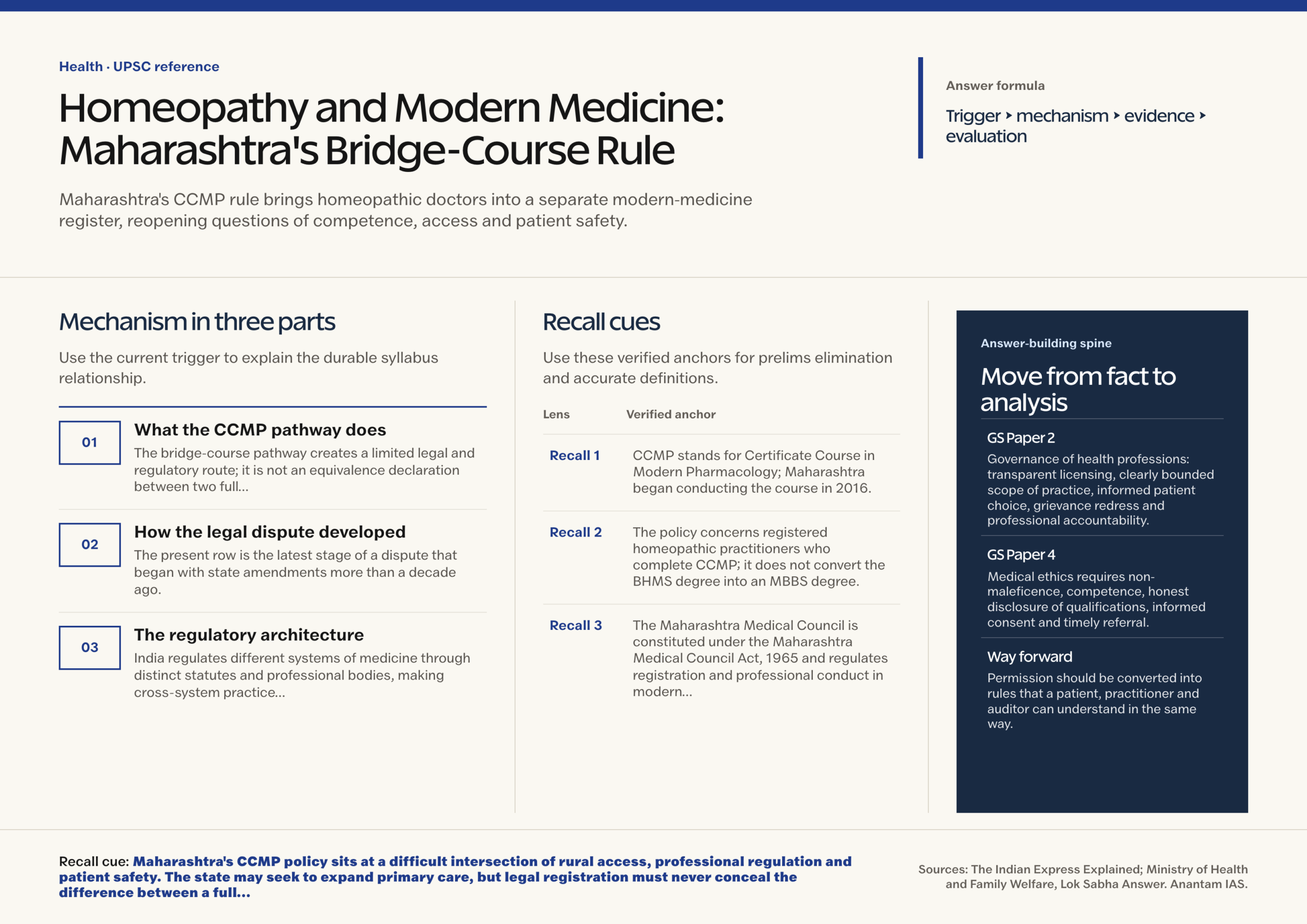
Background and Context
What the CCMP pathway does
The bridge-course pathway creates a limited legal and regulatory route; it is not an equivalence declaration between two full medical degrees.
- A candidate begins as a BHMS graduate registered with the state homeopathy council, completes the one-year CCMP approved in Maharashtra and seeks placement in the MMC’s separate register.
- According to the Union Health Ministry’s Lok Sabha reply of 1 August 2025, modern-medicine treatment is allowed only when needed and only to the extent learned through CCMP.
- The official formulation matters: legal permission is tied to competencies, not to an unrestricted claim to be trained across the full MBBS curriculum.
- A separate register can help identify the category, but its public interface, certificates, prescriptions and workplace design must make the limited scope obvious to patients and other clinicians.
- The health-system question is whether regulators can translate a broad phrase such as ‘to the extent learned’ into auditable lists of conditions, medicines, red flags and mandatory referrals.
How the legal dispute developed
The present row is the latest stage of a dispute that began with state amendments more than a decade ago.
- Maharashtra Act XIX of 2014 amended the state laws governing homeopathic practitioners and the MMC. The amendments were challenged in Writ Petition No. 7847 of 2014 and connected matters.
- The Bombay High Court declined interim relief in December 2014, noting the state’s argument that the policy sought to extend medical relief to rural populations. The Supreme Court declined to interfere with that interim order in.
- The state introduced the certificate course for a June 2016 start. The High Court said admissions and later action would remain subject to the final decision in the writ petitions.
- In 2025, the state directed the MMC to commence registration through a separate mechanism. The MMC first issued a notification on 30 June, withdrew it on 11 July, and later reopened the process through a dedicated.
- On 17 September 2025, the High Court rejected a fresh request to stop registration at the interim stage. It did not finally settle every challenge to the statutory amendments or course recognition.
The regulatory architecture
India regulates different systems of medicine through distinct statutes and professional bodies, making cross-system practice legally sensitive.
- The National Medical Commission sets standards for modern medical education, recognition and professional regulation under the NMC Act, 2019. State medical councils handle registration and discipline within their statutory powers.
- The National Commission for Homoeopathy regulates homeopathy education and professional standards under a separate central law, while state homeopathy councils maintain their own registers.
- The Union Health Ministry stated in a 2013 parliamentary reply that a person trained in another system cannot practise modern medicine unless the applicable state law supplies an enabling basis for enrolment in a state.
- Supporters of Maharashtra’s policy rely on the state’s amended statutes and its power to design rural health delivery. Opponents argue that a state bridge course cannot substitute for nationally recognised education and may blur the legal.
- Judicial review must examine legislative competence, recognised qualifications, patient protection and the exact effect of entry in the separate register; political claims on either side cannot resolve those questions by themselves.
Access arguments and patient-safety risks
Rural shortages and uneven distribution are real, but a bridge course succeeds only if it closes a defined service gap without creating a larger safety gap.
- The access case rests on deploying an existing cadre closer to underserved populations for common, non-serious conditions and early referral. This may improve geographical availability where sanctioned posts are vacant or doctors are unevenly distributed.
- The safety concern is that pharmacology knowledge alone is not the whole of clinical medicine. Diagnosis, differential diagnosis, drug interactions, antimicrobial stewardship, emergency recognition, monitoring and follow-up depend on integrated clinical training.
- A patient may not know whether the practitioner has an MBBS qualification or a BHMS plus CCMP certificate. Transparent identification is a patient-rights requirement, not professional turf protection.
- Unclear limits can create delayed referrals, polypharmacy, inappropriate antibiotic or steroid use and fragmented records. Clear protocols and prescription audits can reduce these risks, but only if enforcement is credible.
- A bridge cadre should never become a cheaper permanent substitute for filling MBBS posts, strengthening primary health centres, building team-based care or improving rural retention incentives.
Way Forward
Define a narrow and public scope of practice
- Publish a positive list of permitted conditions and medicines, a negative list of prohibited procedures and drugs, and red-flag referral triggers for emergencies, pregnancy, children and complex comorbidities.
- Require prescriptions, clinic boards and digital registers to display ‘BHMS + CCMP’ and the registration category in plain language; prohibit representations implying MBBS equivalence.
- Make scope updates evidence-based and subject to public consultation rather than informal administrative expansion.
Conclusion
- Maharashtra’s CCMP policy sits at a difficult intersection of rural access, professional regulation and patient safety.
- A defensible model needs a clearly published scope, truthful qualification disclosure, supervision, referral capacity, prescription audit and unified liability.
UPSC Practice Questions
Prelims MCQ 1
With reference to Maharashtra’s Certificate Course in Modern Pharmacology (CCMP), consider the following statements:
- It is meant for registered homeopathic practitioners.
- CCMP-qualified practitioners are to be kept in a separate register of the Maharashtra Medical Council.
- Completion of CCMP converts the BHMS qualification into an MBBS qualification.
How many of the above statements are correct?
(a) Only one (b) Only two (c) All three (d) None
Answer: (b) Only two
Explanation:
Statements 1 and 2 are correct. The Union Health Ministry’s 2025 Lok Sabha answer described CCMP as a one-year course for registered homeopathic practitioners and required a separate MMC register. It does not turn BHMS into MBBS.
Prelims MCQ 2
Which one of the following correctly describes the Bombay High Court’s interim position on CCMP registration in its order of 17 September 2025?
(a) It finally upheld every provision of the 2014 amendments (b) It permanently prohibited all CCMP registration (c) It allowed registration subject to the final petitions and course-defined competencies (d) It declared CCMP identical to the MBBS qualification
Answer: (c) It allowed registration subject to the final petitions and course-defined competencies
Explanation:
The Court declined interim restraint but said registration would remain subject to the final orders. Registrants could claim no equities and could not exceed the prescribed competencies.
UPSC Mains Questions
- Maharashtra’s CCMP policy highlights the tension between expanding rural health access and maintaining uniform clinical standards. Examine the governance safeguards needed to reconcile the two objectives. (250 words)
- A professional register is not merely an administrative list; it is a public assurance about competence and accountability. Discuss in the context of cross-system medical practice. (150 words)
Sources: The Indian Express Explained and Ministry of Health and Family Welfare, Lok Sabha Answer.
Frequently Asked Questions
What is CCMP in Maharashtra?
CCMP is the Certificate Course in Modern Pharmacology approved by Maharashtra for registered homeopathic practitioners. The Union Health Ministry described it in 2025 as a one-year course permitting modern-medicine treatment only when needed and only within the learning covered by.
Does CCMP make a homeopathic practitioner an MBBS doctor?
No. The pathway retains the practitioner’s BHMS qualification and adds a state-approved certificate with a limited scope. Separate registration with the Maharashtra Medical Council does not convert BHMS into MBBS or establish equivalence with the full MBBS curriculum.
Why does Maharashtra support the bridge-course pathway?
The state’s stated policy objective is to strengthen health services in rural and remote areas by using an existing health workforce for limited primary care. The policy case still has to be tested against competence, patient-safety, supervision and referral requirements.
What did the Bombay High Court decide about CCMP registration?
In September 2025, the Court declined to stop registration at the interim stage. It said registrations would remain subject to the final outcome of the main petitions, registrants could claim no equities, and practice must stay within course-defined competencies.
What is the main patient-safety concern?
The main concern is not pharmacology in isolation but whether limited training supports safe diagnosis, drug selection, interaction checks, monitoring and timely referral. Ambiguous titles may also prevent patients from understanding the practitioner’s actual qualification and scope.
Source: https://anantamias.com/current-affairs/maharashtra-homeopathy-modern-medicine-bridge-course/