Why in News?
Maharashtra has moved ahead with separate registration of eligible homeopathic practitioners who have completed the Certificate Course in Modern Pharmacology, or CCMP, enabling practice of modern medicine within the course-defined competencies.
- The Maharashtra Medical Council, or MMC, has a dedicated CCMP registration portal and maintains the course-qualified practitioners in a separate register rather than treating the CCMP certificate as an MBBS qualification.
- A 2025 Lok Sabha answer recorded Maharashtra’s position that CCMP is a one-year course for registered homeopathic practitioners and that treatment using modern medicines must be limited to need and to what the course teaches.
- The same parliamentary answer said a CCMP practitioner must remain registered with the Maharashtra Council of Homoeopathy while also being placed in the MMC’s separate register.
- The Bombay High Court’s interim order of 17 September 2025 allowed registration to proceed but made it subject to the final outcome of the pending petitions and barred registrants from claiming an irreversible right merely from.
- The Court also required CCMP-qualified practitioners to remain within specified competencies, with serious conditions and cases requiring surgery to be referred to an appropriate medical facility.
- States face a genuine last-mile health-access problem, but workforce expansion is safe only when training, licensing, supervision, referral and liability rules form one coherent system.
- Registration tells patients and employers what a practitioner is legally authorised to do. If the title or register is ambiguous, patients may mistake a limited scope for full modern-medicine competence.
- The dispute also tests the balance between a state’s public-health policy space and nationally coordinated standards for medical education and professional registration.
UPSC Relevance
Prelims Relevance
- CCMP stands for Certificate Course in Modern Pharmacology; Maharashtra began conducting the course in 2016.
- The policy concerns registered homeopathic practitioners who complete CCMP; it does not convert the BHMS degree into an MBBS degree.
- The Maharashtra Medical Council is constituted under the Maharashtra Medical Council Act, 1965 and regulates registration and professional conduct in modern medicine within the state framework.
- The Maharashtra Council of Homoeopathy is the separate state body with which the underlying homeopathic practitioner must also be registered.
- Maharashtra Act XIX of 2014 amended both the Maharashtra Homoeopathic Practitioners’ Act, 1960 and the Maharashtra Medical Council Act, 1965.
- The National Medical Commission regulates modern medical education and recognised medical qualifications under the National Medical Commission Act, 2019; homeopathy education is regulated separately under the National Commission for Homoeopathy Act, 2020.
Mains Relevance
GS Paper 2
- Governance of health professions: transparent licensing, clearly bounded scope of practice, informed patient choice, grievance redress and professional accountability.
- Social-sector delivery: using a mixed health workforce for rural primary care without diluting quality, referral discipline or continuity of care.
GS Paper 4
- Medical ethics requires non-maleficence, competence, honest disclosure of qualifications, informed consent and timely referral.
- A public employer’s duty to fill vacancies cannot displace its duty to give rural patients the same safety protections expected in urban care.
Essay
- The right to health is not fulfilled by physical availability alone; quality, trust and accountability decide whether access is meaningful.
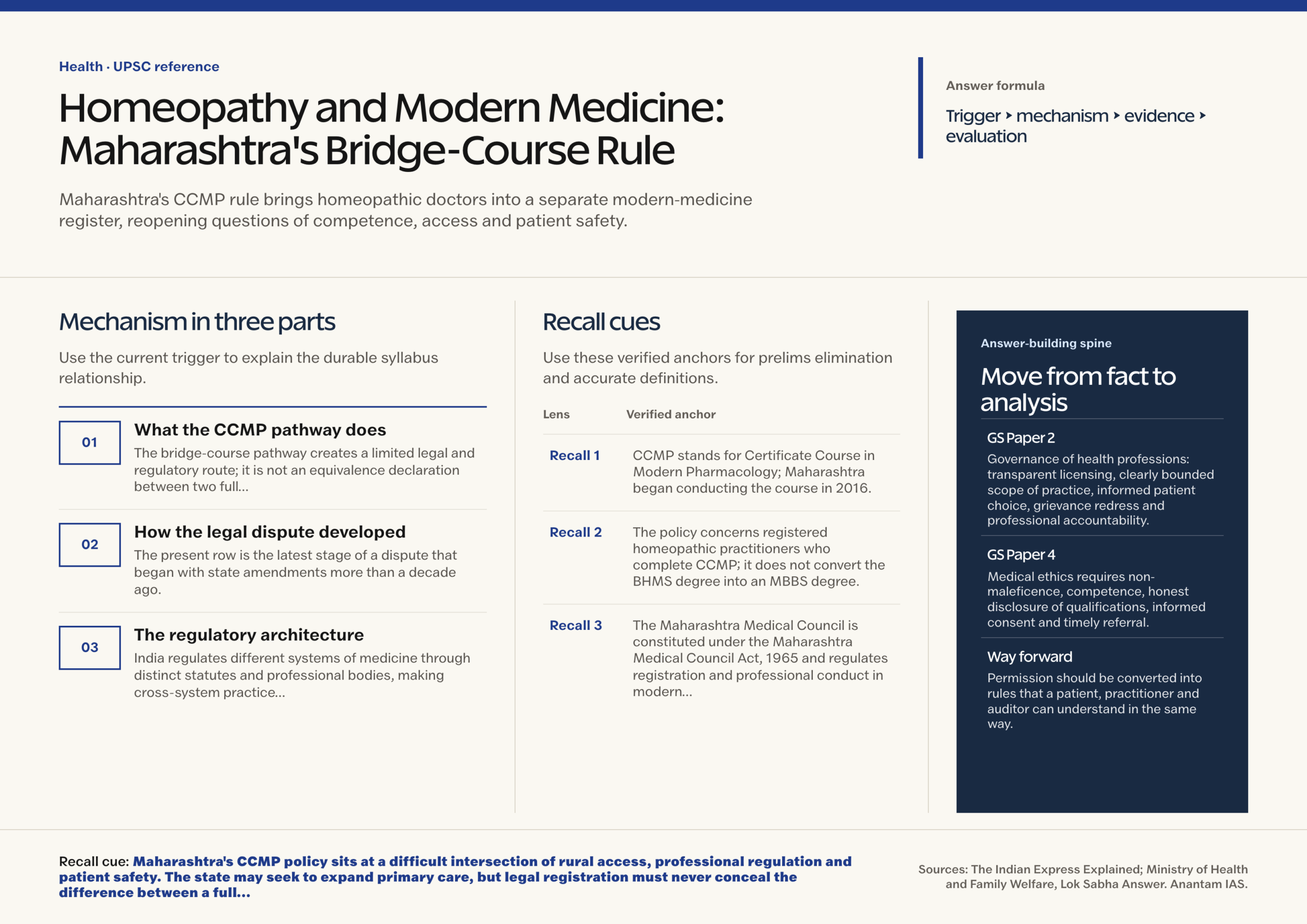
Background and Context
What the CCMP pathway does
The bridge-course pathway creates a limited legal and regulatory route; it is not an equivalence declaration between two full medical degrees.
- A candidate begins as a BHMS graduate registered with the state homeopathy council, completes the one-year CCMP approved in Maharashtra and seeks placement in the MMC’s separate register.
- According to the Union Health Ministry’s Lok Sabha reply of 1 August 2025, modern-medicine treatment is allowed only when needed and only to the extent learned through CCMP.
- The official formulation matters: legal permission is tied to competencies, not to an unrestricted claim to be trained across the full MBBS curriculum.
- A separate register can help identify the category, but its public interface, certificates, prescriptions and workplace design must make the limited scope obvious to patients and other clinicians.
- The health-system question is whether regulators can translate a broad phrase such as ‘to the extent learned’ into auditable lists of conditions, medicines, red flags and mandatory referrals.
How the legal dispute developed
The present row is the latest stage of a dispute that began with state amendments more than a decade ago.
- Maharashtra Act XIX of 2014 amended the state laws governing homeopathic practitioners and the MMC. The amendments were challenged in Writ Petition No. 7847 of 2014 and connected matters.
- The Bombay High Court declined interim relief in December 2014, noting the state’s argument that the policy sought to extend medical relief to rural populations. The Supreme Court declined to interfere with that interim order in.
- The state introduced the certificate course for a June 2016 start. The High Court said admissions and later action would remain subject to the final decision in the writ petitions.
- In 2025, the state directed the MMC to commence registration through a separate mechanism. The MMC first issued a notification on 30 June, withdrew it on 11 July, and later reopened the process through a dedicated.
- On 17 September 2025, the High Court rejected a fresh request to stop registration at the interim stage. It did not finally settle every challenge to the statutory amendments or course recognition.
The regulatory architecture
India regulates different systems of medicine through distinct statutes and professional bodies, making cross-system practice legally sensitive.
- The National Medical Commission sets standards for modern medical education, recognition and professional regulation under the NMC Act, 2019. State medical councils handle registration and discipline within their statutory powers.
- The National Commission for Homoeopathy regulates homeopathy education and professional standards under a separate central law, while state homeopathy councils maintain their own registers.
- The Union Health Ministry stated in a 2013 parliamentary reply that a person trained in another system cannot practise modern medicine unless the applicable state law supplies an enabling basis for enrolment in a state.
- Supporters of Maharashtra’s policy rely on the state’s amended statutes and its power to design rural health delivery. Opponents argue that a state bridge course cannot substitute for nationally recognised education and may blur the legal.
- Judicial review must examine legislative competence, recognised qualifications, patient protection and the exact effect of entry in the separate register; political claims on either side cannot resolve those questions by themselves.
Access arguments and patient-safety risks
Rural shortages and uneven distribution are real, but a bridge course succeeds only if it closes a defined service gap without creating a larger safety gap.
- The access case rests on deploying an existing cadre closer to underserved populations for common, non-serious conditions and early referral. This may improve geographical availability where sanctioned posts are vacant or doctors are unevenly distributed.
- The safety concern is that pharmacology knowledge alone is not the whole of clinical medicine. Diagnosis, differential diagnosis, drug interactions, antimicrobial stewardship, emergency recognition, monitoring and follow-up depend on integrated clinical training.
- A patient may not know whether the practitioner has an MBBS qualification or a BHMS plus CCMP certificate. Transparent identification is a patient-rights requirement, not professional turf protection.
- Unclear limits can create delayed referrals, polypharmacy, inappropriate antibiotic or steroid use and fragmented records. Clear protocols and prescription audits can reduce these risks, but only if enforcement is credible.
- A bridge cadre should never become a cheaper permanent substitute for filling MBBS posts, strengthening primary health centres, building team-based care or improving rural retention incentives.
Way Forward
Define a narrow and public scope of practice
- Publish a positive list of permitted conditions and medicines, a negative list of prohibited procedures and drugs, and red-flag referral triggers for emergencies, pregnancy, children and complex comorbidities.
- Require prescriptions, clinic boards and digital registers to display ‘BHMS + CCMP’ and the registration category in plain language; prohibit representations implying MBBS equivalence.
- Make scope updates evidence-based and subject to public consultation rather than informal administrative expansion.
Conclusion
- Maharashtra’s CCMP policy sits at a difficult intersection of rural access, professional regulation and patient safety.
- A defensible model needs a clearly published scope, truthful qualification disclosure, supervision, referral capacity, prescription audit and unified liability.
UPSC Practice Questions
Prelims MCQ 1
With reference to Maharashtra’s Certificate Course in Modern Pharmacology (CCMP), consider the following statements:
- It is meant for registered homeopathic practitioners.
- CCMP-qualified practitioners are to be kept in a separate register of the Maharashtra Medical Council.
- Completion of CCMP converts the BHMS qualification into an MBBS qualification.
How many of the above statements are correct?
(a) Only one (b) Only two (c) All three (d) None
Answer: (b) Only two
Explanation:
Statements 1 and 2 are correct. The Union Health Ministry’s 2025 Lok Sabha answer described CCMP as a one-year course for registered homeopathic practitioners and required a separate MMC register. It does not turn BHMS into MBBS.
Prelims MCQ 2
Which one of the following correctly describes the Bombay High Court’s interim position on CCMP registration in its order of 17 September 2025?
(a) It finally upheld every provision of the 2014 amendments (b) It permanently prohibited all CCMP registration (c) It allowed registration subject to the final petitions and course-defined competencies (d) It declared CCMP identical to the MBBS qualification
Answer: (c) It allowed registration subject to the final petitions and course-defined competencies
Explanation:
The Court declined interim restraint but said registration would remain subject to the final orders. Registrants could claim no equities and could not exceed the prescribed competencies.
UPSC Mains Questions
- Maharashtra’s CCMP policy highlights the tension between expanding rural health access and maintaining uniform clinical standards. Examine the governance safeguards needed to reconcile the two objectives. (250 words)
- A professional register is not merely an administrative list; it is a public assurance about competence and accountability. Discuss in the context of cross-system medical practice. (150 words)
Sources: The Indian Express Explained and Ministry of Health and Family Welfare, Lok Sabha Answer.
Frequently Asked Questions
What is CCMP in Maharashtra?
CCMP is the Certificate Course in Modern Pharmacology approved by Maharashtra for registered homeopathic practitioners. The Union Health Ministry described it in 2025 as a one-year course permitting modern-medicine treatment only when needed and only within the learning covered by.
Does CCMP make a homeopathic practitioner an MBBS doctor?
No. The pathway retains the practitioner’s BHMS qualification and adds a state-approved certificate with a limited scope. Separate registration with the Maharashtra Medical Council does not convert BHMS into MBBS or establish equivalence with the full MBBS curriculum.
Why does Maharashtra support the bridge-course pathway?
The state’s stated policy objective is to strengthen health services in rural and remote areas by using an existing health workforce for limited primary care. The policy case still has to be tested against competence, patient-safety, supervision and referral requirements.
What did the Bombay High Court decide about CCMP registration?
In September 2025, the Court declined to stop registration at the interim stage. It said registrations would remain subject to the final outcome of the main petitions, registrants could claim no equities, and practice must stay within course-defined competencies.
What is the main patient-safety concern?
The main concern is not pharmacology in isolation but whether limited training supports safe diagnosis, drug selection, interaction checks, monitoring and timely referral. Ambiguous titles may also prevent patients from understanding the practitioner’s actual qualification and scope.
Tell Google you want more of this.
Add Anantam IAS as a preferred sourceOne tap, and this site shows up more often in your own Top Stories, AI Overviews and AI Mode. Remove it any time.