Why in News?
An analysis published by The Hindu reported that more than 31 lakh nursing personnel recorded with State nursing councils were not reflected in the Nurses Registration and Tracking System, or NRTS, exposing uneven implementation across States.
- The Indian Nursing Council created NRTS as a national, computerised system to bring State Nursing Registration Councils onto an integrated platform and build a live register.
- The INC Annual Report 2024-2025 says NRTS enrolment had reached 13,20,926 by 31 March 2025, up from 11,76,375 a year earlier.
- The same annual report separately lists 42,94,688 registered nursing personnel: 10,74,556 auxiliary nurse midwives, 31,62,956 registered nurses and registered midwives, and 57,176 lady health visitors.
- Those two March 2025 tables produce a simple difference of 29,73,762, while The Hindu’s newer comparison of government data reports a gap exceeding 31 lakh. The series are not a single synchronized census, and several.
- The gap must not be read as proof that 31 lakh people are unqualified, unemployed or practising illegally. It measures non-coverage in a national digital register relative to State-level registration records.
- A registry can support policy only when its records are complete, current, comparable and deduplicated; a large coverage gap weakens every estimate derived from it.
- Health is primarily a State subject, while nursing education standards and national coordination involve the Union and the INC. NRTS is a case study in cooperative digital federalism.
- Aadhaar-based identity checks can reduce duplicate identities, but identity verification is not a substitute for checking current licence status, qualifications, place of work and availability.
UPSC Relevance
Prelims Relevance
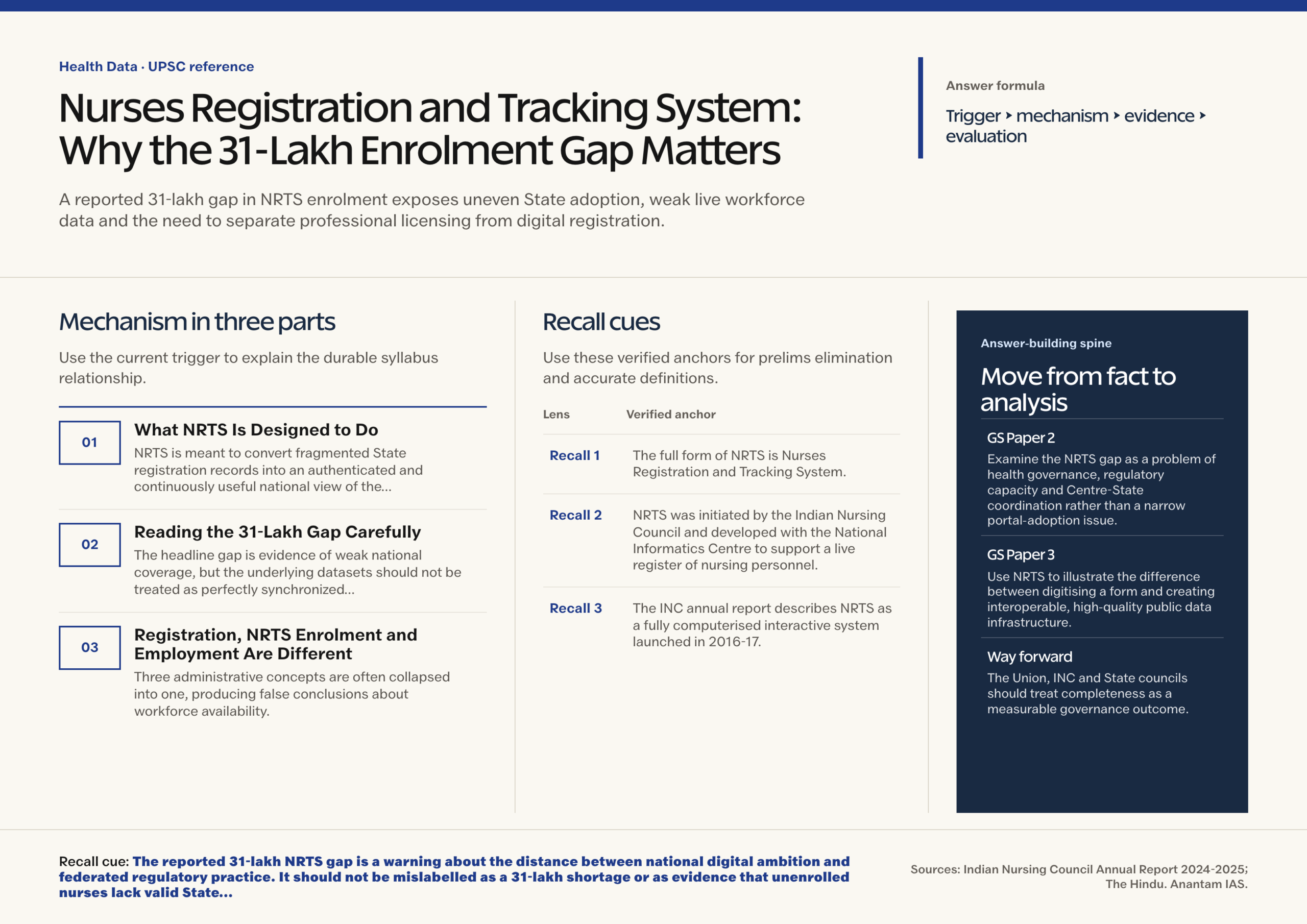
- The full form of NRTS is Nurses Registration and Tracking System.
- NRTS was initiated by the Indian Nursing Council and developed with the National Informatics Centre to support a live register of nursing personnel.
- The INC annual report describes NRTS as a fully computerised interactive system launched in 2016-17.
- A nurse enrolled in NRTS receives a Nurse Unique Identity Number, commonly called NUID, after the prescribed verification process.
- NRTS covers enrolment of previously registered nurses as well as workflows such as primary registration, reciprocal registration and additional qualification through participating State councils.
- The State Nursing Registration Councils, not the INC merely through NRTS enrolment, issue the legal registration or licence to practise within their jurisdiction.
Mains Relevance
GS Paper 2
- Examine the NRTS gap as a problem of health governance, regulatory capacity and Centre-State coordination rather than a narrow portal-adoption issue.
- Discuss how a reliable live register can improve workforce planning while preserving the licensing authority and accountability of State councils.
GS Paper 3
- Use NRTS to illustrate the difference between digitising a form and creating interoperable, high-quality public data infrastructure.
- Connect accurate workforce information with resilience during epidemics, disasters and regional shortages, without treating registry counts as automatic proof of deployment capacity.
Essay
- What the State cannot count accurately, it cannot plan fairly; yet counting citizens and professionals also creates duties of privacy, correction and accountability.
Background and Context
What NRTS Is Designed to Do
NRTS is meant to convert fragmented State registration records into an authenticated and continuously useful national view of the nursing workforce.
- The platform supports the goal of a live register, meaning records can be updated for new registration, reciprocal registration, added qualifications and other changes rather than remaining a periodic aggregate.
- A NUID provides a nationally verifiable identifier intended to reduce ambiguity when a nurse studies, registers, works or seeks reciprocal registration across jurisdictions.
- The INC states that all State Nursing Councils were brought onto the platform, but onboarding a council does not ensure that every legacy record has been migrated, verified and kept current.
- A useful live register needs status fields beyond identity: current registration validity, qualifications, speciality, employment setting and location must be accurate enough for the intended policy use.
Reading the 31-Lakh Gap Carefully
The headline gap is evidence of weak national coverage, but the underlying datasets should not be treated as perfectly synchronized or conceptually identical.
- The Hindu reported a gap of more than 31 lakh from government data comparing State-level registration with NRTS enrolment and highlighted large interstate differences.
- The latest published INC annual report gives a dated cross-check: 13,20,926 NRTS enrolments by 31 March 2025 against 42,94,688 personnel across three State-register categories, a numerical difference of 29,73,762.
- The INC table itself marks several State totals as being from 2020, 2021, 2022, 2023 or January 2023. A national total assembled from different reference dates is not a clean active-workforce census.
- The reported 31-lakh figure is best used as a coverage warning, not as an exact estimate of currently practising nurses missing from the database.
Registration, NRTS Enrolment and Employment Are Different
Three administrative concepts are often collapsed into one, producing false conclusions about workforce availability.
- Professional registration with the relevant State Nursing Registration Council is the legal route connected to the right to practise; NRTS integrates and verifies data but does not replace that State authority.
- NRTS enrolment means a record has entered the national system and completed the applicable workflow. It does not prove that the person is currently employed in nursing or available in a particular district.
- Employment data must distinguish public and private facilities, clinical and non-clinical roles, domestic and overseas work, full-time and inactive personnel, and specialities such as critical care or midwifery.
- A credible workforce denominator should remove deceased, retired, migrated, duplicated and long-inactive records while retaining an auditable history of changes.
Why State-Level Implementation Is Uneven
The platform depends on the administrative capacity and workflows of many State councils, so a national technical system can still reproduce local institutional differences.
- Legacy registers vary in format, completeness, spelling conventions and digitisation quality, making record matching and migration difficult.
- Nurses may face practical barriers such as outdated mobile details, document mismatch, Aadhaar authentication problems, limited help desks or uncertainty about the relationship between NUID and their State licence.
- Councils differ in staffing, verification backlogs, renewal practice, fee systems and integration of primary and reciprocal registration with NRTS.
- Uneven adoption creates a feedback problem: States with incomplete data receive weaker planning insights, while weak perceived value can reduce institutional incentive to finish migration.
Way Forward
Publish a Time-Bound State Coverage Plan
- Publish State-wise denominators, verified NRTS records, pending cases, rejected cases and monthly progress using a common reference date and clear category definitions.
- Prioritise high-volume lagging States and older legacy registers through funded migration teams, standard data templates and monitored service-level timelines.
- Integrate primary registration, renewal, reciprocal registration and added qualifications with NRTS so that an approved State transaction updates the national record once.
- Use open standards and validated APIs, with human review for mismatches, instead of repeated manual uploads to disconnected portals.
Conclusion
- The reported 31-lakh NRTS gap is a warning about the distance between national digital ambition and federated regulatory practice.
- India needs a register that is complete enough for planning, current enough for emergencies and fair enough that a data mismatch cannot erase a professional.
UPSC Practice Questions
Prelims MCQ 1
With reference to the Nurses Registration and Tracking System (NRTS), consider the following statements:
- It was initiated by the Indian Nursing Council to support a live register of nurses.
- Enrolment in NRTS by itself constitutes a licence to practise nursing issued by the Indian Nursing Council.
- The system supports workflows including primary and reciprocal registration through participating State councils.
How many of the above statements are correct?
(a) Only one (b) Only two (c) All three (d) None
Answer: (b) Only two
Explanation:
Statements 1 and 3 are correct. NRTS supports an integrated live register and registration workflows, but the licence to practise remains the responsibility of the relevant State Nursing Registration Council; NRTS enrolment alone is not an INC-issued licence.
Prelims MCQ 2
Which institution is primarily responsible for issuing a nurse’s professional registration or licence to practise within a State?
(a) National Informatics Centre (b) Indian Council of Medical Research (c) State Nursing Registration Council (d) National Health Authority
Answer: (c) State Nursing Registration Council
Explanation:
State Nursing Registration Councils register and license nursing personnel in their jurisdictions. The INC sets national education standards and facilitates NRTS, while NIC provides the technology platform.
UPSC Mains Questions
- The enrolment gap in the Nurses Registration and Tracking System is a challenge of cooperative federalism as much as digital governance. Discuss. (150 words)
- A national professional register is useful only when identity, licence status and active employment are not confused. Examine this statement with reference to health-workforce planning in India. (250 words)
Sources: Indian Nursing Council Annual Report 2024-2025 and The Hindu.
Frequently Asked Questions
What is the Nurses Registration and Tracking System?
NRTS is an Indian Nursing Council initiative, developed with the National Informatics Centre, to create an integrated live register of nursing personnel. It supports verified enrolment and State-council workflows such as primary registration, reciprocal registration and recording additional qualifications.
What does the reported 31-lakh gap mean?
It refers to nursing personnel appearing in State-level registration data but not represented in the national NRTS comparison reported by The Hindu. It is a registry-coverage gap, not automatically a workforce shortage, unemployment count or estimate of people practising without.
How many NRTS enrolments did the INC officially report?
The INC Annual Report 2024-2025 reported 13,20,926 enrolled registered nurses as of 31 March 2025. This is a dated official figure, not a live August 2026 total. The preceding annual report recorded 11,76,375 as of 31 March 2024.
Does a NUID give a nurse the legal right to practise anywhere in India?
No. A NUID is a nationally verifiable identity within NRTS. The relevant State Nursing Registration Council remains responsible for professional registration and licensing. Reciprocal registration or transfer requirements may still apply when a nurse moves between jurisdictions.
Why cannot State registration totals be treated as the active nursing workforce?
Registers may include retired, deceased, migrated, inactive or duplicated records, and some State totals are updated at different times. An active-workforce estimate also needs current licence status, employment setting, location and availability, with transparent definitions and data-quality notes.
Tell Google you want more of this.
Add Anantam IAS as a preferred sourceOne tap, and this site shows up more often in your own Top Stories, AI Overviews and AI Mode. Remove it any time.