Why in News?
The Union government clarified in August 2026 that UPI transactions will remain free for users and that the vast majority of merchant transactions will also remain free.
- No transaction fee has been imposed on ordinary users merely because the legal framework has changed.
- Any future merchant-side charge would require a separate policy decision or notification specifying its scope, rate and exemptions.
- The government indicated that person-to-person transfers and ordinary user payments will stay free, while protection for small merchants keeps most retail acceptance outside a charge.
- The debate concerns the cost of operating UPI, including switching, settlement, cybersecurity, fraud monitoring, dispute handling and customer support.
- A Merchant Discount Rate, if introduced for a defined merchant segment, is a charge on merchant acceptance infrastructure; it is not the same as a fee collected from every payer.
- UPI has become a foundational layer of India’s digital public infrastructure, so a pricing change can affect inclusion, merchant acceptance and confidence at national scale.
- A zero-price experience encouraged rapid adoption, but banks, payment service providers, app providers and NPCI still incur real operating costs.
- The policy challenge is to preserve free, interoperable everyday payments while building a transparent and sustainable way to fund reliability, security and innovation.
UPSC Relevance
Prelims Relevance
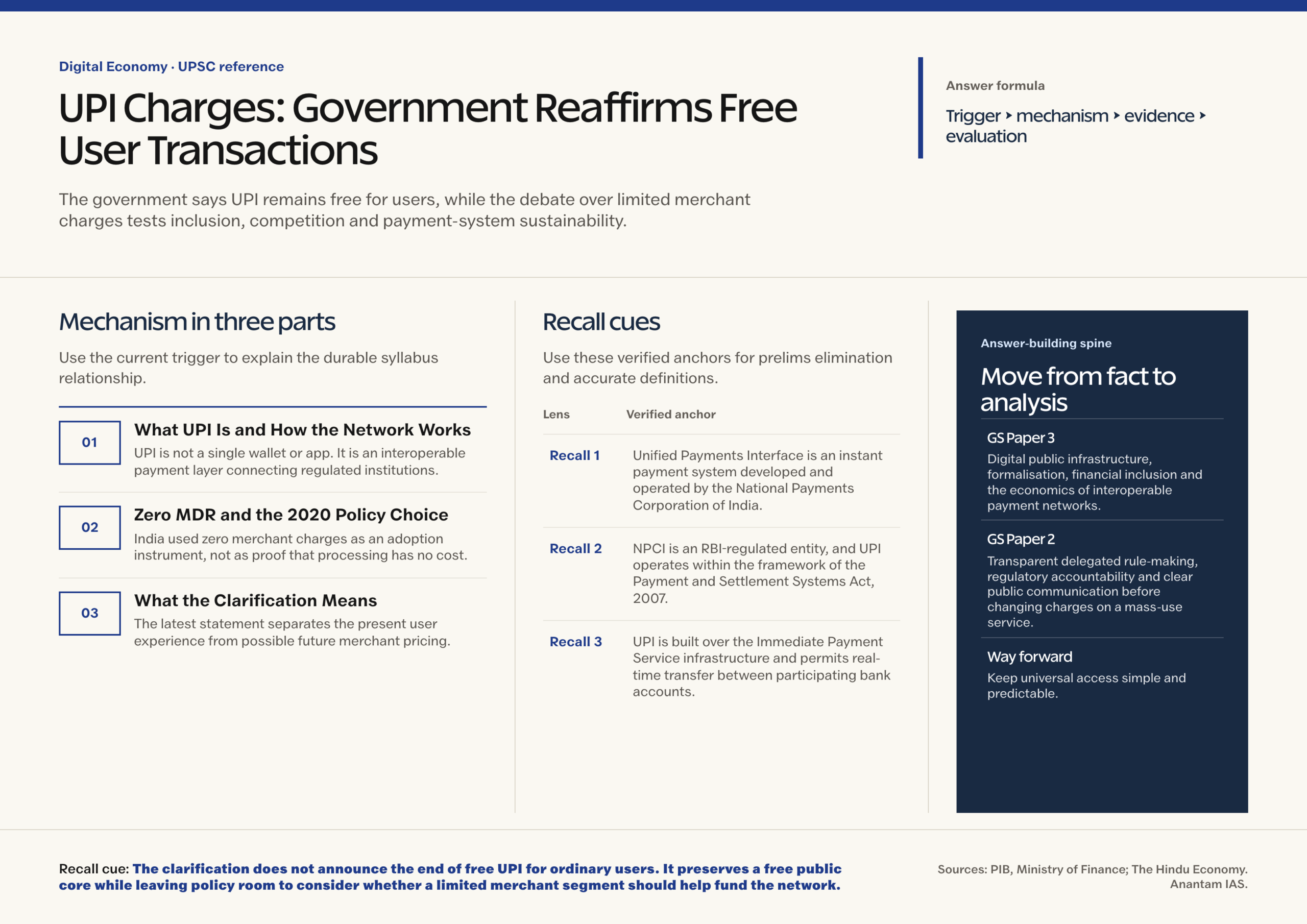
- Unified Payments Interface is an instant payment system developed and operated by the National Payments Corporation of India.
- NPCI is an RBI-regulated entity, and UPI operates within the framework of the Payment and Settlement Systems Act, 2007.
- UPI is built over the Immediate Payment Service infrastructure and permits real-time transfer between participating bank accounts.
- A P2P transaction transfers money between persons; a P2M transaction is a payment from a person to a merchant.
- MDR is the merchant-side rate charged for payment-processing services; it is conceptually different from a direct consumer transaction fee.
- Section 10A of the Payment and Settlement Systems Act was used in the zero-MDR framework for prescribed electronic modes, including UPI and RuPay debit cards.
Mains Relevance
GS Paper 3
- Digital public infrastructure, formalisation, financial inclusion and the economics of interoperable payment networks.
- Trade-off between a zero-price adoption strategy and sustainable funding for payment security, resilience and innovation.
GS Paper 2
- Transparent delegated rule-making, regulatory accountability and clear public communication before changing charges on a mass-use service.
- Protection of consumers and small merchants through exemptions, disclosure rules, grievance redress and monitoring of indirect surcharges.
Essay
- Digital public goods become durable only when access, trust and financial sustainability are designed together.
Background and Context
What UPI Is and How the Network Works
UPI is not a single wallet or app. It is an interoperable payment layer connecting regulated institutions.
- NPCI operates the UPI switch, while the RBI regulates the payment-system framework under the Payment and Settlement Systems Act, 2007.
- A user can access UPI through a bank app or a third-party application provider. The app connects through a payment service provider bank, and the user’s bank debits or credits the linked account.
- On the merchant side, an acquiring institution onboards the merchant and enables QR, intent, collect or application-based acceptance. Multiple entities may participate in a single successful payment.
- Interoperability lets a customer of one bank or app pay a recipient using another bank or app. This reduces closed-network barriers and expands acceptance.
- UPI supports both P2P transfers and P2M payments. These uses can have different policy treatment because a commercial merchant receives payment-processing services as part of business activity.
Zero MDR and the 2020 Policy Choice
India used zero merchant charges as an adoption instrument, not as proof that processing has no cost.
- From 1 January 2020, the government directed that MDR should not be collected on prescribed UPI and RuPay debit-card payments. The framework rested on Section 10A of the Payment and Settlement Systems Act and related tax-law.
- The policy lowered the acceptance cost for merchants and made QR-based payments attractive for small and low-margin businesses.
- A simple and predictable zero-charge user experience reduced friction. Users did not have to calculate whether a small payment was worth making digitally.
- Zero MDR also removed a direct revenue stream that card networks and acquiring institutions normally use to fund acceptance infrastructure.
- The government partly addressed this gap through incentive schemes for specified low-value BHIM-UPI merchant transactions, with payments distributed across ecosystem participants.
What the 2026 Clarification Means
The latest statement separates the present user experience from possible future merchant pricing.
- Users remain protected: the government has said that ordinary UPI transactions will continue to be free for the payer.
- The vast majority of merchant transactions are also expected to remain free because the stated policy preserves protection for small merchants and everyday payments.
- Legal authority to permit or calibrate a charge does not itself specify who must pay, how much they must pay or when payment begins.
- A charge would arise only after the competent authority issues an operative instrument with defined coverage. Reports about possible rates or turnover thresholds should not be treated as settled policy without such a notification.
- The change keeps room for a differentiated model under which a limited commercial segment could contribute without dismantling universal free access for individuals.
MDR, Interchange and User Fees Are Different
Clear terminology prevents a merchant-pricing debate from turning into a false claim that every UPI scan carries a tax.
- MDR is the rate paid by a merchant to the acquiring side for enabling and processing a payment. It can be shared across participants according to the payment arrangement.
- An interchange fee is a payment between participating institutions. For example, interoperable wallet-based UPI merchant payments can have a different interchange framework from ordinary bank-account-to-bank-account UPI.
- A consumer fee is an amount directly charged to the payer for initiating or completing a transaction. The government has ruled out such a charge for ordinary UPI users in the present clarification.
- GST applies to a taxable payment service charge, not to the value transferred through UPI. When no MDR or similar service charge exists, the transferred amount does not become subject to GST merely because UPI was.
- Merchants may try to pass a processing cost into prices or add a surcharge. Consumer-protection rules and clear disclosure become important even when the formal levy falls on the merchant side.
Way Forward
Protect the Free Public Core
- Retain zero direct charges for P2P transfers, ordinary users, small merchants and low-value retail payments.
- Define protected categories in clear, technology-neutral language so the same economic activity receives the same treatment across apps and banks.
- Prohibit hidden user surcharges and require any permitted merchant fee to be shown separately in acquiring contracts and settlement reports.
Conclusion
- The August 2026 clarification does not announce the end of free UPI for ordinary users.
- India’s task is to avoid a false choice between inclusion and sustainability.
UPSC Practice Questions
Prelims MCQ 1
With reference to the Unified Payments Interface (UPI), consider the following statements:
- UPI is operated by the National Payments Corporation of India.
- UPI is built over the Immediate Payment Service infrastructure.
- A Merchant Discount Rate is, by definition, a tax on the full value transferred by a customer.
How many of the above statements are correct?
(a) Only one (b) Only two (c) All three (d) None
Answer: (b) Only two
Explanation:
Statements 1 and 2 are correct. NPCI operates UPI, which is built over IMPS infrastructure. MDR is a payment-processing charge associated with merchant acceptance; it is not a tax on the full transaction value.
Prelims MCQ 2
Which one of the following best describes the immediate effect of the government’s August 2026 clarification on UPI charges?
(a) Every UPI user must pay a fee above a fixed transaction value (b) GST is levied on every amount transferred through UPI (c) User transactions remain free, and any future merchant charge needs a separately defined policy instrument (d) NPCI can impose a consumer fee without regulatory approval
Answer: (c) User transactions remain free, and any future merchant charge needs a separately defined policy instrument
Explanation:
The clarification preserves free UPI use for ordinary users. Legal flexibility does not by itself create an operative charge, rate or merchant category.
UPSC Mains Questions
- UPI is free at the point of use but not costless to operate. Discuss how India can finance digital payment infrastructure without weakening financial inclusion. (150 words)
- Differentiate between a user fee, Merchant Discount Rate and interchange fee in digital payments. Why does this distinction matter for public policy communication? (150 words)
Sources: PIB, Ministry of Finance and The Hindu Economy.
Frequently Asked Questions
Will ordinary users now have to pay for UPI transactions?
No. The government’s August 2026 clarification says ordinary UPI transactions will remain free for users. A change that gives the government flexibility over payment charges does not itself impose a fee. Any operative charge would need a separate instrument identifying.
What is Merchant Discount Rate in UPI?
Merchant Discount Rate is a merchant-side payment-processing charge linked to acceptance infrastructure. It is paid within the acquiring arrangement and may be shared among ecosystem participants. It is different from a fee directly debited from a customer and different from.
Does the new policy mean every merchant will pay MDR?
No such universal charge follows from the clarification. The government says the vast majority of merchant transactions will remain free, with individuals and small merchants protected. A future levy, if adopted, must define eligible merchant categories and other conditions through.
Why would the government consider any merchant charge?
UPI requires spending on switching, cybersecurity, fraud controls, settlement, customer support and dispute resolution. A limited merchant charge is one possible way to fund these services and reduce dependence on budget incentives, but it must be weighed against acceptance, inclusion.
Is GST charged on the amount paid through UPI?
No. The amount transferred does not attract GST merely because the payer used UPI. GST can apply to a taxable payment-processing service charge when such a charge exists. This distinction is why a reported merchant fee should not be described.
Tell Google you want more of this.
Add Anantam IAS as a preferred sourceOne tap, and this site shows up more often in your own Top Stories, AI Overviews and AI Mode. Remove it any time.