Daily Digest
UPSC · Civil Services Examination
Current Affairs · Saturday, 10 January 2026
Current affairs curated and edited by Anantam IAS faculty — pulled from The Hindu, PIB, IDSA, Foreign Affairs and the ministries. Read, annotate, revise.
Old Rajinder Nagar · Delhi 110005 · anantamias.com
Digitalising India’s Dairy Sector: Data, Traceability and Farmer Incomes
Why in News?
India’s dairy economy is being rewired around digital public infrastructure. The Department of Animal Husbandry and Dairying (DAHD) and the National Dairy Development Board (NDDB) are scaling animal tagging, a unique-ID livestock database and electronic milk-procurement systems to raise productivity, build disease traceability and protect farmer incomes.
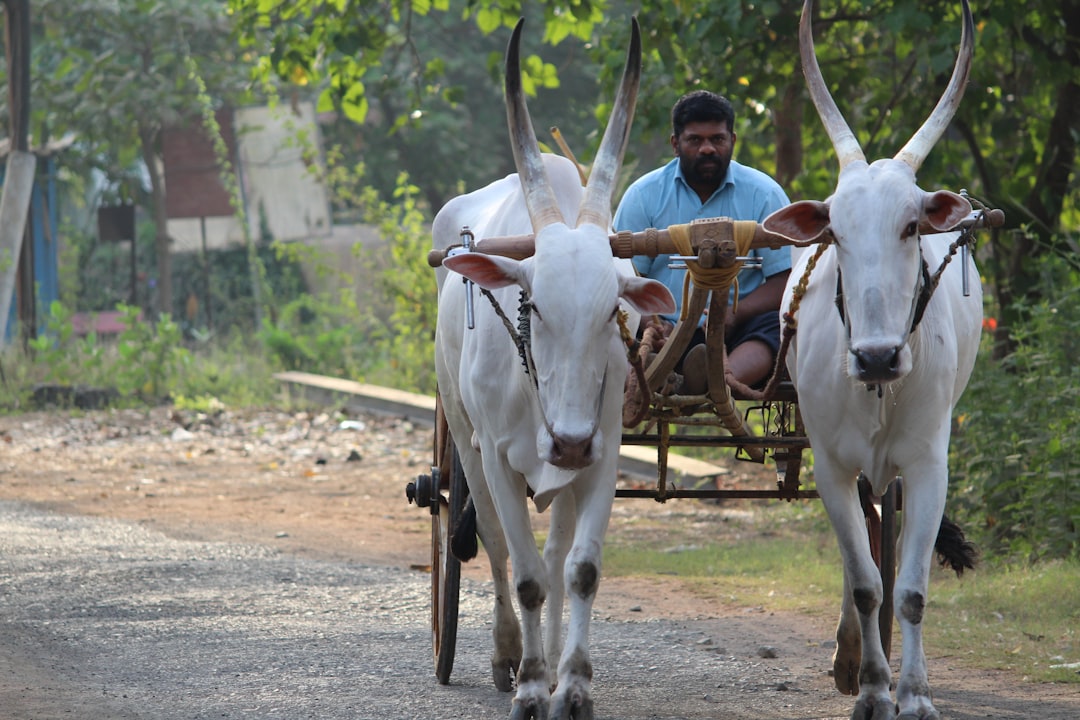
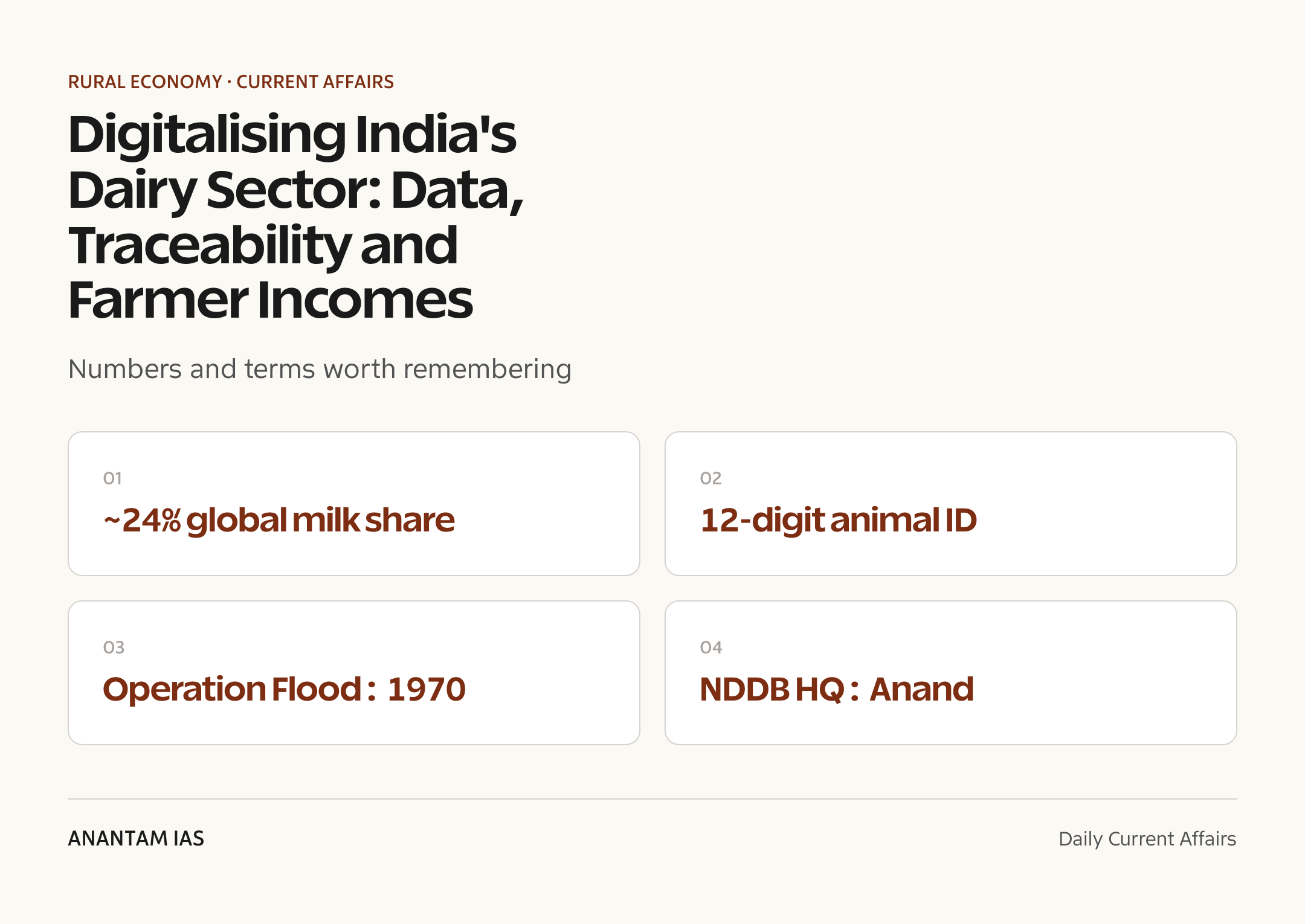
India remains the world’s largest milk producer, accounting for roughly 24% of global milk output, with the sector anchored in millions of small and marginal households organised through dairy cooperatives such as Amul and the wider NDDB network.
- Pashu Aadhaar: Each bovine receives a 12-digit unique identification number linked to a polyurethane ear tag for nationwide tracking.
- INAPH database: The Information Network for Animal Productivity and Health records breeding, nutrition and health data animal-by-animal.
- NDLM: The National Digital Livestock Mission aims to build a unified data architecture for the livestock and dairy sector.
- Largest producer: India produces about 24% of global milk, the single biggest national share.
- e-markets: Electronic milk-collection units and automated fat/SNF testing speed up transparent, real-time payments to farmers.
The development matters in the context of:
- Smallholder base: Dairying is mostly a side-occupation for small, marginal and landless households, making it a key rural livelihood and income smoother.
- Cooperative spine: The Anand pattern of cooperatives links village societies to district unions and state federations, cutting out middlemen.
- Productivity gap: Indian milk yield per animal is below the global average, so breeding and feeding data are central to closing the gap.
UPSC Relevance
Prelims Relevance
- Operation Flood and the White Revolution — Verghese Kurien and the Anand pattern of dairy cooperatives.
- National Dairy Development Board (NDDB) — statutory body under an Act of Parliament (1987), headquartered at Anand, Gujarat.
- Rashtriya Gokul Mission — conservation and development of indigenous bovine breeds.
- INAPH — Information Network for Animal Productivity and Health, maintained for breeding and health records.
- National Digital Livestock Mission (NDLM) and the unique animal-ID tagging (Pashu Aadhaar) system.
- National Programme for Dairy Development (NPDD) — strengthens milk procurement, processing and chilling infrastructure.
- Department of Animal Husbandry and Dairying (DAHD) sits under the Ministry of Fisheries, Animal Husbandry and Dairying.
- India’s share in global milk production (about 24%) and its status as the largest producer.
Mains Relevance
GS Paper 3
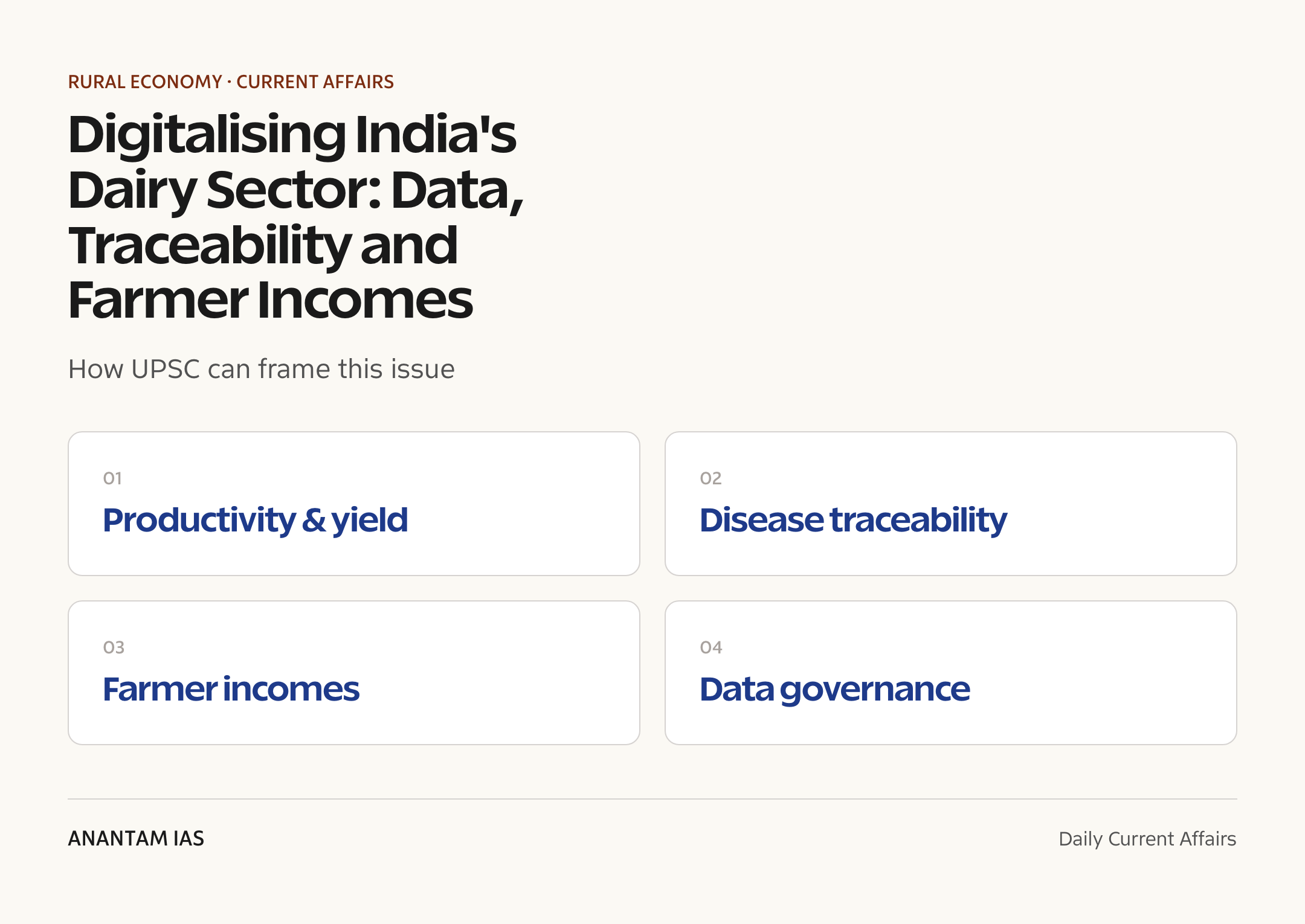
- Examine how digital public infrastructure in animal husbandry can raise productivity and farmer incomes.
- Assess the role of dairy cooperatives in inclusive rural growth and the post-harvest value chain.
- Discuss disease traceability and food safety as economic and public-health priorities for the dairy sector.
GS Paper 2
- Evaluate the design and delivery of livestock-sector government schemes and the data-privacy questions a national animal database raises.
Essay
- Use as evidence in essays on technology and rural transformation, the digital economy, or doubling farmer incomes.
- Relevant to themes on cooperatives, self-reliance and inclusive growth in the agrarian economy.
Background and Context
From Operation Flood to a digital dairy
The sector’s foundations sit in the cooperative White Revolution.
- Operation Flood: Launched in 1970 under Verghese Kurien and the NDDB, the White Revolution made India self-sufficient in milk through the Anand pattern of cooperatives.
- White Revolution: It linked village producers directly to urban demand and turned dairying into a mass rural livelihood.
- Today’s shift: The next phase layers data and digital tools onto this cooperative base to lift yield and transparency.
- Why it matters: With millions of smallholders, marginal gains in productivity and payment efficiency scale into large income effects.
Animal tagging and the unique-ID database
A national livestock database underpins every other intervention.
- Pashu Aadhaar: A 12-digit unique ID on a tamper-evident ear tag identifies each animal across its lifetime.
- INAPH: The Information Network for Animal Productivity and Health stores breeding, artificial-insemination, nutrition and vaccination records per animal.
- Use cases: Tagging enables targeted breeding advice, ration balancing and disease surveillance at the individual-animal level.
- Market trust: Verified identity supports insurance claims, credit, and authentic provenance for buyers.
Schemes driving the digital push
Several government programmes converge on data and infrastructure, building on India’s broader digital public infrastructure.
- National Digital Livestock Mission: Builds a unified data architecture linking animals, owners, traders and services.
- Rashtriya Gokul Mission: Conserves and develops indigenous breeds and improves bovine productivity through scientific breeding.
- National Programme for Dairy Development: Strengthens milk procurement, testing, chilling and processing capacity.
- DAHD oversight: The Department coordinates these under the Ministry of Fisheries, Animal Husbandry and Dairying.
Traceability and food safety
Digital records turn the milk chain into a traceable, auditable system.
- Disease control: Animal-level data speeds outbreak detection and vaccination drives for foot-and-mouth and brucellosis.
- Quality testing: Automated fat and SNF (solids-not-fat) analysers at collection points price milk objectively.
- Provenance: End-to-end traceability supports export standards and consumer confidence in safety.
- Adulteration check: Digital logging of volumes and tests reduces leakage and tampering in procurement.
Farmer incomes and inclusion
The income case rests on faster, fairer and data-led payments across the wider animal husbandry and dairy sector.
- Real-time payment: Electronic milk-collection units transfer dues quickly, often to bank accounts, improving cash flow.
- Higher yield: Breeding and feeding advice from INAPH data can raise per-animal milk output over time.
- Women’s role: Women dominate dairy labour, so transparent income flows strengthen household and gender outcomes.
- Risk cover: Verified identity links animals to livestock insurance and institutional credit.
Challenges and limits
Scaling a national data system faces real friction.
- Connectivity: Patchy rural internet and electricity can stall data uploads and device uptime.
- Data governance: A large database raises questions on privacy, consent and who controls farmer and animal data.
- Tag durability: Ear-tag retention, re-tagging and clean data entry remain field-level hurdles.
- Fragmentation: Many small herds and informal sales outside cooperatives stay hard to digitise.
Way Forward
Strengthen data infrastructure
- Interoperability: Make the livestock database talk to credit, insurance and extension platforms through open standards.
- Offline-first tools: Design field apps that work with poor connectivity and sync later.
Protect farmers and animals
- Data safeguards: Clear consent, security and ownership rules for animal and household records.
- Capacity building: Train cooperative staff and farmers to use devices and read advisories.
Close the productivity gap: Tie breeding data to ration-balancing and fodder programmes so digital records translate into measurable yield gains.
Deepen the cooperative model: Extend e-payment and testing to weaker unions so transparency benefits reach the smallest producers.
Conclusion
Core idea: Digital public infrastructure can convert India’s scale in milk into better breeding, cleaner traceability and faster farmer payments.
The balance: Gains depend on field-level connectivity, data safeguards and reaching the smallest, often informal producers.
Bottom line: Building on the cooperative White Revolution, a well-governed digital layer can raise rural incomes while strengthening food safety.
UPSC Practice Questions
Prelims MCQ 1
With reference to digital initiatives in India’s livestock and dairy sector, consider the following statements:
- INAPH records animal-level breeding, nutrition and health data.
- The National Dairy Development Board is headquartered at Anand, Gujarat.
- Rashtriya Gokul Mission focuses on the conservation and development of indigenous bovine breeds.
How many of the above statements are correct?
(a) Only one (b) Only two (c) All three (d) None
Answer: (c) All three
Explanation:
INAPH maintains per-animal records; NDDB is based at Anand, Gujarat; and the Rashtriya Gokul Mission targets indigenous breed conservation and development. All three statements are correct.
Prelims MCQ 2
India’s approximate share in global milk production is closest to:
(a) 8% (b) 15% (c) 24% (d) 40%
Answer: (c) 24%
Explanation:
India is the world’s largest milk producer, accounting for roughly 24% of global milk output.
UPSC Mains Questions
- Digital public infrastructure is reshaping India’s dairy economy. Examine how animal tagging, a national livestock database and electronic procurement can raise productivity, traceability and farmer incomes, and identify the main implementation challenges.
- The White Revolution made India the world’s largest milk producer through cooperatives. Discuss how a digital layer can build on this cooperative model to deliver inclusive rural growth.
- A national animal-identification database promises better disease control and credit access but raises data-governance concerns. Evaluate the trade-offs and suggest a balanced policy approach.
Sources: Department of Animal Husbandry and Dairying, Ministry of Fisheries, Animal Husbandry and Dairying and National Dairy Development Board (NDDB).
Frequently Asked Questions
Why is India’s dairy sector in the news?
Government agencies are scaling digital tools across the dairy economy — animal tagging, a national livestock database and electronic milk procurement. The aim is to improve breeding, build disease traceability and ensure faster, fairer payments to the millions of small farmers who anchor India’s milk output.
What is Pashu Aadhaar?
Pashu Aadhaar is a unique 12-digit identification number assigned to individual cattle and buffaloes, linked to a tamper-evident ear tag. It lets authorities track an animal’s breeding, health and vaccination history over its lifetime and connects the animal to schemes, insurance and credit.
What is INAPH?
INAPH stands for the Information Network for Animal Productivity and Health. It is a database that records animal-level data on breeding, artificial insemination, nutrition and health, helping deliver targeted advice that can raise per-animal milk yield and improve disease surveillance.
How does digitalisation help dairy farmers’ incomes?
Electronic collection units with automated fat and SNF testing price milk objectively and transfer payments quickly, often straight to bank accounts. Data-driven breeding and feeding advice can lift yields, while verified animal identity unlocks livestock insurance and institutional credit.
What is the link to Operation Flood?
Operation Flood, launched in 1970 under Verghese Kurien and the NDDB, created the cooperative White Revolution that made India self-sufficient in milk. Today’s digital push builds on that same cooperative base, layering data and technology onto the Anand pattern of dairy societies.
What are the main challenges in digitalising dairying?
Key hurdles include patchy rural internet and power, ear-tag durability and accurate data entry, and the difficulty of reaching small, informal herds outside cooperatives. A large animal-and-owner database also raises questions of data privacy, consent and ownership that need clear safeguards.
Source: https://anantamias.com/current-affairs/digitalising-india-dairy-sector-2026/
The Kashmir Markhor: Conserving a Himalayan Flagship Species
Why in News?
Conservation attention has returned to the Kashmir markhor (Capra falconeri), the world’s largest wild goat, whose Indian range has narrowed to a handful of small, fragmented populations across the western Himalaya of Jammu and Kashmir.
Surveys and protected-area reporting place the surviving Indian markhor in pockets such as Kazinag, Hirpora, Shopian and Boniyar, making it a textbook case of a flagship species clinging on at the edge of its global range.
- The markhor is listed as Near Threatened on the IUCN Red List, an improvement from its earlier Endangered status driven largely by recovery in Pakistan.
- India’s markhor is the Pir Panjal markhor (the western, flare-horned form), found only in Jammu and Kashmir and numbering only a few hundred animals.
- Key Indian sites include Kazinag National Park, the Hirpora Wildlife Sanctuary and the Boniyar–Shopian belt along the Pir Panjal.
- Principal threats are habitat loss, grazing competition from domestic livestock, and poaching for meat and the distinctive spiral horns.
- The species is the national animal of Pakistan, where community-run trophy-hunting conservancies have helped numbers rebound — a model debated for its lessons and limits.
The development matters in the context of:
- The markhor matters as an indicator species: a healthy markhor herd signals an intact, well-protected Himalayan slope ecosystem.
- Its decline mirrors the wider stress on Himalayan biodiversity from livestock pressure, fragmentation and weak landscape-level protection.
UPSC Relevance
Prelims Relevance
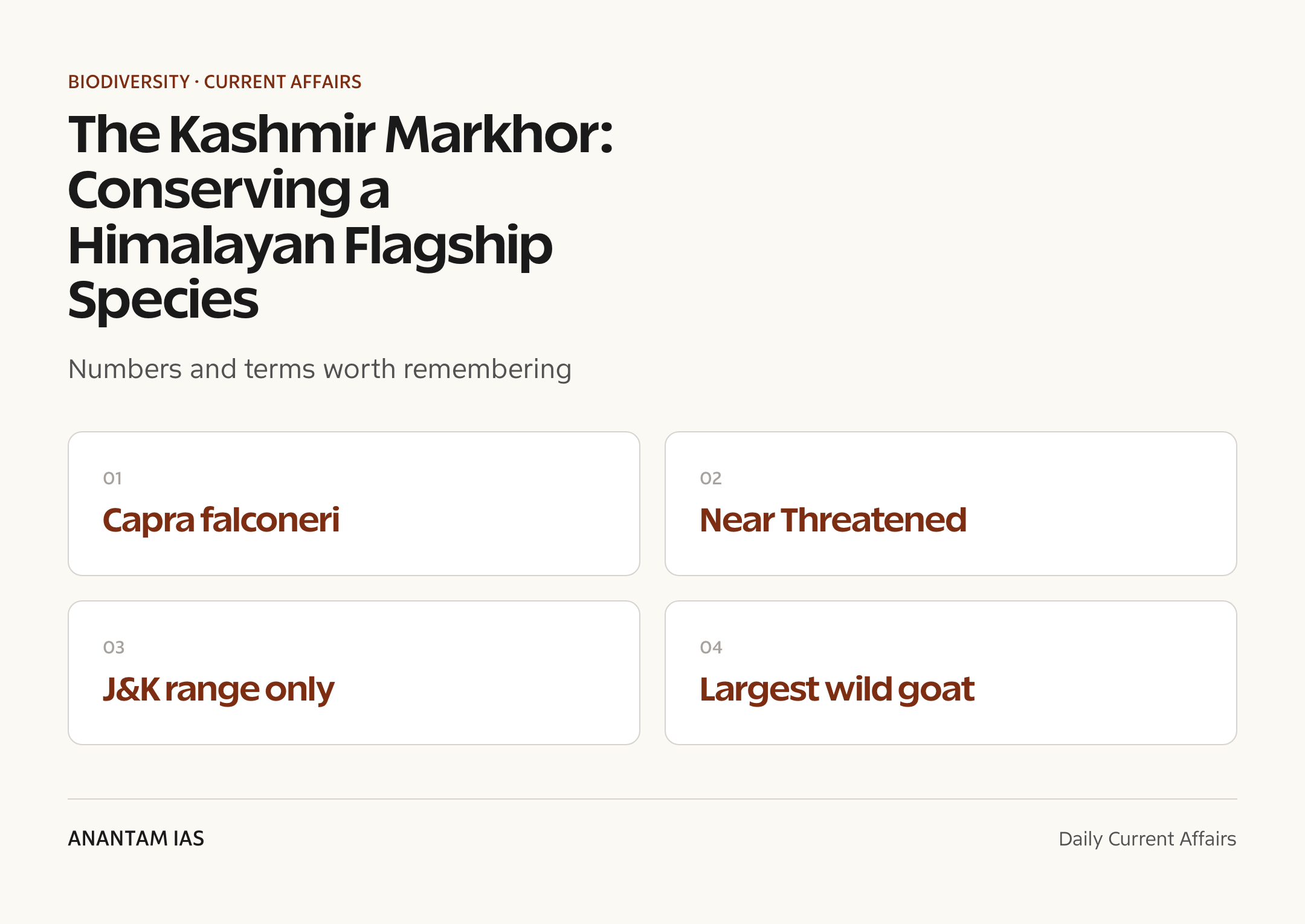
- Capra falconeri — the markhor, the world’s largest wild goat; not a deer or an antelope
- Indian range is restricted to Jammu and Kashmir (Pir Panjal and Kazinag belts)
- IUCN Red List status — Near Threatened (down-listed from Endangered)
- National animal of Pakistan; flare-horned and straight-horned forms exist
- Kazinag National Park and Hirpora Wildlife Sanctuary as key Indian markhor habitats
- Difference between a flagship, indicator, keystone and umbrella species
- Protected under the Wild Life (Protection) Act, 1972 in India
- Shares Himalayan habitat with the snow leopard, its principal natural predator
- Listed on CITES Appendix I, restricting international trade
Mains Relevance
GS Paper 3
- Conserving a flagship Himalayan species through protected areas, the Wild Life (Protection) Act and community reserves.
- Human-wildlife conflict and grazing competition as drivers of mountain biodiversity loss.
- Lessons and limits of incentive-based, community-led conservation models drawn from across the border.
GS Paper 2
- Transboundary conservation cooperation for a species split across the India-Pakistan frontier.
Essay
- Can a single charismatic species rescue an entire landscape — the promise and limits of flagship conservation?
Background and Context
What the markhor is
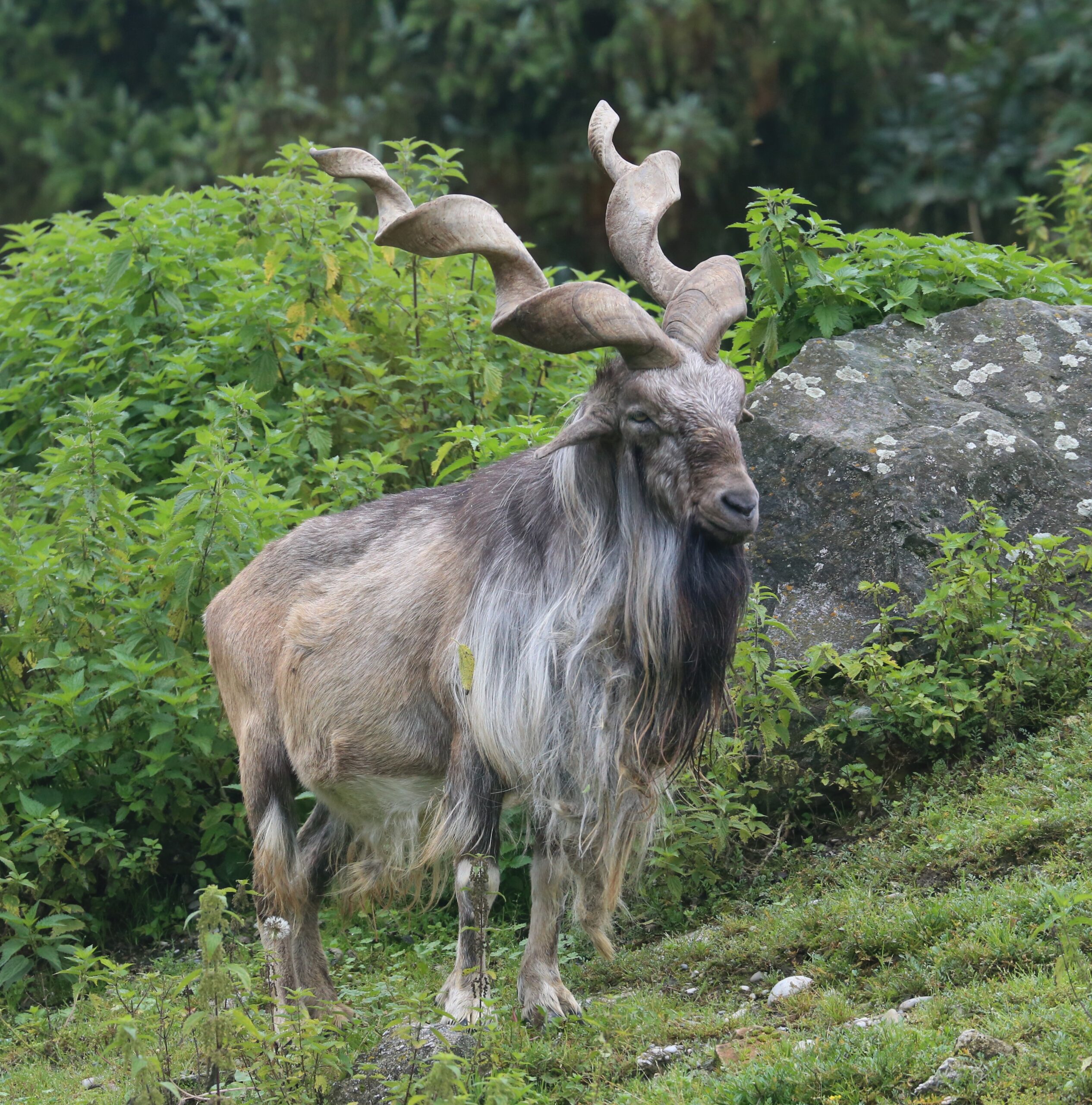
The markhor is a large, spiral-horned wild goat adapted to steep, rugged Himalayan and Central Asian terrain.
- Capra falconeri is the world’s largest wild goat, with males far heavier than females and bearing dramatic corkscrew horns.
- Its global range arcs across the mountains of Pakistan, Afghanistan, Tajikistan, Uzbekistan and the western Himalaya of India.
- Several geographic forms exist — broadly the flare-horned (western) and straight-horned (southern) types.
- India’s animals belong to the Pir Panjal markhor, the flare-horned form at the easternmost edge of the species’ range.
- It grazes and browses on steep grassy and rocky slopes, descending to lower elevations in harsh winter.
Where it survives in India
India holds only a small, fragmented sliver of the global markhor population, confined to Jammu and Kashmir.
- Kazinag National Park, in the lower Jhelum valley, is a core Indian markhor stronghold.
- Hirpora Wildlife Sanctuary along the Pir Panjal protects another key population and a historic migration corridor.
- Animals also persist around Shopian, Boniyar and other pockets of the Pir Panjal range.
- Indian numbers run only to a few hundred, scattered across these isolated patches with limited connectivity.
- Small, broken-up populations are vulnerable to inbreeding, local extinction and chance events.
Why it is threatened
The markhor’s Indian decline is driven by pressure on its mountain habitat rather than any single cause.
- Habitat loss and fragmentation from settlement, infrastructure and degradation of slope pastures.
- Grazing competition with domestic sheep and goats that crowd the same forage and carry disease.
- Poaching for meat and for the prized spiral horns sold as trophies.
- Disturbance along migration routes that severs seasonal movement between summer and winter ranges.
- Disease transmission and predation pressure that small, isolated herds absorb poorly.
Conservation status and legal protection
The markhor sits within an interlocking set of global and Indian protection frameworks.
- IUCN Red List — currently Near Threatened, down-listed from Endangered after recovery elsewhere in its range.
- Listed on CITES Appendix I, banning commercial international trade in the species.
- Protected in India under the Wild Life (Protection) Act, 1972, with its habitats notified as protected areas.
- Conservation rests on the protected-area network plus community reserves that bring local people into stewardship.
- Recovery in Pakistan, where the markhor is the national animal, shows incentive-linked protection can reverse declines.
Flagship and indicator value
The markhor’s worth to conservation goes well beyond its own population numbers.
- As a flagship species, its charisma draws funding, attention and protected-area status that benefit the whole slope ecosystem.
- As an indicator species, a thriving markhor herd signals intact grazing land, low disturbance and a functioning food web.
- It is prey for the snow leopard, so markhor health underpins the survival of a still-rarer Himalayan predator.
- Protecting markhor habitat also shelters co-occurring species across the Himalaya biodiversity hotspot.
- Its plight is a barometer of how well India manages human-wildlife conflict in shared mountain landscapes.
The community-conservation debate
The most-cited markhor success story comes with both a clear model and pointed criticisms.
- Across the border, community conservancies let villages earn from tightly regulated, very limited trophy hunting of old males.
- Channelling that revenue to local communities turned residents into custodians and curbed unregulated poaching.
- Numbers rebounded enough to justify the IUCN down-listing — a headline win for incentive-based conservation.
- Critics question the ethics of hunting for conservation and warn of elite capture of permit revenue.
- India’s path leans instead on the protected-area network, the Wild Life (Protection) Act and non-consumptive community engagement.
Way Forward
Secure and connect the habitat
- Strengthen Kazinag, Hirpora and surrounding reserves and restore corridors so fragmented herds can mix.
- Regulate livestock grazing on key markhor slopes to ease forage and disease pressure.
Build local stewardship
- Develop community reserves and benefit-sharing that give residents a direct stake in markhor survival.
- Curb poaching through patrolling, intelligence and alternative livelihoods rather than enforcement alone.
Monitor and cooperate
- Run regular population surveys and genetic monitoring to track small, isolated herds.
- Explore transboundary cooperation for a species whose range straddles a contested frontier.
Conclusion
The markhor’s Indian story is a reminder that a species can be globally recovering yet locally precarious. The Near Threatened down-listing rides largely on gains across the border, while India’s Pir Panjal animals remain a few hundred individuals scattered across shrinking, disconnected patches of the western Himalaya.
Saving them means protecting habitat, easing grazing competition and stopping poaching — and treating the markhor as a flagship whose fate is tied to the whole mountain ecosystem. Whether through the protected-area network, community reserves or careful borrowing of incentive-based models, the test is the same: keep the slope intact, and the markhor stays.
UPSC Practice Questions
Prelims MCQ 1
With reference to the markhor (Capra falconeri), consider the following statements:
- It is the world’s largest wild goat.
- In India its range is restricted to Jammu and Kashmir.
- It is currently classified as Critically Endangered on the IUCN Red List.
How many of the above statements are correct?
(a) Only one (b) Only two (c) All three (d) None
Answer: (b) Only two
Explanation:
Statements 1 and 2 are correct — the markhor is the largest wild goat and its Indian range is confined to Jammu and Kashmir. Statement 3 is wrong: it is listed as Near Threatened, not Critically Endangered.
Prelims MCQ 2
The markhor is the national animal of which one of the following countries?
(a) Afghanistan (b) Nepal (c) Pakistan (d) Tajikistan
Answer: (c) Pakistan
Explanation:
The markhor is the national animal of Pakistan, where community-run conservancies are credited with helping the species recover.
UPSC Mains Questions
- The markhor is often described as a flagship species of the western Himalaya. Explain what flagship and indicator species mean, and discuss why conserving the markhor matters for the wider Himalayan ecosystem.
- Examine the main threats to the markhor in India and assess how the protected-area network, the Wild Life (Protection) Act, 1972 and community reserves can together secure its small, fragmented populations.
- Incentive-based, community-led conservation has been credited with reviving the markhor across its range. Critically analyse the promise and the limits of such models for Indian wildlife conservation.
Sources: IUCN Red List, Wildlife Institute of India and Jammu & Kashmir Department of Wildlife Protection.
Frequently Asked Questions
What is the markhor?
The markhor (Capra falconeri) is the world’s largest species of wild goat, instantly recognisable by the long, spiralling corkscrew horns of the males. It lives on steep, rugged slopes across the mountains of Pakistan, Afghanistan, Central Asia and the western Himalaya of India, where it grazes and browses on grassy and rocky terrain.
Where is the markhor found in India?
India’s markhor survives only in Jammu and Kashmir, in small, fragmented populations along the Pir Panjal range. Key sites include Kazinag National Park, the Hirpora Wildlife Sanctuary, and pockets around Boniyar and Shopian. The total Indian population runs to only a few hundred animals scattered across these isolated patches.
What is the markhor’s conservation status?
The markhor is listed as Near Threatened on the IUCN Red List, having been down-listed from Endangered after recovery in parts of its range, mainly Pakistan. It is also on CITES Appendix I, which bans commercial international trade, and is protected in India under the Wild Life (Protection) Act, 1972.
Why is the markhor threatened in India?
The main threats are habitat loss and fragmentation, grazing competition with domestic sheep and goats that crowd its forage and spread disease, and poaching for meat and its prized horns. Small, disconnected herds are also vulnerable to inbreeding, disease and chance events that can wipe out a local population.
Which country has the markhor as its national animal?
Pakistan has the markhor as its national animal. There, village-run community conservancies have used tightly regulated, very limited trophy hunting of old males to fund conservation and curb poaching, a model often credited with helping markhor numbers recover, though it remains ethically debated.
Why is the markhor called a flagship species?
As a charismatic, recognisable animal, the markhor attracts attention, funding and protected-area status that benefit its entire mountain habitat. It is also an indicator species — a healthy markhor herd signals an intact slope ecosystem — and it is prey for the snow leopard, so protecting it helps safeguard wider Himalayan biodiversity.
Source: https://anantamias.com/current-affairs/kashmir-markhor-conservation-2026/