Daily Digest
UPSC · Civil Services Examination
Current Affairs · Friday, 10 July 2026
Current affairs curated and edited by Anantam IAS faculty — pulled from The Hindu, PIB, IDSA, Foreign Affairs and the ministries. Read, annotate, revise.
Old Rajinder Nagar · Delhi 110005 · anantamias.com
Astra Mk-1: India’s First Air-to-Air Missile Export Heads to Indonesia
Why in News?
India has secured the first-ever export order for the Astra Mk-1, its indigenous Beyond-Visual-Range Air-to-Air Missile (BVRAAM). The agreement was signed between Bharat Dynamics Limited (BDL) and Indonesia’s state defence holding company Republikorp, and was announced around the recent high-level India-Indonesia engagements.
The Astra Mk-1 is designed by the Defence Research and Development Organisation (DRDO) and manufactured by BDL. Indonesia intends to integrate the missile on its Su-30 fighter fleet, making it the launch export customer for a weapon the Indian Air Force already fields.
- The Astra Mk-1 is India’s first fully indigenous BVRAAM, developed by DRDO for the Indian Air Force and Navy and cleared for full-scale production in 2024.
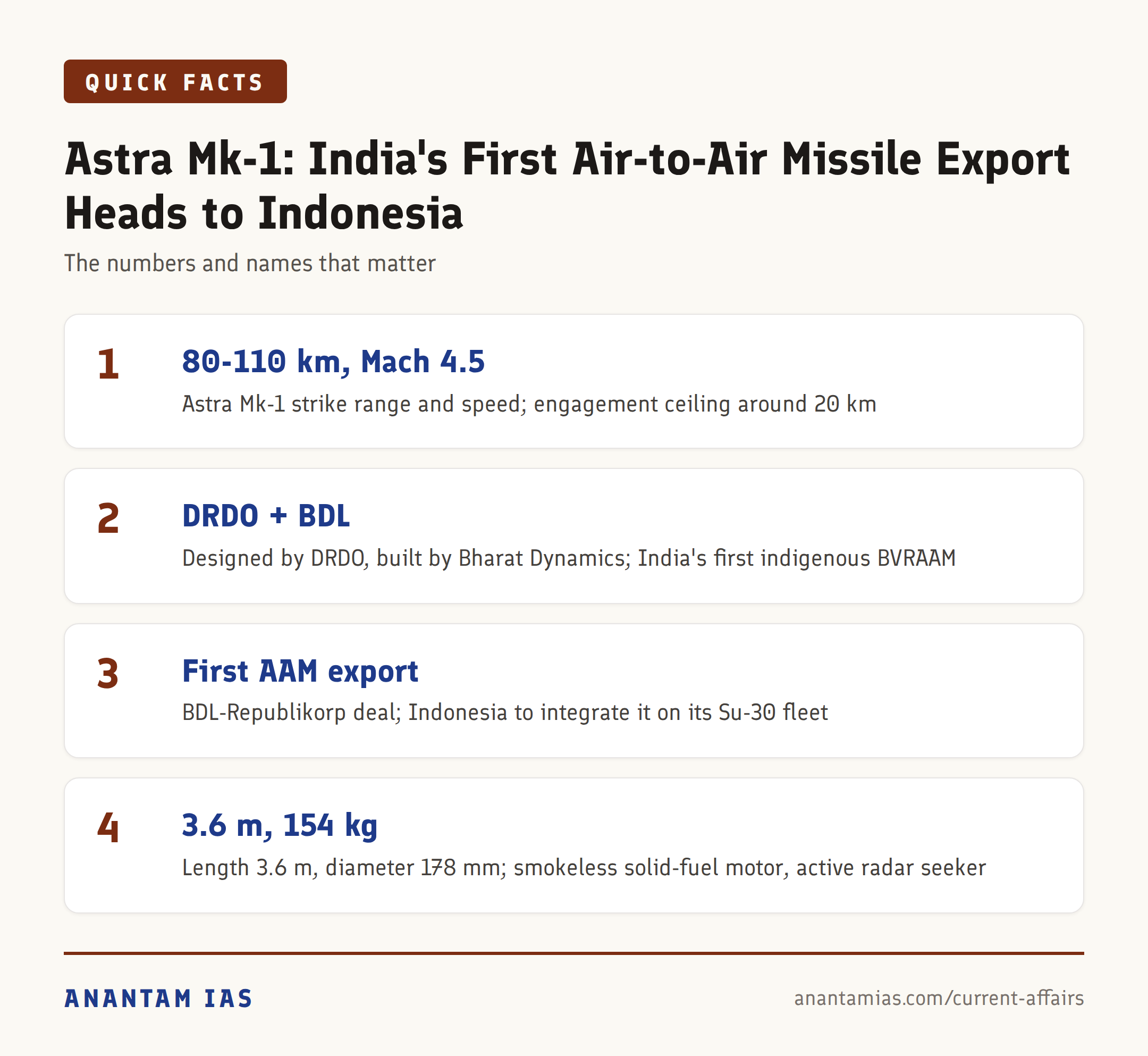
- Key parameters: strike range of 80-110 km (extendable in favourable launch conditions), speed of Mach 4.5, and an engagement ceiling of about 20 km altitude.
- The missile is 3.6 m long, 178 mm in diameter and weighs about 154 kg, using a smokeless solid-fuel motor for a reduced launch signature.
- Guidance is mid-course inertial with datalink updates and terminal active radar homing, with electronic counter-countermeasures (ECCM) to resist jamming.
- The deal makes Indonesia the first foreign buyer of the Astra and is being read as a template for further Southeast Asian sales alongside BrahMos.
The development matters in the context of:
- It moves India visibly up the value chain from arms importer to exporter of a sophisticated, software-defined weapon, the harder end of the defence-export ladder.
- It deepens the India-Indonesia defence relationship and India’s Act East footprint, following earlier BrahMos and Sabang-port cooperation.
- It advances the government’s target of expanding defence exports and the Atmanirbhar Bharat push in high-technology military systems.
UPSC Relevance
Prelims Relevance
- Astra Mk-1: India’s first indigenous BVRAAM, developed by DRDO, manufactured by Bharat Dynamics Limited (BDL); cleared for full production in 2024.
- Specifications: range 80-110 km, speed Mach 4.5, ceiling around 20 km; length 3.6 m, diameter 178 mm, weight ~154 kg.
- Guidance: inertial navigation + mid-course datalink + terminal active radar homing; smokeless solid-fuel motor; ECCM against electronic warfare.
- Integration: fielded on the Su-30 MKI; being integrated with LCA Tejas and planned for other IAF fighters.
- Export: signed between BDL and Republikorp (Indonesia); Indonesia to fit it on its Su-30 fleet; India’s first air-to-air missile export.
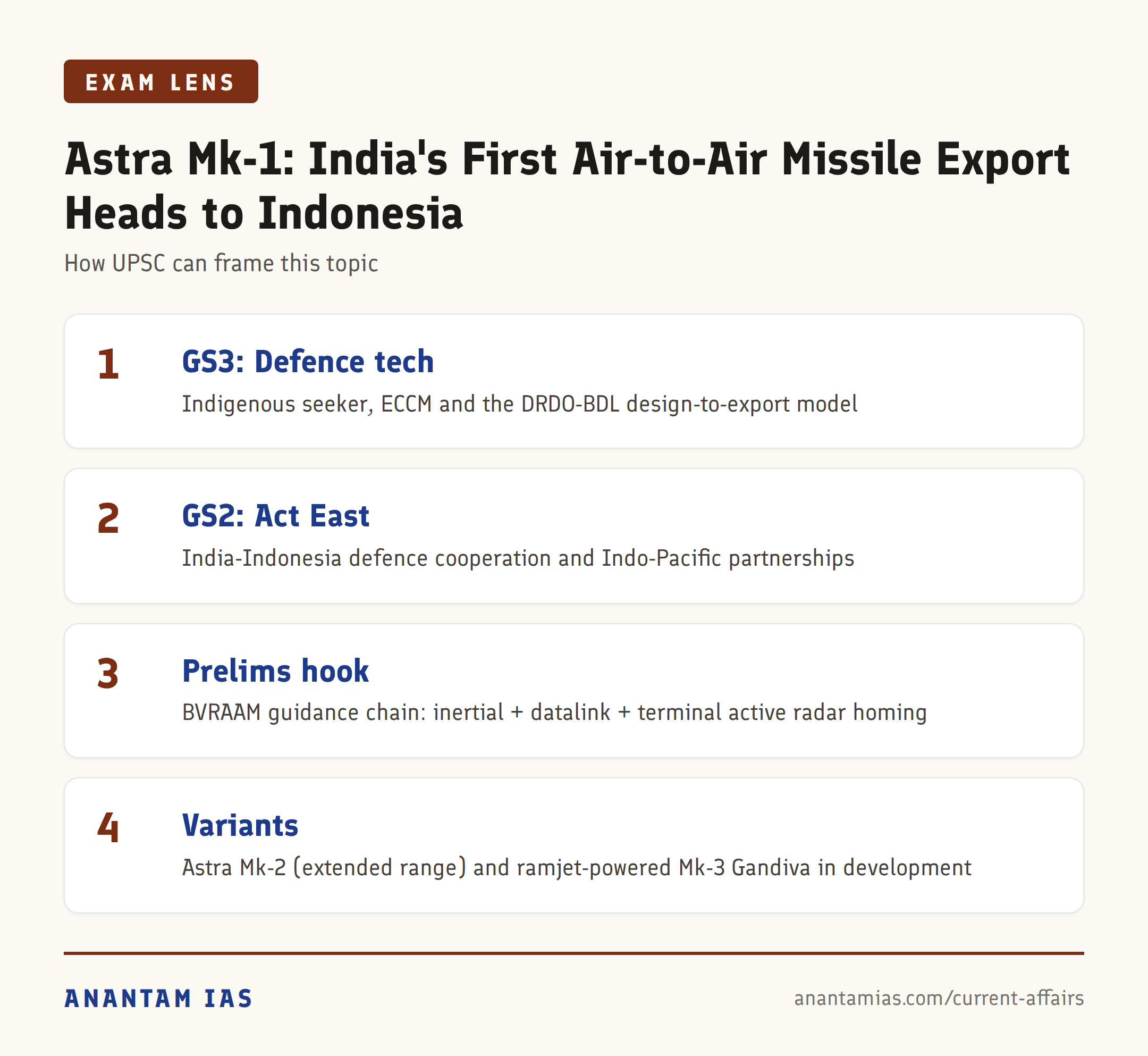
- Variants under development: Astra Mk-2 (extended range, ~160-200 km class) and the ramjet-powered Astra Mk-3 (Gandiva).
- A BVRAAM engages targets beyond the pilot’s visual range: launched under aircraft-radar guidance, then homing autonomously via its own seeker in the terminal phase.
Mains Relevance
GS Paper 3
- Indigenous defence manufacturing: the DRDO-BDL model from design to production to export, and what the Astra sale signals about capability maturity.
- Defence exports as strategic tool: how weapon sales build partnerships, interoperability and long-term influence with buyer states.
- Technology self-reliance: the significance of an indigenous seeker and ECCM suite in a contested electronic-warfare environment.
GS Paper 2
- India-Indonesia and the Act East Policy: defence cooperation as the newest and fastest-growing pillar of the relationship.
- India in the global arms market: positioning against established exporters and the diplomacy of defence sales in Southeast Asia.
Essay
- From buyer to builder to seller: the long arc of technological self-reliance in national security.
- Weapons as diplomacy: what a state exports says about the partnerships it wants to build.
Background and Context
What the Astra Programme Is
Astra is a family of Indian air-to-air missiles built to give fighters a decisive first-shot advantage.
- The programme was developed by DRDO to give the IAF an indigenous alternative to imported BVR missiles, ending dependence on foreign air-to-air weapons.
- The Mk-1 is the operational variant, integrated on the Su-30 MKI and cleared for full-scale production by BDL in 2024 after more than 50 trial firings.
- Astra Mk-2, with an extended range in the 160-200 km class, and the ramjet-powered Mk-3 (Gandiva) are under development for far longer reach.
- The missile’s combat use during Operation Sindoor gave it a ‘combat-proven’ label that buyers weigh heavily.
Why Indonesia, and Why This Deal Matters
Jakarta’s purchase is the first crack in the export market for Indian air-to-air missiles.
- Indonesia operates Su-27/Su-30 fighters on which the Astra Mk-1 can be integrated, making it a natural launch customer.
- The agreement was signed between BDL and Republikorp, Indonesia’s defence holding company, alongside the wider India-Indonesia defence engagement that has also featured BrahMos.
- It positions India to market the missile to other Su-27/30 operators seeking to replace ageing Russian-origin air-to-air weapons.
- For BDL, export orders typically carry better margins and, more importantly, validate Indian systems in the global market.
How a BVRAAM Works
Beyond-visual-range combat is now the decisive phase of most air engagements.
- The launch aircraft detects and tracks the target on its radar and fires the missile while still beyond visual range.
- In the mid-course phase the missile flies on inertial guidance with datalink updates from the launch fighter.
- In the terminal phase the missile’s own active radar seeker switches on, acquires the target and homes in autonomously.
- ECCM features let it hold lock through enemy jamming, the capability that separates modern BVRAAMs from older designs.
The Defence-Export Context
The Astra sale fits a decade-long push to turn India into a net arms exporter.
- India has steadily raised its defence-export figures and set ambitious targets under the Atmanirbhar Bharat and Make in India frameworks.
- Previous milestones include the BrahMos export to the Philippines (2022) and growing interest from other ASEAN states.
- Air-to-air missiles are among the hardest systems to export because of the seeker, guidance and integration complexity, so the Astra deal is a capability statement.
- Export success also creates a sustaining order book for DRDO-BDL beyond domestic IAF demand.
Way Forward
For the Programme
- Ensure smooth integration and after-sales support for Indonesia’s Su-30 fleet, since export reputation rests on sustainment as much as the missile.
- Accelerate Astra Mk-2 and Mk-3 development to keep India competitive at longer ranges against Chinese and Western BVRAAMs.
- Deepen indigenous seeker and propulsion capacity to reduce residual import dependence.
For Defence Diplomacy
- Package the Astra with training, financing and offsets, the model that closed the BrahMos-Philippines deal.
- Use the Indonesia sale as a reference to market the missile to other Su-27/30 and Rafale operators.
- Align export promotion with the strategic logic of Act East and Indo-Pacific partnerships.
Conclusion
The Astra Mk-1’s first export is a genuine milestone: not a component or a small arm, but a complete, guided, software-defined air-to-air missile with an indigenous seeker, sold to a strategically important partner. It tells the world that India can design, build and now export the harder classes of military technology.
The real test is what follows. Reliable integration and support for Indonesia, timely delivery of the longer-range Mk-2 and Mk-3, and disciplined defence diplomacy will decide whether this first sale becomes the start of a sustained export story.
UPSC Practice Questions
Prelims MCQ 1
With reference to the Astra Mk-1 missile, consider the following statements:
- It is India’s first indigenously developed beyond-visual-range air-to-air missile.
- It is developed by the DRDO and manufactured by Bharat Dynamics Limited.
- Its export to Indonesia marks the first overseas sale of an Indian air-to-air missile.
How many of the above statements are correct?
(a) Only one (b) Only two (c) All three (d) None
Answer: (c) All three
Explanation:
All three are correct. The Astra Mk-1 is India’s first indigenous BVRAAM, designed by DRDO and manufactured by BDL, and cleared for full-scale production in 2024. The agreement with Indonesia’s Republikorp is the first export of an Indian air-to-air missile, with Jakarta planning to integrate it on its Su-30 fleet.
Prelims MCQ 2
A beyond-visual-range air-to-air missile such as the Astra Mk-1 typically relies on which guidance sequence?
(a) Wire guidance throughout the flight (b) Mid-course inertial guidance with datalink, then terminal active radar homing (c) Purely infrared homing from launch (d) Ground-station radio command for the entire flight
Answer: (b) Mid-course inertial guidance with datalink, then terminal active radar homing
Explanation:
A modern BVRAAM is launched under the fighter’s radar picture and flies on inertial guidance with mid-course datalink updates. In the terminal phase its own active radar seeker switches on and homes onto the target autonomously. This is precisely the Astra Mk-1’s guidance chain, combined with ECCM to resist jamming.
UPSC Mains Questions
- The first export of the Astra Mk-1 marks India’s transition in a difficult segment of the global arms market. Examine the significance of indigenous air-to-air missile development for India’s strategic autonomy and defence-export ambitions. (250 words)
- Defence exports are as much an instrument of foreign policy as of industrial growth. Discuss with reference to India’s growing defence cooperation with Southeast Asian states. (250 words)
Frequently Asked Questions
What is the Astra Mk-1?
It is India’s first indigenously developed beyond-visual-range air-to-air missile, designed by the DRDO for the Indian Air Force and Navy and manufactured by Bharat Dynamics Limited. It was cleared for full-scale production in 2024 and is integrated on the Su-30 MKI, with integration on the LCA Tejas under way.
Why is the Indonesia deal significant?
It is the first-ever export of an Indian air-to-air missile. The agreement between Bharat Dynamics and Indonesia’s Republikorp makes Jakarta the launch foreign customer, with the missile to be integrated on Indonesia’s Su-30 fleet. It signals that India can export complete guided-missile systems, not just components.
What are the missile’s key specifications?
The Astra Mk-1 has a strike range of about 80 to 110 km, a speed of Mach 4.5 and an engagement ceiling near 20 km. It is roughly 3.6 m long, 178 mm in diameter and weighs about 154 kg, using a smokeless solid-fuel motor and an active radar seeker with electronic counter-countermeasures.
How does a beyond-visual-range missile work?
The launch aircraft fires it while the target is still beyond the pilot’s visual range. The missile flies on inertial guidance with mid-course datalink updates, and in the terminal phase its own active radar seeker acquires and homes onto the target autonomously, resisting jamming through ECCM features.
What variants of the Astra exist?
The Mk-1 is the operational variant. The Astra Mk-2, with a longer range in the 160-200 km class, and the ramjet-powered Astra Mk-3 (Gandiva), designed for much greater reach, are under development to keep India competitive with the latest Chinese and Western air-to-air missiles.
How does this fit India’s defence-export goals?
It advances the Atmanirbhar Bharat and Make in India push and the government’s target of scaling up defence exports. Air-to-air missiles are among the hardest systems to export because of seeker and integration complexity, so the sale is a strong statement of India’s high-technology defence capability.
Source: https://anantamias.com/current-affairs/astra-mk1-first-air-to-air-missile-export-indonesia/
Parrot Bornavirus (PaBV-4) Detected in India for the First Time
Why in News?
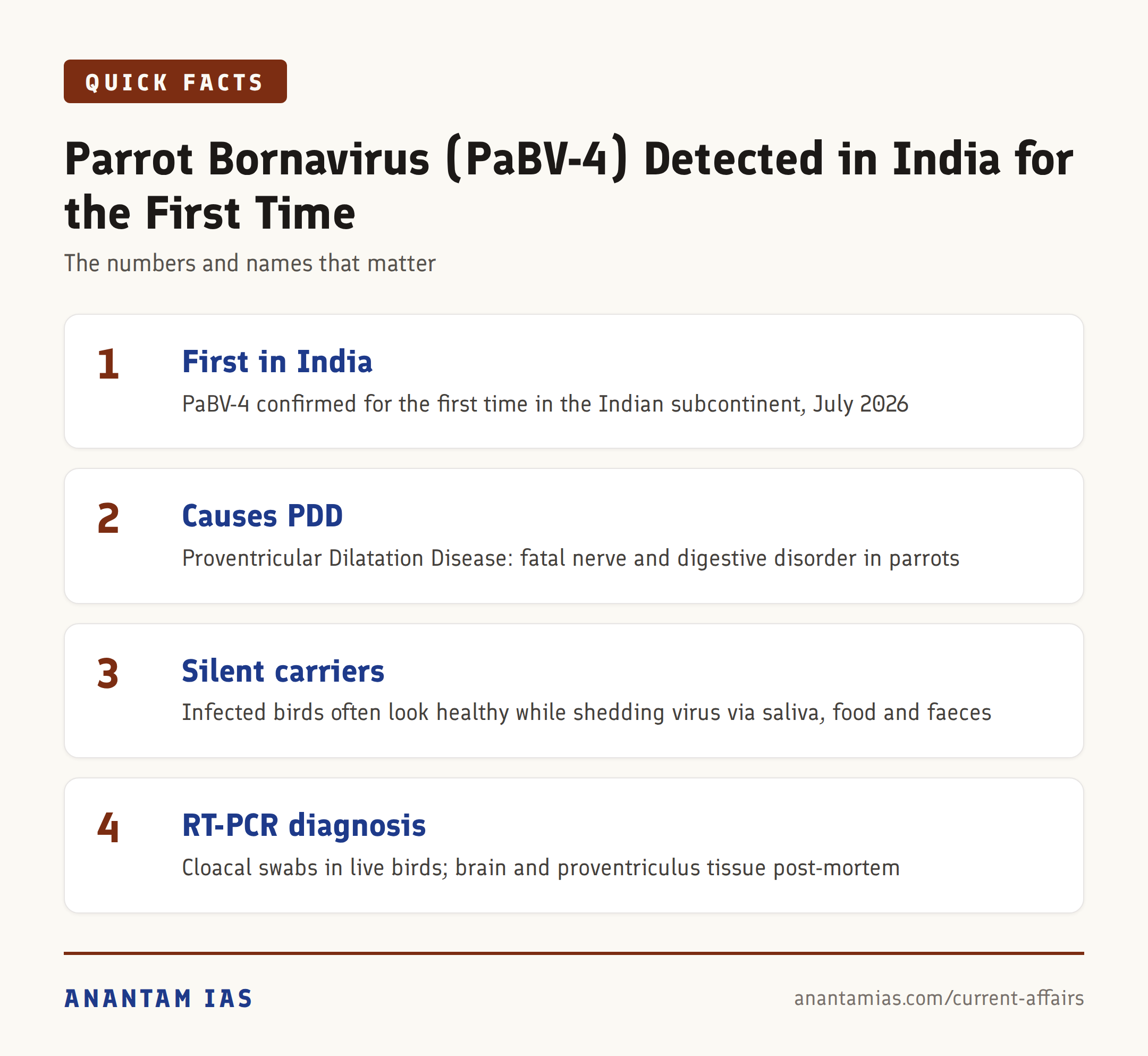
A July 2026 study has reported the first confirmed detection of Parrot Bornavirus (PaBV-4) circulating in India, the first official record of the virus in the Indian subcontinent. The pathogen causes Proventricular Dilatation Disease (PDD), a fatal neurological and digestive disorder in psittacine birds (parrots, parakeets, macaws, cockatoos and related species).
The finding matters for India’s large captive-bird and aviculture ecosystem, since infected birds can appear healthy while silently shedding the virus, spreading it through aviaries without visible symptoms.
- Parrot Bornavirus (PaBV) is an avian bornavirus and the causative agent of Proventricular Dilatation Disease (PDD) in psittacine (parrot-family) birds.
- The disease damages the nerves controlling the digestive tract, enlarging the proventriculus (the glandular stomach), causing poor digestion, undigested food in droppings, weight loss and eventual death.
- Damage is largely immune-driven inflammation of nerves rather than direct destruction of infected cells, a non-cytolytic infection that persists in the bird.
- Many infected birds are asymptomatic carriers, appearing healthy while shedding the virus through saliva, droppings and contaminated food and water; it can also pass from parent birds to eggs.
- Diagnosis relies on RT-PCR, best from cloacal swabs in live birds and from brain and proventriculus tissue in dead birds.
The development matters in the context of:
- It is a biosecurity and conservation concern for India’s captive parrots, breeding aviaries and zoos, and for pet-trade birds.
- It illustrates how emerging animal pathogens enter new geographies through trade and movement of species, a recurring UPSC theme in health and environment.
- It tests India’s animal-disease surveillance and the need for screening in the exotic-bird trade.
UPSC Relevance
Prelims Relevance
- Parrot Bornavirus (PaBV-4): an avian bornavirus causing Proventricular Dilatation Disease (PDD) in psittacine (parrot-family) birds; first detected in India in July 2026.
- Proventriculus: the glandular stomach of birds; PDD causes its dilation, hence the disease name.
- The infection is non-cytolytic: harm comes from immune-mediated inflammation of nerves, not direct cell destruction; infection is persistent.
- Transmission: contaminated food, water, saliva and faeces, and vertically from infected parents to eggs; many carriers are asymptomatic.
- Diagnosis: RT-PCR from cloacal swabs (live birds) and brain/proventriculus tissue (dead birds).
- Psittacine birds include parrots, parakeets, macaws, cockatoos, lovebirds and budgerigars; India hosts native parakeets and a large captive/pet population.
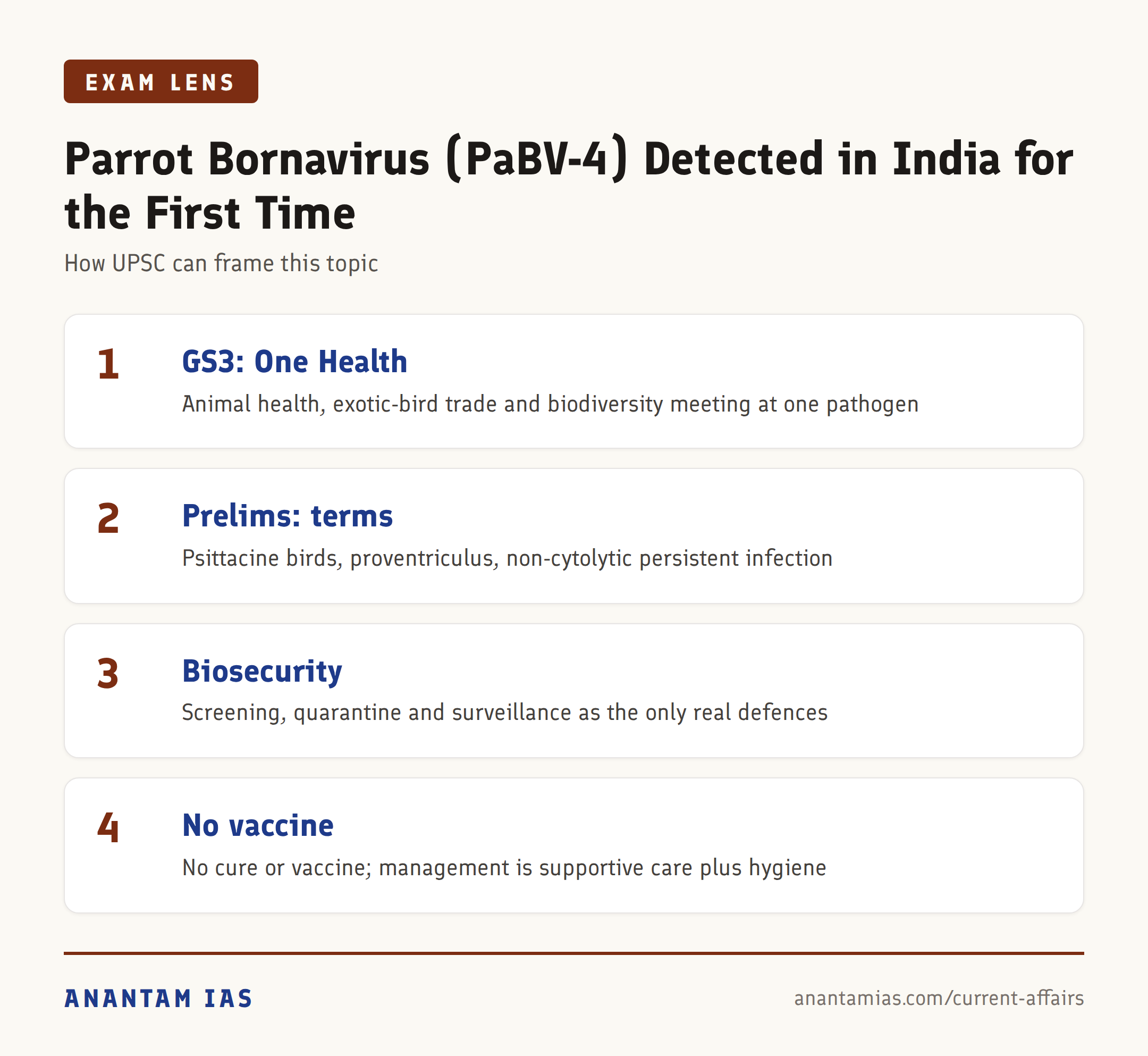
- There is no specific cure or vaccine; management is supportive, making biosecurity and screening the main defences.
Mains Relevance
GS Paper 3
- Emerging and transboundary animal diseases: pathways of introduction through wildlife and pet trade, and the surveillance gaps they expose.
- Biosecurity in aviculture and zoos: screening, quarantine and the role of diagnostics like RT-PCR in containment.
- One Health framing: the interface of animal health, trade regulation and biodiversity conservation.
GS Paper 2
- Regulation of the exotic-species and pet trade: the governance challenge of screening imported and captive birds for novel pathogens.
Essay
- Invisible passengers: how trade in living things moves disease across borders faster than regulation can follow.
- The healthy-looking carrier: why the hardest diseases to control are the ones that hide.
Background and Context
What PaBV and PDD Are
The virus and the disease it causes are well known in global aviculture, now confirmed in India.
- Parrot Bornavirus belongs to the bornavirus family and is the accepted cause of PDD, first described in captive parrots decades ago and reported across many countries.
- PDD attacks the nerves of the gastrointestinal tract, so the bird cannot move food properly; the proventriculus dilates and the bird slowly starves despite eating.
- Some birds also show neurological signs, tremors, weakness and coordination loss, when the virus affects the central nervous system.
- The infection is persistent and non-cytolytic: the immune response to the virus, rather than the virus itself, drives much of the nerve damage.
Why the India Detection Is Significant
A first record changes the risk picture for the country’s captive-bird populations.
- India has a large captive and pet-bird population and active aviculture, plus native parakeet species, all potentially susceptible.
- Because carriers can be asymptomatic, the virus can spread silently through breeding aviaries and the trade before disease appears.
- Confirmation in India signals the need for screening in the exotic-bird trade and in zoo and rescue-centre collections.
- It also raises questions about the route of entry, typically the movement and trade of infected birds across borders.
How It Spreads and Is Detected
Transmission routes and diagnostics shape any containment strategy.
- Spread occurs through contaminated food, water, saliva and faeces, and vertically from parent to egg.
- The virus is shed intermittently, which makes a single negative test unreliable and complicates screening.
- RT-PCR is the mainstay diagnostic: cloacal swabs in live birds, and brain and proventriculus tissue post-mortem.
- There is no licensed vaccine or specific antiviral; management is supportive care plus strict biosecurity.
The Wider One Health and Trade Angle
PaBV joins a list of pathogens that ride the global movement of animals.
- The detection fits the One Health lens linking animal health, trade and biodiversity that India increasingly adopts.
- Regulating the exotic-pet and bird trade, including screening and quarantine, is the practical lever to limit introduction of such pathogens.
- For conservation breeding of threatened psittacines, an undetected carrier can jeopardise an entire programme.
- Strengthening veterinary diagnostic capacity for novel avian viruses is the systemic lesson.
Way Forward
For Biosecurity
- Introduce RT-PCR screening and quarantine for captive parrots in breeding centres, zoos and the regulated trade.
- Build awareness among aviculturists and pet owners about asymptomatic carriage and hygiene practices.
- Map the likely route of introduction and tighten checks at the points of entry for exotic birds.
For the System
- Fold avian bornavirus into national animal-disease surveillance and veterinary lab networks.
- Apply a One Health approach linking wildlife, veterinary and trade authorities.
- Protect conservation-breeding programmes for native and endangered psittacines through routine testing.
Conclusion
The first Indian detection of Parrot Bornavirus is a warning rather than an emergency: the disease it causes is untreatable and often invisible until late, so the country’s defence lies in surveillance, screening and biosecurity across the captive-bird trade. Catching a silent carrier early is far cheaper than losing an aviary or a breeding programme.
For UPSC, the case is a clean illustration of the One Health idea, where trade in living animals, veterinary diagnostics and biodiversity protection meet at a single pathogen.
UPSC Practice Questions
Prelims MCQ 1
With reference to Parrot Bornavirus (PaBV) and Proventricular Dilatation Disease (PDD), consider the following statements:
- The disease primarily affects psittacine birds such as parrots, parakeets and macaws.
- Infected birds can be asymptomatic carriers that shed the virus while appearing healthy.
- A licensed vaccine is widely used to prevent the disease in captive birds.
How many of the above statements are correct?
(a) Only one (b) Only two (c) All three (d) None
Answer: (b) Only two
Explanation:
Statements 1 and 2 are correct: PaBV causes PDD in psittacine birds, and asymptomatic carriage with silent shedding is a defining feature that complicates control. Statement 3 is incorrect: there is no licensed vaccine or specific antiviral; management is supportive care combined with biosecurity, quarantine and RT-PCR screening.
Prelims MCQ 2
The term ‘proventriculus’, which gives Proventricular Dilatation Disease its name, refers to which of the following?
(a) The glandular stomach of birds (b) A part of the avian respiratory system (c) The nerve controlling flight muscles (d) A gland that produces egg shells
Answer: (a) The glandular stomach of birds
Explanation:
The proventriculus is the glandular stomach in birds, which secretes digestive enzymes before food passes to the muscular gizzard. In PDD, damage to the nerves supplying the digestive tract causes the proventriculus to dilate, impairing digestion and leading to weight loss and death, hence the disease’s name.
UPSC Mains Questions
- The first detection of Parrot Bornavirus in India highlights the biosecurity risks embedded in the trade and movement of animals. Discuss the challenges of surveillance for emerging animal pathogens and the relevance of the One Health approach. (250 words)
- Asymptomatic carriage makes certain animal diseases exceptionally hard to control. Examine this proposition and suggest measures to protect captive and conservation-bred bird populations in India. (150 words)
Frequently Asked Questions
What is Parrot Bornavirus?
It is an avian bornavirus and the accepted cause of Proventricular Dilatation Disease (PDD), a fatal disorder of psittacine birds such as parrots, parakeets, macaws and cockatoos. A July 2026 study reported its first confirmed detection in India, the first record in the subcontinent.
What does the disease do to birds?
PaBV damages the nerves controlling the digestive tract, causing the proventriculus, the glandular stomach, to dilate. Affected birds cannot digest food properly, pass undigested food in droppings, lose weight and eventually die. Some also show neurological signs such as tremors and weakness when the nervous system is affected.
Why is the India detection concerning?
India has a large captive and pet-bird population and active aviculture, along with native parakeet species. Because infected birds can be asymptomatic carriers, the virus can spread silently through aviaries and the trade before disease appears, threatening breeding centres, zoos and conservation programmes.
How does the virus spread?
Through contaminated food, water, saliva and faeces, and vertically from infected parent birds to their eggs. Shedding is intermittent, which is why a single negative test is unreliable and why silent carriers are central to the disease’s spread.
How is it diagnosed and treated?
Diagnosis relies on RT-PCR, best from cloacal swabs in live birds and from brain and proventriculus tissue in dead birds. There is no licensed vaccine or specific antiviral; management is supportive care combined with strict biosecurity, quarantine and screening.
What is the policy takeaway?
The case underlines the need for RT-PCR screening and quarantine in the captive-bird trade, integration of avian bornavirus into national animal-disease surveillance, and a One Health approach linking veterinary, wildlife and trade authorities to limit the introduction and spread of such pathogens.
Source: https://anantamias.com/current-affairs/parrot-bornavirus-pabv4-first-detection-india/
CE20 Cryogenic Engine Clears Flight-Acceptance Test for LVM3-M7
Why in News?
The Indian Space Research Organisation (ISRO) has successfully carried out the flight-acceptance hot test of the CE20 cryogenic engine that will power the upper stage (C25) of an upcoming LVM3-M7 mission. The test qualifies this specific engine for flight.
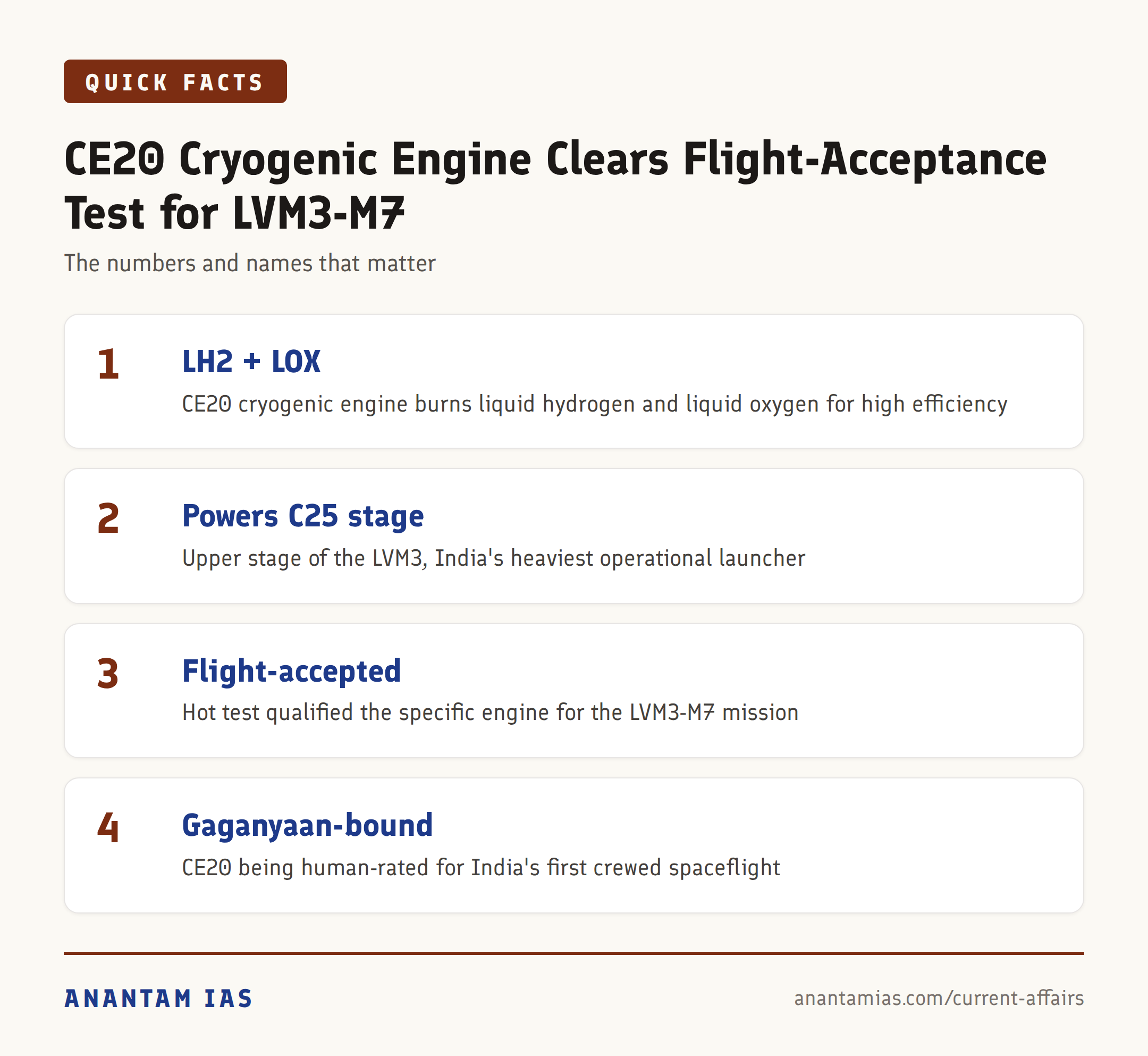
The CE20 is India’s indigenously developed cryogenic engine, burning liquid hydrogen (LH2) and liquid oxygen (LOX). Cryogenic propulsion is among the most technically demanding rocket technologies, and mastering it placed India in a small group of spacefaring nations.
- CE20 is a cryogenic engine developed by ISRO’s Liquid Propulsion Systems Centre (LPSC), powering the C25 upper stage of the LVM3 (Launch Vehicle Mark-3).
- It uses the LH2/LOX propellant combination, giving very high specific impulse (fuel efficiency) essential for injecting heavy payloads into orbit.
- The engine operates on a gas-generator cycle and has been progressively uprated to higher thrust levels across missions.
- A flight-acceptance test hot-fires the actual flight engine to confirm its performance before it is cleared for a specific mission, here LVM3-M7.
- CE20 variants are central to Gaganyaan, India’s human-spaceflight programme, where the engine is being human-rated for crew safety.
The development matters in the context of:
- LVM3 is India’s heaviest operational launcher, carrying Chandrayaan-3, commercial OneWeb constellations and the planned Gaganyaan crew missions.
- Cryogenic mastery is a marker of strategic and commercial space capability, reducing dependence on foreign upper stages.
- Each successful acceptance test de-risks the launch manifest and the human-spaceflight timeline.
UPSC Relevance
Prelims Relevance
- CE20: indigenous cryogenic engine by ISRO’s LPSC; powers the C25 upper stage of the LVM3.
- Propellant: liquid hydrogen (LH2) + liquid oxygen (LOX); engine cycle is the gas-generator type.
- LVM3 (formerly GSLV Mk III): India’s heaviest operational launcher; three stages, two solid strap-ons (S200), a liquid core (L110) and the cryogenic C25 upper stage.
- LVM3 payload: about 4,000 kg to GTO and up to 8,000 kg to LEO; launched Chandrayaan-2 and Chandrayaan-3 and OneWeb satellites.
- A flight-acceptance test hot-fires the actual flight article to confirm performance before integration.
- Gaganyaan: India’s first human-spaceflight programme; a human-rated LVM3 (HLVM3) is the launcher, and CE20 is being human-rated.
- Cryogenic engines use propellants at extremely low temperatures (LH2 near -253 C, LOX near -183 C), giving high efficiency but demanding complex handling.
Mains Relevance
GS Paper 3
- Indigenous cryogenic technology: the strategic significance of self-reliant high-thrust upper stages for heavy-lift capability.
- Human-rating and reliability engineering: what qualifying CE20 for Gaganyaan demands in testing and safety margins.
- India’s space economy: LVM3’s role in commercial launch services and the push for larger indigenous launchers (NGLV).
GS Paper 2
- Space diplomacy and self-reliance: reducing dependence on foreign launch capability as a matter of strategic autonomy.
Essay
- The cold heart of a rocket: how mastering the hardest propulsion technology reshaped India’s space ambitions.
- Reliability as a value: the engineering culture behind putting humans safely into orbit.
Background and Context
What the CE20 Engine Is
The CE20 is the workhorse cryogenic upper-stage engine of India’s heavy launcher.
- Developed by ISRO’s LPSC, the CE20 powers the C25 cryogenic upper stage of the LVM3.
- It burns LH2 and LOX on a gas-generator cycle, and has been uprated across missions to lift heavier payloads.
- Cryogenic upper stages deliver the high efficiency needed to inject satellites into geostationary transfer orbit and beyond.
- India developed cryogenic technology indigenously after facing technology-denial in the 1990s, a long and hard-won capability.

Why Flight-Acceptance Testing Matters
Every flight engine is individually proven before it is trusted with a mission.
- A flight-acceptance hot test fires the specific engine that will fly, confirming thrust, combustion stability and system health.
- Passing it clears the engine for integration with the C25 stage and the LVM3-M7 vehicle.
- This individual qualification is central to ISRO’s reliability record on the LVM3.
- For crewed missions the bar rises further to human-rating, with added margins and redundancy.
LVM3 and the Missions It Carries
The engine’s importance flows from the launcher it powers.
- LVM3 is India’s heaviest operational rocket, lofting about 4 tonnes to GTO and up to 8 tonnes to LEO.
- It launched Chandrayaan-2 and Chandrayaan-3 and multiple OneWeb commercial constellations.
- A human-rated LVM3 (HLVM3) is the launcher for the Gaganyaan crewed missions.
- Reliable CE20 performance underpins both the commercial manifest and the human-spaceflight schedule.
The Human-Spaceflight Dimension
CE20’s testing feeds directly into Gaganyaan readiness.
- Gaganyaan is India’s first crewed programme, targeting a low-Earth-orbit mission with Indian astronauts.
- The CE20 is being human-rated, meaning higher safety factors, exhaustive testing and demonstrated reliability.
- Uncrewed test flights and the crew-escape system are being validated in parallel.
- Each acceptance test is a building block toward a safe crewed launch.
Way Forward
For the Programme
- Sustain the cadence of acceptance and qualification tests to keep the LVM3 manifest and Gaganyaan on track.
- Complete human-rating of CE20 and the HLVM3 with the required margins.
- Advance the Next-Generation Launch Vehicle (NGLV) to raise India’s heavy-lift ceiling.
For the Space Economy
- Leverage proven cryogenic capability to win more commercial launch contracts.
- Deepen the private-sector and IN-SPACe role in propulsion and stage manufacture.
- Build indigenous capacity for reusable and higher-thrust engines for the future.
Conclusion
The CE20’s flight-acceptance test is a routine-sounding milestone that carries real weight: it proves the exact engine that will fly, keeps the LVM3 launch manifest moving, and advances the human-rating that Gaganyaan depends on. Cryogenic reliability, hard-won after decades of indigenous effort, is now a dependable Indian capability.
For UPSC, the story links technology self-reliance, the space economy and human spaceflight in a single engine test, a compact example of why propulsion mastery matters strategically and commercially.
UPSC Practice Questions
Prelims MCQ 1
With reference to the CE20 engine, consider the following statements:
- It is a cryogenic engine that uses liquid hydrogen and liquid oxygen as propellants.
- It powers the cryogenic upper stage of the LVM3 launch vehicle.
- It is being human-rated for use in the Gaganyaan programme.
How many of the above statements are correct?
(a) Only one (b) Only two (c) All three (d) None
Answer: (c) All three
Explanation:
All three are correct. The CE20, developed by ISRO’s LPSC, is a cryogenic engine burning LH2 and LOX; it powers the C25 cryogenic upper stage of the LVM3; and it is being human-rated for the Gaganyaan human-spaceflight programme, where a human-rated LVM3 (HLVM3) is the launcher.
Prelims MCQ 2
The LVM3 launch vehicle, whose cryogenic upper stage is powered by the CE20, is best described as:
(a) India’s smallest sounding rocket (b) India’s heaviest operational launch vehicle, used for Chandrayaan-3 and OneWeb (c) A launcher used only for interplanetary probes (d) A reusable single-stage-to-orbit vehicle
Answer: (b) India’s heaviest operational launch vehicle, used for Chandrayaan-3 and OneWeb
Explanation:
The LVM3 (formerly GSLV Mk III) is India’s heaviest operational launcher, capable of about 4 tonnes to GTO and up to 8 tonnes to LEO. It launched Chandrayaan-2 and Chandrayaan-3 and multiple OneWeb commercial constellations, and its human-rated version is the launcher for Gaganyaan.
UPSC Mains Questions
- Mastery of cryogenic propulsion is a marker of an advanced spacefaring nation. Discuss the strategic and commercial significance of India’s indigenous cryogenic engine capability. (250 words)
- Human-rating a launch vehicle demands a different engineering standard from routine satellite launches. Examine the challenges involved with reference to the Gaganyaan programme. (150 words)
Frequently Asked Questions
What is the CE20 engine?
It is an indigenous cryogenic rocket engine developed by ISRO’s Liquid Propulsion Systems Centre. It powers the C25 cryogenic upper stage of the LVM3, India’s heaviest operational launch vehicle, and burns liquid hydrogen and liquid oxygen for high efficiency.
What is a flight-acceptance test?
It is a hot-fire test of the actual engine that will fly a specific mission, confirming its thrust, combustion stability and overall health before it is cleared for integration. The recent test qualified the CE20 engine intended for the LVM3-M7 mission.
Why are cryogenic engines difficult?
They use propellants at extremely low temperatures, liquid hydrogen near -253 C and liquid oxygen near -183 C, demanding complex materials, pumps and handling. In return they deliver very high efficiency, which is essential for placing heavy payloads into high orbits. India developed the technology indigenously after facing technology denial.
What is the LVM3?
The LVM3, formerly GSLV Mk III, is India’s heaviest operational launcher. It can place about 4 tonnes into geostationary transfer orbit and up to 8 tonnes into low-Earth orbit, and has launched Chandrayaan-2, Chandrayaan-3 and OneWeb satellites. Its human-rated version is the launcher for Gaganyaan.
How does this relate to Gaganyaan?
The CE20 is being human-rated for Gaganyaan, India’s first crewed spaceflight programme. Human-rating means higher safety margins, exhaustive testing and demonstrated reliability. Each successful acceptance and qualification test advances the readiness of the human-rated LVM3 that will carry Indian astronauts.
Why does each engine need individual testing?
Because a flight-acceptance test proves the specific flight article rather than the design in general. Firing the actual engine that will fly is central to ISRO’s reliability record and is especially important for missions carrying valuable payloads or, in the case of Gaganyaan, human crew.
Source: https://anantamias.com/current-affairs/ce20-cryogenic-engine-flight-acceptance-lvm3-m7/
ULLAS: Uttarakhand Becomes India’s Sixth Fully Literate State
Why in News?
Uttarakhand has been declared a fully literate state under the ULLAS-Nav Bharat Saaksharta Karyakram (New India Literacy Programme), becoming one of the first group of states to cross the benchmark.
The declaration is based on performance in the Foundational Literacy and Numeracy Assessment Test (FLNAT) for adult learners, the yardstick the scheme uses to certify literacy among non-literate adults aged 15 and above.
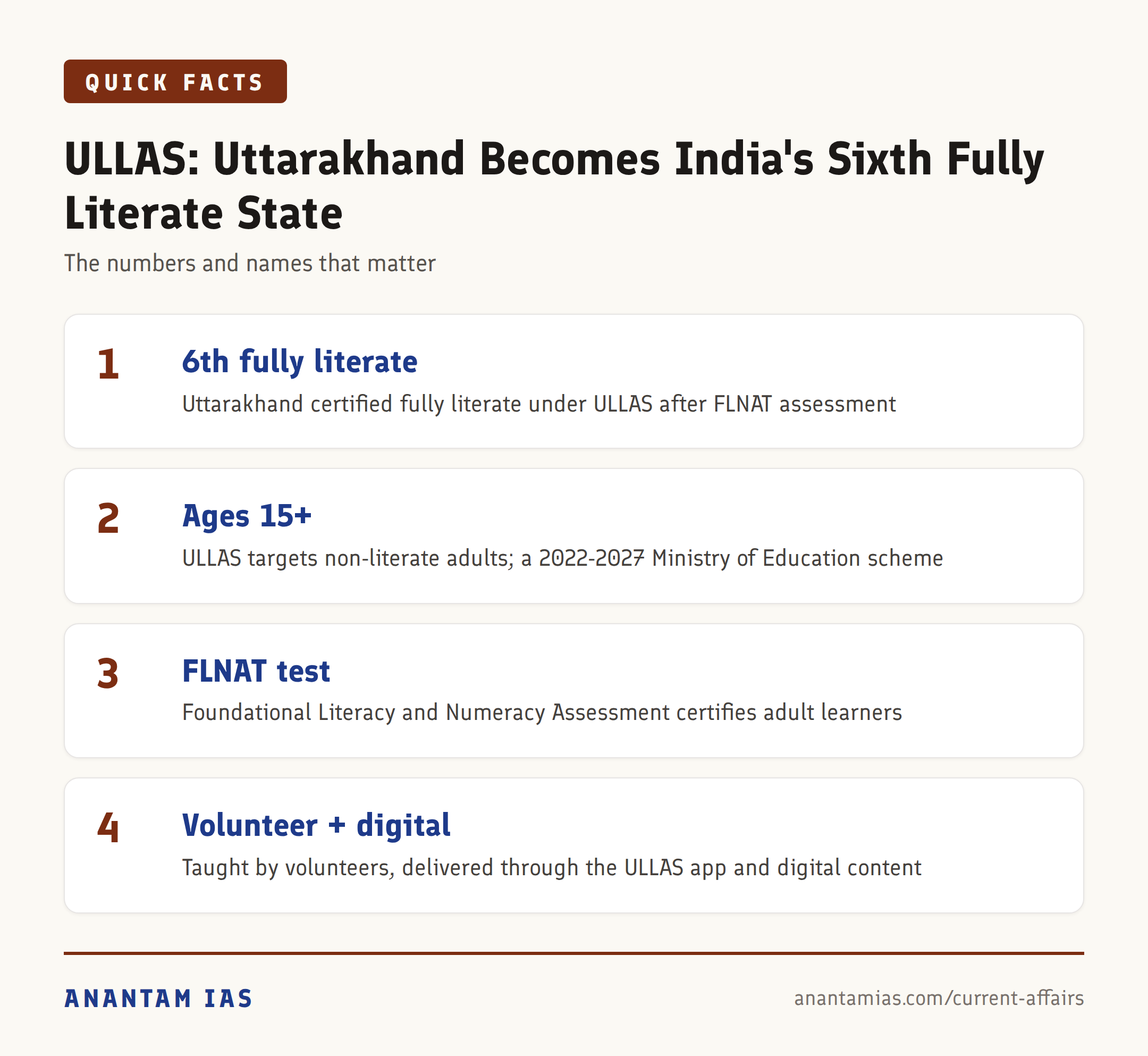
- ULLAS (Understanding of Lifelong Learning for All in Society), also called the Nav Bharat Saaksharta Karyakram / New India Literacy Programme (NILP), is the Centre’s adult-literacy scheme for 2022-2027.
- It targets non-literate adults aged 15 and above and covers foundational literacy and numeracy plus critical life skills, vocational skills, and basic education.
- A state is deemed fully literate on crossing a literacy benchmark (widely taken as around 95%) as measured through the FLNAT.
- The scheme is run in volunteer mode, relying on voluntary teachers, and is delivered largely through digital and mobile-based learning.
- Uttarakhand joins the earlier group of states, including Mizoram, Goa and others, that have been certified fully literate under the programme.
The development matters in the context of:
- It marks progress toward the universal literacy goal aligned with NEP 2020 and the Sustainable Development Goal 4 on inclusive education.
- It shows a working model of adult education delivered in volunteer and digital mode, distinct from school-based literacy.
- It links to foundational literacy and numeracy, a national priority also driven through the school-level FLN mission.
UPSC Relevance
Prelims Relevance
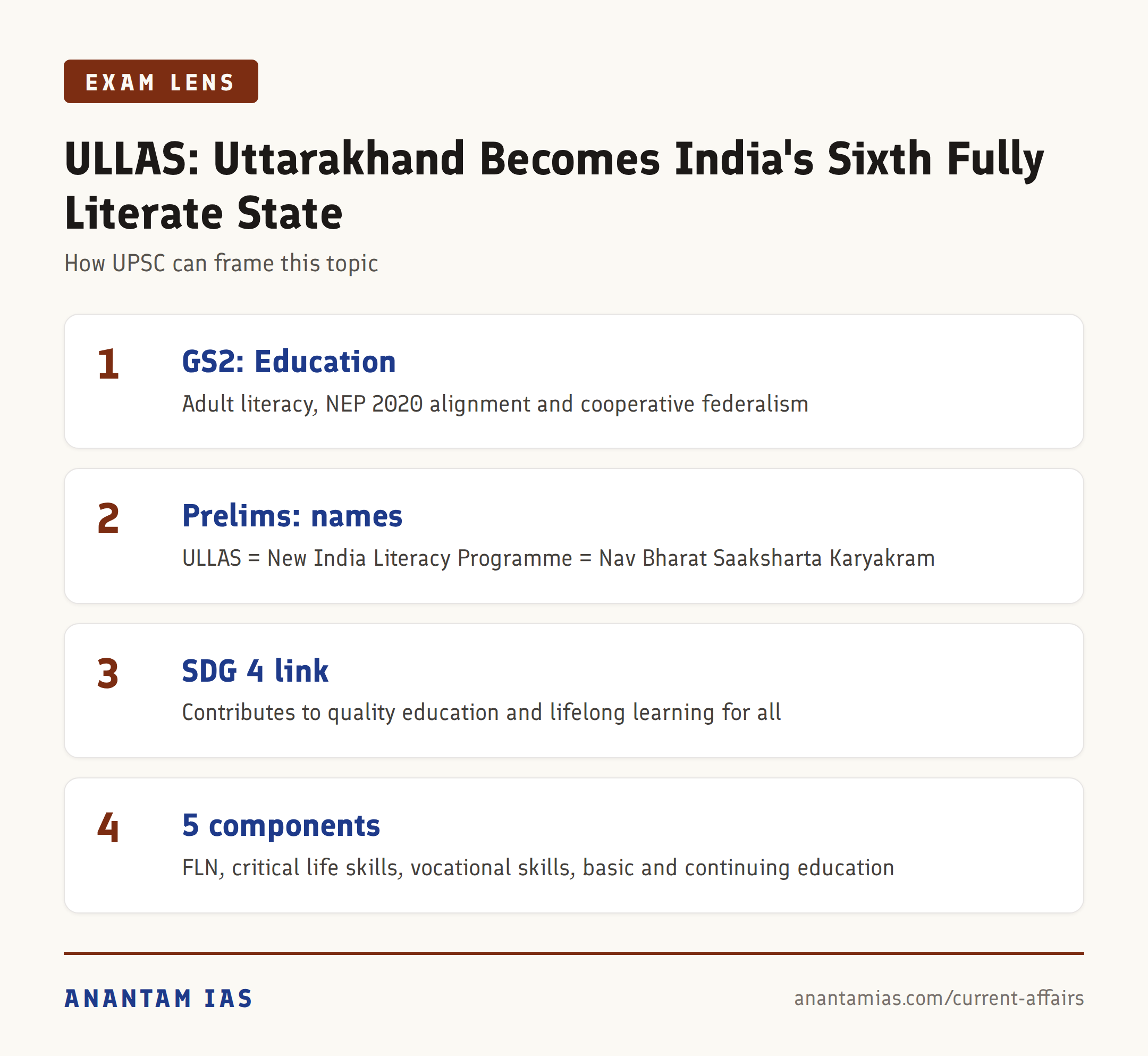
- ULLAS / Nav Bharat Saaksharta Karyakram (New India Literacy Programme, NILP): centrally sponsored adult-literacy scheme for 2022-2027, under the Ministry of Education (Department of School Education and Literacy).
- Target group: non-literate adults aged 15 years and above.
- Five components: foundational literacy and numeracy; critical life skills; vocational skills; basic education; continuing education.
- Assessment: the Foundational Literacy and Numeracy Assessment Test (FLNAT) certifies adult learners.
- Mode: volunteer-based teaching and digital delivery, including the ULLAS mobile app and DIKSHA content.
- ‘Fully literate’ benchmark is taken as roughly 95% literacy; Uttarakhand is among the first states to reach it.
- The scheme is aligned with NEP 2020 and contributes to SDG 4 (quality education for all).
Mains Relevance
GS Paper 2
- Adult literacy as a governance challenge: reaching non-literate adults outside the school system through volunteer and digital models.
- Cooperative federalism in education: a centrally sponsored scheme delivered by states, and what state-level success reveals.
- Education and social justice: literacy as an enabler of rights, welfare access and economic participation.
GS Paper 3
- Human capital and inclusive growth: the economic dividend of raising adult literacy and functional numeracy.
Essay
- Literacy after childhood: why teaching adults to read is a different and harder promise to keep.
- The volunteer as teacher: social participation as the engine of a national mission.
Background and Context
What ULLAS Is
ULLAS is India’s flagship adult-literacy scheme for the current decade.
- Launched for 2022-2027 under the Ministry of Education, ULLAS replaced earlier adult-education programmes with a broader lifelong-learning frame.
- It covers foundational literacy and numeracy, critical life skills, vocational skills, basic education and continuing education.
- Delivery is in volunteer mode, with citizens teaching non-literate adults, supported by digital content and the ULLAS app.
- The scheme aligns with NEP 2020‘s goal of universal foundational literacy and numeracy across ages.
How ‘Fully Literate’ Is Measured
Certification rests on an actual assessment of adult learners, not just enrolment.
- Adult learners are assessed through the FLNAT, testing reading, writing and basic numeracy.
- A state crossing the literacy benchmark, widely cited as around 95%, is declared fully literate.
- The metric focuses on functional literacy and numeracy, the ability to use these skills in daily life.
- Uttarakhand’s certification follows successful FLNAT performance across its districts.
Where Uttarakhand Fits
The state joins a small but growing group certified under the programme.
- Earlier states declared fully literate under ULLAS include Mizoram and Goa, among others, with Uttarakhand extending the list.
- Hill states face specific challenges of terrain, dispersed habitations and out-migration, making the achievement notable.
- Success rests on volunteer mobilisation and state administrative drive.
- The certification is a state-level milestone within a national 2027 target.
Why Adult Literacy Still Matters
Despite gains in schooling, a large adult population historically missed formal education.
- Adult literacy directly affects livelihoods, health-seeking, financial inclusion and rights awareness.
- It complements the school-level foundational literacy and numeracy (FLN) mission for children.
- Functional literacy enables participation in the digital economy and welfare delivery.
- Progress here advances SDG 4 and the NEP 2020 vision of learning across the lifespan.
Way Forward
For the Scheme
- Sustain post-literacy and continuing education so newly literate adults do not relapse.
- Expand vocational and digital-skill components to make literacy economically useful.
- Maintain volunteer momentum through recognition and institutional support.
For the Goal
- Replicate state-level models to keep the 2027 national target on track.
- Integrate ULLAS with financial inclusion and welfare-access drives for real-world impact.
- Focus on hard-to-reach groups: migrants, remote habitations and women learners.
Conclusion
Uttarakhand’s certification as a fully literate state is a concrete marker of progress in the harder half of the literacy challenge, teaching adults who missed formal schooling, through a volunteer and digital model. The achievement is meaningful precisely because adult literacy is difficult to deliver and easy to neglect.
The task now is to make literacy stick and pay: continuing education so skills are not lost, and vocational and digital add-ons so that reading and numeracy translate into better livelihoods and fuller participation.
UPSC Practice Questions
Prelims MCQ 1
With reference to the ULLAS scheme, consider the following statements:
- It is an adult-literacy programme targeting non-literate persons aged 15 years and above.
- It is implemented under the Ministry of Education and delivered largely in volunteer mode.
- Adult learners under the scheme are certified through the Foundational Literacy and Numeracy Assessment Test.
How many of the above statements are correct?
(a) Only one (b) Only two (c) All three (d) None
Answer: (c) All three
Explanation:
All three are correct. ULLAS (New India Literacy Programme, 2022-2027) targets non-literate adults aged 15 and above, is run by the Ministry of Education in volunteer and digital mode, and certifies learners through the Foundational Literacy and Numeracy Assessment Test (FLNAT). A state crossing the literacy benchmark is declared fully literate.
Prelims MCQ 2
The ULLAS programme is also known by which of the following names?
(a) Sarva Shiksha Abhiyan (b) Nav Bharat Saaksharta Karyakram / New India Literacy Programme (c) Samagra Shiksha (d) Rashtriya Madhyamik Shiksha Abhiyan
Answer: (b) Nav Bharat Saaksharta Karyakram / New India Literacy Programme
Explanation:
ULLAS (Understanding of Lifelong Learning for All in Society) is the New India Literacy Programme, also called Nav Bharat Saaksharta Karyakram. The other options are school-education programmes: Sarva Shiksha Abhiyan and RMSA (now subsumed under Samagra Shiksha) address elementary and secondary schooling, not adult literacy.
UPSC Mains Questions
- Adult literacy remains an unfinished agenda even as school enrolment nears universal levels. Examine the design of the ULLAS programme and the significance of state-level ‘fully literate’ certifications. (250 words)
- A volunteer-driven, digitally delivered model marks a shift in how India approaches adult education. Discuss its strengths and limitations. (150 words)
Frequently Asked Questions
What is the ULLAS scheme?
ULLAS (Understanding of Lifelong Learning for All in Society), also called the New India Literacy Programme or Nav Bharat Saaksharta Karyakram, is the Centre’s adult-literacy scheme for 2022-2027. Run by the Ministry of Education, it targets non-literate adults aged 15 and above through foundational literacy and numeracy and allied skills.
What does ‘fully literate state’ mean here?
A state is declared fully literate on crossing a literacy benchmark, widely taken as around 95%, as measured through the Foundational Literacy and Numeracy Assessment Test for adult learners. Uttarakhand’s declaration follows successful FLNAT performance, making it one of the first group of states to reach the mark.
Who is the scheme meant for?
Non-literate adults aged 15 years and above who missed formal schooling. Beyond basic reading, writing and numeracy, ULLAS also covers critical life skills, vocational skills, basic education and continuing education, framing literacy as lifelong learning.
How is the programme delivered?
Largely in volunteer mode, with citizens teaching non-literate adults, supported by digital and mobile-based learning through the ULLAS app and platforms like DIKSHA. This volunteer-plus-digital model distinguishes it from school-based education.
Which states are already fully literate under ULLAS?
Earlier states certified fully literate under the programme include Mizoram and Goa, among others. Uttarakhand extends this list. Each certification is a state-level milestone within the national target of full literacy by 2027.
Why does adult literacy matter for development?
Adult literacy improves livelihoods, health-seeking behaviour, financial inclusion and awareness of rights and welfare entitlements. It complements the school-level foundational literacy mission for children and advances NEP 2020’s vision and SDG 4 on inclusive, lifelong quality education.
Source: https://anantamias.com/current-affairs/ullas-uttarakhand-sixth-fully-literate-state/
Awiqli: World’s First Once-Weekly Insulin Launched in India
Why in News?
Awiqli (insulin icodec), the world’s first once-weekly basal insulin, has been launched in India. It replaces the daily basal-insulin injection with a single weekly dose for adults with type 1 and type 2 diabetes.
The launch makes India one of the early markets for the therapy, significant because India carries one of the world’s largest diabetes burdens, and injection frequency is a major barrier to treatment adherence.
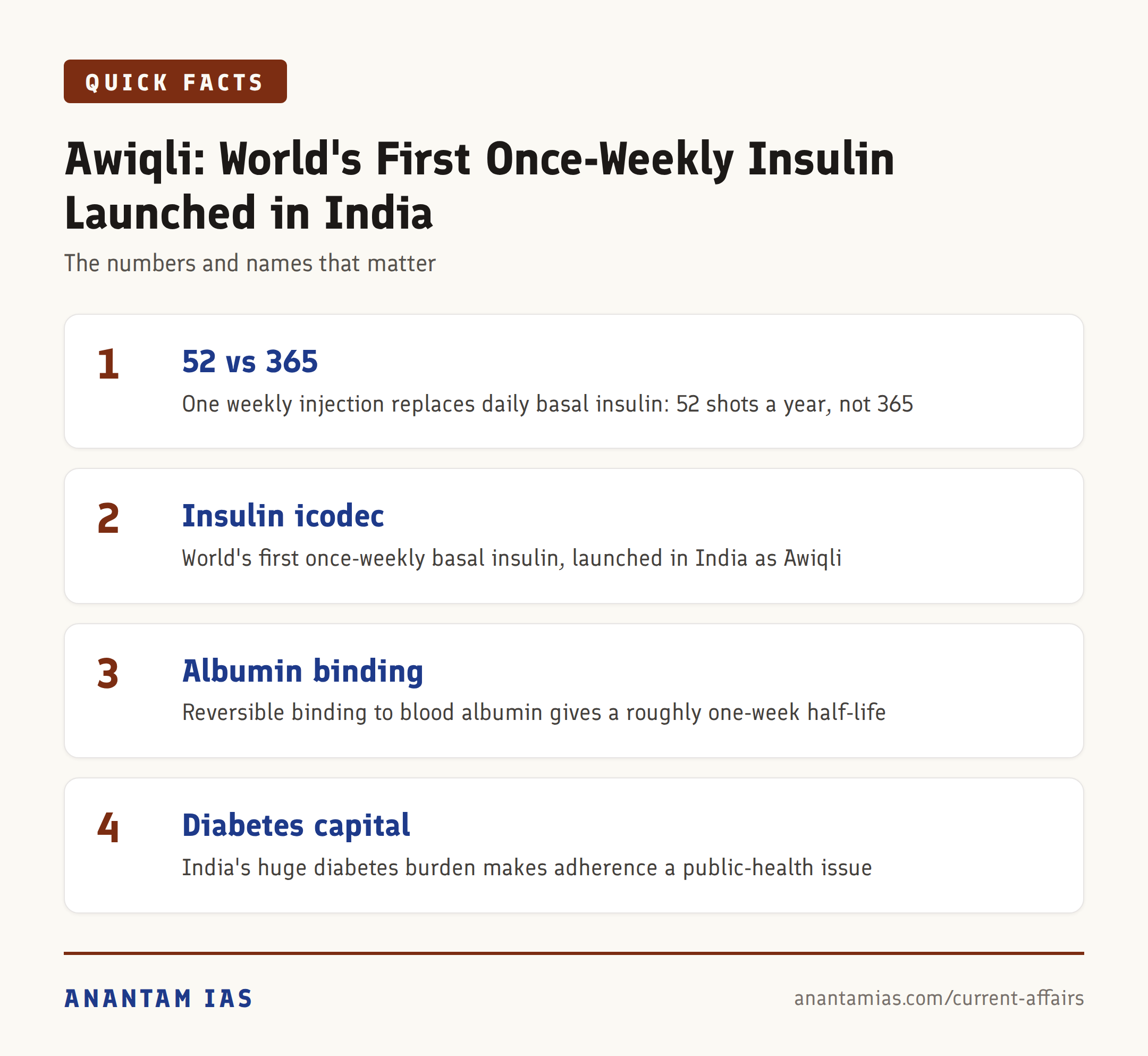
- Insulin icodec is a long-acting basal insulin analogue engineered to stay active in the body for about a week, cutting injections from 365 to 52 a year.
- It works by binding reversibly to albumin in the blood, forming a circulating reservoir that releases insulin slowly and steadily over seven days.
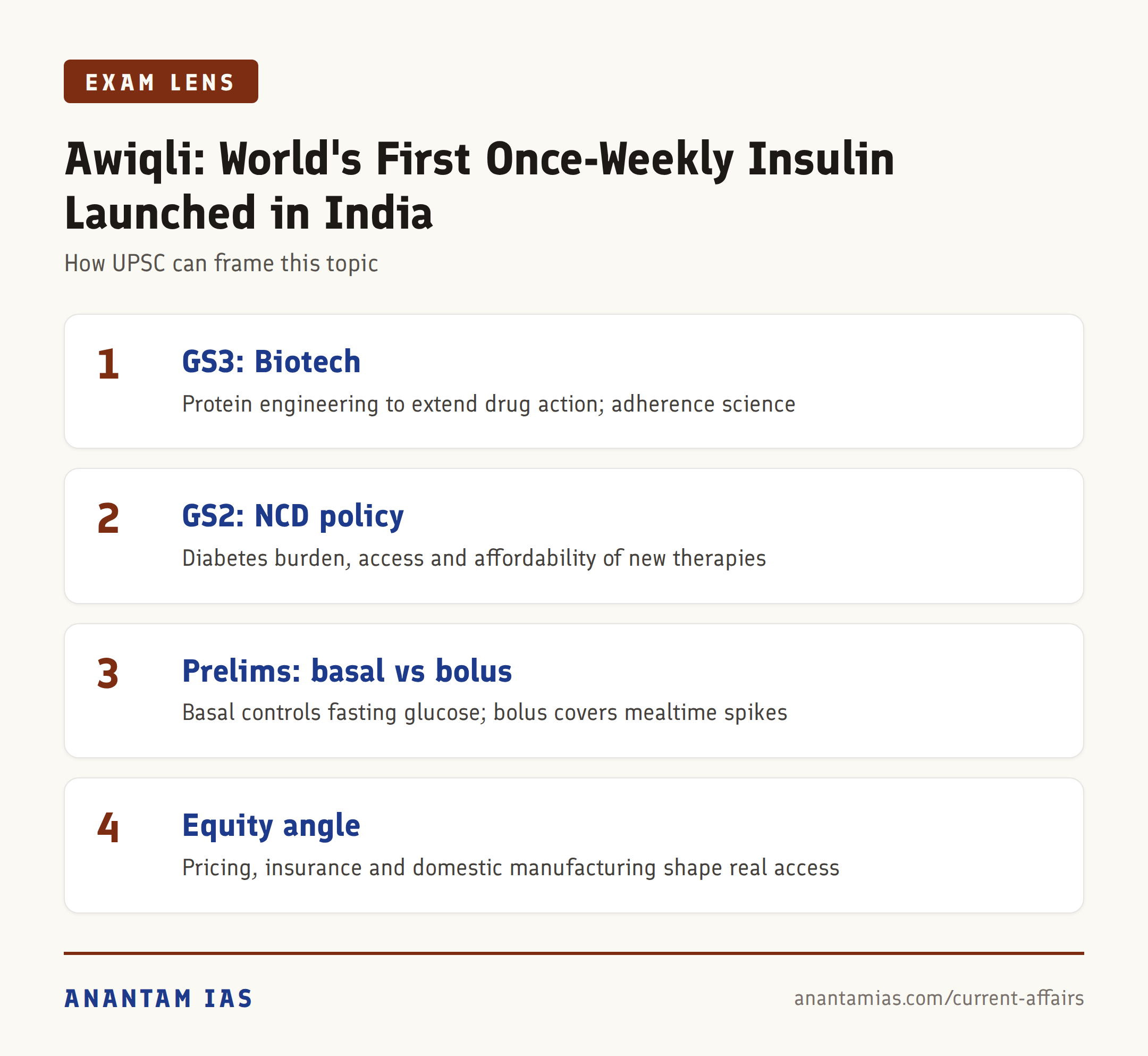
- Basal insulin controls background (fasting) blood glucose between meals and overnight; it does not replace mealtime (bolus) insulin where that is needed.
- Fewer injections are expected to improve treatment adherence, a key problem in long-term diabetes management.
- India has an extremely large diabetes population, so a weekly option has significant public-health potential if access and affordability follow.
The development matters in the context of:
- Diabetes is a major non-communicable disease burden in India, and poor adherence worsens complications and costs.
- It highlights pharmaceutical innovation in chronic-disease management and the science of protein-drug engineering.
- Access and pricing raise equity questions central to India’s health-policy debate.
UPSC Relevance
Prelims Relevance
- Awiqli is the brand name for insulin icodec, the world’s first once-weekly basal insulin, from Novo Nordisk.
- Mechanism: reversible binding to albumin creates a slow-release reservoir, giving a roughly one-week half-life.
- Basal insulin controls fasting/background glucose; bolus (prandial) insulin covers mealtime spikes.
- Injection frequency drops from about 365 to 52 per year, aiding adherence.
- Diabetes mellitus: Type 1 (autoimmune, insulin-dependent) and Type 2 (insulin resistance, the large majority of Indian cases).
- India is often described as a diabetes capital given its very large affected population; diabetes is a key non-communicable disease (NCD).
- Insulin was discovered by Banting and Best (1921-22); icodec represents a modern long-acting engineered analogue.
Mains Relevance
GS Paper 3
- Pharmaceutical innovation and biotechnology: protein engineering (albumin binding) to extend drug action, and its clinical value.
- Health technology and adherence: how dosing convenience affects outcomes in chronic-disease management.
- Access and affordability: ensuring innovative therapies reach India’s vast patient base, not just the affluent.
GS Paper 2
- Non-communicable disease policy: India’s diabetes burden and the health-system response through NCD programmes.
- Regulation and equity: balancing rapid access to new drugs with pricing and safety oversight.
Essay
- Convenience as medicine: how making treatment easier can be as powerful as the treatment itself.
- The diabetes paradox: a manageable disease that overwhelms systems when management fails.
Background and Context
What Makes Icodec Weekly
The once-weekly action is a feat of molecular engineering.
- Insulin icodec is modified so it binds reversibly to albumin, the abundant blood protein, forming a circulating depot.
- The bound insulin is released slowly and steadily, giving a half-life of about a week versus roughly a day for older basal insulins.
- This turns daily basal dosing into a single weekly injection, about 52 shots a year instead of 365.
- It is a basal insulin: it manages background glucose, and patients needing mealtime control may still require bolus insulin.
Why It Matters for India
India’s diabetes numbers make adherence a public-health issue, not just a personal one.
- India has one of the largest diabetes populations in the world, with a heavy and rising Type 2 burden.
- Poor adherence to daily injections drives complications, hospitalisations and long-term costs.
- A weekly regimen can simplify treatment, reduce injection fatigue and support caregivers of elderly patients.
- Launching India as an early market signals its importance to global diabetes-care strategies.
Basal vs Bolus Insulin
Understanding the distinction clarifies what icodec does and does not replace.
- Basal insulin provides a steady background level controlling fasting and overnight glucose.
- Bolus (prandial) insulin is taken at meals to cover the post-meal glucose rise.
- Icodec is a basal product; it does not by itself cover mealtime spikes.
- Many Type 2 patients are managed on basal insulin plus oral drugs, the setting where a weekly basal is most convenient.
The Access and Policy Question
Innovation only helps if it reaches patients.
- Affordability and insurance coverage will determine how widely the weekly insulin is actually used.
- India’s NCD programmes and public health system must weigh new therapies against cost and equity.
- Domestic biosimilar and generic capacity may shape future pricing of long-acting insulins.
- Safety in real-world use, including hypoglycaemia management with a long-acting drug, needs monitoring.
Way Forward
For Patients and Clinicians
- Use the weekly option where it clearly improves adherence, with clear guidance on hypoglycaemia.
- Educate patients on the basal-only nature of the drug and mealtime needs.
- Integrate it into chronic-care pathways for elderly and hard-to-adhere patients.
For Policy
- Address affordability through pricing, insurance and public-procurement pathways.
- Strengthen NCD surveillance and management as the diabetes burden grows.
- Encourage indigenous manufacturing of advanced insulins to widen access.
Conclusion
A once-weekly insulin is a meaningful step in chronic-disease care: by turning 365 injections a year into 52, it attacks the adherence problem that undoes so much diabetes treatment. For a country carrying an enormous diabetes load, the convenience is a genuine clinical advantage, not a mere marketing point.
The decisive question is access. Whether Awiqli reaches beyond affluent patients depends on pricing, insurance and eventually domestic competition, the familiar gap in India between medical innovation and equitable delivery.
UPSC Practice Questions
Prelims MCQ 1
With reference to insulin icodec (Awiqli), consider the following statements:
- It is the world’s first once-weekly basal insulin.
- It achieves its long duration of action by binding reversibly to albumin in the blood.
- It is a mealtime (bolus) insulin intended to control post-meal glucose spikes.
How many of the above statements are correct?
(a) Only one (b) Only two (c) All three (d) None
Answer: (b) Only two
Explanation:
Statements 1 and 2 are correct: insulin icodec is the world’s first once-weekly basal insulin, and it extends its action by binding reversibly to albumin, forming a slow-release reservoir with a roughly one-week half-life. Statement 3 is incorrect: it is a basal insulin controlling background glucose, not a bolus/mealtime insulin.
Prelims MCQ 2
In diabetes management, ‘basal insulin’ primarily refers to insulin that:
(a) Is taken only at mealtimes to cover glucose spikes (b) Controls background or fasting blood glucose between meals and overnight (c) Is used exclusively in Type 1 diabetes (d) Can only be delivered intravenously in hospitals
Answer: (b) Controls background or fasting blood glucose between meals and overnight
Explanation:
Basal insulin provides a steady background level that controls fasting and overnight glucose, whereas bolus (prandial) insulin is taken at meals to manage post-meal spikes. Insulin icodec is a basal insulin, so it addresses background glucose control on a once-weekly schedule.
UPSC Mains Questions
- Treatment adherence is often the weakest link in chronic-disease management. Discuss how innovations such as once-weekly insulin can improve outcomes, and the barriers to their equitable adoption in India. (250 words)
- India’s diabetes burden is both a health and an economic challenge. Examine the role of pharmaceutical innovation and access policy in addressing it. (150 words)
Frequently Asked Questions
What is Awiqli?
Awiqli is the brand name for insulin icodec, the world’s first once-weekly basal insulin, developed by Novo Nordisk and now launched in India. It replaces the daily basal-insulin injection with a single weekly dose for adults with diabetes, cutting injections from about 365 to 52 a year.
How does a weekly insulin work?
Insulin icodec is engineered to bind reversibly to albumin, an abundant blood protein, forming a circulating reservoir that releases insulin slowly and steadily. This gives it a half-life of about a week, so a single injection provides background insulin coverage for seven days.
What is basal insulin?
Basal insulin controls background or fasting blood glucose between meals and overnight. It differs from bolus or mealtime insulin, which covers the glucose rise after eating. Insulin icodec is a basal insulin, so patients who also need mealtime control may still require bolus insulin.
Why is this significant for India?
India carries one of the world’s largest diabetes burdens, and poor adherence to daily injections drives complications and costs. A once-weekly option can simplify treatment, reduce injection fatigue and help caregivers of elderly patients, with real public-health potential if access and affordability follow.
Does it replace all insulin injections?
No. It is a basal insulin that manages background glucose. Patients who need mealtime (bolus) insulin to control post-meal spikes will still require those doses. Many Type 2 patients, however, are managed on basal insulin with oral drugs, the setting where a weekly basal is most convenient.
What determines how widely it will be used?
Access and pricing. Affordability, insurance coverage and eventually domestic competition will decide whether the therapy reaches beyond affluent patients. This reflects the broader Indian challenge of translating medical innovation into equitable, system-wide delivery through NCD programmes.
Source: https://anantamias.com/current-affairs/awiqli-once-weekly-insulin-icodec-india-launch/
TribeX: A Digital Learning Platform for India’s Tribal Heritage
Why in News?
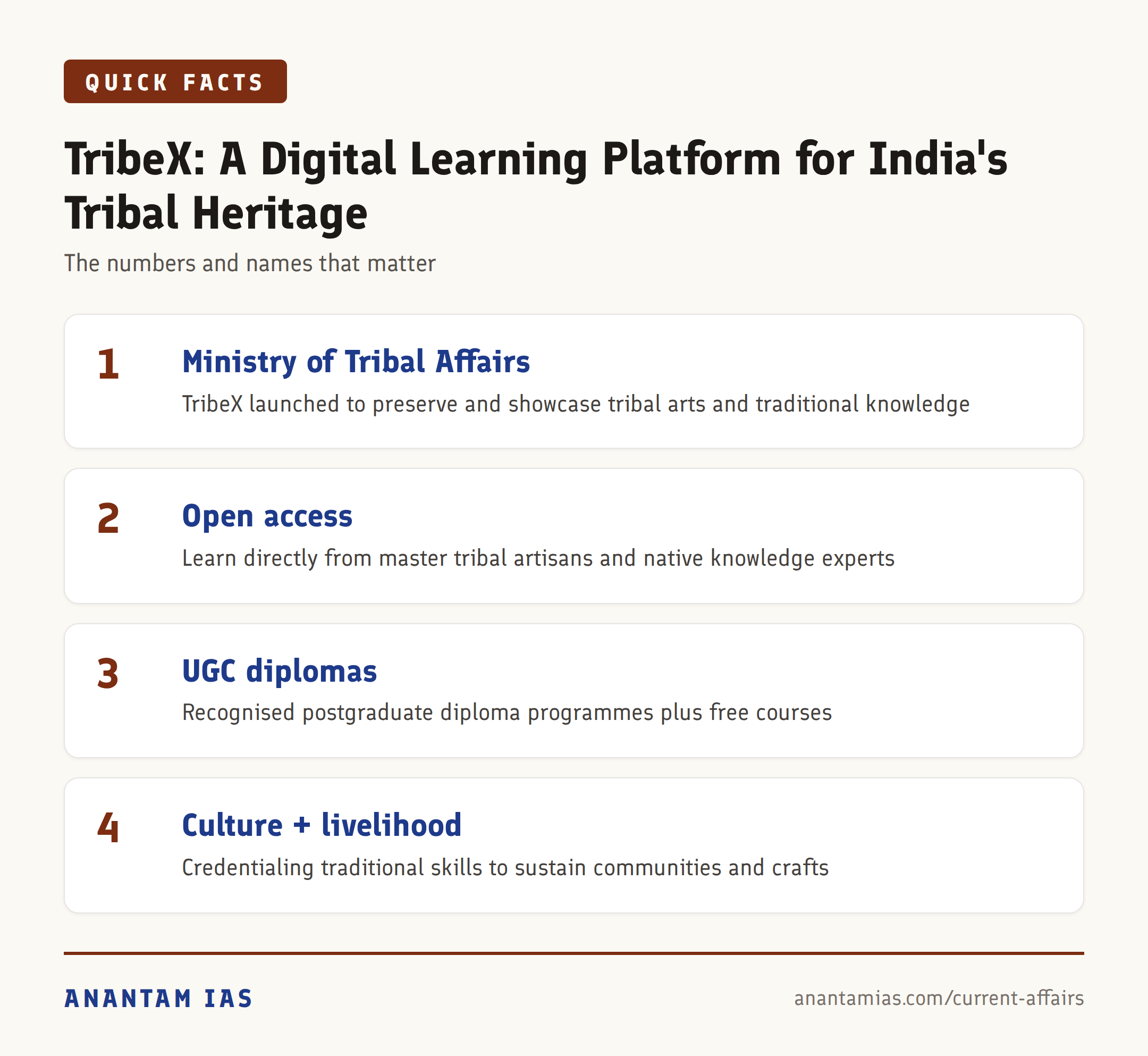
The Ministry of Tribal Affairs has launched TribeX, described as a first-of-its-kind digital learning platform dedicated to tribal arts, culture, traditional knowledge and skill development.
TribeX is designed as a centralised, open-access repository and learning ecosystem where students, researchers and enthusiasts worldwide can learn directly from master tribal artisans and knowledge experts, aiming to preserve indigenous knowledge and support tribal livelihoods.
- TribeX is a centralised digital learning platform created to preserve, document and globally showcase India’s tribal culture and traditional knowledge.
- It offers open-access learning under master tribal artisans and native knowledge experts, bridging geographical barriers through technology.
- The platform reportedly hosts free courses and a set of UGC-recognised postgraduate diploma programmes in tribal arts and knowledge.
- Its stated aims: empower tribal communities, preserve indigenous languages and crafts, and promote sustainable, livelihood-oriented education.
- It is run by the Ministry of Tribal Affairs, the nodal ministry for the welfare and development of Scheduled Tribes.
The development matters in the context of:
- It links cultural preservation with livelihoods, turning traditional knowledge into recognised, marketable skills.
- It supports the protection of indigenous knowledge and languages, many of which are endangered.
- It fits the broader agenda of tribal welfare and inclusion and digital access to education.
UPSC Relevance
Prelims Relevance
- TribeX: digital learning platform for tribal arts, culture and traditional knowledge, launched by the Ministry of Tribal Affairs.
- Features: open-access courses, master-artisan instruction, and UGC-recognised PG diplomas; preserves languages and crafts.
- The Ministry of Tribal Affairs (created 1999) is the nodal ministry for Scheduled Tribes.
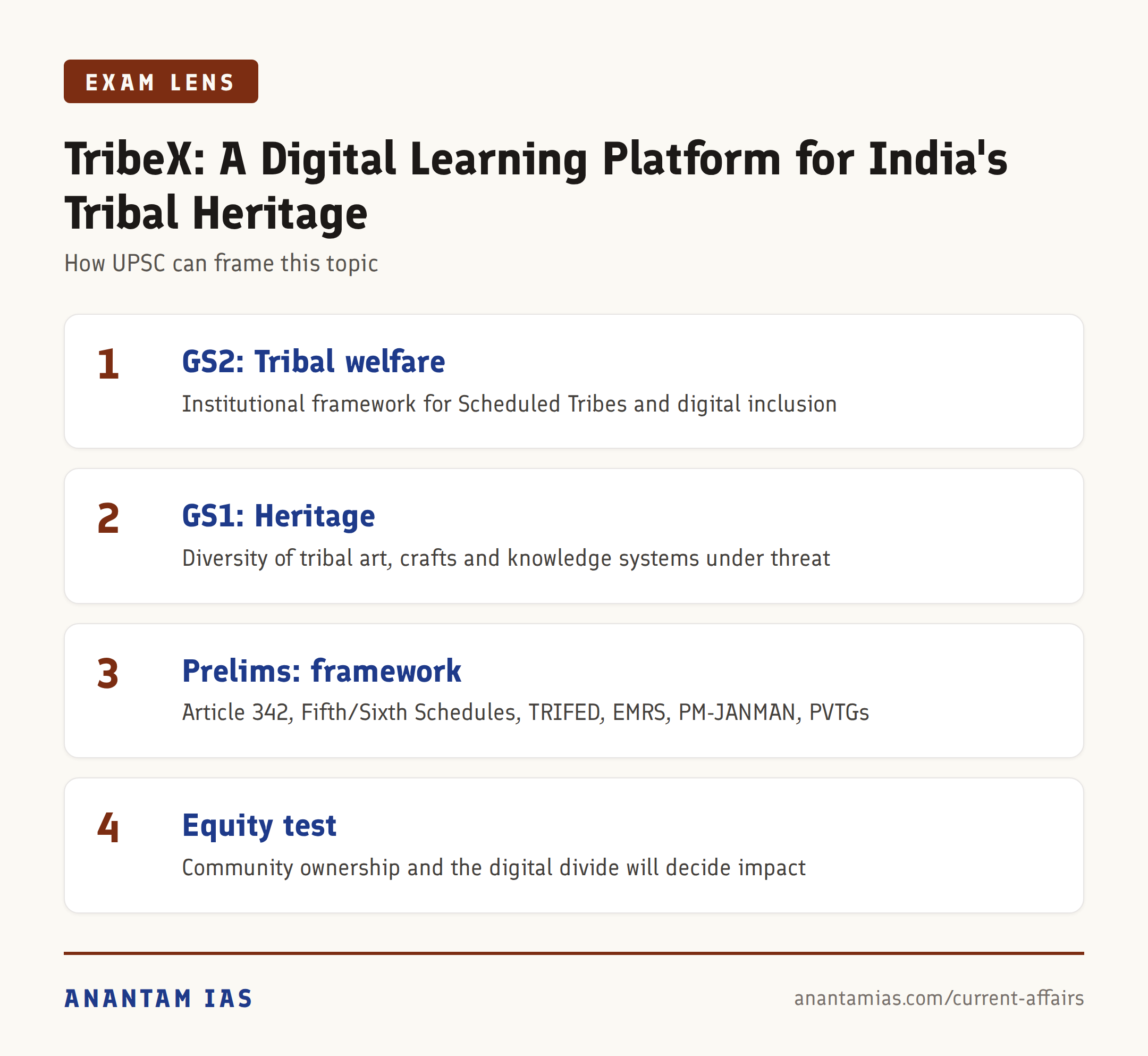
- Constitutional basis for tribal welfare: Article 342 (Scheduled Tribes), the Fifth and Sixth Schedules, and Articles 15(4), 46, 244, 275(1), 330, 332.
- Related tribal initiatives: Eklavya Model Residential Schools (EMRS), TRIFED and its Van Dhan Vikas Kendras, PM-JANMAN and PM-PVTG mission, and PESA, 1996.
- PVTGs (Particularly Vulnerable Tribal Groups): 75 groups needing special protection.
- India’s Scheduled Tribes form roughly 8.6% of the population (Census 2011).
Mains Relevance
GS Paper 2
- Welfare of Scheduled Tribes: the constitutional and institutional framework and the role of digital platforms in inclusion.
- Preserving indigenous knowledge and languages as a governance and cultural-rights concern.
- Livelihood-linked education: converting traditional skills into recognised qualifications and market access.
GS Paper 1
- Indian culture and tribal heritage: the diversity of tribal art forms, crafts and knowledge systems, and threats to their survival.
Essay
- Digitising a living heritage: technology as both a threat to and a saviour of traditional knowledge.
- Knowledge that lives in hands: why craft and culture resist being written down, and what we lose when they fade.
Background and Context
What TribeX Offers
The platform frames tribal knowledge as something to be learned, credentialed and sustained.
- TribeX is a centralised digital repository and learning ecosystem for tribal arts, crafts and traditional knowledge.
- It provides open-access courses taught by master tribal artisans and native experts, reachable from anywhere.
- It reportedly includes UGC-recognised postgraduate diplomas, giving formal weight to tribal knowledge.
- The aim is to preserve endangered crafts and languages while creating livelihood pathways.
Why Preservation Is Urgent
Much tribal knowledge is oral, undocumented and at risk.
- Tribal languages, crafts and ecological knowledge are often transmitted orally and fade with generational change.
- Migration, market pressures and loss of habitat erode traditional practices.
- Documenting and teaching these systems can protect intellectual and cultural heritage.
- Formal recognition helps counter the undervaluation of indigenous knowledge.
The Institutional Framework for Tribal Welfare
TribeX sits within a wider architecture of tribal development.
- The Ministry of Tribal Affairs, created in 1999, is the nodal body for Scheduled Tribes.
- Key institutions include TRIFED (marketing tribal produce, Van Dhan Kendras) and EMRS (residential schooling).
- Constitutional safeguards run through the Fifth and Sixth Schedules and articles on reservation and self-governance.
- Recent missions like PM-JANMAN target PVTGs, the most vulnerable tribal groups.
Culture Meets Livelihood
The platform’s distinctive move is to tie heritage to income.
- By credentialing skills, TribeX aims to make traditional crafts economically viable for practitioners.
- Global open access can widen markets and recognition for tribal art forms.
- It complements TRIFED’s marketing and GI-tagging of tribal products.
- Success depends on connectivity, curation and genuine community ownership.
Way Forward
For the Platform
- Ensure community ownership and fair benefit-sharing so artisans, not intermediaries, gain.
- Address the digital divide in tribal areas through connectivity and offline access.
- Curate content with authenticity and consent, protecting against misappropriation.
For Tribal Development
- Link TribeX credentials to livelihood schemes and market access via TRIFED.
- Integrate with language-preservation and EMRS education efforts.
- Use it to strengthen intellectual-property protection for indigenous knowledge.
Conclusion
TribeX is an imaginative attempt to do two things at once: preserve endangered tribal knowledge and turn it into a recognised, livelihood-generating skill. By putting master artisans online and attaching formal diplomas to their teaching, it treats indigenous knowledge as something valuable enough to credential rather than merely archive.
The platform will be judged on ownership and reach: whether tribal communities themselves benefit, and whether the digital divide in tribal regions is bridged so that the people whose heritage this is can also access and profit from it.
UPSC Practice Questions
Prelims MCQ 1
With reference to the TribeX platform, consider the following statements:
- It is a digital learning platform launched by the Ministry of Tribal Affairs.
- It aims to preserve and showcase tribal arts, culture and traditional knowledge.
- It offers open-access learning, including certain UGC-recognised diploma programmes.
How many of the above statements are correct?
(a) Only one (b) Only two (c) All three (d) None
Answer: (c) All three
Explanation:
All three are correct. TribeX is a digital learning platform launched by the Ministry of Tribal Affairs to preserve, document and showcase tribal arts, culture and traditional knowledge, offering open-access courses taught by master artisans along with UGC-recognised postgraduate diploma programmes, while supporting tribal livelihoods.
Prelims MCQ 2
The Ministry of Tribal Affairs, which launched TribeX, is the nodal ministry for Scheduled Tribes. Which constitutional article provides for the specification of Scheduled Tribes?
(a) Article 341 (b) Article 342 (c) Article 340 (d) Article 338
Answer: (b) Article 342
Explanation:
Article 342 empowers the President to specify the Scheduled Tribes in relation to a state or union territory. (Article 341 deals with Scheduled Castes, Article 340 with backward classes commissions, and Article 338 with the National Commission for Scheduled Castes.) The Ministry of Tribal Affairs, created in 1999, is the nodal ministry for ST welfare.
UPSC Mains Questions
- Digital platforms are emerging as tools to preserve indigenous knowledge while creating livelihoods. Examine the promise and the risks of initiatives like TribeX in the context of tribal welfare. (250 words)
- The preservation of tribal languages and crafts is both a cultural and a developmental imperative. Discuss the institutional framework India has built for tribal welfare. (150 words)
Frequently Asked Questions
What is TribeX?
TribeX is a first-of-its-kind digital learning platform launched by the Ministry of Tribal Affairs to preserve, document and globally showcase India’s tribal arts, culture and traditional knowledge. It offers open-access courses taught by master tribal artisans and experts, along with recognised diploma programmes.
What does the platform aim to achieve?
It aims to bridge geographical barriers through technology, empower tribal communities, preserve indigenous knowledge, languages and crafts, and promote sustainable, livelihood-oriented education. By credentialing traditional skills, it seeks to make tribal knowledge both preservable and economically viable.
Who runs TribeX?
The Ministry of Tribal Affairs, the nodal ministry for the welfare and development of Scheduled Tribes, created in 1999. It works alongside institutions such as TRIFED, which markets tribal produce, and the Eklavya Model Residential Schools that provide residential education.
What kind of courses does it offer?
The platform reportedly hosts free, open-access courses in tribal arts, crafts and traditional knowledge taught by master artisans, and a set of UGC-recognised postgraduate diploma programmes that give formal academic weight to tribal knowledge systems.
Why is preserving tribal knowledge important?
Much tribal knowledge, including languages, crafts and ecological wisdom, is transmitted orally and is at risk from migration, market pressures and habitat loss. Documenting and teaching it protects cultural and intellectual heritage and counters the historical undervaluation of indigenous knowledge.
What will decide the platform’s success?
Genuine community ownership and fair benefit-sharing, so that artisans rather than intermediaries gain; bridging the digital divide in tribal areas through connectivity and offline access; and authentic, consent-based curation that protects against misappropriation of indigenous knowledge.
Source: https://anantamias.com/current-affairs/tribex-digital-learning-platform-tribal-heritage/