Why in News?
Awiqli (insulin icodec), the world’s first once-weekly basal insulin, has been launched in India. It replaces the daily basal-insulin injection with a single weekly dose for adults with type 1 and type 2 diabetes.
The launch makes India one of the early markets for the therapy, significant because India carries one of the world’s largest diabetes burdens, and injection frequency is a major barrier to treatment adherence.
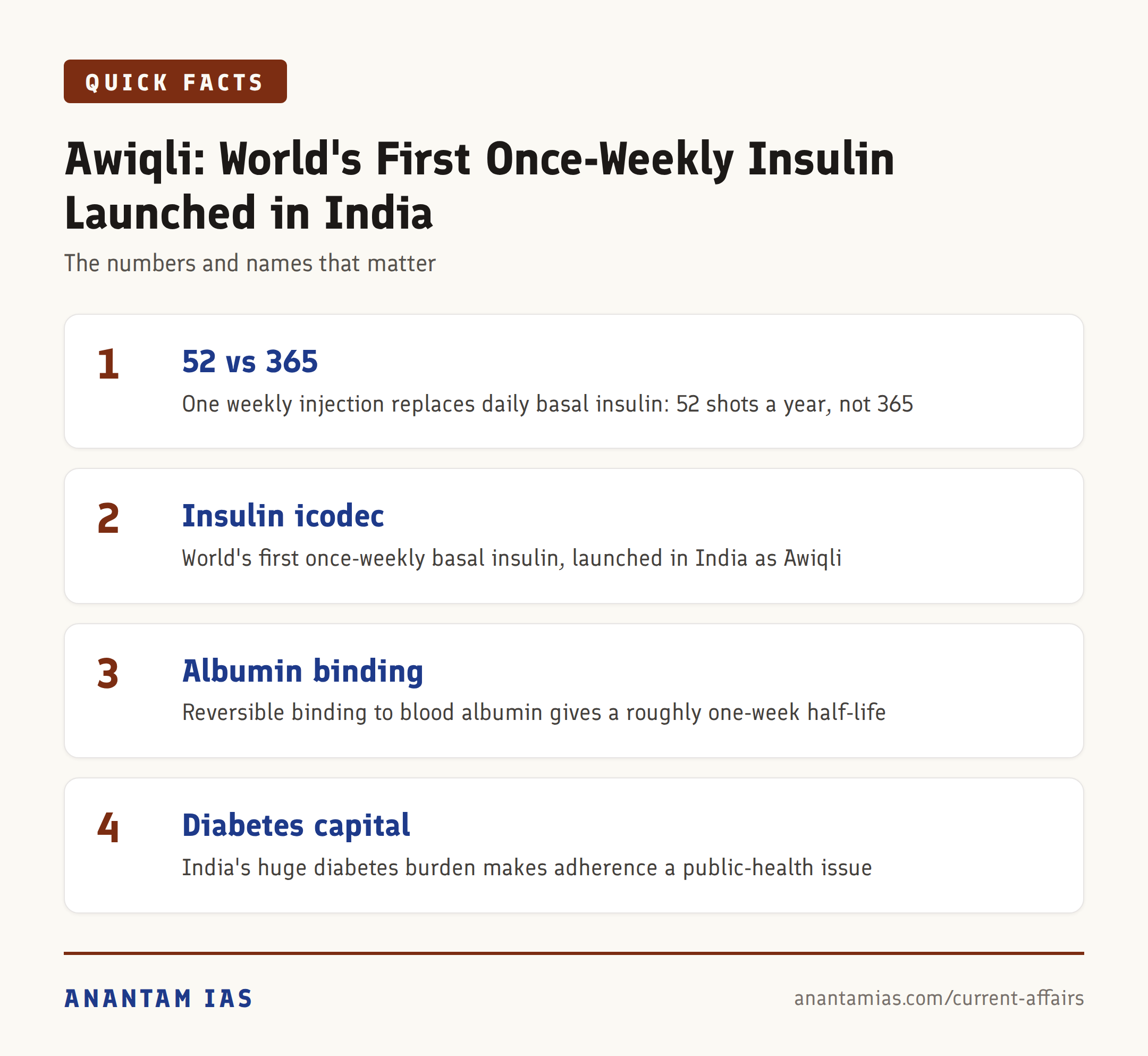
- Insulin icodec is a long-acting basal insulin analogue engineered to stay active in the body for about a week, cutting injections from 365 to 52 a year.
- It works by binding reversibly to albumin in the blood, forming a circulating reservoir that releases insulin slowly and steadily over seven days.
- Basal insulin controls background (fasting) blood glucose between meals and overnight; it does not replace mealtime (bolus) insulin where that is needed.
- Fewer injections are expected to improve treatment adherence, a key problem in long-term diabetes management.
- India has an extremely large diabetes population, so a weekly option has significant public-health potential if access and affordability follow.
The development matters in the context of:
- Diabetes is a major non-communicable disease burden in India, and poor adherence worsens complications and costs.
- It highlights pharmaceutical innovation in chronic-disease management and the science of protein-drug engineering.
- Access and pricing raise equity questions central to India’s health-policy debate.
UPSC Relevance
Prelims Relevance
- Awiqli is the brand name for insulin icodec, the world’s first once-weekly basal insulin, from Novo Nordisk.
- Mechanism: reversible binding to albumin creates a slow-release reservoir, giving a roughly one-week half-life.
- Basal insulin controls fasting/background glucose; bolus (prandial) insulin covers mealtime spikes.
- Injection frequency drops from about 365 to 52 per year, aiding adherence.
- Diabetes mellitus: Type 1 (autoimmune, insulin-dependent) and Type 2 (insulin resistance, the large majority of Indian cases).
- India is often described as a diabetes capital given its very large affected population; diabetes is a key non-communicable disease (NCD).
- Insulin was discovered by Banting and Best (1921-22); icodec represents a modern long-acting engineered analogue.
Mains Relevance
GS Paper 3
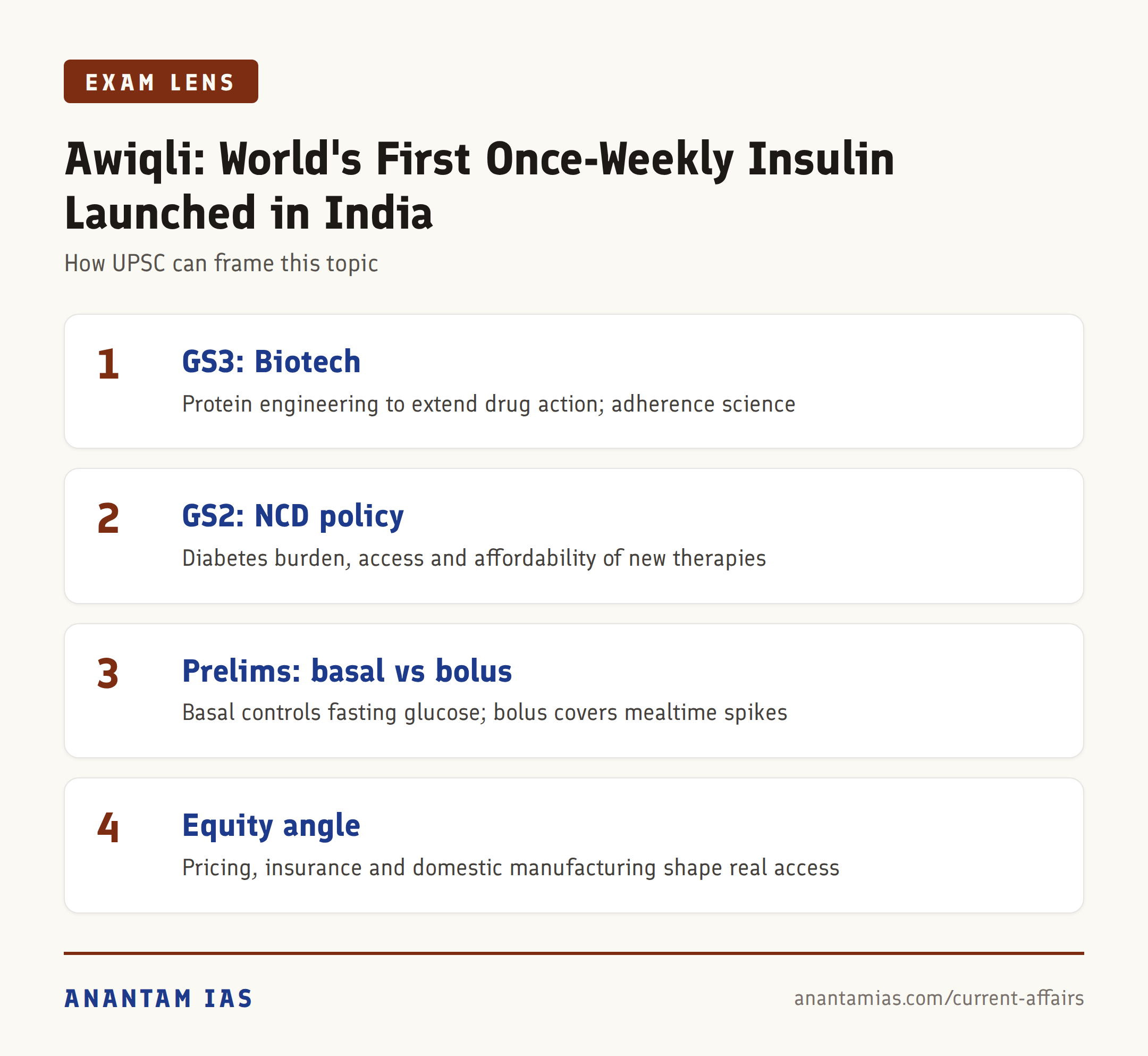
- Pharmaceutical innovation and biotechnology: protein engineering (albumin binding) to extend drug action, and its clinical value.
- Health technology and adherence: how dosing convenience affects outcomes in chronic-disease management.
- Access and affordability: ensuring innovative therapies reach India’s vast patient base, not just the affluent.
GS Paper 2
- Non-communicable disease policy: India’s diabetes burden and the health-system response through NCD programmes.
- Regulation and equity: balancing rapid access to new drugs with pricing and safety oversight.
Essay
- Convenience as medicine: how making treatment easier can be as powerful as the treatment itself.
- The diabetes paradox: a manageable disease that overwhelms systems when management fails.
Background and Context
What Makes Icodec Weekly
The once-weekly action is a feat of molecular engineering.
- Insulin icodec is modified so it binds reversibly to albumin, the abundant blood protein, forming a circulating depot.
- The bound insulin is released slowly and steadily, giving a half-life of about a week versus roughly a day for older basal insulins.
- This turns daily basal dosing into a single weekly injection, about 52 shots a year instead of 365.
- It is a basal insulin: it manages background glucose, and patients needing mealtime control may still require bolus insulin.
Why It Matters for India
India’s diabetes numbers make adherence a public-health issue, not just a personal one.
- India has one of the largest diabetes populations in the world, with a heavy and rising Type 2 burden.
- Poor adherence to daily injections drives complications, hospitalisations and long-term costs.
- A weekly regimen can simplify treatment, reduce injection fatigue and support caregivers of elderly patients.
- Launching India as an early market signals its importance to global diabetes-care strategies.
Basal vs Bolus Insulin
Understanding the distinction clarifies what icodec does and does not replace.
- Basal insulin provides a steady background level controlling fasting and overnight glucose.
- Bolus (prandial) insulin is taken at meals to cover the post-meal glucose rise.
- Icodec is a basal product; it does not by itself cover mealtime spikes.
- Many Type 2 patients are managed on basal insulin plus oral drugs, the setting where a weekly basal is most convenient.
The Access and Policy Question
Innovation only helps if it reaches patients.
- Affordability and insurance coverage will determine how widely the weekly insulin is actually used.
- India’s NCD programmes and public health system must weigh new therapies against cost and equity.
- Domestic biosimilar and generic capacity may shape future pricing of long-acting insulins.
- Safety in real-world use, including hypoglycaemia management with a long-acting drug, needs monitoring.
Way Forward
For Patients and Clinicians
- Use the weekly option where it clearly improves adherence, with clear guidance on hypoglycaemia.
- Educate patients on the basal-only nature of the drug and mealtime needs.
- Integrate it into chronic-care pathways for elderly and hard-to-adhere patients.
For Policy
- Address affordability through pricing, insurance and public-procurement pathways.
- Strengthen NCD surveillance and management as the diabetes burden grows.
- Encourage indigenous manufacturing of advanced insulins to widen access.
Conclusion
A once-weekly insulin is a meaningful step in chronic-disease care: by turning 365 injections a year into 52, it attacks the adherence problem that undoes so much diabetes treatment. For a country carrying an enormous diabetes load, the convenience is a genuine clinical advantage, not a mere marketing point.
The decisive question is access. Whether Awiqli reaches beyond affluent patients depends on pricing, insurance and eventually domestic competition, the familiar gap in India between medical innovation and equitable delivery.
UPSC Practice Questions
Prelims MCQ 1
With reference to insulin icodec (Awiqli), consider the following statements:
- It is the world’s first once-weekly basal insulin.
- It achieves its long duration of action by binding reversibly to albumin in the blood.
- It is a mealtime (bolus) insulin intended to control post-meal glucose spikes.
How many of the above statements are correct?
(a) Only one (b) Only two (c) All three (d) None
Answer: (b) Only two
Explanation:
Statements 1 and 2 are correct: insulin icodec is the world’s first once-weekly basal insulin, and it extends its action by binding reversibly to albumin, forming a slow-release reservoir with a roughly one-week half-life. Statement 3 is incorrect: it is a basal insulin controlling background glucose, not a bolus/mealtime insulin.
Prelims MCQ 2
In diabetes management, ‘basal insulin’ primarily refers to insulin that:
(a) Is taken only at mealtimes to cover glucose spikes (b) Controls background or fasting blood glucose between meals and overnight (c) Is used exclusively in Type 1 diabetes (d) Can only be delivered intravenously in hospitals
Answer: (b) Controls background or fasting blood glucose between meals and overnight
Explanation:
Basal insulin provides a steady background level that controls fasting and overnight glucose, whereas bolus (prandial) insulin is taken at meals to manage post-meal spikes. Insulin icodec is a basal insulin, so it addresses background glucose control on a once-weekly schedule.
UPSC Mains Questions
- Treatment adherence is often the weakest link in chronic-disease management. Discuss how innovations such as once-weekly insulin can improve outcomes, and the barriers to their equitable adoption in India. (250 words)
- India’s diabetes burden is both a health and an economic challenge. Examine the role of pharmaceutical innovation and access policy in addressing it. (150 words)
Frequently Asked Questions
What is Awiqli?
Awiqli is the brand name for insulin icodec, the world’s first once-weekly basal insulin, developed by Novo Nordisk and now launched in India. It replaces the daily basal-insulin injection with a single weekly dose for adults with diabetes, cutting injections from about 365 to 52 a year.
How does a weekly insulin work?
Insulin icodec is engineered to bind reversibly to albumin, an abundant blood protein, forming a circulating reservoir that releases insulin slowly and steadily. This gives it a half-life of about a week, so a single injection provides background insulin coverage for seven days.
What is basal insulin?
Basal insulin controls background or fasting blood glucose between meals and overnight. It differs from bolus or mealtime insulin, which covers the glucose rise after eating. Insulin icodec is a basal insulin, so patients who also need mealtime control may still require bolus insulin.
Why is this significant for India?
India carries one of the world’s largest diabetes burdens, and poor adherence to daily injections drives complications and costs. A once-weekly option can simplify treatment, reduce injection fatigue and help caregivers of elderly patients, with real public-health potential if access and affordability follow.
Does it replace all insulin injections?
No. It is a basal insulin that manages background glucose. Patients who need mealtime (bolus) insulin to control post-meal spikes will still require those doses. Many Type 2 patients, however, are managed on basal insulin with oral drugs, the setting where a weekly basal is most convenient.
What determines how widely it will be used?
Access and pricing. Affordability, insurance coverage and eventually domestic competition will decide whether the therapy reaches beyond affluent patients. This reflects the broader Indian challenge of translating medical innovation into equitable, system-wide delivery through NCD programmes.
Tell Google you want more of this.
Add Anantam IAS as a preferred sourceOne tap, and this site shows up more often in your own Top Stories, AI Overviews and AI Mode. Remove it any time.