Why in News?
India has secured the first-ever export order for the Astra Mk-1, its indigenous Beyond-Visual-Range Air-to-Air Missile (BVRAAM). The agreement was signed between Bharat Dynamics Limited (BDL) and Indonesia’s state defence holding company Republikorp, and was announced around the recent high-level India-Indonesia engagements.
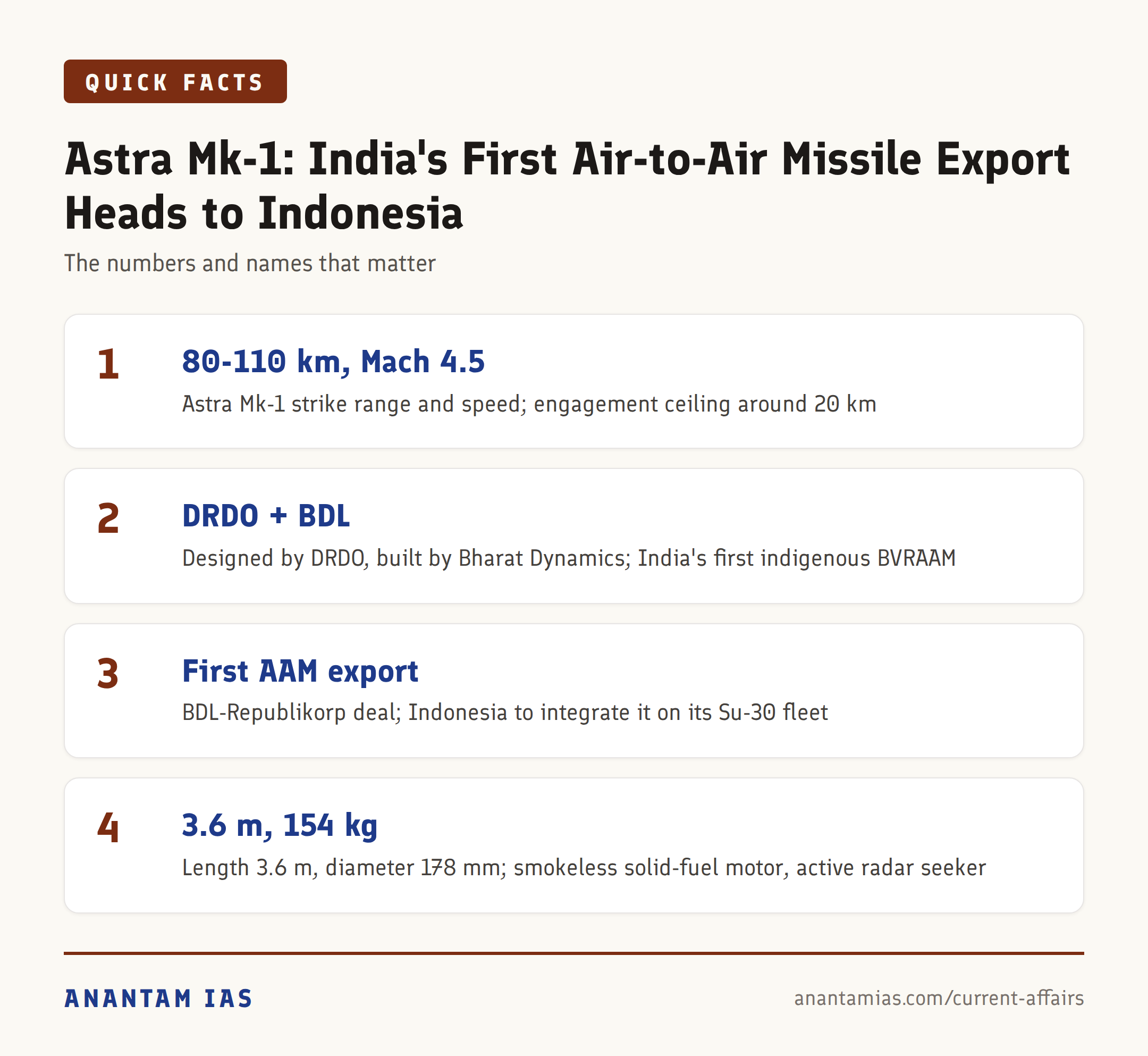
The Astra Mk-1 is designed by the Defence Research and Development Organisation (DRDO) and manufactured by BDL. Indonesia intends to integrate the missile on its Su-30 fighter fleet, making it the launch export customer for a weapon the Indian Air Force already fields.
- The Astra Mk-1 is India’s first fully indigenous BVRAAM, developed by DRDO for the Indian Air Force and Navy and cleared for full-scale production in 2024.
- Key parameters: strike range of 80-110 km (extendable in favourable launch conditions), speed of Mach 4.5, and an engagement ceiling of about 20 km altitude.
- The missile is 3.6 m long, 178 mm in diameter and weighs about 154 kg, using a smokeless solid-fuel motor for a reduced launch signature.
- Guidance is mid-course inertial with datalink updates and terminal active radar homing, with electronic counter-countermeasures (ECCM) to resist jamming.
- The deal makes Indonesia the first foreign buyer of the Astra and is being read as a template for further Southeast Asian sales alongside BrahMos.
The development matters in the context of:
- It moves India visibly up the value chain from arms importer to exporter of a sophisticated, software-defined weapon, the harder end of the defence-export ladder.
- It deepens the India-Indonesia defence relationship and India’s Act East footprint, following earlier BrahMos and Sabang-port cooperation.
- It advances the government’s target of expanding defence exports and the Atmanirbhar Bharat push in high-technology military systems.
UPSC Relevance
Prelims Relevance
- Astra Mk-1: India’s first indigenous BVRAAM, developed by DRDO, manufactured by Bharat Dynamics Limited (BDL); cleared for full production in 2024.
- Specifications: range 80-110 km, speed Mach 4.5, ceiling around 20 km; length 3.6 m, diameter 178 mm, weight ~154 kg.
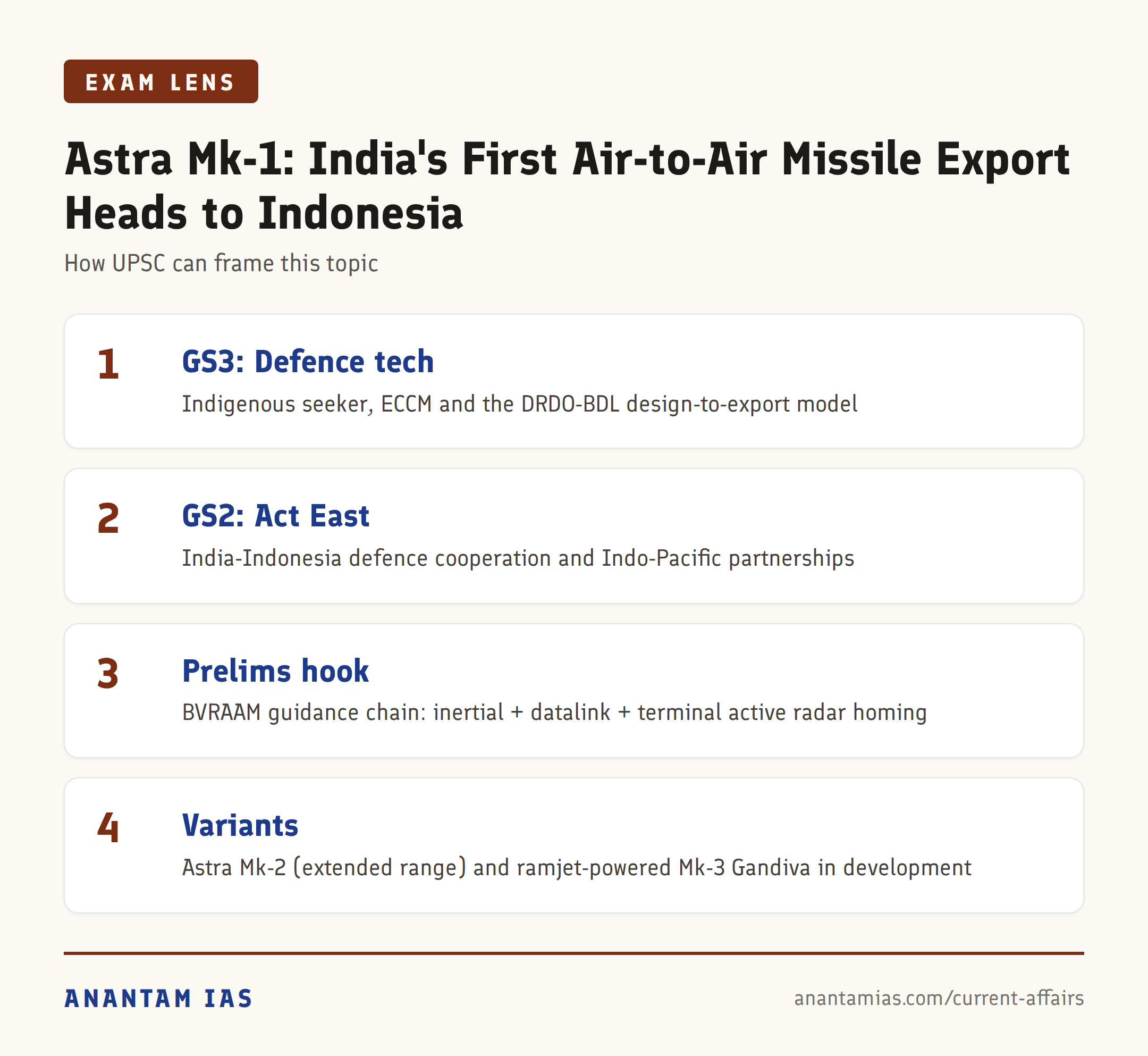
- Guidance: inertial navigation + mid-course datalink + terminal active radar homing; smokeless solid-fuel motor; ECCM against electronic warfare.
- Integration: fielded on the Su-30 MKI; being integrated with LCA Tejas and planned for other IAF fighters.
- Export: signed between BDL and Republikorp (Indonesia); Indonesia to fit it on its Su-30 fleet; India’s first air-to-air missile export.
- Variants under development: Astra Mk-2 (extended range, ~160-200 km class) and the ramjet-powered Astra Mk-3 (Gandiva).
- A BVRAAM engages targets beyond the pilot’s visual range: launched under aircraft-radar guidance, then homing autonomously via its own seeker in the terminal phase.
Mains Relevance
GS Paper 3
- Indigenous defence manufacturing: the DRDO-BDL model from design to production to export, and what the Astra sale signals about capability maturity.
- Defence exports as strategic tool: how weapon sales build partnerships, interoperability and long-term influence with buyer states.
- Technology self-reliance: the significance of an indigenous seeker and ECCM suite in a contested electronic-warfare environment.
GS Paper 2
- India-Indonesia and the Act East Policy: defence cooperation as the newest and fastest-growing pillar of the relationship.
- India in the global arms market: positioning against established exporters and the diplomacy of defence sales in Southeast Asia.
Essay
- From buyer to builder to seller: the long arc of technological self-reliance in national security.
- Weapons as diplomacy: what a state exports says about the partnerships it wants to build.
Background and Context
What the Astra Programme Is
Astra is a family of Indian air-to-air missiles built to give fighters a decisive first-shot advantage.
- The programme was developed by DRDO to give the IAF an indigenous alternative to imported BVR missiles, ending dependence on foreign air-to-air weapons.
- The Mk-1 is the operational variant, integrated on the Su-30 MKI and cleared for full-scale production by BDL in 2024 after more than 50 trial firings.
- Astra Mk-2, with an extended range in the 160-200 km class, and the ramjet-powered Mk-3 (Gandiva) are under development for far longer reach.
- The missile’s combat use during Operation Sindoor gave it a ‘combat-proven’ label that buyers weigh heavily.
Why Indonesia, and Why This Deal Matters
Jakarta’s purchase is the first crack in the export market for Indian air-to-air missiles.
- Indonesia operates Su-27/Su-30 fighters on which the Astra Mk-1 can be integrated, making it a natural launch customer.
- The agreement was signed between BDL and Republikorp, Indonesia’s defence holding company, alongside the wider India-Indonesia defence engagement that has also featured BrahMos.
- It positions India to market the missile to other Su-27/30 operators seeking to replace ageing Russian-origin air-to-air weapons.
- For BDL, export orders typically carry better margins and, more importantly, validate Indian systems in the global market.
How a BVRAAM Works
Beyond-visual-range combat is now the decisive phase of most air engagements.
- The launch aircraft detects and tracks the target on its radar and fires the missile while still beyond visual range.
- In the mid-course phase the missile flies on inertial guidance with datalink updates from the launch fighter.
- In the terminal phase the missile’s own active radar seeker switches on, acquires the target and homes in autonomously.
- ECCM features let it hold lock through enemy jamming, the capability that separates modern BVRAAMs from older designs.
The Defence-Export Context
The Astra sale fits a decade-long push to turn India into a net arms exporter.
- India has steadily raised its defence-export figures and set ambitious targets under the Atmanirbhar Bharat and Make in India frameworks.
- Previous milestones include the BrahMos export to the Philippines (2022) and growing interest from other ASEAN states.
- Air-to-air missiles are among the hardest systems to export because of the seeker, guidance and integration complexity, so the Astra deal is a capability statement.
- Export success also creates a sustaining order book for DRDO-BDL beyond domestic IAF demand.
Way Forward
For the Programme
- Ensure smooth integration and after-sales support for Indonesia’s Su-30 fleet, since export reputation rests on sustainment as much as the missile.
- Accelerate Astra Mk-2 and Mk-3 development to keep India competitive at longer ranges against Chinese and Western BVRAAMs.
- Deepen indigenous seeker and propulsion capacity to reduce residual import dependence.
For Defence Diplomacy
- Package the Astra with training, financing and offsets, the model that closed the BrahMos-Philippines deal.
- Use the Indonesia sale as a reference to market the missile to other Su-27/30 and Rafale operators.
- Align export promotion with the strategic logic of Act East and Indo-Pacific partnerships.
Conclusion
The Astra Mk-1’s first export is a genuine milestone: not a component or a small arm, but a complete, guided, software-defined air-to-air missile with an indigenous seeker, sold to a strategically important partner. It tells the world that India can design, build and now export the harder classes of military technology.
The real test is what follows. Reliable integration and support for Indonesia, timely delivery of the longer-range Mk-2 and Mk-3, and disciplined defence diplomacy will decide whether this first sale becomes the start of a sustained export story.
UPSC Practice Questions
Prelims MCQ 1
With reference to the Astra Mk-1 missile, consider the following statements:
- It is India’s first indigenously developed beyond-visual-range air-to-air missile.
- It is developed by the DRDO and manufactured by Bharat Dynamics Limited.
- Its export to Indonesia marks the first overseas sale of an Indian air-to-air missile.
How many of the above statements are correct?
(a) Only one (b) Only two (c) All three (d) None
Answer: (c) All three
Explanation:
All three are correct. The Astra Mk-1 is India’s first indigenous BVRAAM, designed by DRDO and manufactured by BDL, and cleared for full-scale production in 2024. The agreement with Indonesia’s Republikorp is the first export of an Indian air-to-air missile, with Jakarta planning to integrate it on its Su-30 fleet.
Prelims MCQ 2
A beyond-visual-range air-to-air missile such as the Astra Mk-1 typically relies on which guidance sequence?
(a) Wire guidance throughout the flight (b) Mid-course inertial guidance with datalink, then terminal active radar homing (c) Purely infrared homing from launch (d) Ground-station radio command for the entire flight
Answer: (b) Mid-course inertial guidance with datalink, then terminal active radar homing
Explanation:
A modern BVRAAM is launched under the fighter’s radar picture and flies on inertial guidance with mid-course datalink updates. In the terminal phase its own active radar seeker switches on and homes onto the target autonomously. This is precisely the Astra Mk-1’s guidance chain, combined with ECCM to resist jamming.
UPSC Mains Questions
- The first export of the Astra Mk-1 marks India’s transition in a difficult segment of the global arms market. Examine the significance of indigenous air-to-air missile development for India’s strategic autonomy and defence-export ambitions. (250 words)
- Defence exports are as much an instrument of foreign policy as of industrial growth. Discuss with reference to India’s growing defence cooperation with Southeast Asian states. (250 words)
Frequently Asked Questions
What is the Astra Mk-1?
It is India’s first indigenously developed beyond-visual-range air-to-air missile, designed by the DRDO for the Indian Air Force and Navy and manufactured by Bharat Dynamics Limited. It was cleared for full-scale production in 2024 and is integrated on the Su-30 MKI, with integration on the LCA Tejas under way.
Why is the Indonesia deal significant?
It is the first-ever export of an Indian air-to-air missile. The agreement between Bharat Dynamics and Indonesia’s Republikorp makes Jakarta the launch foreign customer, with the missile to be integrated on Indonesia’s Su-30 fleet. It signals that India can export complete guided-missile systems, not just components.
What are the missile’s key specifications?
The Astra Mk-1 has a strike range of about 80 to 110 km, a speed of Mach 4.5 and an engagement ceiling near 20 km. It is roughly 3.6 m long, 178 mm in diameter and weighs about 154 kg, using a smokeless solid-fuel motor and an active radar seeker with electronic counter-countermeasures.
How does a beyond-visual-range missile work?
The launch aircraft fires it while the target is still beyond the pilot’s visual range. The missile flies on inertial guidance with mid-course datalink updates, and in the terminal phase its own active radar seeker acquires and homes onto the target autonomously, resisting jamming through ECCM features.
What variants of the Astra exist?
The Mk-1 is the operational variant. The Astra Mk-2, with a longer range in the 160-200 km class, and the ramjet-powered Astra Mk-3 (Gandiva), designed for much greater reach, are under development to keep India competitive with the latest Chinese and Western air-to-air missiles.
How does this fit India’s defence-export goals?
It advances the Atmanirbhar Bharat and Make in India push and the government’s target of scaling up defence exports. Air-to-air missiles are among the hardest systems to export because of seeker and integration complexity, so the sale is a strong statement of India’s high-technology defence capability.
Tell Google you want more of this.
Add Anantam IAS as a preferred sourceOne tap, and this site shows up more often in your own Top Stories, AI Overviews and AI Mode. Remove it any time.