Why in News?
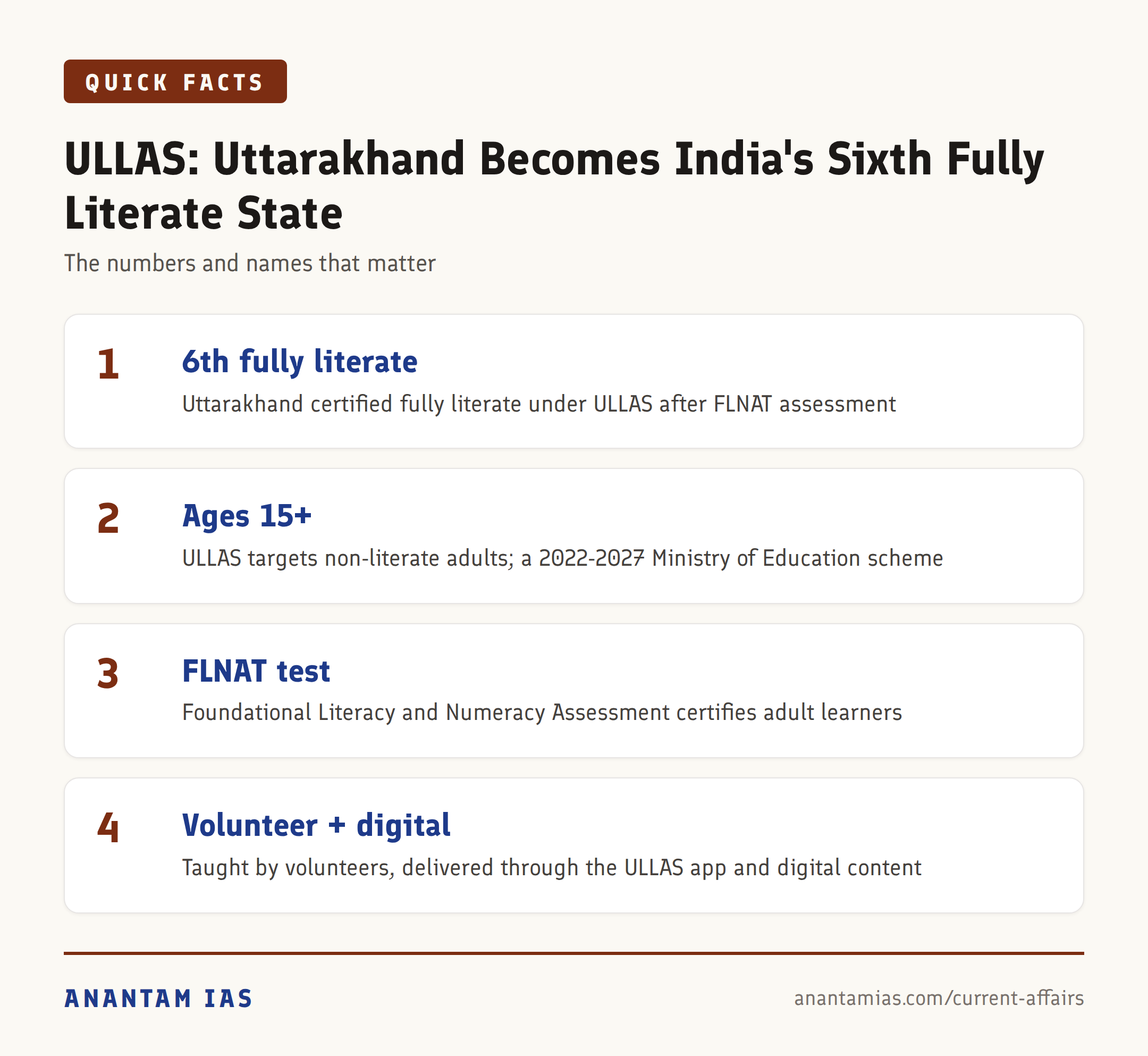
Uttarakhand has been declared a fully literate state under the ULLAS-Nav Bharat Saaksharta Karyakram (New India Literacy Programme), becoming one of the first group of states to cross the benchmark.
The declaration is based on performance in the Foundational Literacy and Numeracy Assessment Test (FLNAT) for adult learners, the yardstick the scheme uses to certify literacy among non-literate adults aged 15 and above.
- ULLAS (Understanding of Lifelong Learning for All in Society), also called the Nav Bharat Saaksharta Karyakram / New India Literacy Programme (NILP), is the Centre’s adult-literacy scheme for 2022-2027.
- It targets non-literate adults aged 15 and above and covers foundational literacy and numeracy plus critical life skills, vocational skills, and basic education.
- A state is deemed fully literate on crossing a literacy benchmark (widely taken as around 95%) as measured through the FLNAT.
- The scheme is run in volunteer mode, relying on voluntary teachers, and is delivered largely through digital and mobile-based learning.
- Uttarakhand joins the earlier group of states, including Mizoram, Goa and others, that have been certified fully literate under the programme.
The development matters in the context of:
- It marks progress toward the universal literacy goal aligned with NEP 2020 and the Sustainable Development Goal 4 on inclusive education.
- It shows a working model of adult education delivered in volunteer and digital mode, distinct from school-based literacy.
- It links to foundational literacy and numeracy, a national priority also driven through the school-level FLN mission.
UPSC Relevance
Prelims Relevance
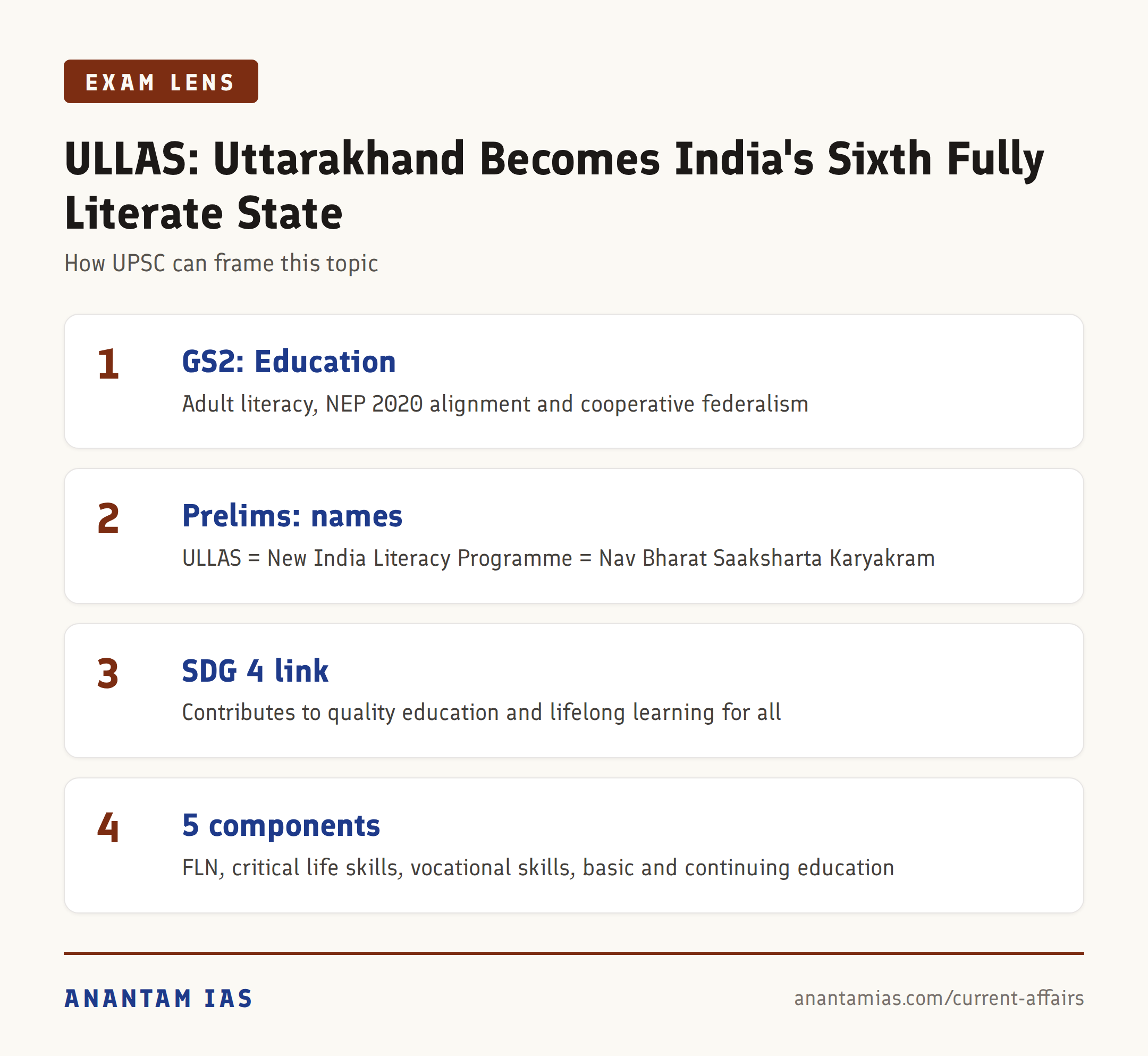
- ULLAS / Nav Bharat Saaksharta Karyakram (New India Literacy Programme, NILP): centrally sponsored adult-literacy scheme for 2022-2027, under the Ministry of Education (Department of School Education and Literacy).
- Target group: non-literate adults aged 15 years and above.
- Five components: foundational literacy and numeracy; critical life skills; vocational skills; basic education; continuing education.
- Assessment: the Foundational Literacy and Numeracy Assessment Test (FLNAT) certifies adult learners.
- Mode: volunteer-based teaching and digital delivery, including the ULLAS mobile app and DIKSHA content.
- ‘Fully literate’ benchmark is taken as roughly 95% literacy; Uttarakhand is among the first states to reach it.
- The scheme is aligned with NEP 2020 and contributes to SDG 4 (quality education for all).
Mains Relevance
GS Paper 2
- Adult literacy as a governance challenge: reaching non-literate adults outside the school system through volunteer and digital models.
- Cooperative federalism in education: a centrally sponsored scheme delivered by states, and what state-level success reveals.
- Education and social justice: literacy as an enabler of rights, welfare access and economic participation.
GS Paper 3
- Human capital and inclusive growth: the economic dividend of raising adult literacy and functional numeracy.
Essay
- Literacy after childhood: why teaching adults to read is a different and harder promise to keep.
- The volunteer as teacher: social participation as the engine of a national mission.
Background and Context
What ULLAS Is
ULLAS is India’s flagship adult-literacy scheme for the current decade.
- Launched for 2022-2027 under the Ministry of Education, ULLAS replaced earlier adult-education programmes with a broader lifelong-learning frame.
- It covers foundational literacy and numeracy, critical life skills, vocational skills, basic education and continuing education.
- Delivery is in volunteer mode, with citizens teaching non-literate adults, supported by digital content and the ULLAS app.
- The scheme aligns with NEP 2020‘s goal of universal foundational literacy and numeracy across ages.
How ‘Fully Literate’ Is Measured
Certification rests on an actual assessment of adult learners, not just enrolment.
- Adult learners are assessed through the FLNAT, testing reading, writing and basic numeracy.
- A state crossing the literacy benchmark, widely cited as around 95%, is declared fully literate.
- The metric focuses on functional literacy and numeracy, the ability to use these skills in daily life.
- Uttarakhand’s certification follows successful FLNAT performance across its districts.
Where Uttarakhand Fits
The state joins a small but growing group certified under the programme.
- Earlier states declared fully literate under ULLAS include Mizoram and Goa, among others, with Uttarakhand extending the list.
- Hill states face specific challenges of terrain, dispersed habitations and out-migration, making the achievement notable.
- Success rests on volunteer mobilisation and state administrative drive.
- The certification is a state-level milestone within a national 2027 target.
Why Adult Literacy Still Matters
Despite gains in schooling, a large adult population historically missed formal education.
- Adult literacy directly affects livelihoods, health-seeking, financial inclusion and rights awareness.
- It complements the school-level foundational literacy and numeracy (FLN) mission for children.
- Functional literacy enables participation in the digital economy and welfare delivery.
- Progress here advances SDG 4 and the NEP 2020 vision of learning across the lifespan.
Way Forward
For the Scheme
- Sustain post-literacy and continuing education so newly literate adults do not relapse.
- Expand vocational and digital-skill components to make literacy economically useful.
- Maintain volunteer momentum through recognition and institutional support.
For the Goal
- Replicate state-level models to keep the 2027 national target on track.
- Integrate ULLAS with financial inclusion and welfare-access drives for real-world impact.
- Focus on hard-to-reach groups: migrants, remote habitations and women learners.
Conclusion
Uttarakhand’s certification as a fully literate state is a concrete marker of progress in the harder half of the literacy challenge, teaching adults who missed formal schooling, through a volunteer and digital model. The achievement is meaningful precisely because adult literacy is difficult to deliver and easy to neglect.
The task now is to make literacy stick and pay: continuing education so skills are not lost, and vocational and digital add-ons so that reading and numeracy translate into better livelihoods and fuller participation.
UPSC Practice Questions
Prelims MCQ 1
With reference to the ULLAS scheme, consider the following statements:
- It is an adult-literacy programme targeting non-literate persons aged 15 years and above.
- It is implemented under the Ministry of Education and delivered largely in volunteer mode.
- Adult learners under the scheme are certified through the Foundational Literacy and Numeracy Assessment Test.
How many of the above statements are correct?
(a) Only one (b) Only two (c) All three (d) None
Answer: (c) All three
Explanation:
All three are correct. ULLAS (New India Literacy Programme, 2022-2027) targets non-literate adults aged 15 and above, is run by the Ministry of Education in volunteer and digital mode, and certifies learners through the Foundational Literacy and Numeracy Assessment Test (FLNAT). A state crossing the literacy benchmark is declared fully literate.
Prelims MCQ 2
The ULLAS programme is also known by which of the following names?
(a) Sarva Shiksha Abhiyan (b) Nav Bharat Saaksharta Karyakram / New India Literacy Programme (c) Samagra Shiksha (d) Rashtriya Madhyamik Shiksha Abhiyan
Answer: (b) Nav Bharat Saaksharta Karyakram / New India Literacy Programme
Explanation:
ULLAS (Understanding of Lifelong Learning for All in Society) is the New India Literacy Programme, also called Nav Bharat Saaksharta Karyakram. The other options are school-education programmes: Sarva Shiksha Abhiyan and RMSA (now subsumed under Samagra Shiksha) address elementary and secondary schooling, not adult literacy.
UPSC Mains Questions
- Adult literacy remains an unfinished agenda even as school enrolment nears universal levels. Examine the design of the ULLAS programme and the significance of state-level ‘fully literate’ certifications. (250 words)
- A volunteer-driven, digitally delivered model marks a shift in how India approaches adult education. Discuss its strengths and limitations. (150 words)
Frequently Asked Questions
What is the ULLAS scheme?
ULLAS (Understanding of Lifelong Learning for All in Society), also called the New India Literacy Programme or Nav Bharat Saaksharta Karyakram, is the Centre’s adult-literacy scheme for 2022-2027. Run by the Ministry of Education, it targets non-literate adults aged 15 and above through foundational literacy and numeracy and allied skills.
What does ‘fully literate state’ mean here?
A state is declared fully literate on crossing a literacy benchmark, widely taken as around 95%, as measured through the Foundational Literacy and Numeracy Assessment Test for adult learners. Uttarakhand’s declaration follows successful FLNAT performance, making it one of the first group of states to reach the mark.
Who is the scheme meant for?
Non-literate adults aged 15 years and above who missed formal schooling. Beyond basic reading, writing and numeracy, ULLAS also covers critical life skills, vocational skills, basic education and continuing education, framing literacy as lifelong learning.
How is the programme delivered?
Largely in volunteer mode, with citizens teaching non-literate adults, supported by digital and mobile-based learning through the ULLAS app and platforms like DIKSHA. This volunteer-plus-digital model distinguishes it from school-based education.
Which states are already fully literate under ULLAS?
Earlier states certified fully literate under the programme include Mizoram and Goa, among others. Uttarakhand extends this list. Each certification is a state-level milestone within the national target of full literacy by 2027.
Why does adult literacy matter for development?
Adult literacy improves livelihoods, health-seeking behaviour, financial inclusion and awareness of rights and welfare entitlements. It complements the school-level foundational literacy mission for children and advances NEP 2020’s vision and SDG 4 on inclusive, lifelong quality education.
Tell Google you want more of this.
Add Anantam IAS as a preferred sourceOne tap, and this site shows up more often in your own Top Stories, AI Overviews and AI Mode. Remove it any time.