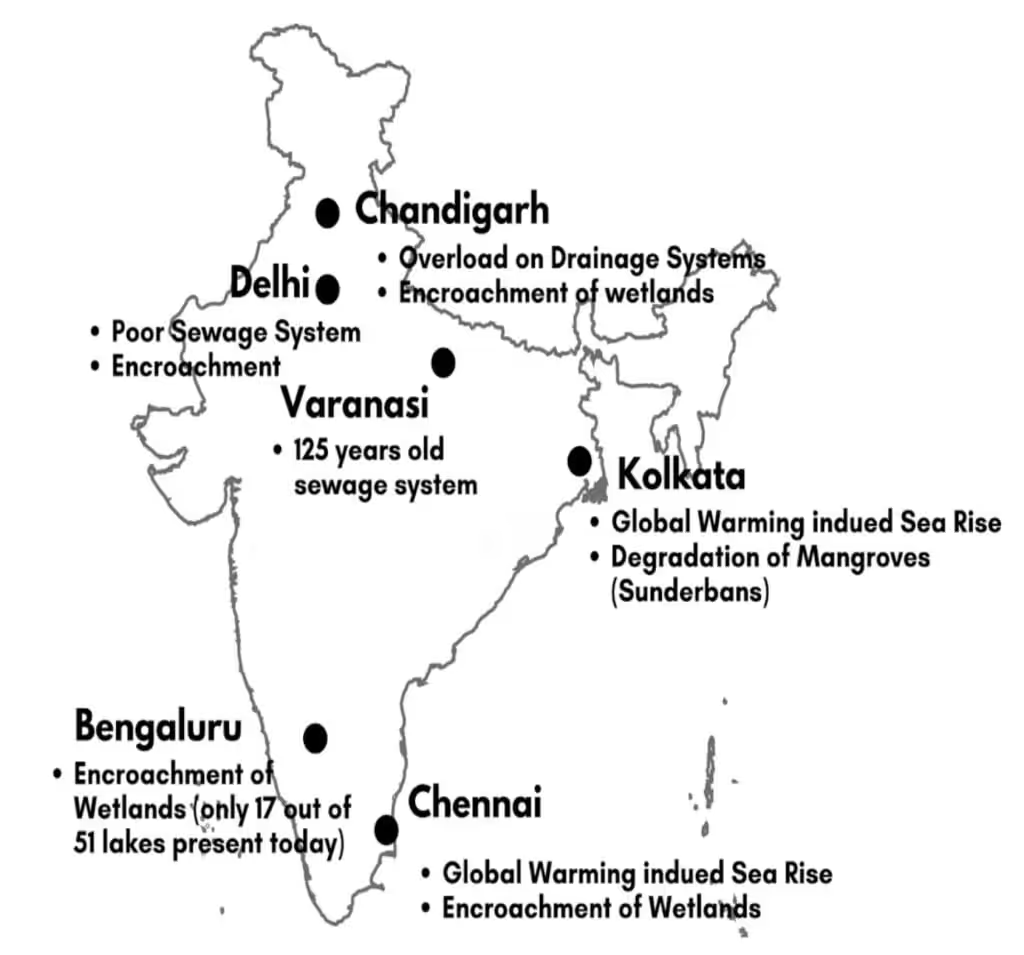
Urban Climate Resilience in India: World Bank Report, Pluvial Flooding, Heat Stress & Local Governance Reforms
Context: Indian cities will need some autonomy to invest effectively in climate change adaptation and mitigation, according to the World Bank’s Country Director for India. The report, prepared by the World Bank with the Union Ministry of Housing and Urban Affairs, estimates Indian cities will require $2.4 trillion by 2050 to build climate-resilient infrastructure and services.
Current scenario of India
- The 74th Constitutional Amendment Act of 1992 gave constitutional status to Urban Local Bodies (ULBs) to strengthen local self-governance.
- Official audits of 2022 have found that several states have yet to fully implement its provisions.
- Local conditions are better addressed by local Administration
- Devolution of power also improves accountability
- Towards Resilient and Prosperous Cities Report states that
- Country’s urban population will nearly double to 951 million by 2050, and that by 2030, cities will account for 70% of all new employment generated.
- In addition to the rapid pace of urbanisation, Indian cities will face two major shocks in a business-
- flooding and extreme heat
- Flood risk is growing rapidly.
- Cities are growing into areas that are exposed to flooding
- Building more concrete structures and pavings restrict the amount of rainwater the ground can absorb called as pluvial flooding.
- Annual pluvial flood-related losses can amount to $5 billion by 2030 and $30 billion by 2070 if cities don’t invest in adaptation.
Heat-related deaths can double to over 3 lakh each year by 2050 due to global warming and the urban heat island phenomenon. Exposure to dangerous extreme heat stress has increased by 71 per cent. Urban heat island impact- which makes cities warmer at night because they have concrete structures and roads that absorb heat and release it at night.
Measures that can be taken to save over 1.3 lakh lives
For cities, it calls for risk evaluation and the mobilisation of capital including private investment to support mitigation and adaptation efforts.
- Shifting working hours to early morning and late afternoon
- urban greening,
- early warning systems,
- cool roofs
- boosting private sector engagement
- creating a financing roadmap,
- setting standards to build municipal capacities.
Global case studies
Kuala Lumpur (Malaysia’s capital city)
- Constructed extensive water discharge tunnels.
- Tunnels divert excess floodwater away from the city’s densely populated areas.
Tokyo
- It has installed sensors in more than 30,000 stormwater drains to issue flood warnings in advance.
- Constructed a stormwater management system that includes the construction of reservoirs, underground storage facilities, and permeable surfaces to help capture excess rainwater and prevent it from overwhelming the drainage system.
- prioritized green infrastructure, which can absorb rainwater and reduce runoff.
- Installed Early Warning Systems
Buenos Aires
- It has installed sensors in more than 30,000 stormwater drains to issue flood warnings in advance.
Measures Taken by the Government
Standard Operating Procedures (SOP) for mitigating Urban Flooding by the Central Government under AMRUT
- National Guidelines on Management on Urban Flooding by the National Disaster Management Authority (NDMA)
- It lays down a predefined set of directives or responsibilities for public agencies in a city/town in 3 phases:
- Pre-Monsoon Phase: Preparedness and Planning for Disaster Reduction.
- During Monsoon Phase: Early Warning, Effective Response and Management, and Relief planning and execution
- Post-Monsoon Phase: Restoration and Rehabilitation.
Sponge Cities Plan by Urban Local Bodies and State Governments to make cities more permeable.
- Use of permeable material for roads and pavement, contiguous open green spaces, green roofs, etc.