Daily Digest
UPSC · Civil Services Examination
Current Affairs · Saturday, 12 September 2026
Current affairs curated and edited by Anantam IAS faculty — pulled from The Hindu, PIB, IDSA, Foreign Affairs and the ministries. Read, annotate, revise.
Old Rajinder Nagar · Delhi 110005 · anantamias.com
Bankers’ Books Evidence Act: Digital Records and Court Certification
Why in News?
The Ministry of Finance announced that the Bankers’ Books Evidence Act, 2026 will commence on 1 October 2026, following a notification issued on 10 September.
- The commencement date is in the future: the new framework is not yet operative on 12 September.
- The Act recognises physical and digital banking records, including electronic, virtual and cloud-based forms.
- Standardised certification can use manual, digital or electronic signatures, according to the ministry.
- Courts must record a special cause in writing when summoning bank officials where the bank is not a party.
- Banking increasingly separates the record from paper; evidence procedures must accommodate different storage formats without losing reliability.
- Procedural efficiency must coexist with scrutiny: easier presentation of records should not be confused with automatic acceptance of every assertion.
UPSC Relevance
Prelims Relevance
- Commencement notification and presidential assent are distinct events.
- Technology-neutral recognition of banking records.
- Manual, digital and electronic certification signatures.
- Special cause for summoning officials where a bank is not a party.
- Central Government power to extend provisions to specified financial entities.
Mains Relevance
GS Paper 2
- Modernising legal procedures while retaining reasoned judicial scrutiny.
- Delegated extension of a legal framework to specified institutions.
GS Paper 3
- Digital banking infrastructure and reliable financial records.
Essay
- Trust in institutions depends on verifiable records, not merely faster information flows.
Background and Context
Commencement changes when the framework operates
An enacted law and an operative law need not begin at the same moment; the notification fixes this transition.
- The ministry says the 2026 Act replaces the older Bankers’ Books Evidence Act; its subject remains banking records used as evidence, rather than a general redesign of banking services.
- Presidential assent and commencement answer different questions: assent concerns enactment, while the appointed commencement date determines when the notified provisions come into force legally.
- The notification appoints 1 October 2026 for commencement. An answer written before that date should describe a forthcoming framework, without claiming that courts already operate under it.
- The central institutional problem is evidentiary usability: records produced through changing banking technologies must be presented through a legal framework that recognises contemporary forms of record-keeping.
- Keep the reform’s scope precise: a change concerning banking evidence does not, by itself, establish changes to deposit protection, lending eligibility or the regulation of interest rates.
Technology neutrality and certification perform different jobs
The record’s format and its certification are related but distinct: one concerns storage, while the other concerns presenting the record for legal use.
- Technology neutrality recognises physical, electronic, digital, virtual and cloud-based records. The legal framework can accommodate different forms instead of treating a paper ledger as the only relevant model.
- Cloud-based storage describes how a record is maintained; it is not, by itself, a guarantee that the information is accurate, complete or appropriately connected to a disputed transaction.
- The ministry describes simplified and standardised certification, including manual, digital or electronic signatures. This addresses the procedure for using banking records, alongside recognition of their varied formats.
- For example, a digitally maintained transaction record raises both a format question and a certification question. Recognising its format does not make those two questions identical or interchangeable.
- As an implementation priority, banks should preserve record integrity and clear responsibility for certification. These are governance recommendations, rather than additional statutory duties inferred from the ministry’s announcement.
Summoning officials requires a reasoned judicial step
The announced safeguard concerns bank officials in proceedings where their bank is not itself a party.
- The ministry specifies a special cause, recorded in writing by the court, for summoning bank officials in that situation; the relevant condition should accompany any description of the safeguard.
- A written reason makes the court’s decision explicit. It helps distinguish a considered need for an official’s presence from treating every request for banking evidence as requiring personal attendance.
- The provision is not described as blanket immunity from summons. The announcement preserves the possibility of summoning officials, subject to the stated special-cause requirement in the specified situation.
- Do not merge certification with personal attendance: supplying a certified record and requiring an official to appear are different procedures, even when concerning the same information.
- For Mains, evaluate the balance between administrative burden and access to useful evidence. The announced reform seeks clearer procedure; actual improvements would require evidence from its subsequent operation.
Extension to other entities is a separate power
The framework can reach additional financial-sector entities through government action, rather than through an assumption that every entity is already covered.
- The Central Government may extend the provisions to specified financial-sector entities or classes of entities, according to the ministry; this is a distinct mechanism for adapting institutional coverage.
- The word may identifies a power to act. It should not be rewritten as proof that the government has already extended the framework to every financial institution or platform.
- Specified entities matter because institutional coverage determines who falls within a framework. A general description of the financial sector cannot substitute for checking an issued extension.
- An exam statement claiming that all fintech businesses are automatically covered would go beyond the announcement. Assess the actual scope of any later government action before accepting that claim.
- This illustrates adaptable legislation: Parliament establishes a framework while an identified executive power can extend coverage. Evaluation should consider clarity of scope and accountability when that power is exercised.
Way Forward
Prepare records and staff for the transition
- Map existing record formats and certification workflows before commencement, identifying where internal responsibilities or retrieval procedures need clarification.
- Train relevant staff to distinguish certified records, personal attendance and the conditions described for summoning officials.
- Track subsequent official instruments governing extensions of coverage; assess implementation through reliable evidence instead of assuming faster case disposal.
Conclusion
- Technology neutrality broadens the recognised forms of banking records, while certification and reasoned summons address different procedural needs.
- The key exam distinction is between a forthcoming commencement, recognised record formats and powers that require further government action.
UPSC Practice Questions
Prelims MCQ 1
With reference to the announced Bankers’ Books Evidence Act, 2026 framework, consider the following statements:
- It recognises cloud-based banking records.
- It requires a special cause recorded in writing for summoning bank officials where the bank is not a party.
- Its provisions came into force on the date of the September commencement notification.
How many of the above statements are correct?
(a) Only one (b) Only two (c) All three (d) None
Answer: (b) Only two
Explanation:
The first two statements match the ministry announcement. Commencement is appointed for 1 October 2026, not the notification date.
Prelims MCQ 2
The announced power to extend provisions to specified financial-sector entities means that:
(a) Every financial platform is automatically covered. (b) Only courts can extend institutional coverage. (c) The Central Government may extend coverage to specified entities or classes. (d) Record certification is unnecessary for electronic records.
Answer: (c) The Central Government may extend coverage to specified entities or classes.
Explanation:
The ministry identifies a Central Government extension power. The existence of this power does not establish that every entity is already covered.
UPSC Mains Questions
- How can technology-neutral rules for banking evidence improve legal administration while preserving reliable scrutiny? Discuss.
- Explain the distinction between recognising electronic records, certifying records and summoning bank officials in legal proceedings.
Source: PIB, Ministry of Finance.
Frequently Asked Questions
When does the Bankers’ Books Evidence Act, 2026 commence?
The ministry states that its provisions will come into force on 1 October 2026. The commencement notification was issued on 10 September, so the framework is forthcoming as of 12 September.
What does technology-neutral recognition mean?
It means the framework recognises banking records in multiple forms, including physical, electronic, digital, virtual and cloud-based records. Recognition of a storage format should be distinguished from certification and questions about reliability.
Can bank officials still be summoned?
The ministry says courts must record a special cause in writing when summoning bank officials where the bank is not a party. This is a conditional safeguard, not a blanket prohibition on summons.
Does the Act automatically cover all financial entities?
The announcement says the Central Government may extend provisions to specified financial-sector entities or classes. That extension power does not establish that every financial entity or fintech platform is already covered.
Source: https://anantamias.com/current-affairs/bankers-books-evidence-digital-records-commencement/
EU Cyber Resilience Act: Product-Security Reporting Begins
Why in News?
The EU Cyber Resilience Act began requiring manufacturers to report actively exploited product vulnerabilities and severe security incidents from 11 September 2026.
- Manufacturers submit mandatory notifications through ENISA’s operational Single Reporting Platform for covered products made available on the EU market.
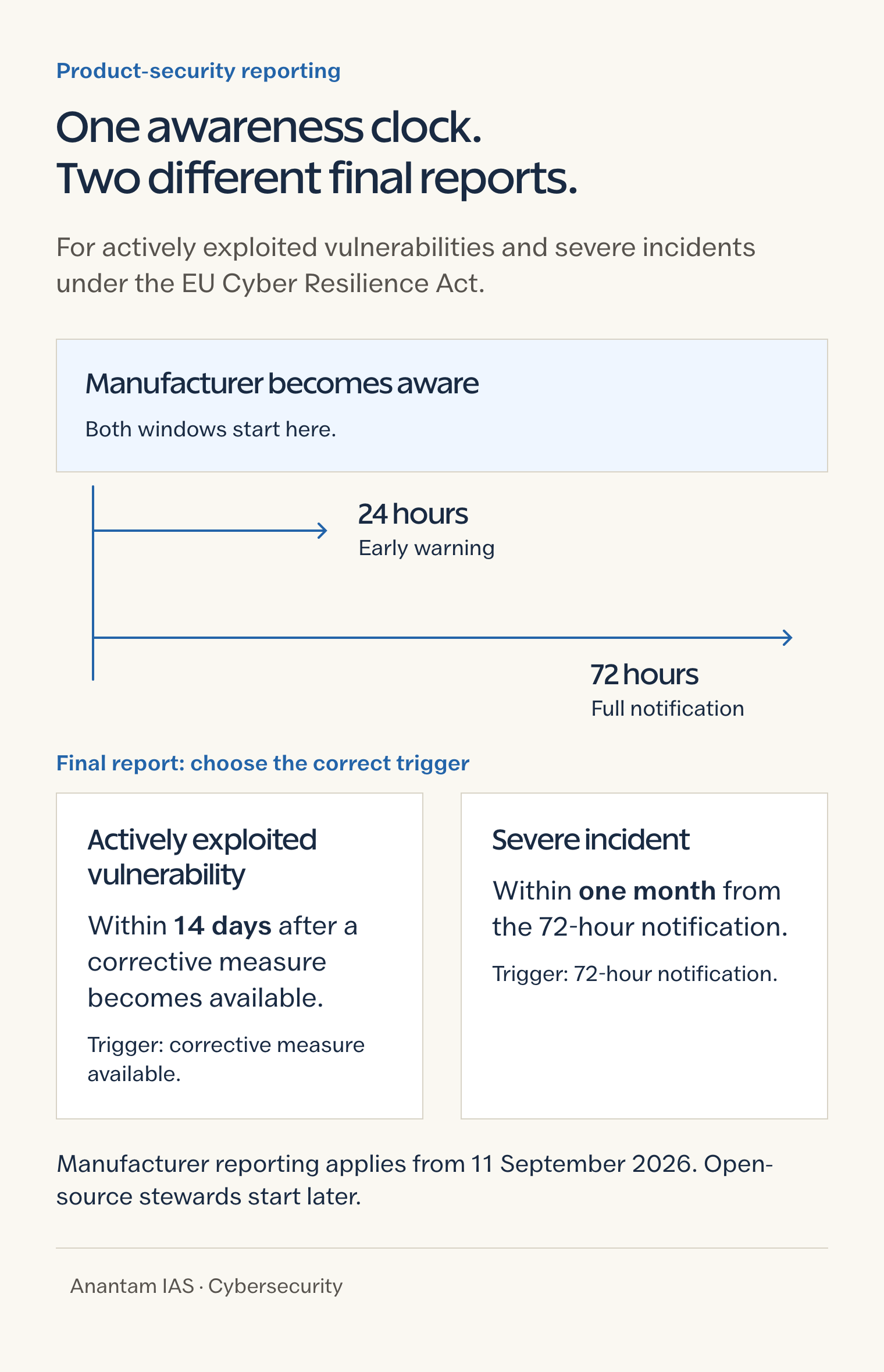
- Early warning is due within 24 hours of awareness; the full notification follows within 72 hours of awareness.
- Final reports follow different clocks for vulnerabilities and severe incidents, making the reporting trigger important.
- Open-source software stewards become subject to their reporting obligations from 11 December 2027; their starting date differs from manufacturers.
- Connected products can distribute the same security weakness across borders, requiring coordinated reporting alongside technical correction.
- Indian exporters supplying covered products to the EU need to assess product-security reporting responsibilities within their market-access planning.
UPSC Relevance
Prelims Relevance
- Cyber Resilience Act: product-security reporting in the EU.
- ENISA: European Union Agency for Cybersecurity.
- CSIRT: Computer Security Incident Response Team.
- Actively exploited vulnerability versus severe security incident.
- Awareness-based notifications versus separate final-report deadlines.
Mains Relevance
GS Paper 3
- Product cybersecurity, incident response and supply-chain accountability.
- Compliance capacity of Indian digital-product exporters.
GS Paper 2
- Cross-border regulatory coordination and differentiated implementation timelines.
Essay
- Trust in technology depends on accountability after deployment.
Background and Context
Which product-security problems trigger reporting?
The reporting duty concerns serious security developments affecting products with digital elements, rather than every defect discovered during development.
- Products with digital elements cover hardware and software. A connected router illustrates why product security involves physical equipment and its controlling software.
- An actively exploited vulnerability concerns a weakness being exploited, rather than merely a theoretical flaw. The distinction prevents treating every bug report as the same mandatory notification trigger.
- A severe incident affecting product security is the other reporting trigger. Keep this incident category separate from vulnerability discovery: an incident describes a security event, not simply defective code.
- The manufacturer reporting start is a specific implementation milestone. It does not establish that every CRA duty, for every type of actor, became applicable on that same day.
- Open-source software stewards have a later reporting start under the Commission’s explanation. Do not infer a blanket immediate reporting duty for every individual contributor or every open-source project.

How do the reporting deadlines work?
The first deadlines share an awareness clock, but the final report branches according to the type of security problem.
- The early warning must be submitted within 24 hours of becoming aware. Manufacturers need an internal escalation path that can begin while investigation and technical assessment are still continuing.
- The full notification is due within 72 hours of awareness. That period runs from the original awareness point, rather than beginning after the early warning has been submitted.
- For an actively exploited vulnerability, the final report is due no later than 14 days after a corrective measure is available. Availability of the measure starts this final-report clock.
- For a severe incident, the final report is due within one month from the 72-hour notification. Its clock is tied to that notification, rather than availability of a corrective measure.
- The key exam trap is substituting one clock for another. A single fixed final deadline calculated from first awareness would misstate the Commission’s explanation of these two reporting routes.
How does one report reach several authorities?
The Single Reporting Platform provides one submission channel while supporting coordinated handling across affected national jurisdictions.
- ENISA develops, operates and maintains the Single Reporting Platform. Manufacturers submit through this shared channel, allowing relevant authorities to receive information without separate initial submissions through multiple platforms.
- The notification is addressed to the CSIRT where the manufacturer has its main establishment. The Commission describes this national response team as the initial recipient in the coordination chain.
- Unless particularly exceptional circumstances apply, information is made available simultaneously to ENISA. The arrangement combines a national receiving authority with EU-level visibility of the reported product-security problem.
- The receiving CSIRT shares the notification without delay with other relevant CSIRTs in territories where the product was made available. Distribution follows the affected product’s market reach across jurisdictions.
- In exceptional circumstances, justified cybersecurity grounds may support delayed dissemination to other CSIRTs. This qualified safeguard should not be confused with a general manufacturer option to disregard reporting deadlines.
Why does the mechanism matter for Indian suppliers?
The practical lesson is to connect export compliance with engineering response, rather than keeping them in separate departments.
- Market destination matters: the reporting framework concerns covered products made available in the EU. Indian firms should assess their role and product coverage rather than assuming domestic location settles applicability.
- Internal accountability needs a reporting owner, an escalation route and awareness records. These are operational implications of short reporting windows, not additional legal deadlines.
- Technical remediation and notification should proceed together. Sending information to authorities does not itself remove an exploited weakness or demonstrate that affected products and users are adequately protected.
- Cross-border coordination is the durable governance mechanism: one report feeds several responsible authorities. It addresses information fragmentation, while the manufacturer still needs the capacity to investigate and correct product problems.
- Connect this development with India’s 6G security and standards debate: trusted technology requires both design choices and institutions capable of responding when security failures emerge.
Way Forward
Prepare the reporting chain before an incident
- Assign responsibility across product engineering, security response and compliance teams; rehearse escalation against the awareness-based notification windows.
- Record the right clocks: awareness, notification submission and corrective-measure availability should be distinguishable in incident records.
- Check current guidance for product coverage, actor responsibilities and exceptional dissemination rules instead of treating a short policy summary as complete compliance advice.
Conclusion
- The CRA reporting mechanism combines staged manufacturer notifications with coordinated authority access. Its central distinction is between shared early deadlines and different final-report clocks.
- For an analytical answer, connect product security with cross-border accountability, while separating reporting commencement from the application of every obligation under the wider law.
UPSC Practice Questions
Prelims MCQ 1
With reference to the EU Cyber Resilience Act reporting mechanism, consider the following statements:
- The early warning and full notification periods run from awareness.
- The vulnerability final-report clock begins when a corrective measure is available.
- Open-source software stewards began mandatory reporting on the same date as manufacturers.
How many of the above statements are correct?
(a) Only one (b) Only two (c) All three (d) None
Answer: (b) Only two
Explanation:
The first two statements are correct. Manufacturers began reporting on 11 September 2026; open-source software stewards begin on 11 December 2027.
Prelims MCQ 2
For a severe product-security incident, the final CRA report is due within one month from which point?
(a) The first product sale (b) The availability of a corrective measure (c) The 72-hour notification (d) The next software release
Answer: (c) The 72-hour notification
Explanation:
The Commission links the severe-incident final report to the 72-hour notification. The separate vulnerability final-report deadline runs from corrective-measure availability.
UPSC Mains Questions
- Explain how a single reporting platform can improve coordination over cross-border product-security risks. What operational limits remain?
- Discuss the implications of timed cybersecurity reporting duties for Indian manufacturers supplying digital products to overseas markets.
Sources: European Commission and ENISA.
Frequently Asked Questions
What began under the CRA in September 2026?
Manufacturer reporting of actively exploited vulnerabilities and severe incidents affecting product security began on 11 September 2026. This was a reporting milestone, not the simultaneous commencement of every CRA obligation.
Are the 24-hour and 72-hour deadlines consecutive?
No. Both run from becoming aware of the relevant vulnerability or severe incident. The 72-hour notification period does not begin only after the early warning has been filed.
Why are there two final-report clocks?
The vulnerability final report is due no later than 14 days after a corrective measure becomes available. The severe-incident final report is due within one month from the 72-hour notification.
When do open-source software stewards begin reporting?
The Commission states that reporting obligations for open-source software stewards apply from 11 December 2027. Their date differs from the manufacturer milestone and should not be generalized to every open-source contributor.
Does filing a report fix the security problem?
No. Reporting makes information available to responsible authorities and supports coordination. Investigation, technical correction and protection of affected users remain distinct practical needs; notification is not evidence that remediation has succeeded.
Source: https://anantamias.com/current-affairs/eu-cyber-resilience-act-reporting-starts/
Enoxaparin Reference Standard: Measuring Biological Activity Reliably
Why in News?
On 11 September 2026, the Indian Pharmacopoeia Commission announced an authenticated enoxaparin sodium reference substance for bioassays, strengthening the measurement infrastructure behind pharmaceutical quality testing.
- The Indian Pharmacopoeia Reference Substance was released during a national conference addressing quality and safety of biosimilars.
- Enoxaparin sodium is a low-molecular-weight heparin anticoagulant used in preventing and treating thromboembolic disorders.
- IPC states that the material may support accurate, consistent and comparable assessment of biological activity.
- A reference material makes a laboratory comparison more meaningful; it does not itself approve the medicine being tested.
- The development concerns quality infrastructure, including standards and analytical capability, rather than a newly demonstrated treatment benefit.
UPSC Relevance
Prelims Relevance
- IPC is an autonomous institution under the Ministry of Health and Family Welfare.
- A bioassay assesses biological activity through an appropriate biological response or system.
- Enoxaparin belongs to the low-molecular-weight heparin group of anticoagulants.
- An authenticated reference substance supports comparison of test results.
- Pharmacovigilance concerns monitoring and assessing medicine-related safety problems.
Mains Relevance
GS Paper 3
- Measurement infrastructure as a foundation for pharmaceutical manufacturing and credible innovation.
- Distinguishing analytical evidence from clinical evidence in biotechnology.
GS Paper 2
- Regulatory capacity, drug quality and patient safety in public-health governance.
Essay
- Trust in science depends on what measurements establish and what they leave unanswered.
Background and Context
What the New Reference Substance Provides
The reference substance supplies a recognised comparison point for laboratory testing; its value lies in the reliability of the measurement relationship.
- Biological activity describes an effect measured in a biological testing system. Identifying a substance chemically and measuring its activity answer related questions, but the answers should not automatically be treated as interchangeable.
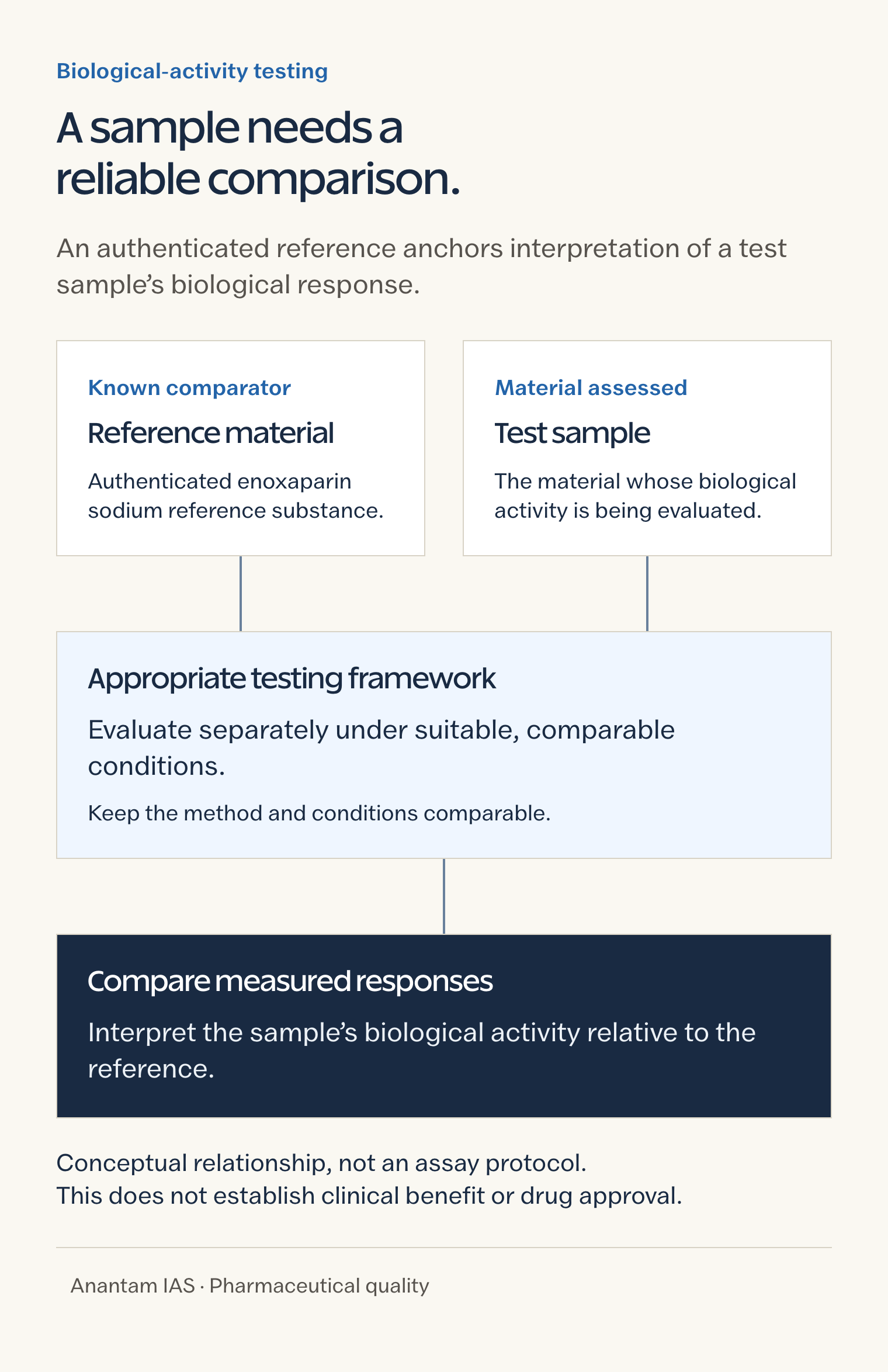
- An authenticated reference gives laboratories an established material against which a test sample can be evaluated. This reduces dependence on an arbitrary local comparison whose properties may be poorly established or inconsistently understood.
- The newly released material is specifically enoxaparin sodium for bioassays. It supports the quality-testing ecosystem around an existing anticoagulant; the announcement does not describe discovery of a different medicine or a new clinical indication.
- IPC links its release to consistent, comparable assessment of biological activity. This is a contribution to measurement capability, not a published finding that every product using the standard meets every applicable quality requirement.
- The conference discussed biosimilar quality and safety, but that setting does not classify every discussed product as a newly approved biosimilar. The concrete development to remember is the authenticated substance released for bioassay-related testing.

How Reference and Sample Become Comparable
A meaningful comparison requires both an appropriate reference and controlled testing conditions; placing two vials together does not establish equivalence.
- Conceptually, the reference material and the test sample enter an appropriate testing framework. Their measured responses are interpreted in relation to each other, rather than treating the sample response as a self-explanatory number alone.
- Testing conditions matter because a response can reflect the method as well as the material. Comparable preparation, suitable procedures and reliable equipment help prevent procedural differences from being mistaken for differences between the tested substances.
- Repeatability asks whether testing can produce consistent results under specified conditions. A recognised reference supports interpretation, but cannot compensate for poor laboratory practice, unsuitable methods or errors in handling, recording and evaluating a sample.
- Reference availability also helps laboratories speak a common measurement language. Agreement becomes more meaningful when users understand the comparator and procedure, instead of assuming that identically labelled results necessarily describe the same measured property.
- This is a conceptual explanation, not the announced enoxaparin assay protocol. The release supplies no detailed experimental procedure, numerical potency requirement or acceptance range from which a student should reconstruct a laboratory test.
Where Quality Evidence Ends and Other Evidence Begins
Pharmaceutical confidence combines several kinds of evidence; a biological-activity comparison contributes to that system without replacing its other safeguards.
- An analytical comparison concerns properties measured under test conditions. A clinical assessment concerns effects in people. Good laboratory comparability can support evaluation, but alone cannot establish the size of a treatment benefit in patients.
- Immunogenicity concerns the possibility of an immune response to a biological product. The conference treated it as a separate scientific challenge; an activity measurement should not be represented as a complete assessment of that risk.
- Pharmacovigilance continues the safety task beyond a single quality test. Monitoring suspected adverse effects and examining their causes can reveal concerns that a reference-substance comparison was never designed, by itself, to resolve fully.
- Separate commercialisation support from clinical proof, as in patient-specific bone grafts. These developments concern different products, but both require claims to stay within the kind of evidence actually available for each decision.
- Patient-level registry evidence illustrates another distinct layer: observing outcomes in care. A reference standard, regulatory evaluation and patient follow-up serve complementary purposes; none should silently substitute for the others in public communication.
Way Forward
Make the Standard Useful in Practice
- Pair reference availability with appropriate laboratory training, documented procedures and dependable handling so the material improves real testing capability.
- Communicate exactly which quality attribute a test assesses, and separate its result from broader safety, efficacy or authorisation claims.
- Strengthen links between pharmacopoeial institutions, regulators and testing laboratories while retaining safety monitoring and evidence appropriate to each product.
Conclusion
- The enoxaparin reference substance strengthens comparability in biological-activity testing. Its importance is the shared basis it provides for measurement, with benefits depending on appropriate methods, capable laboratories and careful interpretation of their results.
- For an exam answer, distinguish reference material, quality assessment and clinical evidence. The new standard supports the first link and helps the second; it does not announce drug approval, prove efficacy or remove the need for safety evaluation.
UPSC Practice Questions
Prelims MCQ 1
With reference to the newly released enoxaparin sodium reference substance, consider the following statements:
- It is intended for bioassay-related testing.
- Its release by itself establishes clinical efficacy of every enoxaparin product.
- It may support comparable assessment of biological activity.
How many of the above statements are correct?
(a) Only one (b) Only two (c) All three (d) None
Answer: (b) Only two
Explanation:
Statements 1 and 3 are correct. The reference supports testing; its release is not clinical proof or a product approval.
Prelims MCQ 2
What is the principal purpose of using an authenticated reference substance in an appropriate bioassay?
(a) To replace all clinical and safety evaluation (b) To grant a manufacturing licence automatically (c) To provide a recognised basis for comparing biological activity (d) To guarantee identical outcomes in every patient
Answer: (c) To provide a recognised basis for comparing biological activity
Explanation:
A reference substance supports meaningful laboratory comparison. Clinical outcomes, regulatory authorisation and safety assessment require their own evidence.
UPSC Mains Questions
- Explain how pharmacopoeial reference substances strengthen pharmaceutical quality infrastructure. Why can their availability not be equated with proof of clinical efficacy?
- Discuss the complementary roles of analytical comparability, regulatory evaluation and pharmacovigilance in building confidence in biopharmaceutical products.
Source: PIB, Ministry of Health and Family Welfare.
Frequently Asked Questions
What did IPC release?
IPC released an Indian Pharmacopoeia Reference Substance for enoxaparin sodium for bioassays. It may serve as an authenticated material supporting accurate, consistent and comparable assessment of biological activity.
Is this a new medicine or drug approval?
No. The announcement concerns a reference substance used in testing an existing anticoagulant. It does not announce approval of a new medicine, a new clinical indication or demonstrated patient benefit.
Why does a bioassay need a reference substance?
A recognised reference gives the test sample a meaningful comparison point. Its usefulness depends on an appropriate method, controlled conditions and sound laboratory practice, rather than the reference material alone.
Does comparable activity prove clinical efficacy?
No. Biological activity measured under test conditions is one kind of evidence. Clinical efficacy concerns effects in people and cannot be established solely by announcing a reference material or an analytical comparison.
Source: https://anantamias.com/current-affairs/enoxaparin-reference-standard-bioassay-quality/
Tara Coal Block: Revised Boundaries and Environmental Decision-Making
Why in News?
The Ministry of Coal explained on 11 September why the Tara coal block returned to auction after a revised boundary and fresh communication from Chhattisgarh.
- The ministry says Tara was withdrawn from auction in 2023 following concerns raised by the Chhattisgarh government.
- According to the ministry, a December 2025 state communication supported including Tara, describing it as outside the Lemru Elephant Corridor.
- The ministry says CMPDIL revised the boundary and the influence zone was removed before the block was auctioned.
- The announced auction outcome was a 37.5% revenue share; this commercial result is distinct from an assessment of ecological impacts.
- A revised boundary changes the area offered for allocation; its ecological significance depends on the actual spatial evidence and surrounding landscape.
- The case tests public accountability: official explanations should identify what changed, why it changed and what evidence supports the decision.
UPSC Relevance
Prelims Relevance
- Tara coal block and Chhattisgarh.
- Lemru elephant corridor in the ministry’s account.
- CMPDIL boundary revision as reported by the ministry.
- Commercial auction outcome versus ecological assessment.
- Habitat connectivity as a landscape-level concern.
Mains Relevance
GS Paper 3
- Reconciling resource allocation with ecological connectivity.
- Evidence needed to assess mining proposals in forest landscapes.
GS Paper 2
- Centre-state communication and transparency in administrative decisions.
Essay
- A boundary on paper does not answer every question about a living landscape.
Background and Context
Why the block returned to auction
The ministry presents the auction as the outcome of changed state communication and a revised area, rather than an unchanged proposal.
- According to the Ministry of Coal, the earlier withdrawal followed a Chhattisgarh request concerning Hasdeo Arand coal blocks.
- The ministry reports that the state later supported including Tara, describing the block as outside the Lemru Elephant Corridor. That description should remain attributed to the ministry.
- The ministry states that CMPDIL revised the block boundary before the auction. Its explanation also says the corridor’s influence zone was removed from the area offered for auction.
- The reported sequence is withdrawal, renewed state communication, boundary revision and auction. It establishes the government’s stated decision pathway, without independently settling the ecological consequences of the revised proposal.
- For an exam answer, separate the administrative explanation from independent confirmation. The ministry’s statement is evidence of its position; examining revised maps would answer a different question.
Allocation and environmental scrutiny answer different questions
An auction allocates a commercial opportunity; it does not itself demonstrate that every environmental concern or applicable permission has been resolved.
- The announced revenue share describes an auction outcome. It indicates a commercial term, not a measure of habitat quality, the adequacy of safeguards or the absence of ecological disturbance.
- A statement that a block was successfully auctioned should not be converted into a claim that all environmental, forest or wildlife permissions are in place for subsequent mining activity.
- The ministry’s account addresses why Tara was offered again. It does not present a complete permission record, so readers should avoid treating this explanation as a comprehensive clearance dossier.
- Likewise, expectations about employment or state revenue are projections rather than realised outcomes. Their assessment requires later evidence about actual activity, receipts and jobs, rather than repetition of promised benefits.
- The decision problem is not solved by commercial interest alone. A proposal can attract bidders while still requiring careful scrutiny of its environmental implications and the evidence supporting implementation decisions.
Elephant connectivity requires a landscape perspective
The durable ecological question is how a proposed activity relates to movement and habitat beyond the line defining the allocation.
- Habitat connectivity concerns links through a landscape that allow wildlife movement. Assessing a project’s relationship to those links requires more than reading the name or boundary of an auction block.
- A corridor boundary and the broader landscape around it answer related but different questions. The relevant assessment should examine spatial relationships instead of assuming that one line describes every ecological interaction.
- For instance, an assessment might examine roads, movement routes and surrounding habitat. These are questions for investigation here, not claims that particular impacts have already been demonstrated at Tara.
- The ministry’s claim about removal of the influence zone needs its underlying spatial basis for evaluation. Assessing it requires the revised maps and the criteria used to define that zone.

What transparent spatial decision-making should disclose
The additional governance mechanism is traceability: readers should be able to connect the revised boundary with the reasoning behind it.
- A useful public record would show old and revised boundaries together, making the change legible. This is a recommendation for disclosure, not an assertion that such a comparison is already available.
- It should explain the basis for excluding the influence zone, including how the area was identified. A bare statement that a revision occurred cannot communicate the full assessment behind it.
- The record should distinguish state recommendations, technical revisions and allocation decisions. Keeping these roles visible helps identify which institution supplied evidence and which institution relied on it when acting.
- Independent evaluation should examine the same proposal and boundary version used for the decision. Otherwise, arguments can talk past each other by referring to different geographical extents or administrative stages.
- Finally, scrutiny should remain open to new evidence. Clear reasons make a decision assessable and correctable; neither promotional certainty nor unsupported allegations substitute for examining the relevant documents.
Way Forward
Make the revised proposal assessable
- Publish an accessible boundary comparison with the technical basis for the change and its relationship to the corridor’s reported influence zone.
- Keep allocation and permission status separately visible, so an auction announcement does not become a misleading shorthand for implementation readiness.
- Evaluate ecological and economic outcomes using subsequent evidence, retaining uncertainty where documents or observations do not establish a conclusion.
Conclusion
- Tara’s revised auction illustrates why a changed administrative boundary and ecological safety are different claims, requiring different evidence.
- Use the case to connect resource governance, spatial transparency and habitat connectivity, while keeping the ministry’s contested boundary account clearly attributed.
UPSC Practice Questions
Prelims MCQ 1
With reference to the Ministry of Coal’s account of the Tara revised coal-block auction, consider the following statements:
- The ministry reports that the block was earlier withdrawn following Chhattisgarh’s concerns.
- The ministry states that CMPDIL revised the block boundary.
- A successful auction by itself proves that all environmental permissions have been obtained.
How many of the above statements are correct?
(a) Only one (b) Only two (c) All three (d) None
Answer: (b) Only two
Explanation:
The first two statements follow the official account. Auction success does not, by itself, establish the status of every applicable permission.
Prelims MCQ 2
Which evidence would most directly help evaluate the reported spatial change to the Tara coal block?
(a) A generic photograph of an elephant (b) The number of bidders alone (c) Comparable old and revised boundary maps with the technical basis for revision (d) A projected employment total alone
Answer: (c) Comparable old and revised boundary maps with the technical basis for revision
Explanation:
Assessing a boundary change requires spatial evidence and its rationale. Illustrations, bidder interest and projected benefits do not establish the geographical change.
UPSC Mains Questions
- Why should commercial allocation and ecological assessment remain distinct in resource governance? Discuss with reference to the Tara revised coal-block auction.
- Explain how transparent spatial information can improve accountability in decisions affecting wildlife connectivity and mineral development.
Source: PIB, Ministry of Coal.
Frequently Asked Questions
Why was Tara offered for auction again?
The Ministry of Coal says Chhattisgarh later supported its inclusion and CMPDIL revised the boundary. The ministry presents these developments as the basis for returning the block to auction after its earlier withdrawal.
Does auction success mean all permissions are complete?
No. The auction outcome alone does not establish the status of environmental, forest or wildlife permissions. The ministry’s explanation of the auction should not be treated as a complete record of every applicable approval.
Why does elephant connectivity matter to this case?
The ministry’s account refers to the Lemru Elephant Corridor and its influence zone. Connectivity adds a landscape-level question, requiring examination of actual boundaries and relevant evidence rather than assumptions based on an auction result.
What would help assess the revised boundary?
Comparable old and revised maps, the technical basis for the revision and the relevant institutional records would help. Without these, an explanation of the decision should remain distinct from independent verification of its ecological implications.
Source: https://anantamias.com/current-affairs/tara-coal-block-revised-boundary-auction/
Cochin Ship Repair JV: Building a Maritime Services Cluster
Why in News?
Cochin Shipyard Limited and Drydocks World signed a ship-repair joint venture agreement on 11 September 2026 to operate and expand the International Ship Repair Facility in Cochin.
- Equal ownership: each partner will hold a 50% stake, with initial capital funded through equity contributions from both parties.
- New development: the agreement formalises collaboration explored through an MoU signed during India Maritime Week 2025.
- Facility mandate: the venture will operate, consolidate and expand the International Ship Repair Facility, serving Indian, regional and international customers.
- Expected benefits: additional capacity, skilled employment and better turnaround are prospective outcomes, not independently measured achievements announced in the release.
- Maritime services create value through maintenance, repair and conversion, alongside the more visible activities of building ships and moving cargo.
- Industrial cooperation between Indian and UAE-linked firms can combine local engineering capability with international repair experience and customer networks.
UPSC Relevance
Prelims Relevance
- Cochin Shipyard Limited and Drydocks World: the joint venture partners.
- Drydocks World: a DP World company.
- International Ship Repair Facility: located in Cochin, Kerala.
- Joint venture: shared equity ownership in a defined business arrangement.
- Ship repair, conversion and shipbuilding: distinct maritime activities.
Mains Relevance
GS Paper 3
- Maritime infrastructure, industrial clusters and skilled employment.
- Public-private cooperation and evidence-based infrastructure evaluation.
GS Paper 2
- India-UAE economic cooperation through industrial partnerships.
Essay
- Infrastructure creates lasting value when institutions and skills match physical assets.
Background and Context
What changed from the earlier understanding?
The fresh development is a formal equity partnership around a defined facility, following an earlier exploratory understanding.
- The 2025 MoU explored ship repair and allied maritime services cooperation. The new agreement establishes the partnership structure intended to carry that collaboration forward.
- The 50:50 ownership means both parties will hold equal equity stakes. Initial capital comes from their equity contributions; the release does not supply a completed investment or spending total.
- The venture’s stated scope is the International Ship Repair Facility in Cochin. Operating, consolidating and expanding this facility is more specific than a general announcement about maritime cooperation.
- Cochin Shipyard brings domestic shipbuilding and repair capabilities, engineering experience and skilled workers. These existing strengths provide the local industrial foundation described in the release.
- Drydocks World, a DP World company, brings experience in vessel maintenance, major conversions and offshore engineering. Complementarity between the partners explains the business rationale, rather than proving future commercial success.
How does a ship-repair facility create value?
Repair services keep existing vessels serviceable, making infrastructure useful throughout a ship’s operating life rather than only at construction.
- Shipbuilding creates a vessel; repair and maintenance address an existing vessel’s condition. Conversion changes its configuration or use. These activities share engineering skills but serve different commercial requirements.
- The Ministry describes ISRF as having a ship lift system and modern docking facilities. Such infrastructure enables access needed for repair work; the announcement does not establish new numerical lifting capacities.
- Repair work can require inspection, fabrication, component replacement and engineering support. This explains why a repair facility depends on coordinated specialist services, rather than functioning only as a place to berth.
- Turnaround time matters because time spent awaiting or undergoing repair affects vessel availability. Faster service is an expected partnership benefit here, not a measured improvement demonstrated by the agreement.
- Quality and safety matter alongside speed. For an analytical answer, judge whether service reliability improves, rather than assuming that larger capacity automatically means better repair performance for customers.

How can one facility support an industrial cluster?
A repair cluster forms when recurring vessel work supports nearby specialist businesses, workers and services that reinforce one another.
- Engineering and fabrication suppliers can serve repair orders generated by the main facility. The Ministry identifies opportunities in these activities, although the release does not quantify realised orders or supplier income.
- Skilled employment depends on actual workloads and capabilities. A pipeline of repair projects could support specialist training and jobs; the announcement alone cannot establish that those employment gains have occurred.
- International customers broaden the potential market beyond domestic vessels. The facility’s location near major shipping routes supports the commercial rationale, while winning repair contracts still requires competitive and dependable services.
- Local linkages determine how much value spreads through Kerala’s economy. Procurement, workforce development and supporting services are useful evaluation questions, rather than outcomes that can be inferred solely from equity ownership.
- Replication elsewhere is an ambition expressed in the announcement. A successful cluster model would need suitable demand, skills and infrastructure at each location; this agreement does not establish completed nationwide hubs.
What should an infrastructure assessment distinguish?
Separate the signed arrangement, its intended operational changes and the evidence needed to judge its eventual economic results.
- Agreement versus delivery: signing establishes the collaboration milestone. Expanded capacity, improved efficiency and employment should be evaluated later against actual facility operations, rather than reported as completed benefits today.
- Facility partnership versus company ownership: equal stakes concern the joint venture. The announcement does not say that the entire Cochin Shipyard enterprise has been privatised or transferred to its partner.
- Commercial cooperation versus defence arrangements: this is a ship-repair business partnership. Its international context does not turn it into a defence pact or establish access rights for foreign naval forces.
- Useful performance evidence would include actual repair throughput, delivery reliability, safety performance and supplier participation. These are proposed assessment measures, not statistics or reporting commitments announced by the Ministry.
Way Forward
Track whether the facility creates dependable services
- Build skills around demand by connecting training to the repair and fabrication work that the facility actually secures.
- Assess operational delivery through service reliability, safety and turnaround evidence, alongside any additional capacity brought into use.
- Strengthen local suppliers through transparent procurement opportunities and quality requirements that help smaller engineering businesses participate.
Conclusion
- The Cochin joint venture illustrates how maritime infrastructure can support a wider repair-services economy when physical facilities, skills and specialist suppliers work together.
- The exam distinction is between the signed partnership and its expected benefits: equal equity is established in the agreement, while industrial outcomes require subsequent evidence.
UPSC Practice Questions
Prelims MCQ 1
With reference to the Cochin Shipyard-Drydocks World agreement, consider the following statements:
- Both partners will hold equal equity stakes in the joint venture.
- The arrangement concerns operating and expanding the International Ship Repair Facility.
- The announcement establishes privatisation of the entire Cochin Shipyard enterprise.
How many of the above statements are correct?
(a) Only one (b) Only two (c) All three (d) None
Answer: (b) Only two
Explanation:
Equal ownership and the facility mandate are stated in the release. It does not announce privatisation of the entire Cochin Shipyard enterprise.
Prelims MCQ 2
Which best explains how a ship-repair facility can support an industrial cluster?
(a) It eliminates demand for engineering skills (b) It generates recurring demand for specialised suppliers and services (c) It automatically creates a defence alliance (d) It replaces all shipbuilding activity
Answer: (b) It generates recurring demand for specialised suppliers and services
Explanation:
Repair work can support fabrication, engineering, maintenance and associated services. A cluster develops through these business and skill linkages, rather than through the facility alone.
UPSC Mains Questions
- Explain how ship-repair infrastructure can generate industrial-cluster benefits. Identify the conditions needed for those benefits to reach local firms and workers.
- Distinguish between an infrastructure partnership announcement and verified economic outcomes. Discuss suitable criteria for evaluating a maritime services joint venture.
Source: PIB, Ministry of Ports, Shipping and Waterways.
Frequently Asked Questions
What did Cochin Shipyard and Drydocks World sign?
They signed a joint venture agreement to operate, consolidate and expand the International Ship Repair Facility in Cochin. Each company will hold an equal stake, with initial equity contributions from both partners.
How is this different from the earlier MoU?
The earlier MoU explored cooperation in ship repair and allied services. The new agreement formalises a joint venture with an identified ownership structure and a defined facility mandate.
Does the agreement privatise all of Cochin Shipyard?
No such transfer is announced in the release. The equal ownership shares relate to the joint venture around the repair facility, not ownership of the entire Cochin Shipyard enterprise.
Have the promised jobs and faster repairs already materialised?
The announcement describes employment, capacity and turnaround gains as expected benefits. Signing the agreement does not independently demonstrate that these operational or economic improvements have already been delivered.
Why is ship repair relevant to industrial policy?
Repair can sustain demand for fabrication, engineering and specialist maintenance services. When local suppliers and skilled workers participate, a facility can support a broader industrial cluster around recurring vessel work.
Source: https://anantamias.com/current-affairs/cochin-drydocks-ship-repair-joint-venture/
August Ocean Heat: El Niño and Uneven Regional Risks
Why in News?
WMO’s 11 September assessment reported exceptional August ocean-surface warmth, established El Niño conditions and contrasting tropical-cyclone activity across ocean basins.
- The report cites 21.11°C as the highest observed daily global sea-surface temperature over the extra-polar ocean, rather than a monthly or deep-ocean average.
- El Niño was established, with exceptionally warm conditions across much of the central and eastern tropical Pacific.
- WMO reported an unusually quiet Atlantic alongside more active storm development in the Eastern North Pacific during August.
- Strong or severe marine heatwaves affected waters near Europe, including the western Mediterranean and Atlantic coast.
- A global average summarises widespread conditions but conceals differences between ocean regions, seasons and the hazards that matter to particular communities.
- Regional preparedness needs local forecasts and exposure information, alongside broad climate signals such as El Niño and exceptionally warm seas.
UPSC Relevance
Prelims Relevance
- Sea-surface temperature versus deep-ocean temperature.
- Daily observations versus monthly averages.
- El Niño and the central and eastern tropical Pacific.
- Marine heatwaves and unusual regional ocean warmth.
- Global cyclone activity versus basin-level activity.
Mains Relevance
GS Paper 3
- Using climate observations without overstating regional predictions.
- Connecting ocean monitoring with hazard-specific preparedness.
GS Paper 1
- Ocean-atmosphere relationships and uneven regional climate impacts.
Essay
- A global average can reveal a crisis while hiding where preparation is most urgent.
Background and Context
Read the ocean measurement before interpreting it
The ocean headline describes a particular measured variable and area; those qualifiers are essential to its meaning.
- Sea-surface temperature describes conditions near the ocean’s surface. It should not be relabelled as the temperature of the entire water column or the total heat stored throughout the ocean.
- The reported daily extra-polar ocean value is not an August monthly mean. Keeping the time interval and geographical coverage attached prevents an accurate number from becoming a misleading statement.
- An average combines different locations. A high global value can coexist with varied regional conditions, so it cannot identify which particular coast is experiencing the greatest immediate hazard.
- WMO draws on several climate datasets. When their temperature anomalies use different reference periods, subtracting the published anomalies does not provide a valid measure of disagreement between the underlying observations.
- For answer-writing, state the variable, period and coverage before explaining implications. Precision about what was measured is more useful than repeating a temperature record without its defining limits.
El Niño links ocean conditions with atmospheric patterns
WMO identifies El Niño as one driver of August’s climate, connecting tropical Pacific warmth with wider changes in weather patterns.
- El Niño concerns the tropical Pacific ocean-atmosphere system. WMO reports exceptionally warm waters across the central and eastern tropical Pacific and describes the event as established during the reported period.
- The importance extends beyond a warmer patch of water: ocean-atmosphere interactions influence rainfall and temperature patterns. This helps explain why distant regions can experience different conditions during the same event.
- The report links El Niño conditions with varied cyclone activity and rainfall impacts. Its wording identifies an influence, rather than making El Niño the sole explanation for every extreme event.
- WMO’s expectation of further strengthening is a forecast; the recorded August ocean conditions are observations. Distinguishing those categories prevents a future expectation from being presented as an already measured outcome.
- For India, the responsible implication is to examine regional forecasts. This global assessment alone does not establish a deterministic prediction for Indian monsoon rainfall, a particular district or an individual storm.

Why cyclone activity differs between basins
August’s contrast shows why a global climate signal does not translate into identical hazards in every ocean basin.
- The report describes the Atlantic as unusually quiet, while warmer waters supported storm development in the Eastern North Pacific. These contrasting outcomes belong to the same month and global climate setting.
- Global cyclone activity can be above average while one basin is quiet. The global total combines separate regional outcomes; it does not mean that every basin experienced an increase.
- Warm ocean conditions matter for tropical storms, but the observed basin contrast warns against turning ocean warmth into a universal storm-count rule. Regional atmospheric conditions remain relevant to interpreting hazards.
- The distinction also matters for preparedness: a quiet basin-wide month is not a guarantee that every coastline is safe. Operational decisions still require forecasts for that location and period.
Marine heatwaves require a different response lens
The same ocean assessment also points to persistent regional warmth, which needs attention beyond the development of tropical storms.
- WMO associates record August surface warmth along Europe’s Atlantic coast and western Mediterranean with widespread strong or severe marine heatwave conditions. This is a regional finding, not a universal ocean classification.
- A marine heatwave concerns unusually warm ocean conditions for the relevant location and time. A single global average cannot describe the severity or duration of each regional episode.
- This creates a separate monitoring question: where is unusual warmth persisting, and which local systems are exposed? Those questions differ from tracking the formation and movement of a tropical cyclone.
- Response planning should connect ocean observations with relevant local monitoring. The report does not itself quantify damage to a particular fishery or reef, so such losses should not be invented.
- The durable lesson is hazard-specific interpretation: ocean warmth can be relevant to several risks, while the evidence, affected locations and appropriate warning products differ across those risks.
Way Forward
Translate the global signal into regional decisions
- Present measurement qualifiers with every headline figure, including the time interval, area and reference period where relevant.
- Combine broad El Niño assessments with regional climate forecasts and current hazard warnings before making local preparedness decisions.
- Track marine heatwaves and tropical cyclones through their relevant monitoring products; avoid treating one temperature indicator as a complete risk assessment.
Conclusion
- Exceptional ocean warmth and El Niño help explain August’s climate, but a global signal can produce contrasting regional hazards.
- The strongest analytical approach separates observations, forecasts and local impacts, then matches each hazard with the evidence needed for action.
UPSC Practice Questions
Prelims MCQ 1
With reference to WMO’s August ocean assessment, consider the following statements:
- The cited 21.11°C value refers to a daily sea-surface temperature measurement over the extra-polar ocean.
- Above-average global cyclone activity necessarily means above-average activity in every basin.
- A forecast of El Niño strengthening is distinct from an observed August condition.
How many of the above statements are correct?
(a) Only one (b) Only two (c) All three (d) None
Answer: (b) Only two
Explanation:
Statements 1 and 3 are correct. A global cyclone total combines different basin outcomes, and WMO reports contrasting Atlantic and Eastern North Pacific activity.
Prelims MCQ 2
Why should temperature anomalies based on different reference periods not simply be subtracted to claim disagreement?
(a) Ocean temperatures cannot be measured. (b) All climate datasets use identical methods. (c) Their anomalies are measured relative to different baselines. (d) Anomalies always describe deep-ocean heat.
Answer: (c) Their anomalies are measured relative to different baselines.
Explanation:
An anomaly expresses departure from a reference baseline. Comparing published anomalies directly without aligning those baselines can create a misleading impression.
UPSC Mains Questions
- Explain why exceptional global ocean-surface warmth does not imply identical cyclone risks in every ocean basin.
- How should public agencies translate broad El Niño assessments into responsible regional risk communication and preparedness?
Source: World Meteorological Organization.
Frequently Asked Questions
What does the reported 21.11°C value measure?
It is the highest observed daily global sea-surface temperature over the extra-polar ocean cited in WMO’s August assessment. It is not an August monthly mean or the average temperature throughout the deep ocean.
Was El Niño the only driver of August’s weather?
No. WMO describes El Niño as one driver and links it to several observed patterns. This does not establish that every flood, drought or storm was caused solely by El Niño.
Can global cyclone activity rise while the Atlantic is quiet?
Yes. Global activity combines outcomes across ocean basins. WMO’s August account contrasts an unusually quiet Atlantic with storm development in the Eastern North Pacific, illustrating why regional patterns matter alongside the global total.
Does this assessment predict India’s monsoon outcome?
The global assessment alone does not provide a deterministic forecast for India or individual districts. Regional forecasts and current warnings are needed to interpret the broader climate signal for local preparedness decisions.
Source: https://anantamias.com/current-affairs/august-ocean-heat-el-nino-regional-risks/
Bundibugyo Outbreak: Why Geographical Spread Changes Response
Why in News?
WHO’s 10 September 2026 update reported the Bundibugyo outbreak reaching another health zone in the Democratic Republic of the Congo, highlighting continuing geographical spread and barriers to control.
- The newly affected Kayna health zone in North Kivu brought the affected total to 61 health zones across six provinces.
- WHO’s figures are reported as of 7 September; they should not be presented as a real-time count for today.
- WHO identifies delayed detection, insecurity and displacement as important constraints on surveillance, treatment access and interruption of transmission.
- Geographical expansion adds locations requiring response capacity; it does not, by itself, measure how quickly transmission is changing within every location.
- A risk assessment distinguishes settings and exposure pathways so preparedness can be proportionate without treating distant countries as unaffected by all risk.
UPSC Relevance
Prelims Relevance
- Bundibugyo virus disease is an Ebola disease caused by Bundibugyo virus.
- A health zone is a subnational reporting and response unit in the DRC; it is not equivalent to a province.
- Contact tracing identifies and follows exposed people to support early detection.
- WHO distinguishes national, neighbouring-country and global risk in this outbreak.
- Laboratory confirmation helps distinguish Ebola disease from other illnesses with overlapping early symptoms.
Mains Relevance
GS Paper 2
- How conflict, displacement and access barriers undermine public-health response.
- Coordinating cross-border preparedness while communicating differentiated risk.
GS Paper 3
- Interpreting surveillance evidence without confusing counts, geographical spread and transmission dynamics.
Essay
- Public-health security depends on whether institutions can reach people before preventable harm spreads.
Background and Context
What a Newly Affected Health Zone Means
A wider footprint changes the operational task: response teams must reach additional communities while sustaining work where transmission is already occurring.
- The Kayna expansion is the new development in WHO’s update. It adds another affected health zone within North Kivu, rather than establishing that an entirely new province had joined the outbreak in that report.
- Health-zone totals describe the outbreak’s geographical footprint. They help locate operational demand, but do not reveal population exposure, detection completeness or whether all affected zones have the same intensity of current transmission.
- WHO describes variable transmission dynamics: some locations show sustained increases while the outbreak also expands geographically. A single national aggregate can conceal these differences, making subnational investigation important for directing personnel, testing and supplies.
- Reported cases depend partly on recognition, access and testing. Changes in detection can affect reported numbers; a growing count alone cannot establish a precise transmission rate without additional information about timing and the population observed.
- Dated evidence prevents false precision. The publication date is 10 September and the data cutoff is 7 September; neither should be silently replaced by today’s date when describing the outbreak’s reported extent or interpreting change.
Why Access Barriers Sustain Transmission
Finding and caring for cases requires functioning local systems; insecurity and displacement can interrupt several parts of that response at once.
- Early symptoms can resemble other febrile illnesses, including malaria. WHO notes that laboratory confirmation is important because clinical uncertainty can delay recognition, while an undetected case may remain in households or care settings requiring precautions.
- Insecurity and population displacement restrict movement of response teams and access to health services. When teams cannot consistently reach communities, case investigation and contact follow-up become harder even when plans and resources exist centrally.
- Overcrowding and limited sanitation compound these constraints in displaced-person sites, mining communities and informal settlements. The concern is the combination of exposure opportunities and weakened services, rather than treating any community as inherently responsible for transmission.
- Contact tracing connects identified exposure with timely follow-up. It depends on finding people, maintaining communication and investigating symptoms; an expanding list creates operational demands that cannot be solved by counting contacts without reaching them reliably.
- Community engagement supports access and trust alongside testing, infection prevention and care. The implementation question resembles district-focused surveillance: resources must follow local gaps, while disease-specific controls remain appropriate to the pathogen involved.
Reading Local, Border and Global Risk Together
Different risk levels can coexist because exposure patterns and response conditions differ; a severe local emergency need not mean equal risk everywhere.
- WHO’s 14 August reassessment, reproduced in the September update, classifies risk in the DRC as very high. Keep that assessment date visible: the later bulletin reports it rather than announcing a newly conducted risk review.
- For countries sharing land borders with the DRC, WHO assesses risk as high. Population movement and continuing transmission support cross-border coordination and preparedness, without implying that every bordering country has the same documented case situation.
- Risk for the rest of the African region and globally is assessed as low. Low is not zero; it supports proportionate preparedness and communication, rather than either declaring a worldwide high-risk situation or dismissing surveillance needs.
- Response capacity must address present access failures while preparing for further spread. As with learning from response gaps, planning is useful when institutions convert identified weaknesses into clear responsibilities, workable coordination and corrective action.
- WHO places outbreak control around rapid recognition, testing, care, infection prevention, safe burials and community participation. Experimental vaccine activity does not establish protection against Bundibugyo; it cannot replace these response functions or justify weaker preparedness.
Way Forward
Match Response Capacity to the Actual Gaps
- Prioritise accessible testing and case investigation in expanding locations while protecting continuity of care in already affected communities.
- Make cross-border information sharing and referral coordination practical, with responsibilities clear before suspected cases create urgent decisions.
- Communicate assessment dates, geographical scope and uncertainty together so lower global risk is understood without minimising the local emergency.
- Track whether teams can reach and follow people, alongside reported counts, to identify delivery failures requiring additional support.
Conclusion
- The new health-zone expansion shows that outbreak geography and response access must be read together. Effective control depends on reaching communities, recognising cases and sustaining care, not merely maintaining a national tally of reported infections.
- An exam answer should distinguish geographical spread, surveillance counts and assessed risk. Preserve each date and geographical scale, explain barriers to response, and avoid turning a severe local outbreak into an unsupported claim of uniformly high global danger.
UPSC Practice Questions
Prelims MCQ 1
With reference to WHO’s September update on the Bundibugyo outbreak, consider the following statements:
- An increased number of affected health zones indicates geographical expansion.
- A national case count alone establishes the precise transmission rate in every affected zone.
- Different local and global risk levels can coexist within the same outbreak assessment.
How many of the above statements are correct?
(a) Only one (b) Only two (c) All three (d) None
Answer: (b) Only two
Explanation:
Statements 1 and 3 are correct. Counts and geographical spread do not independently establish local transmission rates.
Prelims MCQ 2
Which interpretation best reflects WHO’s differentiated risk assessment reported in this update?
(a) Low global risk means surveillance is unnecessary (b) Every country faces the same level of risk as the DRC (c) Response and preparedness should reflect geographical exposure and local conditions (d) An affected health zone is identical to an affected province
Answer: (c) Response and preparedness should reflect geographical exposure and local conditions
Explanation:
WHO distinguishes the DRC, its land-border neighbours and other regions. These differences support proportionate preparedness, not abandonment of surveillance.
UPSC Mains Questions
- How do insecurity, displacement and limited access to health services obstruct infectious-disease control? Discuss using the geographical expansion of the Bundibugyo outbreak.
- Explain why geographical spread, reported case counts and risk assessments should be interpreted separately when designing cross-border public-health preparedness.
Source: World Health Organization.
Frequently Asked Questions
What was new in WHO’s September update?
WHO reported expansion into Kayna health zone in North Kivu, bringing the affected total to 61 health zones across six provinces. The report was published on 10 September using figures as of 7 September.
Does a larger case count establish a transmission rate?
No. Counts depend on detection, access and testing as well as infections. Interpreting transmission requires additional information about timing, the population observed and local conditions, rather than treating the aggregate as a complete measure.
Why are insecurity and displacement important?
They can restrict access to care and movement of response teams, interrupt case investigation and make contact follow-up harder. Overcrowding and limited sanitation further complicate prevention and timely detection in affected communities.
Does low global risk mean there is no risk?
No. WHO’s assessment differentiates the DRC, neighbouring countries and more distant settings. Low global risk supports proportionate preparedness and accurate communication, while surveillance and cross-border coordination remain relevant to preventing further spread.
Source: https://anantamias.com/current-affairs/bundibugyo-outbreak-spread-layered-risk/
The BRICS bank an alternative that wasn’t
Why in news?
As India hosts the 18th BRICS summit in New Delhi on September 12-13, 2026, experts review the New Development Bank’s success.
UPSC Relevance
Prelims
Mains, GS2, Bilateral, Regional and Global Groupings and Agreements involving India and/or affecting India’s interests.
Important International Institutions, agencies and fora – their Structure, Mandate.
New Development Bank (NDB)
The New Development Bank (NDB), formerly referred to as the BRICS Development Bank, is a multilateral development bank (MDB) established by the BRICS nations (Brazil, Russia, India, China, and South Africa).
Important Facts
| Parameter | Key Facts |
| Establishment & History | Concept proposed by India at the 4th BRICS Summit in New Delhi (2012). Agreement signed at the 6th BRICS Summit in Fortaleza, Brazil (July 2014); entered into force in July 2015. |
| Headquarters | Shanghai, China. |
| Regional Offices | First regional centre in Johannesburg, South Africa (2017), followed by São Paulo/Brasília (Brazil), Moscow (Russia), and Gujarat International Finance Tec-City (GIFT City, India). |
| First President | K. V. Kamath (India), who served from 2015 to 2020. |
| Current Leadership | Dilma Rousseff (former President of Brazil). |
| Capital Structure | Initial Authorised Capital: USD 100 Billion. Initial Subscribed Capital: USD 50 Billion (equally shared among the five founding members at USD 10 billion each). |
| Voting Power & Shareholding | • Unlike the IMF/World Bank (weighted by capital), each founding member received equal voting power. • Rule: No single member has veto power. The total voting power of the founding BRICS members cannot drop below 55%. |
| UN Observer Status | Granted Observer status in the United Nations General Assembly in 2018. |
| Key Governance Bodies | • Board of Governors: Highest body (Finance Ministers of member states).• Board of Directors: Manages operations and project approvals.• President: Rotates among founding members. |
NDB Members
The membership of the NDB is open to any member state of the United Nations(both borrowing and non-borrowing members). Member countries are divided into Founding Members and Admitted Members:
1. Founding Members (2015)
- Brazil
- Russia
- India
- China
- South Africa
2. Non-Founding Members – Since 2021, the NDB has formally admitted several new non-BRICS members:
- Bangladesh (Admitted 2021)
- United Arab Emirates (Admitted 2021)
- Egypt (Admitted 2023)
- Algeria (Admitted 2024)
(Note: Uruguay was approved as a prospective member by the Board of Governors and officially becomes a full member upon depositing its instrument of accession).
Functions
- Infrastructure & Sustainable Development Financing:
- Direct financial assistance through loans, guarantees, equity participation, and other financial instruments to public or private projects.
- Primary operational focus areas include:
- Clean Energy & Energy Efficiency
- Transport Infrastructure (roads, bridges, railways, urban transit)
- Water & Sanitation Management
- Environmental Protection & Restoration
- Social & Digital Infrastructure
- Promoting Local Currency Financing:
- To mitigate exchange-rate volatility risks faced by developing economies, NDB issues local currency-denominated bonds (such as Green Bonds in RMB, Rupee bonds, etc.) and provides a significant portion of its loans in national currencies.
- Technical Assistance & Knowledge Sharing:
- Provides technical expertise for project preparation and implementation.
- Conducts information and personnel exchanges to promote South-South cooperation.
- Crisis Response Support:
- Extends emergency funding during global shocks (e.g., establishing a $10 billion Emergency Assistance Program during COVID-19 to assist members with healthcare and economic recovery).
How does it provide an alternative global economic framework?
The New Development Bank (NDB) challenges the US-led economic framework by creating a multipolar alternative to Western institutions like the World Bank and IMF.
- Equal Representation: It rejects Western weighted voting power (like US veto rights) by giving all founding BRICS members equal voting power without single-country vetoes.
- De-dollarisation: It reduces reliance on the US dollar by providing loans and issuing bonds directly in local member currencies to lower exchange-rate risks.
- No Political Conditions: Unlike IMF or World Bank loans, NDB grants development funding for infrastructure without imposing Western political reforms or stringent policy conditions on borrowing nations.
How has it fallen short of its objectives?
Reliance on Western Financial Structures
- Dollar Dominance: Half of the New Development Bank’s (NDB) outstanding bonds remain denominated in U.S. dollars. Local currency lending reached only roughly 22% as of mid-2025 (short of its 30% target).
- Credit Rating Agencies: The NDB continues to rely on major Western credit-rating agencies (S&P, Fitch, Moody’s). When these agencies’ rules clashed with bloc solidarity following the 2022 invasion of Ukraine, the bank froze all operations related to Russia (a 20% shareholder) to protect its credit standing in New York.
- Co-financing: Rather than competing, the NDB co-finances projects directly with the World Bank and International Monetary Fund (IMF).
The Contingent Reserve Arrangement (CRA) Trap
- Lack of Independence: The CRA was created in 2015 as a $100 billion pool to help members weather financial crises without turning to the IMF. However, any member wishing to draw more than 30% of its allotted share must first enter into an IMF programme, effectively tying emergency aid back to the very institution it was built to bypass.
- No Operational Capacity: The CRA has no permanent staff, independent surveillance capacity, or research wing, making it functionally incapable of operating independently.
Structural Limitations and Demands
- Limited Scale: Total NDB project approvals reached $39 billion by late 2024. In comparison, the World Bank Group commits roughly $100 billion annually—meaning the NDB approved less in a decade than the World Bank commits in six months.
- Reforming vs. Replacing: Instead of replacing Western institutions, official BRICS declarations (such as the 2024 Kazan and 2025 Rio summits) call for a “quota-based and adequately resourced” IMF—asking for more influence within existing rules rather than creating a new system.
- Lack of De-dollarisation Consensus: The bloc’s 126-point declaration at the July 2025 Rio summit did not contain the word “de-dollarisation,” and key members remain divided due to fears of trade reprisals or differing geopolitical interests.
To ensure its effectiveness, the NDB must scale local currency lending, operationalise independent crisis-support mechanisms, expand non-BRICS membership, and streamline loan processing. Aligning sustainable infrastructure financing with autonomous financial systems will truly position the bank as a credible alternative global institution.
Practice MCQ
With reference to the New Development Bank (NDB) and the financial initiatives of the BRICS nations, consider the following statements:
- Unlike the International Monetary Fund (IMF), no single member state holds veto power in the New Development Bank.
- The total voting power of the founding members can legally decrease over time as new members join, provided it does not drop below 50%.
- Emergency aid under the BRICS Contingent Reserve Arrangement (CRA) can be fully accessed by a member nation completely independent of any existing IMF programs.
- Membership in the NDB is exclusively restricted to member states of the United Nations General Assembly.
Which of the statements given above are correct?
(a) 1 and 4 only
(b) 1, 2, and 4 only
(c) 2 and 3 only
(d) 1, 3, and 4 only
Correct Answer: (a) 1 and 4 only
- Statement 1 is CORRECT: In the NDB, decisions are made on a voting system where each founding member has equal voting rights (one member, one vote base). No single country holds veto power, unlike the U.S. in the IMF (where the U.S. holds over 16% voting power, effectively giving it a veto on major decisions requiring an 85% supermajority).
- Statement 2 is INCORRECT: While the initial subscribed capital of $50 billion was divided equally among the five founding members ($10 billion each), the Agreement on the NDB explicitly states that the total voting power of the founding members cannot fall below 55% (not 50%) of the total voting power as new members join.
- Statement 3 is INCORRECT: The Contingent Reserve Arrangement (CRA) is not fully independent of the IMF. Under the rules of the CRA, if a member country wants to draw more than 30% of its allotted quota, it must first enter into an active program with the IMF.
- Statement 4 is CORRECT: According to the NDB Charter, membership in the bank is open to all member countries of the United Nations. Non-UN states cannot join.
Practice Question
Discuss how the New Development Bank aims to reform global financial governance. Evaluate its key structural limitations in offering a true alternative to the Western-dominated economic order. (10 marks)
Source: https://anantamias.com/current-affairs/the-brics-bank-an-alternative-that-wasnt/
Experts call for protecting genetic data from misuse in a changing landscape
Why in News?
At the Biotech Conclave 2026 in Chennai, experts highlighted advances in genetic testing, gene editing and precision medicine while calling for stronger safeguards against the misuse of genetic information.
| UPSC Relevance: GS-3 Science and Technology: Biotechnology Prelims: Applications of genetic data-based technologies Mains: Genetic data-based technologies: Applications, Challenges and Policy Framework |
Applications of genetic data-based technologies:
The rapid expansion of genome sequencing, genetic testing, gene editing and precision medicine is transforming healthcare. Genetic data can help diagnose rare diseases, predict disease susceptibility and tailor treatments.
- Diagnosis of rare diseases: Whole-exome sequencing can identify genetic causes of unexplained developmental disorders in children, providing diagnostic clarity and guiding care.
- Disease-risk assessment: Inherited harmful BRCA1/BRCA2 variants indicate increased breast and ovarian cancer risks, enabling appropriate surveillance and preventive strategies.
- Precision medicine: Genetic information helps select suitable treatments; for example, certain EGFR mutations in lung cancer indicate potential benefit from EGFR-targeted medicines. Pharmacogenomics similarly helps guide drug and dose selection.
- Carrier screening: Testing for beta-thalassaemia or sickle-cell disease can identify carriers and support informed reproductive choices through genetic counselling.
- Gene therapy and editing: Casgevy, a CRISPR-based treatment, edits patients’ blood-forming stem cells to increase fetal haemoglobin production in sickle-cell disease.
- Research and public health: Genomic datasets help identify therapeutic targets and guide screening. GenomeIndia’s 10,000 sequenced genomes from 83 population groups provide a reference for understanding India’s genetic diversity.
The UAE introduced mandatory premarital genetic testing for Emiratis planning to marry from January 2025, covering 570 genes associated with more than 840 conditions.
Concerns Associated with Genetic Data:
A. Data-related risks:
- Privacy of genomic data: Genomic data is permanent, highly personal and familial. An individual’s genetic information can reveal information about parents, siblings and children who may never have consented to testing.
- Data ownership and control: Ambiguity remains over whether genomic data should be controlled by the individual, family, community, state, research institution or private company. This raises questions about access, commercial use, withdrawal of consent and secondary use of genetic information.
- Cybersecurity risks: Large genomic databases are attractive targets for cyberattacks. A breach could expose not merely names and medical records but potentially an individual’s biological identity and disease susceptibility, making strong encryption, access controls and audit mechanisms essential.
- Commercial exploitation: Private companies can derive considerable commercial value from genomic information through genetic testing, drug discovery and data analytics. This raises concerns about fair benefit-sharing, particularly when genetic resources are obtained from vulnerable or indigenous communities.
- Regulatory gaps: India’s genomic sector operates through a combination of constitutional privacy protection, the Digital Personal Data Protection Act (DPDP Act), 2023, sectoral regulation and research-ethics guidelines. However, general data-protection provisions may not fully address the permanent, predictive and familial nature of genetic data.
B. Technology- and society-related risks:
- Germline and embryonic gene editing: Somatic gene editing affects the treated individual, whereas germline or embryonic editing could potentially affect future generations. This raises concerns regarding intergenerational consent, unintended genetic changes and irreversibility.
- Biosecurity and dual-use risks: Genomic knowledge has dual-use potential. Technologies developed to understand diseases and engineer beneficial organisms could potentially be misused for harmful biological research, pathogen modification or other biosecurity threats.
- Genetic discrimination: Employers, insurers or social institutions could potentially misuse genetic information to discriminate against people who have a predisposition to particular diseases.
- Community stigma: Genomic findings associated with particular castes, tribes, regions or ethnic groups could be misinterpreted and reinforce existing stereotypes.
India’s Existing Safeguards:
- Constitutional protection: The K.S. Puttaswamy judgment (2017) recognised privacy as a fundamental right and established informational privacy as an important component of individual dignity and autonomy. This provides a constitutional foundation for protecting genetic information.
- General data protection: The DPDP Act, 2023, along with the DPDP Rules, 2025, provides India’s general framework for digital personal data. However, implementation is phased, and all substantive obligations are not fully operational.
- Research ethics: ICMR’s 2017 guidelines address consent, confidentiality, genetic counselling and sample storage, but do not replace comprehensive statutory protection against discrimination and commercial misuse. ICMR-DBT’s 2019 gene-therapy guidelines prohibit germline and in-utero gene therapy.
Way Forward:
- India should develop sector-specific genomic-data rules or legislation covering sensitive genomic information, permissible purposes of collection, retention, secondary use, cross-border transfers, research and commercial access, and individual rights and remedies.
- Consent should be informed, purpose-specific and understandable, with clear disclosure of whether genetic samples may be used for treatment, research, commercial development or future studies.
- Adopt privacy- and security-by-design: Genomic repositories should employ encryption, pseudonymisation, strict access controls, audit trails and robust breach-response mechanisms from the point of data collection itself.
- Ensure equitable benefit-sharing: Communities contributing genomic information should benefit fairly from research and commercial applications arising from it. Public-private partnerships should therefore ensure transparency, accountability and benefit-sharing.
- Regulate gene editing responsibly: India should clearly distinguish between therapeutic somatic gene editing, germline or embryonic editing, and genetic enhancement, with progressively stronger scientific and ethical scrutiny as the potential risks increase.
- Prevent genetic discrimination: India should establish explicit safeguards against the use of genetic information for unfair employment, insurance and social discrimination.
India must therefore build a trusted genomic ecosystem based on informed consent, privacy-by-design, cybersecurity, non-discrimination, ethical oversight and equitable benefit-sharing.
The objective should be to ensure that genomic innovation expands the possibilities of healthcare without turning an individual’s biological identity into a source of exploitation or discrimination.
UPSC PYQ 2017
Q. With reference to agriculture in India, how can the technique of ‘genome sequencing’, often seen in the news, be used in the immediate future?
1. Genome sequencing can be used to identify genetic markers for disease resistance and drought
tolerance in various crop plants.
2. This technique helps in reducing the time required to develop new varieties of crop plants.
3. It can be used to decipher the host-pathogen relationship in crops.
Select the correct answer using the code given below :
(a) 1 only
(b) 2 and 3 only
(c) 1 and 3 only
(d) 1, 2 and 3
Answer: (d)
Road Safety in India
Why in News?
The Supreme Court recently asked the Road Transport Ministry to examine concerns over weak enforcement of seat-belt and child-safety requirements. The editorial argues that judicial directions and individual compliance must be supported by safer roads, effective enforcement and timely trauma care.
| UPSC Relevance: GS-2 Polity and Governance: Government policies and implementation; Road Safety; Health Prelims: Important provisions of the Motor Vehicles Act |
Scale of the Problem:
- High mortality: India recorded over 1.77 lakh road deaths in 2024, approximately 484 deaths daily.
- Vulnerable road users: Two-wheeler users accounted for 46.2% and pedestrians 20.6% of fatalities (together over 2/3rds of total fatalities).
- Dominance of speeding: Over-speeding was the recorded violation associated with 70.3% of fatalities in 2024.
The Stockholm Declaration on Road Safety, adopted at the 3rd Global Ministerial Conference on Road Safety in 2020, sets a new global target to reduce road traffic deaths and injuries by 50% by 2030.
Why is safety-device enforcement necessary?
- Proven protection: According to WHO, seat belts can reduce occupant deaths by up to 50%, while child restraints can reduce infant deaths by 71%. They prevent ejection and reduce impact against vehicle interiors.
- Limited coverage: Seat belts and child restraints primarily protect vehicle occupants; they do not directly protect pedestrians or two-wheeler riders, who constitute two-thirds of fatalities. Helmet enforcement therefore remains equally critical.
- Prevention and injury mitigation differ: Restraints reduce injury severity after a collision; speed management and safer infrastructure can reduce both crash likelihood and severity.
- Compliance requires institutional capacity: Traffic police shortages, intermittent checking and disabled seat-belt reminders weaken enforcement. Higher penalties yield limited benefits when detection remains unlikely.
Structural causes requiring attention:
- Speed-oriented road design: Wide carriageways, unsafe junctions and high-speed roads passing through settlements expose people to dangerous impact speeds. WHO estimates that a 1% increase in mean speed raises fatal-crash risk by 4%.
- Neglect of pedestrians: Missing footpaths, inconvenient crossings and inadequate lighting force people into fast-moving traffic; children, older persons and persons with disabilities face particular risks.
- Fragmented accountability: Transport departments, police, highway agencies, municipalities and health services control different parts of road safety, making responsibility for outcomes diffuse.
- Delayed emergency care: Ambulance delays, weak trauma facilities and hesitation among bystanders can convert survivable injuries into fatalities.
- Economic and social consequences: Death or disability can remove a household’s breadwinner, increase medical expenditure and impose unpaid caregiving burdens.
Existing Legal Provisions:
The Motor Vehicles Act, 1988, strengthened by the 2019 Amendment, provides several relevant mechanisms:
- Penalises seat-belt violations and carrying children below 14 without a safety belt or child restraint system, with a statutory fine of ₹1000.
- Provides for helmet requirements and penalties for non-compliance.
- Enables electronic monitoring and enforcement of road safety.
- Protects Good Samaritans who assist crash victims.
- Provides accountability for failure to meet road-design, construction and maintenance standards; specified failures resulting in death or disability can attract fines up to ₹1 lakh. Responsibility thus extends beyond drivers to road providers.
Additionally, the 2022 rules under the Central Motor Vehicles Rules prescribe safety measures for children below four travelling on motorcycles, including a safety harness, prescribed helmet protection and a 40 km/h speed restriction.
Judicial Contribution and its Limits:
- SaveLIFE Foundation v. Union of India (2016): The Supreme Court gave binding force to safeguards protecting Good Samaritans against harassment, addressing bystanders’ reluctance to assist victims.
- S. Rajaseekaran v. Union of India (2017): The Court issued directions covering road-safety institutions, audits, traffic calming and emergency care, recognising the need for systemic intervention.
Courts can enforce duties and demand accountability, but cannot substitute for daily policing, engineering decisions, maintenance budgets or functioning hospitals.
Way Forward:
- Manage speed through design: Introduce appropriately designed low-speed school and market zones, raised crossings, safer junctions and median protection; supplement these with automated enforcement.
- Protect vulnerable users: Provide continuous accessible footpaths, safe crossings and cycling infrastructure; improve reliable public and school transport to reduce risky exposure.
- Fix dangerous locations and assign responsibility: Combine black-spot rectification with preventive network-wide audits. Publish repair deadlines and enforce accountability of road providers where statutory conditions are met.
- Improve vehicles and compliance: Require effective, tamper-resistant restraint reminders, prevent disabling accessories and enforce correctly fastened helmets and rear-seat belts.
- Make trauma care operational: PM-RAHAT, launched in 2026, provides eligible motor-vehicle crash victims cashless treatment up to ₹1.5 lakh for a maximum of seven days at designated hospitals.
- Measure safety outcomes: Integrate police, hospital and road-engineering data through systems such as e-DAR (e-Detailed Accident Report is a central digital platform created by the Indian government to record, track, and analyse road accidents in real time).
Road safety requires shared responsibility backed by enforceable duties. India must combine safer behaviour with roads and emergency services designed to ensure that a foreseeable human error does not become a fatality.
Source: https://anantamias.com/current-affairs/road-safety-in-india/
India-Canada Relations: From Diplomatic Reset to Strategic Cooperation
Why in News?
The Canadian High Commissioner described relations as moving “beyond reset”, citing restored diplomatic capacity, progressing security cooperation and accelerated trade negotiations.
A possible visit by Prime Minister Narendra Modi to Canada in December 2026 and a CEPA announcement are anticipated.
| UPSC Relevance: GS-2 International Relations: Bilateral Relations Mains: India-Canada bilateral relations |
Background: From confrontation to engagement:
- September 2023: Relations deteriorated after Prime Minister Justin Trudeau alleged Indian involvement in the killing of Canadian citizen and Khalistan supporter Hardeep Singh Nijjar. India rejected the allegations.
- October 2024: Further diplomatic expulsions and withdrawals deepened the dispute over alleged transnational operations and India’s concerns about extremist activity in Canada.
- 2025-26: The leadership of Mark Carney (Canada’s present Prime Minister) enabled renewed engagement through the 2025 G7 meeting, reinstatement of High Commissioners, a 2025 bilateral roadmap and his 2026 India visit.
Normalisation has reopened channels without resolving every security dispute.
What makes the current reset substantive?
- Trade negotiations have formally resumed: Comprehensive Economic Partnership Agreement (CEPA) Terms of Reference were signed in March 2026, covering goods, services and other mutually agreed areas. The official stance from India’s Ministry of External Affairs and Global Affairs Canada is a shared commitment to conclude the trade deal by the end of 2026, with a US $50-billion bilateral trade goal by 2030.
- Security cooperation is becoming institutionalised: In 2026, the countries agreed on a shared security work plan and security and law-enforcement liaison officers, supporting more timely communication and practical cooperation.
- Action against organised crime: Canada listed the Bishnoi Gang as a terrorist entity under its Criminal Code in 2025, strengthening tools against financing and criminal activity.
- Cooperation extends beyond trade: The 2026 outcomes included critical-minerals and clean-energy cooperation, a proposed defence dialogue and expanded university partnerships.
Significance of India-Canada relationship:
- Trade diversification and economic resilience: Canada seeks markets beyond the US, while India seeks dependable suppliers and export destinations amid trade uncertainty. India’s official merchandise trade was US$8.66 billion in FY2024-25 (exports of US $4.22 billion and imports of US $4.44 billion). Pharmaceuticals, garments and engineering goods complement Canadian pulses, fertilisers and energy supplies.
- Long-term investment: Canadian pension and institutional capital can finance Indian infrastructure, renewable energy and real estate. The High Commissioner cited approximately US$80 billion in institutional investment; this should not be equated with cumulative FDI, which measures a different category.
- Energy and nuclear security: The C $2.6-billion Cameco-Department of Atomic Energy uranium agreement supports fuel diversification. Cooperation in small modular reactors, storage and clean energy offers additional opportunities. The 2010 Nuclear Cooperation Agreement provides an established legal foundation for civil nuclear engagement.
- Critical minerals and food security: Canadian mineral resources can support batteries and advanced manufacturing, while potash and pulses serve India’s agricultural needs. A proposed Pulse Protein Centre of Excellence at NIFTEM Kundli would extend cooperation into processing and nutrition research.
- Education and innovation: As of 2026, there are over 4.25 lakh Indian students in Canada. Partnerships such as the McGill-Jubilant Bhartia AI initiative and University of Toronto-IISc cooperation can broaden ties beyond student migration.
- Indo-Pacific cooperation: Maritime security, resilient supply chains and technology partnerships offer convergence. However, India and Canada are partners, not military allies, and India’s G7 participation as an invited country does not confer membership.
Continuing Challenges:
- Unresolved security mistrust: India’s concerns about violent Khalistan-linked activity coexist with Canada’s concerns about sovereignty and alleged transnational repression.
- Diaspora politics: Threats, extortion and polarising mobilisation can strain relations.
- Different legal thresholds: Extradition and prosecution require admissible evidence and domestic legal scrutiny; political demands cannot replace these procedures.
- Trade sensitivities: Agricultural market access, standards, services mobility and investment predictability require negotiated compromises.
- Student vulnerability: Tighter permit policies, housing shortages, higher living costs and education fraud can weaken a major bilateral link.
- Logistical constraints: Canada’s Pacific export infrastructure and shipping economics constrain energy trade.
- Geopolitical differences: Canada’s alliance commitments and India’s strategic autonomy can produce divergent positions, particularly on Russia. Cooperation must accommodate these differences.
Way Forward:
- Use existing legal mechanisms: Strengthen the 1987 Extradition Treaty and bilateral Mutual Legal Assistance Treaty through complete evidence dossiers, designated contact points and regular case reviews.
- Deliver measurable security outcomes: Prioritise joint action against extortion, terrorist financing, cyberfraud and drug networks while respecting sovereignty and due process.
- Pursue a balanced CEPA: Seek commercially meaningful access for goods and services, transparent standards and predictable rules, while addressing sensitive sectors.
- Turn resource agreements into supply chains: Follow mineral and energy MoUs with bankable projects, long-term supply contracts and viable transport arrangements.
- Protect people-to-people ties: Improve consular responsiveness, oversight of education agents, institutional quality and clarity on student and work-permit rules.
- Build resilience against future disputes: Regular ministerial, security and business dialogues should preserve communication during crises. Economic cooperation can support trust, but cannot substitute for addressing security concerns.
India-Canada ties can become a durable partnership if economic complementarity is matched by credible security cooperation, legal accountability and predictable policy. The test of the reset will be implementation rather than summit announcements.
Prelims Practice MCQ:
Q. With reference to India-Canada relations, consider the following statements:
1. The two countries signed a Nuclear Cooperation Agreement in 2010.
2. The Terms of Reference for their CEPA negotiations were signed in March 2026.
3. India became a member of the G7 following its participation in the Kananaskis Summit.
Which of the statements given above are correct?
(a) 1 and 2 only
(b) 2 and 3 only
(c) 1 and 3 only
(d) 1, 2 and 3
Answer: (a)
Mains Practice Question:
Q. Despite strong economic complementarities and people-to-people ties, India–Canada relations have remained vulnerable to political and security tensions. Examine the opportunities and challenges in building a stable bilateral partnership.
E-commerce firms brought under tighter regulation
Why in news?
The Union Consumer Affairs Department’s recently notified rules for protecting buyers’ interests on e-commerce platforms to address emerging consumer concerns in the digital marketplaces
UPSC Relevance
Prelims
Mains, GS3, Indian Economy and issues relating to Planning, Mobilisation of Resources, Growth, Development and Employment.
E Commerce
E-commerce (electronic commerce) is the buying and selling of goods or services over the internet. Examples include buying clothes on Amazon, ordering food via Swiggy, or purchasing tickets on MakeMyTrip.
In India, e-commerce is governed by a robust regulatory framework:
- Consumer Protection (E-Commerce) Rules, 2020 (Amended 2026): Mandates dark pattern prevention, clear price/seller disclosures, NCH integration, and fair search results.
- Information Technology Act, 2000: Governs cyber laws, data security, and intermediary liability.
- FDI Policy (FEMA): Allows 100% FDI in marketplace models, but restricts FDI in inventory-based models.
- DPDP Act, 2023: Regulates consumer data processing and consent.
- GST & Competition Act: Ensures tax compliance and prevents anti-competitive practices.
Importance of the E-Commerce Sector in India
- Economic Growth & Investment: The Indian e-commerce market is projected to reach $350 billion by 2030, attracting significant venture capital and Foreign Direct Investment (FDI) while bolstering India’s overall digital economy target of $1 trillion.
- MSME Empowerment: Over 70% of e-commerce sales originate from Micro, Small, and Medium Enterprises (MSMEs). Digital marketplaces allow small businesses to expand beyond local boundaries without massive physical capital.
- Job Creation & Supply Chain Modernization: Drives employment directly and indirectly across logistics, warehousing, last-mile delivery, data analytics, and digital marketing especially the gig workforce.
- Digital Financial Inclusion: Operates hand-in-hand with India’s Unified Payments Interface (UPI), driving cashless transactions and expanding consumer credit access.
- Democratizing Market Access (ONDC): Open-source frameworks like the Open Network for Digital Commerce (ONDC) break platform monopolies, enabling small kirana stores and local artisans to compete fairly with mega-platforms.
- Boosting Cross-Border Trade & Exports: Platforms and initiative-backed E-Commerce Export Hubs (ECEHs) allow domestic manufacturers to sell directly to global consumers, helping India achieve its $1 trillion merchandise export vision.
- Bridging the Urban-Rural Divide: Connects Tier-II, Tier-III, and rural regions into national supply chains, encouraging regional entrepreneurship and reducing forced economic migration.
- Enhanced Transparency & Consumer Trust: Government regulatory frameworks—such as mandatory seller origin disclosures, dark pattern prevention, and National Consumer Helpline (NCH) convergence—build trust and ensure sustainable economic development.
New Rules
The Department of Consumer Affairs has notified the Consumer Protection (E-Commerce) (Amendment) Rules, 2026, which will come into force on January 1, 2027.
- National Consumer Helpline (NCH) Integration: Every e-commerce entity must partner in the convergence process of the NCH to strengthen national grievance redressal.
- Consumer Complaints Copy: Platforms must provide complainants with a copy of their complaint as recorded by the grievance officer.
- Fair Search Results: E-commerce platforms are prohibited from manipulating search results to mislead users or affect search relevance.
- Disclosures for Sponsored Listings: Paid/sponsored listings must be clearly and prominently identified.
- Price Reduction & Prior Price Rules: Announced discounts must display both the reduced price and the “prior price” (defined as the lowest price in the preceding 30 days).
- Dark Pattern Compliance & Audits: Entities must comply with the 2023 Dark Patterns guidelines, conduct an annual self-audit, and prominently display a compliance certificate.
- Seller and Product Transparency: Marketplace platforms must disclose best before/use before dates, return/refund terms, warranty, delivery, and payment details.
- Imported Goods Disclosure: Platforms must disclose country of origin and importer details for imported products.
- Consumer Data Protection: Platforms cannot use consumer information for specified purposes without express and affirmative consent.
- Restrictions on Bundled Fees: Marketplace platforms cannot collect bundled fees for services unrelated to the platform (except for loyalty/membership programs).
Why New Rules ?
- Addresses Growing Grievances: Strengthens dispute resolution in a sector that accounted for 5,11,196 (around 29%) of the 17,71,622 NCH complaints received in 2025.
- Consumer Empowerment & Informed Decisions: Provides clear product, pricing, seller, and origin details so buyers can make well-informed purchasing choices.
- Eradication of Deceptive Practices: Prevents dark patterns, misleading search manipulation, hidden bundled fees, and fake discount schemes through strict prior-price definitions.
- Transparency and Accountability: Creates a transparent, accountable, and consumer-centric digital marketplace.
- Level Playing Field: Balances consumer protection with the Ease of Doing Business by offering clear regulatory responsibilities without placing unnecessary burdens on platforms.
Case Study : China
China’s e-commerce ecosystem succeeds through deep digital integration, innovative business models, and robust infrastructure:
- Super-Apps & Social Commerce: Ecosystems like WeChat, Douyin, and Taobao merge social media, instant messaging, digital payments (Alipay, WeChat Pay), and shopping into single platforms.
- Livestream Shopping: Content creators and influencers drive massive sales by engaging consumers through interactive, real-time product demonstrations.
- Direct-from-Factory Models: Platforms like Pinduoduo use C2M (Consumer-to-Manufacturer) and group-buying models to cut out middlemen, drastically lowering prices.
- Advanced Logistics Infrastructure: Massive state-supported supply chains, automated fulfillment hubs, and rapid last-mile delivery networks ensure fast, low-cost fulfillment across both urban hubs and rural regions.
Practice Question
How do the Consumer Protection (E-Commerce) Amendment Rules, 2026 balance consumer welfare with platform accountability? Discuss its role in driving inclusive economic growth toward Viksit Bharat. (15 Marks)
Source: https://anantamias.com/current-affairs/e-commerce-firms-brought-under-tighter-regulation/
India-EU FTA closer to becoming a reality
Why in News?
On September 11, 2026, the European Commission forwarded the text of the India-EU Free Trade Agreement to the European Council for its signature and conclusion. This advances the agreement towards formal approval, following the conclusion of negotiations at the 16th India-EU Summit on January 27, 2026. The FTA has not yet entered into force.
| UPSC Relevance: GS-2 International Relations: Bilateral Relations; International groupings Mains: India-European Union relations |
The EU is a 27-member political and economic bloc. Ties were elevated to a Strategic Partnership in 2004, and the relationship, once dominated by trade, development cooperation and normative disputes, now spans security, climate, digital technology, connectivity, migration, defence industry, clean energy and the Indo-Pacific.
- For India: market access, investment, technology, climate finance, clean energy, skilling, data governance, critical technologies, higher education and supply-chain diversification.
- For the EU: a large democratic market, a trusted manufacturing partner, an Indo-Pacific actor, a Global South voice, a technology partner and an alternative to overdependence on China.
India-EU Trade relations:
- The European Union is one of India’s largest trading partners.
- In 2024-25, India’s bilateral trade in goods with the EU stood at USD 136.54 billion, with exports worth USD 75.85 billion and imports amounting to USD 60.68 billion.
- India-EU trade in services reached USD 83.10 billion in 2024.
- India and the EU are the 4th and 2nd largest economies, comprising 25% of Global GDP and accounting for one-third of global trade. Negotiations for an FTA began in 2007, stalled in 2013, and resumed in 2022.
Integration of the two large, diverse and complementary economies will create unprecedented trade and investment opportunities.
India-EU FTA: Key provisions and opportunities:
- Wider access for Indian exports: India secured preferential market access covering 99.5% of its exports by trade value.
- Employment-intensive manufacturing: Textiles, apparel, leather, footwear, marine products and jewellery stand to benefit.
- Calibrated automobile liberalisation: Quota-based concessions balance access for European manufacturers with adjustment space for Indian industry. Potential gains include greater consumer choice, technology partnerships and opportunities for India-made vehicle exports.
- Agricultural opportunities with safeguards: Tea, coffee, spices and processed foods gain opportunities, while India has protected sensitive products, including dairy, cereals, poultry and soymeal. Export gains nevertheless depend on meeting EU food-safety requirements.
- Services and professional mobility: EU commitments cover 144 services subsectors, while India offers commitments across 102. Mobility provisions cover categories such as intra-corporate transferees, contractual service suppliers and independent professionals.
- Regulatory and intellectual-property cooperation: The agreement addresses customs procedures, rules of origin, sanitary and phytosanitary measures and technical barriers. Its intellectual-property provisions reaffirm the Doha Declaration on TRIPS and Public Health and recognise India’s Traditional Knowledge Digital Library.
Associated Challenges:
- CBAM remains a major constraint: The EU’s Carbon Border Adjustment Mechanism entered its definitive phase in January 2026. Carbon-intensive exports, particularly steel and aluminium, can face carbon-related costs despite preferential customs tariffs. The FTA’s cooperation provisions do not constitute a blanket CBAM exemption.
- Non-tariff compliance costs: Food-safety requirements, pesticide limits, product standards and traceability can restrict effective access. For instance, a tariff-free food consignment may still be rejected for failing safety standards. The EU explicitly retains its health and food-safety rules.
- MSME preparedness: Smaller exporters may struggle with testing, certification, carbon accounting and documentation costs, allowing larger firms to capture a disproportionate share of benefits.
- Rules-of-origin requirements: Preferential tariffs require proof that products meet agreed origin criteria. Complex supply chains and inadequate records can prevent otherwise competitive exporters from claiming concessions.
- Mobility implementation: Professional licensing, qualification recognition and national immigration procedures can limit the commercial value of services commitments. A framework for discussing social-security agreements does not itself eliminate double contributions.
- Outstanding agreements: Investment protection and geographical-indication negotiations remain separate, leaving additional work on investor confidence and protection of distinctive regional products.
The FTA’s value will depend on whether negotiated market access becomes commercially usable access. Regulatory preparedness, competitive production and institutional follow-through will determine the scale and distribution of India’s gains.
UPSC Prelims PYQ 2017
Q. ‘Broad-based Trade and Investment Agreement (BTIA)’ is sometimes seen in the news in the context of negotiations held between India and:
(a) European Union
(b) Gulf Cooperation Council
(c) Organisation for Economic Co-operation and Development
(d) Shanghai Cooperation Organisation
Answer: (a) European Union. BTIA was the earlier negotiating framework for India–EU trade and investment engagement
Mains Practice Question:
Q. The India-EU FTA offers significant market-access opportunities, but realising its benefits requires regulatory and industrial preparedness. Discuss.
Source: https://anantamias.com/current-affairs/india-eu-fta-closer-to-becoming-a-reality/
