Why in News?
On 9 September 2026, the Technology Development Board announced financial support for Ceramat’s project to commercialise 3D-printed bone grafts using indigenous calcium-phosphate materials and patient-specific digital designs.
- TDB, under the Department of Science & Technology, supports the commercialisation project at Ceramat in Palghar, Maharashtra.
- The project combines Digital Light Processing and extrusion-based printing for standard and patient-specific grafts.
- The announcement concerns financial assistance and planned manufacturing; it does not establish clinical approval, patient outcomes or general availability.
- Domestic biomaterials and advanced manufacturing can address import dependence, but patient access also depends on reliable production and demonstrated clinical suitability.
- The case connects science policy with health governance: support for innovation must be assessed separately from evidence supporting medical use.
UPSC Relevance
Prelims Relevance
- TDB: Technology Development Board under DST.
- Bioceramics: ceramic materials developed for biological or medical applications.
- Hydroxyapatite and beta-tricalcium phosphate: calcium-phosphate biomaterials.
- Additive manufacturing: forming a designed object by adding material in successive layers.
- Patient-specific: matched to individual anatomy; not equivalent to printing living tissue.
Mains Relevance
GS Paper 3
- Indigenous medical technology and commercialisation of research.
- Advanced manufacturing, quality assurance and domestic supply chains.
GS Paper 2
- Evidence-based adoption of health technologies and affordable access.
Essay
- Innovation earns public trust when scientific ambition is matched by evidence.
Background and Context
What is a bioceramic bone graft?
A ceramic graft addresses a material and structural requirement; understanding natural bone prevents confusing that manufactured object with a complete living replacement.
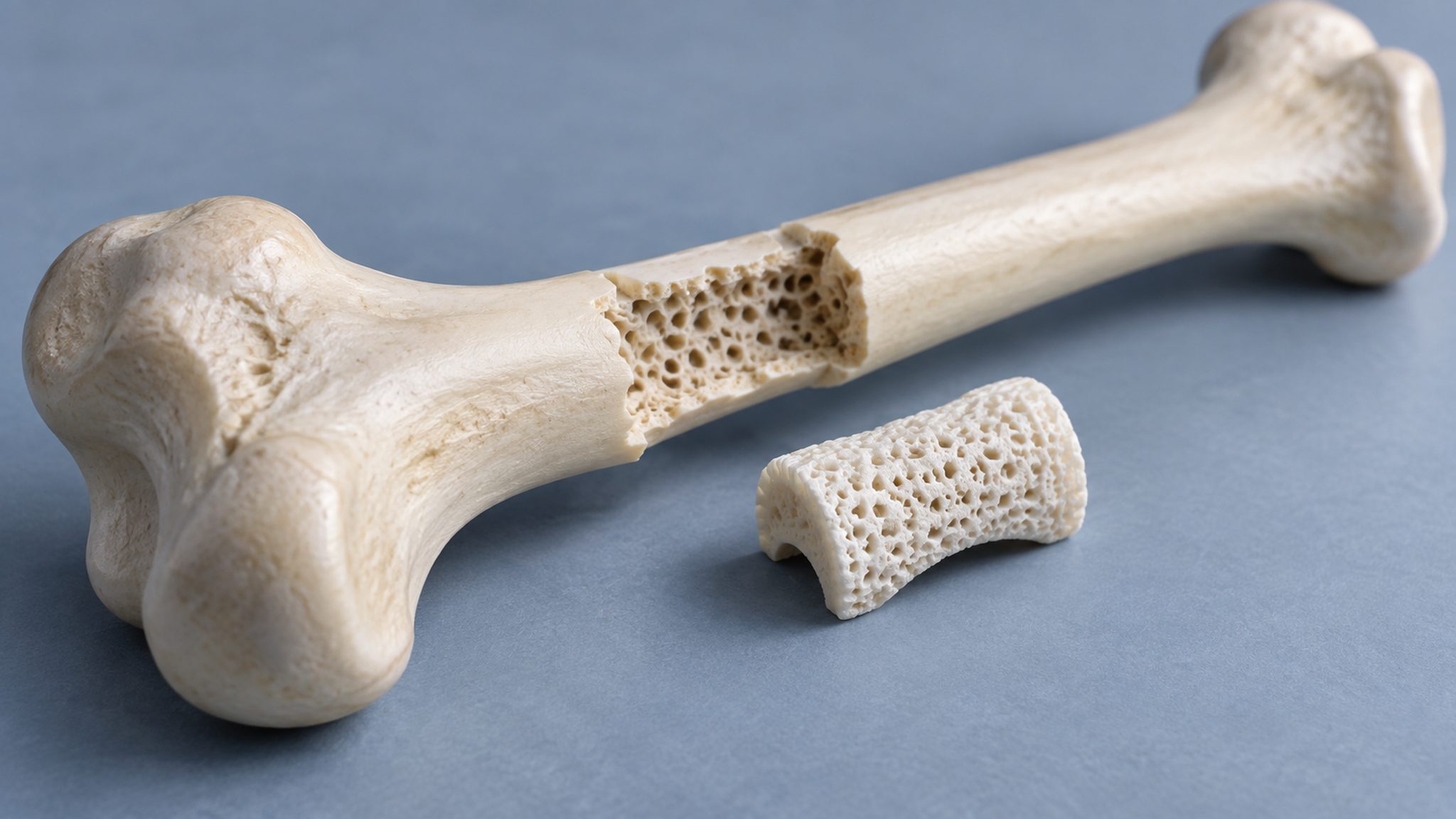
- Bioceramics are ceramic materials intended for biological applications. This project uses calcium-phosphate materials, including hydroxyapatite and beta-tricalcium phosphate, whose relevance comes from their similarity to the mineral component of natural bone.
- Natural bone is living tissue containing cells and a collagen-based framework with mineral deposits. NIAMS explains that it constantly remodels; a calcium-phosphate structure alone does not reproduce this entire biological system.
- A graft provides material for a bone-repair application. Its composition, shape and intended use matter together: chemical resemblance to bone mineral cannot by itself establish suitability for every defect or surgical requirement.
- Patient-specific describes anatomical matching. FDA explains that medical imaging can guide designs fitted to an individual; matching shape answers a design problem but does not independently establish how well a product performs clinically.
- The announced project concerns ceramic manufacture, not deposition of living cells into a functioning bone. Keep the distinction explicit when interpreting the phrase “3D-printed bone”: the printed object here is a graft material.
How digital design becomes a printed graft
Additive manufacturing connects a digital shape to a physical object through controlled layers, while the chosen printing method determines how each layer is formed.
- Digital design establishes the desired geometry before manufacture. Patient-matched models can use anatomical information, while standard models serve predefined designs; both routes still require checking that the finished object corresponds to its intended specifications.
- Digital Light Processing uses projected light to selectively cure a light-sensitive formulation, layer by layer. In ceramic printing, ceramic particles are carried in that formulation; light does not directly turn calcium phosphate into living tissue.
- Extrusion-based printing deposits material through a nozzle along a programmed path. Successive tracks build the structure; the material must flow during deposition while retaining enough shape for the intended geometry to form.
- Post-processing can alter a ceramic part after printing. NIST identifies sintering and dimensional accuracy as manufacturing concerns; checking only the digital file misses changes that occur while producing the finished ceramic object.
- The important distinction is light-controlled curing versus nozzle-controlled deposition. These are manufacturing approaches rather than competing medical diagnoses; the release identifies both without proving that either universally delivers better clinical outcomes for patients.
Commercialisation support is not clinical proof
The policy opportunity is domestic capability, but responsible assessment separates a supported project, a consistently manufactured product and evidence for its intended medical use.
- TDB support helps move a proposed technology toward commercial application. The announcement is evidence of that support and project direction; it should not be presented as a completed clinical trial or regulatory authorisation.
- Import substitution involves more than owning a printer. Domestic capability must cover suitable raw materials, repeatable fabrication, testing and dependable supply; weaknesses in any link can limit the value of a locally manufactured product.
- Quality control must follow the finished device. FDA’s process guidance distinguishes design, material controls, post-processing and testing, illustrating why an attractive printed shape is only one part of evaluating an additive-manufactured medical product.
- Affordability remains a question to investigate, not an outcome demonstrated by this announcement. A policy evaluation should examine total treatment costs and access alongside manufacturing capability before claiming that localisation has benefited patients.
- Evidence gaps include product-specific clinical results and verified availability in this release. Naming these gaps keeps an answer balanced: technological promise supports further development, while patient-use claims require evidence beyond financial assistance.
Way Forward
Tie support to verifiable development milestones
- Require manufacturing evidence on dimensional consistency, material properties and finished-product quality for each intended application.
- Assess clinical suitability through the applicable evidence and regulatory pathway before describing a supported project as a proven treatment.
- Track patient access through availability and total treatment costs, rather than treating domestic production alone as proof of affordability.
Conclusion
- Patient-specific bioceramics bring materials science and digital manufacturing together, but a graft’s anatomical fit, manufacturing quality and clinical suitability remain separate questions that must be answered with appropriate evidence.
- Use this case to explain innovation governance: public support can strengthen domestic capability, while transparent evaluation must establish what a finished medical product can safely and effectively do for its intended patients.
UPSC Practice Questions
Prelims MCQ 1
With reference to patient-specific bioceramic grafts, consider the following statements:
- Hydroxyapatite is a calcium-phosphate biomaterial.
- Patient-specific manufacturing necessarily involves printing living bone cells.
- Financial support for commercialisation establishes that a product has proven clinical effectiveness.
How many of the above statements are correct?
(a) Only one (b) Only two (c) All three (d) None
Answer: (a) Only one
Explanation:
Only statement 1 is correct. Patient-specific describes anatomical matching, and commercialisation support does not establish clinical effectiveness.
Prelims MCQ 2
Which pairing correctly distinguishes the printing approaches in this project?
(a) DLP: projected-light curing; extrusion: nozzle-based deposition (b) DLP: living-cell division; extrusion: X-ray imaging (c) DLP: nozzle-based deposition; extrusion: projected-light curing (d) Both methods directly grow a complete living bone
Answer: (a) DLP: projected-light curing; extrusion: nozzle-based deposition
Explanation:
DLP selectively cures a light-sensitive formulation using projected light. Extrusion deposits material along a controlled path through a nozzle.
UPSC Mains Questions
- Explain how patient-specific additive manufacturing can strengthen India’s medical-technology capability. Distinguish manufacturing potential from clinical evidence. (150 words)
- Import substitution in medical devices requires more than domestic production. Discuss with reference to bioceramic bone grafts and patient access. (250 words)
Sources: PIB, Ministry of Science & Technology and FDA: Medical Applications of 3D Printing.
Frequently Asked Questions
What are 3D-printed bioceramic bone grafts?
They are graft structures manufactured using ceramic biomaterials and additive techniques. The supported project uses calcium-phosphate materials to develop standard and anatomically customised products; it does not claim to print complete living bones.
What makes a graft patient-specific?
Its design is matched to an individual’s anatomical features, potentially using medical imaging. This describes how the product is shaped; clinical suitability and manufacturing quality still need separate evaluation.
Are calcium-phosphate ceramics the same as natural bone?
No. Calcium phosphate resembles bone’s mineral component, while natural bone is living tissue with cells and a collagen-based framework. A ceramic structure does not reproduce that complete biological system.
Does TDB support mean the grafts are clinically approved?
No. The announcement establishes financial assistance for a commercialisation project. It does not provide product-specific clinical outcomes or establish regulatory approval, so those claims cannot be inferred from this release.
Tell Google you want more of this.
Add Anantam IAS as a preferred sourceOne tap, and this site shows up more often in your own Top Stories, AI Overviews and AI Mode. Remove it any time.