Why in News?
The EU Cyber Resilience Act began requiring manufacturers to report actively exploited product vulnerabilities and severe security incidents from 11 September 2026.
- Manufacturers submit mandatory notifications through ENISA’s operational Single Reporting Platform for covered products made available on the EU market.
- Early warning is due within 24 hours of awareness; the full notification follows within 72 hours of awareness.
- Final reports follow different clocks for vulnerabilities and severe incidents, making the reporting trigger important.
- Open-source software stewards become subject to their reporting obligations from 11 December 2027; their starting date differs from manufacturers.
- Connected products can distribute the same security weakness across borders, requiring coordinated reporting alongside technical correction.
- Indian exporters supplying covered products to the EU need to assess product-security reporting responsibilities within their market-access planning.
UPSC Relevance
Prelims Relevance
- Cyber Resilience Act: product-security reporting in the EU.
- ENISA: European Union Agency for Cybersecurity.
- CSIRT: Computer Security Incident Response Team.
- Actively exploited vulnerability versus severe security incident.
- Awareness-based notifications versus separate final-report deadlines.
Mains Relevance
GS Paper 3
- Product cybersecurity, incident response and supply-chain accountability.
- Compliance capacity of Indian digital-product exporters.
GS Paper 2
- Cross-border regulatory coordination and differentiated implementation timelines.
Essay
- Trust in technology depends on accountability after deployment.
Background and Context
Which product-security problems trigger reporting?
The reporting duty concerns serious security developments affecting products with digital elements, rather than every defect discovered during development.
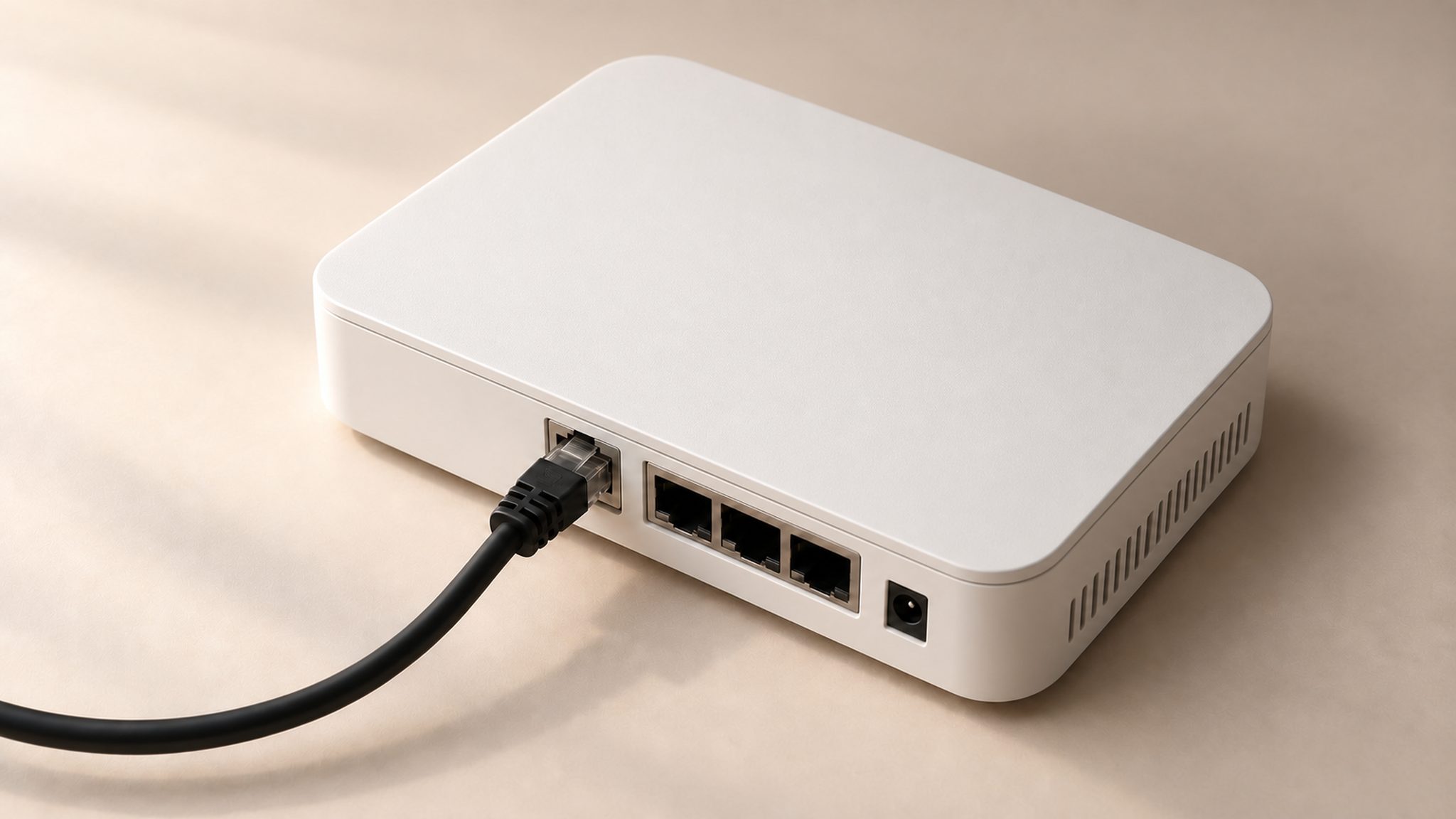
- Products with digital elements cover hardware and software. A connected router illustrates why product security involves physical equipment and its controlling software.
- An actively exploited vulnerability concerns a weakness being exploited, rather than merely a theoretical flaw. The distinction prevents treating every bug report as the same mandatory notification trigger.
- A severe incident affecting product security is the other reporting trigger. Keep this incident category separate from vulnerability discovery: an incident describes a security event, not simply defective code.
- The manufacturer reporting start is a specific implementation milestone. It does not establish that every CRA duty, for every type of actor, became applicable on that same day.
- Open-source software stewards have a later reporting start under the Commission’s explanation. Do not infer a blanket immediate reporting duty for every individual contributor or every open-source project.
How do the reporting deadlines work?
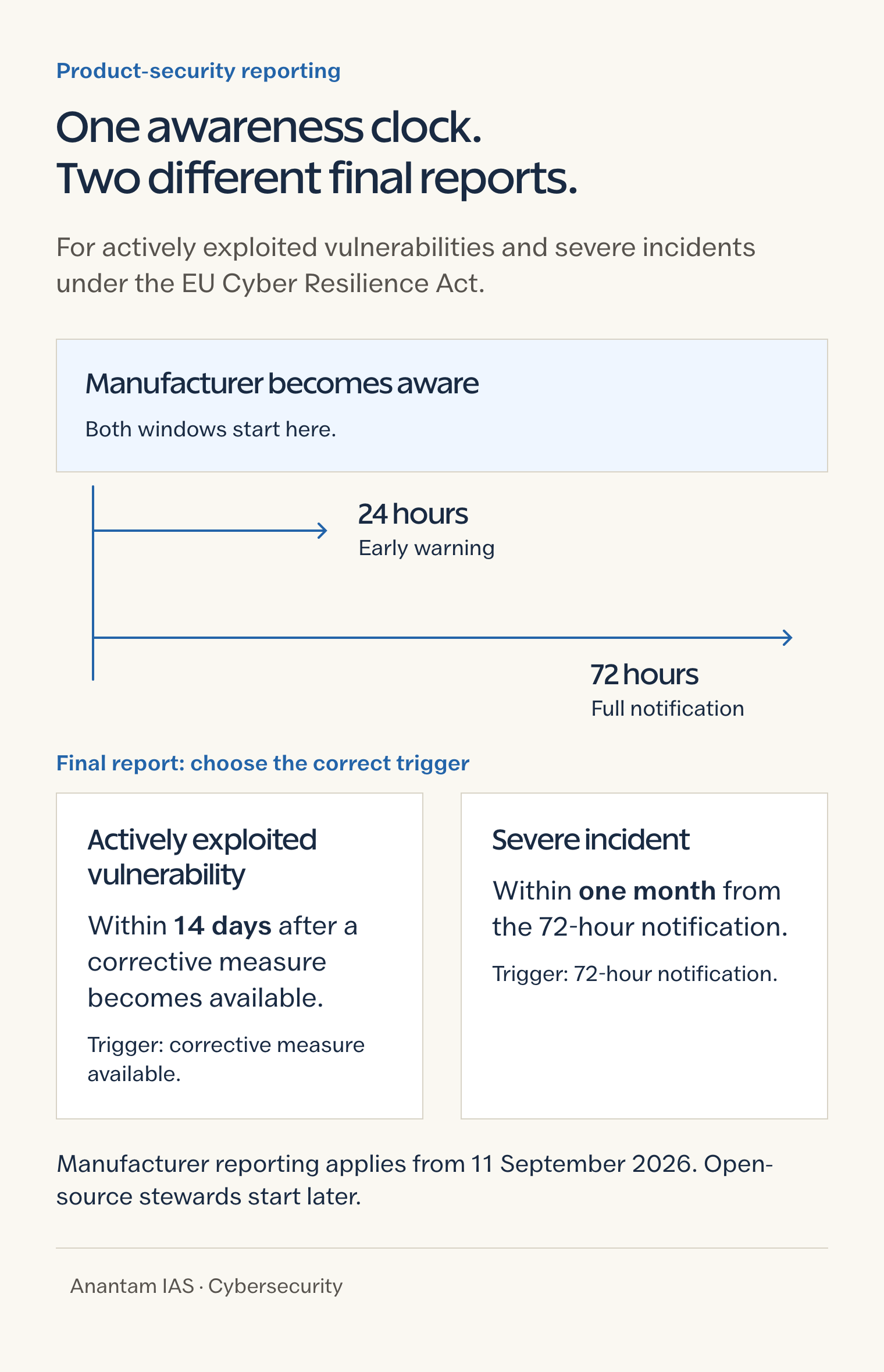
The first deadlines share an awareness clock, but the final report branches according to the type of security problem.
- The early warning must be submitted within 24 hours of becoming aware. Manufacturers need an internal escalation path that can begin while investigation and technical assessment are still continuing.
- The full notification is due within 72 hours of awareness. That period runs from the original awareness point, rather than beginning after the early warning has been submitted.
- For an actively exploited vulnerability, the final report is due no later than 14 days after a corrective measure is available. Availability of the measure starts this final-report clock.
- For a severe incident, the final report is due within one month from the 72-hour notification. Its clock is tied to that notification, rather than availability of a corrective measure.
- The key exam trap is substituting one clock for another. A single fixed final deadline calculated from first awareness would misstate the Commission’s explanation of these two reporting routes.
How does one report reach several authorities?
The Single Reporting Platform provides one submission channel while supporting coordinated handling across affected national jurisdictions.
- ENISA develops, operates and maintains the Single Reporting Platform. Manufacturers submit through this shared channel, allowing relevant authorities to receive information without separate initial submissions through multiple platforms.
- The notification is addressed to the CSIRT where the manufacturer has its main establishment. The Commission describes this national response team as the initial recipient in the coordination chain.
- Unless particularly exceptional circumstances apply, information is made available simultaneously to ENISA. The arrangement combines a national receiving authority with EU-level visibility of the reported product-security problem.
- The receiving CSIRT shares the notification without delay with other relevant CSIRTs in territories where the product was made available. Distribution follows the affected product’s market reach across jurisdictions.
- In exceptional circumstances, justified cybersecurity grounds may support delayed dissemination to other CSIRTs. This qualified safeguard should not be confused with a general manufacturer option to disregard reporting deadlines.
Why does the mechanism matter for Indian suppliers?
The practical lesson is to connect export compliance with engineering response, rather than keeping them in separate departments.
- Market destination matters: the reporting framework concerns covered products made available in the EU. Indian firms should assess their role and product coverage rather than assuming domestic location settles applicability.
- Internal accountability needs a reporting owner, an escalation route and awareness records. These are operational implications of short reporting windows, not additional legal deadlines.
- Technical remediation and notification should proceed together. Sending information to authorities does not itself remove an exploited weakness or demonstrate that affected products and users are adequately protected.
- Cross-border coordination is the durable governance mechanism: one report feeds several responsible authorities. It addresses information fragmentation, while the manufacturer still needs the capacity to investigate and correct product problems.
- Connect this development with India’s 6G security and standards debate: trusted technology requires both design choices and institutions capable of responding when security failures emerge.
Way Forward
Prepare the reporting chain before an incident
- Assign responsibility across product engineering, security response and compliance teams; rehearse escalation against the awareness-based notification windows.
- Record the right clocks: awareness, notification submission and corrective-measure availability should be distinguishable in incident records.
- Check current guidance for product coverage, actor responsibilities and exceptional dissemination rules instead of treating a short policy summary as complete compliance advice.
Conclusion
- The CRA reporting mechanism combines staged manufacturer notifications with coordinated authority access. Its central distinction is between shared early deadlines and different final-report clocks.
- For an analytical answer, connect product security with cross-border accountability, while separating reporting commencement from the application of every obligation under the wider law.
UPSC Practice Questions
Prelims MCQ 1
With reference to the EU Cyber Resilience Act reporting mechanism, consider the following statements:
- The early warning and full notification periods run from awareness.
- The vulnerability final-report clock begins when a corrective measure is available.
- Open-source software stewards began mandatory reporting on the same date as manufacturers.
How many of the above statements are correct?
(a) Only one (b) Only two (c) All three (d) None
Answer: (b) Only two
Explanation:
The first two statements are correct. Manufacturers began reporting on 11 September 2026; open-source software stewards begin on 11 December 2027.
Prelims MCQ 2
For a severe product-security incident, the final CRA report is due within one month from which point?
(a) The first product sale (b) The availability of a corrective measure (c) The 72-hour notification (d) The next software release
Answer: (c) The 72-hour notification
Explanation:
The Commission links the severe-incident final report to the 72-hour notification. The separate vulnerability final-report deadline runs from corrective-measure availability.
UPSC Mains Questions
- Explain how a single reporting platform can improve coordination over cross-border product-security risks. What operational limits remain?
- Discuss the implications of timed cybersecurity reporting duties for Indian manufacturers supplying digital products to overseas markets.
Sources: European Commission and ENISA.
Frequently Asked Questions
What began under the CRA in September 2026?
Manufacturer reporting of actively exploited vulnerabilities and severe incidents affecting product security began on 11 September 2026. This was a reporting milestone, not the simultaneous commencement of every CRA obligation.
Are the 24-hour and 72-hour deadlines consecutive?
No. Both run from becoming aware of the relevant vulnerability or severe incident. The 72-hour notification period does not begin only after the early warning has been filed.
Why are there two final-report clocks?
The vulnerability final report is due no later than 14 days after a corrective measure becomes available. The severe-incident final report is due within one month from the 72-hour notification.
When do open-source software stewards begin reporting?
The Commission states that reporting obligations for open-source software stewards apply from 11 December 2027. Their date differs from the manufacturer milestone and should not be generalized to every open-source contributor.
Does filing a report fix the security problem?
No. Reporting makes information available to responsible authorities and supports coordination. Investigation, technical correction and protection of affected users remain distinct practical needs; notification is not evidence that remediation has succeeded.
Tell Google you want more of this.
Add Anantam IAS as a preferred sourceOne tap, and this site shows up more often in your own Top Stories, AI Overviews and AI Mode. Remove it any time.