Daily Digest
UPSC · Civil Services Examination
Current Affairs · Sunday, 18 January 2026
Current affairs curated and edited by Anantam IAS faculty — pulled from The Hindu, PIB, IDSA, Foreign Affairs and the ministries. Read, annotate, revise.
Old Rajinder Nagar · Delhi 110005 · anantamias.com
Green Ammonia at Kakinada: India’s Bet on Clean Fuel Exports
Why in News?
Andhra Pradesh is moving to anchor one of India’s largest green-ammonia and green-hydrogen production complexes on its Kakinada coast in the East Godavari region, positioning the state as a hub for clean-fuel manufacturing and exports under the National Green Hydrogen Mission.
The plan stitches together gigawatt-scale renewable power, large electrolyser capacity and a deep-water port so that green ammonia made from green hydrogen can be shipped to fertiliser plants and to buyers in Europe, Japan and South Korea.
- Project sited at Kakinada, Andhra Pradesh, leveraging an existing deep-water port and SEZ for direct export.
- Built around renewable-powered electrolysis — solar and wind feeding electrolysers that split water into hydrogen.
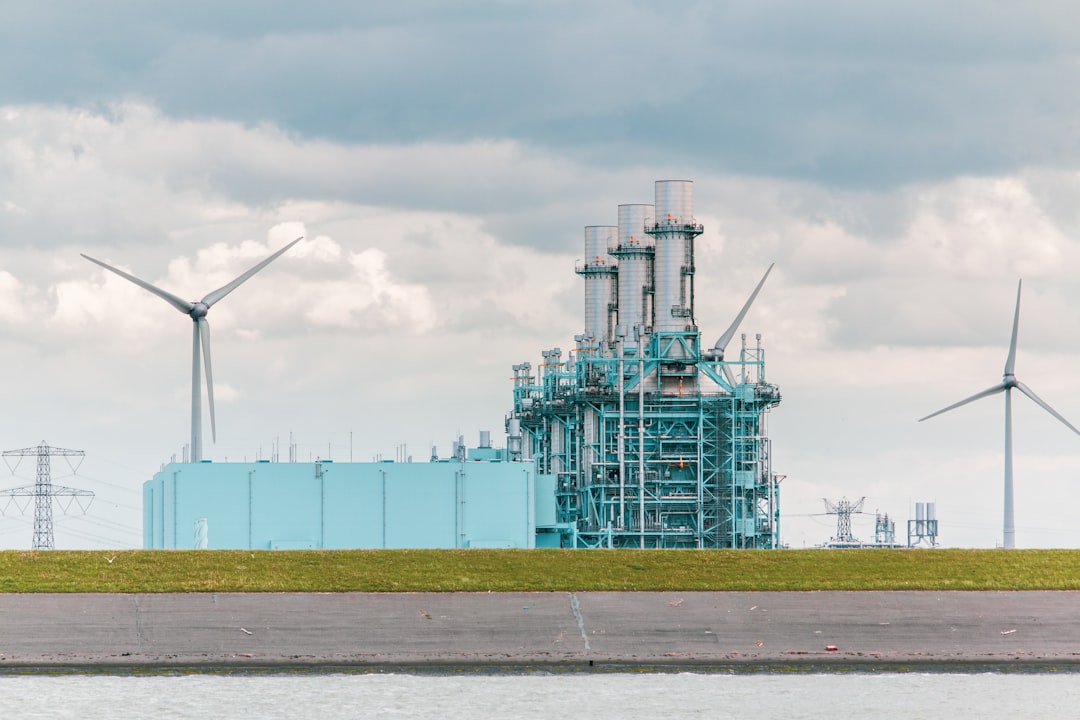
- Falls under the National Green Hydrogen Mission (launched 2023), with a Mission outlay of about Rs 19,744 crore.
- Targets green ammonia (NH3) as the marketable output — a fertiliser feedstock, a shipping fuel and a hydrogen carrier.
- Aligns with India’s net-zero by 2070 commitment and its target of 5 MMT green-hydrogen output by 2030.
The development matters in the context of:
- Hard-to-abate sectors — fertilisers, refining, steel and shipping — need a non-fossil molecule, not just clean electricity.
- Coastal complexes like Kakinada link domestic decarbonisation with an export revenue stream in green fuels.
- Sits at the intersection of energy security, the trade balance and climate diplomacy.
UPSC Relevance
Prelims Relevance
- National Green Hydrogen Mission — launched 2023, nodal ministry MNRE, outlay about Rs 19,744 crore.
- SIGHT — Strategic Interventions for Green Hydrogen Transition, the Mission’s incentive scheme.
- Green hydrogen — made by electrolysis of water using renewable electricity (zero carbon).
- Grey hydrogen — from natural gas / coal with no carbon capture; blue hydrogen — fossil-based with carbon capture.
- Green ammonia — NH3 synthesised from green hydrogen plus nitrogen via the Haber-Bosch process.
- Ammonia is a hydrogen carrier — liquefies at about -33 degrees C, far easier to ship than pure hydrogen.
- India’s targets — 5 MMT green hydrogen by 2030; net-zero by 2070.
- Kakinada is in East Godavari district, Andhra Pradesh, on the Bay of Bengal.
Mains Relevance
GS Paper 3
- Role of green hydrogen and green ammonia in decarbonising hard-to-abate sectors and securing energy.
- Renewable energy infrastructure, electrolyser manufacturing and the economics of clean-fuel exports.
GS Paper 2
- Centre-state coordination and federal incentives in delivering a flagship energy mission.
GS Paper 1
- Industrial location: why coastal Andhra Pradesh suits an export-oriented green-fuel complex.
Essay
- Can a developing economy lead the clean-energy transition while still meeting its development needs?
- Energy independence is the new measure of national strength.
Background and Context
What is green ammonia and why it matters
Green ammonia is the bridge molecule that turns clean electrons into a tradeable, storable clean fuel.
- Green hydrogen is produced by passing renewable electricity through water in an electrolyser, splitting it into hydrogen and oxygen with no carbon emissions.
- Green ammonia (NH3) combines that green hydrogen with nitrogen drawn from the air through the Haber-Bosch process.
- Three uses in one molecule — a fertiliser feedstock (urea, ammonium-based nutrients), a low-carbon marine fuel, and a hydrogen carrier for export.
- Ammonia liquefies at about -33 degrees C, so it ships in conventional tankers far more easily than pure hydrogen, which needs cryogenic -253 degrees C handling.
- It lets countries with abundant renewables ‘export sunshine and wind’ as a dense chemical fuel.
Green vs grey vs blue hydrogen
The colour code is really a carbon-intensity code; only green hydrogen carries no fossil baggage.
- Grey hydrogen — made from natural gas (steam methane reforming) or coal gasification; emits large volumes of CO2 and dominates today’s output.
- Blue hydrogen — the same fossil route but paired with carbon capture and storage, so emissions are partly trapped.
- Green hydrogen — electrolysis powered by solar, wind or hydro; near-zero carbon, the goal of India’s mission.
- India’s edge is cheap, plentiful renewable power, which can drive electrolysis costs down over the decade.
- Cost parity with grey hydrogen — closing the gap is the single biggest hurdle to scale.
National Green Hydrogen Mission and SIGHT
The Kakinada complex would draw on the policy and money put in place by the national mission.
- The National Green Hydrogen Mission was approved in 2023 with an outlay of about Rs 19,744 crore, steered by the Ministry of New and Renewable Energy.
- Headline targets — about 5 million tonnes of annual green-hydrogen production by 2030, with associated renewable and electrolyser build-out.
- SIGHT (Strategic Interventions for Green Hydrogen Transition) offers incentives for both electrolyser manufacturing and green-hydrogen production.
- Aims to cut fossil-fuel imports, build a domestic clean-tech industry and create skilled green jobs.
- Read more on India’s clean-energy push in our explainer on the National Green Hydrogen Mission.
Why Kakinada and Andhra Pradesh
Location is the whole bet — coastal Andhra Pradesh ties renewables to a port and to demand.
- Kakinada offers a deep-water port and an SEZ, so finished green ammonia can be loaded directly for export.
- Andhra Pradesh has strong solar and wind potential, supplying the renewable electricity electrolysers need.
- Proximity to fertiliser and refining demand gives an anchor domestic off-take market.
- State industrial policy and land are being aligned to attract developers and electrolyser supply chains.
- Coastal siting also eases imports of equipment and exports to Europe, Japan and South Korea.
Decarbonising hard-to-abate sectors
Some sectors cannot simply switch to electricity — they need a clean molecule, and that is the strategic prize.
- Fertilisers — green ammonia can replace fossil-based ammonia, cutting both emissions and the import bill.
- Shipping — ammonia is a leading candidate fuel for cutting maritime carbon under tightening global rules.
- Refining and steel — green hydrogen can displace grey hydrogen and coke in industrial processes.
- These sectors are ‘hard to abate’ because heat, chemistry or weight make direct electrification impractical.
- Compare the wider transition story in our note on India’s energy transition.
Hurdles and risks
The promise is large but the path is capital-heavy and technically demanding.
- High cost — green hydrogen still costs more than grey; viability hinges on falling renewable and electrolyser prices.
- Water and energy intensity — electrolysis needs large volumes of clean water and firm renewable supply.
- Safety — ammonia is toxic and corrosive, demanding strict handling, storage and transport norms.
- Demand certainty — bankable long-term export and domestic off-take contracts are essential.
- Infrastructure — pipelines, storage, port handling and a skilled workforce must scale together.
Way Forward
Drive down cost
- Scale electrolyser manufacturing under SIGHT and cut renewable tariffs to reach grey-hydrogen parity.
- Use viability-gap and demand-aggregation tools to de-risk first-mover projects.
Secure demand
- Set blending or purchase obligations for green ammonia in fertilisers and refining.
- Negotiate long-term export off-take with Japan, South Korea and the EU.
Build the ecosystem
- Develop port handling, storage and safety codes for ammonia at Kakinada.
- Invest in skilling, R&D and certification of green origin for credibility abroad.
Conclusion
The Kakinada green-ammonia complex captures a larger Indian wager — that the country can turn its renewable abundance into a clean-fuel industry that decarbonises at home and earns abroad.
Whether the bet pays off depends on driving down cost, locking in demand and building safe infrastructure. If it works, green ammonia could become to the energy transition what software once was to India’s services economy: a globally traded export born of a domestic strength.
UPSC Practice Questions
Prelims MCQ 1
With reference to green hydrogen and green ammonia, consider the following statements:
- Green hydrogen is produced by the electrolysis of water using renewable electricity.
- Green ammonia is synthesised by combining green hydrogen with nitrogen.
- Ammonia can serve as a carrier for transporting hydrogen over long distances.
How many of the above statements are correct?
(a) Only one (b) Only two (c) All three (d) None
Answer: (c) All three
Explanation:
Green hydrogen comes from renewable-powered electrolysis; green ammonia is green hydrogen plus nitrogen via Haber-Bosch; ammonia liquefies easily and is widely seen as a practical hydrogen carrier. All three are correct.
Prelims MCQ 2
The National Green Hydrogen Mission is administered by which Union ministry?
(a) Ministry of Power (b) Ministry of New and Renewable Energy (c) Ministry of Petroleum and Natural Gas (d) Ministry of Heavy Industries
Answer: (b) Ministry of New and Renewable Energy
Explanation:
The Mission, approved in 2023 with an outlay of about Rs 19,744 crore, is steered by the Ministry of New and Renewable Energy (MNRE), with SIGHT as its incentive scheme.
UPSC Mains Questions
- Green hydrogen and green ammonia are central to decarbonising India’s hard-to-abate sectors. Discuss their role in India’s energy transition and examine the challenges in scaling up domestic production. (250 words)
- Coastal complexes such as Kakinada aim to make India an exporter of clean fuels. Critically analyse the economic and strategic case for green-ammonia export hubs. (250 words)
- Examine how the National Green Hydrogen Mission seeks to balance India’s net-zero commitment with its energy-security and industrial-growth objectives. (150 words)
Sources: Ministry of New and Renewable Energy (MNRE) and Press Information Bureau (PIB).
Frequently Asked Questions
What is green ammonia?
Green ammonia is ammonia (NH3) made by combining green hydrogen with nitrogen from the air. Because the hydrogen comes from electrolysis powered by renewable energy, the whole process emits little or no carbon. It is used as a fertiliser feedstock, a low-carbon shipping fuel and a carrier for transporting hydrogen.
How is green hydrogen different from grey and blue hydrogen?
Grey hydrogen is made from natural gas or coal and emits a lot of carbon. Blue hydrogen uses the same fossil route but captures part of the emissions. Green hydrogen is produced by splitting water through electrolysis using renewable electricity, so it carries near-zero carbon emissions.
Why is Kakinada chosen for the project?
Kakinada in coastal Andhra Pradesh has a deep-water port and an SEZ, allowing green ammonia to be exported directly. The state also has strong solar and wind potential to power electrolysers, and lies close to fertiliser and refining demand, making it well suited for an export-oriented clean-fuel complex.
What is the National Green Hydrogen Mission?
Launched in 2023 with an outlay of about Rs 19,744 crore, the Mission is run by the Ministry of New and Renewable Energy. It aims for roughly five million tonnes of green hydrogen a year by 2030 and uses the SIGHT scheme to incentivise electrolyser manufacturing and green-hydrogen production.
Why is ammonia useful for transporting hydrogen?
Pure hydrogen is very light and must be cooled to around -253 degrees C to liquefy, making it costly to ship. Ammonia liquefies at about -33 degrees C and moves in conventional tankers. So hydrogen can be converted to ammonia, shipped, and then either used directly or converted back, making long-distance export practical.
What are the main challenges for green ammonia in India?
The biggest challenge is cost, as green hydrogen is still pricier than grey. Other hurdles include the large water and renewable-energy needs of electrolysis, the safe handling of toxic ammonia, securing long-term demand and export contracts, and building ports, storage, pipelines and a skilled workforce together at scale.
Source: https://anantamias.com/current-affairs/andhra-pradesh-green-ammonia-kakinada-2026/
Counting River Dolphins: India’s Second Nationwide Survey and Project Dolphin
Why in News?
India has launched its second nationwide riverine and estuarine dolphin survey, extending the methodology of the first comprehensive count completed in 2024. The exercise is coordinated by the Wildlife Institute of India (WII), Dehradun, under the umbrella of Project Dolphin and the National Mission for Clean Ganga.
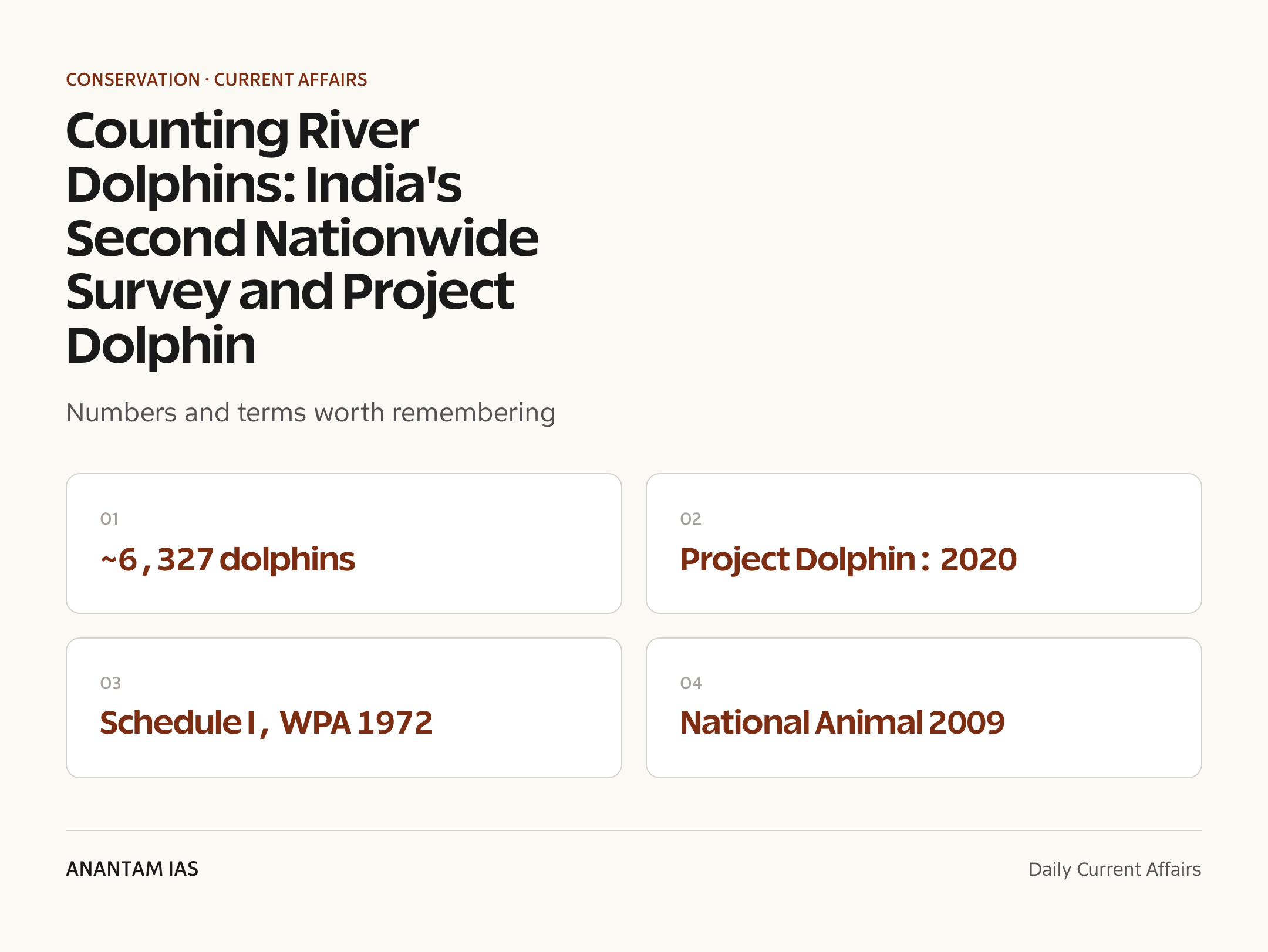
The first survey put the population at about 6,327 river dolphins across the Ganga, Brahmaputra and their tributaries plus the Beas, establishing the first scientific baseline for the species and turning a once-data-poor animal into a measurable indicator of river health.
- Second cycle builds on the 2024 baseline of ~6,327 dolphins, the country’s first systematic estimate.
- Survey spans the Ganga and Brahmaputra basins across eight states, plus the lone Indus dolphin population in the Beas, Punjab.
- Run under Project Dolphin (announced 2020) with the Wildlife Institute of India as the technical lead.
- Uses standardised boat-based double-observer counts and emerging environmental DNA (eDNA) and acoustic methods.
- Feeds directly into the Namami Gange programme’s river-rejuvenation targets.
The development matters in the context of:
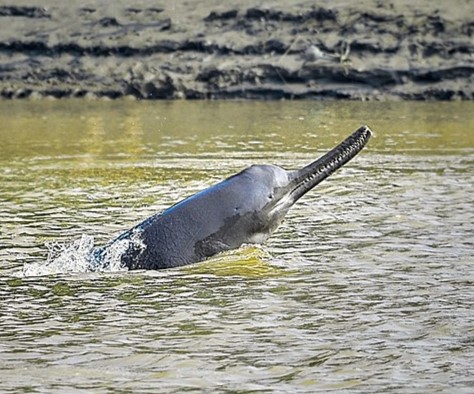
- The Gangetic dolphin is India’s National Aquatic Animal, notified in 2009, making its numbers a flagship measure of conservation success.
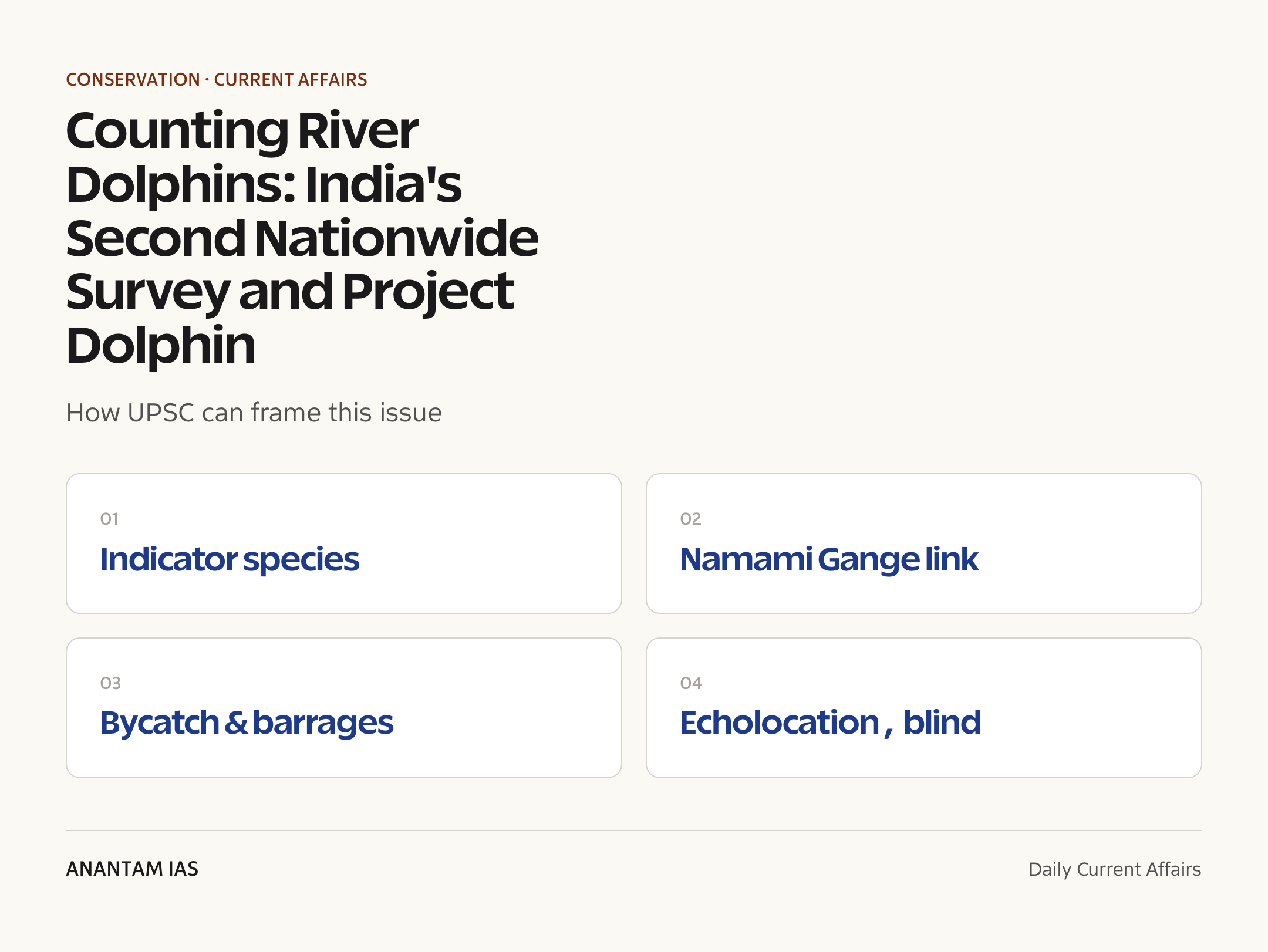
- As an apex predator and an indicator species, healthy dolphin counts signal a living, connected river; declines flag pollution, flow loss and overfishing.
UPSC Relevance
Prelims Relevance
- Gangetic dolphin (Platanista gangetica) — India’s National Aquatic Animal (declared 2009).
- Project Dolphin launched 2020; nodal agency MoEFCC, technical lead Wildlife Institute of India.
- First nationwide count (2024) estimated ~6,327 river dolphins.
- Listed in Schedule I of the Wildlife (Protection) Act, 1972 — highest protection.
- IUCN Red List: Endangered; listed on CMS Appendix I and II and CITES Appendix I.
- Two subspecies: the Ganges river dolphin and the Indus river dolphin (bhulan), in the Beas, Punjab.
- Dolphins are functionally blind; they navigate and hunt by echolocation.
- Vikramshila Gangetic Dolphin Sanctuary (Bihar) is India’s only protected stretch dedicated to the species.
- National Ganga River Dolphin Day is observed on 5 October.
Mains Relevance
GS Paper 3
- Conservation of indicator and flagship species and the case for ecosystem-level river management.
- Balancing river infrastructure (dams, barrages, waterways) with aquatic-biodiversity protection.
GS Paper 2
- Government interventions (Project Dolphin, Namami Gange) and the role of specialised institutions like WII in evidence-based policy.
Essay
- What a river’s last sentinel tells us about our development model.
- Counting what we cannot afford to lose: data, conservation and the public good.
Background and Context
The species: a blind river sentinel
The Gangetic dolphin is uniquely adapted to murky, sediment-heavy rivers, which makes it both fascinating and fragile.
- Platanista gangetica is a freshwater cetacean found only in the Ganga, Brahmaputra and Meghna river systems across India, Nepal and Bangladesh (see our explainer on the river dolphins of India).
- It is effectively blind — its eyes lack a lens — and relies entirely on echolocation to navigate turbid water.
- It surfaces every few minutes to breathe, producing the characteristic exhalation that earns it the local name susu.
- Females are larger than males; the species breeds slowly, giving birth typically to a single calf every two to three years, which limits recovery speed.
- It sits at the top of the aquatic food chain, so its presence reflects abundant fish and a functioning river ecosystem.
Project Dolphin and the institutional architecture
The survey is the data backbone of a structured national programme rather than a one-off count.
- Project Dolphin was announced by the Prime Minister on 15 August 2020 and approved to conserve both riverine and oceanic dolphins.
- It is anchored in the Ministry of Environment, Forest and Climate Change (MoEFCC) and draws on the National Mission for Clean Ganga (NMCG).
- The Wildlife Institute of India (WII), an autonomous body under MoEFCC, provides the scientific design, training and population modelling.
- It mirrors the model of Project Tiger and Project Elephant — using a charismatic flagship to drive habitat-wide protection.
- Conservation funds also flow through the dedicated National Dolphin Research Centre (NDRC) at Patna, India’s first such facility.
How the count is done
Counting a fast, blink-and-miss animal in opaque water demands a careful, repeatable method.
- Surveyors use boat-based double-observer protocols, where two independent teams log sightings to correct for animals missed at the surface.
- Distance and GPS data feed statistical abundance models, producing population estimates with confidence bands rather than raw tallies.
- Newer cycles supplement visual counts with environmental DNA (eDNA) from water samples and passive acoustic monitoring of echolocation clicks.
- Standardising the method across the first and second surveys is what makes a trend — not just a snapshot — possible.
- Building local capacity is explicit: forest staff and researchers are trained so monitoring continues beyond the survey window.
The threats the numbers track
The pressures on the dolphin are the same pressures degrading India’s rivers, which is precisely why it works as an indicator.
- Accidental bycatch in fishing nets is the leading cause of death; dolphins drown when entangled.
- Dams and barrages fragment populations into isolated stretches, blocking movement and shrinking the gene pool.
- Reduced dry-season flow from abstraction for irrigation and water supply strands dolphins in shallow pools.
- Industrial and agricultural pollution — including heavy metals and pesticides — accumulates up the food chain in this apex predator.
- Underwater noise from vessels and dredging for inland waterways can disrupt the echolocation the animal depends on.
- Historic poaching for dolphin oil, used as fish bait, once drove sharp local declines.
Indus versus Gangetic: two cousins, two fates
India hosts both surviving South Asian river dolphin subspecies, and their contrasting status is itself a lesson.
- The Ganges river dolphin ranges widely across the Ganga-Brahmaputra system and holds the larger global population.
- The Indus river dolphin (bhulan) survives in India only in a short stretch of the Beas river in Punjab, with the bulk of its range in Pakistan.
- The Beas population is protected within the Beas Conservation Reserve, a transboundary conservation interest.
- Both were long treated as one species but are now recognised as distinct subspecies, sharpening the case for managing each population separately.
- The Indus dolphin’s near-extinction in fragmented canals is a cautionary preview of what unchecked barrages can do to the Gangetic stock.
Why an indicator species matters for policy
Conserving the dolphin is shorthand for conserving the whole river, which is the survey’s deeper value.
- An indicator species is one whose condition reveals the health of its wider ecosystem, much like a canary in a coal mine.
- Because the dolphin needs deep, connected, fish-rich water, a stable count certifies that Namami Gange rejuvenation is working on the ground.
- Tracking the same metric over time gives policymakers a measurable outcome, not just spending or activity reports.
- Protecting the dolphin’s habitat simultaneously secures fisheries, water quality and livelihoods for riverine communities.
- It anchors India’s commitments under the Convention on Migratory Species (CMS) and broader biodiversity goals.
Way Forward
Make monitoring continuous
- Move from periodic surveys to year-round monitoring using eDNA, acoustic sensors and trained local teams.
- Maintain a shared open database so trends, not isolated counts, drive decisions.
Fix the river, not just the dolphin
- Guarantee environmental flows (e-flows) below barrages so dolphin stretches never run dry.
- Mandate dolphin-safe fishing gear and net-free zones in core habitats, with compensation for affected fishers.
Engage communities and link missions
- Build community stewardship through eco-tourism and local ‘dolphin mitra’ volunteers.
- Tightly couple Project Dolphin targets with Namami Gange pollution-abatement milestones.
Conclusion
The second nationwide survey turns the river dolphin from a symbol into a yardstick. By repeating a standardised count, India can finally say whether its rivers are recovering or simply being managed on paper.
If the dolphin thrives, the Ganga and Brahmaputra are alive in the fullest sense — clean, flowing and fish-rich. Protecting this blind sentinel is, in the end, the most honest test of whether river-rejuvenation promises are being kept.
UPSC Practice Questions
Prelims MCQ 1
With reference to the Gangetic river dolphin, consider the following statements:
- It is designated as India’s National Aquatic Animal.
- It is listed in Schedule I of the Wildlife (Protection) Act, 1972.
- It primarily uses keen eyesight to hunt in clear waters.
How many of the above statements are correct?
(a) Only one (b) Only two (c) All three (d) None
Answer: (b) Only two
Explanation:
Statements 1 and 2 are correct — it was declared the National Aquatic Animal in 2009 and enjoys Schedule I protection. Statement 3 is wrong: the dolphin is effectively blind and hunts by echolocation in turbid water.
Prelims MCQ 2
Project Dolphin, launched in 2020, is implemented under the overall charge of which of the following?
(a) Ministry of Jal Shakti only (b) Ministry of Environment, Forest and Climate Change (c) Department of Fisheries (d) Indian Council of Agricultural Research
Answer: (b) Ministry of Environment, Forest and Climate Change
Explanation:
Project Dolphin is anchored in the MoEFCC, with the Wildlife Institute of India as technical lead, and draws on the National Mission for Clean Ganga under Jal Shakti for the Ganga component.
UPSC Mains Questions
- Indicator species can convert abstract conservation goals into measurable outcomes. Examine this proposition with reference to the Gangetic river dolphin and India’s river-rejuvenation programmes. (250 words)
- Riverine infrastructure such as dams, barrages and inland waterways often conflicts with aquatic biodiversity. Discuss the threats this poses to river dolphins and suggest a framework to reconcile the two. (250 words)
- What is Project Dolphin? Evaluate how a flagship-species approach, on the lines of Project Tiger, can strengthen ecosystem-wide conservation in India. (150 words)
Sources: Ministry of Environment, Forest and Climate Change (MoEFCC) and Wildlife Institute of India.
Frequently Asked Questions
Why is the Gangetic dolphin India’s National Aquatic Animal?
The Government of India declared the Gangetic dolphin the National Aquatic Animal in 2009 to highlight the urgent need to conserve it and the river systems it inhabits. As a top predator confined to the Ganga and Brahmaputra basins, its survival reflects the overall health of these rivers, making it a natural flagship for freshwater conservation.
What is Project Dolphin and when did it start?
Project Dolphin was announced on 15 August 2020 and approved as a national programme to conserve both riverine and oceanic dolphins. It is run by the Ministry of Environment, Forest and Climate Change, with the Wildlife Institute of India providing scientific support and the National Mission for Clean Ganga assisting on the Ganga stretch.
How many river dolphins are there in India?
India’s first comprehensive nationwide survey, completed in 2024, estimated about 6,327 river dolphins across the Ganga and Brahmaputra basins and the Beas. This figure is a scientific baseline rather than a final tally, which is why a second survey is now being carried out to measure how the population is changing over time.
Why are river dolphins called an indicator species?
An indicator species reveals the condition of its wider ecosystem. River dolphins need deep, connected, unpolluted and fish-rich water, so a stable or rising population signals that the river is healthy and that clean-up efforts like Namami Gange are working. A decline warns of pollution, reduced flow, overfishing or habitat fragmentation.
What are the main threats to river dolphins?
The biggest threat is accidental bycatch in fishing nets, which drowns the animals. Dams and barrages fragment populations, reduced dry-season flow strands them in shallow pools, and industrial and agricultural pollution accumulates in this apex predator. Underwater noise from boats and dredging can also disrupt the echolocation they rely on to navigate.
How is the Indus dolphin different from the Gangetic dolphin?
Both are subspecies of the South Asian river dolphin. The Gangetic dolphin ranges widely across the Ganga-Brahmaputra system, while the Indus dolphin, or bhulan, survives in India only in a short stretch of the Beas river in Punjab, protected within the Beas Conservation Reserve. Most of the Indus dolphin’s range lies in Pakistan.
Source: https://anantamias.com/current-affairs/national-dolphin-survey-project-dolphin-2026/