River dolphins are freshwater cetaceans that have adapted to live and hunt in rivers rather than in the open ocean. They are among the most threatened mammals on the planet because they share their habitat with the densest concentrations of human activity, and their fate is therefore tightly linked to how India and its neighbours manage their major river systems. The Ganges River Dolphin, locally called Susu, is India’s National Aquatic Animal. The Indus River Dolphin, called Bhulan, survives in India only in a narrow stretch of the Beas River in Punjab. The Irrawaddy Dolphin survives in Chilika Lake in Odisha and parts of the Sundarbans, although it is technically an oceanic dolphin that tolerates brackish water rather than a true river dolphin.
For UPSC the topic shows up in both prelims and mains. Prelims questions ask about the National Aquatic Animal, the IUCN status of Indian dolphins, the Wildlife Protection Act schedules, and the year and scope of Project Dolphin. Mains questions test the threats facing river dolphins and the policy response, including the 2020 launch of Project Dolphin, the 2023 Bogota Declaration, and the linkages with broader river management under programmes such as Namami Gange.
This guide covers the biology and habitat of all three Indian dolphins, the four river dolphin species globally, the conservation status under IUCN and Indian law, the major threats, and the institutional response. It closes with prelims pointers, model mains questions, and a structured FAQ to lock down recall.
Quick Facts at a Glance
River dolphins are freshwater cetaceans adapted to muddy, low-visibility river water. They have long, slender beaks, flexible necks for navigating shallow water, and very poor eyesight. They rely on echolocation, the emission of ultrasonic clicks and the interpretation of echoes, to hunt and navigate. The Gangetic River Dolphin, Platanista gangetica gangetica, locally called Susu, is the National Aquatic Animal of India and the State Aquatic Animal of Uttar Pradesh, Bihar, and Assam. The Indus River Dolphin, Platanista gangetica minor, locally called Bhulan, is the State Aquatic Animal of Punjab. Both are listed in Schedule I of the Wildlife Protection Act 1972 and both are categorised as Endangered on the IUCN Red List. The Gangetic dolphin is found in the Ganga, Brahmaputra, and Meghna river systems across India, Nepal, and Bangladesh. The Indus dolphin is found in the Indus river in Pakistan and in India only in the Beas River in Punjab. The Irrawaddy Dolphin, Orcaella brevirostris, is found in Chilika Lake in Odisha and in the Sundarbans; it is also Endangered on the IUCN Red List. Globally, the four surviving river dolphin lineages are the Ganges-Indus group, the Amazon River Dolphin or Boto, the Yangtze River Dolphin or Baiji which is functionally extinct, and the La Plata Dolphin. Project Dolphin was launched by the Government of India in 2020 under the Ministry of Environment, Forest and Climate Change, with a target to double the dolphin population by 2030. The Global Declaration for River Dolphins, also known as the Bogota Declaration, was signed in Colombia in 2023 by 11 countries including India, Bangladesh, Nepal, and Pakistan.
What River Dolphins Are
River dolphins are an evolutionary curiosity. They belong to the order Cetacea, which also includes whales and oceanic dolphins, but they have made the unusual move of returning from the sea to freshwater. The current scientific consensus is that the four river dolphin lineages evolved independently from oceanic ancestors, in a textbook example of convergent evolution: similar bodies and habits arising in unrelated lineages because they solve the same problem.
Their biology is shaped by their habitat. River water is muddy and visibility is low, so river dolphins have very poor eyesight. The Gangetic River Dolphin lacks a crystalline eye lens and is functionally blind; it can detect only the direction and intensity of light. To compensate, river dolphins have evolved very precise echolocation, emitting ultrasonic clicks in narrow beams and interpreting the returning echoes to build a sound picture of their environment. Their long, slender beaks are studded with sharp teeth that interlock when the jaws close, an adaptation for catching slippery fish and crustaceans. Their flexible necks let them manoeuvre in shallow water and around obstacles such as submerged logs.
The species map of Indian river dolphins is small but ecologically important. The Gangetic and Indus river dolphins were originally treated as subspecies of Platanista gangetica but are increasingly recognised as distinct species. They share habitat across the wetlands of the Indo-Gangetic basin and the Indus basin and are at the centre of conservation programmes that interact with broader mangroves marine biodiversity conservation work in the deltas.
Background and Historical Context
The dolphins of the Indian subcontinent have a long cultural and scientific history. The Susu features in folk traditions across the Gangetic plains and is repeatedly mentioned in ancient and medieval texts as an indicator of a healthy river. Western scientific interest began in the colonial era. The Gangetic River Dolphin was first scientifically described by William Roxburgh in 1801. The Indus River Dolphin was treated as a subspecies of the Gangetic dolphin from the late nineteenth century until DNA-based analysis in the 2000s established that the two are distinct species.
The conservation story has three major moments. The first is 1972, when the Wildlife Protection Act gave the Gangetic dolphin its first formal legal protection by listing it in Schedule I. The second is 2009, when the Government of India declared the Gangetic River Dolphin the National Aquatic Animal and launched a campaign to integrate dolphin conservation into river management. The third is the launch of Project Dolphin in 2020, which is the first dedicated, central scheme covering both river and oceanic dolphins, modelled in part on the more familiar Project Tiger.
Pakistan ran a parallel conservation effort for the Indus dolphin. The Sindh Wildlife Department set up the Indus Dolphin Reserve between Guddu and Sukkur barrages in 1974, which became one of the more successful river dolphin conservation experiments globally and provided a template for what coordinated barrage-to-barrage management can achieve.
The Three Indian Dolphins in Detail
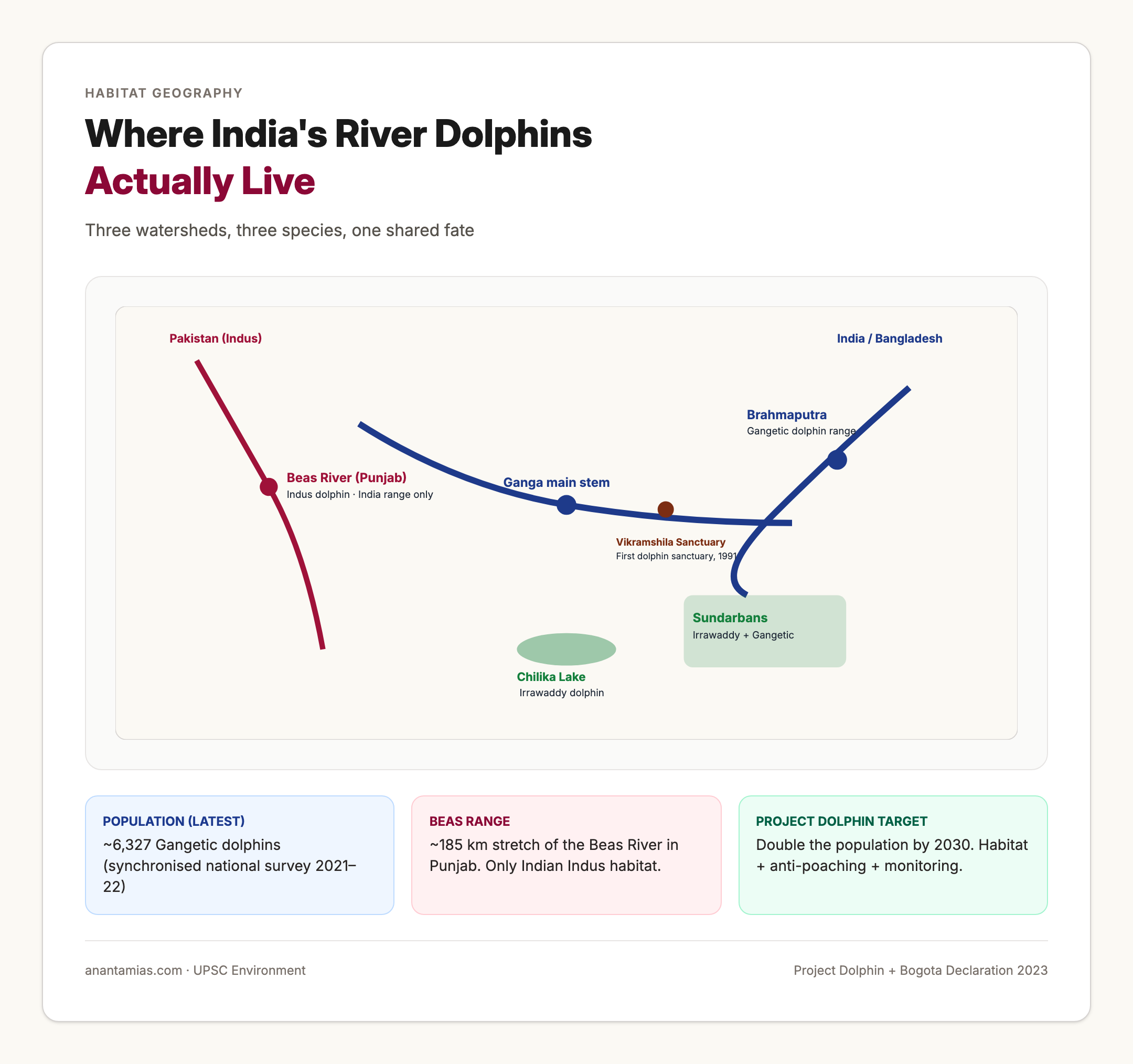
The Gangetic River Dolphin, Platanista gangetica gangetica, is found across the Ganges, Brahmaputra, and Meghna river systems. Its range covers India, Nepal, and Bangladesh. Within India it is found from the upper Ganga in Uttar Pradesh down to the Bay of Bengal, with major populations in Uttar Pradesh, Bihar, Jharkhand, West Bengal, Assam, and Madhya Pradesh. It is functionally blind, with poor eyes that can detect only the direction and intensity of light, and depends entirely on echolocation. It hunts by emitting ultrasonic clicks and listening for the echoes from fish, crustaceans, and small turtles. The species is endangered on the IUCN Red List.
The Indus River Dolphin, Platanista gangetica minor, is the second of the two Platanista species. Its global range is the Indus River system in Pakistan, where the bulk of the population lives. In India the species survives only in a roughly 185-kilometre stretch of the Beas River in Punjab. The Indus dolphin is also functionally blind. It is famously known to swim on its side, a behaviour believed to help it navigate shallow water and detect prey near the riverbed. It is the State Aquatic Animal of Punjab and is also classified as Endangered on the IUCN Red List.
The Irrawaddy Dolphin, Orcaella brevirostris, is technically an oceanic dolphin that tolerates brackish water and freshwater rather than a true river dolphin. It is the largest of the three species relevant to India. Its body is more compact than the Platanista dolphins, and it has a blunt, rounded head with no beak, which is the easiest visual difference for prelims. In India it is found in Chilika Lake in Odisha, the Sundarbans, and the lower reaches of some rivers in West Bengal. Globally its range extends through Southeast Asia. It is classified as Endangered on the IUCN Red List.
River Dolphins Outside India
Globally there are six recognised river dolphin species, surviving across two continents.
The Amazon River Dolphin, Inia geoffrensis, locally called Boto or Pink River Dolphin, is the largest river dolphin. It is found across the Amazon and Orinoco basins in South America. It is sometimes pink, especially in adult males, due to the colour of skin tissues. Its IUCN status is Endangered.
The Tucuxi, Sotalia fluviatilis, is a smaller dolphin found in the Amazon and Orinoco basins. The Bolivian River Dolphin is now treated as a separate species in some classifications.
The Yangtze River Dolphin, Lipotes vexillifer, locally called the Baiji, was endemic to the Yangtze in China. It was declared functionally extinct after surveys in 2006 failed to record any individuals. The Baiji is the most cited example of an aquatic mammal driven to functional extinction in modern times by industrial pressure on a river system.
The La Plata Dolphin, Pontoporia blainvillei, lives in the estuarine waters of the Rio de la Plata in South America. It is the only river dolphin that lives primarily in estuarine and coastal waters rather than in fresh water.
The Ganges River Dolphin and the Indus River Dolphin together complete the global list of surviving river dolphin lineages.
Why River Dolphins Matter
River dolphins are biological indicators. They sit at the apex of the freshwater food chain and need clean, fast-flowing water with healthy fish populations to survive. A river that supports a stable dolphin population is by definition a river that is functioning ecologically. Conversely, when dolphin populations crash, it usually indicates that something is going wrong in the wider river system, whether through pollution, fragmentation, or fishery collapse.
They are flagship species for cultural and political reasons too. Dolphins capture public attention in a way that fish, turtles, and crustaceans rarely do, which makes them powerful symbols for river restoration campaigns. Project Dolphin and the Bogota Declaration both leverage this symbolic power. The cultural connection in India is strong: the Susu features in regional folklore from Bihar to Bengal, and the Beas community in Punjab has its own traditions around the Bhulan.
Finally, dolphins anchor a regional cooperation agenda. The Gangetic dolphin’s range crosses India, Nepal, and Bangladesh; the Indus dolphin’s range crosses India and Pakistan. Effective conservation requires water-sharing and barrage management coordination across borders, which makes river dolphins a useful test case for South Asian environmental diplomacy.
Threats and Conservation Initiatives
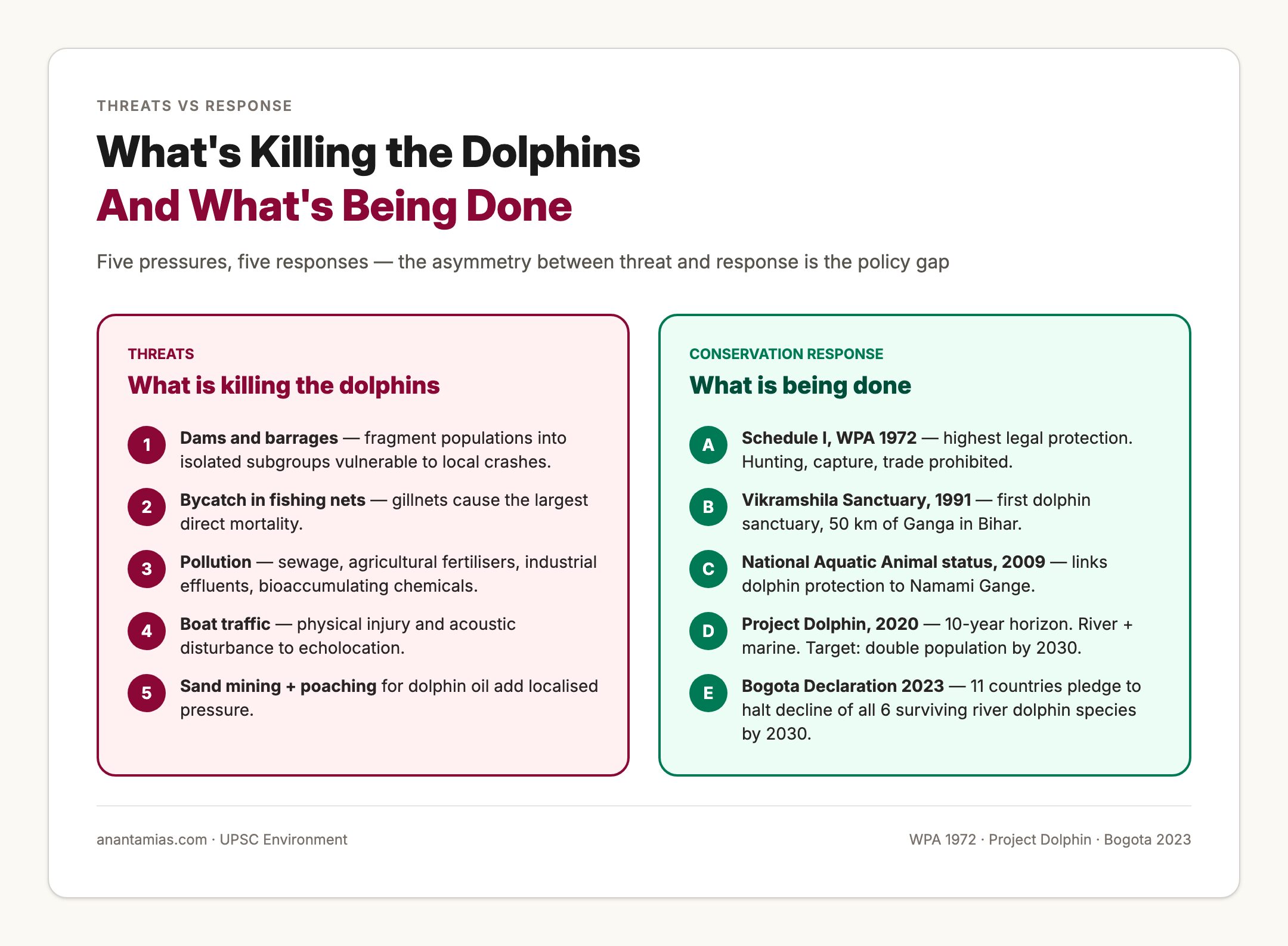
The threats facing river dolphins are well documented and overlap across all three Indian species. Construction of dams and barrages on major rivers fragments dolphin populations into isolated subpopulations that can crash from local disturbances. Accidental capture in fishing nets, called bycatch, kills a significant share of river dolphins annually; gillnets are the most common culprit. Pollution from urban sewage, agricultural runoff carrying synthetic fertilisers and pesticides, and industrial effluents reduces fish populations and contaminates dolphin tissue with bioaccumulating chemicals. Boat traffic, particularly motorised vessels, causes physical injury and acoustic disturbance that interferes with echolocation. Sand mining and direct poaching for oil, used in some traditional medicine systems, add localised pressure. Increasing crocodile populations are not, despite popular perception, a meaningful threat; the dominant pressures are the human ones.
The conservation response has built up in layers. Schedule I of the Wildlife Protection Act 1972 provides the highest legal protection. The Vikramshila Gangetic Dolphin Sanctuary in Bihar, declared in 1991, is the first dedicated sanctuary for the species. The 2009 declaration of the Gangetic dolphin as the National Aquatic Animal placed dolphin conservation at the centre of the Namami Gange programme. Project Dolphin, launched in 2020, is the most comprehensive intervention to date. It has a 10-year horizon and covers both river and marine dolphins. It works on habitat improvement, anti-poaching enforcement, river-cleanliness coordination with the National Mission for Clean Ganga, scientific monitoring, and community engagement. The target is to double the dolphin population by 2030.
Internationally, the Global Declaration for River Dolphins, also known as the Bogota Declaration of 2023, was signed in Colombia by 11 countries including India, Bangladesh, Nepal, and Pakistan. The declaration commits signatories to halt the decline of all six surviving river dolphin species globally by 2030. It is non-binding but creates a coordination platform.
Comparative: Gangetic vs Indus vs Irrawaddy
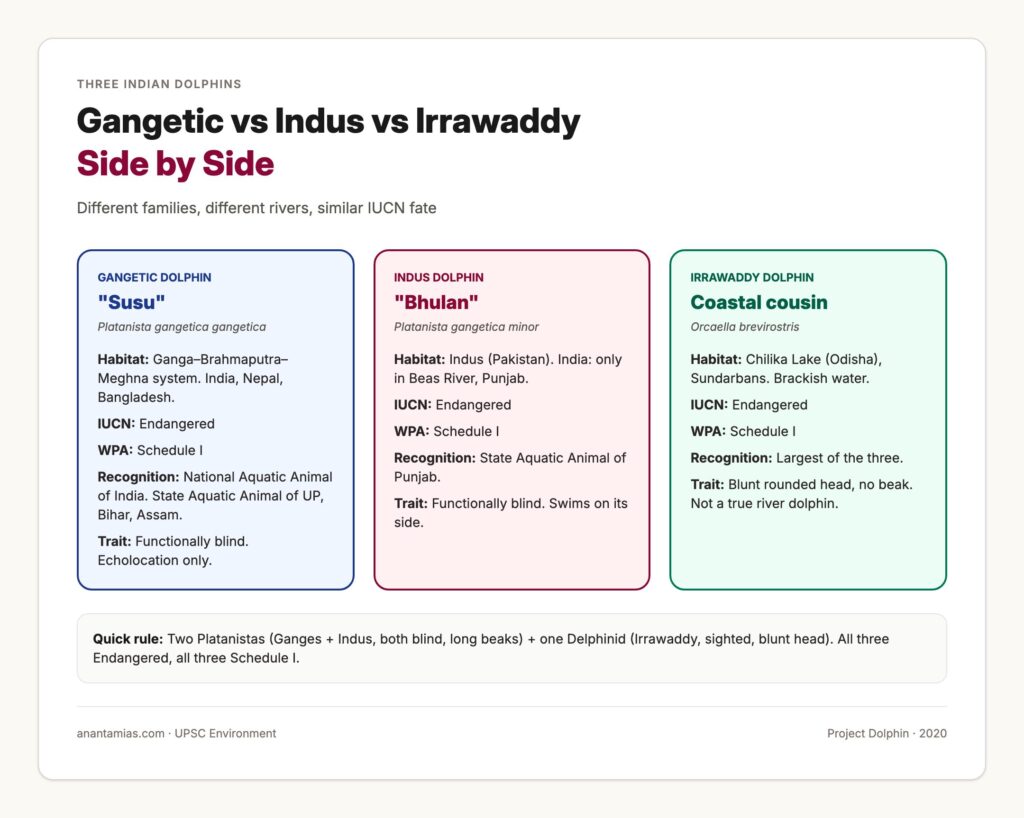
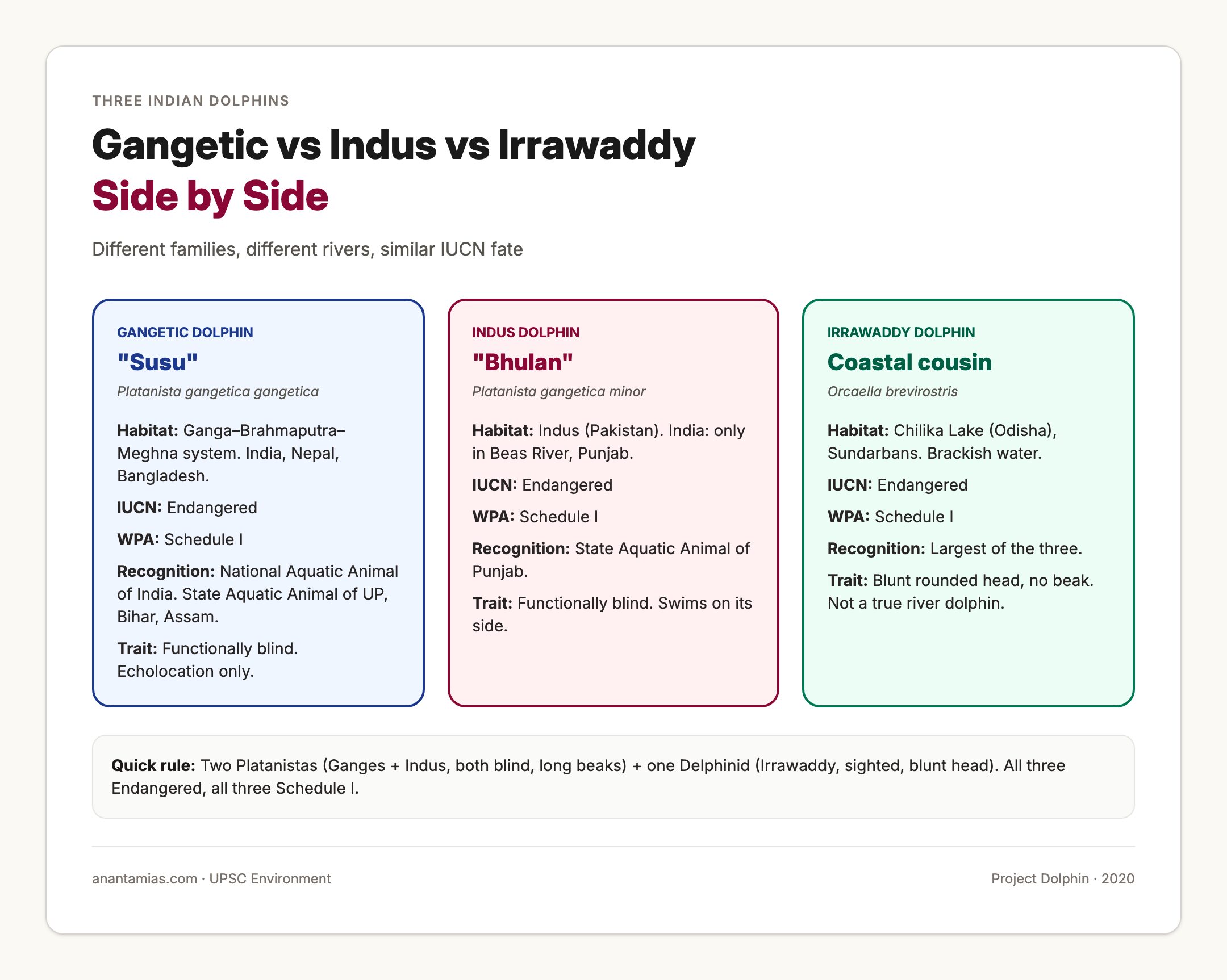
The three species differ in scientific identity, habitat, and physical features. The Gangetic dolphin and the Indus dolphin both belong to the Platanistidae family, share long beaks and pinkish skin tones, and are functionally blind, relying on echolocation. The Irrawaddy dolphin belongs to the Delphinidae family, has a blunt, rounded head with no beak, and is the largest of the three. In habitat, the Gangetic dolphin lives across the Ganga-Brahmaputra-Meghna system. The Indus dolphin lives in Pakistan’s Indus and survives in India only in the Beas River. The Irrawaddy dolphin lives in coastal and brackish water systems including Chilika Lake and the Sundarbans. All three are classified as Endangered on the IUCN Red List and listed in Schedule I of the Wildlife Protection Act 1972, but only the Gangetic dolphin holds the National Aquatic Animal status.
Challenges Ahead
Three challenges stand in the way of stable dolphin populations. The first is fragmentation. The Indian river system has accumulated more than 500 large dams and many more barrages, each of which slices the dolphin range into smaller, more vulnerable units. Retrofitting fish ladders or fish-friendly gates into existing barrages is technically possible but politically and financially heavy. The second is fisheries. Bycatch in artisanal and commercial fisheries is the largest direct cause of dolphin mortality, and addressing it requires gear modification, no-fishing zones, and enforcement. The third is information. Dolphin populations are notoriously hard to count because the animals surface only briefly and the rivers are turbid. The first synchronised national survey of the Gangetic dolphin was conducted in 2021-22 and reported around 6,327 dolphins; the figure is the baseline for the Project Dolphin doubling target. Continued surveys at consistent intervals are essential.
Prelims Pointers
The Gangetic River Dolphin (Platanista gangetica gangetica) is the National Aquatic Animal of India.
The Indus River Dolphin (Platanista gangetica minor) is the State Aquatic Animal of Punjab. In India it survives only in the Beas River.
Both Indus and Gangetic dolphins are Endangered (IUCN) and listed in Schedule I of the Wildlife Protection Act 1972.
The Irrawaddy Dolphin is found in Chilika Lake and Sundarbans and is also Endangered.
Project Dolphin was launched in 2020 under MoEFCC. Target: double the dolphin population by 2030.
Global Declaration for River Dolphins (Bogota Declaration) was signed in 2023 in Colombia by 11 countries including India.
The Yangtze River Dolphin (Baiji) is functionally extinct.
The first sanctuary for the Gangetic dolphin is the Vikramshila Gangetic Dolphin Sanctuary in Bihar (1991).
Mains Questions
Discuss the major threats facing the Gangetic River Dolphin and evaluate the effectiveness of Project Dolphin in addressing them. (GS III, 250 words)
The Indus River Dolphin survives in India only in the Beas River. Examine the conservation strategy required to secure its long-term survival in this habitat. (GS III, 250 words)
Why are river dolphins considered indicator species for the health of river ecosystems? Discuss with reference to the Ganga and the Brahmaputra basins. (GS III, 150 words)
Compare and contrast Project Dolphin with Project Tiger as flagship species conservation programmes. (GS III, 250 words)
Way Forward
The way forward for river dolphin conservation hinges on integrating species protection with river management. Three priorities stand out. First, fish-friendly barrage and dam design and the retrofitting of existing barrages to permit at least seasonal connectivity between dolphin subpopulations. Second, expansion of synchronised national censuses to all major dolphin habitats with a fixed periodicity, ideally every three years, so that Project Dolphin’s 2030 target can be tracked credibly. Third, regional cooperation under the Bogota Declaration framework, particularly between India, Bangladesh, Nepal, and Pakistan, on barrage management, water sharing during lean season, and joint research on dolphin biology and threats.
Frequently Asked Questions
What is the National Aquatic Animal of India?
The Gangetic River Dolphin, scientific name Platanista gangetica gangetica and locally known as the Susu, is the National Aquatic Animal of India. It was given this status by the Government of India in 2009 and is the only mammalian species so designated.
Where is the Indus River Dolphin found in India?
The Indus River Dolphin, locally known as the Bhulan, is found in India only in a roughly 185-kilometre stretch of the Beas River in Punjab. The bulk of the global population lives in the Indus River in Pakistan.
Are river dolphins blind?
The Gangetic and Indus river dolphins are functionally blind. They lack a crystalline eye lens and can detect only the direction and intensity of light. They rely entirely on echolocation, emitting ultrasonic clicks and interpreting the echoes to navigate and to hunt in turbid river water. The Irrawaddy Dolphin has functional eyes but also uses echolocation in low-visibility conditions.
What is Project Dolphin?
Project Dolphin is a dedicated central scheme launched by the Government of India in 2020 under the Ministry of Environment, Forest and Climate Change. It covers both river and marine dolphins, has a 10-year horizon, and aims to double the dolphin population by 2030 through habitat improvement, anti-poaching measures, scientific monitoring, and community engagement.
What is the Bogota Declaration on river dolphins?
The Bogota Declaration, formally the Global Declaration for River Dolphins, was signed in Colombia in 2023 by 11 countries including India, Bangladesh, Nepal, and Pakistan. The declaration commits signatories to halt the decline of all six surviving river dolphin species globally by 2030.
What is the IUCN status of Indian river dolphins?
The Gangetic River Dolphin is Endangered on the IUCN Red List. The Indus River Dolphin is Endangered. The Irrawaddy Dolphin is Endangered. All three are listed in Schedule I of the Wildlife Protection Act 1972, the highest level of legal protection in India.
Is the Irrawaddy Dolphin a true river dolphin?
The Irrawaddy Dolphin is technically an oceanic dolphin that tolerates brackish and fresh water rather than a true river dolphin. It belongs to the family Delphinidae rather than to Platanistidae. In India it is found in Chilika Lake in Odisha and in parts of the Sundarbans.
What are the main threats to river dolphins?
The main threats are construction of dams and barrages that fragment the population, accidental bycatch in fishing nets, water pollution from sewage and agricultural chemicals, boat traffic that causes injury and acoustic disturbance, sand mining, and localised poaching for dolphin oil. Increase in crocodile population is not a significant threat to dolphins.
Where is the first dolphin sanctuary in India?
The Vikramshila Gangetic Dolphin Sanctuary, declared in 1991, is in the Bhagalpur district of Bihar along a 50-kilometre stretch of the Ganga. It is the first protected area in India dedicated to the Gangetic dolphin.
Which river dolphin is functionally extinct?
The Yangtze River Dolphin, locally called the Baiji, is functionally extinct. Surveys conducted in the Yangtze River in 2006 failed to record any individuals, and the species is treated as functionally extinct in conservation literature.
Tell Google you want more of this.
Add Anantam IAS as a preferred sourceOne tap, and this site shows up more often in your own Top Stories, AI Overviews and AI Mode. Remove it any time.