Daily Digest
UPSC · Civil Services Examination
Current Affairs · Sunday, 19 July 2026
Current affairs curated and edited by Anantam IAS faculty — pulled from The Hindu, PIB, IDSA, Foreign Affairs and the ministries. Read, annotate, revise.
Old Rajinder Nagar · Delhi 110005 · anantamias.com
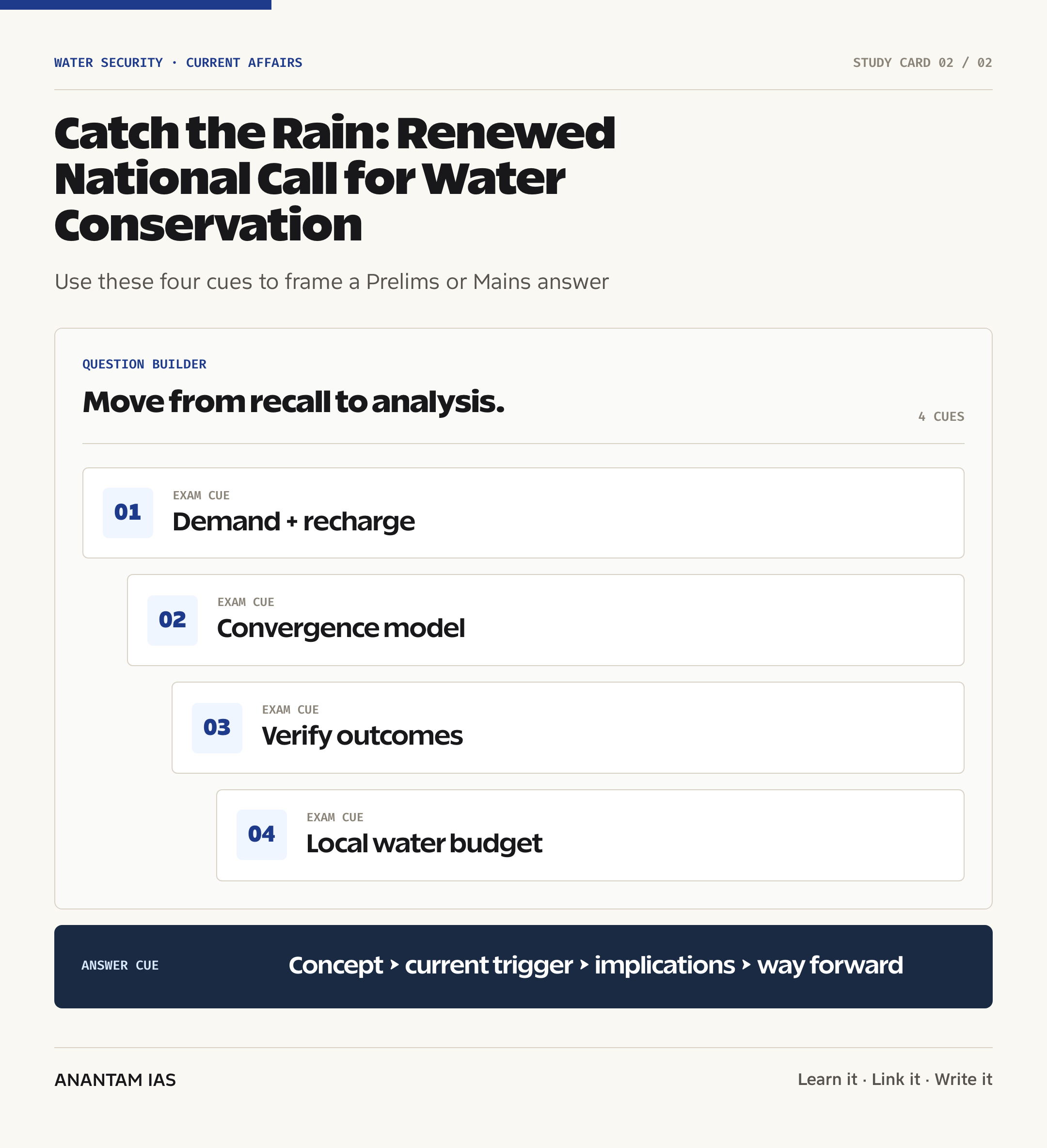
Catch the Rain: Renewed National Call for Water Conservation
Why in News?
The Ministry of Jal Shakti, through a 19 July 2026 PIB backgrounder, renewed the national call to conserve rainwater. It placed a focused nationwide mobilisation running from 4 July to 4 August 2026 at the centre of efforts on rainwater harvesting, groundwater recharge, restoration of traditional water bodies, plantation and public participation.
The immediate mobilisation followed the call made during the 135th Mann Ki Baat episode on 28 June 2026. The backgrounder also explained the larger institutional shift: Jal Sanchay Jan Bhagidari: Catch the Rain, launched on 1 June 2026, expands JSJB and integrates it with Jal Shakti Abhiyan: Catch the Rain.
- The focused campaign period is 4 July to 4 August 2026; it is a time-bound national mobilisation, not a new report of completed structures.
- JSJB: CTR was launched on 1 June 2026 by widening Jal Sanchay Jan Bhagidari and integrating it with the older Catch the Rain campaign.
- The action menu covers rooftop harvesting and recharge structures, revival of wells and baolis, desilting of ponds and reservoirs, plantation and citizen participation.
- The programme favours low-cost, locally appropriate interventions supported by community action, government convergence and Corporate Social Responsibility.
- PIB presents the campaign as a route to climate resilience, stronger agriculture, rural livelihoods and sustainable water security.
The development matters in the context of:
- Monsoon concentration makes the timing, storage and infiltration of rainfall as important as the annual rainfall total.
- Groundwater stress cannot be solved by adding structures alone; recharge, extraction, water quality and maintenance must be managed together.
- Decentralised governance matters because catchments, aquifers, land use and demand differ across villages, wards and districts.
- Climate adaptation becomes durable when communities help plan, monitor and maintain water assets instead of receiving one-time construction works.

UPSC Relevance
Prelims Relevance
- Jal Shakti Abhiyan began in 2019 in 1,592 water-stressed blocks across 256 districts.
- JSA: Catch the Rain was launched on World Water Day, 22 March 2021, with the theme Catch the Rain, where it falls, when it falls.
- Jal Sanchay Jan Bhagidari was launched on 6 September 2024 in Surat, Gujarat.
- The JSJB model rests on the 3Cs: Community, Corporate Social Responsibility and Cost.
- JSJB: CTR was launched on 1 June 2026 and integrates JSJB with JSA: CTR.
- Jal Shakti Kendras function as district-level knowledge and facilitation centres for water conservation.
- Campaign convergence includes PMKSY components, CAMPA, Finance Commission Grants, VB-G RAM-G and State schemes.
- Artificial recharge means deliberately increasing the movement of suitable surface water into an aquifer through structures such as recharge pits, shafts and wells.
Mains Relevance
GS Paper 3
- Environment conservation and water security: connect rainwater harvesting, aquifer recharge, restoration of water bodies and climate adaptation.
- Agriculture and irrigation: assess groundwater dependence, source sustainability, demand management and the role of local water budgets.
- Disaster resilience: explain how watershed treatment, retention and recharge can reduce drought vulnerability while moderating runoff.
GS Paper 2
- Government policies and interventions: examine scheme convergence, measurable outcomes and the gap between reported structures and verified functionality.
- Devolution and participatory governance: evaluate the roles of Panchayati Raj Institutions, Urban Local Bodies, women’s groups and civil society.
Essay
- Water security is built locally even when policy and finance are organised nationally.
- People’s participation turns conservation infrastructure into a maintained public asset.
- Climate resilience depends on aligning ecological limits with development choices.
Background and Context
Read the July Trigger Correctly
Two related updates sit close together, but the exam-ready distinction is straightforward.
- The earlier Anantam IAS note on 1.5 crore recharge and storage structures covered the reported output of JSJB 2.0. That June development is background, not the new July trigger.
- The new July development is the focused mobilisation from 4 July to 4 August 2026, designed to intensify harvesting, recharge, restoration, plantation and public participation during the monsoon window.
- A separate institutional change preceded it: JSJB: CTR began on 1 June 2026, expanding JSJB and integrating it with Jal Shakti Abhiyan: Catch the Rain.
- PIB says the more than 1.5 crore structures reported against the JSJB 2.0 target are undergoing physical verification and field validation. Reported construction must not be written as independently verified performance.
- For answers, separate assets reported from assets that are functional, hydrogeologically suitable, maintained and producing measurable recharge. The second category is the policy outcome that matters.
- This distinction also prevents current-affairs duplication: use the June article for the output figure and artificial-recharge background, and use this July note for mobilisation, integration, local water planning and climate resilience.
From Jal Shakti Abhiyan to an Integrated Campaign
The present campaign is the latest layer in an evolving water-conservation architecture.
- Jal Shakti Abhiyan 2019 targeted 1,592 water-stressed blocks in 256 districts and combined rainwater harvesting, groundwater recharge, watershed development, water-body rejuvenation and afforestation through a Jan Andolan approach.
- On World Water Day 2021, the nationwide JSA: Catch the Rain campaign carried the memorable principle of catching rain where it falls and when it falls.
- The 2021 phase added geo-tagging of water bodies, scientific planning, district Jal Shakti Kendras and awareness activities to the construction and conservation agenda.
- The 2022 phase widened attention to traditional water bodies, watersheds, wetlands, rivers, springsheds and catchment protection, recognising that recharge starts across a landscape.
- The 2023 phase focused on source sustainability in 150 water-stressed districts, linking drinking-water reliability with groundwater recharge, field monitoring and community participation.
- The 2024 phase, themed Nari Shakti se Jal Shakti, emphasised women-led action, desilting, revival of abandoned borewells and afforestation. JSJB: CTR now brings the participation and campaign tracks together.
How Jal Sanchay Jan Bhagidari Works
JSJB treats groundwater conservation as a shared local task backed by converged finance and institutions.
- Jal Sanchay Jan Bhagidari was launched on 6 September 2024 in Surat, Gujarat, with a focus on low-cost recharge and storage structures, revival of defunct borewells and locally suitable designs.
- Its 3Cs model combines Community, Corporate Social Responsibility and Cost. Community identifies and maintains assets, CSR can add institutional support, and low cost aims to make interventions replicable.
- The model uses a Whole-of-Government and Whole-of-Society approach: departments and schemes converge while Panchayats, urban bodies, institutions, businesses and citizens share implementation responsibility.
- JSJB 1.0, implemented from 1 April 2024 to 31 May 2025, crossed a target of at least 10 lakh structures, with more than 27 lakh artificial recharge structures reported.
- JSJB 2.0 began on 1 June 2025 with special attention to Over-Exploited and Critical districts. Against a one-crore target by 31 May 2026, more than 1.5 crore structures were reported.
- The 2026 integrated version shifts attention from a stand-alone structure drive toward a broader monsoon strategy that combines harvesting, recharge, storage, participation and climate resilience.
- Recognition through the 6th National Water Awards in November 2025 shows how the programme also uses public recognition to reward exemplary participation, though awards can’t replace outcome verification.
What the Focused Campaign Asks Communities to Do
The July mobilisation turns the national call into a practical five-part local action menu.
- Adopt rainwater-harvesting systems in homes, housing societies and workplaces so roof runoff can be stored or directed to suitable recharge arrangements.
- Install recharge pits and shafts at appropriate sites and repair unused borewells for recharge, with filtration and water-quality safeguards to prevent contaminants from being carried underground.
- Restore baolis, wells and traditional water bodies. These assets often combine storage, infiltration, local knowledge and cultural stewardship, but revival must include catchment protection and maintenance.
- Remove silt from ponds and reservoirs where scientific assessment supports it. Desilting can improve retention capacity, but excavated material, inflow channels and downstream effects also need a plan.
- Expand tree and green cover in water-retention areas. Vegetation can slow runoff and improve soil structure, but species, location and local hydrogeology decide the actual water benefit.
Aquifer Recharge and Local Water Budgeting
A structure becomes useful only when it fits the aquifer, the catchment and the local balance between supply and demand.
- An aquifer is a permeable geological formation that stores and transmits groundwater. Recharge is the movement of water into that formation, naturally through infiltration or deliberately through suitable structures.
- Artificial recharge doesn’t create water. It changes the route and timing of available runoff so more suitable water enters storage underground instead of leaving the area rapidly as surface flow.
- A local water budget compares expected rainfall, runoff, storage and recharge with household, farm, livestock, institutional and ecological demand at village, ward or aquifer scale.
- The budget exposes the key limitation of supply-only policy: new recharge works can be cancelled out by uncontrolled extraction, water-intensive cropping, leakage or paved recharge zones.
- Useful planning links ridge-to-valley treatment, water-body restoration, rooftop harvesting, soil-moisture conservation and efficient irrigation. Each intervention handles a different part of the same water cycle.
- Because aquifers cross administrative boundaries, hydrogeological information and cooperation between neighbouring local bodies are essential. A successful pit in one location isn’t a universal design template.
- In cities, the same budget should connect stormwater drainage and recharge. Capturing clean roof runoff can support recharge, while contaminated road runoff may need treatment or safe conveyance instead.
Convergence and Institutional Architecture
Convergence means aligning existing programmes, grants, technical staff and community effort around one local water plan.
- PIB lists VB-G RAM-G among the convergence routes, allowing employment and livelihood works to support water conservation where approved under the programme’s design.
- Under PMKSY, Per Drop More Crop addresses efficient on-farm water use, while Repair, Renovation and Restoration of Water Bodies supports the revival of storage and recharge assets.
- CAMPA, Finance Commission Grants, State schemes and CSR can support catchment treatment, plantation, local infrastructure and maintenance, reducing dependence on a single budget line.
- Panchayati Raj Institutions and Urban Local Bodies are critical because they can connect land-use decisions, asset registers, community priorities, local finance and routine upkeep.
- Women’s groups, youth, educational institutions and civil society widen participation beyond contractors and departments. Their role can include mapping, awareness, monitoring, water budgeting and maintenance.
- Jal Shakti Kendras serve as district knowledge and facilitation hubs. They disseminate techniques, guide communities and administrations, and support scientific planning and implementation.
- Convergence works only with a shared local plan and clear accounts. Otherwise, the same asset may be counted under several schemes while responsibility for maintenance remains unclear.
Climate Value, Limits and Measurement
Catch the Rain is best understood as climate adaptation with a demanding implementation test.
- Stored surface water and recharged aquifers can create a buffer against dry spells, support irrigation and drinking-water sources, and reduce the vulnerability of rural livelihoods to variable monsoons.
- Slower runoff, healthier catchments and revived water bodies may also reduce erosion and local flood peaks, but benefits depend on basin position, soil, slope, drainage and maintenance.
- India’s wider groundwater crisis makes demand management unavoidable. Recharge without extraction discipline can encourage a rebound in pumping and leave water levels unchanged.
- A high structure count measures administrative output; functionality, water quality, storage created, recharge achieved, seasonal water-level change and beneficiary equity measure outcomes.
- The PIB caveat on physical verification and field validation should shape evaluation. Geo-tagged completion records need site inspections and hydrogeological evidence before performance claims are final.
- Equity also matters: landless households, downstream users and drinking-water needs can be missed when benefits are judged only through private wells or irrigated acreage.
- A credible programme needs an asset-life-cycle view: design, construction, pre-monsoon preparation, monsoon performance, post-monsoon verification, routine maintenance and correction of failed or unsafe structures.
Way Forward
Plan by Aquifer and Catchment
- Use aquifer maps, rainfall records and catchment surveys before selecting pits, shafts, ponds or borewell-recharge sites; reject one-design-fits-all construction targets.
- Protect recharge zones and inflow channels through land-use controls, permeable surfaces, soil conservation and pollution safeguards.
- Require pre-treatment and water-quality checks before routing runoff into shafts or defunct borewells.
Pair Recharge with Demand Management
- Prepare a public village or ward water budget before each monsoon and revise it after rainfall and water-level observations.
- Link conservation assets with micro-irrigation, crop choices, leakage control and reuse so new recharge isn’t erased by higher withdrawals.
- Reserve a clear share of planning attention for drinking water and ecosystem needs, not only irrigation output.
Measure Outcomes, Not Only Structures
- Publish geo-tagged asset records with verification status, design, cost, maintenance owner and pre-monsoon and post-monsoon observations.
- Track functionality, storage, recharge and water quality over several seasons instead of treating construction completion as the final result.
- Use independent field audits and social audits to test reported numbers, identify failed designs and repair assets quickly.
Make Participation Operational
- Give local bodies and user groups defined roles in site selection, procurement oversight, upkeep and conflict resolution.
- Use Jal Shakti Kendras and educational institutions to translate technical guidance into local-language training and citizen monitoring.
- Create an operation and maintenance fund for every asset so desilting, filters, inlets and protective works don’t fail after the launch period.
Conclusion
Catch the Rain provides a useful national frame: conserve rainfall close to where it falls, restore local storage and make water security a shared public responsibility. The integrated JSJB: CTR model adds community participation and scheme convergence to that frame.
Its credibility will rest on the step after construction. Verified recharge, restrained extraction, safe water quality and maintained assets must replace structure counts as the measure of success. Local water budgets can connect those pieces into one defensible climate-resilience strategy.
UPSC Practice Questions
Prelims MCQ 1
With reference to Jal Sanchay Jan Bhagidari: Catch the Rain, consider the following statements:
- It was launched on 1 June 2026.
- It integrates Jal Sanchay Jan Bhagidari with Jal Shakti Abhiyan: Catch the Rain.
- Its implementation is restricted to Urban Local Bodies.
How many of the above statements are correct?
(a) Only one (b) Only two (c) All three (d) None
Answer: (b) Only two
Explanation:
Statements 1 and 2 are correct. The integrated initiative began on 1 June 2026. It mobilises rural and urban local bodies, women’s groups, youth, institutions, civil society and communities, so Statement 3 is incorrect.
Prelims MCQ 2
Which option best describes the 4 July to 4 August 2026 Catch the Rain campaign?
(a) A declaration that 1.5 crore structures had completed independent field validation (b) A replacement for Jal Shakti Abhiyan: Catch the Rain (c) A focused nationwide mobilisation for harvesting, recharge, restoration, plantation and public participation (d) A programme restricted only to Over-Exploited groundwater districts
Answer: (c) A focused nationwide mobilisation for harvesting, recharge, restoration, plantation and public participation
Explanation:
Option (c) is correct. The July campaign is a time-bound nationwide mobilisation. The 1.5 crore figure belongs to the earlier JSJB 2.0 update and remained subject to physical verification and field validation.
UPSC Mains Questions
- Rainwater harvesting can strengthen climate resilience only when recharge is linked with demand management. Discuss the role of aquifer-based planning, local water budgets and community institutions in making the Catch the Rain campaign ecologically and socially effective. (15 marks, 250 words)
- The success of water-conservation programmes should be judged by verified hydrological outcomes, not the number of structures reported. Critically examine this statement in the context of JSJB: Catch the Rain and suggest an outcome-based monitoring framework. (15 marks, 250 words)
- Scheme convergence can pool finance and institutions, but it can also blur accountability. Analyse how Panchayati Raj Institutions, Urban Local Bodies, Jal Shakti Kendras, CSR and community groups can share clear responsibility under Catch the Rain. (10 marks, 150 words)
Source: PIB, Ministry of Jal Shakti.
Frequently Asked Questions
What is Catch the Rain?
Jal Shakti Abhiyan: Catch the Rain is a national water-conservation campaign launched on World Water Day, 22 March 2021. Its guiding idea is to capture rainfall where and when it falls through harvesting, recharge, restoration of water bodies, watershed work, scientific planning, district Jal Shakti Kendras and community participation.
What is new in July 2026?
The July 2026 trigger is a focused nationwide mobilisation from 4 July to 4 August. It intensifies rainwater harvesting, recharge, revival of traditional water bodies, desilting, plantation and public participation. It should be distinguished from the earlier JSJB 2.0 report of more than 1.5 crore structures.
What does JSJB: CTR integrate?
JSJB: CTR, launched on 1 June 2026, expands Jal Sanchay Jan Bhagidari and integrates it with Jal Shakti Abhiyan: Catch the Rain. The combination joins JSJB’s low-cost local structures, 3Cs model and community ownership with the nationwide monsoon campaign, scientific planning and institutional network of Catch the Rain.
What does the 1.5 crore figure show?
It refers to more than 1.5 crore recharge structures reported nationwide under JSJB 2.0 against a target of at least one crore by 31 May 2026. PIB explicitly states that the reported structures are undergoing physical verification and field validation, so the number isn’t the same as verified recharge performance.
What is a local water budget?
A local water budget compares available rainfall, runoff, surface storage and groundwater recharge with demand from households, farms, livestock, institutions and ecosystems. Prepared at village, ward or aquifer scale, it helps communities choose suitable works, set priorities and see when extraction exceeds the water likely to be replenished.
Why does aquifer recharge build resilience?
Aquifer recharge stores suitable water underground, where it can support wells, irrigation and drinking-water sources during dry periods. But recharge is only one part of resilience. Water quality, extraction limits, crop choices, land-use protection and asset maintenance decide whether the added storage produces a lasting local buffer.
Source: https://anantamias.com/current-affairs/catch-the-rain-water-conservation-national-call/
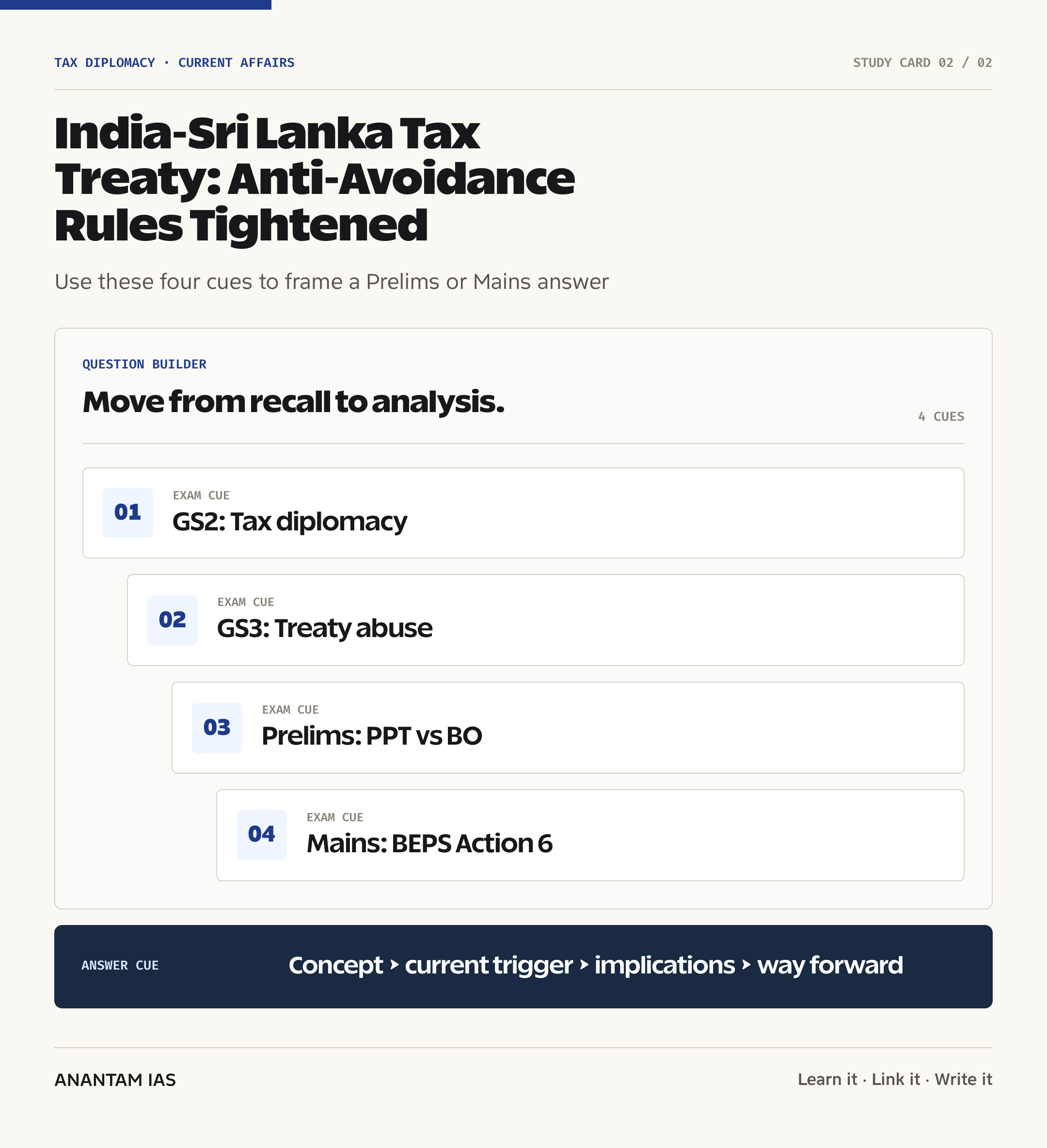
India-Sri Lanka Tax Treaty: Anti-Avoidance Rules Tightened
Why in News?
The Ministry of Finance notified a protocol tightening the India-Sri Lanka tax treaty through Notification No. 88/2026-Income-Tax dated 16 July 2026. The amendment adds a treaty-level anti-abuse rule without creating a new tax.
The key change is the Principal Purpose Test, or PPT. It allows treaty relief to be refused when obtaining that relief was one of the principal purposes of an arrangement, unless granting it would still match the object and purpose of the relevant treaty provision.
- The amending Protocol was signed at New Delhi on 16 December 2024.
- It entered into force on 19 June 2026, the date fixed under the protocol after both countries completed their required legal procedures.
- In India, the changes apply to income derived in fiscal years beginning on or after 1 April 2027, meaning FY 2027-28 onward.
- The protocol changes the treaty’s preamble and replaces paragraph 6 of Article 28; it doesn’t revise treaty tax rates.
The development matters in the context of:
- The existing India-Sri Lanka DTAA was signed on 22 January 2013 and entered into force on 22 October 2013.
- A PIB Cabinet release explained that the bilateral amendment was designed to meet the treaty-abuse minimum standard under G20-OECD BEPS Action 6.
- The development links India-Sri Lanka relations with revenue protection, investment certainty and rules for genuine cross-border business.

UPSC Relevance
Prelims Relevance
- DTAA stands for Double Taxation Avoidance Agreement; it allocates taxing rights and provides relief when two jurisdictions may tax the same income.
- The PPT is a general anti-abuse rule aimed at arrangements whose principal purposes include obtaining a treaty benefit.
- The test contains an exception: a benefit may continue if granting it accords with the object and purpose of the relevant treaty provisions.
- Beneficial ownership tests whether the recipient truly enjoys or controls income rather than receiving it as a mere conduit.
- Treaty shopping means routing an arrangement through a jurisdiction mainly to claim treaty advantages not intended for the underlying investor or transaction.
- BEPS Action 6 deals with preventing treaty abuse, including treaty-shopping arrangements.
- India’s MLI entered into force on 1 October 2019, but this treaty was updated through a bilateral protocol.
- The amended protocol applies in India from FY 2027-28; its entry into force on 19 June 2026 isn’t the same as its date of effect for Indian income.
Mains Relevance
GS Paper 2
- Bilateral, regional and global groupings and agreements involving India: tax treaties as instruments of economic diplomacy with a close maritime neighbour.
- India and its neighbourhood relations: how predictable taxation can support trade and investment while cooperation limits cross-border treaty abuse.
- International institutions and agreements: the G20-OECD Inclusive Framework, BEPS minimum standards and bilateral implementation.
GS Paper 3
- Indian economy and resource mobilisation: protecting the tax base from artificial structures and unintended treaty benefits.
- Liberalisation and investment: balancing commercial certainty for bona fide investors with scrutiny of shell entities and conduit arrangements.
- Inclusive growth and fiscal capacity: revenue protection helps preserve public resources without treating every cross-border structure as abusive.
Essay
- Rules-based globalisation works only when mobility of capital is paired with cooperation against regulatory arbitrage.
- Trust and verification in diplomacy: a good treaty protects legitimate exchange while denying benefits to arrangements that defeat its purpose.
Background and Context
How a DTAA Works
A Double Taxation Avoidance Agreement coordinates two tax systems so genuine cross-border income isn’t taxed twice merely because two countries claim a connection.
- A DTAA allocates or limits taxing rights over income such as business profits, dividends, interest, royalties and capital gains. It doesn’t abolish domestic tax law; it tells the two states how their claims interact.
- Relief commonly comes through an exemption or a foreign tax credit. A credit lets the residence country account for eligible tax paid in the source country, reducing economic double taxation within treaty limits.
- The treaty also sets connecting rules such as residence, source and permanent establishment. These rules decide which country may tax, whether a rate cap applies and what evidence the claimant must provide.
- The central bargain is easy to remember: a treaty reduces tax friction for bona fide exchange, but it isn’t a shopping coupon available to any structure that can produce a residence certificate.
What the Amending Protocol Changes
The Protocol makes two targeted anti-abuse changes rather than rewriting the whole India-Sri Lanka treaty.
- First, the revised preamble says the treaty seeks to eliminate double taxation without creating opportunities for non-taxation or reduced taxation through evasion or avoidance, including treaty-shopping arrangements.
- Second, the protocol replaces Article 28(6) with the PPT. Treaty benefits can be denied when, considering all relevant facts and circumstances, it is reasonable to conclude that obtaining a benefit was one principal purpose of an arrangement or transaction.
- The denial rule isn’t absolute. If granting the benefit would accord with the object and purpose of the relevant treaty provisions, the PPT’s saving clause allows the claim to survive.
- The amendment changes access to treaty benefits, not the rate schedule. It neither creates a new taxable event nor automatically raises withholding tax on every India-Sri Lanka payment.
Principal Purpose Test in Plain Language
The PPT asks why an arrangement was built, not only whether its paperwork looks formally correct.
- Picture a company inserted between an investor and an Indian asset. If the intermediary has a genuine operating role, people, decision-making and commercial risk, treaty relief may fit the treaty’s purpose. If it mainly supplies a favourable treaty address, the claim faces scrutiny.
- The phrase one of the principal purposes matters. Tax advantage needn’t be the sole purpose or even the only major purpose; it is enough for it to be among the arrangement’s principal purposes, subject to the saving clause.
- The standard is based on what it is reasonable to conclude from the facts and circumstances. Contracts, board decisions, funding flows, functions, risks and the sequence of transactions can reveal more than a residence certificate alone.
- The PPT doesn’t declare all tax planning unlawful. It addresses access to a specific treaty benefit. Tax evasion involves illegal concealment, while treaty abuse may use formally legal steps that defeat the purpose for which relief was negotiated.
- The PPT and a domestic General Anti-Avoidance Rule operate at different legal layers. The PPT tests entitlement to treaty relief, while a domestic anti-avoidance rule tests an arrangement under national tax law. One shouldn’t be assumed to cancel the other.
- A reasoned PPT analysis should identify the particular treaty benefit, the evidence pointing to a principal tax purpose and the object of the relevant provision. Simply labelling an entity a shell doesn’t complete that three-part inquiry.
Beneficial Ownership and PPT Are Different Gates
Beneficial ownership and the PPT can overlap in a conduit case, but they ask different questions and shouldn’t be treated as synonyms.
- A beneficial-owner condition asks whether the stated recipient truly enjoys and controls the dividend, interest or royalty, rather than being legally or contractually bound to pass it to someone else.
- The PPT is wider. It examines the purpose of the arrangement or transaction that generated the treaty claim, including structures that may pass formal residence and beneficial-ownership checks.
- Meeting objective requirements such as tax residence, beneficial ownership and prescribed documents can support a claim, but it doesn’t create automatic immunity from a purpose-based anti-abuse review.
- For exam recall, use a two-gate model: beneficial ownership tests the recipient’s relationship with the income; the PPT tests whether obtaining treaty relief was a principal purpose and whether relief fits the provision’s purpose.
Treaty Shopping, BEPS and Action 6
Base Erosion and Profit Shifting, or BEPS, describes strategies that exploit gaps and mismatches to disconnect taxable profit from substantial economic activity.
- Treaty shopping is one abuse channel. A resident of a third jurisdiction may route investment through a treaty partner to seek a lower withholding rate or another benefit that the contracting states didn’t intend for that investor.
- The G20-OECD BEPS Project contains 15 actions. Action 6 focuses on preventing treaty abuse and requires participating jurisdictions to adopt a minimum standard against treaty-shopping opportunities.
- The revised preamble and PPT work together. The preamble states the anti-abuse purpose, while the PPT provides an operative rule for testing a particular arrangement against that purpose.
- This distinction prevents a common exam error: BEPS is the wider international tax agenda, Action 6 is the treaty-abuse component, and the PPT is one legal tool used to meet that component.
- BEPS doesn’t mean every low-tax outcome is abusive. The policy concern is a mismatch between profit allocation, treaty entitlement and substantial activity, which is why evidence of functions, risks and commercial purpose matters.
Why India and Sri Lanka Used a Bilateral Protocol
Countries can update treaty networks through the Multilateral Instrument, or MLI, or negotiate a protocol directly with one treaty partner.
- The MLI lets participating jurisdictions apply agreed BEPS treaty measures across multiple covered agreements without renegotiating each treaty from scratch. It entered into force for India on 1 October 2019.
- The official PIB explanation recorded that Sri Lanka was not an MLI signatory when the Cabinet approved this amendment in 2020, so the two states needed a bilateral route.
- Both countries participate in the Inclusive Framework on BEPS. The protocol converts the Action 6 commitment into treaty text suited to their bilateral agreement.
- The sequence also tests chronology: Cabinet approval came in 2020, signature in 2024, entry into force in June 2026, notification in July 2026 and effect for Indian income from FY 2027-28.
What Changes for Investors and Tax Authorities
The amendment shifts attention from formal eligibility alone toward commercial substance, documented purpose and the treaty’s intended bargain.
- A claimant should be able to explain the commercial rationale for entity location, ownership, financing, functions and transaction timing. Documents created after a dispute begins are less persuasive than records that match actual conduct.
- The Central Board of Direct Taxes and other tax authorities gain a treaty-grounded basis to examine facts and circumstances. But a PPT conclusion still needs a reasoned link between evidence, the alleged principal purpose and the object of the benefit being claimed.
- Purpose-based tests add judgment and can reduce mechanical certainty. Consistent administration, clear examples and access to the treaty’s Mutual Agreement Procedure become important when India and Sri Lanka interpret a case differently.
- The CBDT’s PPT guidance is relevant to India’s broader treaty practice, but treaty-specific dates and protections must still be read from the applicable agreement and protocol.
Bilateral and Strategic Significance
Tax cooperation is a quiet part of economic diplomacy: it can make legitimate investment easier while protecting both states from structures with little economic substance.
- For India, the protocol supports tax-base protection and signals consistency with its wider anti-BEPS treaty policy. For Sri Lanka, predictable interpretation matters when attracting investment and financing during economic recovery.
- For bilateral commerce, the best outcome isn’t maximum taxation. It is appropriate taxation: relief for genuine trade, services and capital flows, paired with denial where a structure seeks an unintended advantage.
- The agreement sits within a broader neighbourhood relationship covering trade, connectivity, energy, fisheries and development cooperation. The tax layer can reduce friction, but inconsistent enforcement could also become an investment irritant.
- A balanced reading matters in Mains answers. Revenue sovereignty and investment certainty aren’t opposites; durable treaties need both, backed by consultation between the two competent authorities.
Way Forward
Issue practical, treaty-specific guidance
- The CBDT can publish anonymised examples showing when ordinary commercial choices pass the PPT and when conduit or circular arrangements fail it.
- Guidance should explain how the saving clause is applied, so the test doesn’t become a presumption against every tax-efficient structure.
Reward contemporaneous substance
- Businesses should align legal form with people, functions, control, risk and decision-making, then retain records showing the commercial reasons for the structure.
- Tax administrations should judge actual conduct and avoid treating a missing document as conclusive when other reliable evidence establishes a bona fide purpose.
Use cooperative dispute resolution
- India and Sri Lanka should keep their competent-authority channels active and use the Mutual Agreement Procedure to address double taxation created by inconsistent treaty interpretations.
- Regular consultation can build a shared approach to residence, beneficial ownership and PPT questions before recurring disputes harden into barriers to investment.
Track outcomes, not only denials
- Authorities should review whether the amendment reduces abusive claims without delaying genuine relief or increasing unresolved cross-border disputes.
- Public, aggregated data on cases, resolution time and recurring issues can improve accountability without disclosing confidential taxpayer information.
Conclusion
The amended India-Sri Lanka DTAA draws a clearer boundary around treaty relief. Formal residence and documentation still matter, but they no longer answer the whole question when the arrangement’s principal purposes include securing an unintended benefit.
Its success will depend on disciplined administration. A well-applied PPT can protect revenue and preserve genuine exchange at the same time; an unpredictable one can simply replace treaty shopping with treaty uncertainty.
UPSC Practice Questions
Prelims MCQ 1
With reference to the amended India-Sri Lanka tax treaty, consider the following statements:
- The protocol revises the treaty preamble and inserts a Principal Purpose Test.
- It entered into force on 19 June 2026 and applies in India to income from FY 2027-28 onward.
- It replaces the existing treaty rate schedule with a uniform withholding tax rate.
How many of the above statements are correct?
(a) Only one (b) Only two (c) All three (d) None
Answer: (b) Only two
Explanation:
Statements 1 and 2 are correct. The protocol changes the preamble and Article 28(6), but it doesn’t impose a uniform rate or rewrite the treaty’s rate schedule.
Prelims MCQ 2
Which statement best distinguishes beneficial ownership from the Principal Purpose Test?
(a) Beneficial ownership examines control over income, while the PPT examines the purpose and treaty fit of an arrangement. (b) Beneficial ownership applies only to domestic transactions, while the PPT applies only to customs duties. (c) Beneficial ownership automatically overrides every anti-avoidance rule, while the PPT concerns residence certificates alone. (d) Both terms are interchangeable tests for whether income was reported in the source country.
Answer: (a) Beneficial ownership examines control over income, while the PPT examines the purpose and treaty fit of an arrangement.
Explanation:
Beneficial ownership asks whether the recipient truly enjoys or controls the income. The PPT asks whether obtaining a treaty benefit was one principal purpose and whether granting it matches the provision’s object and purpose.
UPSC Mains Questions
- Tax treaties are instruments of both revenue protection and economic diplomacy. Discuss this statement with reference to the India-Sri Lanka DTAA amendment, the Principal Purpose Test and the need to preserve certainty for bona fide cross-border investment.
- Differentiate between treaty shopping, beneficial ownership and the Principal Purpose Test. Explain how these concepts operate as distinct but related safeguards against abuse of Double Taxation Avoidance Agreements.
- The G20-OECD BEPS framework depends on domestic and bilateral implementation, not declarations alone. Examine with reference to Action 6, the Multilateral Instrument and India’s bilateral protocol with Sri Lanka.
Sources: Ministry of Finance, Notification No. 88/2026-Income-Tax and The Indian Express.
Frequently Asked Questions
What is the India-Sri Lanka DTAA?
The India-Sri Lanka DTAA is a bilateral agreement that coordinates taxing rights over cross-border income and provides relief from double taxation. The present agreement was signed on 22 January 2013 and entered into force on 22 October 2013. It covers issues such as residence, business profits, dividends, interest, royalties and tax relief.
What did the 2026 protocol change?
The protocol revised the treaty’s preamble to reject opportunities for non-taxation or reduced taxation through evasion, avoidance and treaty shopping. It also replaced Article 28(6) with a Principal Purpose Test. It didn’t create a new tax or replace the treaty’s existing rate schedule.
What is the Principal Purpose Test?
The PPT permits denial of a treaty benefit when it is reasonable to conclude, from all relevant facts and circumstances, that obtaining that benefit was one of an arrangement’s principal purposes. The benefit may still be granted when doing so accords with the object and purpose of the relevant treaty provisions.
Is beneficial ownership the same as PPT?
No. Beneficial ownership asks whether a recipient truly enjoys or controls income instead of acting as a conduit. The PPT examines why the wider arrangement or transaction was undertaken and whether treaty relief fits the provision’s purpose. A claimant may satisfy one test and still face the other.
When will the amended rules apply in India?
The protocol entered into force on 19 June 2026, but its Indian tax effect begins later. It applies to income derived in fiscal years starting on or after 1 April 2027, so the operative Indian period is FY 2027-28 onward. Entry into force and date of effect are separate treaty concepts.
Does the amendment raise treaty tax rates?
No. The protocol adds an anti-abuse gateway to decide whether a claimant should receive an existing treaty benefit. It doesn’t announce a new tax or a general rate increase. If the PPT denies relief, the applicable tax outcome follows the treaty and domestic law that remain in force for that income.
Source: https://anantamias.com/current-affairs/india-sri-lanka-tax-treaty-anti-avoidance/
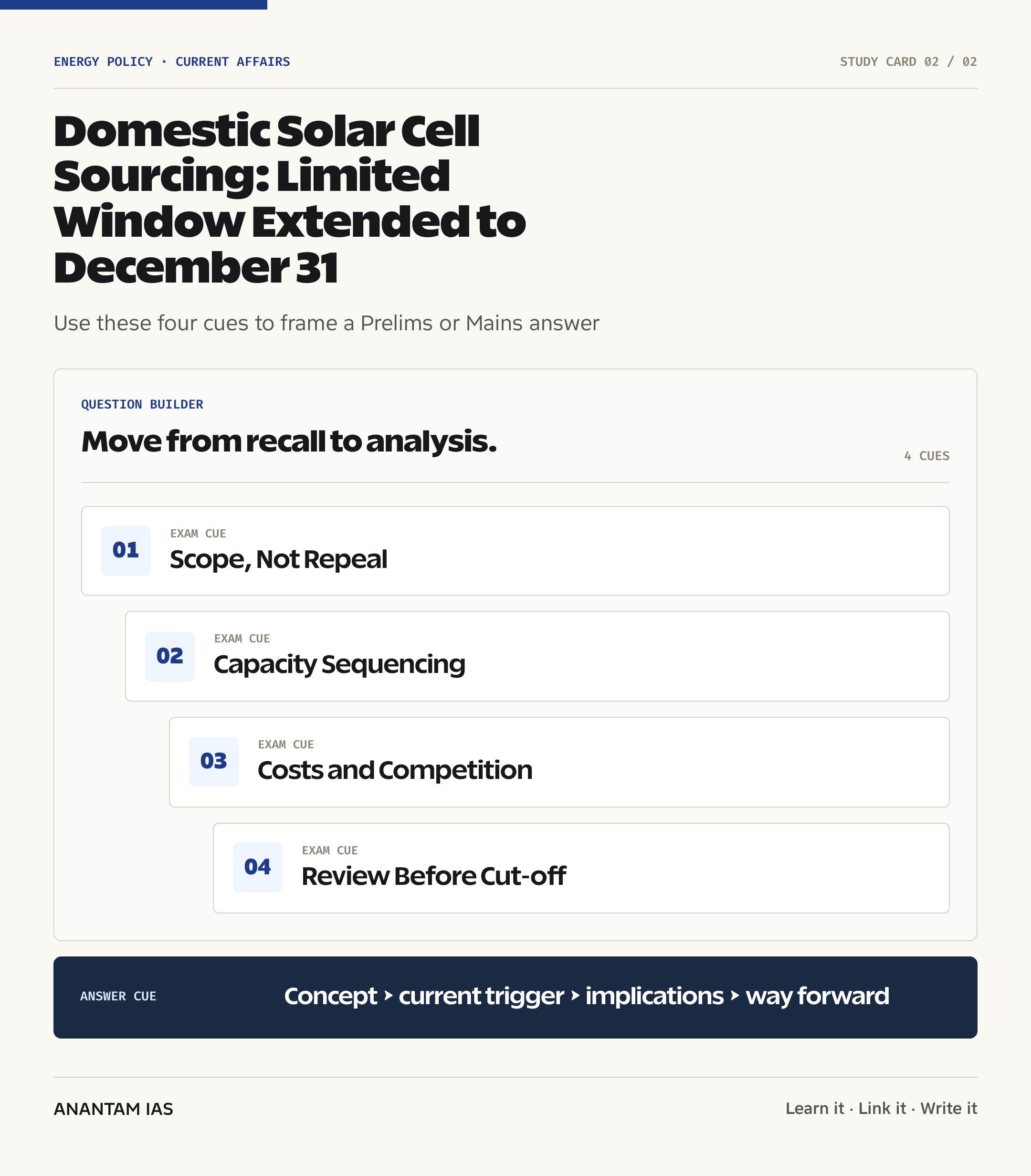
Domestic Solar Cell Sourcing: Limited Window Extended to December 31
Why in News?
The Ministry of New and Renewable Energy (MNRE) issued an Office Memorandum on 18 July 2026 allowing net-metering and open-access renewable energy projects to commission with an exemption from the solar-cell requirement under ALMM List-II until 31 December 2026.
The Indian Express reported the development on 19 July 2026. The official order makes the crucial qualification clear: this is not a blanket deferral of the domestic solar-cell mandate. It is a limited commissioning window for two named project categories, while projects commissioned after the cut-off must comply with List-II.
- The new order is O.M. No. 283/53/2026-GRID SOLAR, dated 18 July 2026.
- The relief covers net-metering projects and open-access RE power projects.
- Eligible projects may commission up to 31 December 2026 without using cells enlisted under ALMM List-II.
- Projects commissioned after the cut-off must meet the ALMM List-II provisions for solar photovoltaic cells.
- MNRE said the decision followed stakeholder deliberations and was intended to support a smooth transition.
The development matters in the context of:
- The change exposes a sequencing problem: domestic cell capacity is much smaller than India’s module-assembly base.
- A rapid mandate can deepen energy security, but scarce domestic cells can raise project costs and slow solar deployment.
- The policy question is not self-reliance versus climate action. It is how to phase industrial policy so both goals reinforce each other.


UPSC Relevance
Prelims Relevance
- The Approved List of Models and Manufacturers (ALMM) flows from MNRE’s 2019 compulsory-registration order for solar photovoltaic equipment.
- ALMM List-I covers approved models and manufacturers of solar PV modules.
- ALMM List-II covers approved models and manufacturers of solar PV cells.
- The original solar-cell framework was made effective from 1 June 2026 by MNRE’s order dated 9 December 2024.
- The first formal List-II for solar cells was issued on 31 July 2025 and has been revised periodically.
- Net metering adjusts a consumer’s electricity bill for surplus rooftop-solar power exported to the distribution grid.
- Open access permits an eligible consumer to procure electricity directly from a generator using the transmission or distribution network, subject to regulation and charges.
- The solar manufacturing chain is polysilicon to ingot to wafer to cell to module; a cell converts sunlight into electricity, while a module combines many cells.
- The July order changes the compliance window for specified projects; it does not repeal ALMM List-I, List-II, or every domestic-content rule.
Mains Relevance
GS Paper 3
- Indian economy and industrial policy: sequencing protection, investment incentives, competition and manufacturing capacity.
- Infrastructure and energy: balancing solar deployment speed with reliable domestic supply chains.
- Environment: aligning the clean-energy transition with affordability and India’s non-fossil capacity goals.
- Inclusive growth: protecting smaller non-integrated module makers from input scarcity and market concentration.
- Science and technology: moving domestic capability upstream from module assembly to cells, wafers and polysilicon.
Essay
- Self-reliance and speed: strategic autonomy works best when domestic capacity is built before scarcity becomes the policy instrument.
- Green transition and distributive justice: the costs of industrial upgrading must not fall only on small firms or electricity consumers.
Background and Context
What the July Order Actually Changes
The new order changes the transition window, not the basic architecture of the ALMM solar-cell regime.
- MNRE’s 18 July Office Memorandum says there will be no blanket extension in the applicability of List-II for solar power projects.
- It creates a limited window only for net-metering and open-access renewable energy projects to commission without List-II cells until 31 December.
- The earlier dispensation for these project categories was available only till 31 May 2026, immediately before the mandate took effect.
- The practical effect is a seven-month transition window from the original cut-off, but the 1 June framework remains the legal starting point.
- The order says projects commissioned after 31 December 2026 will be required to comply with List-II provisions.
- It supersedes MNRE’s 25 May 2026 memorandum and associated June memoranda dealing with investment protection and transition arrangements.
- This scope distinction matters in an answer: call it a limited commissioning exemption, not a universal withdrawal of domestic cell sourcing.
How the June 1 Mandate Was Designed
The older rule sought to push India’s solar industry one step upstream, from assembling panels to manufacturing the cells inside them.
- MNRE’s 9 December 2024 memorandum proposed that List-II for solar PV cells would become effective from 1 June 2026.
- Covered projects were already required to use modules from ALMM List-I; the new layer required those modules to contain cells sourced from List-II manufacturers.
- MNRE reiterated the effective date through a 28 July 2025 memorandum, after the solar-cell list was ready for publication.
- The first List-II was issued on 31 July 2025, giving manufacturers and developers advance notice before enforcement.
- The earlier Anantam IAS note on ALMM List-II explains why the 1 June rollout became a test of capacity, costs and industrial sequencing.
- The mandate is not an economy-wide import ban. It applies through the ALMM eligibility framework to specified government-linked, net-metered and open-access projects.
- The July action is a follow-up to that rollout. It gives named projects more commissioning time while retaining the long-term domestic manufacturing signal.
ALMM List-I and List-II
The two lists regulate different stages of the same product, a distinction that is easy to miss under exam pressure.
- The ALMM Order, 2019 was issued by MNRE to verify that listed solar equipment is produced in the manufacturing units that claim it.
- List-I identifies approved solar PV module models and manufacturers; a module is the finished panel installed at a project site.
- List-II identifies approved solar PV cell models and manufacturers; a cell is the electricity-generating semiconductor unit inside a module.
- MNRE’s official ALMM page links the framework to consumer protection, long-term reliability and national energy security.
- The first module list was issued on 10 March 2021, while the first solar-cell list followed on 31 July 2025.
- An approved module under List-I does not automatically answer whether its cells meet List-II sourcing; the lists test separate levels of the value chain.
- For Prelims, remember the clean pair: List-I equals modules, and List-II equals cells.
The Capacity Mismatch Behind the Deferral
India has built module assembly much faster than cell manufacturing, so the binding constraint sits below the finished panel.
- The Indian Express reported annual module manufacturing capacity of nearly 200 GW, compared with cell capacity of around 30 GW.
- That gap means many Indian module factories still depend on imported solar cells, even when the final panel is assembled domestically.
- The same report estimated module production at 60-65 GW against solar installations of about 45 GW in 2025-26.
- Industry sources cited by the newspaper placed capacity use at several module plants near 30-40%, reflecting overcapacity in assembly and weaker export opportunities.
- A vertically integrated manufacturer makes both cells and modules. A non-integrated manufacturer buys cells and assembles them into modules.
- When domestic cells are scarce, non-integrated firms may have to buy a key input from larger rivals that also compete in the module market.
- The July window gives these firms time to adjust supply contracts and commissioning schedules, but it doesn’t by itself create more cell capacity.
- This is the core Mains point: a demand mandate can accelerate investment, but a large capacity gap can first produce scarcity, higher prices and concentration.
Why a Limited Window Was Chosen
MNRE is trying to protect the policy signal without forcing every project to absorb an immediate supply shock.
- A blanket rollback would weaken the incentive to invest in domestic solar-cell lines after firms had planned capacity around the June mandate.
- Immediate universal enforcement could raise input costs for projects that were designed, financed or contracted before adequate List-II supply became available.
- The selected categories are deployment-heavy: net-metering supports distributed rooftop systems, while open access serves commercial and industrial consumers.
- The Indian Express reported concern that cell scarcity could raise the price of DCR modules used in distributed renewable-energy projects such as rooftops and agricultural pumps.
- A time-bound window can reduce short-run disruption while preserving a clear final date. But it works only if the extra months produce capacity, competition and contracting certainty.
- The policy still creates a deadline effect: projects may rush to commission before 31 December, putting pressure on approvals, grid connectivity and quality checks.
- Because the exemption turns on commissioning, not merely equipment purchase, delays in connectivity or distribution-company inspection can decide whether an otherwise ready project falls inside the window.
- Aspirants should frame the choice as calibrated protection, not as a simple choice between imports and domestic industry.
Economic and Environmental Trade-offs
The policy sits at the intersection of industrial depth, affordable electricity and the pace of India’s energy transition.
- Domestic cell manufacturing can reduce strategic import dependence and retain more value addition, skills and investment within the Indian solar economy.
- A guaranteed home market can support scale, learning and technology upgrades, especially when paired with the PLI Scheme for High-Efficiency Solar PV Modules.
- But higher cell costs can raise module prices, weaken project returns and slow additions needed for India’s broader solar-energy transition.
- Smaller module makers face a distributional risk: scarce cells may transfer margins and bargaining power toward a few integrated producers.
- Consumers can also bear part of the adjustment through higher rooftop-system prices or electricity tariffs if procurement costs rise under domestic sourcing.
- Environmental gains depend on deployment volume as well as domestic origin. Delayed projects can postpone fossil-fuel displacement even when the manufacturing goal is sound.
- The balanced test is whether the policy creates globally competitive capacity without turning temporary protection into permanent high-cost dependence.
ALMM, DCR and Scheme Implementation
ALMM and the Domestic Content Requirement often appear together, but they answer different regulatory questions.
- ALMM asks whether a model and manufacturer are on MNRE’s approved list for covered projects.
- A Domestic Content Requirement (DCR) asks whether specified components were manufactured in India under the rules of a particular scheme or procurement programme.
- A project may face both tests, but an exemption from ALMM List-II shouldn’t be read automatically as an exemption from every DCR condition.
- This distinction is relevant to PM Surya Ghar: Muft Bijli Yojana, where rooftop vendors, domestic modules and net-metering rules meet at the household level.
- It also matters for commercial and industrial open-access projects, which contract power directly but still depend on state-level grid and regulatory approvals.
- The Union government sets the ALMM framework, while state regulators and distribution companies shape net-metering and open-access implementation on the ground.
- For Mains, separate the central industrial-policy objective from state electricity regulation: manufacturing approval, project eligibility and grid permission operate through different institutions.
- Good policy coordination must align procurement rules, commissioning evidence, grid connectivity and scheme portals so a central deadline doesn’t create administrative bottlenecks.
Way Forward
Publish a Clear Transition Protocol
- MNRE should define the exact commissioning evidence, eligible project categories and treatment of projects that cross the deadline because of grid-side delays.
- A public dashboard should track approvals, exemptions and commissioning status to reduce discretion and litigation.
Scale Cells and Upstream Inputs
- Policy support should expand competitive solar-cell capacity while also building wafers, ingots and polysilicon capability.
- PLI incentives, research support and standards should reward technology depth and efficiency, not only announced factory capacity.
Protect Competition and Affordability
- The government should monitor cell prices, merchant availability and supply contracts so the mandate doesn’t create excessive market concentration.
- Targeted credit and technology support can help smaller module manufacturers integrate upstream or secure diversified domestic supplies.
Review Before the Cut-off
- A published review before 31 December should compare enlisted cell capacity, actual output, prices and project pipelines.
- Any next step should be rule-based and announced early, preserving both investment certainty and India’s solar deployment trajectory.
Conclusion
The July decision is best understood as a sequencing correction. MNRE has retained ALMM List-II and its domestic-manufacturing objective, while granting net-metering and open-access projects a limited period to commission without the cell condition.
The extra months will matter only if they narrow the cell-capacity gap, improve open-market supply and reduce uncertainty. India’s energy transition needs domestic depth, but it also needs affordable panels and timely projects. A phased, transparent and competition-aware mandate can serve both goals.
UPSC Practice Questions
Prelims MCQ 1
With reference to the Approved List of Models and Manufacturers (ALMM), consider the following statements:
- ALMM List-I covers solar photovoltaic modules.
- ALMM List-II covers solar photovoltaic cells.
- The July 2026 order grants a blanket extension from List-II to all solar power projects.
How many of the above statements are correct?
(a) Only one (b) Only two (c) All three (d) None
Answer: (b) Only two
Explanation:
Statements 1 and 2 are correct. The 18 July 2026 memorandum expressly denies a blanket extension and provides a limited window only to net-metering and open-access RE projects.
Prelims MCQ 2
Which project categories receive the limited commissioning window under MNRE’s 18 July 2026 ALMM List-II memorandum?
(a) All utility-scale solar projects (b) Only central public-sector solar parks (c) Net-metering and open-access RE power projects (d) Only export-oriented module factories
Answer: (c) Net-metering and open-access RE power projects
Explanation:
The order allows net-metering and open-access RE power projects to commission with exemption from List-II cells until 31 December 2026.
UPSC Mains Questions
- India’s solar manufacturing policy seeks self-reliance, but module capacity has grown much faster than cell capacity. Critically examine how the sequencing of ALMM List-II can affect project costs, competition and the pace of the energy transition. (15 marks, 250 words)
- Distinguish between ALMM List-I, ALMM List-II and the Domestic Content Requirement. Discuss how these instruments, together with production incentives, can deepen domestic manufacturing without creating avoidable supply shocks. (15 marks, 250 words)
- A time-bound regulatory exemption can protect sunk investment while preserving a long-term policy signal. Evaluate this statement with reference to the December 31 commissioning window for net-metering and open-access solar projects. (10 marks, 150 words)
Sources: Ministry of New and Renewable Energy and The Indian Express Business.
Frequently Asked Questions
What did MNRE change in July 2026?
MNRE created a limited commissioning window for net-metering and open-access renewable-energy projects. Such projects may commission without solar cells from ALMM List-II until 31 December 2026. The order doesn’t abolish List-II, and projects commissioned after the cut-off must comply.
Is ALMM List-II cancelled?
No. ALMM List-II remains the approved list for solar PV cells. The July memorandum states that there is no blanket extension. It temporarily relaxes the cell requirement only for two project categories and keeps the post-December compliance obligation intact.
Which projects get the December 31 window?
The relief covers net-metering projects and open-access renewable-energy power projects. It shouldn’t be described as relief for every solar project, every government scheme or the entire private market. Project-specific scheme and procurement rules can still apply.
How is a solar cell different from a module?
A solar cell is the semiconductor unit that converts sunlight into electricity. Multiple cells are electrically connected, laminated and framed to form a solar module, commonly called a panel. List-II covers cells, while List-I covers modules.
Why does India’s cell capacity matter?
The Indian Express reported module capacity near 200 GW a year but cell capacity around 30 GW. A rule requiring domestic cells can create scarcity when cell output is far below module demand, raising prices and placing non-integrated module makers at a disadvantage.
How are ALMM and DCR different?
ALMM is an approved-list framework for eligible models and manufacturers in covered projects. A Domestic Content Requirement is a scheme-specific condition requiring named components to be made in India. They can overlap, but an ALMM exemption doesn’t automatically remove every DCR obligation.
Source: https://anantamias.com/current-affairs/solar-cell-sourcing-mandate-deferral/