Daily Digest
UPSC · Civil Services Examination
Current Affairs · Tuesday, 23 June 2026
Current affairs curated and edited by Anantam IAS faculty — pulled from The Hindu, PIB, IDSA, Foreign Affairs and the ministries. Read, annotate, revise.
Old Rajinder Nagar · Delhi 110005 · anantamias.com
India’s Emerging Technology Ecosystem: GII Rank 38, Quantum Mission and the Semiconductor Push
Why in News?
A recent feature from the Ministry of Electronics & IT (MeitY) and the Department of Science & Technology (DST) maps India’s transition from a technology consumer to a technology producer. The story rests on three pillars: a sharp rise in the Global Innovation Index (GII), a fully funded National Quantum Mission, and the rapid scaling of the Semicon India Programme for chip manufacturing.
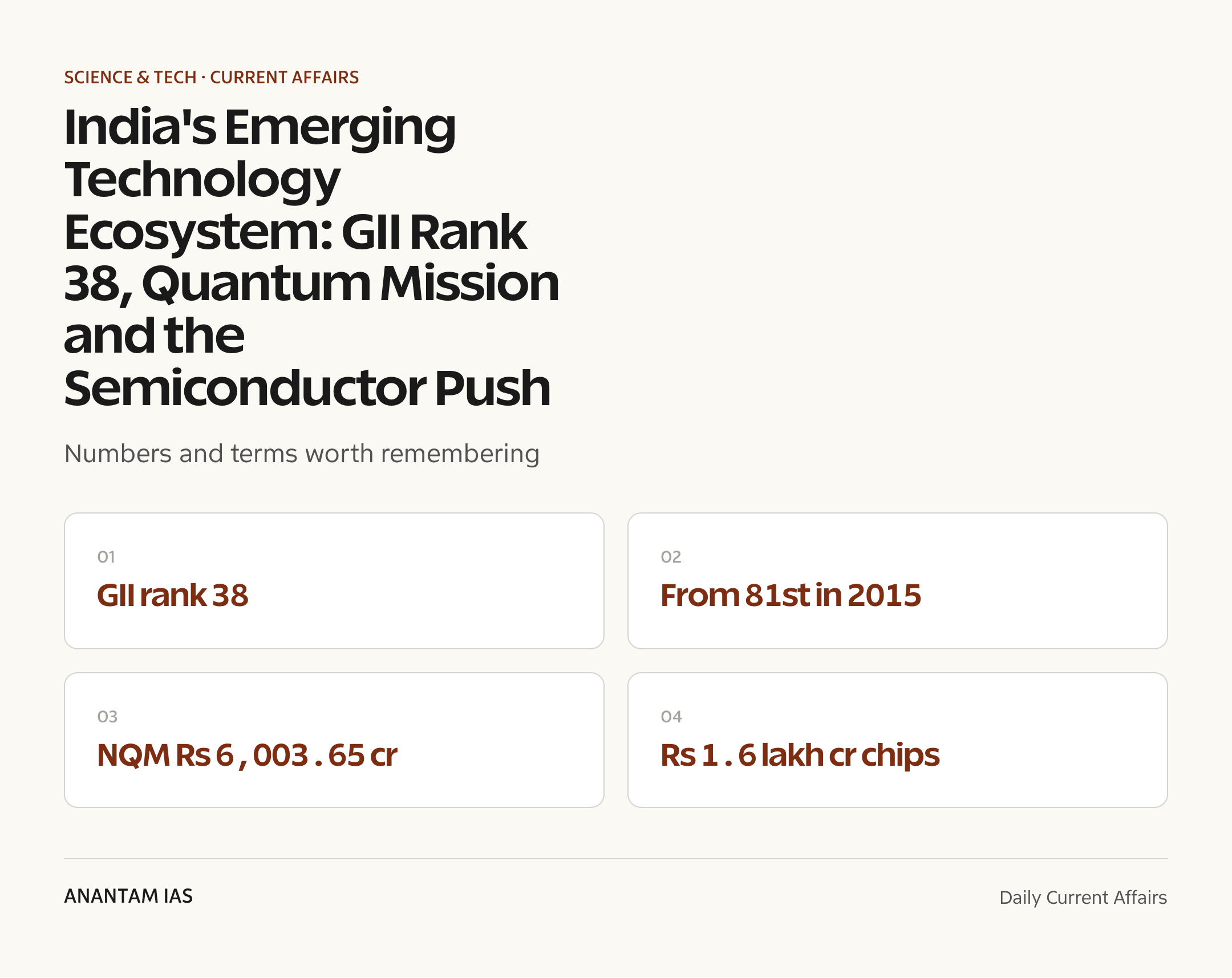
On the World Intellectual Property Organization (WIPO) GII 2025, India ranks 38th — up from 81st in 2015 — and remains an innovation overperformer for the 15th year running. Alongside, the National Quantum Mission carries a Rs 6,003.65 crore outlay and semiconductor investment commitments have crossed Rs 1.6 lakh crore, anchoring the longer-horizon goal of Viksit Bharat 2047.
- India ranks 38th on the WIPO Global Innovation Index 2025, up from 81st in 2015.
- The National Quantum Mission has a Rs 6,003.65 crore outlay for 2023-24 to 2030-31.
- Under Semicon India, investment commitments of about Rs 1.6 lakh crore have been received in three years.
- 10 semiconductor units are approved, including 2 fabs and 8 ATMPs/OSATs; one has begun commercial production.
- Union Budget 2026-27 announced India Semiconductor Mission 2.0 for equipment, materials, design and supply chains.
- DST is funding deep-tech research through the ANRF (Rs 50,000 crore) and a Rs 1 lakh crore RDI Fund.
The development matters in the context of:
- The Global Innovation Index is published annually by WIPO and ranks ~130 economies on innovation inputs and outputs across seven pillars.
- A semiconductor fab manufactures chips; ATMP/OSAT units handle assembly, testing, marking and packaging — the back-end of the chip value chain.
- Quantum technology uses the principles of quantum mechanics for computing, secure communication, sensing and new materials.
- These efforts sit within Atmanirbhar Bharat and the vision of a developed India — Viksit Bharat 2047.
UPSC Relevance
Prelims Relevance
- India ranks 38th in the WIPO Global Innovation Index 2025, a rise from 81st in 2015.
- India tops Central and Southern Asia in the GII and ranks 1st globally in ICT services exports.
- Bengaluru (21st) and Delhi (26th) feature among the world’s top innovation clusters in GII 2025.
- The National Quantum Mission was approved in 2023 with a Rs 6,003.65 crore outlay for 2023-31.
- NQM will set up four Thematic Hubs (T-Hubs) in Quantum Computing, Communication, Sensing & Metrology, and Materials & Devices.
- The Semicon India Programme has attracted about Rs 1.6 lakh crore in investment commitments.
- 10 units are approved under Semicon India — 2 fabs and 8 ATMPs/OSATs.
- The Design Linked Incentive (DLI) Scheme supports design of ICs, chipsets and SoCs.
- India hosts about 7% of the world’s GCCs in the semiconductor domain and ~20% of the global chip-design workforce.
- The Anusandhan National Research Foundation (ANRF) has an outlay of Rs 50,000 crore over five years.
Mains Relevance
GS Paper 3
- How a coordinated innovation policy stack — GII benchmarking, mission-mode programmes and incentives — moves an economy up the technology value chain.
- Semiconductor self-reliance as a strategic objective: fabs, ATMP/OSAT, design (DLI) and talent, and the risks of import dependence.
- The role of quantum technology in computing, secure communication and sensing, and India’s National Quantum Mission as a deep-tech bet.
- Building a research-to-commercialisation pipeline through the ANRF and the RDI Fund for critical technologies.
GS Paper 2
- Government schemes for technology development and the institutional architecture (MeitY, DST, ANRF) behind Viksit Bharat 2047.
- Leveraging global benchmarks such as the GII to shape policy priorities and attract investment.
Essay
- From consumer to producer: India’s climb up the technology ladder
- Innovation as the engine of a developed India by 2047
Background and Context
The Global Innovation Index — India's steady climb
The GII is the most cited global yardstick of innovation capacity, and India’s trajectory on it is striking.
- Published by WIPO, the Global Innovation Index ranks economies on seven pillars spanning innovation inputs and outputs.
- India ranks 38th in GII 2025, a long rise from 81st in 2015.
- India is an innovation overperformer for the 15th consecutive year, beating its income-group peers across all seven pillars.
- It ranks 1st in ICT services exports, performs strongly on late-stage VC deals and intangible-asset intensity, and leads Central and Southern Asia.
- Bengaluru (21st) and Delhi (26th) rank among the world’s top innovation clusters, with Mumbai also in the top 50.
- India still does better on innovation outputs than inputs, pointing to weak domestic R&D spending as the gap to close.
National Quantum Mission — a deep-tech bet
Quantum technology is the next computing frontier, and India has committed serious money to it.
- The National Quantum Mission was approved by the Union Cabinet in 2023 with an outlay of Rs 6,003.65 crore for 2023-24 to 2030-31.
- It will establish four Thematic Hubs (T-Hubs) in leading institutions, each a not-for-profit Section-8 company.
- The four verticals are Quantum Computing, Quantum Communication, Quantum Sensing & Metrology, and Quantum Materials & Devices.
- The mission aims to seed and scale industrial and scientific R&D, develop quantum computers, secure satellite-based communication and high-sensitivity sensors, and build a domestic quantum ecosystem.
- It is implemented by the Department of Science & Technology (DST), placing India among a small group of nations with a dedicated, funded quantum programme.
Semicon India — building the chip ecosystem
The Semicon India Programme is the centrepiece of India’s push to make, not just import, semiconductors.
- Investment commitments of about Rs 1.6 lakh crore have come in within three years of launch.
- 10 units are approved — 2 fabs and 8 ATMPs/OSATs — with one in commercial production and three in pilot production.
- The Design Linked Incentive (DLI) Scheme supports design of ICs, chipsets, SoCs and IP cores; 24 design projects are approved.
- 7 chips have been fabricated from 16 designs taped out, including a 12 nm node at TSMC; Indian engineers now design up to 2 nm chips.
- Union Budget 2026-27 launched India Semiconductor Mission 2.0 for equipment, materials, a design full stack and resilient supply chains.
Talent, GCCs and the design advantage
India’s biggest semiconductor strength today is brains, not fabs.
- India hosts about 7% of the world’s Global Capability Centres (GCCs) in the semiconductor domain.
- It employs nearly 20% of the global semiconductor chip-design workforce.
- 105 fabless chip-design companies have been supported with advanced design infrastructure.
- 315 universities are getting access to advanced EDA tools, and SCL has fabricated and packaged 94 student-designed chips.
- Indian-origin engineers in GCCs contribute to design, verification and development of cutting-edge nodes.
Funding the research-to-market pipeline
Two DST-backed funds are designed to carry ideas from the lab to the market.
- The Anusandhan National Research Foundation (ANRF) has an outlay of Rs 50,000 crore over five years for academic, industry and translational research.
- The Research, Development and Innovation (RDI) Fund carries an allocation of Rs 1 lakh crore for late-stage technology and commercialisation.
- Priority areas include AI, quantum computing, deep tech, robotics, biotechnology, climate and advanced materials.
- Together they target the full innovation pipeline, from knowledge creation to industrial deployment.
- MeitY also funds projects such as the GaN ecosystem initiative (~Rs 334 crore, IISc) and next-generation AMOLED displays (~Rs 42 crore, IIT Madras).
The Viksit Bharat 2047 framing
Each of these programmes feeds a single long-term goal — a technologically self-reliant, developed India.
- The strategy draws on Atmanirbhar Bharat and the slogan Make in India, Make for the World.
- Rising GII rank, a funded quantum mission and a growing chip industry signal a shift from consumer to producer.
- Critical technologies — semiconductors, quantum, AI — are treated as strategic assets, not just commercial ones, with national security and economic resilience in view.
- Sustained R&D funding through ANRF and the RDI Fund aims to reduce import dependence and build resilient domestic supply chains for chips, equipment and materials.
- The cumulative effect is meant to anchor economic ambition for Viksit Bharat 2047.
Way Forward
Deepen the chip value chain
- Move beyond assembly toward front-end fabrication at advanced nodes, materials and equipment under ISM 2.0.
- Convert design strength and GCC talent into Indian IP and domestic product companies.
Sustain research funding and talent
- Ensure ANRF and the RDI Fund deliver timely, predictable support across the lab-to-market pipeline.
- Expand specialised STEM talent in quantum, chip design and AI through university and industry partnerships.
Build resilience and translate rank into outcomes
- Strengthen supply-chain security for critical minerals, equipment and chemicals.
- Use the rising GII position to attract investment while improving weak innovation inputs such as R&D spend.
Conclusion
India’s technology story in 2026 is no longer only about consumption. A 38th-place GII rank, a fully funded National Quantum Mission and over Rs 1.6 lakh crore of semiconductor commitments mark a deliberate shift toward becoming a producer of frontier technology.
The harder task is execution — turning approved fabs into running lines, design talent into Indian IP, and research funds into commercial products. If those gaps close, the building blocks now in place could make deep-tech a genuine engine of Viksit Bharat 2047.
UPSC Practice Questions
Prelims MCQ 1
With reference to India’s emerging technology ecosystem, consider the following statements:
- India ranks 38th in the WIPO Global Innovation Index 2025.
- The National Quantum Mission has an outlay of Rs 6,003.65 crore for the period 2023-31.
- The National Quantum Mission proposes to set up four Thematic Hubs.
How many of the above statements are correct?
Only one Only two All three None
Answer: All three
Explanation:
All three are correct. India ranks 38th in GII 2025 (up from 81st in 2015); the National Quantum Mission, approved in 2023, has a Rs 6,003.65 crore outlay for 2023-24 to 2030-31; and it will establish four Thematic Hubs in Quantum Computing, Communication, Sensing & Metrology, and Materials & Devices.
Prelims MCQ 2
Under India’s Semicon India Programme, the abbreviation ‘ATMP/OSAT’ refers to which stage of the semiconductor value chain?
Front-end wafer fabrication Assembly, testing, marking and packaging Chip design and IP cores Raw silicon and materials supply
Answer: Assembly, testing, marking and packaging
Explanation:
ATMP (Assembly, Testing, Marking and Packaging) and OSAT (Outsourced Semiconductor Assembly and Test) units handle the back-end of the chip value chain — packaging and testing finished wafers — as distinct from front-end fabrication (fabs) and chip design (supported under the DLI Scheme).
UPSC Mains Questions
- India’s recent rise in the Global Innovation Index reflects a coordinated policy effort rather than a single reform. Examine the roles of the National Quantum Mission, the Semicon India Programme and dedicated research funds in this transition. (250 words)
- Semiconductor self-reliance is now a strategic, not merely commercial, objective for India. Discuss the strengths and gaps in India’s chip ecosystem across fabrication, design and talent. (250 words)
- How can India convert its rising innovation rankings and deep-tech missions into tangible economic outcomes for Viksit Bharat 2047? Suggest a way forward. (150 words)
Sources: PIB (Ministry of Electronics & IT) and WIPO Global Innovation Index 2025.
Frequently Asked Questions
What is India’s rank in the Global Innovation Index 2025?
India ranks 38th in the WIPO Global Innovation Index 2025, a sharp rise from 81st in 2015. It is an innovation overperformer for the 15th consecutive year, leads Central and Southern Asia, and ranks 1st globally in ICT services exports, with Bengaluru and Delhi among the world’s top innovation clusters.
What is the National Quantum Mission and its outlay?
The National Quantum Mission, approved in 2023, is India’s mission-mode programme for quantum technology with an outlay of Rs 6,003.65 crore for 2023-24 to 2030-31. It will set up four Thematic Hubs covering Quantum Computing, Quantum Communication, Quantum Sensing & Metrology, and Quantum Materials & Devices, and is implemented by the Department of Science & Technology.
How much investment has the Semicon India Programme attracted?
Within three years, the Semicon India Programme has drawn investment commitments of about Rs 1.6 lakh crore. Ten units are approved — two fabs and eight ATMPs/OSATs — with one in commercial production and three in pilot production. The Design Linked Incentive Scheme additionally supports chip design.
What is the difference between a fab and an ATMP/OSAT unit?
A fab (fabrication plant) manufactures the actual semiconductor chips on silicon wafers — the front-end and most capital-intensive stage. ATMP (Assembly, Testing, Marking and Packaging) and OSAT (Outsourced Semiconductor Assembly and Test) units handle the back-end: packaging and testing finished chips for use in devices.
What are the ANRF and the RDI Fund?
The Anusandhan National Research Foundation (ANRF) supports academic, industry and translational research with an outlay of Rs 50,000 crore over five years. The Research, Development and Innovation (RDI) Fund, with an allocation of Rs 1 lakh crore, backs late-stage technology development and commercialisation in critical areas such as AI, quantum computing and biotechnology.
How does this ecosystem connect to Viksit Bharat 2047?
Rising innovation rankings, a funded quantum mission and a growing semiconductor industry mark India’s shift from technology consumer to producer. Built on Atmanirbhar Bharat and Make in India, these efforts treat critical technologies as strategic assets and aim to reduce import dependence, anchoring the long-term goal of a developed India by 2047.
Core Sector Growth Slows to 0.5% in May 2026: What the Eight Core Industries Signal
Why in News?
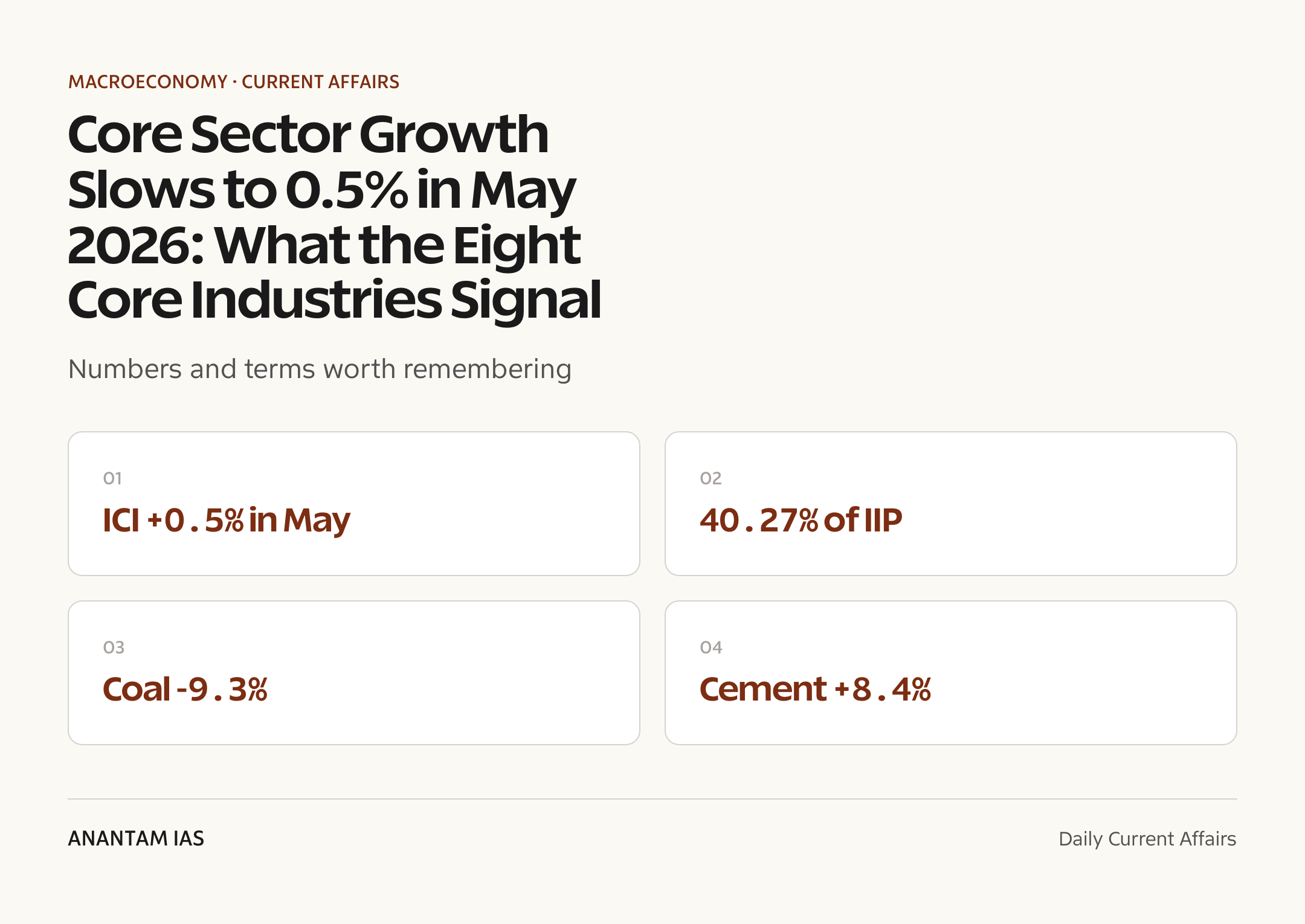
The Index of Eight Core Industries (ICI) grew only 0.5% year-on-year in May 2026, the slowest pace in seven months, according to data released by the Department for Promotion of Industry and Internal Trade (DPIIT). The reading marks a sharp deceleration from the 1.8% recorded in April 2026 and signals weakening industrial momentum at the start of the fiscal year.
The drag came almost entirely from the energy block. Coal, crude oil, natural gas and refinery products all contracted, offsetting strong gains in cement, electricity and steel. Since the ICI accounts for 40.27% of the Index of Industrial Production, the soft print is a leading warning sign for the broader IIP number due later.
- ICI rose 0.5% in May 2026 versus 1.8% in April 2026 — a seven-month low.
- Four of eight sectors contracted: coal (-9.3%), natural gas (-4.9%), refinery products (-8.7%), crude oil (-4.6%).
- Cement (+8.4%), electricity (+8.7%) and steel (+5.0%) were the bright spots.
- Cumulative growth for April-May FY27 stood at 1.1%, matching the year-ago period.
- ICI is a key lead indicator feeding the Index of Industrial Production (IIP).
The development matters in the context of:
- The ICI is compiled and released monthly by the Office of the Economic Adviser, DPIIT, with a roughly six-week lag.
- The current base year for the index is 2011-12 = 100.
- May data typically captures pre-monsoon construction and peak summer power demand, which lifted cement and electricity this year.
UPSC Relevance
Prelims Relevance
- ICI covers eight industries: coal, crude oil, natural gas, refinery products, fertilizers, steel, cement, electricity.
- Combined ICI weight in IIP = 40.27% — the single largest component group.
- Largest individual weight: refinery products (28.04%); smallest: fertilizers (2.63%).
- Base year of both ICI and IIP is currently 2011-12.
- ICI is released by DPIIT (Ministry of Commerce and Industry), not by the RBI or NSO.
- IIP is released by the National Statistical Office (NSO), Ministry of Statistics and Programme Implementation.
- ICI acts as a lead indicator for IIP because it is published earlier.
- Sector weight order: Refinery 28.04 > Electricity 19.85 > Steel 17.92 > Coal 10.33 > Crude Oil 8.98 > Natural Gas 6.88 > Cement 5.37 > Fertilizers 2.63.
- A reading near zero indicates near-flat infrastructure output, not contraction.
Mains Relevance
GS Paper 3
- Use ICI trends to discuss the health of India’s infrastructure and industrial sector and the drivers of industrial growth.
- Energy-block contraction (coal, oil, gas) links to questions on energy security, import dependence and the transition away from fossil fuels.
- Divergence between energy and construction materials illustrates the role of government capital expenditure in sustaining demand for steel and cement.
- Reliance on lead indicators like ICI underscores the importance of timely, credible official statistics for evidence-based policy.
Background and Context
What the Index of Eight Core Industries measures
The ICI tracks the combined and individual production performance of eight foundational industries that supply the rest of the economy.
- Released monthly by the Office of the Economic Adviser, DPIIT, Ministry of Commerce and Industry.
- Current base year is 2011-12 = 100, the same base as the IIP.
- The eight industries are coal, crude oil, natural gas, refinery products, fertilizers, steel, cement and electricity.
- These are upstream sectors — their output feeds construction, manufacturing, transport and power generation across the economy.
The eight industries and their weights
Each industry carries a fixed weight in the index, so a few large sectors dominate the headline number.
- Refinery products — 28.04%: the single largest component.
- Electricity — 19.85% and steel — 17.92%: the next two heavyweights.
- Coal — 10.33%, crude oil — 8.98%, natural gas — 6.88%.
- Cement — 5.37% and fertilizers — 2.63%: the smallest weights.
- Because refinery, electricity and steel together exceed 65% of the index, swings in these three move the headline most.
How ICI feeds the IIP
The core sector is the backbone of the broader industrial production measure, which is why it is watched as an early signal.
- The eight core industries together carry a weight of 40.27% in the Index of Industrial Production (IIP).
- IIP itself is released by the National Statistical Office (NSO) and covers mining, manufacturing and electricity.
- ICI is published roughly two weeks before the IIP, making it a reliable lead indicator of the larger number.
- A weak core print, as in May 2026, often foreshadows a subdued IIP reading for the same month.
What May 2026 data shows
Growth slowed to 0.5%, the weakest in seven months, as the energy block dragged while construction materials held up.
- Contractions: coal -9.3%, refinery products -8.7%, natural gas -4.9%, crude oil -4.6%, and fertilizers -0.9%.
- Expansions: electricity +8.7%, cement +8.4% and steel +5.0%.
- Headline cooled from 1.8% in April 2026 to 0.5% in May 2026.
- Cumulative April-May FY27 growth was 1.1%, level with the same two months a year earlier.
Why the energy block weakened
The contraction in fossil-fuel output reflects both base effects and structural shifts in India’s energy mix.
- Coal output fell as high stockpiles at thermal plants and softer demand reduced fresh mining.
- Crude oil and natural gas continue to face declining yields from ageing domestic fields, keeping India import-dependent.
- Refinery products dipped on maintenance shutdowns and weaker fuel demand growth.
- Strong electricity growth was met increasingly by renewables, easing pressure on coal-fired generation.
Way Forward
Strengthen domestic energy supply
- Arrest the decline in crude oil and natural gas output through enhanced recovery and new exploration under reformed licensing.
- Balance coal rationalisation with reliable thermal supply during peak demand to avoid power stress.
Sustain construction momentum
- Maintain public capital expenditure on roads, housing and railways to keep steel and cement demand firm.
- Crowd in private investment so industrial growth does not rest on government spending alone.
Track ICI alongside other lead indicators (GST collections, PMI, e-way bills) for a fuller read on industrial momentum.
Accelerate the long-pending base-year revision of ICI and IIP to better capture the current economic structure.
Conclusion
A 0.5% core-sector print is not contraction, but it is a clear loss of momentum that warns of a soft IIP reading for May. The split picture — falling energy output against rising cement, steel and power — captures an economy where government-backed construction is doing the heavy lifting while domestic fossil-fuel production keeps shrinking.
For policymakers, the message is twofold: shore up domestic energy supply and keep capital expenditure flowing until private investment broadens the base of industrial growth. For aspirants, the ICI remains a compact, high-yield lens on the real economy and a dependable early signal of where industrial output is headed.
UPSC Practice Questions
Prelims MCQ 1
With reference to the Index of Eight Core Industries (ICI), consider the following statements:
- It is compiled and released monthly by the Reserve Bank of India.
- The eight core industries together account for about 40.27% of the Index of Industrial Production.
- Refinery products carry the largest weight among the eight industries.
How many of the above statements are correct?
Only one Only two All three None
Answer: Only two
Explanation:
Statement 1 is incorrect: the ICI is released by the Office of the Economic Adviser, DPIIT (Ministry of Commerce and Industry), not the RBI. Statement 2 is correct: the eight core industries carry a combined weight of 40.27% in the IIP. Statement 3 is correct: refinery products, at 28.04%, have the largest individual weight.
Prelims MCQ 2
In the Index of Eight Core Industries, which of the following industries carries the smallest weight?
Cement Fertilizers Natural gas Crude oil
Answer: Fertilizers
Explanation:
Fertilizers carry the smallest weight in the ICI at 2.63%, below cement (5.37%), natural gas (6.88%) and crude oil (8.98%). Refinery products carry the largest weight at 28.04%.
UPSC Mains Questions
- The Index of Eight Core Industries is often described as a lead indicator of industrial output. Examine how its composition and weighting shape the signal it sends about the wider economy. (250 words)
- Recent core-sector data show domestic energy production contracting even as construction-linked industries expand. Discuss the implications of this divergence for India’s energy security and industrial strategy. (250 words)
- Timely and credible official statistics are essential for evidence-based economic policy. In this context, evaluate the role of indices such as the ICI and IIP and the case for revising their base year. (150 words)
Sources: Department for Promotion of Industry and Internal Trade (DPIIT), Ministry of Commerce and Industry and Business Today.
Frequently Asked Questions
What is the Index of Eight Core Industries?
The ICI is a monthly index that measures the combined and individual production of eight foundational industries: coal, crude oil, natural gas, refinery products, fertilizers, steel, cement and electricity. It is released by the DPIIT under the Ministry of Commerce and Industry and uses 2011-12 as its base year.
How much did core sector grow in May 2026?
Core sector output grew 0.5% year-on-year in May 2026, the slowest pace in seven months. This was down from 1.8% in April 2026. Coal, crude oil, natural gas and refinery products contracted, while cement, electricity and steel posted strong gains.
What is the weight of the core industries in the IIP?
The eight core industries together account for 40.27% of the Index of Industrial Production, making them the single largest component group. Because of this large share, the ICI is closely watched as an early indicator of the broader IIP, which is released about two weeks later by the NSO.
Which industry has the highest weight in the ICI?
Refinery products carry the highest weight in the ICI at 28.04%, followed by electricity at 19.85% and steel at 17.92%. The smallest weight belongs to fertilizers at 2.63%. This means swings in refinery, electricity and steel output move the headline number the most.
Why did the May 2026 core sector reading slow down?
The slowdown was driven almost entirely by the energy block. Coal fell 9.3%, refinery products 8.7%, natural gas 4.9% and crude oil 4.6%, reflecting high stockpiles, ageing fields and maintenance shutdowns. Strong cement, electricity and steel output partly offset these declines but could not lift the headline.
Who releases the ICI and the IIP?
The ICI is released by the Office of the Economic Adviser, DPIIT, in the Ministry of Commerce and Industry. The IIP is released separately by the National Statistical Office under the Ministry of Statistics and Programme Implementation. Both currently use 2011-12 as the base year.
Source: https://anantamias.com/current-affairs/core-sector-growth-slows-may-2026-eight-industries/
India Becomes the World’s Top Ship Recycling Nation: 35.4% Share and the Hong Kong Convention
Why in News?
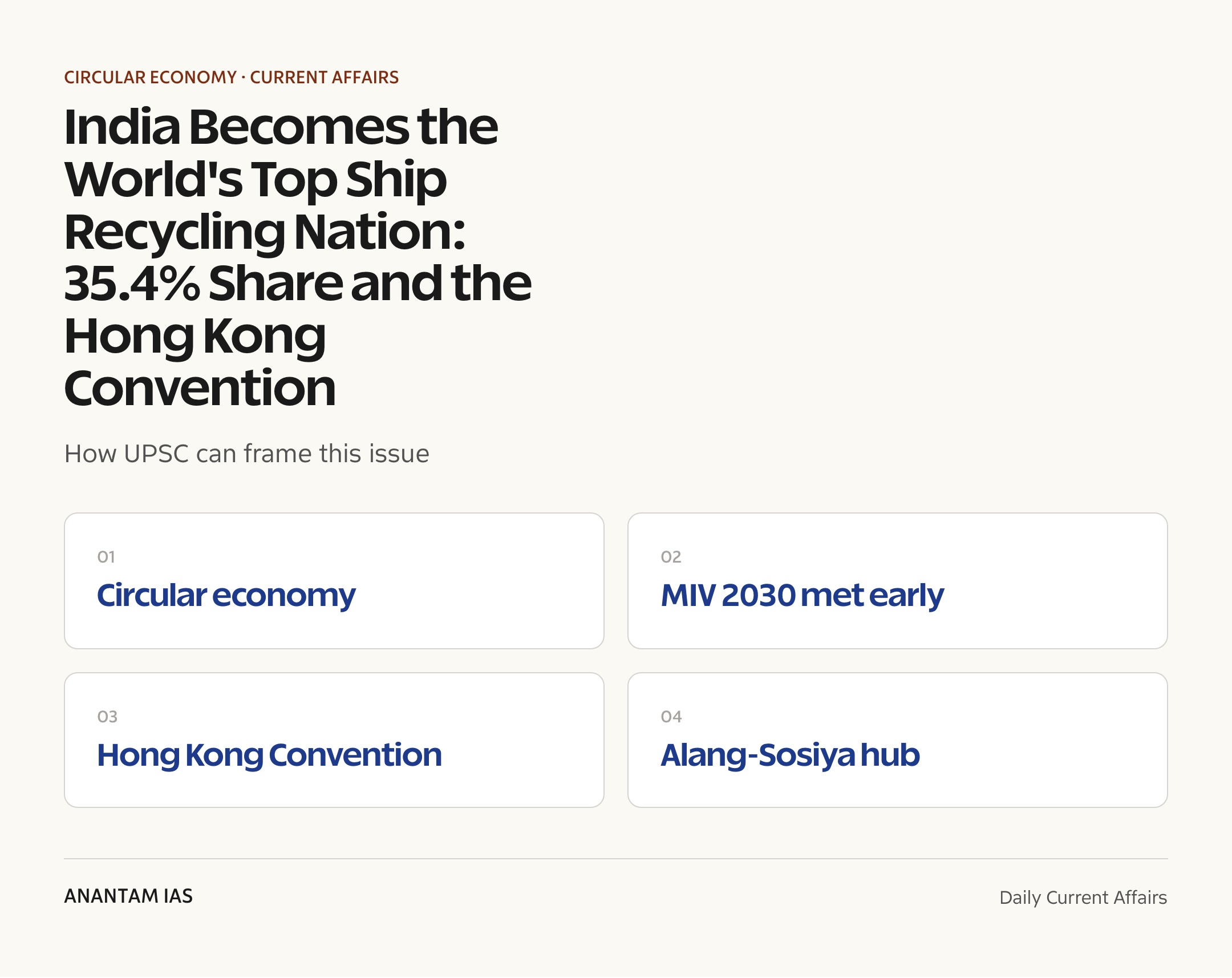
India has emerged as the world’s largest ship recycling nation in 2025, the Ministry of Ports, Shipping & Waterways announced, with its share of the global market climbing to 35.4% from 30.1% a year earlier. The milestone means India has met a key Maritime India Vision 2030 target a full five years ahead of schedule.
The leap rests on a policy stack built over the past few years — the Recycling of Ships Act, 2019, India’s early ratification of the Hong Kong Convention (which entered into force on 26 June 2025), a network of 115 HKC-compliant yards at Alang-Sosiya, and the new Ship-breaking Credit Note Scheme that links green recycling to fresh shipbuilding orders.
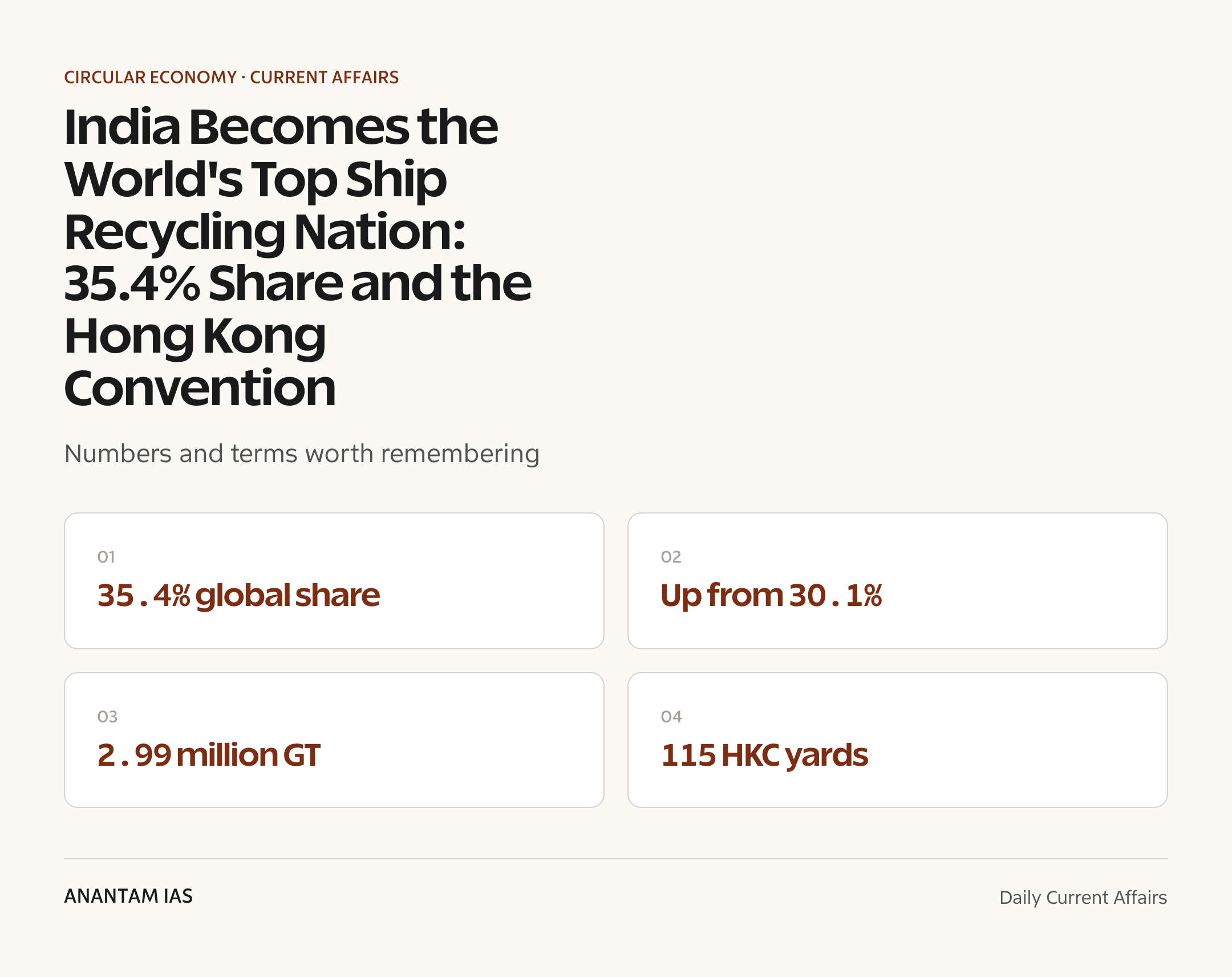
- Global market share rose to 35.4% in 2025, up from 30.1% in 2024 — the highest of any country.
- Recycled tonnage grew nearly 60%, from 1.86 million GT in 2024 to 2.99 million GT in 2025.
- India achieved its Maritime India Vision (MIV) 2030 ship-recycling leadership target five years early.
- Union Minister Sarbananda Sonowal credited the Recycling of Ships Act, HKC compliance and the Credit Note Scheme.
- Rs 53.5 crore in financial assistance has supported yard modernisation; 115 yards are now HKC-compliant.
The development matters in the context of:
- Ship recycling (ship-breaking) is the dismantling of end-of-life vessels to recover steel and reusable equipment — a classic circular-economy activity.
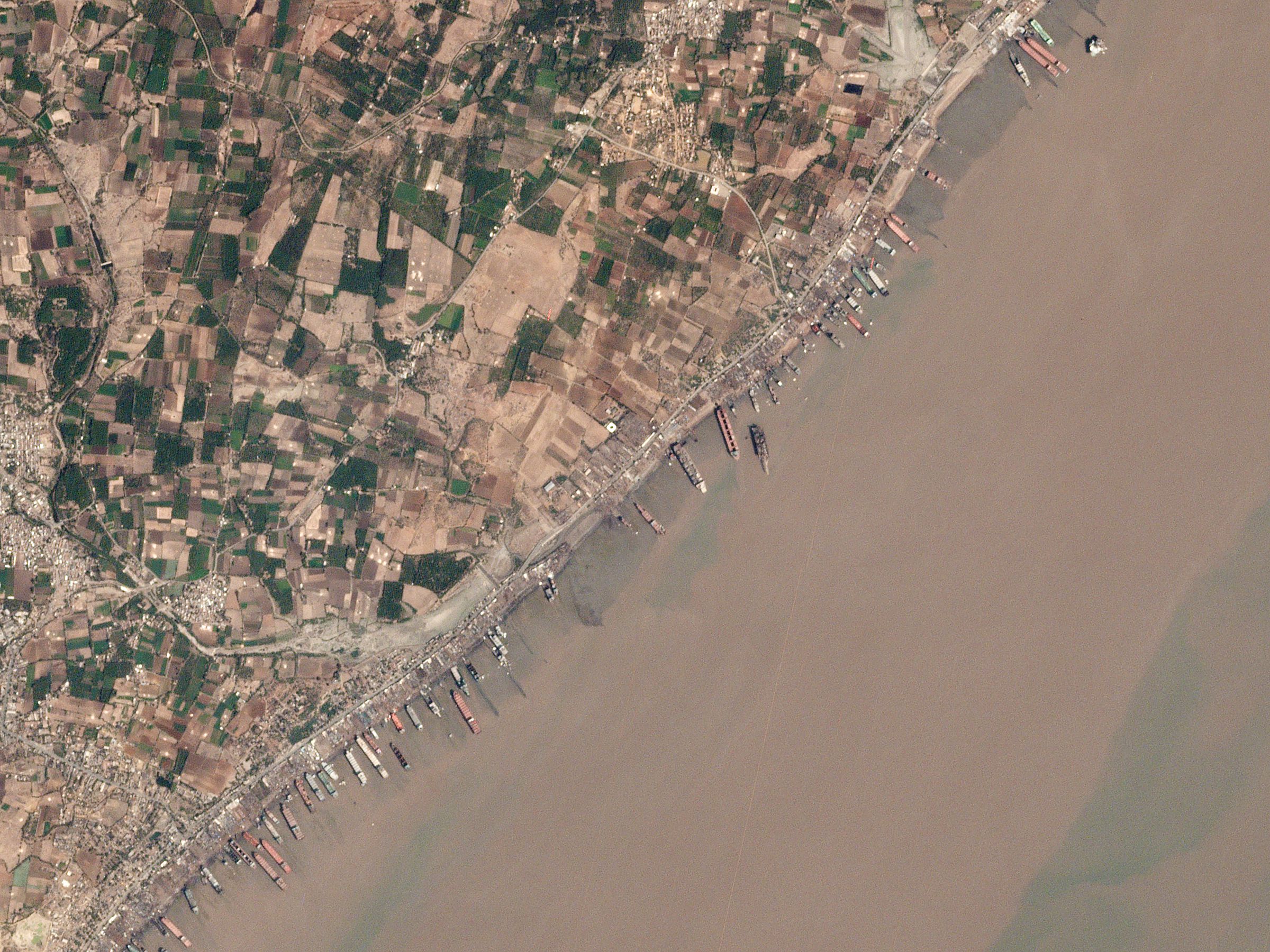
- India competes mainly with Bangladesh, Pakistan and Turkey; the Alang-Sosiya belt in Gujarat is among the largest recycling clusters on earth.
- The sector ties together three syllabus strands: the maritime economy, environmental governance, and India’s role in international conventions.
UPSC Relevance
Prelims Relevance
- India became the world’s top ship-recycling nation in 2025 with a 35.4% global share (up from 30.1% in 2024).
- The achievement met a Maritime India Vision 2030 target five years ahead of schedule.
- The Recycling of Ships Act, 2019 is India’s domestic law governing safe ship recycling.
- India acceded to the Hong Kong International Convention in 2019; the Convention was adopted in 2009 and entered into force on 26 June 2025.
- The HKC requires every ship to carry an Inventory of Hazardous Materials (IHM) and every yard to have a Ship Recycling Facility Plan.
- The Convention enters into force only after ratification by 15 states representing 40% of world merchant shipping tonnage plus a combined recycling-volume threshold.
- Alang-Sosiya in Gujarat is India’s principal ship-recycling hub; 115 yards there are HKC-compliant.
- The Ship-breaking Credit Note Scheme gives owners credit notes worth 40% of a vessel’s scrap value, usable for up to 5% of new-vessel construction cost at Indian yards.
- The administering ministry is the Ministry of Ports, Shipping & Waterways, headed by Sarbananda Sonowal.
- Alang’s capacity is being expanded toward about 9 million LDT (light displacement tonnes).
Mains Relevance
GS Paper 3
- Ship recycling as a model of the circular economy — recovering steel and equipment from end-of-life assets while creating coastal employment.
- Role of targeted policy (Recycling of Ships Act, Credit Note Scheme, yard subsidies) in building a globally competitive maritime manufacturing ecosystem.
- Balancing industrial growth with occupational safety and coastal-pollution control at hubs like Alang.
GS Paper 2
- India’s compliance with the Hong Kong Convention and its leverage in shaping global maritime-environment governance.
- Centre-state coordination (Gujarat) and the use of financial incentives to drive a regulated, green sector.
Essay
- Growth that does not cost the earth: India’s green ship-recycling story
- From scrap to strategy — building a circular maritime economy
Background and Context
What changed in 2025 — the headline numbers
India did not just grow its recycling business; it overtook every rival to lead the world.
- Global share jumped to 35.4% in 2025 from 30.1% in 2024, lifting India to the No. 1 position.
- Volume rose nearly 60% — from 1.86 million GT to 2.99 million GT — in a single year.
- The surge fulfilled a Maritime India Vision 2030 ambition five years early.
- On current share, India recycles an estimated 500-600 vessels a year.
- Global demand is set to climb: industry body BIMCO projects more than 16,000 vessels reaching end-of-life over the next decade, much of which India is positioned to capture.
- The gain is also a quality story — India pulled ahead while moving its yards to internationally certified standards, not by undercutting on safety or environment.
The domestic law — Recycling of Ships Act, 2019
India’s recycling boom sits on a statutory base passed in 2019.
- The Recycling of Ships Act, 2019 created a national framework for the safe and environmentally sound recycling of ships.
- It mandates authorisation of recycling yards and an Inventory of Hazardous Materials for vessels brought in for dismantling.
- The Act effectively domesticated the standards of the Hong Kong Convention ahead of its global entry into force.
- It is administered by the Ministry of Ports, Shipping & Waterways, with the Gujarat Maritime Board a key state regulator at Alang.
The Hong Kong Convention enters into force
The global rulebook for green ship recycling finally became binding in June 2025.
- The Hong Kong International Convention for the Safe and Environmentally Sound Recycling of Ships was adopted under the International Maritime Organization (IMO) on 15 May 2009.
- It entered into force on 26 June 2025, 16 years after adoption, once the ratification thresholds were met.
- Entry into force needed 15 states representing 40% of world merchant shipping tonnage, plus a combined annual recycling-volume threshold.
- Core duties: ships must carry an Inventory of Hazardous Materials (IHM); yards must operate to an approved Ship Recycling Facility Plan and prepare a vessel-specific Ship Recycling Plan.
- It restricts hazardous substances such as asbestos, ozone-depleting substances and certain heavy metals, and requires initial, renewal and final surveys.
Alang-Sosiya — the engine of the sector
Almost all of India’s recycling happens along one stretch of the Gujarat coast.
- The Alang-Sosiya belt in Bhavnagar district, Gujarat, is among the world’s largest ship-recycling clusters.
- 115 yards there are now certified HKC-compliant, a credential that attracts EU-flagged tonnage.
- Government support of Rs 53.5 crore has funded yard modernisation and worker-safety upgrades.
- Capacity is being scaled up toward roughly 9 million LDT to handle rising global demand.
- The cluster recovers large volumes of recyclable steel, feeding domestic re-rolling mills and cutting reliance on virgin ore.
The Ship-breaking Credit Note Scheme
A new incentive closes the loop between recycling old ships and building new ones.
- Under the Ship-breaking Credit Note Scheme, owners who recycle a vessel at an Indian yard get a credit note worth 40% of the vessel’s scrap value.
- The note can be set against up to 5% of the cost of building a new vessel at an Indian shipyard.
- It is designed to retain end-of-life tonnage in India while seeding demand for domestic shipbuilding.
- Read our dedicated explainer: India’s first ship-recycling credit note.
Why it matters strategically
The ranking is more than a statistic; it strengthens several national goals at once.
- Reinforces the circular economy by turning retired vessels into steel, machinery and jobs.
- Advances the Maritime India Vision 2030 and the longer-horizon Amrit Kaal Vision 2047 for the blue economy.
- HKC compliance lets Indian yards bid for high-value, well-regulated European tonnage that once avoided South Asia.
- It anchors a wider push for self-reliant shipbuilding and ship repair under maritime-sector reforms.
- Recovered steel substitutes for imported and virgin material, easing pressure on iron-ore demand and the carbon footprint of fresh steelmaking.
- Generates large-scale coastal employment and downstream trade in re-rollable steel, machinery and ship equipment.
Way Forward
Lock in green credibility
- Sustain HKC compliance across all yards and pursue third-party certification to keep attracting EU-flagged ships.
- Strengthen downstream hazardous-waste handling for asbestos, oils and heavy metals beyond the cutting beach.
Protect workers and the coast
- Make worker safety, training and health monitoring non-negotiable, given the sector’s history of accidents.
- Monitor and remediate intertidal-zone pollution at Alang with independent audits.
Build the full value chain
- Use the Credit Note Scheme to translate recycling leadership into a credible domestic shipbuilding order book.
- Diversify hubs beyond Gujarat and invest in mechanised, less labour-intensive dismantling.
Conclusion
India’s rise to the top of global ship recycling is a rare case of an industrial target met ahead of schedule and on the back of a coherent policy stack — a domestic law, an international convention, certified infrastructure and a clever incentive that links recycling to new orders.
The next test is qualitative, not quantitative. Holding the No. 1 spot will mean proving that 35.4% of the world’s ship recycling can be done safely, cleanly and in a way that feeds India’s wider maritime ambitions rather than scarring its coast.
UPSC Practice Questions
Prelims MCQ 1
With reference to ship recycling in India, consider the following statements:
- India became the world’s largest ship-recycling nation in 2025 with about a 35.4% global share.
- The Recycling of Ships Act was enacted in 2019.
- The Hong Kong International Convention on ship recycling is administered by the World Trade Organization.
How many of the above statements are correct?
Only one Only two All three None
Answer: Only two
Explanation:
Statements 1 and 2 are correct — India led globally in 2025 with a 35.4% share, and the Recycling of Ships Act dates to 2019. Statement 3 is wrong: the Hong Kong Convention is adopted under the International Maritime Organization (IMO), not the WTO.
Prelims MCQ 2
The Ship-breaking Credit Note Scheme allows a shipowner to receive a credit note worth what share of the recycled vessel’s scrap value?
20% 40% 60% 75%
Answer: 40%
Explanation:
Under the scheme, owners recycling a vessel at an Indian yard receive a credit note equal to 40% of the vessel’s scrap value, usable against up to 5% of the cost of building a new ship at an Indian shipyard.
UPSC Mains Questions
- India’s rise to the top of global ship recycling reflects a coherent policy stack rather than a single reform. Examine the roles of the Recycling of Ships Act, 2019, the Hong Kong Convention and the Ship-breaking Credit Note Scheme. (250 words)
- Ship recycling embodies both the promise and the perils of a circular economy. Discuss with reference to the Alang-Sosiya cluster, balancing economic gains against environmental and occupational risks. (250 words)
- How can India convert its leadership in ship recycling into a competitive domestic shipbuilding and ship-repair industry? Suggest a way forward. (150 words)
Sources: DD News (Ministry of Ports, Shipping & Waterways) and Business Standard.
Frequently Asked Questions
What is India’s current share of global ship recycling?
India recycled about 35.4% of the world’s tonnage in 2025, up from 30.1% in 2024, making it the world’s largest ship-recycling nation. Recycled volume rose nearly 60%, from 1.86 million GT to 2.99 million GT, lifting India ahead of competitors such as Bangladesh, Pakistan and Turkey.
What is the Maritime India Vision 2030 link?
Maritime India Vision (MIV) 2030 set targets for the maritime sector, including ship-recycling leadership. By topping the global rankings in 2025, India met that goal five years ahead of the 2030 deadline, signalling rapid progress on its blue-economy roadmap.
When did the Hong Kong Convention enter into force?
The Hong Kong International Convention for the Safe and Environmentally Sound Recycling of Ships was adopted under the IMO in 2009 and entered into force on 26 June 2025, once enough states representing the required share of world tonnage and recycling volume had ratified it.
What does the Hong Kong Convention require?
Ships must carry an Inventory of Hazardous Materials (IHM) listing substances like asbestos and heavy metals, and undergo initial, renewal and final surveys. Recycling yards must operate to an approved Ship Recycling Facility Plan and prepare a vessel-specific Ship Recycling Plan for each ship.
Where does most ship recycling happen in India?
The Alang-Sosiya belt in Bhavnagar district, Gujarat, is India’s principal ship-recycling hub and one of the largest in the world. It now hosts 115 HKC-compliant yards, supported by Rs 53.5 crore in modernisation assistance, with capacity expanding toward about 9 million LDT.
How does the Ship-breaking Credit Note Scheme work?
Owners recycling a vessel at an Indian yard receive a credit note worth 40% of its scrap value. The note can be set against up to 5% of the cost of building a new vessel at an Indian shipyard, encouraging owners to recycle in India and place fresh shipbuilding orders domestically.
Source: https://anantamias.com/current-affairs/india-top-ship-recycling-nation-2025-hong-kong-convention/
Net FDI Quadruples to $6.6 Billion in April 2026: Reading the RBI’s Inflow Data
Why in News?
The Reserve Bank of India’s monthly data, captured in the RBI Bulletin’s “State of the Economy” article, showed net foreign direct investment (FDI) jumping more than fourfold to $6.58 billion in April 2026, against a far weaker year-ago figure. The surge was driven by a rebound in equity inflows and lower repatriation by foreign investors, even as the wider economy showed signs of an industrial slowdown.
The headline matters because net FDI had stayed unusually thin through much of 2025-26 despite record gross inflows. April’s reading offers an early, tentative counterweight, though the gap between gross and net FDI remains the central story for India’s capital account and balance of payments.
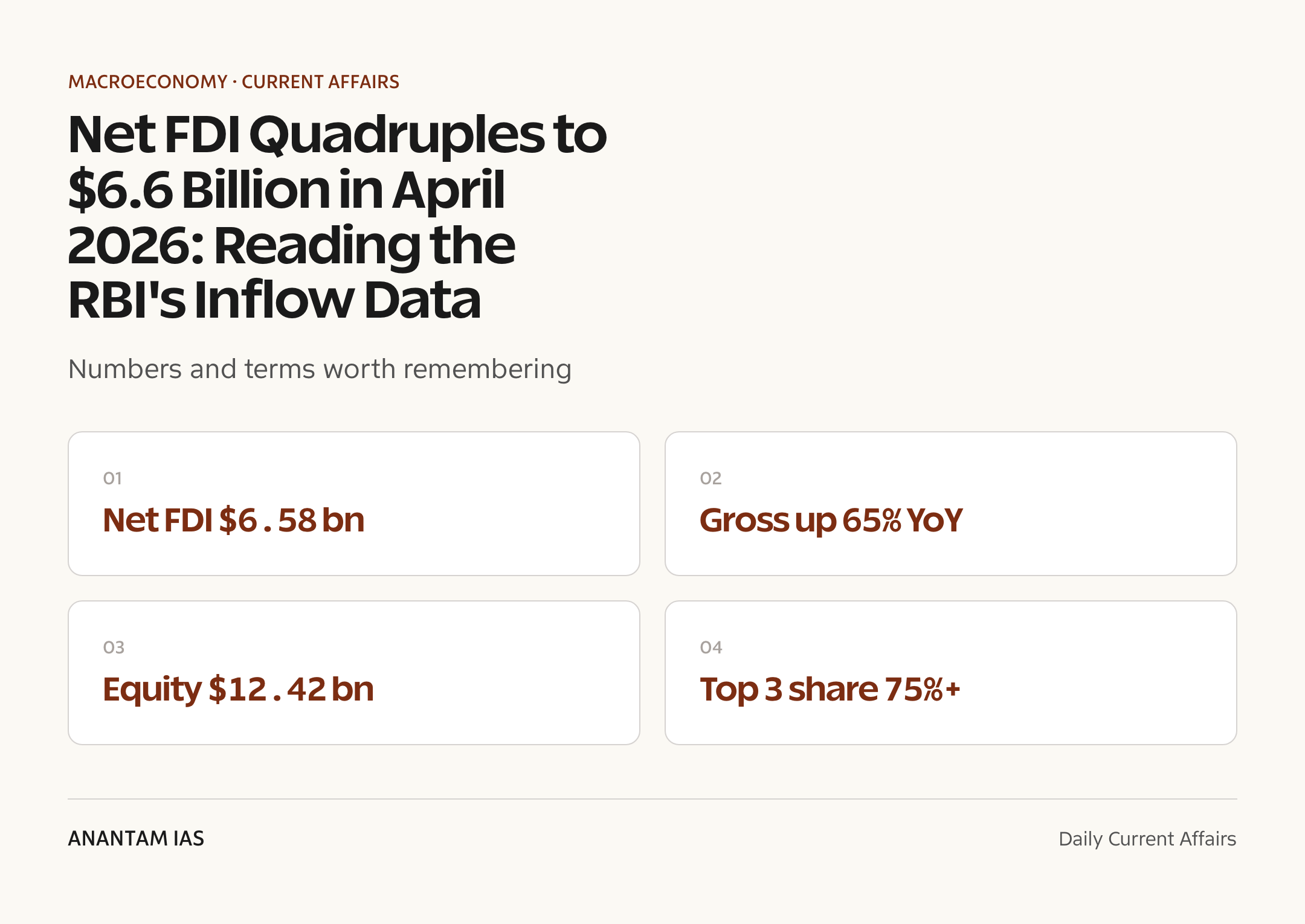
- Net FDI rose to $6.58 billion in April 2026, more than four times the year-earlier level.
- Gross FDI inflows grew 65% year-on-year to $15.29 billion.
- Equity inflows, the largest component, climbed to $12.42 billion from $6.82 billion a year earlier and $3.58 billion in March 2026.
- Japan, Singapore and Mauritius together supplied more than 75% of the inflows.
- The jump comes against an industrial slowdown, making robust capital inflows a useful cushion for the external account.
The development matters in the context of:
- Net FDI had been depressed for most of 2025-26: gross inflows touched a record near $94.5 billion, yet net FDI was only about $7.65 billion for the full year.
- The squeeze came from elevated repatriation and disinvestment (about $53.6 billion in FY26, a multi-year high) plus rising outward FDI by Indian firms.
- April 2026’s improvement was led by stronger equity inflows and softer repatriation, not a structural break.
UPSC Relevance
Prelims Relevance
- Net FDI = gross FDI inflows minus repatriation/disinvestment by foreign investors minus outward FDI by residents; it is the figure that enters the balance of payments.
- FDI is recorded in the capital account (financial account) of the balance of payments, not the current account.
- FDI vs FPI: FDI involves a lasting management interest (10%+ equity threshold) and is long-term; FPI (Foreign Portfolio Investment) is passive stock/bond exposure and far more volatile.
- Automatic route: no prior government approval needed up to sector caps; Government route: prior approval required, now routed through concerned ministries after FIPB’s abolition.
- FDI inflows are governed under the Foreign Exchange Management Act (FEMA), 1999 and the Non-Debt Instruments Rules.
- Top FDI source jurisdictions for India have historically included Mauritius, Singapore, the US, Netherlands and Japan.
- The RBI Bulletin publishes the monthly “State of the Economy” assessment; full-fiscal FDI is also tracked by DPIIT.
- Press Note 3 (2020) requires government approval for FDI from countries sharing a land border with India.
- Outward FDI flows in April 2026 went largely (about 80%) to the US and the Cayman Islands.
- Among equity inflows, financial services drew the largest share, then retail and wholesale trade, manufacturing and computer services.
Mains Relevance
GS Paper 3
- Explains the divergence between record gross FDI and weak net FDI, and what it signals about investor confidence versus profit-booking.
- Links FDI to balance of payments stability, rupee management and the financing of the current account deficit.
- Frames the policy debate on FDI routes, sector caps and ease of doing business needed to convert inflows into durable capital formation.
- Connects rising outward FDI to the growing global footprint of Indian firms and the maturing of India’s capital account.
Essay
- U
- s
- e
- f
- u
- l
- a
- s
- e
- v
- i
- d
- e
- n
- c
- e
- i
- n
- e
- s
- s
- a
- y
- s
- o
- n
- g
- l
- o
- b
- a
- l
- i
- s
- a
- t
- i
- o
- n
- ,
- s
- e
- l
- f
- –
- r
- e
- l
- i
- a
- n
- c
- e
- v
- e
- r
- s
- u
- s
- o
- p
- e
- n
- c
- a
- p
- i
- t
- a
- l
- f
- l
- o
- w
- s
- ,
- o
- r
- w
- h
- e
- t
- h
- e
- r
- f
- o
- r
- e
- i
- g
- n
- c
- a
- p
- i
- t
- a
- l
- s
- u
- b
- s
- t
- i
- t
- u
- t
- e
- s
- f
- o
- r
- o
- r
- c
- o
- m
- p
- l
- e
- m
- e
- n
- t
- s
- d
- o
- m
- e
- s
- t
- i
- c
- i
- n
- v
- e
- s
- t
- m
- e
- n
- t
- .
Background and Context
What net FDI actually measures
The headline number is a net figure, and the arithmetic explains why a record gross year can still produce thin net inflows.
- Net FDI = gross FDI inflows minus repatriation and disinvestment by foreign investors minus outward FDI by Indian residents.
- Gross inflows capture fresh equity, reinvested earnings and intra-company debt coming in; they say nothing about money leaving.
- Repatriation/disinvestment is foreign investors booking profits, selling stakes or exiting; high repatriation drags net FDI down even when gross stays strong.
- Outward FDI is Indian companies investing abroad, which also subtracts from the net figure.
- April 2026 improved on all three legs at once: higher gross equity, lower repatriation, and a more favourable balance against outflows.
The April 2026 numbers in detail
The RBI’s monthly data shows a broad-based rebound led by equity.
- Net FDI: $6.58 billion, more than four times the year-ago level.
- Gross FDI inflows: $15.29 billion, up about 65% year-on-year.
- Equity inflows: $12.42 billion versus $6.82 billion in April 2025 and $3.58 billion in March 2026 — the standout driver.
- Outward FDI: $4.82 billion, up from $2.56 billion the previous month and $3.39 billion a year earlier.
- The net jump reflects gross inflows outpacing the rise in outflows and softer repatriation.
Where the money came from and went
Source-country and sector concentration tells the qualitative story behind the totals.
- Japan, Singapore and Mauritius together accounted for more than 75% of inflows.
- Singapore and Mauritius dominate partly for treaty and routing reasons; Japan reflects genuine strategic capital.
- Financial services drew the largest equity share, followed by retail and wholesale trade, manufacturing and computer services — the top four together over 80% of inflows.
- On the outward side, roughly 80% of flows went to the US and Cayman Islands, with financial, insurance and business services plus manufacturing making up over 90%.
FDI versus FPI: a distinction that matters
Both are foreign capital, but they behave very differently and sit in different policy boxes.
- FDI implies a lasting interest and management influence; the international threshold is a 10% equity stake.
- FPI is passive exposure to listed stocks and bonds, easily reversible and far more volatile — often called “hot money”.
- FDI is generally seen as stickier and growth-enhancing because it brings technology, jobs and managerial capacity.
- Both flow through the capital account, but their stability profiles differ, which shapes how the RBI reads external-sector risk.
The routes and the legal framework
How FDI enters India is governed by a route system and FEMA.
- Automatic route: investment up to sector caps needs no prior government nod, only post-facto RBI reporting.
- Government route: prior approval required, now handled by the relevant administrative ministry after the FIPB was abolished in 2017.
- The overarching law is FEMA, 1999, with the Non-Debt Instruments Rules specifying caps and conditions.
- Press Note 3 (2020) mandates government approval for FDI from land-bordering countries, a key strategic safeguard.
Why net FDI stayed weak through 2025-26
The full-year picture frames why one strong month is encouraging but not conclusive.
- Gross FDI hit a record near $94.5 billion in 2025-26, yet net FDI was only about $7.65 billion.
- Repatriation and disinvestment of roughly $53.6 billion — a multi-year high — was the main drag.
- Rising outward FDI by Indian firms reflects their globalisation but also subtracts from net inflows.
- A single robust month like April does not reverse the structural trend; sustained equity inflows and steadier repatriation would be needed.
Way Forward
Read net FDI alongside gross inflows and repatriation, since the gap, not the headline, drives balance-of-payments stress.
Policy attention should focus on converting strong gross inflows into durable capital formation through stable rules, faster approvals and predictable taxation.
Deepening domestic markets and improving ease of doing business can reduce the incentive for early profit-booking and exits.
Monitoring source-country concentration matters, since heavy reliance on a few jurisdictions raises routing and resilience concerns.
Conclusion
April 2026’s fourfold jump in net FDI is a welcome signal, especially as a counterweight to a softening industrial cycle. The rebound in equity inflows and the cooling of repatriation suggest foreign investors are, at least for now, more willing to commit fresh capital and less eager to exit.
The deeper test is durability. With full-year net FDI thin despite record gross inflows, the real measure of health is whether India can keep the wide gross-net gap from reopening. For exam purposes, the durable lesson is the arithmetic itself: net FDI is what the balance of payments sees, and it lives or dies on repatriation and outward flows as much as on fresh money coming in.
UPSC Practice Questions
Prelims MCQ 1
With reference to net foreign direct investment (FDI) as reported by the RBI, consider the following statements:
- Net FDI is calculated as gross FDI inflows minus repatriation/disinvestment by foreign investors and outward FDI by residents.
- FDI transactions are recorded in the current account of India’s balance of payments.
- A record level of gross FDI inflows necessarily implies a record level of net FDI.
1 only 1 and 2 only 2 and 3 only 1, 2 and 3
Answer: 1 only
Explanation:
Statement 1 is the correct definition of net FDI. Statement 2 is wrong — FDI is recorded in the capital (financial) account, not the current account. Statement 3 is wrong — high repatriation and outward FDI can keep net FDI low even in a record gross year, as seen in 2025-26.
Prelims MCQ 2
In the RBI’s data for April 2026, which group of countries together accounted for more than 75% of FDI inflows into India?
United States, United Kingdom and Germany Japan, Singapore and Mauritius China, Russia and the UAE Netherlands, France and Switzerland
Answer: Japan, Singapore and Mauritius
Explanation:
Per RBI data for April 2026, Japan, Singapore and Mauritius together supplied over 75% of FDI inflows. Singapore and Mauritius feature heavily for treaty and routing reasons, while Japan reflects strategic investment.
UPSC Mains Questions
- Explain the difference between gross FDI and net FDI. Why did India record thin net FDI in 2025-26 despite near-record gross inflows? (10 marks, 150 words)
- Distinguish between Foreign Direct Investment and Foreign Portfolio Investment, and discuss why the stability of FDI matters for India’s balance of payments. (10 marks, 150 words)
- “Rising outward FDI by Indian firms is both a sign of economic maturity and a drag on net inflows.” Critically examine. (15 marks, 250 words)
Sources: RBI Bulletin (May 2026, State of the Economy) and Business Standard (reporting RBI data).
Frequently Asked Questions
What is net FDI and how is it different from gross FDI?
Gross FDI is the total fresh foreign direct investment coming into India. Net FDI subtracts repatriation/disinvestment by foreign investors and outward FDI by Indian residents from that gross figure. Net FDI is the number that enters the balance of payments, which is why a record gross year can still show weak net inflows.
How much did net FDI rise in April 2026?
Net FDI rose to about $6.58 billion in April 2026, more than four times the year-ago level, helped by gross inflows climbing 65% to $15.29 billion and lower repatriation by foreign investors.
What is the difference between FDI and FPI?
FDI involves a lasting interest and management influence (the 10% equity threshold) and is long-term and relatively stable. FPI is passive investment in listed stocks and bonds, is easily reversible, and is far more volatile — often called hot money. Both flow through the capital account.
What are the automatic and government routes for FDI?
Under the automatic route, foreign investment up to sector caps needs no prior government approval, only reporting to the RBI. Under the government route, prior approval is required, now handled by the relevant ministry after the abolition of the Foreign Investment Promotion Board in 2017. FDI is governed by FEMA, 1999.
Why was India’s net FDI so low in 2025-26 despite record gross inflows?
Gross FDI touched a record near $94.5 billion in 2025-26, but net FDI was only about $7.65 billion. The main reasons were very high repatriation and disinvestment (about $53.6 billion) by foreign investors booking profits and exiting, plus rising outward FDI by Indian companies.
Which sectors and countries dominated April 2026’s FDI?
Japan, Singapore and Mauritius together supplied over 75% of inflows. By sector, financial services drew the largest equity share, followed by retail and wholesale trade, manufacturing and computer services, with the top four accounting for over 80% of inflows.
Source: https://anantamias.com/current-affairs/net-fdi-surge-april-2026-rbi-data/
BrahMos and Akashteer for the UAE: India’s Pivot from Defence Buyer to Exporter
Why in News?
India and the UAE are reportedly in talks over the potential sale of key Indian defence platforms, led by the BrahMos supersonic cruise missile and possibly the Akashteer air-defence control network. StratNews Global, citing four Indian sources and Reuters inputs, reports that Abu Dhabi is shopping for arms after being heavily struck during the recent Middle East conflict and wants to harden its ability to protect the Strait of Hormuz, a vital energy chokepoint. The discussions are described as being at an initial stage but moving fast.
The story matters far beyond one deal. It tracks India’s transformation from the world’s largest arms importer into a credible exporter under Atmanirbhar Bharat. The same report notes that any BrahMos sale would first need Russia’s nod, since the missile is a joint India-Russia venture — a clean illustration of how co-development shapes export sovereignty. If concluded, the UAE would become the first Gulf buyer of BrahMos, opening a new regional market for Indian arms in a part of the world long dominated by American, French and Italian suppliers. For aspirants, the episode bundles defence indigenisation, missile-control regimes, West Asia diplomacy and energy security into a single, exam-ready case.
- India is reportedly in talks to sell the BrahMos supersonic cruise missile to the UAE, with the Akashteer air-defence network also discussed.
- Trigger: the UAE is rebuilding its defences after being struck during the recent Middle East war and wants to secure the Strait of Hormuz.
- A BrahMos sale would require Russia’s approval, as the missile is a joint India-Russia development; sources say Moscow-Abu Dhabi ties make this unlikely to be a hurdle.
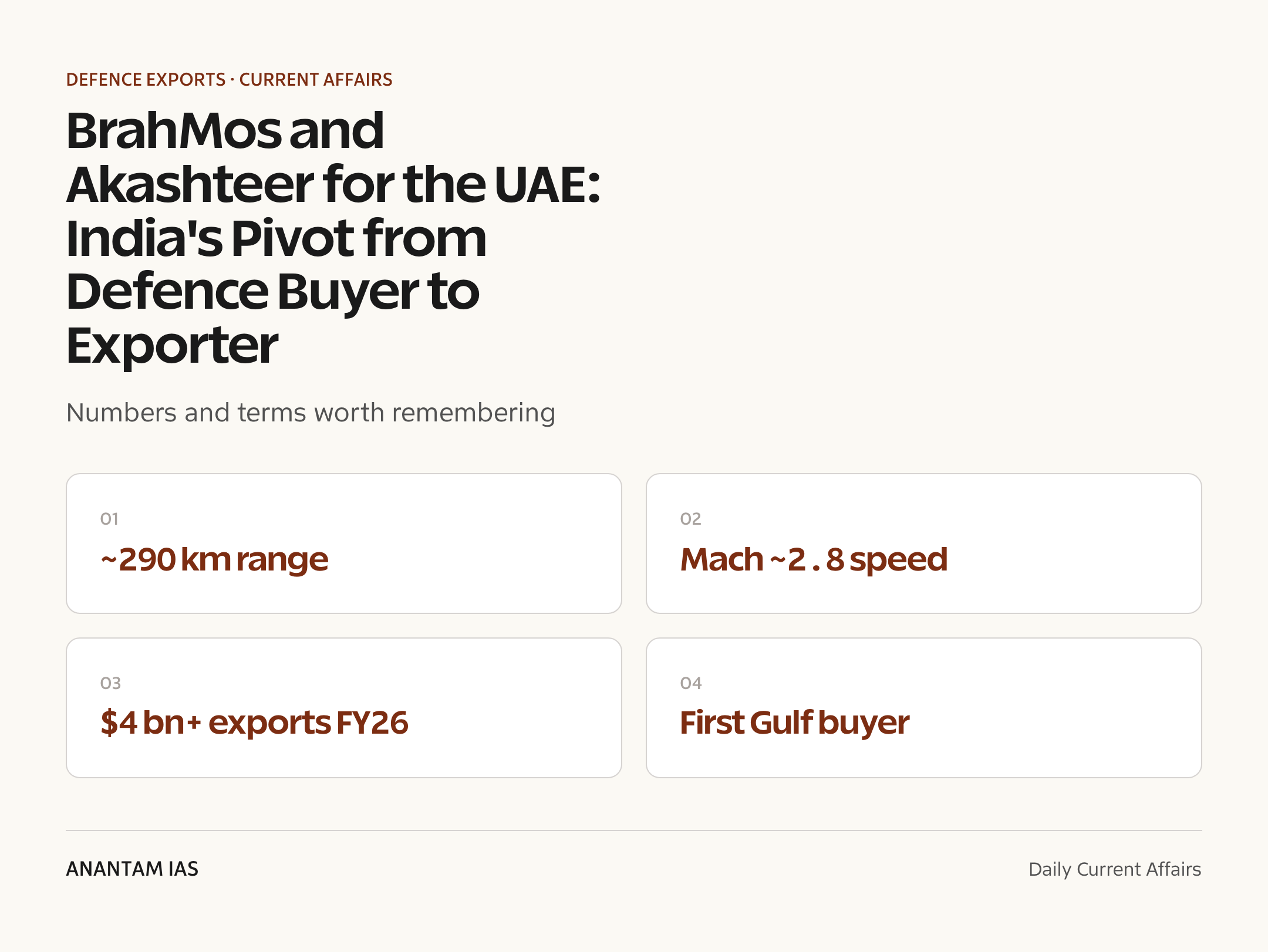
- If finalised, the UAE would be the first Gulf buyer of BrahMos; the only completed export so far is the Philippines (2022).
- The talks sit against India’s defence exports crossing over $4 billion in the year ending March 2026.
The development matters in the context of:
- Treat the deal as reported and in talks, not signed — figures and platforms are drawn from media sourcing, not an official Indian contract announcement.
- Earlier reporting flagged BrahMos sale deals or interest involving Vietnam and Indonesia, plus expressions of interest from Thailand, South Africa, Brazil and Chile.
UPSC Relevance
Prelims Relevance
- BrahMos is a joint venture between India’s DRDO and Russia’s NPO Mashinostroyeniya; the name fuses the Brahmaputra and Moskva rivers.
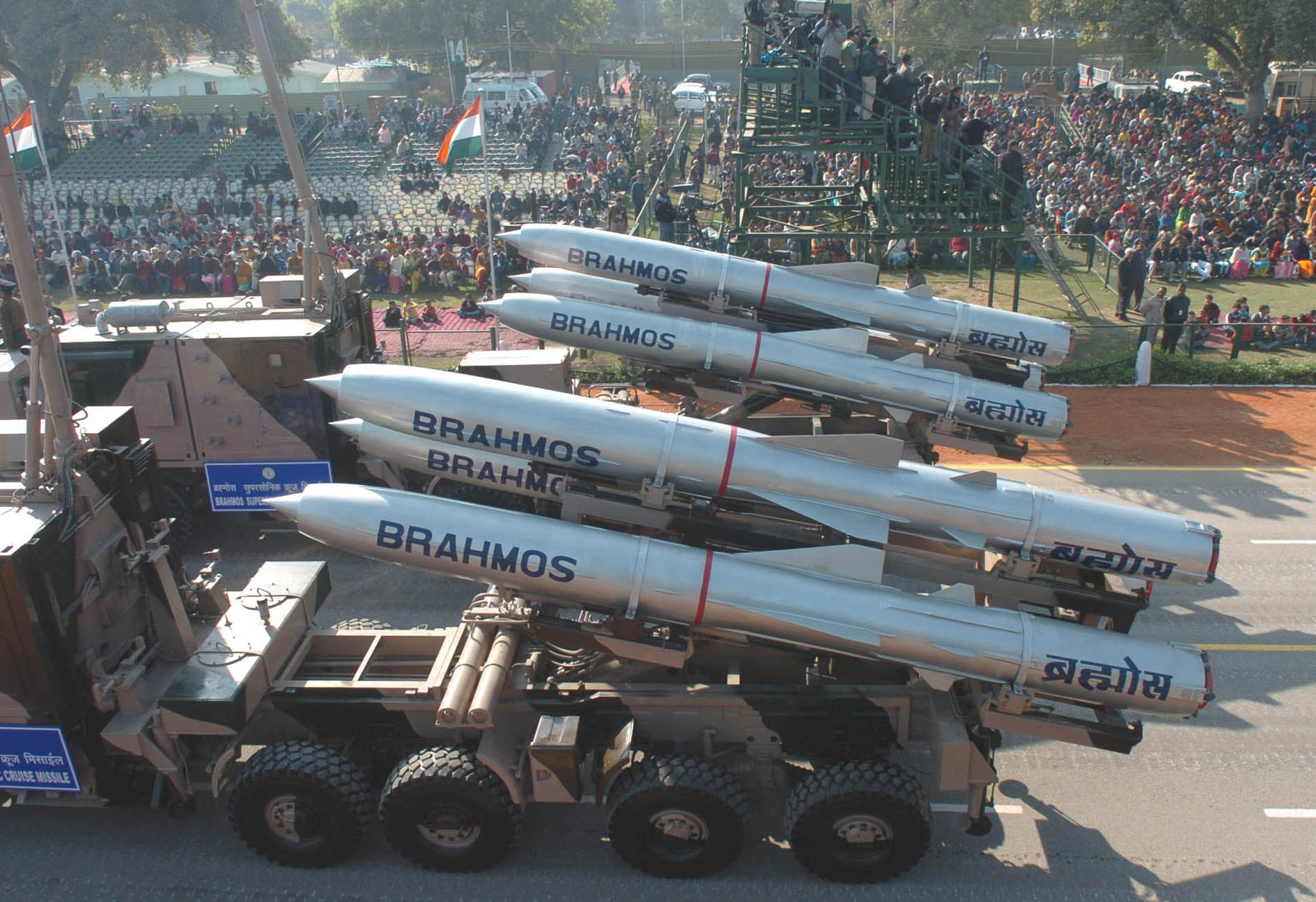
- BrahMos is a supersonic cruise missile cruising at roughly Mach 2.8, with the standard export variant ranged at about 290 km; extended-range variants reach farther for domestic use.
- BrahMos can be launched from land, sea and air platforms (mobile launchers, warships, and the Su-30MKI fighter).
- The Missile Technology Control Regime (MTCR) capped jointly-built missile exports at ~290 km; India’s 2016 MTCR membership enabled longer-range development.
- Akashteer is an automated air-defence control and reporting system built by Bharat Electronics Ltd (BEL) with the Indian Army, integrating radar and sensor data into a common air picture.
- India’s defence exports reached over $4 billion (year ending March 2026), up from about $7.26 million in 2013-14, per the Indian government.
- The Philippines became the first foreign BrahMos buyer in 2022 (a shore-based anti-ship variant for its Marine Corps).
- India and the UAE signed a CEPA (Comprehensive Economic Partnership Agreement) that entered into force in 2022, anchoring the broader strategic partnership.
Mains Relevance
GS Paper 3
- Use as a live case for Atmanirbhar Bharat in defence: the shift from import-dependence to export capability, and the role of DRDO-BEL-private sector.
- Discuss defence indigenisation targets and how export orders sustain the domestic industrial base and R&D.
- Analyse technology-sovereignty constraints: co-developed platforms like BrahMos require partner (Russia) clearance, limiting autonomous export decisions.
- Link to internal and external security economics — export revenue, jobs and strategic leverage from arms diplomacy.
GS Paper 2
- Frame as defence diplomacy deepening the India-UAE strategic partnership and India’s West Asia outreach.
- Examine the balancing act with Russia (co-development) while courting Gulf partners aligned with the West.
- Connect to energy security — a stable Gulf and a protected Strait of Hormuz serve India’s import lifeline.
- Position India as a net security provider in the wider Indian Ocean and West Asian neighbourhood.
Essay
- Self-reliance themes: “From buyer to builder — the economics of strategic autonomy.”
- Arms trade and ethics: the responsibilities that accompany a rising defence exporter.
Background and Context
BrahMos: the flagship export platform
BrahMos is the showpiece of India’s missile diplomacy — fast, accurate, and battle-marketed.
- A joint venture of India’s DRDO and Russia’s NPO Mashinostroyeniya, named after the Brahmaputra and Moskva rivers.
- A supersonic cruise missile flying at around Mach 2.8, far faster than subsonic rivals like the Tomahawk, which compresses an adversary’s reaction time.
- Standard export range is about 290 km; it is a true land-sea-air weapon fired from mobile launchers, ships and the Su-30MKI.
- Its precision and speed make it a credible anti-ship and land-attack deterrent for coastal states.
Akashteer: the silent force-multiplier
If BrahMos is the sword, Akashteer is the nervous system that decides when to strike.
- An automated air-defence control and reporting system developed by BEL with the Indian Army.
- It fuses inputs from radars and sensors into a single, real-time air picture, helping commanders track and engage aerial threats faster and with fewer errors.
- Defence experts cited in the reporting note it would knit together information from other devices to counter incoming threats.
- The UAE already fields U.S. THAAD and Patriot systems and the MGM-168 ATACMS; an integrating command-and-control layer like Akashteer is the missing glue across them.
- Such a layer raises the value of any missile sale, since speed of decision often matters more than the number of interceptors.
MTCR and the range question
Export range is set as much by treaty as by engineering.
- The MTCR is a voluntary regime restricting transfer of missiles capable of carrying a 500 kg payload beyond 300 km.
- That logic kept the jointly-built BrahMos export variant pegged near 290 km.
- India’s 2016 entry into the MTCR opened the path to extended-range BrahMos versions for its own forces.
- Export customers typically receive the treaty-compliant range, keeping deals diplomatically clean.
India's defence-export drive
The numbers tell a steep, deliberate climb.
- Defence exports crossed over $4 billion in the year ending March 2026, up from about $7.26 million in 2013-14.
- Government targets an exports run-rate of roughly Rs 50,000 crore by 2029, part of the wider self-reliance push.
- The Philippines (2022) remains the only completed BrahMos export; reporting cites further BrahMos interest from several states.
- Export orders give DRDO, BEL and private firms the scale and revenue to fund the next generation of systems.
The Russia-approval nuance
Co-development is a strength and a leash at once.
- Because BrahMos is jointly developed, any sale needs Russia’s clearance — a limit on India’s independent export decisions.
- One source quoted by StratNews said Moscow’s close ties with Abu Dhabi make approval unlikely to be a hurdle.
- The episode underlines why India is pursuing fully indigenous systems where export freedom is total.
- It is a textbook example of how technology partnerships shape strategic autonomy.
India-UAE: a thickening partnership
Defence talk sits atop years of trade, energy and tech deals.
- A CEPA in force since 2022 has lifted bilateral trade and investment sharply.
- The two sides have a pact to jointly develop military hardware, signalling intent beyond one-off purchases.
- The UAE’s wider arms diversification includes a reported $35 billion+ defence-cooperation MoU with South Korea.
- A protected Strait of Hormuz serves both Abu Dhabi’s exports and India’s energy security.
Way Forward
Convert interest into orders by offering full-package solutions — missiles plus the Akashteer command layer, training and lifecycle support — rather than standalone hardware.
Deepen indigenous content so future flagship systems carry no third-country veto, widening India’s export freedom.
Pair sales with maintenance, ToT and co-production offers to build durable strategic relationships, as with the India-UAE hardware pact.
Keep exports MTCR-compliant and end-use safeguarded to protect India’s standing as a responsible supplier.
Conclusion
The reported BrahMos and Akashteer talks with the UAE capture a larger story: India is graduating from the world’s biggest arms importer toward a maker and seller of high-end systems. A first Gulf customer would be a marquee win for Atmanirbhar Bharat and for arms diplomacy in West Asia.
The caveats matter. The deal is in talks, not signed, and the Russia-approval clause is a reminder that co-development trades some export sovereignty for shared cost and capability. For aspirants, the case ties together defence indigenisation, MTCR, energy security and India’s role as a net security provider — a rich, multi-paper anchor.
UPSC Practice Questions
Prelims MCQ 1
With reference to the BrahMos missile, consider the following statements: 1. It is a supersonic cruise missile jointly developed by India and Russia. 2. Its standard export variant has a range of about 290 km. 3. It can be launched only from naval platforms. Which of the statements given above are correct?
1 and 2 only 2 and 3 only 1 and 3 only 1, 2 and 3
Answer: 1 and 2 only
Explanation:
BrahMos is an India-Russia supersonic cruise missile with a ~290 km export range. It is a land-sea-air weapon, fired from mobile launchers, ships and the Su-30MKI — not only from ships, so statement 3 is wrong.
Prelims MCQ 2
Consider the following statements about India’s defence cooperation: 1. Akashteer is an automated air-defence control and reporting system associated with Bharat Electronics Ltd. 2. The Philippines was the first foreign country to buy the BrahMos missile. 3. India joined the Missile Technology Control Regime (MTCR) in 2016. Which of the statements given above are correct?
1 and 2 only 2 and 3 only 1 and 3 only 1, 2 and 3
Answer: 1, 2 and 3
Explanation:
Akashteer is a BEL-Army automated air-defence control system; the Philippines became the first BrahMos export customer in 2022; and India joined the MTCR in 2016, enabling extended-range development. All three are correct.
UPSC Mains Questions
- India’s defence exports have surged from a few million dollars to over $4 billion in a decade. Examine the drivers of this rise and the structural challenges that could constrain India’s ambition to become a major arms exporter. (250 words)
- “Co-development of strategic platforms enhances capability but can dilute export sovereignty.” Discuss with reference to the BrahMos missile and India’s pursuit of self-reliance in defence. (250 words)
- Defence diplomacy has become a key instrument of India’s West Asia policy. Analyse, with examples, how arms cooperation advances India’s strategic and energy-security interests in the Gulf. (150 words)
Sources: StratNews Global and The New Arab.
Frequently Asked Questions
What is the India-UAE BrahMos news about?
India is reportedly in talks to sell the BrahMos supersonic cruise missile, and possibly the Akashteer air-defence network, to the UAE. The discussions are at an early stage; no contract has been signed.
Why does the UAE want these systems?
The UAE is rebuilding its defences after being struck during the recent Middle East war and wants to better protect the Strait of Hormuz, a vital energy chokepoint. It is sourcing arms from India and others.
Why does a BrahMos sale need Russia’s approval?
BrahMos is jointly developed by India’s DRDO and Russia’s NPO Mashinostroyeniya, so exports require Russia’s clearance. Sources say Moscow’s close ties with Abu Dhabi make approval unlikely to be a hurdle.
What is Akashteer?
Akashteer is a fully automated air-defence control and reporting system built by Bharat Electronics Ltd with the Indian Army. It fuses radar and sensor data into a single real-time air picture to track and counter aerial threats.
Who has bought BrahMos before?
The Philippines (2022) is the only completed export so far. Reporting also points to BrahMos deals or interest involving Vietnam, Indonesia, and other countries. A UAE deal would make it the first Gulf buyer.
How big are India’s defence exports now?
India’s defence exports crossed over $4 billion in the year ending March 2026, up from about $7.26 million in 2013-14, with a target of roughly Rs 50,000 crore by 2029.
Source: https://anantamias.com/current-affairs/brahmos-akashteer-export-talks-uae/
Rakhigarhi Ancient DNA: What Harappan Skeletons Reveal About India’s Ancestry
Why in News?
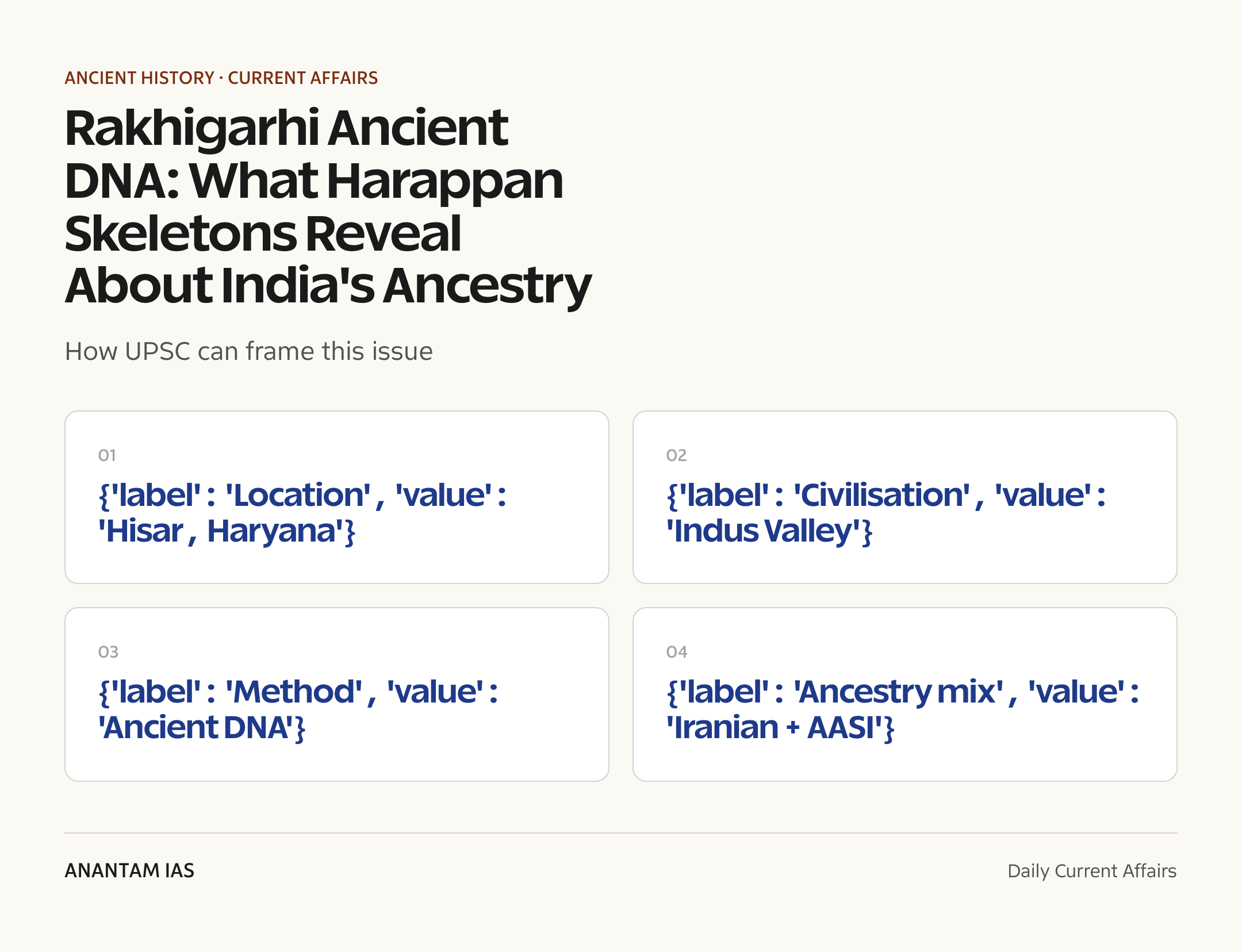
Rakhigarhi, in Hisar district of Haryana, is back in focus as the Archaeological Survey of India (ASI) continues a multidisciplinary study of skeletons recovered from one of the largest Indus Valley Civilisation (IVC) sites — combining excavation, physical anthropology, ancient DNA (aDNA) and facial reconstruction of individuals who lived around 5,000 years ago.
The work revives the long-running Harappan-ancestry and Aryan-migration debate. The landmark 2019 genome study of a single Rakhigarhi individual, published in the journal Cell by Vasant Shinde, David Reich and colleagues, found a mix of Iranian-related ancestry and a deep South-Asian hunter-gatherer lineage, with no Central-Asian Steppe ancestry in the Indus sample.
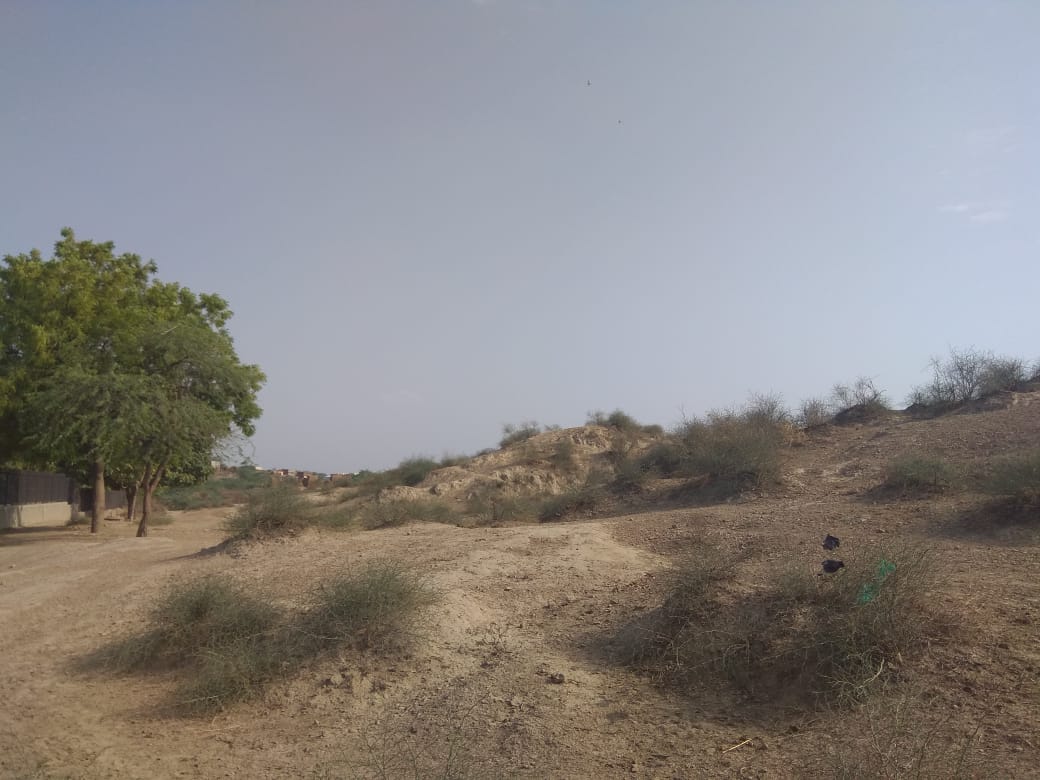
- Rakhigarhi is among the largest IVC sites excavated so far, with eleven mounds (labelled RGR-1 to RGR-11) on the Ghaggar plain of Haryana.
- aDNA stands for ancient DNA — genetic material extracted from skeletal remains, here primarily from the dense petrous (inner-ear) bone, which preserves DNA well.
- The 2019 Cell paper (Shinde et al.) and the companion 2019 Science paper (Narasimhan et al.) together placed the Rakhigarhi genome within a wider study of ancient South and Central Asian populations.
- The Rakhigarhi individual’s ancestry profile is described as the single largest source for present-day South Asians, linking the IVC directly to modern Indian populations.
- ASI excavations resumed at the site from 2021, and facial reconstruction of two individuals has been attempted to visualise Harappan people.
- The findings feed the peopling of India theme — a durable UPSC topic spanning prehistory, the IVC and later migrations.
The development matters in the context of:
- The IVC (c. 2600-1900 BCE for its Mature phase) was one of the world’s earliest urban civilisations, alongside Mesopotamia and Egypt; Rakhigarhi shows pre-Harappan, Early Harappan and Mature Harappan layers.
- The genome studies are based on a very small number of usable ancient samples, so conclusions are framed cautiously by the researchers themselves and remain open to revision as more data emerge.

UPSC Relevance
Prelims Relevance
- Rakhigarhi: IVC site in Hisar district, Haryana; among the largest Harappan sites; eleven mounds (RGR-1 to RGR-11).
- Located on the Ghaggar (Ghaggar-Hakra) plain, often linked in literature with the hypothesised Saraswati river.
- Excavated by ASI under Amarendra Nath (1997-2000) and by Deccan College under Vasant Shinde (2011-2016); ASI work resumed from 2021.
- Other major IVC sites: Harappa, Mohenjo-daro, Dholavira, Lothal, Kalibangan, Banawali, Ropar.
- aDNA: ancient DNA, often extracted from the petrous bone of the skull.
- Shinde et al. (Cell, 2019): single Rakhigarhi genome; Narasimhan et al. (Science, 2019): companion ancient South/Central Asia study.
- Key finding: Iranian-related ancestry + Ancient Ancestral South Indian (AASI / South-Asian hunter-gatherer); no Steppe ancestry in the IVC sample.
- The Iranian-related lineage is argued to have split before the spread of farming in the Fertile Crescent, implying farming was adopted locally or by cultural diffusion, not by mass farmer migration.
Mains Relevance
GS Paper 1
- Indus Valley Civilisation: salient features, town planning, and the value of multidisciplinary archaeology (excavation + aDNA + anthropology).
- Peopling of India and the Aryan-migration debate: how genetic evidence reshapes earlier philological and archaeological arguments.
- Use of science and technology (genomics, facial reconstruction) in reconstructing ancient Indian history, and the limits of small-sample inference.
- Heritage management: conserving and interpreting major sites like Rakhigarhi while balancing local livelihoods and tourism.
Essay
- Science as a lamp on the past: what genomes can and cannot tell us about who we are
Background and Context
Rakhigarhi: One of the Largest Harappan Sites
Rakhigarhi sits in Hisar district, Haryana, roughly 150 km north-west of Delhi on the Ghaggar plain, and ranks among the largest known IVC settlements.
- The site comprises eleven mounds (RGR-1 to RGR-11); estimates of its extent range widely, with some scholars putting the core at 80-100+ hectares and others claiming a much larger spread after later surveys.
- It preserves a long sequence: pre-Harappan, Early Harappan and Mature Harappan phases, making it valuable for studying the civilisation’s origins as well as its peak.
- Excavations span decades: initial digs in the 1960s, an ASI campaign under Amarendra Nath (1997-2000), Deccan College work under Vasant Shinde (2011-2016), and renewed ASI excavation from 2021.
- Finds include planned streets, drainage, kilns, seals, beads and a cemetery — and skeletal remains that became the raw material for the ancient-DNA work.
- Its setting on the Ghaggar-Hakra system is significant, as this seasonal river is often identified in the literature with the hypothesised Saraswati, placing Rakhigarhi within a major cluster of Harappan settlements east of the Indus.
What Ancient DNA Adds
Ancient DNA (aDNA) is genetic material recovered from old skeletal remains; it lets researchers read ancestry directly rather than infer it from pottery, language or skull shape.
- DNA in tropical conditions degrades fast, so usable Rakhigarhi data came mainly from the dense petrous (inner-ear) bone, after screening many samples.
- Only a very small number of individuals yielded enough authentic DNA — the headline 2019 study rests on essentially a single genome, a key caveat.
- aDNA complements traditional archaeology: it tests, rather than assumes, whether cultural change came with people moving or with ideas spreading.
- It also enables facial reconstruction, where forensic modelling on a skull produces an approximate likeness of a long-dead individual for public engagement.
- Authenticating the data is itself demanding: scientists must rule out modern contamination and degraded fragments, which is why so many samples are screened before a usable genome emerges.
The 2019 Genome Findings
The 2019 Cell paper by Shinde, Reich and colleagues, alongside the Science paper led by Narasimhan, described the genetic make-up of the Rakhigarhi individual and its wider implications.
- The Indus individual carried a mix of an Iranian-related lineage and a deep South-Asian hunter-gatherer component (often termed Ancient Ancestral South Indian, AASI).
- Crucially, the sample showed no Steppe (Central-Asian pastoralist) ancestry — the component associated in later periods with the spread of Indo-European languages.
- The Iranian-related ancestry is argued to have diverged early — before farming spread in the Fertile Crescent — suggesting agriculture in South Asia was adopted locally or by cultural transmission, not chiefly by migrating farmers.
- The researchers describe this IVC ancestry as the single largest source for present-day South Asians, tying living Indians to the Harappans.
- The companion Science study placed this single genome in a much larger sample of ancient South and Central Asians, strengthening confidence in the broad ancestry pattern while still resting on limited Indus data.
The Migration-vs-Indigenous Debate
The Rakhigarhi data sit at the centre of a contested question: did later Steppe-related populations migrate into South Asia, and how does that square with an indigenous Harappan core?
- One reading: because the IVC sample lacks Steppe ancestry while many later and modern North Indians carry some, a migration of Steppe-related groups after the IVC’s decline (roughly second millennium BCE) is inferred — a position many geneticists hold.
- An alternative public reading stresses cultural and demographic continuity from the Harappans into later India, citing the absence of Steppe ancestry in the IVC individual itself.
- The careful position: the single Indus genome shows no Steppe ancestry at that time and place; it does not by itself settle the timing, scale or direction of every later movement.
- The debate intertwines genetics with archaeology, linguistics and politics, so claims should be read as evolving science built on still-limited ancient samples.
Why It Matters for the Syllabus
Rakhigarhi is a model case of history meeting hard science, and a recurring touchpoint for the IVC and peopling-of-India themes.
- It demonstrates how genomics can refine, support or challenge older narratives based on pottery styles, skeletal measurements or language.
- It reinforces understanding of the IVC’s geography, including major sites such as Mohenjo-daro, Harappa, Dholavira, Lothal and Kalibangan.
- It illustrates the importance of institutions like the ASI and research universities in protecting and interpreting heritage.
- It models academic humility: strong claims rest on small datasets, and good answers acknowledge uncertainty rather than overstate.
Way Forward
Expand the Genetic Record
- Sequence more individuals from Rakhigarhi and other IVC sites so conclusions rest on populations, not single genomes.
- Build shared, well-documented ancient-DNA datasets with transparent methods to reduce overreach in interpretation.
Protect and Interpret the Site
- Strengthen conservation, site museums and signage at Rakhigarhi while supporting the surrounding villages and responsible tourism.
- Pair excavation with public communication that explains both the findings and their limits, keeping the science separate from polemics.
Conclusion
Rakhigarhi is where India’s deep past is being read at the level of bone and gene. The 2019 genome — an Iranian-related lineage layered over a deep South-Asian hunter-gatherer ancestry, with no Steppe component in the Indus sample — links living Indians directly to the Harappans and reframes how the IVC’s origins are understood.
For the exam, the lesson is twofold: command the durable facts about the IVC and the peopling of India, and treat the migration debate with academic balance. A single ancient genome is a powerful clue, not a final verdict, and the strongest answers respect both the evidence and its limits.
UPSC Practice Questions
Prelims MCQ 1
With reference to the Rakhigarhi archaeological site, consider the following statements: 1. It is located in the Hisar district of Haryana. 2. It is one of the largest sites of the Indus Valley Civilisation. 3. The Archaeological Survey of India is associated with its excavation. Which of the statements given above are correct?
1 and 2 only 2 and 3 only 1 and 3 only 1, 2 and 3
Answer: 1, 2 and 3
Explanation:
Rakhigarhi is in Hisar district, Haryana, ranks among the largest IVC sites, and has been excavated under the ASI (notably by Amarendra Nath, 1997-2000) and by Deccan College under Vasant Shinde, with ASI work resuming from 2021. All three statements are correct.
Prelims MCQ 2
The 2019 ancient-DNA study of the Rakhigarhi individual (Shinde et al., Cell) is best summarised by which of the following?
It found substantial Central-Asian Steppe ancestry in the Indus sample. It found a mix of Iranian-related ancestry and a deep South-Asian hunter-gatherer lineage, with no Steppe ancestry in the sample. It proved that farming reached South Asia through a mass migration of Fertile Crescent farmers. It established that the Indus people had no genetic link to present-day South Asians.
Answer: It found a mix of Iranian-related ancestry and a deep South-Asian hunter-gatherer lineage, with no Steppe ancestry in the sample.
Explanation:
The study reported an Iranian-related lineage combined with an Ancient Ancestral South Indian (South-Asian hunter-gatherer) component and no Steppe ancestry in the Indus individual. It also argued the Iranian-related lineage split before farming spread in the Fertile Crescent, implying local adoption or cultural transmission of agriculture, and described this ancestry as a major source for modern South Asians.
UPSC Mains Questions
- The Rakhigarhi ancient-DNA findings have reshaped the debate on the peopling of India. Examine how genetic evidence complements traditional archaeology, and discuss why such conclusions must be read with academic caution. (250 words)
- Discuss the salient features of the Indus Valley Civilisation with reference to a major site such as Rakhigarhi. How does multidisciplinary research enrich our understanding of early urbanism in the subcontinent? (250 words)
- What does the absence of Steppe ancestry in the Indus genome imply for the Aryan-migration debate? Present a balanced view. (150 words)
Sources: The Indian Express and Cell (Shinde et al., 2019).
Frequently Asked Questions
Where is Rakhigarhi located?
Rakhigarhi is in the Hisar district of Haryana, on the Ghaggar plain about 150 km north-west of Delhi. It is one of the largest sites of the Indus Valley Civilisation, with eleven mounds labelled RGR-1 to RGR-11.
What did the 2019 Rakhigarhi DNA study find?
The study (Shinde et al., published in Cell) found that the Rakhigarhi individual carried a mix of an Iranian-related lineage and a deep South-Asian hunter-gatherer component, with no Central-Asian Steppe ancestry in the Indus sample. It described this ancestry as a major source for present-day South Asians.
What is ancient DNA (aDNA)?
Ancient DNA is genetic material recovered from old skeletal remains. At Rakhigarhi, usable DNA came mainly from the dense petrous (inner-ear) bone, which preserves DNA better than most bones in hot climates.
Does the study settle the Aryan-migration debate?
Not on its own. The single Indus genome shows no Steppe ancestry at that time and place, which many researchers read as evidence that Steppe-related groups arrived after the IVC’s decline. Because the conclusion rests on very few samples, it should be treated as evolving science rather than a final verdict.
Who excavated Rakhigarhi?
The Archaeological Survey of India excavated under Amarendra Nath (1997-2000), and Deccan College excavated under Vasant Shinde (2011-2016). ASI work resumed at the site from 2021.
What is facial reconstruction in this context?
It is a forensic technique that builds an approximate likeness of a person from their skull. Researchers attempted reconstructions of Rakhigarhi individuals to help visualise Harappan people, though such models are interpretive rather than exact portraits.
Source: https://anantamias.com/current-affairs/rakhigarhi-ancient-dna-harappan-ancestry-asi/
One Nation One Subscription (ONOS): Rs 6,000-Crore Push for Research Journal Access
Why in News?
A recent policy commentary carried by The Hindu and analysed by Legacy IAS has revived scrutiny of One Nation One Subscription (ONOS), the centrally funded scheme that pools the country’s subscription budget to buy bulk access to international research journals. The piece argues that ONOS has solved the reading problem for cash-strapped colleges while leaving the deeper publishing problem untouched.
With the scheme now operational for over a year and its first three-year cycle running from 2025 to 2027, the debate has shifted from access to self-reliance — whether India should keep subsidising foreign publishers to read its own publicly funded research, or invest in domestic open-access platforms aligned with NEP 2020 and the Anusandhan National Research Foundation.
- ONOS commits Rs 6,000 crore over three years (2025-2027) to centrally negotiate and fund journal subscriptions for public institutions.
- The scheme covers 30 international publishers and more than 13,000 e-journals, reaching nearly 6,400 institutions.
- An estimated 1.8 crore students, faculty and researchers become eligible beneficiaries.
- Commentary flags continued dependence on commercial publishers and the absence of a transparent post-2027 strategy.
- Critics contrast India’s subscribe-and-read model with global moves toward diamond open access and immediate open-access mandates.
The development matters in the context of:
- Before ONOS, India ran several fragmented consortia (such as e-ShodhSindhu) where individual institutions negotiated separately, leaving smaller colleges with patchy access.
- The Union Cabinet approved ONOS on 25 November 2024; the access portal became functional in January 2025, with publisher agreements and payments finalised by March 2025.
- ONOS is positioned as a flagship deliverable under the research ecosystem reforms envisaged in NEP 2020.
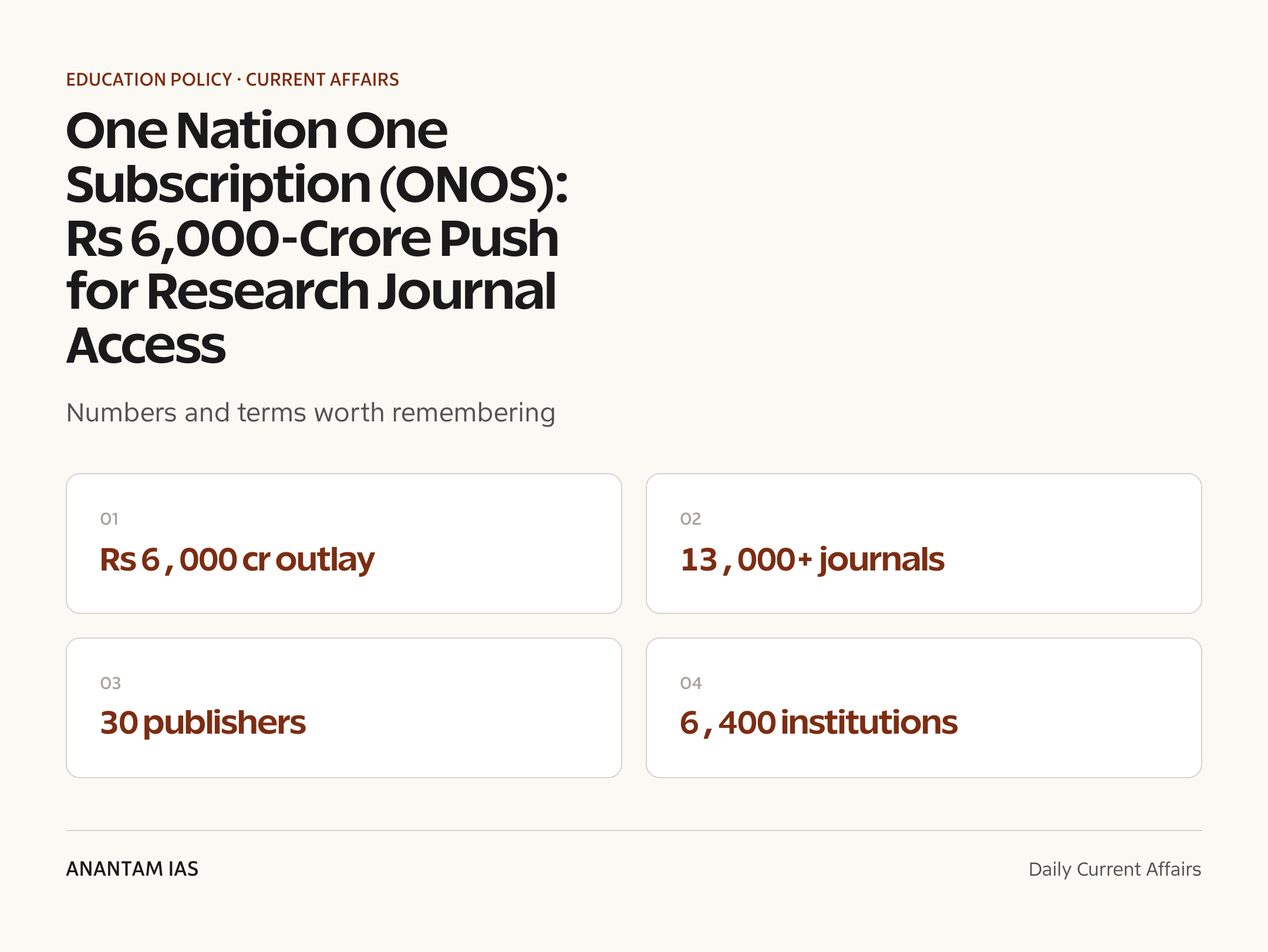
UPSC Relevance
Prelims Relevance
- ONOS is a central-sector scheme of the Department of Higher Education, Ministry of Education.
- The implementing agency is the INFLIBNET Centre, an Inter-University Centre under the University Grants Commission (UGC).
- Total outlay: Rs 6,000 crore for the first cycle, 2025 to 2027.
- Coverage: 30 publishers, over 13,000 journals, and nearly 6,400 government higher-education and central R&D institutions.
- A dedicated fund of Rs 150 crore per year supports Article Processing Charges (APCs) for open-access publishing.
- INFLIBNET is headquartered in Gandhinagar, Gujarat, and also runs Shodhganga (theses repository) and Shodh Shuddhi (anti-plagiarism).
- The Anusandhan National Research Foundation (ANRF), set up under the ANRF Act 2023, is the apex body funding and steering research in India.
- Diamond open access means publication that is free to both read and publish, with no Article Processing Charge.
Mains Relevance
GS Paper 2
- Government policies and interventions for development in the education sector and issues arising from their design and implementation — ONOS as a case study in centralised welfare delivery.
- Role of the state in widening access to knowledge as a public good, and equity between tier-1 and tier-2/tier-3 institutions.
- Centre-state and institutional coordination through a single negotiating agency (INFLIBNET) to achieve scale and bargaining power.
GS Paper 3
- Science and technology developments and their applications — building a self-reliant research and innovation ecosystem.
- Issues of intellectual property, publishing sovereignty, and dependence on foreign commercial platforms for publicly funded research.
Essay
- Knowledge as a public good versus knowledge as a commodity.
- Self-reliance and Atmanirbharta in the digital knowledge economy.
Background and Context
What ONOS Is and How It Is Designed
ONOS replaces fragmented institution-by-institution deals with a single national licence negotiated centrally.
- It is a central-sector scheme fully funded by the Department of Higher Education, with no matching state contribution required.
- The INFLIBNET Centre under UGC negotiates one country-wide agreement with each publisher, giving India far stronger bargaining leverage than scattered libraries.
- Access is delivered through a unified portal with on-campus and remote login, so a researcher in a district college reads the same journals as one in a metro university.
- The first cycle runs 2025 to 2027 with a total commitment of Rs 6,000 crore.
Coverage and Scale
The numbers explain why ONOS is treated as a structural reform rather than a routine subscription.
- 30 major international publishers are on board, including the large commercial houses that dominate scholarly publishing.
- More than 13,000 e-journals are made accessible under one licence.
- Coverage extends to nearly 6,400 institutions — government higher-education bodies and central-government R&D laboratories.
- The eligible reach is roughly 1.8 crore students, faculty and researchers.
The Access Gap It Addresses
The core problem ONOS targets is the unequal reading access that held back research outside elite institutions.
- Premier institutes could afford rich journal bundles; most state universities and tier-2 and tier-3 colleges could not, creating a sharp reading divide.
- Subscription paywalls priced out exactly the students who most needed current literature for projects and dissertations.
- By centralising the spend, ONOS converts uneven institutional budgets into one equitable national entitlement.
- This directly serves the equity and quality goals of NEP 2020 for higher education.
The Open-Access and APC Debate
Critics argue ONOS fixes who can read, not who can afford to publish.
- Much of the content ONOS pays for is already freely available through preprints and open repositories, raising value-for-money questions.
- Indian authors still face steep Article Processing Charges to publish open access; ONOS sets aside Rs 150 crore a year for APCs, but this is modest against demand.
- The commentary contrasts India’s model with diamond open access (free to read and publish) used in parts of Europe, and Australia’s push for immediate open-access mandates.
- The concern is that the scheme subsidises reading without changing the economics that keep publishing expensive for Indian scholars.
Dependence on Commercial Publishers
A single large cheque to global publishers raises a sovereignty question.
- ONOS deepens reliance on a handful of commercial publishers who set prices and control the most-cited titles.
- India effectively keeps paying foreign firms to access research that its own public money funded — a knowledge-sovereignty gap.
- There is limited public clarity on per-publisher pricing and on the negotiating terms.
- No transparent post-2027 strategy has been disclosed, leaving long-run cost escalation an open risk.
Links to NEP 2020 and ANRF
ONOS is one piece of a larger architecture meant to make Indian research globally competitive.
- NEP 2020 calls for a vibrant, equitable research culture; ONOS supplies the reading infrastructure that ambition needs.
- The Anusandhan National Research Foundation (ANRF), created under the ANRF Act 2023, is meant to fund and steer research at scale.
- Analysts urge channelling ANRF resources toward domestic open-access platforms and Indian-run journals rather than only foreign subscriptions.
- Read together, ONOS, NEP 2020 and ANRF form the spine of India’s bid for genuine research self-reliance.
Way Forward
Pair the reading entitlement with a credible open-access publishing path — scale the APC fund and back diamond open-access journals so Indian authors are not priced out.
Publish transparent per-publisher pricing and a disclosed post-2027 roadmap to avoid lock-in and runaway costs.
Use ANRF funding to build and sustain domestic platforms, indexing services and Indian-run journals that reduce dependence on foreign publishers.
Track outcomes — citations, publications and downloads from tier-2 and tier-3 institutions — to confirm the access gain converts into real research output.
Conclusion
ONOS is a genuine equity win: for the first time a college in a small town reads the same journals as a national institute, and the Rs 6,000-crore commitment signals that the government treats research access as a public good worth funding at scale.
The harder test is sovereignty. Unless the reading subsidy is matched by investment in open access and home-grown publishing through ANRF and NEP 2020, India risks paying global publishers indefinitely to read its own knowledge — solving the reading problem while the publishing problem quietly compounds.
UPSC Practice Questions
Prelims MCQ 1
Consider the following statements regarding the One Nation One Subscription (ONOS) scheme: 1. It is implemented by the INFLIBNET Centre, an Inter-University Centre under the University Grants Commission. 2. It is a centrally sponsored scheme requiring an equal matching contribution from state governments. 3. It includes a dedicated annual fund to support Article Processing Charges for open-access publishing. Which of the statements given above is/are correct?
1 and 2 only 1 and 3 only 2 and 3 only 1, 2 and 3
Answer: 1 and 3 only
Explanation:
ONOS is implemented by INFLIBNET under UGC and carries a Rs 150-crore-per-year APC fund, so statements 1 and 3 are correct. It is a central-sector scheme fully funded by the Centre, not a centrally sponsored scheme with state matching, so statement 2 is wrong.
Prelims MCQ 2
With reference to the research and education ecosystem in India, consider the following: 1. Anusandhan National Research Foundation (ANRF) 2. INFLIBNET Centre 3. Shodhganga Which of the above are associated with strengthening access to or funding of research?
1 and 2 only 2 and 3 only 1 and 3 only 1, 2 and 3
Answer: 1, 2 and 3
Explanation:
ANRF funds and steers research under the ANRF Act 2023; INFLIBNET implements ONOS and digital library services; Shodhganga is INFLIBNET’s repository of Indian theses and dissertations. All three strengthen the research ecosystem.
UPSC Mains Questions
- One Nation One Subscription solves the reading problem but not the publishing problem. Critically examine this statement in the context of India’s pursuit of knowledge sovereignty. (250 words)
- Evaluate how the One Nation One Subscription scheme advances the equity goals of NEP 2020, and discuss the risks of long-term dependence on commercial academic publishers. (250 words)
- Open access is a public good but its costs are unevenly borne. Discuss with reference to Article Processing Charges and the role the Anusandhan National Research Foundation can play. (150 words)
Sources: The Hindu (via Legacy IAS analysis) and INFLIBNET Centre, Ministry of Education.
Frequently Asked Questions
What is the One Nation One Subscription (ONOS) scheme?
ONOS is a central-sector scheme of the Department of Higher Education that pools the country’s subscription spending to buy a single national licence for international research journals, giving nearly 6,400 public institutions centrally funded access.
How much funding does ONOS have and for how long?
The scheme commits Rs 6,000 crore over its first three-year cycle, running from 2025 to 2027. It also sets aside Rs 150 crore per year to support Article Processing Charges for open-access publishing.
Which agency implements ONOS?
The INFLIBNET Centre, an Inter-University Centre under the University Grants Commission (UGC) in the Ministry of Education, implements the scheme and negotiates the national agreements with publishers.
How many journals and institutions does ONOS cover?
ONOS covers more than 13,000 e-journals from 30 international publishers, accessible to nearly 6,400 government higher-education and central R&D institutions, benefiting roughly 1.8 crore students, faculty and researchers.
Why do critics say ONOS does not go far enough?
Critics argue it fixes reading access but not publishing economics — Indian authors still pay steep Article Processing Charges, and the scheme deepens dependence on commercial publishers without a clear post-2027 plan or a strong push toward diamond open access.
How does ONOS connect to NEP 2020 and ANRF?
NEP 2020 envisions an equitable research culture and ONOS supplies the reading infrastructure for it, while the Anusandhan National Research Foundation (ANRF) is meant to fund research and could be channelled toward domestic open-access platforms to reduce reliance on foreign publishers.
Source: https://anantamias.com/current-affairs/one-nation-one-subscription-onos-research-access/
Pallikaranai Marsh in Focus: Conserving a Ramsar Wetland in an Urbanising City
Why in News?
The Pallikaranai marsh in Chennai, a designated Ramsar site, is back in policy debate as authorities work to define its boundary and the surrounding Influence Zone — the buffer where land use must respect the wetland’s ecology. The marsh is one of the few surviving large freshwater wetlands of south India and a natural flood sink for a fast-urbanising city.
As The Hindu’s analysis notes, the dispute is not only ecological. Large stretches of the buffer overlap a planned development area and the OMR IT corridor, and thousands of families hold residential plots inside the zone. The episode frames a recurring exam theme: how to protect an urban wetland without making conservation an exclusionary or punitive process for lawful landholders.
- Boundary and Influence Zone for the Pallikaranai Ramsar wetland are under study by the National Green Tribunal (NGT) and the Chennai Metropolitan Development Authority (CMDA).
- The Hindu reports that about 85–90% of the 8,537-acre Influence Zone was already marked a development area under CMDA’s Second Master Plan (2008).
- Roughly 60% (2,850 acres) of the OMR IT corridor overlaps the Influence Zone, and there are claims of lawfully held private lands within the Ramsar boundary.
- Core tension: property rights and regulatory transparency versus the wetland’s role in flood mitigation, groundwater recharge and biodiversity.
The development matters in the context of:
- Pallikaranai is the case study India keeps returning to on urban wetlands, the lesson of the 2015 Chennai floods, and the limits of master-plan-led city growth over natural drainage.
- The marsh aids flood mitigation, groundwater recharge and biodiversity conservation — the ecosystem services that make wetland loss so costly for cities.
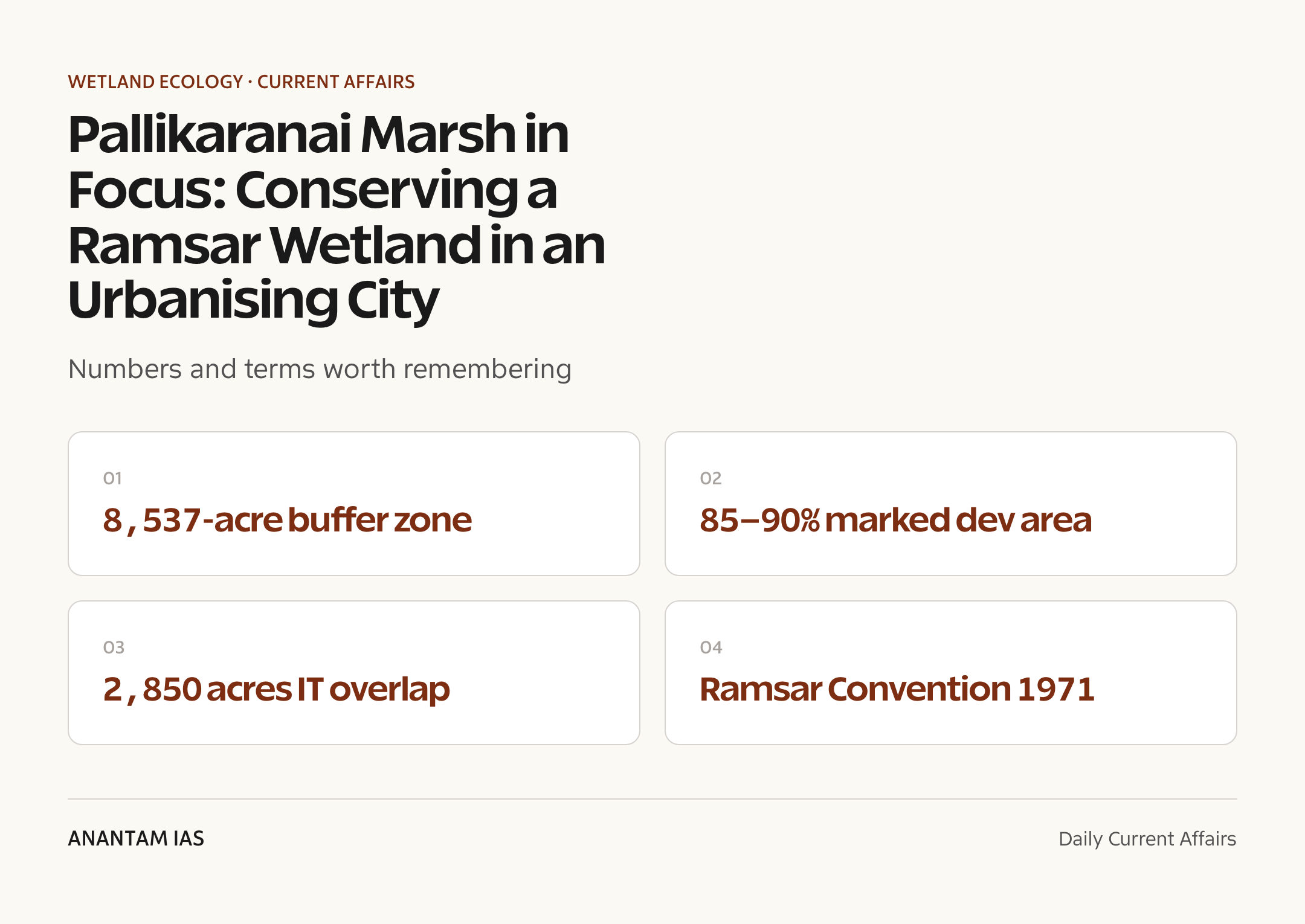
UPSC Relevance
Prelims Relevance
- Pallikaranai marsh lies in Chennai, Tamil Nadu — one of the few surviving large freshwater wetlands of south India and a Ramsar site.
- The Ramsar Convention on Wetlands was adopted in Ramsar, Iran, in 1971 and is the only global treaty dedicated to a single ecosystem type.
- The Convention’s guiding principle is the ‘wise use’ of wetlands — sustainable use that maintains ecological character.
- The Montreux Record lists Ramsar sites where ecological character has changed, is changing or is likely to change due to human pressure; India’s Keoladeo and Loktak have featured on it.
- India’s domestic framework is the Wetlands (Conservation and Management) Rules, 2017, notified under the Environment (Protection) Act, 1986.
- The 2017 Rules set up State/UT Wetlands Authorities and list prohibited activities such as encroachment and permanent construction.
- Tamil Nadu has among the highest number of Ramsar sites of any Indian state, several of them around the Chennai region.
- An Influence Zone is the buffer around a wetland where land use is regulated to protect the wetland’s hydrology and ecology.
- Key wetland ecosystem services include flood control, groundwater recharge, carbon storage and habitat for migratory birds.
- Wetlands are governed nationally by the Ministry of Environment, Forest and Climate Change (MoEFCC).
Mains Relevance
GS Paper 3
- Conservation of urban wetlands as natural infrastructure for flood control and groundwater recharge, using Pallikaranai as a model case.
- Effectiveness and gaps in the Wetlands (Conservation and Management) Rules, 2017 and the Ramsar framework for protecting ecologically sensitive land near cities.
- Balancing development pressure and the right to livelihood with ecological limits — the governance challenge of buffer zones and Influence Zones.
- Lessons of the 2015 Chennai floods for city master planning, drainage and climate resilience.
Essay
- Development versus environment: who pays the price when cities grow over their wetlands.
- Nature as infrastructure — why protecting ecosystems is also disaster risk reduction.
Background and Context
Pallikaranai marsh: a city's natural sponge
Pallikaranai is a freshwater marsh on the southern fringe of Chennai and a rare survivor among south India’s large urban wetlands.
- It functions as a natural flood sink, absorbing monsoon runoff that would otherwise inundate built-up Chennai.
- The marsh supports migratory and resident waterbirds and a distinct wetland biodiversity within a dense metropolitan setting.
- Decades of city expansion shrank the marsh through encroachment, road and rail embankments, and garbage dumping at its edges.
- Its Ramsar designation recognised both its ecological value and its vulnerability to urban pressure.
The Ramsar Convention and 'wise use'
The international anchor for wetland protection is the Ramsar Convention, the world’s oldest treaty focused on a single ecosystem.
- Adopted in Ramsar, Iran, in 1971, it commits parties to conserve and sustainably use wetlands of international importance.
- Its core idea is ‘wise use’ — maintaining the ecological character of wetlands while allowing sustainable human use.
- Sites under threat can be placed on the Montreux Record, flagging changes in ecological character for priority attention.
- Listing as a Ramsar site is a recognition and a commitment, not a fence — protection still depends on domestic law and local governance.
India's wetlands framework
India translates Ramsar commitments through national rules and state-level authorities.
- The Wetlands (Conservation and Management) Rules, 2017, issued under the Environment (Protection) Act, 1986, are the operative national law.
- They require states to constitute Wetlands Authorities and to identify and notify wetlands for protection.
- Prohibited activities include encroachment, permanent construction and solid-waste dumping within notified wetlands.
- The Rules have been criticised for slow notification of wetlands and for leaving buffer-zone rules to state discretion.
Urban pressure and the 2015 flood lesson
The Pallikaranai dispute is really a contest over how a city treats the land that drains it.
- The Hindu reports that 85–90% of the 8,537-acre Influence Zone was already a development area under the CMDA Second Master Plan (2008).
- About 60% (2,850 acres) of the OMR IT corridor overlaps the Influence Zone, layering economic stakes onto the ecology.
- The 2015 Chennai floods showed how building over natural drainage and wetlands magnifies urban flood damage.
- Loss of wetland storage shifts flood risk onto residents and public infrastructure across the city.
Property rights and regulatory transparency
Conservation collides with people who bought land in good faith, making fair process as important as the rule itself.
- There are claims of lawfully held private lands within the Ramsar boundary, and families who invested life savings in plots inside the Influence Zone.
- The NGT and CMDA are studying a clear boundary and Influence Zone framework to settle what is and is not buildable.
- The Hindu’s analysis stresses that environmental protection should not become an exclusionary or punitive process.
- Credible conservation needs transparent maps, public consultation and fair compensation where rights are extinguished.
Way Forward
Finalise a science-based boundary and Influence Zone for Pallikaranai with publicly accessible maps, so landholders and planners share the same reference.
Pair protection with fair compensation, land swaps or transferable development rights for lawful owners affected by the wetland boundary.
Strengthen the Wetlands Rules 2017 in practice — faster notification, stricter control on encroachment and dumping, and active eco-restoration of degraded stretches.
Embed urban wetlands into city master plans as flood infrastructure, treating them as assets to be funded, not vacant land awaiting development.
Conclusion
Pallikaranai shows that a Ramsar tag is the start of conservation, not the end. The hard work is governance — drawing honest boundaries, enforcing the Wetlands Rules, and restoring what cities have already degraded.
The durable lesson for exam and policy alike is that wetlands are infrastructure. Protecting them is cheaper than the floods that follow their loss, provided protection stays transparent and fair to the people who live at the water’s edge.
UPSC Practice Questions
Prelims MCQ 1
With reference to the Ramsar Convention on Wetlands, consider the following statements: 1. It was adopted in 1971 and is dedicated specifically to the conservation of wetlands. 2. The Montreux Record lists wetlands whose ecological character is under threat from human activity. 3. The ‘wise use’ principle bars all human use of designated wetlands. Which of the statements given above are correct?
1 and 2 only 2 and 3 only 1 and 3 only 1, 2 and 3
Answer: 1 and 2 only
Explanation:
The Ramsar Convention (1971) is the only global treaty focused on wetlands, and the Montreux Record flags sites with changing ecological character. ‘Wise use’ means sustainable use, not a total ban on human use, so statement 3 is wrong.
Prelims MCQ 2
Consider the following statements about wetland governance in India: 1. The Wetlands (Conservation and Management) Rules, 2017 were notified under the Environment (Protection) Act, 1986. 2. The Rules provide for the constitution of State/UT Wetlands Authorities. 3. Pallikaranai marsh is located in Karnataka. Which of the statements given above are correct?
1 and 2 only 1 and 3 only 2 and 3 only 1, 2 and 3
Answer: 1 and 2 only
Explanation:
The 2017 Rules sit under the Environment (Protection) Act, 1986 and create State/UT Wetlands Authorities. Pallikaranai marsh is in Chennai, Tamil Nadu, not Karnataka, so statement 3 is wrong.
UPSC Mains Questions
- Urban wetlands are natural infrastructure, yet they are among the first casualties of city growth. Examine this statement with reference to the Pallikaranai marsh and the lessons of the 2015 Chennai floods. (250 words)
- Critically evaluate the effectiveness of the Wetlands (Conservation and Management) Rules, 2017 and the Ramsar framework in protecting India’s urban wetlands. (250 words)
- Conservation of ecologically sensitive land near cities often collides with property rights. Discuss how regulatory transparency and fair process can reconcile the two, using a recent example. (150 words)
Source: The Hindu (via Legacy IAS analysis).
Frequently Asked Questions
Where is the Pallikaranai marsh located?
It is a freshwater marsh on the southern edge of Chennai, Tamil Nadu, and one of the few surviving large urban wetlands of south India. It acts as a natural flood sink and supports rich birdlife.
What is the Ramsar Convention?
It is an international treaty adopted in Ramsar, Iran, in 1971, dedicated to the conservation and ‘wise use’ of wetlands of international importance. India is a party and has designated dozens of Ramsar sites.
What is the Montreux Record?
It is a register under the Ramsar Convention listing wetlands where the ecological character has changed, is changing or is likely to change due to human pressure, so they receive priority conservation attention.
What law governs wetlands in India?
The Wetlands (Conservation and Management) Rules, 2017, notified under the Environment (Protection) Act, 1986, are the main national framework. They set up State/UT Wetlands Authorities and prohibit activities like encroachment and dumping.
What is the Pallikaranai ‘Influence Zone’ dispute about?
It concerns the buffer around the wetland where land use must protect its ecology. Much of this 8,537-acre zone was earlier marked for development and overlaps the OMR IT corridor, so the NGT and CMDA are working to fix a clear boundary that also respects lawful landholders.
Why does the 2015 Chennai floods episode matter here?
Those floods showed how building over wetlands and natural drainage worsens urban flooding. Protecting Pallikaranai is also a flood-resilience measure for the wider city.
Source: https://anantamias.com/current-affairs/pallikaranai-wetland-ramsar-urban-conservation/
Facial Recognition and NATGRID: Surveillance, Data Fusion and the Privacy Question
Why in News?
The Central Industrial Security Force (CISF) said facial-recognition cameras at major airports will link to a proposed data fusion centre in Delhi, drawing in feeds from roughly 1.5 lakh surveillance cameras at vital installations and integrating with the National Intelligence Grid (NATGRID) for real-time monitoring. The Home Ministry has separately asked States to use a platform that reaches across driving licences, vehicle registrations, Aadhaar, airline records, bank data and suspicious-transaction reports.
Reported by The Hindu (carried in the Legacy IAS daily analysis), the move revives a long-running debate. Pooling facial recognition technology (FRT) with NATGRID’s cross-dataset fusion gives security agencies powerful real-time identification, but it runs straight into the right to privacy affirmed in K.S. Puttaswamy (2017) and the safeguards expected under the Digital Personal Data Protection Act, 2023.
- CISF airport FRT cameras to feed a Delhi data fusion centre wired into NATGRID.
- Around 1.5 lakh cameras at vital installations to supply real-time feeds.
- Home Ministry platform spans licences, Aadhaar, airline, bank and transaction data plus social-media analysis.
- Complements a national DNA-and-biometric rollout under the Criminal Procedure (Identification) Act, 2022, with 100,000-plus DNA profiles via NAFIS.
- Raises the core test: do such systems satisfy legality, legitimate aim and proportionality under Puttaswamy.
The development matters in the context of:
- NATGRID was conceived after the 26/11 Mumbai attacks (2008) to break intelligence silos between agencies that had failed to connect actionable warnings.
- FRT is already used in policing, airport boarding through DigiYatra and crowd monitoring, but it still lacks a dedicated governing statute that defines who may deploy it and under what limits.
- India’s data-protection regime under the DPDP Act, 2023 is still being operationalised through subordinate rules and the setting up of a Data Protection Board.
- A fusion centre marks a shift from isolated cameras and registers to a single, queryable picture of a person’s movements, money and identity in one screen.
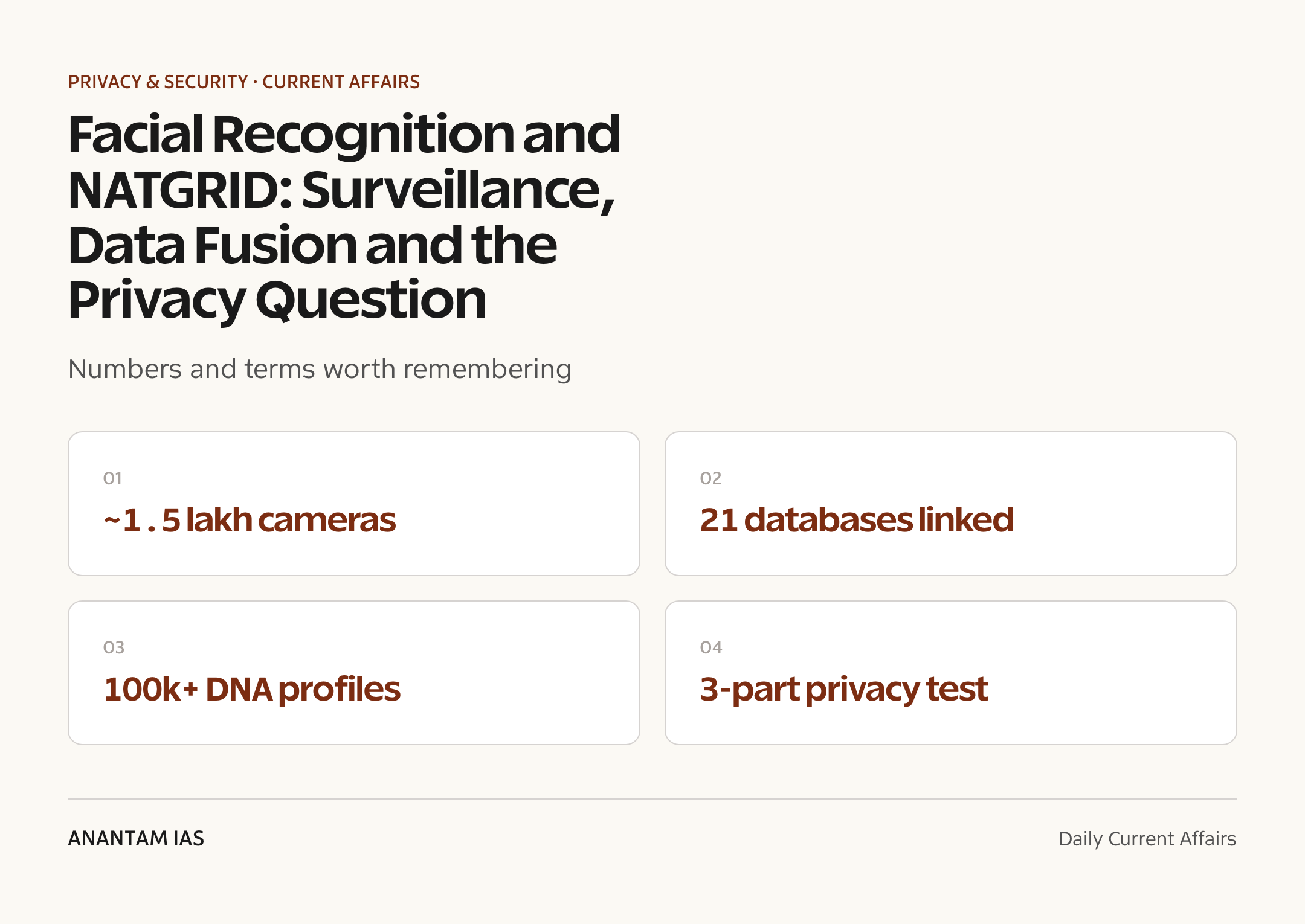
UPSC Relevance
Prelims Relevance
- NATGRID — National Intelligence Grid; links around 21 databases of multiple agencies; conceived post-26/11; attached to the Ministry of Home Affairs.
- K.S. Puttaswamy v. Union of India (2017) — nine-judge bench held privacy a fundamental right under Article 21; laid down the three-part proportionality test.
- Proportionality test limbs — legality (a valid law), legitimate/necessary aim, and proportionality (least-intrusive means, with procedural safeguards).
- DPDP Act, 2023 — first dedicated data-protection law; principles of purpose limitation, data minimisation, consent and a Data Protection Board of India.
- DPDP state exemptions — the Union may exempt State instrumentalities (Section 17) in the interest of sovereignty, security and public order.
- FRT — facial recognition technology; a biometric system matching face images against a database; prone to error rates and bias.
- Criminal Procedure (Identification) Act, 2022 — allows collection of biometric and biological samples; NAFIS is the fingerprint/criminal-record system.
- DigiYatra — facial-recognition-based contactless boarding at Indian airports.
- EU AI Act — classifies AI by risk tiers and restricts real-time remote biometric identification in public spaces.
Mains Relevance
GS Paper 2
- Right to privacy as a fundamental right (Article 21) and the limits it places on state surveillance.
- The Puttaswamy proportionality test as the constitutional yardstick for any data-fusion or FRT programme.
- Gaps in the DPDP Act 2023 — broad state exemptions and the independence of the Data Protection Board.
- Need for a clear legislative basis and judicial/parliamentary oversight of intelligence-grid surveillance.
GS Paper 3
- Internal-security utility of NATGRID and FRT in counter-terror, crowd control and border management.
- Risks of mass surveillance, profiling and function creep when datasets are fused without firewalls.
- Algorithmic bias and error rates in FRT, and the harm of false positives in policing.
- Cyber-security and data-breach exposure of a centralised fusion centre holding sensitive citizen data.
Essay
- Security versus liberty in the digital age — can the state watch without overreaching?
- Technology is a tool; its ethics depend on the safeguards we build around it.
Background and Context
FRT and NATGRID: what is being fused
The new architecture stitches biometric identification onto a long-planned intelligence grid, turning scattered feeds into one searchable system.
- Facial recognition technology (FRT) maps facial features into a numeric template and matches it against a stored gallery in near real time, flagging a name from a face in a crowd.
- NATGRID, conceived after 26/11, links roughly 21 databases so authorised agencies can query travel, financial and identity records in one place instead of writing to each department.
- The proposed data fusion centre in Delhi would combine airport FRT feeds, about 1.5 lakh installation cameras and NATGRID datasets into a single real-time monitoring layer.
- The Home Ministry platform reaches across driving licences, vehicle registrations, Aadhaar, airline, bank and suspicious-transaction data, with social-media analysis layered on top.
- It complements the DNA-and-biometric rollout under the Criminal Procedure (Identification) Act, 2022, which already holds 100,000-plus DNA profiles via the NAFIS criminal-records system.
- Each dataset alone is regulated loosely; the risk grows when they are joined, because the combined profile reveals far more than any single record.
The privacy jurisprudence: Puttaswamy
Any surveillance system in India must clear a constitutional gate set in 2017.
- K.S. Puttaswamy (2017), a nine-judge bench, held privacy intrinsic to life and liberty under Article 21 and treated informational autonomy as a protected interest.
- State intrusion must pass a three-part proportionality test: a backing law (legality), a legitimate and necessary aim, and the least-intrusive proportional means.
- The judgment also expects procedural safeguards against abuse — independent oversight, periodic review and limits on how long data is kept.
- Real-time identification and cross-dataset fusion, the analysis stresses, must satisfy legality, legitimate aim and proportionality rather than rest on administrative convenience.
- Mass, suspicion-less surveillance of the general public sits in tension with the proportionality limb, which favours targeted and least-intrusive measures.
DPDP Act 2023 and state exemptions
India’s data-protection statute sets principles but leaves wide room for the state.
- The DPDP Act, 2023 codifies purpose limitation, data minimisation, consent and storage-retention limits as the baseline for processing personal data.
- Compliance for these systems would demand purpose limitation, data minimisation, retention limits and independent oversight, the analysis notes.
- Section 17 lets the Union exempt State instrumentalities for sovereignty, integrity, security of the State and public order — a carve-out critics call broad and loosely defined.
- Exempted processing can sidestep core duties such as consent and purpose limitation, which is precisely where a fusion centre would operate.
- The Data Protection Board‘s independence, its appointment process and the absence of a dedicated surveillance-reform law remain open concerns.
Risks: function creep, bias and oversight gaps
Fusing datasets multiplies both capability and the scope for harm.
- Function creep — data gathered for one purpose drifts into others once silos are merged, a recurring concern in internal-security data systems.
- FRT carries documented error rates and demographic bias; false positives can wrongly implicate individuals, and the burden often falls on the person to disprove a machine’s match.
- A centralised fusion centre is a high-value cyber-attack and data-breach target, since a single compromise exposes linked identity, travel and financial records together.
- A chilling effect on free speech and assembly can follow when people know their movements are continuously tracked.
- The analysis warns of mass surveillance and profiling in the absence of strong institutional protections and independent oversight.
Global comparison
Other jurisdictions are tightening the leash on biometric surveillance.
- The EU AI Act sorts AI into risk tiers and curbs real-time remote biometric identification in public spaces.
- Several democracies require judicial authorisation or independent sign-off before deploying mass biometric tools.
- The contrast highlights India’s need for a statutory FRT framework rather than executive-led rollout.
Way Forward
Anchor any FRT or fusion-centre deployment in a clear law that names its purpose, scope and limits, as Puttaswamy requires.
Build in purpose limitation and data minimisation so datasets are not merged beyond the stated security aim.
Set strict retention and deletion timelines and audit logs for every query into the grid.
Create independent oversight — judicial or parliamentary review of surveillance powers, not executive self-certification.
Mandate bias and accuracy testing of FRT systems and publish error rates before operational use.
Narrow the DPDP Act’s state exemptions and strengthen the Data Protection Board’s autonomy.
Conclusion
NATGRID and facial recognition can sharpen India’s response to terror and organised crime, and the case for capable, real-time intelligence after 26/11 is genuine. The question is not whether the state may watch, but on what terms.
Puttaswamy and the DPDP Act already supply the grammar — legality, necessity, proportionality and oversight. Building these safeguards into the design, rather than bolting them on later, is what keeps a security tool from becoming an instrument of unchecked surveillance.
UPSC Practice Questions
Prelims MCQ 1
With reference to the National Intelligence Grid (NATGRID), consider the following statements: 1. It was conceived in the aftermath of the 26/11 Mumbai attacks. 2. It is designed to link databases of multiple agencies for security use. 3. It functions under the Ministry of Home Affairs. Which of the statements given above are correct?
1 and 2 only 2 and 3 only 1 and 3 only 1, 2 and 3
Answer: 1, 2 and 3
Explanation:
NATGRID was conceived after the 2008 Mumbai attacks to link around 21 databases of various agencies for security purposes and operates under the Ministry of Home Affairs.
Prelims MCQ 2
The three-part test of legality, legitimate aim and proportionality for limiting a fundamental right is most directly associated with which of the following?
The K.S. Puttaswamy (Right to Privacy) judgment, 2017 The Criminal Procedure (Identification) Act, 2022 The Digital Personal Data Protection Act, 2023 The Information Technology Act, 2000
Answer: The K.S. Puttaswamy (Right to Privacy) judgment, 2017
Explanation:
The 2017 Puttaswamy judgment recognised privacy as a fundamental right and laid down the three-part proportionality test for any state intrusion.
UPSC Mains Questions
- Cross-dataset fusion through systems like NATGRID enhances internal-security capability but strains the right to privacy. Examine in the light of the Puttaswamy proportionality test. (250 words)
- Facial recognition technology in public spaces raises concerns of function creep, algorithmic bias and mass surveillance. Suggest a regulatory framework that balances security with civil liberties. (250 words)
- “Data protection without independent oversight is a promise without a guarantee.” Critically evaluate the exemptions available to the state under the Digital Personal Data Protection Act, 2023. (150 words)
Source: The Hindu (via Legacy IAS analysis).
Frequently Asked Questions
What is NATGRID?
The National Intelligence Grid is a secure platform, conceived after the 26/11 attacks, that links around 21 databases of various agencies so authorised security users can access travel, financial and identity records in one place. It works under the Ministry of Home Affairs.
What did the Puttaswamy judgment decide?
The 2017 nine-judge K.S. Puttaswamy verdict held that the right to privacy is a fundamental right under Article 21. It also laid down a three-part test for any state intrusion: it must rest on a valid law, serve a legitimate and necessary aim, and be proportionate with procedural safeguards.
How does facial recognition technology work, and why is it controversial?
FRT converts a face into a digital template and matches it against a stored database in near real time. It is controversial because it can carry error rates and demographic bias, enable mass tracking, and is often deployed without a dedicated law or independent oversight.
What is function creep?
Function creep is when data collected for one stated purpose is gradually used for other, unrelated purposes. Fusing datasets that were once separate makes this drift far easier, which is why purpose limitation matters.
Does the DPDP Act 2023 limit government surveillance?
The Act sets principles such as purpose limitation, data minimisation and retention limits. However, Section 17 lets the Union exempt State instrumentalities in the interest of sovereignty, security and public order, which critics see as a broad carve-out.
How does the EU regulate biometric surveillance differently?
The EU AI Act classifies AI systems by risk and restricts real-time remote biometric identification in public spaces, often requiring strict conditions or authorisation. This contrasts with India’s largely executive-led FRT rollout.
Source: https://anantamias.com/current-affairs/facial-recognition-natgrid-surveillance-privacy/