Introduction
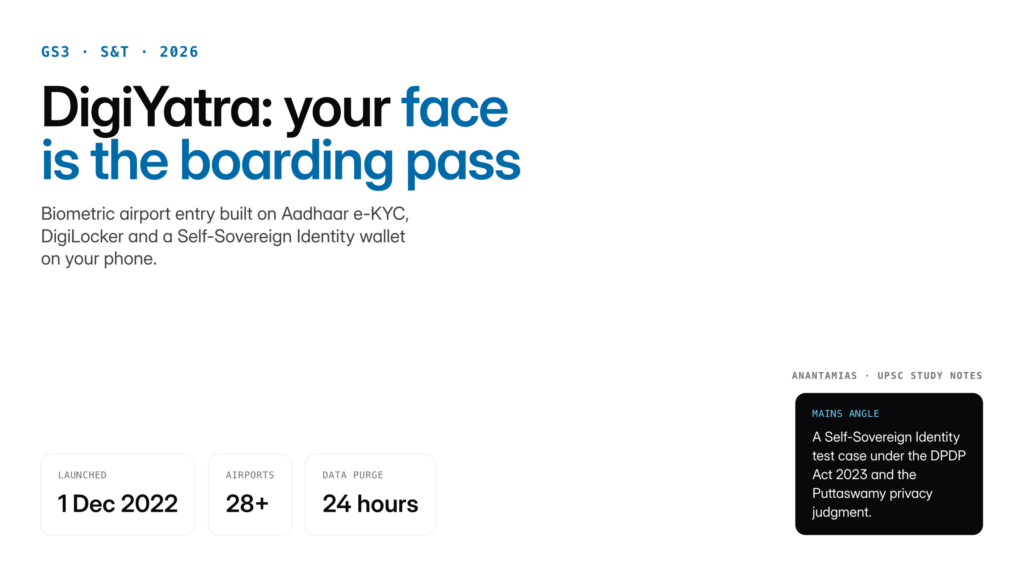
Indian airports have been among the fastest-growing aviation ecosystems in the world, and the passenger-processing experience is being re-engineered around biometric identity. DigiYatra, launched by the Ministry of Civil Aviation in December 2022, is the flagship attempt to make the journey from airport entry to boarding gate contactless, paperless and biometric. For an aspirant preparing General Studies Paper 3 (science and technology, digital infrastructure) and Paper 2 (governance, data protection), DigiYatra is a rich case study that pulls together aviation policy, face-recognition technology, federated identity, and the Digital Personal Data Protection Act of 2023.
This note unpacks what DigiYatra is, how the Android and iOS app works, which airports have deployed it, what privacy concerns civil-society groups have raised, and how the scheme interacts with India’s larger Digital Public Infrastructure (DPI). The goal is to give you a single, exam-ready reference that works for Prelims factual questions and Mains analytical answers alike.
Quick Facts at a Glance
| Parameter | Detail |
|---|---|
| Launch date | 1 December 2022 (first three airports) |
| Nodal ministry | Ministry of Civil Aviation (MoCA) |
| Implementing body | DigiYatra Foundation (DYF), a not-for-profit joint-venture |
| DYF shareholders | Airports Authority of India (26%) + Bengaluru, Delhi, Hyderabad, Mumbai, Cochin airport operators |
| Technology core | Facial Recognition Technology (FRT) + Self-Sovereign Identity wallet |
| Identity anchor | Aadhaar-based e-KYC through DigiLocker |
| Airports onboarded (Apr 2026) | 28+ airports across India |
| Regulatory framework | Aircraft Act 1934, BCAS circulars, IT Act 2000, DPDP Act 2023 |
| Data residency | Stored on user device; purged from airport servers within 24 hours |
| App availability | Google Play Store and Apple App Store |
Background and Historical Context
Air travel in India scaled from roughly 60 million domestic passengers in 2013 to over 153 million in financial year 2023-24, according to the Directorate General of Civil Aviation. This surge exposed chronic bottlenecks: long entry queues at airport gates, repeated ID checks at the CISF frisking point, at the airline counter and again at the boarding gate. In 2017 the Ministry of Civil Aviation floated the DigiYatra policy paper, envisioning a single digital token that would travel with the passenger from entry to aircraft door.
The policy drew on three earlier strands. First, the India Stack, whose Aadhaar-enabled e-KYC and DigiLocker had already normalised paperless verification for banking and tax. Second, international benchmarks like Changi Airport’s FAST programme and Atlanta’s Delta biometric boarding trial, which had demonstrated throughput gains of 30 to 40 per cent. Third, Bureau of Civil Aviation Security mandates that required a verifiable audit trail of who boards which flight, a mandate that manual ink-stamped boarding passes fulfilled only clumsily.
After a pilot at Bengaluru and Varanasi airports in 2019, the MoCA constituted the DigiYatra Foundation as a Section-8 company in 2019 and formally launched the consumer rollout on 1 December 2022 at Delhi, Bengaluru and Varanasi. Pune, Vijayawada, Kolkata and Hyderabad followed through 2023, and by April 2026 more than 28 airports accept the DigiYatra token, covering the bulk of metro traffic.
Key Features
Self-Sovereign Identity Wallet
DigiYatra’s defining architectural choice is that the passenger’s identity and biometric template live in an encrypted wallet on the user’s phone, not in a central government database. This is often called a Self-Sovereign Identity model, and it distinguishes DigiYatra from, say, China’s all-government ZhiMa airport scheme.
Aadhaar-based Onboarding
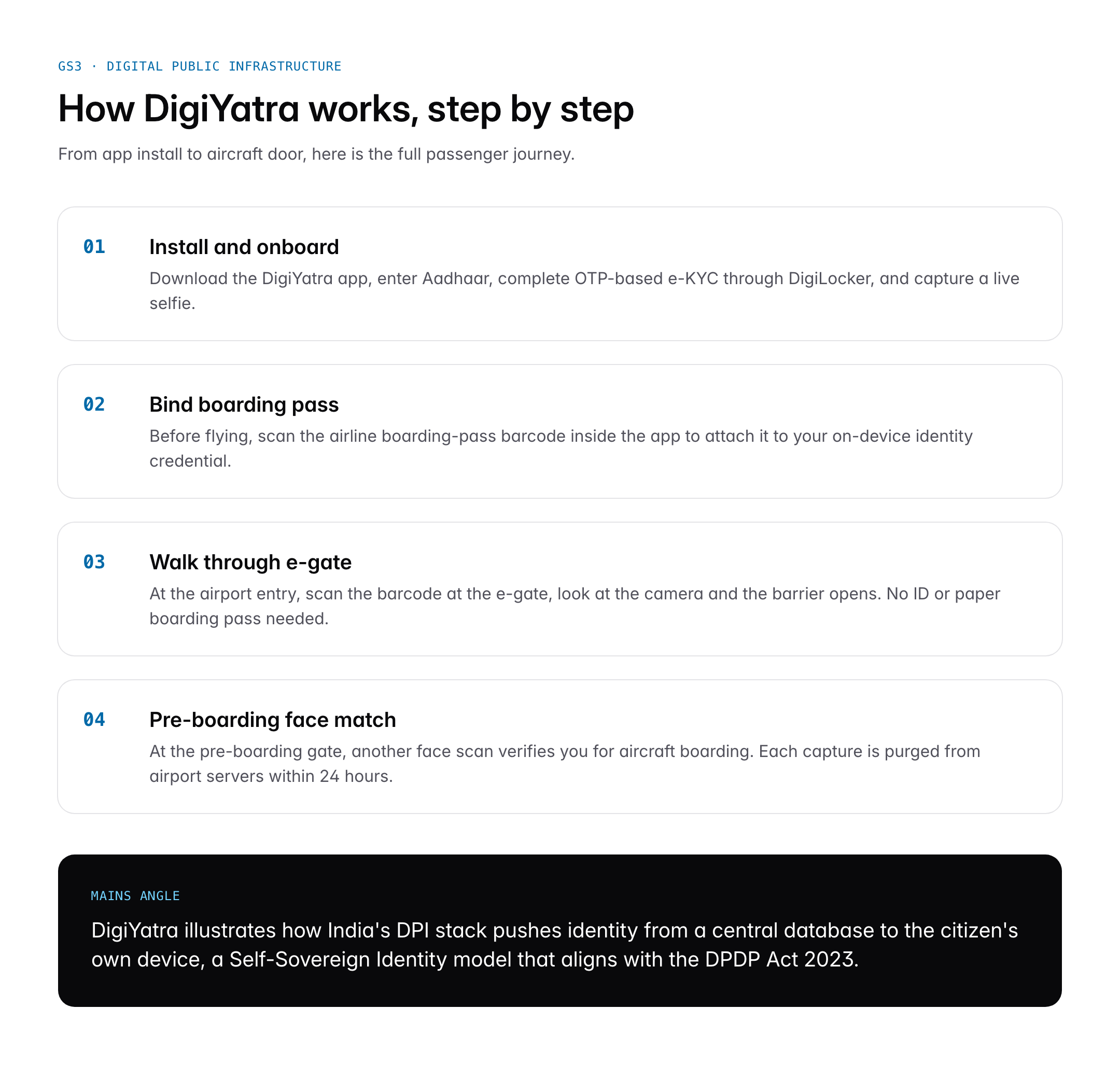
The user downloads the app, enters an Aadhaar number or Offline XML, and completes an OTP-based e-KYC through DigiLocker. A selfie then binds the Aadhaar photo to a live face scan, and a cryptographic credential is minted on the device.
Face-as-Boarding-Pass
At a DigiYatra-enabled airport, the passenger scans the flight’s barcode at the e-gate; a camera captures the face, matches it against the wallet token, and the boom barrier opens. The same process repeats at the pre-boarding gate. No paper boarding pass or ID card changes hands.
Data Purge Window
According to the DigiYatra Foundation’s Privacy Policy updated in 2023, all face data captured at an airport is purged from airport servers within 24 hours of the flight’s departure. Audit logs retained are limited to transaction metadata.
Optional, not Mandatory
The MoCA has reiterated in Parliament that DigiYatra is a voluntary convenience. Passengers who prefer the traditional manual channel must be provided a lane, and this is audited during Bureau of Civil Aviation Security inspections.
Extension Beyond Air
In 2024 the DigiYatra Foundation signed an MoU with the Indian Railways’ RailOne app for pilot deployments at select metro and railway stations, and cruise-terminal pilots at Mumbai Port have been announced. This positions DigiYatra as a cross-modal identity rail rather than a narrow aviation product.
Significance for UPSC and General Knowledge
- Illustrates how Digital Public Infrastructure (DPI) principles (Aadhaar, DigiLocker, UPI-style plumbing) extend from finance into physical mobility.
- Provides a live Indian example of Self-Sovereign Identity, a concept central to the 2026 debate on the EU Digital Identity Wallet and Web3 governance.
- Operationalises the Digital Personal Data Protection Act 2023 through purpose-limitation and data-minimisation clauses.
- Links GS3 (Science and Technology) with GS2 (Governance, Transparency and Accountability) and Ethics (surveillance and consent).
- Surfaces federal and regulatory questions about airports run under Public-Private Partnership models and the role of the Airports Authority of India.
- Serves as a Prelims-friendly factual anchor (launch date, ministry, 28+ airports) and a Mains essay hook on balancing convenience with civil liberties.
Detailed Analysis: Policy and Privacy Architecture
DigiYatra sits at the intersection of aviation law, data protection and identity regulation, and each layer deserves unpacking for a high-scoring Mains answer.
On aviation law, the Bureau of Civil Aviation Security operates under the Aircraft Act 1934 and issues security circulars that effectively make DigiYatra equivalent to a boarding pass for entry verification. This reduces pressure on CISF personnel, who processed more than 400 million passengers in 2023, and lifts throughput at peak hours by approximately 20 to 30 seconds per passenger.
On data protection, the DigiYatra Foundation self-certifies compliance with the Digital Personal Data Protection Act 2023. Key levers the Act provides include the right to data erasure, the requirement of specific and informed consent, and the principle of purpose limitation. The 24-hour purge window and the device-local storage model map neatly onto these obligations, but civil-society organisations such as the Internet Freedom Foundation have argued that the voluntary regime can become coercive in practice if lanes for non-DigiYatra passengers shrink or become notably slower.
On identity policy, DigiYatra leverages Aadhaar e-KYC but, unlike Aadhaar-based payments, no Aadhaar number is transmitted to the airport. This architectural choice anticipated the Supreme Court’s Puttaswamy judgment of 2017, which held that any infringement of privacy must satisfy necessity, proportionality and legality. By keeping biometrics on-device and the airport transaction limited to a one-time face match, DigiYatra attempts to satisfy proportionality.
Finally, the scheme interacts with Pradhan Mantri Gati Shakti and the UDAN regional-connectivity policy by smoothing the passenger experience that underpins aviation-sector GDP contribution, estimated by IBEF at about 1.5 per cent of GDP in 2024.
Comparative Perspective
| Programme | Country | Identity Anchor | Data Storage | Mandatory? |
|---|---|---|---|---|
| DigiYatra | India | Aadhaar e-KYC | Device (SSI) | No |
| TSA PreCheck + CAT-2 | USA | Passport + biometric enrolment | Central DHS database | No |
| Changi FAST | Singapore | NRIC + biometric | Airport biometric store | No |
| e-Gate Schengen | EU | ePassport chip | On-chip + central SIS II | No |
| Smart Tunnel | UAE (Dubai) | Emirates ID + iris scan | GDRFA central | No |
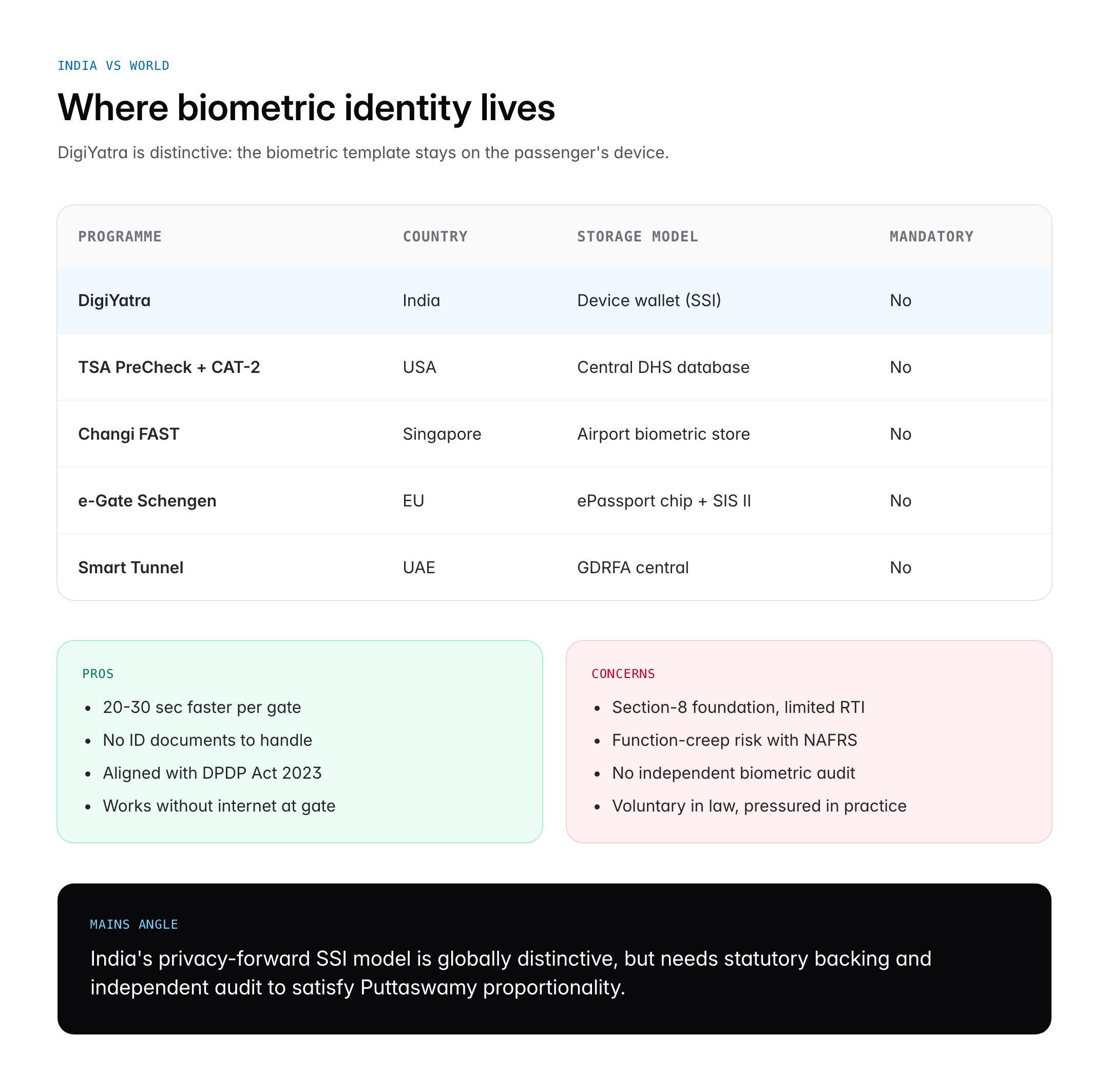
India’s model is globally distinctive because the biometric template is not held by the airport operator or the government. In contrast, the U.S. TSA and the UAE Smart Tunnel rely on centralised biometric databases, and the European e-Gate mixes on-chip storage with the Schengen Information System. For UPSC answers, this comparison helps frame India as pursuing a privacy-forward architecture despite having no omnibus data-protection regulator until the Data Protection Board becomes operational.
Controversies and Debates
DigiYatra has faced four sustained criticisms. First, critics including the Internet Freedom Foundation have questioned the privacy posture of early versions of the app, which allegedly shared usage data with third-party software-development kits; the Foundation has since claimed to have removed these. Second, observers note that the DigiYatra Foundation is structured as a private Section-8 company, which places it partly outside the Right to Information Act 2005 scrutiny, raising accountability concerns. Third, legal scholars argue that while the Digital Personal Data Protection Act 2023 applies, the Data Protection Board has yet to hear a DigiYatra complaint, so enforcement remains theoretical.
Fourth, there is a broader civil-liberties concern about function-creep. Several commentators have asked whether face data captured for aviation convenience could later be used for law-enforcement facial-recognition matching, especially given the National Automated Facial Recognition System proposed by the National Crime Records Bureau. The DigiYatra Foundation has denied any data sharing with NAFRS, but absent a statutory audit mechanism, the public must rely on self-certification.
Prelims Pointers
- DigiYatra launched on 1 December 2022 at Delhi, Bengaluru and Varanasi airports.
- The nodal ministry is the Ministry of Civil Aviation.
- DigiYatra Foundation is a Section-8 not-for-profit joint venture; AAI holds 26 per cent.
- The app uses Self-Sovereign Identity with biometric data stored on the user’s device.
- Onboarding is through Aadhaar e-KYC via DigiLocker.
- Airport face-capture data is purged within 24 hours of flight departure.
- The DigiYatra policy paper was first released by MoCA in 2017.
- The scheme is voluntary; a manual lane must be offered at every airport.
- As of April 2026, more than 28 Indian airports support DigiYatra.
- DigiYatra pilots have begun at railway stations with the RailOne app.
- The programme is anchored in the Aircraft Act 1934 and BCAS circulars.
- The Digital Personal Data Protection Act 2023 governs DigiYatra’s data handling.
Mains Practice Questions
Q1. “DigiYatra operationalises the principles of Self-Sovereign Identity within India’s digital public infrastructure.” Examine this statement with reference to data-protection safeguards. (15 marks, 250 words)
- Define SSI and contrast with centralised identity databases; map to DigiYatra’s on-device wallet.
- Link safeguards to the Digital Personal Data Protection Act 2023 (consent, purpose limitation, 24-hour purge).
- Critique residual concerns: function creep, Section-8 governance, absence of independent audit.
Q2. Evaluate the role of facial recognition technology in airport security and passenger facilitation in India, highlighting the governance challenges involved. (10 marks, 150 words)
- Outline FRT use at DigiYatra airports and efficiency gains (20 to 30 seconds per passenger).
- Highlight governance gaps: voluntariness in practice, DPDP enforcement lag, NAFRS ambiguity.
- Suggest reforms: statutory DigiYatra Authority, parliamentary oversight, RTI coverage.
Conclusion
DigiYatra is one of the cleanest case studies of India’s digital public infrastructure crossing over into physical-world mobility. Its architecture borrows what worked from Aadhaar and DigiLocker, while avoiding what worried the Supreme Court in Puttaswamy by keeping biometric templates on the device. For a student of governance and technology, it reveals how a seemingly mundane airport convenience actually encodes deep choices about identity, consent and state capacity.
At the same time, the programme must prove itself in the DPDP era. Statutory backing instead of reliance on a Section-8 foundation, an independent audit of the face-purge claim, and clearly protected non-biometric lanes at airports would go a long way toward converting DigiYatra from a convenience product into a credible civil-liberties-respecting public good. For the UPSC aspirant, the story is unfinished, which is precisely what makes it examinable.
Frequently Asked Questions
What is DigiYatra?
DigiYatra is a voluntary, biometric-based paperless airport entry and boarding system launched by the Ministry of Civil Aviation on 1 December 2022. It uses facial recognition linked to an Aadhaar-based e-KYC done through DigiLocker, and stores the user’s identity token on the passenger’s own smartphone instead of a central database.
Why is DigiYatra important for UPSC?
DigiYatra is examinable across GS2 (governance, data protection) and GS3 (science, technology, digital infrastructure). It illustrates Self-Sovereign Identity, operationalises the Digital Personal Data Protection Act 2023, and raises civil-liberties debates after the Puttaswamy privacy judgment, making it a compact case study for both Prelims factual and Mains analytical answers.
How is DigiYatra related to Aadhaar and DigiLocker?
DigiYatra uses Aadhaar-based electronic KYC routed through DigiLocker to onboard passengers. A selfie is then bound to the Aadhaar photograph to mint a cryptographic credential stored on the phone. The Aadhaar number itself is not transmitted to the airport, only the credential and a live face match.
Which airports support DigiYatra in 2026?
As of April 2026 more than 28 Indian airports support DigiYatra, including Delhi, Mumbai, Bengaluru, Hyderabad, Kolkata, Chennai, Pune, Ahmedabad, Varanasi, Vijayawada, Lucknow, Guwahati, Jaipur, Kochi and Patna. The list is expanding steadily, and cross-modal pilots have begun at selected railway stations through the RailOne app.
Is DigiYatra mandatory for air travel?
No. The Ministry of Civil Aviation has stated in Parliament that DigiYatra is a voluntary convenience. Every DigiYatra-enabled airport is required to maintain at least one manual lane for passengers who prefer traditional verification, and compliance is audited during Bureau of Civil Aviation Security inspections.
What are the main privacy concerns with DigiYatra?
Civil-society groups such as the Internet Freedom Foundation have flagged three concerns: insufficient independent audit of the 24-hour data-purge claim, the Section-8 private structure of the DigiYatra Foundation that sits partly outside the Right to Information Act, and potential function creep if face data were linked to the proposed National Automated Facial Recognition System.
How does DigiYatra compare to biometric airport systems abroad?
Unlike the U.S. TSA PreCheck, Changi FAST or the Dubai Smart Tunnel, which store biometric templates in centralised government or airport databases, DigiYatra keeps the template on the user’s own device. This Self-Sovereign Identity model is designed to satisfy the Puttaswamy judgment’s proportionality test and the Digital Personal Data Protection Act 2023.
How long is passenger data retained by DigiYatra?
According to the DigiYatra Foundation privacy policy, all face-capture data collected at an airport is purged from airport servers within 24 hours of the flight’s departure. Only transaction metadata and audit logs are retained, and the biometric template itself never leaves the passenger’s device in the first place.
Tell Google you want more of this.
Add Anantam IAS as a preferred sourceOne tap, and this site shows up more often in your own Top Stories, AI Overviews and AI Mode. Remove it any time.