Daily Digest
UPSC · Civil Services Examination
Current Affairs · Thursday, 24 September 2026
Current affairs curated and edited by Anantam IAS faculty — pulled from The Hindu, PIB, IDSA, Foreign Affairs and the ministries. Read, annotate, revise.
Old Rajinder Nagar · Delhi 110005 · anantamias.com
BRICS Tax Cooperation: Permanent Groups for Taxation and Revenue Data
Why in News?
BRICS tax authorities established two India-led working groups on international taxation and transfer pricing, and revenue statistics, at their New Delhi meeting on September 23, 2026.
- The working groups will continue across rotating chairships, creating sustained platforms for technical cooperation.
- The Young Tax Professionals capacity-building programme became an annual feature of the tax cooperation track.
- The Cross-Learning Lab was launched and the Tax Support Network terms were approved.
- The BRICS Tax Progress Report 2026 was signed; the announcement did not establish a common tax rate.
- Cross-border business creates questions about where income should be taxed and how related enterprises should price their transactions.
- Comparable revenue evidence helps administrations learn from one another without assuming that identical collection totals imply identical tax systems.
UPSC Relevance
Prelims Relevance
- BRICS tax cooperation and India-led working groups
- Transfer pricing and related enterprises
- Arm’s-length principle
- Revenue classification and government coverage
- Administrative cooperation versus a common tax code
Mains Relevance
GS Paper 3
- Tax-base protection and predictable treatment of cross-border business
- Comparable revenue statistics as a foundation for fiscal policy
GS Paper 2
- Institutional cooperation while preserving domestic policy choices
Essay
- International cooperation is strongest when shared knowledge improves national capacity.
Background and Context
What the new institutions change
The development concerns the machinery of tax cooperation: standing groups, professional learning and continuity beyond the country holding the chair.
- The Finance Ministry announcement establishes two distinct workstreams. One addresses international taxation and transfer pricing; the other addresses revenue statistics. Keeping them separate recognises that tax administration needs both case expertise and reliable measurement.
- India will lead both groups, which are intended to continue regardless of the chairship. This provides an institutional home for technical work instead of making every new chair restart cooperation from a blank slate.
- Peer learning is another practical channel: the new Cross-Learning Lab combines work on client-centred administration and human-resource practices. Its relevance lies in how authorities organise services and develop professional capability, rather than setting rates.
- The annual young-professionals programme creates a recurring training opportunity. For analysis, its value should be judged through skills applied in administration; institutionalising a programme alone does not prove improved collections or fewer disputes.
- Status matters: the release reports working groups and support arrangements, not a common BRICS tax code. As with other multilateral cooperation, an institutional commitment should be read at the level actually agreed.
How transfer pricing affects the tax base
Transfer pricing concerns transactions between related enterprises; the central question is whether their pricing appropriately reflects the economic transaction being taxed.
- The UN transfer-pricing manual explains the arm’s-length principle: assess related-party transactions against conditions that independent enterprises would agree in comparable circumstances. Common ownership makes this comparison necessary; it does not itself establish wrongdoing.
- Consider an illustrative transaction: a manufacturer sells components to its overseas affiliate. Changing the transfer price changes the seller’s recorded revenue and the buyer’s costs, affecting where the group records taxable profit.
- A credible comparison examines commercial substance, including the functions performed, assets used and risks assumed. The same product label alone cannot establish comparability when enterprises perform different activities or accept different business risks.
- The policy challenge is to protect the tax base while avoiding inappropriate double taxation. Authorities examining the same cross-border transaction can reach different conclusions, making consistent analysis and dispute prevention important for legitimate business.
- The new group offers a venue for technical exchange on such issues. It should not be described as having already changed transfer-pricing law, settled individual disputes or assigned taxing rights through a new treaty.
Why revenue statistics need common definitions
The statistics workstream addresses a different problem: tax data cannot support sound comparison unless users know what the figures include and how they were recorded.
- The IMF’s government finance framework distinguishes taxes from other revenue. Combining tax receipts with property income or sales of services can change the meaning of a headline revenue figure and mislead a fiscal comparison.
- Government coverage also matters. Central-government data and general-government data do not necessarily include the same institutions. A comparison must identify the reporting boundary before attributing differences in collections to administrative performance.
- Recording time can alter the picture: cash receipt and recognition of an underlying economic claim are different accounting concepts. Comparable classifications help, but users must also understand the basis on which each series is compiled.
- This is the same interpretive discipline needed for national accounts methods: definitions come before conclusions. Better metadata makes it easier to distinguish a real economic change from a change in coverage or recording.
- The BRICS announcement creates a forum for statistics cooperation; it does not publish a harmonised dataset or a new measurement standard. Its future contribution should be assessed through comparable outputs and transparent methodological explanations.
Way Forward
Turn cooperation into usable capacity
- Publish clear work programmes so users can distinguish training, methodological work and proposals requiring further agreement.
- Prioritise revenue metadata, including coverage and recording basis, before presenting cross-country comparisons as evidence of superior performance.
- Evaluate technical learning through documented administrative improvements, while keeping taxpayer confidentiality and lawful information-sharing safeguards central.
Conclusion
- BRICS tax cooperation now has continuing platforms for related-party taxation and revenue measurement. The useful distinction is between improving national administrative capacity and creating a shared legal system; the announcement establishes the former cooperation route.
- For a Mains answer, connect tax-base protection with business certainty, and connect revenue comparison with clear definitions. Treat future gains as outcomes to assess, rather than benefits already delivered by creating the working groups.
UPSC Practice Questions
Prelims MCQ 1
With reference to the newly established BRICS tax working groups, consider the following statements:
- Both groups will be led by India.
- One group concerns revenue statistics.
- Their establishment creates a common BRICS tax rate.
How many of the above statements are correct?
(a) Only one (b) Only two (c) All three (d) None
Answer: (b) Only two
Explanation:
The India-led groups concern international taxation and transfer pricing, and revenue statistics. The announcement does not establish a common tax rate.
Prelims MCQ 2
The arm’s-length principle in transfer pricing primarily refers to:
(a) Applying the same tax rate in every country (b) Exempting all transactions within a corporate group (c) Comparing related-party conditions with comparable independent-party conditions (d) Taxing only the country where a company is incorporated
Answer: (c) Comparing related-party conditions with comparable independent-party conditions
Explanation:
The principle evaluates related-party transactions using comparable conditions between independent enterprises.
UPSC Mains Questions
- Explain how cooperation on transfer pricing can protect the tax base while improving certainty for cross-border businesses.
- Why are common definitions and metadata essential for comparing tax revenues across countries? Discuss with reference to BRICS tax cooperation.
Sources: PIB, Ministry of Finance and United Nations Practical Manual on Transfer Pricing.
Frequently Asked Questions
What did the BRICS tax meeting establish?
It established two India-led working groups, covering international taxation and transfer pricing, and revenue statistics. These are continuing cooperation platforms; their creation does not establish a common tax code or rate.
What is transfer pricing?
Transfer pricing concerns the pricing of transactions between related enterprises. Tax analysis examines whether the conditions reflect those that independent enterprises would agree in comparable circumstances, rather than assuming every related-party transaction is abusive.
Why is revenue statistics cooperation useful?
Revenue comparisons can mislead when they use different government coverage, classifications or recording bases. Cooperation can improve methodological understanding and help users interpret differences without prematurely attributing them to stronger or weaker tax administration.
Did the meeting conclude the UN tax convention negotiations?
No. The Finance Ministry release refers to ongoing negotiations on the UN Framework Convention on International Tax Cooperation. It reports BRICS institutional outcomes, rather than the conclusion of that separate multilateral negotiation.
Source: https://anantamias.com/current-affairs/brics-tax-working-groups-transfer-pricing-statistics/
Domestic Tourism Survey: Reading Recall Periods and Trip Shares
Why in News?
MoSPI released findings from the Domestic Tourism Expenditure Survey on September 23, 2026, covering household travel surveyed between July 2025 and June 2026.
- Pilgrimage and religious travel accounted for 48% of overnight trips within the survey’s selected 365-day purpose group.
- Social travel accounted for 89% of overnight trips within its separate 30-day purpose group; this is not a share of all domestic tourism.
- The National Statistics Office also measured same-day trips separately, capturing travel that does not involve a qualifying overnight stay.
- Tourism statistics include medical, social and religious journeys, so they can inform public-service access as well as leisure infrastructure.
- A headline changes meaning when its reference period, purpose coverage or counting unit changes, even if every reported figure is correct.
UPSC Relevance
Prelims Relevance
- NSO: household-based Domestic Tourism Expenditure Survey.
- Recall periods: 365 days and 30 days for different overnight purpose groups.
- Leading purpose: the purpose without which the household members would not have undertaken the trip.
- Tourist household: a household reporting at least one relevant trip in the specified period.
- Counting units: households, trips and visitor-trips are distinct.
Mains Relevance
GS Paper 3
- Using household travel evidence to plan transport and service infrastructure.
- Interpreting official statistics without mixing denominators or reference periods.
GS Paper 2
- Medical travel and the accessibility of public services.
Essay
- What we count shapes what we build.
Background and Context
What the survey counts as domestic tourism
The survey follows household journeys beyond the usual environment, rather than treating tourism as a synonym for holidays or hotel stays.
- Domestic visitors are country residents who undertake qualifying overnight or same-day trips. The journey returns to the usual residence, distinguishing the survey’s trip concept from relocation to a new permanent home.
- Leading purpose identifies the reason without which the participating household members would not have travelled. It assigns a common purpose to that trip, even when travellers undertake other activities along the way.
- Travel purpose can be leisure, pilgrimage, medical care, shopping, business, social activity or education. A journey need not be recreational to fall within the relevant survey category and contribute to tourism expenditure.
- Accommodation need not be a paid hotel: visits can involve relatives’ homes or other non-commercial stays. Counting only hotel bookings would miss qualifying journeys that households report through this survey.
- Same-day trips form a separate category without a qualifying overnight stay. The definition is not simply a calendar-date test: a trip can cross a date boundary without satisfying the overnight conditions.
Why the two overnight headlines cannot be combined
The reference period is the span households recall before interview; the purpose categories attached to that period define which trips enter the result.
- The 365-day window covers overnight journeys for holidaying, leisure and recreation; pilgrimage and religion; health and medical care; and shopping. Its purpose shares describe this selected group rather than every journey.
- The 30-day overnight window covers business, social visits, education and training, and other purposes. Its reported social share uses that group as the denominator, excluding the separate longer-recall purpose categories.
- The 30-day same-day window is a third, distinct collection category. Sharing a reference-period length with some overnight trips does not make their duration definitions or reported distributions interchangeable for comparison.
- The religious and social headlines have different denominators. Adding their shares, subtracting one from the other, or presenting them as rival slices of one national tourism total would create a misleading comparison.
- Recall period is not the survey’s fieldwork period: interviews ran across a year, while respondents recalled specified earlier journeys. This release alone does not establish that NSO changed its methodology.
From trip counts to useful public decisions
Before using a figure, identify who was counted, what journey qualified and which policy question the measure can actually answer.
- Trips per tourist household measure travel frequency among households reporting travel. They do not show how widely travel is distributed across all households, because households without relevant trips are absent from that denominator.
- A trip group may contain several visitors; one person can also make repeated journeys. Trip counts and visitor-trips cannot automatically be read as counts of unique individuals travelling in the population.
- Expenditure shares answer a different question from trip shares. A purpose can generate fewer journeys yet absorb substantial spending, so transport provision and household financial burden require reading the appropriate measure.
- Medical travel makes service accessibility relevant to tourism analysis. Its presence can prompt investigation of treatment access and travel costs, but the survey alone cannot prove why particular households lacked nearby care.
- The household survey uses multi-stage stratified sampling, not a complete journey register. As with local survey estimates, analysts should check coverage and suitability before drawing conclusions for individual destinations.

Way Forward
Publish the denominator beside the headline
- Label every tourism figure with its purpose group, recall period and counting unit; keep same-day and overnight findings separately identifiable.
- Use travel and expenditure evidence together when assessing transport access, medical journeys and visitor facilities, rather than choosing projects from trip counts alone.
- For tourism development, distinguish the survey’s measured demand from new proposals; test whether proposed facilities serve the journeys households actually undertake.
Conclusion
- Domestic tourism includes journeys for care, family, faith and work. Its public-policy value improves when the travel purpose remains attached to the statistic rather than disappearing behind a single leisure-oriented headline.
- Use the sequence purpose, recall period, denominator, unit before interpreting any share. The new findings offer evidence for planning; incompatible categories cannot be combined merely because each appears in the same official release.
UPSC Practice Questions
Prelims MCQ 1
With reference to the Domestic Tourism Expenditure Survey, consider the following statements:
- Health and medical overnight trips are covered under the selected 365-day recall group.
- Social overnight trips are covered under the selected 30-day recall group.
- Trips per tourist household necessarily use all households as their denominator.
How many of the above statements are correct?
(a) Only one (b) Only two (c) All three (d) None
Answer: (b) Only two
Explanation:
The first two statements correctly identify the purpose groups. Tourist-household measures restrict the denominator to households reporting relevant travel, rather than all households.
Prelims MCQ 2
Why should the religious and social overnight-trip shares in the new survey not be added?
(a) They cover only international visitors (b) One necessarily counts only hotel stays (c) They use different purpose groups and recall periods (d) Social journeys are excluded from domestic tourism
Answer: (c) They use different purpose groups and recall periods
Explanation:
The religious share belongs to selected 365-day overnight purposes, while the social share belongs to selected 30-day overnight purposes. They are not parts of one common denominator.
UPSC Mains Questions
- Explain how recall periods and denominators affect the interpretation of household tourism statistics. Illustrate with the Domestic Tourism Expenditure Survey.
- How can domestic travel data inform transport and healthcare-access planning? Discuss the limits of drawing policy conclusions from trip counts alone.
Source: PIB, Ministry of Statistics and Programme Implementation.
Frequently Asked Questions
Does domestic tourism mean only holidays?
No. The survey includes qualifying journeys for purposes such as medical care, religious visits, shopping, business, social activity and education. Leisure travel is one part of its coverage.
Which overnight purposes use 365-day recall?
The selected 365-day overnight group covers holidaying, leisure and recreation; pilgrimage and religion; health and medical care; and shopping. Business, social, education and training, and other purposes use a separate 30-day overnight window.
Is a tourist household the same as every surveyed household?
No. A tourist household reports at least one relevant trip during the specified reference period. A trips-per-tourist-household measure excludes households without relevant travel from its denominator and measures frequency among travelling households.
Did this release announce a change in survey methodology?
The release describes the current survey’s reference periods, categories and sampling design. It does not establish a methodological change. Different headlines can result from different category coverage without implying that the method changed.
Source: https://anantamias.com/current-affairs/dtes-domestic-tourism-recall-windows-purpose/
El Niño Heat Death Projections: Reading Risk Before It Becomes Loss
Why in News?
On September 23, Climate Impact Lab published El Niño heat-mortality projections, estimating additional deaths while identifying opportunities for governments to act before losses occur.
- The report projects 15,800 additional heat-related deaths in India during September 2026-February 2027, relative to the corresponding months of its historical baseline.
- Its baseline is the average for matching months during 1996-2025; the estimate is neither India’s total mortality nor an observed heatstroke toll.
- The widely reported 451,000 global estimate covers June 2026-February 2027, a nine-month period; it must not be labelled a six-month total.
- The estimates combine seasonal temperature forecasts with regional temperature-mortality relationships; the report says full methodological details will appear in a forthcoming peer-reviewed paper.
- Anticipatory adaptation uses a risk forecast to prepare cooling access, outreach and health services before local heat conditions become dangerous.
- The policy question is who is exposed and able to adapt, rather than whether a single global temperature indicator determines every community’s experience.
UPSC Relevance
Prelims Relevance
- ENSO: a coupled ocean-atmosphere climate phenomenon in the tropical Pacific.
- El Niño: its warm phase, associated with changes in tropical Pacific atmospheric circulation.
- Excess mortality: deaths above a specified comparison baseline.
- Ensemble forecast: multiple model forecasts used to explore possible outcomes.
- Adaptation: reducing exposure or vulnerability to climate impacts.
Mains Relevance
GS Paper 3
- Using uncertain forecasts for disaster preparedness.
- Climate adaptation, worker exposure and unequal cooling access.
GS Paper 2
- Coordination between local government, health systems and vulnerable communities.
Essay
- The value of a warning lies in the action it makes possible.
Background and Context
What a projected death count actually measures
A mortality projection estimates an outcome under stated assumptions; understanding its comparison is essential before using the headline in a policy argument.
- Additional deaths means the estimated difference between mortality under forecast temperatures and mortality under the reference climate. It does not mean every death occurring during the forecast period is caused by heat.
- A matching-month baseline compares September with historical Septembers, rather than with a cooler or warmer season. This keeps ordinary seasonal variation from being mistaken for the additional effect being estimated.
- Temperature-related excess mortality is a statistical measure and is not interchangeable with certified heatstroke deaths. A reported administrative heatstroke count and a modelled excess-mortality estimate can answer different questions about the same period.
- Geography and time window belong beside every headline estimate. Comparing India’s six-month projection with a global nine-month total without explaining their different coverage creates a misleading impression of relative burden.
- Projected also matters when part of a reporting window has already elapsed: a model-based figure does not become an observed death count merely because some of the months are now in the past.
How seasonal climate forecasts become health-risk estimates
The model connects forecast temperatures with regional mortality relationships, rather than applying one universal death rate to every place exposed to heat.
- El Niño changes tropical Pacific ocean and atmospheric conditions, influencing weather beyond that region. The NOAA September advisory describes a strengthening event while stressing that expected regional impacts remain probabilistic, not guaranteed.
- Seasonal forecasts supply possible temperature departures from normal. Climate Impact Lab applies regional temperature-mortality relationships to those forecasts, connecting a physical climate hazard with its potential consequences for exposed populations.
- Local vulnerability changes the relationship between temperature and mortality. The analysis accounts for differences in local climate and adaptive capacity, so a temperature departure cannot be translated into identical losses everywhere.
- Forecast uncertainty and uncertainty in the estimated temperature-mortality relationship both carry into the result. A central estimate expresses the model’s main result; it cannot describe every plausible outcome on its own.
- Methodological transparency remains important because full details are still forthcoming. Users should examine the baseline, assumptions and updating process before treating a precise-looking number as a settled measurement of future deaths.
Turning a warning into protection
The practical use of these estimates is to identify where earlier action may reduce harm, while testing whether those actions reach the people exposed.
- Early warning should connect information with assigned responsibilities: local officials need a usable trigger for outreach and service readiness. As with weather observation systems, collecting information alone does not ensure action reaches households.
- Cooling access includes usable shelter and reliable water, not simply a facility listed on paper. Planners should ask whether the people most exposed can reach and use protection during the relevant hours.
- Worker protection is an adaptation question because occupational exposure may limit people’s ability to avoid heat. Local planning should assess working conditions and practical access to rest, shade and drinking water.
- Public-health capacity links warnings with outreach and readiness for increased demand. The report identifies these interventions as useful options, while recognising that evidence from one geography may not transfer unchanged to another.
- Evaluation should track whether vulnerable groups received protection and whether outcomes improved. The same implementation concern appears in climate-resilient city management: an approved plan needs working services and coordination beyond its written objectives.

Way Forward
Connect forecasts with locally tested action
- Update risk assessments as seasonal forecasts change, and publish their assumptions so decisions can be revised without presenting earlier uncertainty as failure.
- Assign operational responsibility for heat outreach, water access, cooling facilities and health-service readiness; check actual availability where exposure is concentrated.
- Evaluate interventions locally before scaling them, using evidence on access and outcomes rather than assuming that measures effective elsewhere will work identically.
Conclusion
- Heat-mortality projections are decision tools whose meaning depends on the baseline, period and assumptions. Their value is the opportunity to act earlier, while the outcome can still change.
- Adaptation turns a climate warning into a governance task: identify exposure, deliver usable protection and evaluate results. A precise estimate deserves careful interpretation; it does not make the projected loss inevitable.
UPSC Practice Questions
Prelims MCQ 1
With reference to seasonal heat-mortality projections, consider the following statements:
- They can estimate additional deaths relative to matching months in a historical baseline.
- Their central estimates are equivalent to a register of certified heatstroke deaths.
- Uncertainty in temperature forecasts can carry into mortality estimates.
How many of the above statements are correct?
(a) Only one (b) Only two (c) All three (d) None
Answer: (b) Only two
Explanation:
Statements 1 and 3 are correct. Modelled temperature-related excess mortality is distinct from recorded or certified heatstroke mortality.
Prelims MCQ 2
Which action best illustrates anticipatory climate adaptation?
(a) Treating a projected death count as a confirmed toll (b) Waiting for final mortality data before arranging protection (c) Preparing accessible cooling and outreach using updated heat-risk forecasts (d) Assuming all regions respond identically to a temperature anomaly
Answer: (c) Preparing accessible cooling and outreach using updated heat-risk forecasts
Explanation:
Anticipatory adaptation uses risk information before impacts occur, while adjusting action to local exposure and vulnerability.
UPSC Mains Questions
- How can heat-mortality projections inform disaster preparedness without being misrepresented as inevitable outcomes? Discuss with reference to baselines and uncertainty.
- Explain why effective heat adaptation requires more than accurate climate forecasts. Examine the roles of local government, worker protection and public-health capacity.
Sources: Climate Impact Lab original report and NOAA Climate Prediction Center.
Frequently Asked Questions
Does the India estimate record deaths that have already occurred?
No. It projects additional temperature-related mortality during September 2026-February 2027 against matching historical months. It is a model-based estimate, not a register of observed deaths or certified heatstroke cases.
Why does the historical baseline matter?
The baseline defines what counts as additional mortality. Comparing matching months controls for ordinary seasonal differences; changing the reference period or comparing unlike months can change how a headline figure should be interpreted.
Does El Niño guarantee the same heat impacts everywhere?
No. El Niño influences climate conditions, but regional impacts remain probabilistic. Local temperature patterns, population exposure, vulnerability and adaptive capacity affect health risks, so a single Pacific indicator cannot determine every locality’s outcome.
Can adaptation change the projected outcome?
Yes, protective action can reduce exposure or vulnerability. The report identifies heat warnings, outreach, cooling access, worker protections and health-system capacity as options, while emphasising the need to understand what works locally.
Source: https://anantamias.com/current-affairs/el-nino-heat-mortality-projections-adaptation/
ePlane RDI Support: Moving From Demonstration to Operational Readiness
Why in News?
On September 23, the Technology Development Board approved RDI Fund support for Ubifly Technologies to advance its ePlane aircraft technology toward operational readiness.
- TDB, under the Department of Science and Technology, approved ₹285 crore support against an approved project cost of ₹570 crore.
- The stated objective is progression from TRL 6 to TRL 9, requiring further maturation, testing, validation and scale-up.
- Funding will use Optionally Convertible Debentures; the announcement does not establish certification or the start of passenger services.
- The e200X under development is configured for one pilot and two passengers, combining electric propulsion with vertical-lift and forward-flight components.
- Deep technology can require repeated engineering and testing before reliable revenues; development finance addresses this difficult transition.
- The relevant policy question is whether public support produces verified capability, with evidence strong enough to justify subsequent investment and operational decisions.
UPSC Relevance
Prelims Relevance
- Technology Readiness Level: a measure of technological maturity.
- TRL 6: prototype or system demonstration in a relevant environment.
- TRL 9: an actual system proven through successful operations.
- Technology Development Board and Department of Science and Technology.
- Optionally Convertible Debentures: the announced financing instrument.
Mains Relevance
GS Paper 3
- Public finance for private deep-technology development.
- Technology validation, indigenous capability and commercialisation.
Essay
- Innovation succeeds when promising designs become dependable systems.
Background and Context
What the funding is intended to change
Development finance supports the work between a promising demonstration and a dependable product, when technical uncertainty still affects commercial decisions.
- According to the PIB announcement, the project requires technology maturation, testing, validation and scale-up; approval establishes a financing commitment rather than evidence that these activities have already succeeded.
- Patient capital gives developers time to resolve engineering problems before regular sales begin. Its justification rests on credible learning and progress, rather than assuming every supported design will become commercially successful.
- The TDB funding framework provides for debt with an equity-conversion component under specified conditions. Conversion can change the financier’s position from creditor to shareholder; it does not itself improve the aircraft’s readiness.
- Public accountability should follow what the money enables: completed tests, independently assessed results and unresolved risks. A larger financing announcement cannot substitute for evidence that the underlying technology performs reliably under demanding conditions.
- Technology support addresses development risk. The related UDAN route discussion concerns connectivity and service viability; funding an aircraft design does not settle whether future routes will attract passengers or sustain operations.
Reading the technology-readiness claim
Readiness levels describe the strength of technological evidence; the next level must be demonstrated rather than inferred from an investment announcement.
- In NASA’s readiness framework, TRL 6 involves a system or prototype demonstrated in a relevant environment. This is beyond isolated component experimentation, but it leaves further work before final operational proof.
- TRL 9 describes an actual system proven through successful operations. The ePlane announcement identifies this as the destination of the supported project; it does not report that the destination has already been reached.
- The distinction is demonstration versus operational proof: evidence obtained in representative conditions does not automatically establish performance across real service demands. The environment and configuration tested must match the claim being made.
- Integration matters because propulsion, flight controls, power distribution and cooling must work together. A satisfactory component result cannot alone demonstrate that the complete aircraft will respond safely when several systems interact during flight.
- Readiness is evidence-dependent, not a percentage of commercial success. Advancing through levels can reduce technological uncertainty, while questions about operating costs, maintenance arrangements and customer demand still require separate commercial assessment before expansion.
What the aircraft description does and does not establish
The announced architecture explains the engineering task, while its advertised operating ambitions remain claims to be tested during development and validation.
- The announced design combines vertical rotors with forward propellers and wings. These components serve different flight functions, making coordination between lift, propulsion and control central to the integrated aircraft rather than an optional refinement.
- Battery cooling and power-distribution controllers are named parts of the system. Their inclusion identifies engineering work within the project; it does not establish independently verified battery endurance, thermal safety or reliability in commercial service.
- The aircraft’s range and speed are described as targets in the release. An answer should distinguish design ambitions from demonstrated performance and avoid converting advertised figures into guaranteed results for every load or operating condition.
- Claims about environmental benefits need a defined boundary. The release supplies no whole-lifecycle assessment, so it cannot establish zero emissions across electricity supply, battery production, aircraft manufacture and disposal; see the lifecycle-boundary explainer.
- Commercial deployment remains a goal. The release does not announce passenger-service certification or operating permission; public communication should keep funding approval, technological demonstration and permission to carry passengers as distinct milestones requiring their own evidence.

Way Forward
Tie support to evidence
- Use independent milestone reviews to assess test results, remaining engineering risks and whether further funding is justified.
- Disclose demonstrated performance separately from design targets, including the conditions under which measurements were obtained.
- Assess operating viability and environmental claims with transparent assumptions before treating a development project as a scalable public-transport solution.
Conclusion
- RDI support can help bridge the financing gap between advanced development and operational demonstration, but its value must be judged through verified engineering progress and responsible use of public resources.
- The durable distinction is between funding, readiness and deployment. Use the ePlane case to explain why a government-backed technology objective remains conditional on evidence, rather than presenting approved investment as a completed transport service.
UPSC Practice Questions
Prelims MCQ 1
With reference to the announced ePlane RDI support, consider the following statements:
- The project aims to advance the technology from TRL 6 to TRL 9.
- The financial support will use Optionally Convertible Debentures.
- The announcement establishes that commercial passenger services have begun.
How many of the above statements are correct?
(a) Only one (b) Only two (c) All three (d) None
Answer: (b) Only two
Explanation:
The readiness progression and financing instrument are announced. Passenger-service commencement is not established by the release.
Prelims MCQ 2
Which evidence most directly supports a claim that a technology has reached operational maturity?
(a) A government financing approval (b) A large addressable market estimate (c) Successful operation of the actual system (d) A proposed performance target
Answer: (c) Successful operation of the actual system
Explanation:
Readiness concerns demonstrated technological maturity. Financing, market estimates and targets do not themselves provide operational proof.
UPSC Mains Questions
- Explain how patient public finance can support deep-technology commercialisation while preserving accountability for technical outcomes.
- Distinguish technology readiness from commercial viability. Illustrate the distinction using the announced ePlane RDI support.
Sources: PIB, Ministry of Science and Technology and NASA; Technology Development Board.
Frequently Asked Questions
What has been approved for ePlane?
The Technology Development Board approved RDI Fund support for Ubifly Technologies to mature its ePlane technology. Further engineering, testing, validation and scale-up are needed; the release does not announce passenger-service commencement.
What does TRL 6 to TRL 9 mean?
It describes a proposed progression from demonstration in a relevant environment toward operational proof of the actual system. The announcement identifies the intended progression, rather than confirming that TRL 9 has already been achieved.
Does an optionally convertible debenture mean a grant?
No. The announced instrument is a debenture with a conversion feature. TDB’s framework provides for debt-to-equity conversion under specified conditions; approval should not be described as an unconditional grant or an accomplished conversion.
Does electric propulsion prove zero lifecycle emissions?
No. A whole-lifecycle claim requires evidence covering relevant upstream and downstream stages. The announcement provides no lifecycle assessment establishing zero emissions from electricity supply, battery production, aircraft manufacture and disposal.
Source: https://anantamias.com/current-affairs/eplane-rdi-technology-readiness-commercialisation/
Preservatives: Cell-Envelope Damage and Internal Chemical Stress
Why in News?
On September 23, PIB reported an INST Mohali-Unilever study linking preservative action to bacterial cell-envelope damage and internal biochemical stress.
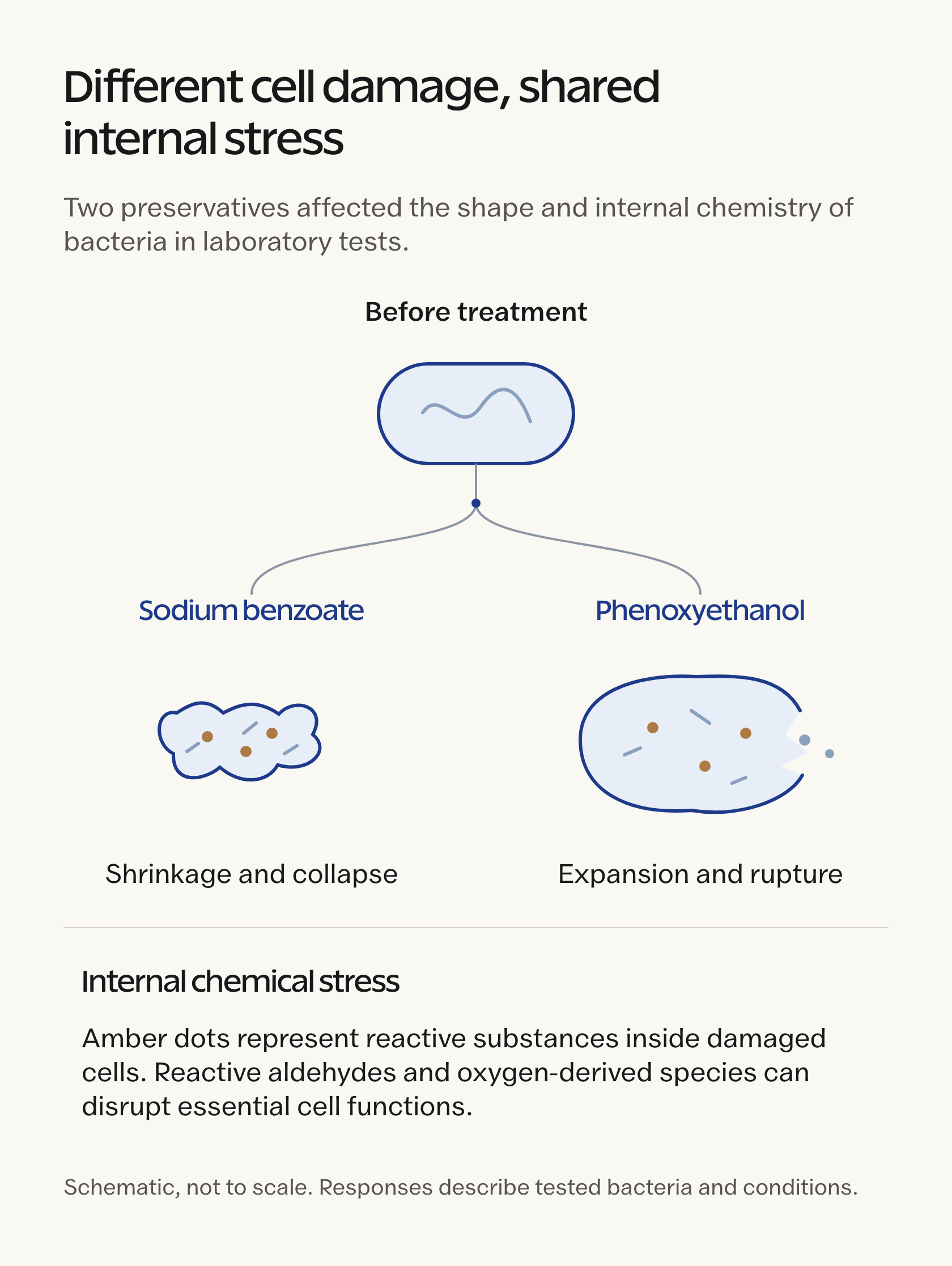
- Sodium benzoate and phenoxyethanol were investigated using microscopy and biochemical tests; the work appeared in Letters in Applied Microbiology.
- The study examined Staphylococcus aureus, a Gram-positive bacterium, and Pseudomonas aeruginosa, a Gram-negative bacterium.
- The reported responses combined physical damage to the cell envelope with accumulation of reactive substances inside bacterial cells.
- Preservation helps prevent microbial spoilage in products; understanding its mechanism can improve formulation choices rather than relying only on observed growth inhibition.
- Laboratory evidence must be separated from claims about consumer safety, treatment of infections or the effectiveness of every finished product.
UPSC Relevance
Prelims Relevance
- Cell envelope and membrane integrity
- Gram-positive and Gram-negative bacteria
- Transmission electron microscopy
- Minimum inhibitory concentration
- pH-dependent preservative activity
Mains Relevance
GS Paper 3
- Connecting basic microbiology with product formulation and spoilage reduction.
- Interpreting laboratory evidence before claiming commercial or clinical benefits.
GS Paper 2
- Evidence standards for consumer-product safety.
Essay
- Scientific understanding improves decisions when its limits remain visible.
Background and Context
What a preservative must disrupt
Preservatives interfere with microbial survival, but the affected structures and internal processes must be examined together to explain their action.
- The cell envelope is the protective boundary surrounding a bacterial cell, including its membrane and associated layers; damage to this boundary can disturb the controlled internal conditions essential for survival.
- The cell membrane regulates exchanges between the cell and its surroundings; loss of integrity can permit leakage, linking a visible structural change to disruption of the cell’s normal internal functioning.
- Gram-positive and Gram-negative bacteria have different envelope architectures; studying representatives of both groups broadens the investigation, although two tested organisms cannot establish how every bacterial species will respond under all conditions.
- Sodium benzoate is used in acidic food products, while phenoxyethanol is used in personal-care formulations; these existing applications explain the practical interest in understanding how their antibacterial action works.
- The research question concerns mode of action: what happens to cells exposed to a preservative; this differs from simply establishing whether bacterial growth slows or stops during a particular laboratory test.

Envelope damage and internal stress
The findings connect changes in bacterial shape with biochemical injury inside the cell, supporting an explanation involving several cellular targets.
- Transmission electron microscopy revealed altered cell structures after treatment; the reported observations included membrane rupture and cytoplasmic leakage, providing visual evidence of envelope damage rather than merely a change in growth.
- Reactive aldehydes and oxygen-derived species accumulated inside treated cells; the researchers linked this internal chemical stress with disruption of proteins, genetic material and other functions needed for bacterial survival.
- Sodium benzoate induced cellular shrinkage and collapse, whereas phenoxyethanol caused membrane expansion and eventual rupture; these are distinct responses observed in the tested systems, not universal sequences for every microorganism.
- Dye-leakage tests helped assess compromised membranes, while biochemical assays examined internal changes; using complementary methods connects outward structural damage with inward chemical stress more convincingly than relying on cell appearance alone.
- Growth-inhibition tests and minimum inhibitory concentration measurements establish whether growth is suppressed under specified conditions; microscopy and biochemical analyses address the separate question of how that suppression may occur inside cells.
Why formulation conditions and evidence limits matter
Preservative performance depends on the environment in which it acts, so a laboratory result cannot become a universal formulation rule.
- Sodium benzoate showed stronger activity in acidic conditions, while phenoxyethanol performed more consistently across the tested pH conditions; the comparison concerns experimental settings rather than an assurance covering every possible product.
- pH describes how acidic or alkaline an environment is; choosing a preservative requires attention to that environment, since results obtained under one condition need not transfer unchanged to another formulation.
- Multiple cellular targets help explain bacterial inactivation, but they do not prove that resistance can never develop; claims about resistance require specific evidence beyond identifying several forms of damage in treated cells.
- Product validation remains necessary because a finished formulation combines ingredients and storage conditions absent from a simplified experiment; the study can inform choices without replacing tests on the actual product.
- Antibacterial activity does not establish suitability for treating human infections or universal sterilisation; the reported findings neither grant a new regulatory approval nor justify increasing preservative quantities beyond applicable product requirements.
Way Forward
Translate mechanisms into tested formulations
- Validate preservative performance in the finished formulation, including its intended pH and storage conditions, before making claims about protection against spoilage.
- Assess safety and efficacy separately: bacterial damage alone cannot demonstrate that a particular exposure is appropriate for consumers.
- Report experimental limits alongside benefits, distinguishing observed mechanisms from proposed improvements in products or resistance management.
Conclusion
- Preservative action can combine damage to a bacterial boundary with chemical injury inside the cell; this study is useful because it links those processes through complementary observations rather than treating growth inhibition as a complete explanation.
- For an analytical answer, connect mechanism, formulation and validation: knowing how a substance acts helps guide product development, while evidence from tested organisms and conditions must remain distinct from wider claims about safety or clinical usefulness.
UPSC Practice Questions
Prelims MCQ 1
With reference to the reported preservative study, consider the following statements:
- The researchers examined both Gram-positive and Gram-negative bacteria.
- Microscopy and biochemical analyses were used together.
- The findings constitute approval to use preservatives for treating bacterial infections.
How many of the above statements are correct?
(a) Only one (b) Only two (c) All three (d) None
Answer: (b) Only two
Explanation:
The study examined representatives of both bacterial groups using complementary methods. It investigated laboratory mechanisms, not approval of clinical treatments.
Prelims MCQ 2
Which observation best illustrates why formulation pH matters when interpreting preservative activity?
(a) All preservatives act identically at every pH. (b) Sodium benzoate showed stronger activity under acidic conditions in the study. (c) Microscopy alone establishes consumer safety. (d) Multiple cellular targets eliminate the need for product testing.
Answer: (b) Sodium benzoate showed stronger activity under acidic conditions in the study.
Explanation:
The reported pH-dependent response shows why experimental conditions matter. It does not support a universal dose or removal of finished-product testing.
UPSC Mains Questions
- Explain how combining structural and biochemical evidence improves understanding of antibacterial preservative action. (150 words)
- Discuss the limits of translating laboratory findings on preservatives into claims about product effectiveness and consumer safety. (150 words)
Source: PIB, Ministry of Science and Technology.
Frequently Asked Questions
What did the preservative study find?
It linked bacterial cell-envelope damage with internal biochemical stress. Sodium benzoate and phenoxyethanol produced different structural responses, indicating that preservative action involves more than a single visible change in the cell.
Why were microscopy and biochemical tests used together?
Microscopy showed structural damage, while biochemical tests examined internal stress. Combining these methods helped connect changes in cell appearance with processes affecting proteins, genetic material and other essential cellular functions.
Why does pH matter for preservatives?
The study found stronger sodium benzoate activity in acidic conditions and more consistent phenoxyethanol activity across tested conditions. This makes the formulation environment relevant when interpreting performance, without establishing a universal rule.
Does this research recommend treating infections with preservatives?
No. The findings concern laboratory bacterial responses and possible formulation improvements. They do not establish clinical treatment, new regulatory approval, universal sterilisation or permission to increase the preservative content of products.
Source: https://anantamias.com/current-affairs/preservatives-bacterial-envelope-biochemical-damage/
REWARD Watersheds: Testing Draft Guidelines Against Field Evidence
Why in News?
A September 23, 2026, official release reported a REWARD technical review calling for field-data validation of additions to the second draft of national watershed guidelines.
- The National Rainfed Area Authority convened the technical meeting on September 22 to review the developing National Technical Guidelines.
- Odisha and Karnataka were asked to share recorded watershed data with NRAA and consortium partners for analysis and validation.
- The review emphasized integrating Land Resource Inventory and hydrology, explaining methods clearly, and sharing Decision Support Systems with stakeholders.
- Shortening Detailed Project Report preparation was suggested, not mandated; the release does not announce final or notified guidelines.
- Watershed works need to fit the land and water conditions of their location; a standard list of structures cannot establish local suitability.
- Field validation tests whether the evidence supports a proposed recommendation before that recommendation guides wider planning.
UPSC Relevance
Prelims Relevance
- REWARD: Rejuvenating Watersheds for Agricultural Resilience through Innovative Development.
- NRAA: National Rainfed Area Authority, a technical knowledge partner in watershed work.
- LRI: Land Resource Inventory used in science-based watershed planning.
- Hydrology: the study of water occurrence, movement and distribution.
- DSS: Decision Support System, assisting evidence-based choices rather than granting automatic approval.
Mains Relevance
GS Paper 3
- Science-based watershed planning for rainfed agriculture and soil-water conservation.
- Integrating local observations with technical decision tools.
GS Paper 2
- Transparent methods and coordination between technical institutions and state implementing agencies.
Essay
- Good public policy learns from the ground.
Background and Context
Why land evidence and water evidence belong together
A watershed connects land through drainage; planning needs to understand both the land’s characteristics and how water moves across and through it.
- A Land Resource Inventory organizes information about local land conditions for planning. Its value comes from identifying differences within the landscape, rather than assuming that neighbouring plots face identical constraints and opportunities.
- Hydrology adds the water relationship: rainfall can become runoff, infiltrate the soil or move onward through drainage. Land information alone cannot establish how much water a proposed intervention can retain or redirect.
- The proposed integration asks planners to interpret these evidence streams together. An intervention should respond to the land-water setting, rather than start with a preferred structure and search later for a convenient site.
- Upstream and downstream locations are connected by water movement. Considering only the plot receiving a structure can miss consequences elsewhere, making the watershed a useful planning unit beyond individual property boundaries.
- REWARD supports improved watershed practices and institutional capacity. The Department of Land Resources describes soil, water, crop and weather advisories as part of its intended contribution to resilience and livelihoods.

What field validation should establish
The review’s central demand was to test claims in the draft against recorded programme data and make the reasoning visible to other users.
- Recorded observations provide a basis for checking whether a claim holds in practice. Sharing the underlying evidence allows technical partners to assess a recommendation instead of relying only on the draft’s stated conclusion.
- Clear methods show how an observation became a result: what was measured, how it was analysed and which assumptions were used. Without that explanation, another team cannot judge whether the finding travels well.
- Local variation matters when extending a finding beyond its original setting. A result from one watershed does not automatically establish the same response elsewhere; applicability should be checked against relevant land and water conditions.
- A Decision Support System can help organize evidence for planning, but access alone does not establish accuracy. Users should understand the information behind its recommendation and the limits within which that recommendation applies.
- Analysis and validation are distinct from displaying collected data. A useful review should show whether the evidence supports the draft claim, requires qualification, or points to a question needing further investigation.
Draft review, project planning and implementation
A technical review can improve a proposed framework without making it final; administrative speed and evidentiary quality remain separate tests for watershed planning.
- The meeting examined additions to the second draft of the National Technical Guidelines. Its requests for analysis and validation describe work still underway, rather than proof that final recommendations have already been issued.
- The release says the developing guidelines are intended for future watershed development under WDC-PMKSY 3.0. That intended use does not make every suggestion discussed at the meeting an operative instruction for current projects.
- A shorter DPR preparation period was proposed to allow more implementation time. The news establishes a suggestion, not a binding deadline, and does not show that faster preparation would automatically preserve planning quality.
- Sector convergence was also suggested for the draft. Its practical purpose is to examine related activities together; any resulting arrangement still needs clear responsibilities and evidence that the activities support the watershed’s needs.
- Implementation outcomes must be distinguished from plans and completed works. A structure being built does not by itself demonstrate improved water availability, reduced erosion or greater farm resilience under the conditions it encounters.
Way Forward
Make every recommendation traceable
- Connect each proposed technical recommendation to recorded evidence, analytical method and applicability limits; qualify claims that the available field data cannot yet support.
- Give implementing teams access to usable data and DSS explanations, with a practical route to report mismatches between recommendations and observed local conditions.
- Assess planning speed alongside evidence quality and implementation readiness; a shorter DPR schedule should not substitute for checking land-water conditions and coordinating responsibilities.
Conclusion
- The REWARD review puts field evidence before wider technical guidance. Its useful lesson is to connect land information, water behaviour and transparent methods so that a recommendation can be examined before it is applied elsewhere.
- For public-policy analysis, distinguish draft, validation and implementation. The meeting advanced a review process; durable gains depend on whether locally suitable decisions are followed by measurable improvements in watershed conditions and livelihoods.
UPSC Practice Questions
Prelims MCQ 1
With reference to the September REWARD technical review, consider the following statements:
- It called for integration of Land Resource Inventory and hydrology.
- It sought recorded programme data for validation of draft guidelines.
- It notified a mandatory shorter DPR preparation deadline.
How many of the above statements are correct?
(a) Only one (b) Only two (c) All three (d) None
Answer: (b) Only two
Explanation:
The first two statements reflect the review. A shorter DPR preparation period was suggested; the release does not establish a notified mandatory deadline.
Prelims MCQ 2
Which best explains why watershed planning combines land inventories with hydrological information?
(a) Land characteristics alone determine every water outcome (b) The combination removes the need for local observations (c) Water movement and land conditions jointly affect intervention suitability (d) A decision tool automatically approves all proposed structures
Answer: (c) Water movement and land conditions jointly affect intervention suitability
Explanation:
Land information identifies local conditions, while hydrology explains relevant water relationships. Considering them together supports better-grounded choices but does not replace validation or approval processes.
UPSC Mains Questions
- Explain how integrating Land Resource Inventory and hydrology can improve watershed planning. Why must recommendations be tested against field evidence?
- Technical guidelines need both scientific credibility and practical usability. Discuss with reference to the REWARD watershed review.
Sources: PIB, Ministry of Agriculture and Farmers Welfare and Department of Land Resources, REWARD programme.
Frequently Asked Questions
What is REWARD?
REWARD stands for Rejuvenating Watersheds for Agricultural Resilience through Innovative Development. It supports improved watershed practices and institutional capacity, with science-based planning intended to strengthen agricultural resilience and livelihoods in participating watersheds.
Were final national watershed guidelines announced?
No. The September release describes review of additions to the second draft and requests for recorded data, analysis and validation. It does not announce that final National Technical Guidelines were notified.
Why combine LRI with hydrology?
A Land Resource Inventory describes local land conditions, while hydrology explains water relationships. Combining them helps planners judge whether an intervention suits its location and consider connections across the watershed.
Did the review mandate a shorter DPR deadline?
No. Compressing the preparation period was suggested to leave more time for execution. The release records that proposal without establishing a binding deadline or proving that planning quality would remain unaffected.
Source: https://anantamias.com/current-affairs/reward-watershed-guidelines-field-data-validation/
SAT-SAAW Contract: Indigenous Procurement Before Induction
Why in News?
On September 23, the Ministry of Defence signed a contract with Bharat Dynamics Limited for Satellite Smart Anti Airfield Weapons under the Buy (Indian-IDDM) category.
- The SAT-SAAW system was designed and developed by DRDO; the Indian Air Force is the intended recipient.
- The Ministry states 60% indigenous content for the system, alongside further indigenisation of subsystems.
- Delivery is scheduled during 2027-28 and 2028-29; the announcement reports a signed contract rather than completed induction.
- Domestic procurement can connect research organisations with production capacity, but manufacturing quality and delivery schedules determine whether contracted systems become usable capability.
- Indigenisation should be assessed through design capability and dependable supply chains, alongside the domestic-content figure attached to a procurement announcement.
UPSC Relevance
Prelims Relevance
- Buy (Indian-IDDM): Indigenously Designed, Developed and Manufactured
- DRDO: design and development role in this system
- Bharat Dynamics Limited: contracted supplier
- Contract, delivery and induction as distinct stages
- Indigenous content and subsystem indigenisation
Mains Relevance
GS Paper 3
- Defence procurement as a bridge between domestic research and manufacturing.
- Delivery accountability and critical supply-chain dependence in defence self-reliance.
Essay
- Institutional capability depends on turning commitments into reliable delivery.
Background and Context
What the signed contract establishes
The new development is a procurement commitment, connecting an indigenously developed system with a supplier and a future delivery schedule.
- Contract signing records an agreement to procure the system and associated equipment; it provides a firmer purchasing commitment than a proposal, but does not establish that the ordered items have been delivered.
- DRDO designed and developed SAT-SAAW, while Bharat Dynamics Limited is the contracted supplier; separating these roles helps explain how public research can move toward production rather than ending at a technology demonstration.
- SAT-SAAW is described by the Ministry as an air-to-ground precision-guided glide weapon; the relevant policy issue here is the domestic acquisition pathway, rather than specifications or claims about operational use.
- The announced delivery window lies ahead of contract signing; reporting these stages separately prevents an order placed today from being counted as equipment already available to the intended service for operational purposes.
- Induction concerns the system entering service, not merely being ordered; the Ministry describes future capability benefits, so the announcement should be read as a production and acquisition milestone rather than completed deployment.
What Indian-IDDM and indigenous content tell us
The procurement category makes indigenous design, development and manufacture central to the purchase, while the content figure describes only part of self-reliance.
- Indian-IDDM expands to Indigenously Designed, Developed and Manufactured; the Ministry explicitly places this contract in that category, making the domestic origin of design and development part of the announcement’s industrial significance.
- The stated 60% indigenous content should not be read as complete domestic sourcing; it describes the reported level for this system, leaving a separate question about dependencies within the remaining supply chain.
- Subsystem indigenisation matters because a domestically developed final system can still depend on specialised components; replacing such dependencies requires reliable substitutes, not simply changing the location where the finished equipment is assembled.
- Design capability and manufacturing capability answer different questions: who can develop the system, and who can reproduce it consistently; a procurement assessment should examine both rather than treating either as sufficient by itself.
- A headline content percentage cannot reveal which components are most difficult to replace; strategic dependence also concerns their importance, availability and substitutability, so the aggregate figure should not stand in for supply-chain analysis.
From production commitments to dependable capability
A signed domestic order creates an opportunity for industrial learning, but delivery discipline and reproducible quality determine whether that opportunity produces lasting capability.
- Production readiness requires more than a successful design: manufacturers must produce consistent outputs over repeated batches; this explains why research success and a procurement contract remain different from a record of reliable deliveries.
- Supplier coordination becomes important when several subsystems enter a final product; delays or quality failures in one component can affect delivery of the whole system, even where other manufacturing work proceeds on schedule.
- Quality assurance should accompany indigenisation so that replacing an imported component does not weaken reliability; this is a general production requirement, not evidence that a particular substitution has already passed all necessary checks.
- Delivery accountability means comparing subsequent progress with the announced schedule; the current release supplies a future delivery window, but it does not provide evidence that those deliveries or eventual service induction have already occurred.
- Domestic industrial learning may grow through repeated production and problem-solving, but wider benefits cannot be assumed from a single order; procurement analysis should track actual supplier capability and sustained performance after the signing ceremony.

Way Forward
Track execution and critical dependencies
- Assess delivery progress against the announced window and distinguish contracted, delivered and inducted equipment in public reporting.
- Prioritise critical subsystem dependencies when planning indigenisation, rather than treating every component as equally important to supply-chain resilience.
- Link domestic production with consistent quality, supplier capability and maintainability, using verified execution evidence instead of the contract announcement alone.
Conclusion
- The SAT-SAAW contract is a concrete procurement step for an indigenously developed system; its significance lies in connecting design with production demand, while the stated delivery window makes clear that execution remains ahead.
- For a balanced answer, assess self-reliance through design capability, critical dependencies and dependable delivery together; neither an indigenous-content figure nor a signed order can independently establish that operational capability has already been created.
UPSC Practice Questions
Prelims MCQ 1
With reference to the announced SAT-SAAW procurement, consider the following statements:
- The contract is under the Buy (Indian-IDDM) category.
- DRDO designed and developed the system.
- The signing announcement confirms completion of delivery and induction.
How many of the above statements are correct?
(a) Only one (b) Only two (c) All three (d) None
Answer: (b) Only two
Explanation:
The first two statements match the Ministry announcement. Delivery is scheduled for future periods, so contract signing does not confirm completed delivery or induction.
Prelims MCQ 2
Which is the most appropriate conclusion from a stated indigenous-content figure in a defence procurement announcement?
(a) Every critical component is necessarily sourced domestically. (b) The system has already entered operational service. (c) The figure should be considered alongside critical subsystem dependencies. (d) The system requires no further manufacturing quality checks.
Answer: (c) The figure should be considered alongside critical subsystem dependencies.
Explanation:
An aggregate content figure does not identify the strategic importance or replaceability of individual components. It also says nothing by itself about delivery or induction.
UPSC Mains Questions
- Explain how defence procurement can connect indigenous research with manufacturing capability. Distinguish contract signing from delivery and induction. (150 words)
- Why should indigenous-content figures be considered alongside critical supply-chain dependencies when assessing defence self-reliance? Discuss. (150 words)
Source: PIB, Ministry of Defence.
Frequently Asked Questions
What is the new SAT-SAAW development?
The Ministry of Defence signed a procurement contract with Bharat Dynamics Limited for a DRDO-developed system. The announcement identifies the domestic procurement category and a future delivery window rather than completed induction.
What does Indian-IDDM stand for?
Indian-IDDM stands for Indigenously Designed, Developed and Manufactured. The Ministry places this contract under that procurement category, linking its acquisition to indigenous design and development as well as manufacturing.
Does 60% indigenous content mean complete self-reliance?
No. The stated figure does not mean every component is sourced domestically. Critical dependencies also depend on which subsystems remain externally sourced and how readily they can be replaced with reliable alternatives.
Why is contract signing different from induction?
A contract establishes a procurement commitment, while delivery transfers the ordered equipment and induction concerns entry into service. The SAT-SAAW release announces future deliveries, so completed induction cannot be inferred from it.
Source: https://anantamias.com/current-affairs/sat-saaw-contract-indigenous-defence-procurement/
Siang Survey Committee: Pre-Feasibility and Community Engagement
Why in News?
On September 23, Arunachal Pradesh’s Cabinet approved an Empowered High-Level Committee to coordinate the proposed Siang Upper Multipurpose Project’s pre-feasibility survey, amid continuing local opposition.
- The Hindu reports that the committee will guide and coordinate the survey and associated activities; the decision concerns an early study stage of a proposed project.
- The proposed Siang Upper Multipurpose Project has an estimated generating capacity of about 11,000 MW; this is a proposal estimate, not electricity already being produced.
- The Cabinet statement promises a transparent, peaceful and people-centric survey, with sustained engagement with residents of Siang and Upper Siang districts.
- Residents along the river belt continue to oppose the survey; committee formation does not establish construction approval, environmental clearance or settled community consent.
- Pre-feasibility should help determine what further investigation is warranted, keeping uncertainties visible before political commitments become difficult to reconsider.
- Community engagement is substantive when affected people can question assumptions and influence choices, rather than merely receive information about a preferred project.
UPSC Relevance
Prelims Relevance
- Siang: the river’s name in Arunachal Pradesh after it enters from Tibet.
- Yarlung Tsangpo: the upstream river in Tibet.
- Brahmaputra: formed in Assam through the joining of the Siang, Dibang and Lohit.
- Pre-feasibility study: an early examination of a proposal’s potential and constraints.
- Installed capacity: a power rating, distinct from electricity actually generated over time.
Mains Relevance
GS Paper 2
- Meaningful public participation and trust in infrastructure decisions.
- Distinguishing administrative coordination from substantive project approval.
GS Paper 3
- Hydropower, river-basin planning and appraisal of environmental and social trade-offs.
Essay
- Listening is part of building public infrastructure.
Background and Context
What the survey committee changes
The decision creates a coordination mechanism for an early project study; it does not answer every question that later appraisal must examine.
- Committee formation identifies an institution to guide survey work and associated activities. It should be read as an administrative step, rather than evidence that technical feasibility, social acceptability and environmental consequences have been settled.
- A pre-feasibility survey examines whether a proposal deserves more detailed investigation. Its usefulness lies in identifying constraints and missing information early, when alternatives can still be compared without assuming that construction must follow.
- Study, approval and implementation are different project stages. Evidence that officials authorised a survey cannot by itself demonstrate permission to build, completion of subsequent appraisal or the start of works on the proposed dam.
- Estimated generating capacity describes the proposed scale, not assured electricity supply. Actual generation depends on operating conditions; the headline capacity cannot establish the amount, timing or reliability of energy that would eventually be delivered.
- Stage clarity also improves public accountability: residents should know what work is proposed now, what questions it is meant to answer and which subsequent decisions remain open to examination after the survey concludes.
Why the river setting demands broader evidence
A multipurpose river project should be assessed through linked water, energy, ecological and livelihood questions, rather than through its generating capacity alone.
- River continuity connects upstream conditions with downstream consequences. The Siang joins the Dibang and Lohit to form the Brahmaputra, making the wider basin relevant when examining a proposal located within one state.
- Multipurpose benefits are claims requiring separate evaluation. The Cabinet says the project could improve water and energy security, mitigate floods and support development; these are attributed expectations, not benefits already demonstrated by an operating project.
- Water storage and electricity can involve different operating priorities. Appraisal should explain how proposed operations address competing objectives, instead of assuming that one large structure automatically delivers every advertised benefit under all conditions.
- Environmental and livelihood evidence should inform the comparison of options, including effects on river-dependent activities and affected settlements. Such questions deserve investigation without presenting unverified impacts as established findings about this particular proposed project.
- Basin-level coordination means testing how local choices affect other users and places, a concern also illustrated by shared river-storage planning; national significance does not remove the need for local evidence and careful appraisal.

What meaningful engagement should establish
Continuing opposition makes the quality of engagement central: communication must explain uncertainties and provide a credible route for responding to affected people’s concerns.
- Affected communities are participants in the decision process, not simply an audience for publicity. Their concerns can identify information gaps and priorities that a technical survey might otherwise overlook when framing its study questions.
- Accessible disclosure should explain the immediate survey’s purpose, likely activities and remaining decisions in language residents can use. It should separate what is known from what is proposed, uncertain or dependent on further study.
- Feedback becomes meaningful when questions receive recorded responses and influence the next steps. A list of meetings held is weaker evidence of participation than an explanation of which concerns changed the study or appraisal.
- Outreach is not consent: the reported school exhibitions may convey information, but they cannot establish agreement among project-affected families. Participation quality must be judged by who was heard and how their concerns were addressed.
- Trust depends on treating disagreement as something to examine, rather than assuming it has disappeared after an official statement. Transparent follow-through matters in river-management planning because coordination must survive beyond a single announcement.
Way Forward
Make the study process answerable
- Publish a clear stage note explaining the survey’s scope, the decisions it does not settle and the evidence needed for subsequent appraisal.
- Keep a public response record of community concerns, answers and unresolved issues; distinguish information events from direct engagement with affected families.
- Evaluate each claimed benefit against stated assumptions and alternatives, with river-basin and livelihood evidence informing the assessment rather than being appended after choices are fixed.
Conclusion
- The Siang committee advances coordination of a proposed survey. Responsible interpretation keeps that administrative step separate from construction permission, proven benefits and community agreement, all of which require their own evidence.
- Credible appraisal combines technical investigation with meaningful participation. The stronger policy approach preserves room to examine alternatives and uncertainties, so an early survey informs decisions instead of merely validating a predetermined outcome.
UPSC Practice Questions
Prelims MCQ 1
With reference to the proposed Siang Upper Multipurpose Project, consider the following statements:
- The reported Cabinet decision creates a committee to coordinate a pre-feasibility survey.
- A committee for a pre-feasibility survey by itself establishes environmental clearance for construction.
- Proposed generating capacity and electricity actually generated are different measures.
How many of the above statements are correct?
(a) Only one (b) Only two (c) All three (d) None
Answer: (b) Only two
Explanation:
Statements 1 and 3 are correct. A coordination committee for an early survey does not itself demonstrate environmental clearance or construction approval.
Prelims MCQ 2
Which of the following best demonstrates meaningful engagement with project-affected communities?
(a) Counting publicity events without recording concerns (b) Treating a school exhibition as proof of affected families’ consent (c) Recording concerns, answering them and explaining how they influence the study (d) Assuming a national project designation settles all local objections
Answer: (c) Recording concerns, answering them and explaining how they influence the study
Explanation:
Meaningful engagement requires a responsive process in which affected people can raise concerns and see how these inform subsequent work.
UPSC Mains Questions
- Distinguish pre-feasibility investigation from project approval. Why does this distinction matter for accountability in large river infrastructure?
- Discuss how meaningful community engagement can improve the appraisal of multipurpose river projects. Use the proposed Siang project as context.
Source: The Hindu.
Frequently Asked Questions
Has the Siang project been approved for construction through this decision?
The reported decision approves a committee to coordinate a pre-feasibility survey. It does not, by itself, establish construction approval, environmental clearance or agreement among the communities likely to be affected.
What is the purpose of a pre-feasibility survey?
It is an early investigation into a proposal’s potential and constraints. It helps identify information needed for more detailed study and should leave room to compare alternatives rather than assume construction must follow.
Are flood protection and energy benefits already proven?
No operating-project evidence is established by this announcement. The Cabinet describes these as potential benefits; their feasibility, conditions and trade-offs need appraisal rather than being treated as guaranteed results of committee formation.
Do outreach exhibitions demonstrate community consent?
No. Exhibitions can communicate information, but cannot establish the agreement of project-affected families. Meaningful engagement requires opportunities to raise concerns, receive answers and understand how feedback influences the study and later decisions.
Source: https://anantamias.com/current-affairs/siang-survey-committee-pre-feasibility-community-engagement/
The Physics Hidden in an Umbrella: Electromagnetic Force
Context:
An ordinary automatic umbrella provides a simple illustration of several important concepts in physics, including elasticity, mechanical energy storage, atomic interactions and electromagnetic force.
| UPSC Relevance: GS-3 Science and Technology: Developments and their applications and effects in everyday life Prelims: Fundamental Forces, Standard Model of Physics |
How does an automatic umbrella open?
The main rod of an automatic umbrella contains a compressed spring and cylindrical sections.
- When we close an umbrella, the spring is compressed. This mechanical energy is stored as elastic potential energy.
- A locking mechanism or hook holds the spring in its compressed state.
- Pressing the button releases the lock. The spring expands and converts its stored elastic potential energy into mechanical energy, pushing the cylinders outward and unfolding the umbrella.
Thus, the button merely releases energy that was previously stored in the compressed spring.
How can a spring store Energy?
- When the spring is compressed: The atoms are forced closer together than their natural, stable equilibrium distance. The negatively charged electron clouds of neighbouring atoms begin to overlap and repel each other via the electromagnetic force.
- When the external force is removed (button is pushed in an umbrella), the material (springs) tends to return towards its equilibrium configuration, i.e, the similar charges push back to return to their original configuration. This is how the elastic force of any material arises.
The restoring force of an ordinary spring is an example of an electromagnetic force.
Four Fundamental Forces of Nature:
There are 4 fundamental forces of nature.
1. Gravitational Force: The force of attraction between objects that have mass. It is responsible for phenomena such as planetary motion and objects falling toward Earth. It is the weakest among the four fundamental forces.
2. Electromagnetic Force: The force of attraction or repulsion between electrically charged particles. Responsible for electricity, magnetism, chemical bonding and many macroscopic material properties.
3. Strong Nuclear Force: The strong nuclear force holds protons and neutrons together in a nucleus. It is the strongest among the four fundamental forces.
4. Weak Nuclear Force: Responsible for processes such as beta decay, and plays an important role in nuclear reactions such as those occurring in stars.
The Standard Model of Physics explains 3 of the 4 fundamental forces (electromagnetic, strong, and weak) but not gravity. The graviton, the force-carrying particle of gravity, has not been discovered yet.
UPSC PYQ 2013
Q. The known forces of nature can be divided into four classes, viz., gravity, electromagnetism, weak nuclear force and strong nuclear force. With reference to them, which one of the following statements is not correct?
(a) Gravity is the strongest of the four
(b) Electromagnetism acts only on particles with an electric charge
(c) Weak nuclear force causes radioactivity
(d) Strong nuclear force holds protons and neutrons inside the nucleus of an atom four
Answer: (a)
Source: https://anantamias.com/current-affairs/the-physics-hidden-in-an-umbrella-electromagnetic-force/
Towards recognising Women Farmers
Why in News?
Recently, Maharashtra has enacted the Women Farmers Empowerment Act, 2026, after receiving the Governor’s assent. It provides for a Woman Farmer Certificate, recognising women’s agricultural work independently of land ownership.
The development coincides with the United Nations’ International Year of the Woman Farmer, 2026, which highlights women’s contributions to agrifood systems and barriers involving land, finance, technology and services.
| UPSC Relevance: GS-3 Economy: Agriculture, Inclusive growth; GS-I Indian Society: Women empowerment Prelims: Govt Initiatives, International Year of the Woman Farmer (2026) Mains: Women in Agriculture: associated challenges and govt policy initiatives; Feminisation of Agriculture |
Women undertake sowing, transplanting, weeding, harvesting, livestock care and post-harvest processing. However, administrative identification of farmers frequently depends on land records, where men’s names predominate. This creates a gap between who performs agricultural work and who receives institutional recognition and support.
The National Policy for Farmers, 2007 has already adopted a broad definition covering cultivators, agricultural labourers, tenants, sharecroppers, livestock rearers and other agricultural occupations. However, this inclusive policy definition does not automatically determine eligibility under every agricultural scheme.
Data on Women’s Participation in Agriculture:
- Dependence on agriculture: According to PLFS 2023-24, agriculture employed 64.4% of female workers, compared with 36.3% of male workers.
- Greater rural concentration: Among rural workers, 76.9% of women worked in agriculture, compared with 49.4% of men.
- Increasing concentration: The proportion of female workers employed in agriculture increased from 57% in 2017-18 to 64.4% in 2023-24.
- Limited operational control: Agriculture Census 2015-16 recorded women’s share at approximately 13.96% of operational holdings, accounting for 11.72% of operated area. Operational holdings are not identical to legal land ownership.
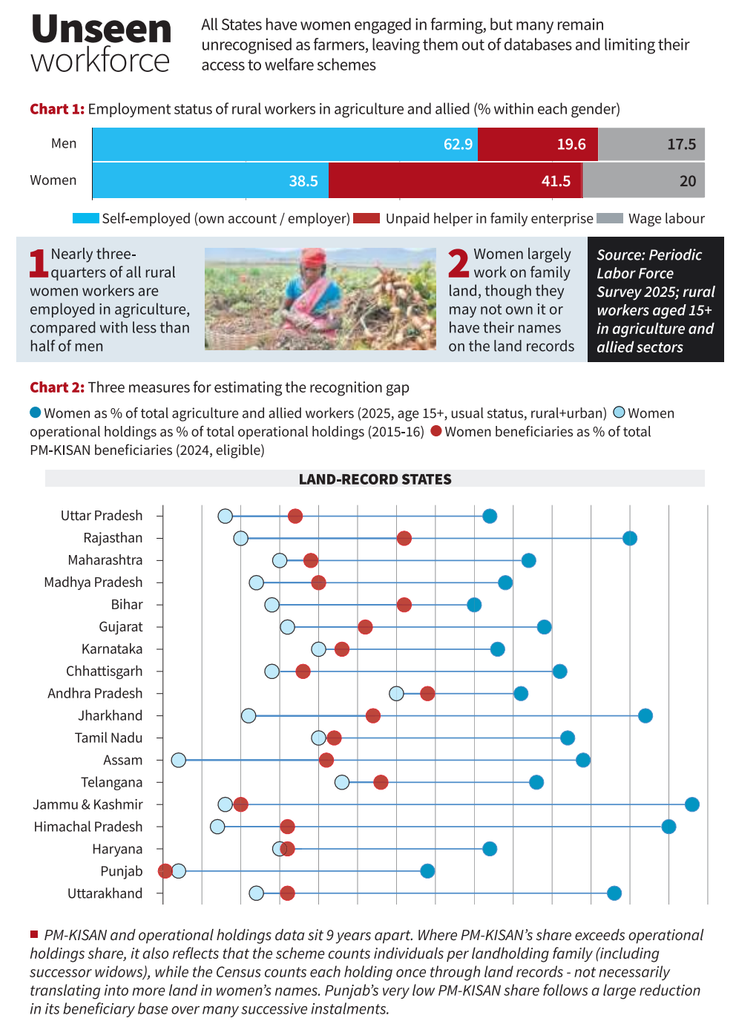
What is Feminisation of Agriculture?
Feminisation of agriculture refers to the increasing participation, labour contribution and responsibility of women in agricultural production, cultivation and farm management, particularly as men increasingly move to non-farm employment or migrate.
Its major drivers include:
- Male migration: Migration of men to cities and non-farm sectors leaves women to manage cultivation, livestock and other farm activities in their absence.
- Shift towards non-farm employment: Expansion of construction, manufacturing, services and other sectors has drawn men away from agriculture, increasing women’s relative contribution to farming.
- Limited rural employment opportunities for women: Lower mobility, skill constraints, social norms and inadequate access to non-farm jobs can make agriculture one of the few available livelihood options for rural women.
- Agrarian livelihood distress: Falling farm incomes, rising input costs and indebtedness may compel households to increase women’s participation in farm and allied activities to supplement family income.
- Growth of allied activities: Women have traditionally been heavily involved in dairy, poultry, livestock rearing, fisheries, horticulture and food processing. Expansion of these activities can increase their economic role in agriculture.
- Land fragmentation and smallholder farming: In small and family-operated farms, women often undertake multiple stages of production, from sowing and weeding to harvesting and post-harvest processing.
- Women’s collectives and institutional support: Self-Help Groups (SHGs), Farmer Producer Organisations (FPOs), cooperatives and women-led producer groups can facilitate collective farming, access to credit, inputs, markets and value addition.
- Climate and demographic pressures: Climate variability, changing cropping patterns and demographic changes can increase women’s responsibility for maintaining household food and livelihood security.
However, greater participation of women does not necessarily imply empowerment. Women may acquire more work without corresponding control over land, income or production decisions.
Major Challenges faced by Women Farmers:
- Insecure access to land: Patriarchal inheritance practices and informal tenancy restrict women’s control over agricultural assets. Even when women cultivate land, their contribution may remain absent from administrative records.
- According to the Agriculture Census 2015-16, only 13.87% of total operational farm holdings are held by women.
- According to the National Family Health Survey (NFHS-5), only 8.3% of Indian women owned land alone (sole ownership).
- Barriers to agricultural benefits: PM-KISAN requires beneficiaries to hold an official cultivable land title to receive the ₹6,000 annual benefit. Consequently, even if a landless woman is legally recognised as a farmer, she is excluded from the scheme as she does not hold the official deed or title to the land she cultivates.
- Limited access to formal credit: Weak asset ownership, documentation gaps and limited banking limits their access to financial institutions. SHG finance can help, but may not meet larger requirements for irrigation, machinery or commercial cultivation.
- Unpaid labour and weak decision-making power: Women’s work on family farms often receives no separate remuneration. Decisions about crop choice, marketing and spending may remain with male household members.
- Time poverty and mechanisation gap: Agricultural work combines with cooking, childcare and water or fuel collection. Heavy equipment and inconvenient training schedules can further restrict women’s access to mechanisation and extension services.
- Climate vulnerability: Droughts, heat and crop failures can increase farm workloads, fodder and water collection burdens, and household livelihood insecurity.
Existing Initiatives and their Relevance:
- Mahila Kisan Sashaktikaran Pariyojana (MKSP): A sub-component of DAY-NRLM, implemented by the Ministry of Rural Development, to strengthen women’s agricultural skills, productivity and sustainable livelihoods.
- SHGs under DAY-NRLM: Support collective organisation, access to finance and livelihood diversification.
- Gender-responsive agricultural assistance: Agricultural programmes have provided targeted expenditure and additional assistance for women, including support for training and mechanisation. Actual benefits depend on the relevant scheme guidelines.
- Collective farming: Kerala’s Kudumbashree is an example of women participating in agriculture through groups, including where individual land ownership is limited.
| Key Features of Maharashtra’s Women Farmers Empowerment Act, 2026: Activity-based recognition: Covers eligible women aged 18 years or above residing in Village Panchayat or Nagar Panchayat areas. Broad coverage: Includes tenants with oral or written arrangements, landless cultivators, livestock rearers, agricultural labourers and pastoralists. Recognition of unpaid work: Agriculture includes specified activities performed with or without remuneration. Certification: Gram Sabhas assess applications; designated officers issue certificates. Gram Sabhas can also identify eligible women who have not applied. Procedural safeguards: Provides written reasons for rejection and an appeal mechanism. Institutional support: Provides for a women farmers’ database, State Fund, Empowerment Council, Empowerment Cell and monitoring arrangements. Limitation: The certification establishes women farmers’ identity under the Act, but this certificate cannot be used as a legal property deed. The land still belongs to whoever legally owns it (like a landlord, husband, or family member). To get the help from Central schemes (like PM-KISAN), she must still meet the specific, separate rules and criteria set by the Central Government. |
Way Forward:
- Move from recognition to entitlements: A Women Farmer Certificate should become a gateway to a clearly defined set of agricultural services (credit, extension, insurance, inputs, mechanisation, training and market support) subject to the eligibility conditions of individual schemes. This would prevent certification from becoming merely an identity document.
- Create a gender-responsive Farmer Registry: Farmer databases should capture cultivators, tenants, sharecroppers, agricultural labourers and allied-activity workers, rather than equating farmer exclusively with the landowner.
- Strengthen women’s land and tenancy security: Certification must be complemented by joint land titles, enforcement of inheritance rights, recognition of tenancy and secure leasing arrangements.
- Shift from individual ownership to collective access: Where individual land ownership is difficult, women’s SHGs, cooperatives and FPOs can be treated as viable units for accessing credit, machinery, storage, processing and markets. The Kudumbashree experience demonstrates the potential of collective approaches where individual ownership is limited.
- Make agricultural technology gender-responsive: Mechanisation policy should move beyond simply providing machines to ensure that equipment is affordable, ergonomically suitable and accessible through Custom Hiring Centres.
- Design finance around women’s actual constraints: Expand collateral-light and group-based credit, while improving women’s access to crop insurance, working capital and investment finance. SHG-based finance can be complemented with larger institutional credit for irrigation, machinery and commercial agricultural activities.
- Recognise unpaid work and measure outcomes: Policy monitoring should distinguish between participation and empowerment. Indicators should include women’s ownership/control of assets, access to credit and extension, income retained, participation in crop and marketing decisions, reduction in drudgery and representation in farmer institutions & not merely the number of women registered as farmers.
The objective should therefore be to move from “women working in agriculture” to “women recognised, resourced and empowered as farmers” with rights over assets, access to technology and finance, participation in markets, and a meaningful voice in agricultural decision-making.
UPSC PYQ 2014:
Q. Discuss the various economic and socio-cultural forces that are driving increasing feminisation of agriculture in India. (GS-I)
Mains Practice Question:
Q. “Recognition of women as farmers is necessary but insufficient for their empowerment.” Discuss with reference to land rights, agricultural databases and access to institutional support.
Prelims Practice MCQ:
Q. With reference to women farmers in India, consider the following statements:
- The National Policy for Farmers 2007 includes agricultural labourers and sharecroppers within its definition of farmers.
- Mahila Kisan Sashaktikaran Pariyojana is a sub-component of DAY-NRLM.
- Recognition as a farmer by a State government automatically makes a landless agricultural worker eligible for PM-KISAN.
Which of the statements given above are correct?
(a) 1 and 2 only
(b) 2 and 3 only
(c) 1 and 3 only
(d) 1, 2 and 3
Answer: (a)
Explanation: Statement 3 is incorrect because PM-KISAN eligibility depends on its own conditions, including eligible cultivable landholding.
Source: https://anantamias.com/current-affairs/towards-recognising-women-farmers/
Using Trade Treaty Policy to strengthen Arbitration: FTAs, BITs and Arbitration
Why in News?
India’s expanding network of Free Trade Agreements (FTAs) and Bilateral Investment Treaties (BITs) provides an opportunity to strengthen commercial arbitration. Investors seek not only market access but also confidence that disputes will be resolved fairly and efficiently.
| UPSC Relevance: GS-2 International Relations; GS-3 Economy: External Sector, Trade, Ease of doing business Prelims: Recent FTAs; Bilateral Investment Treaty |
What are FTAs and BITs?
- Free Trade Agreements (FTAs) primarily seek to facilitate cross-border trade by reducing tariffs and other barriers and establishing rules governing trade in goods and services. Modern FTAs may also cover investment, intellectual property, digital trade, government procurement and dispute settlement.
- Bilateral Investment Treaties (BITs) primarily establish reciprocal standards for the protection and treatment of investments made by investors of one country in the territory of another. They may provide protections against discriminatory treatment and unlawful expropriation and may establish mechanisms for resolving investment disputes.
Commercial Arbitration and Investor-State Dispute Settlement:
(i) Commercial Arbitration:
- Commercial arbitration is an alternative dispute resolution method where parties agree to submit business or contractual disagreements to a private arbitrator instead of a public court.
- Legal Basis: In India, this is governed by the Arbitration and Conciliation Act, 1996, which covers both domestic and international commercial arbitrations.
- Cross-Border Application: Foreign investors and Indian companies or government bodies rely on an explicit arbitration clause in their contracts to bypass local court delays.
- E.g., it can be used to recover unpaid dues or address breach-of-contract claims between a foreign contractor and an Indian public sector undertaking or government agency.
(ii) Investor-State Dispute Settlement:
- Investor-State Dispute Settlement (ISDS) is a specialised legal mechanism embedded in international investment agreements (IIAs) and bilateral investment treaties (BITs). It grants eligible foreign investors the right to directly initiate international arbitration against a host government.
- Legal Basis: Claims are brought if the host State allegedly breaches specific treaty obligations, such as expropriating property without compensation, denying fair and equitable treatment, or implementing discriminatory regulations.
- ISDS bypasses local domestic courts, providing foreign investors with a neutral, international forum to protect their capital and seek financial compensation.
India is a party to the New York Convention, 1958, subject to reciprocity and commercial reservations. It supports cross-border recognition and enforcement of arbitral awards, but enforcement remains subject to prescribed conditions.
Major Challenges in the Existing Framework:
- Investor Protection vs. Policy Space: Balancing robust investor protection with host-state sovereignty is a primary hurdle. India’s strict Model Bilateral Investment Treaty (BIT) tilts heavily toward defending state regulatory powers. While this shields the government’s authority to act on public interests (such as health, tax, and environment), the omission of baseline protections like the Most-Favoured-Nation (MFN) clause significantly dampens foreign investor confidence.
- The ISDS void in Modern FTAs: India’s recent trade policy shows a strong aversion to traditional international tribunals. Major pacts like the India-UK CETA omit ISDS entirely, opting instead for State-to-State dispute resolution. Consequently, foreign investors face unclear remedies. While commercial arbitration can resolve standard contract disputes with state entities, it cannot enforce or protect broader treaty rights.
- Lengthy local-remedies requirements: Some BITs require investors to pursue domestic remedies before international arbitration. E.g., India-UAE BIT: Provides a three-year local-remedies requirement. India-Uzbekistan BIT: Contains a five-year requirement, with specified qualifications. Given the backlog in the Indian judicial system, this mandatory litigation period adds severe delays and prohibitive cost burdens.
- Lack of a Statutory Framework for Third-Party Funding (TPF): While Indian courts passively permit third-party funding for commercial disputes, the country lacks a dedicated statutory framework to govern it in arbitration. This regulatory vacuum creates compliance uncertainty regarding mandatory disclosures, conflicts of interest, and cost liabilities for international funders backing complex claims against state entities.
- Delays in Domestic Enforcement: The efficiency of any international or commercial award relies heavily on swift enforcement. If a foreign investor wins an award against an Indian entity, the subsequent domestic litigation required to enforce it through Indian courts often turns into a multi-year battle, undermining the primary speed advantage that arbitration is supposed to deliver.
The Editorial’s Three Proposals:
1. Explain Why an FTA Omits ISDS: When an FTA deliberately leaves out Investor-State Dispute Settlement (ISDS), the treaty text should explicitly map out the alternative domestic courts and contractual remedies available to investors. This transparency reduces market uncertainty and establishes clear expectations from day one
2. Recognise Suitable Commercial Arbitration as a Local Remedy: Future Bilateral Investment Treaties (BITs) should explicitly state that time spent pursuing private commercial arbitration in India counts toward fulfilling the mandatory local-remedies timeline (such as the 3 or 5-year periods).
3. Separate Funding Rules for ISDS and Commercial Arbitration: Treaties must draw a sharp line between different types of dispute financing. A blanket treaty ban on Third-Party Funding (TPF) for international investment claims should explicitly exclude domestic commercial arbitration, allowing India to maintain a distinct, pro-business policy for commercial disputes.
Conclusion:
India’s treaty policy should link market access and investment protection with credible dispute resolution. Clear treaty obligations, effective commercial arbitration and predictable enforcement can strengthen investor confidence while preserving legitimate regulatory space.
Deep rot: With the SIR thoroughly vitiated, CEC Gyanesh Kumar must resign
Why in news?
Probe shows two Election Commissioners objected 14 times to SIR decisions; ex-CEC calls SIR illegal.
UPSC Relevance
Prelims: Constitutional body ECI, RPA 1950; Registration of Electors Rules 1960 (Form 6, Rule 21A); CEC & ECs Act 2023; Anoop Baranwal (2023); ADR v ECI (2026)
Mains: GS-II – Salient features of RPA; Appointment, powers and functions of constitutional bodies; Separation of powers
The findings of the Indian Express Report
- ECs Sukhbir Singh Sandhu and Vivek Joshi objected on record at least 14 times (Oct 2025–Aug 2026), to mostly decisions taken without their knowledge.
- Form 6: EC Joshi warned (May) Form 6 could not be changed without amending the rules but the warning was ignored and in July it still asked if applicants or their parents/grandparents were in the “last SIR” roll. EC Sandhu called it “unauthorised and illegal”.
- Centralisation: The Roll database was centralised and the two ECs sought an audit of the same. Moreover, field officials lacked full ERONet access and changes were made centrally that overrode Electoral Registration Officers (EROs) – the statutory authority on eligibility.
- West Bengal: ~60 lakh flagged for software-generated “logical discrepancies”; 9 in 10 appeals decided so far got the names back in the roll.
- Delhi: 24 of 70 seats have fewer electors in draft rolls than actual voters 1.5 years ago.
- ECI’s response : Differing views are normal deliberation; all final decisions in the past year were unanimous; ECINet runs under strict data-security protocols.
What is SIR?
- A Special Intensive Revision is a fresh, house-to-house preparation of the electoral roll, unlike the annual summary revision which only updates the existing roll.
- ECI ordered it for Bihar on 24 June 2025 (last intensive revision: 2003), invoking Art. 324 + Sec. 21(3), RPA 1950. Bihar’s roll fell from 7.89 crore to 7.42 crore (final roll, 30 Sept 2025).
- Phase-2 followed in other States, including West Bengal from Nov 2025.
Constitutional and Legal framework
- Art. 324: Superintendence, direction and control of preparation of electoral rolls vests in ECI. Art. 324(5): CEC removable only like an SC judge; ECs removable only on CEC’s recommendation.
- Art. 325: One general roll; no exclusion on religion, race, caste or sex.
- Art. 326: Adult suffrage – citizen, 18+, not disqualified by law.
- RPA 1950: Sec. 13B – ERO prepares the roll; Sec. 16 – disqualification (non-citizen, unsound mind etc.); Sec. 21(3) – special revision “in such manner as ECI thinks fit”; Sec. 22 – correction of entries; Sec. 24 – appeals; Sec. 28 – Central Govt makes rules after consulting ECI.
- Registration of Electors Rules 1960: Prescribe Form 6 (new electors); Rule 21A – deletion only after due procedure.
Key judgments
- Lal Babu Hussein v ERO (1995): A person already on the roll cannot be deleted without notice and a fair hearing; earlier inclusion carries weight.
- ADR v ECI (2026): Upheld Bihar SIR – power exists under Art. 324 + Sec. 21(3); passes proportionality; ECI may examine citizenship for roll purposes but cannot decide citizenship itself.
SIR – legal and constitutional
- Clear legal source: Art. 324 read with Sec. 21(3) expressly allows special revision in the manner ECI thinks fit – confirmed in ADR v ECI (2026).
- Constitutional duty: Art. 326 limits franchise to citizens; Sec. 16 bars non-citizens. Verifying eligibility is a duty, not an excess.
- Legitimate aim: Two decades of migration, urbanisation and unreported deaths left rolls with dead, shifted and duplicate entries. Clean rolls protect ‘one person, one vote’.
- Safeguards exist: House-to-house enumeration, claims and objections, appeals under Sec. 24, tribunals with judicial officers; SC supervision during Bihar exercise.
- Judicial finality: Once the SC has upheld the exercise, calling it “illegal” questions a settled legal position.
SIR – illegal and unconstitutional
- Ultra vires Form 6 change: Forms are part of rules made by the Centre under Sec. 28. ECI cannot alter them alone – Art. 324 cannot override law (Mohinder Singh Gill). Hence EC Sukhbir Sandhu’s “unauthorised and illegal” note.
- Bypassing the ERO: Sec. 13B, 22 and Rule 21A make the ERO the statutory decision-maker. Deletions/changes at central-database level by excluding ERO are without authority of law.
- Reversed burden of proof: Deleting before verification and asking citizens to prove eligibility goes against Lal Babu Hussein and weakens universal adult franchise (Art. 326).
- Citizenship is not ECI’s domain: Under the Citizenship Act 1955, the Centre/competent authority decides citizenship. ADR (2026) itself said ECI cannot decide it – yet the Form 6 “last SIR” question works like a citizenship filter.
- Fails proportionality in practice: 90%+ appeals in West Bengal restored names – shows the means were excessive, not least restrictive (Puttaswamy test).
- Arbitrariness (Art. 14): Software-generated “logical discrepancies” without human scrutiny are manifestly arbitrary (E.P. Royappa 1974; Shayara Bano 2017).
- Collegial breach: Decisions taken without the knowledge of two of three Commissioners go against the unanimity/majority rule of 2023 Act.
- Independence deficit: Executive-dominated panel (2023 Act) chose the CEC; Justice Datta: an ECI must be, and be seen to be, independent.
- Data and privacy: A centralised, un-audited roll database raises privacy and security concerns (Puttaswamy; DPDP Act 2023).
Way ahead
- Immediate audit : Independent technical audit of ECINet/ERONet and the roll database (as the ECs sought); pause further deletions until audit .
- Due process: No deletion without notice, hearing and a reasoned order by the ERO (Lal Babu Hussein; Rule 21A). Burden of proving ineligibility on the State. Accept Aadhaar and past roll entries as presumptive proof.
- Rule of law: Any change in forms only through amendment of the 1960 Rules under Sec. 28, with public consultation.
- Transparency: Publish lists of deletions with reasons (as SC ordered for Bihar, Aug 2025); record and disclose Commission minutes and dissents.
- Independence of ECI: Neutral selection panel – Tarkunde Committee (1975) and Anoop Baranwal (2023): PM, LoP, CJI; Dinesh Goswami Committee (1990): consultation with CJI and LoP; Law Commission 255th Report (2015): collegium of PM, LoP, CJI and equal removal protection for ECs; 2nd ARC (4th Report): broad-based collegium. Larger Bench should decide the 2023 Act quickly.
- “The ECI must not only be independent but also be seen to be independent.” – Justice Dipankar Datta (2026).
- Global practices: Canada and Australia use continuous, data-linked rolls with automatic enrolment; the burden of registration stays largely on the State.
Practice MCQs
Q1. Consider the following statements:
1. Section 21(3) of the RPA, 1950 empowers the ECI to direct a special revision of electoral rolls in such a manner as it thinks fit.
2. The ECI can alter forms under the Registration of Electors Rules, 1960 on its own, without amending the Rules.
3. The Electoral Registration Officer is the statutory authority for preparing the roll of a constituency.
How many of the above statements are correct?
(a) Only one
(b) Only two
(c) All three
(d) None
Answer: (b). Rules are made by the Central Government after consulting the ECI (Sec. 28), so statement 2 is wrong.
Quality control and India’s manufacturing growth
Why in news?
DPIIT’s Transition Facilitation (Quality Control) Order 2026 eases BIS certification.Experts urge wider QCO reassessment.
UPSC Relevance
Mains: GS-III – Changes in industrial policy and their effect on industrial growth; Effects of liberalisation; Growth, development and employment; Inclusive growth (MSMEs).
What is a QCO?
- A Quality Control Order makes an Indian Standard mandatory for a product. Once notified, the product cannot be made, imported, sold or stored without the BIS standard mark.
- QCOs are issued by the line ministry (e.g., Chemicals, Steel, Textiles, DPIIT) in consultation with BIS, under Section 16 of the BIS Act, 2016. Violations attract penalties under the Act.
- BIS conformity schemes
- Scheme-I (Product Certification / ISI mark): Licence after factory inspection and sample testing by BIS – slower and costlier.
- Scheme-II (Compulsory Registration Scheme): Registration based on self-declaration and test reports from BIS-recognised labs; mainly electronics and IT goods – lighter process. The 2026 Transition Order lets firms temporarily source from Scheme-II-licensed suppliers.
- They apply equally to domestic and foreign producers; foreign firms need BIS licences under the Foreign Manufacturers Certification Scheme (FMCS).
- It is often considered a non-tariff barrier.
- A non-tariff barrier is a trade restriction used by countries to limit imports through mechanisms other than direct taxes or duties.
Recent issues and developments
- WTO scrutiny: At India’s 8th Trade Policy Review (July 2026), QCOs and other Non Tariff Barriers were questioned by the EU and US, and also by BRICS partners Brazil, China and Indonesia.
- Rapid expansion: Products under QCOs rose from 88 (2019) to 765 (Dec 2024). Expansion slowed by end-2025 as several QCOs, mainly on intermediate goods, were revoked or suspended.
- New order: Transition Facilitation (Quality Control) Order, 2026, notified by DPIIT on 25 June 2026. Firms unable to get BIS Scheme-I certification can temporarily source from BIS Scheme-II-licensed suppliers in sectors like toys, footwear and air conditioners, subject to eligibility and approval by a DPIIT committee.
- Pending work: 600+ QCO-covered products still to be reassessed, including key inputs in chemicals, steel, textiles, machinery, electronics, rubber and plastics.
- Success of quality standards should be judged not by the number of products covered, but by whether quality improves without hurting scale, efficiency and competitiveness.
Why did QCOs expand ?
- Consumer safety: Curb substandard goods (e.g., toys, helmets, pressure cookers) as per spirit of Art. 47 and Consumer Protection Act, 2019.
- Atmanirbhar Bharat: Check cheap, low-quality imports, especially from China; support PLI-linked domestic manufacturing.
- Push domestic firms to upgrade quality – “zero defect, zero effect”.
- Allowed under WTO Technical Barriers to Trade (TBT) Agreement for legitimate objectives (safety, health, environment).
Problems with excessive QCOs
- Input shortage: Many covered inputs (polymers, fibres, chemicals) are not produced domestically in enough quantity and foreign suppliers face BIS licensing delays causing shortage.
- Cost push: Higher input prices due to compliance cost cut value addition downstream ( GVA for large firms reduced by 37%).
- MSME squeeze: Fixed compliance costs hurt small firms most (reduced their profitability by 47.6%).
- Export competitiveness: Costlier inputs make Indian final goods less competitive, working against GVC integration.
- Trade friction: Seen by partners as disguised Non Tariff Barriers; raised as Specific Trade Concerns at the WTO TBT Committee.
- BIS testing and inspection capacity lags behind the pace of notifications.
Government’s course correction
- Rajiv Gauba Committee ( NITI Aayog) recommended rationalising or phasing QCOs on raw materials used by MSMEs.
- Revocations were made on certain products : Six QCOs on fatty acids (22 Oct 2025); 14 QCOs on plastics, polymers, polyester fibre and yarns (12 Nov 2025); seven chemical QCOs (28 Nov 2025).
- Transition Facilitation (Quality Control) Order, 2026 – temporary flexibility for firms stuck on Scheme-I certification under BIS Scheme-II.
Way ahead
- Regulatory Impact Assessment (RIA) before every new QCO – check domestic capacity, input prices and downstream effects.
- Priority: Final consumer goods with safety risks must be prioritised and not intermediate inputs.
- Economic Survey 2024-25 on MSME : Urged deregulation and easing of compliance for MSMEs via Graded compliance, fee waivers, longer transition, common testing facilities.
- Capacity: More BIS-recognised labs; time-bound licensing for foreign suppliers.
- Global alignment: Mutual Recognition Agreements (MRAs) and adoption of international standards (ISO/IEC).
- Sunset and review clauses in every QCO with periodic reassessment.
Practice MCQs
Q1. Consider the following statements about Quality Control Orders (QCOs):
1. They are issued under Section 16 of the Bureau of Indian Standards Act, 2016.
2. They apply only to imported goods and not to domestic manufacturers.
3. They can be issued by line ministries in consultation with BIS.
How many of the above statements are correct?
(a) Only one
(b) Only two
(c) All three
(d) None
Answer: (b) QCOs apply equally to domestic and imported goods.
Q2. With reference to the WTO Trade Policy Review Mechanism, consider:
1. All members are reviewed at the same interval.
2. Reviews are conducted by the Trade Policy Review Body, which is the General Council.
3. The reviews are meant to enforce specific WTO obligations and impose penalties.
Which of the above is/are correct?
(a) 1 and 2 only
(b) 2 and 3 only
(c) 2 only
(d) 1, 2 and 3
Answer: (c) Frequency depends on trade share; TPRs are for transparency, not enforcement.
Mains practice questions
Q1. Non-tariff measures are increasingly shaping India’s trade relations. Discuss the challenges they pose to India’s integration into global value chains and suggest reforms. (10 marks, 150 words)
Source: https://anantamias.com/current-affairs/quality-control-and-indias-manufacturing-growth/