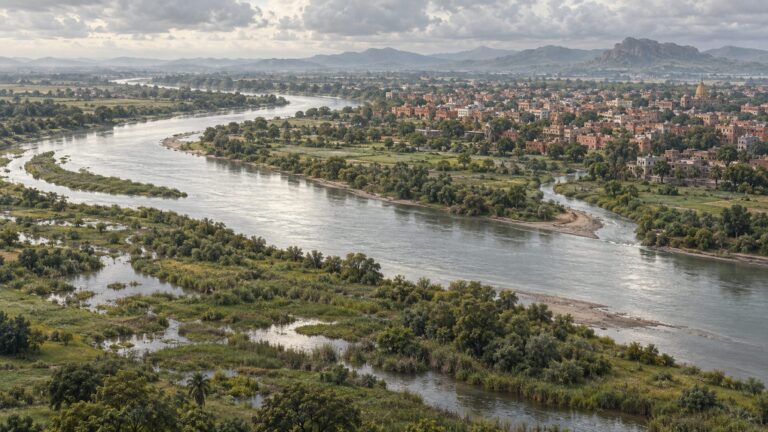
Why in News?
On September 23, Arunachal Pradesh’s Cabinet approved an Empowered High-Level Committee to coordinate the proposed Siang Upper Multipurpose Project’s pre-feasibility survey, amid continuing local opposition.
- The Hindu reports that the committee will guide and coordinate the survey and associated activities; the decision concerns an early study stage of a proposed project.
- The proposed Siang Upper Multipurpose Project has an estimated generating capacity of about 11,000 MW; this is a proposal estimate, not electricity already being produced.
- The Cabinet statement promises a transparent, peaceful and people-centric survey, with sustained engagement with residents of Siang and Upper Siang districts.
- Residents along the river belt continue to oppose the survey; committee formation does not establish construction approval, environmental clearance or settled community consent.
- Pre-feasibility should help determine what further investigation is warranted, keeping uncertainties visible before political commitments become difficult to reconsider.
- Community engagement is substantive when affected people can question assumptions and influence choices, rather than merely receive information about a preferred project.
UPSC Relevance
Prelims Relevance
- Siang: the river’s name in Arunachal Pradesh after it enters from Tibet.
- Yarlung Tsangpo: the upstream river in Tibet.
- Brahmaputra: formed in Assam through the joining of the Siang, Dibang and Lohit.
- Pre-feasibility study: an early examination of a proposal’s potential and constraints.
- Installed capacity: a power rating, distinct from electricity actually generated over time.
Mains Relevance
GS Paper 2
- Meaningful public participation and trust in infrastructure decisions.
- Distinguishing administrative coordination from substantive project approval.
GS Paper 3
- Hydropower, river-basin planning and appraisal of environmental and social trade-offs.
Essay
- Listening is part of building public infrastructure.
Background and Context
What the survey committee changes
The decision creates a coordination mechanism for an early project study; it does not answer every question that later appraisal must examine.
- Committee formation identifies an institution to guide survey work and associated activities. It should be read as an administrative step, rather than evidence that technical feasibility, social acceptability and environmental consequences have been settled.
- A pre-feasibility survey examines whether a proposal deserves more detailed investigation. Its usefulness lies in identifying constraints and missing information early, when alternatives can still be compared without assuming that construction must follow.
- Study, approval and implementation are different project stages. Evidence that officials authorised a survey cannot by itself demonstrate permission to build, completion of subsequent appraisal or the start of works on the proposed dam.
- Estimated generating capacity describes the proposed scale, not assured electricity supply. Actual generation depends on operating conditions; the headline capacity cannot establish the amount, timing or reliability of energy that would eventually be delivered.
- Stage clarity also improves public accountability: residents should know what work is proposed now, what questions it is meant to answer and which subsequent decisions remain open to examination after the survey concludes.
Why the river setting demands broader evidence
A multipurpose river project should be assessed through linked water, energy, ecological and livelihood questions, rather than through its generating capacity alone.
- River continuity connects upstream conditions with downstream consequences. The Siang joins the Dibang and Lohit to form the Brahmaputra, making the wider basin relevant when examining a proposal located within one state.
- Multipurpose benefits are claims requiring separate evaluation. The Cabinet says the project could improve water and energy security, mitigate floods and support development; these are attributed expectations, not benefits already demonstrated by an operating project.
- Water storage and electricity can involve different operating priorities. Appraisal should explain how proposed operations address competing objectives, instead of assuming that one large structure automatically delivers every advertised benefit under all conditions.
- Environmental and livelihood evidence should inform the comparison of options, including effects on river-dependent activities and affected settlements. Such questions deserve investigation without presenting unverified impacts as established findings about this particular proposed project.
- Basin-level coordination means testing how local choices affect other users and places, a concern also illustrated by shared river-storage planning; national significance does not remove the need for local evidence and careful appraisal.

What meaningful engagement should establish
Continuing opposition makes the quality of engagement central: communication must explain uncertainties and provide a credible route for responding to affected people’s concerns.
- Affected communities are participants in the decision process, not simply an audience for publicity. Their concerns can identify information gaps and priorities that a technical survey might otherwise overlook when framing its study questions.
- Accessible disclosure should explain the immediate survey’s purpose, likely activities and remaining decisions in language residents can use. It should separate what is known from what is proposed, uncertain or dependent on further study.
- Feedback becomes meaningful when questions receive recorded responses and influence the next steps. A list of meetings held is weaker evidence of participation than an explanation of which concerns changed the study or appraisal.
- Outreach is not consent: the reported school exhibitions may convey information, but they cannot establish agreement among project-affected families. Participation quality must be judged by who was heard and how their concerns were addressed.
- Trust depends on treating disagreement as something to examine, rather than assuming it has disappeared after an official statement. Transparent follow-through matters in river-management planning because coordination must survive beyond a single announcement.
Way Forward
Make the study process answerable
- Publish a clear stage note explaining the survey’s scope, the decisions it does not settle and the evidence needed for subsequent appraisal.
- Keep a public response record of community concerns, answers and unresolved issues; distinguish information events from direct engagement with affected families.
- Evaluate each claimed benefit against stated assumptions and alternatives, with river-basin and livelihood evidence informing the assessment rather than being appended after choices are fixed.
Conclusion
- The Siang committee advances coordination of a proposed survey. Responsible interpretation keeps that administrative step separate from construction permission, proven benefits and community agreement, all of which require their own evidence.
- Credible appraisal combines technical investigation with meaningful participation. The stronger policy approach preserves room to examine alternatives and uncertainties, so an early survey informs decisions instead of merely validating a predetermined outcome.
UPSC Practice Questions
Prelims MCQ 1
With reference to the proposed Siang Upper Multipurpose Project, consider the following statements:
- The reported Cabinet decision creates a committee to coordinate a pre-feasibility survey.
- A committee for a pre-feasibility survey by itself establishes environmental clearance for construction.
- Proposed generating capacity and electricity actually generated are different measures.
How many of the above statements are correct?
(a) Only one (b) Only two (c) All three (d) None
Answer: (b) Only two
Explanation:
Statements 1 and 3 are correct. A coordination committee for an early survey does not itself demonstrate environmental clearance or construction approval.
Prelims MCQ 2
Which of the following best demonstrates meaningful engagement with project-affected communities?
(a) Counting publicity events without recording concerns (b) Treating a school exhibition as proof of affected families’ consent (c) Recording concerns, answering them and explaining how they influence the study (d) Assuming a national project designation settles all local objections
Answer: (c) Recording concerns, answering them and explaining how they influence the study
Explanation:
Meaningful engagement requires a responsive process in which affected people can raise concerns and see how these inform subsequent work.
UPSC Mains Questions
- Distinguish pre-feasibility investigation from project approval. Why does this distinction matter for accountability in large river infrastructure?
- Discuss how meaningful community engagement can improve the appraisal of multipurpose river projects. Use the proposed Siang project as context.
Source: The Hindu.
Frequently Asked Questions
Has the Siang project been approved for construction through this decision?
The reported decision approves a committee to coordinate a pre-feasibility survey. It does not, by itself, establish construction approval, environmental clearance or agreement among the communities likely to be affected.
What is the purpose of a pre-feasibility survey?
It is an early investigation into a proposal’s potential and constraints. It helps identify information needed for more detailed study and should leave room to compare alternatives rather than assume construction must follow.
Are flood protection and energy benefits already proven?
No operating-project evidence is established by this announcement. The Cabinet describes these as potential benefits; their feasibility, conditions and trade-offs need appraisal rather than being treated as guaranteed results of committee formation.
Do outreach exhibitions demonstrate community consent?
No. Exhibitions can communicate information, but cannot establish the agreement of project-affected families. Meaningful engagement requires opportunities to raise concerns, receive answers and understand how feedback influences the study and later decisions.
Tell Google you want more of this.
Add Anantam IAS as a preferred sourceOne tap, and this site shows up more often in your own Top Stories, AI Overviews and AI Mode. Remove it any time.