Why in News?
On 22 September 2026, India International Water Week saw the launch of the Sustainable Urban River Management Framework and five Urban River Management Plans.
- The framework was launched at the inaugural session, according to the Ministry of Jal Shakti release.
- The five plans were launched at a Global River Cities Alliance session during the same event.
- The announcement emphasised integrated policy and institutional innovation; launching plans does not demonstrate that river restoration has been completed.
- A city affects its river through land use, wastewater and drainage, including activities far from the visible waterfront.
- River management must connect pollution control with water movement and habitat protection; improving appearance alone cannot establish ecological recovery.
UPSC Relevance
Prelims Relevance
- URMP: Urban River Management Plan, a city-level river-planning instrument.
- Catchment: land from which water drains towards a river or other common outlet.
- Stormwater: rainfall runoff; it can carry pollutants even without a sewage connection.
- Floodplain: land beside a river that can receive floodwater.
- NMCG and NIUA: institutions associated with the earlier urban river management framework.
Mains Relevance
GS Paper 3
- Urban flooding, river pollution and ecological restoration as connected management problems.
- Land-use decisions that change runoff, flood exposure and habitat connectivity.
GS Paper 2
- Coordination between municipal services, development authorities and river-management institutions.
Essay
- A city must plan for the water it releases as carefully as the water it consumes.
Background and Context
What an urban river plan changes
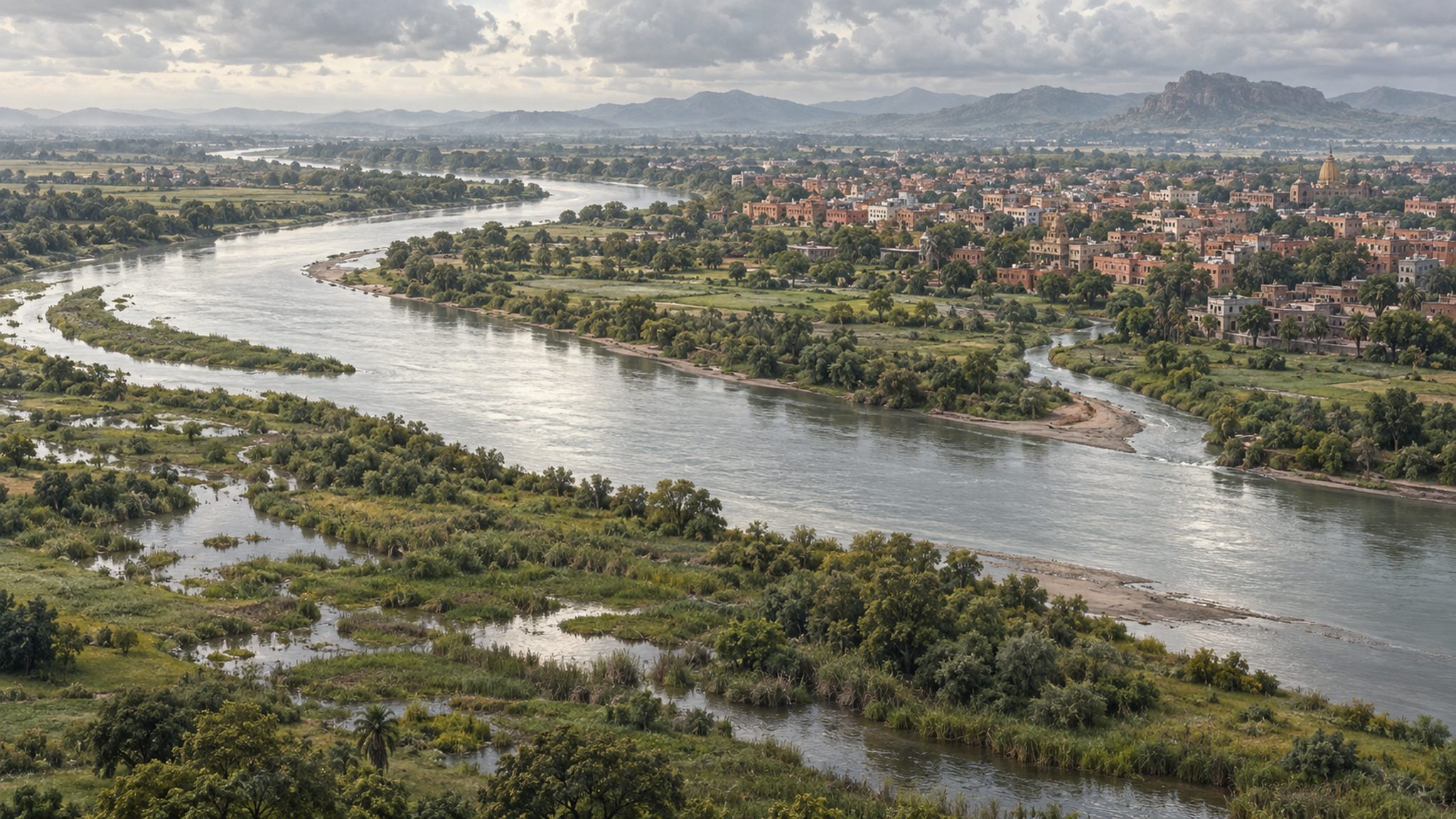
The planning unit is a connected river system, not simply the strip of land chosen for a waterfront project or public promenade.
- An urban river management plan links the river with the city that influences it. Land-use decisions, wastewater services and riverbank activities become connected planning questions instead of isolated projects handled without a shared diagnosis.
- The earlier NMCG–NIUA framework already used a systems approach covering environmental, economic and social dimensions. The new launch should not be read as the first recognition that rivers need coordinated city-level management.
- A catchment can extend beyond a municipal boundary. Water and pollution reaching the city may originate upstream, while local decisions can affect downstream communities; administrative jurisdiction does not stop the movement of water.
- The existing framework complements city plans rather than treating the river as an unrelated sector. This matters because decisions about construction, sanitation and open spaces can strengthen or undermine river-management investments over time.
- Riverfront beautification improves access or appearance when appropriately designed; river management addresses water quality, flows and ecological functions. A clean-looking promenade cannot by itself establish that sewage interception or habitat protection is working.
How sewage, runoff and floodplains interact
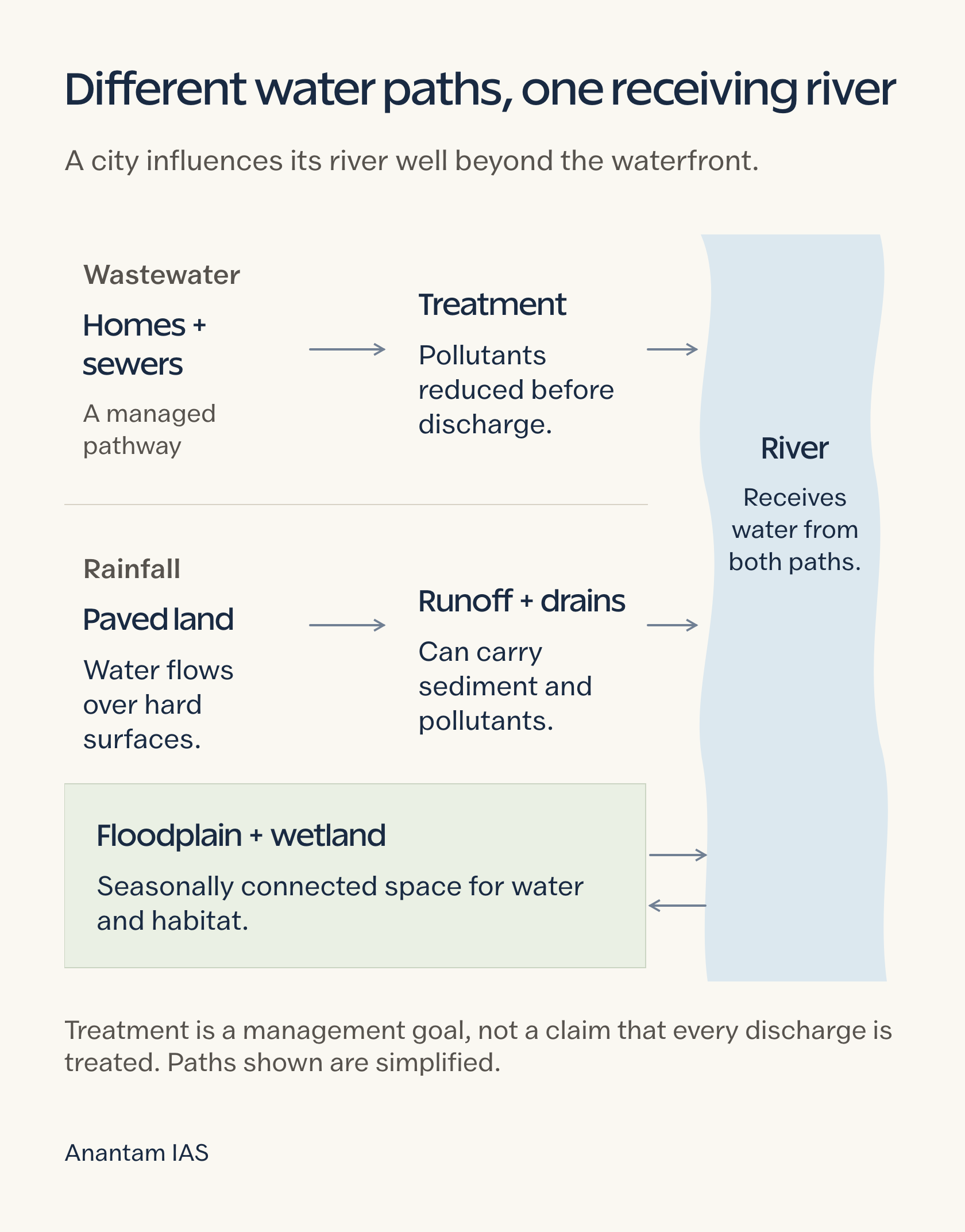
A useful diagnosis separates pollution entering the river from changes in how water reaches it, while recognising that both processes can interact.
- Sewage is wastewater requiring collection and suitable treatment. A treatment plant can address the waste routed to it; untreated discharges elsewhere remain a separate problem, so infrastructure must be assessed alongside the collection network.
- Stormwater starts as rainfall runoff, but it need not remain clean. USGS explains that urban development affects water quality as well as flow; drainage planning must consider pollutants carried towards receiving water bodies.
- Impervious surfaces, such as roofs and paved roads, reduce infiltration and accelerate runoff towards streams. Faster delivery can increase flood peaks, connecting construction choices across a city with pressures experienced at its river.
- Floodplains and connected wetlands are part of the river landscape. The Moradabad District Ganga Plan identifies encroachment and wetland degradation as threats to habitats and lateral connectivity, not merely as problems of visual appearance.
- Environmental flows and pollution loads require attention together. The Moradabad plan separately identifies reduced flows and polluted tributary inflows; treating wastewater does not answer every question about how much water remains in the river.
Turning a plan into accountable management
Implementation needs a common diagnosis, named responsibilities and observable outcomes; a launch announcement provides none of those outcomes by itself.
- Start with a baseline: map drains, discharge points, river-linked water bodies and floodplain pressures. The Moradabad plan illustrates why the assessment must connect physical conditions with the institutions responsible for responding to them.
- River-sensitive master planning connects land use with sanitation, water supply and flood management. NIUA’s existing guidance treats these sectors together, helping avoid situations where one department protects a river while another increases pressure on it.
- Assign responsibility for each proposed intervention and its upkeep. As a practical governance test, ask who operates the facility, who inspects the result and who must act when monitoring identifies continuing pollution or damage.
- Judge progress through outcomes, not completed construction alone. Useful assessment questions include whether untreated discharges persist, whether identified floodplain pressures decline and whether the responsible agencies can demonstrate that remedial actions remain functional.
- The latest PIB announcement confirms a framework and plan launches. It does not establish a new legal prohibition, disclose every plan provision or prove restoration; those claims need the relevant instruments and subsequent implementation evidence.
Way Forward
Link investment with river outcomes
- Publish a shared action register connecting each identified river pressure with an agency, intervention, maintenance responsibility and measurable result.
- Protect floodplain connectivity through evidence-based land-use decisions, while assessing upstream and downstream consequences before approving individual waterfront works.
- Audit sewage collection and treatment together; a functioning plant cannot remove pollution that never reaches it.
- Use repeat monitoring to revise priorities, separating announced works, operational services and demonstrated improvements in river conditions.
Conclusion
- Urban river management is a coordination problem with physical consequences: land use shapes runoff, wastewater services shape pollution loads, and floodplain decisions shape the river’s relationship with surrounding land.
- The new plans matter as a planning step. In a Mains answer, connect each pressure to an intervention and an accountable institution, while distinguishing announced intent from verified ecological improvement.
UPSC Practice Questions
Prelims MCQ 1
With reference to urban river management, consider the following statements:
- Impervious surfaces can increase the speed of runoff reaching streams.
- Stormwater is necessarily free of pollutants.
- A river catchment may extend beyond a municipal boundary.
How many of the above statements are correct?
(a) Only one (b) Only two (c) All three (d) None
Answer: (b) Only two
Explanation:
Statements 1 and 3 are correct. Urban runoff can carry pollutants, so stormwater cannot be assumed clean.
Prelims MCQ 2
Which approach best represents integrated urban river management?
(a) Measuring success only by the length of a promenade (b) Considering sewage treatment without examining collection (c) Connecting land use, wastewater, drainage and floodplain management (d) Restricting assessment to the river channel within municipal limits
Answer: (c) Connecting land use, wastewater, drainage and floodplain management
Explanation:
A systems approach addresses linked pressures and institutional responsibilities across the river landscape.
UPSC Mains Questions
- Why can riverfront beautification fail to improve river health? Explain the role of integrated urban river planning. (150 words)
- Discuss how land-use planning, sewage management and inter-agency coordination can improve the climate resilience of river cities. (250 words)
Sources: PIB, Ministry of Jal Shakti and NMCG, Moradabad District Ganga Plan.
Frequently Asked Questions
What was announced on 22 September 2026?
The Sustainable Urban River Management Framework was launched at India International Water Week. A Global River Cities Alliance session also launched five Urban River Management Plans, according to the Ministry of Jal Shakti.
How is river management different from riverfront beautification?
Beautification addresses the appearance or public use of a waterfront. River management also considers sewage, runoff, flows, habitats and connected land use, including pressures originating away from the visible riverbank.
Why should sewage and stormwater be distinguished?
Sewage is wastewater needing collection and treatment. Stormwater is rainfall runoff, which can still carry pollutants. Distinguishing them helps identify sources of pollution and choose suitable drainage and sanitation interventions.
Does the framework launch create a new binding law?
The verified announcement establishes a publication launch, not a new binding legal mandate. Any claim about compulsory restrictions must be checked against the relevant legal instrument rather than inferred from the announcement.
Tell Google you want more of this.
Add Anantam IAS as a preferred sourceOne tap, and this site shows up more often in your own Top Stories, AI Overviews and AI Mode. Remove it any time.