Daily Digest
UPSC · Civil Services Examination
Current Affairs · Thursday, 28 May 2026
Current affairs curated and edited by Anantam IAS faculty — pulled from The Hindu, PIB, IDSA, Foreign Affairs and the ministries. Read, annotate, revise.
Old Rajinder Nagar · Delhi 110005 · anantamias.com
Supreme Court confirms organised online gaming comes under GST regime
Why in News?
The Supreme Court recently upheld the constitutional validity of levying Goods and Services Tax (GST) on organised online gaming activities involving money stakes, including fantasy sports and online games played for wagers. The Court also upheld State laws regulating or prohibiting such activities, observing that online gaming involving uncertain outcomes and monetary stakes falls within the ambit of “betting and gambling” for the purposes of the GST framework.
UPSC Relevance
Prelims: GST, actionable claims, betting and gambling, online gaming, fantasy sports, State List.
Mains:
GS II – Judiciary, Centre-State legislative powers, constitutional interpretation;
GS III – Digital economy, taxation, online gaming regulation, public health and governance.
Background/Context
India’s online gaming industry has witnessed rapid expansion due to increasing smartphone penetration, affordable internet services and the growth of digital payment infrastructure. Fantasy sports, poker, rummy and various real-money gaming platforms have emerged as major components of the digital economy.
At the same time, the sector has generated intense legal and policy debates regarding taxation, regulation, addiction and public welfare. Several State governments attempted to regulate or prohibit online gaming involving wagers, leading to constitutional challenges before High Courts and ultimately the Supreme Court.
The recent judgment addresses two major issues:
- Whether online gaming involving stakes can be taxed as betting and gambling under the GST regime.
- Whether States possess constitutional competence to regulate or prohibit such activities in public interest.
What are Actionable Claims?
Actionable Claim refers to a claim to a debt or beneficial interest that can be enforced through legal action. Under the GST framework, actionable claims relating to betting, gambling and lottery are taxable.
The Supreme Court held that organised online gaming involving monetary stakes and uncertain outcomes also falls within this taxable category because such platforms involve financial stakes linked to uncertain results.
Supreme Court’s Key Observations
Online gaming involving stakes attracts GST
The Court observed that even where online games involve elements of skill, the presence of monetary stakes and uncertain outcomes brings them within the GST framework applicable to betting and gambling activities. According to the judgment, the core issue is not merely whether skill is involved, but whether the activity includes wagering upon uncertain outcomes with financial consequences.
Skill versus chance distinction is not absolute
Online gaming companies argued that games such as rummy, poker and fantasy sports are predominantly games of skill and therefore should not be treated similarly to gambling activities.
The Court, however, clarified that even games involving skill may attract regulation and taxation if played for wagers or stakes. It noted that the constitutional protection available to games of skill does not automatically extend to betting activities associated with such games.
Horse racing precedent distinguished
The petitioners relied on earlier Supreme Court decisions that treated horse racing as a game involving substantial skill. The Court distinguished horse racing from online gaming by observing that horse racing operates within a heavily regulated ecosystem under State supervision.
In contrast, online gaming platforms involve greater anonymity, wider accessibility and comparatively weaker regulatory oversight, thereby creating broader concerns relating to financial losses, addiction and public welfare.
Constitutional and Legal Dimensions
Distribution of legislative powers
The Constitution distributes legislative powers between the Union and States through the Seventh Schedule.
Entry 34 of State List empowers States to legislate on betting and gambling activities. At the same time, taxation powers under the GST regime operate through the constitutional framework introduced by the 101st Constitutional Amendment Act.
The judgment therefore reflects the intersection of:
- State powers over betting and gambling,
- Union taxation authority under GST,
- and constitutional freedoms relating to trade and profession.
Fundamental rights dimension
Earlier, High Courts such as the Madras High Court had struck down certain State gaming laws on grounds that they violated the freedom to practice any profession or trade under Article 19(1)(g).
The Supreme Court, however, upheld the validity of State restrictions by emphasising that reasonable restrictions may be imposed in the interests of public order, morality and public health.
GST and Online Gaming
The Goods and Services Tax Council had earlier recommended a 28% GST on online gaming, casinos and horse racing based on the full face value of bets or deposits.
The rationale behind taxation includes:
- Bringing clarity and uniformity within the taxation framework.
- Monitoring large-scale digital financial transactions.
- Preventing tax leakages.
- Expanding government revenues from rapidly growing digital sectors.
The judgment provides constitutional backing to this broader GST framework.
Public Health and Social Concerns
Gaming addiction
The Court acknowledged increasing concerns regarding gaming addiction, particularly among younger users. Excessive online gaming has been linked to psychological stress, compulsive behavioural patterns and social isolation. The reward-based structure of many gaming platforms may encourage repetitive engagement, sometimes resulting in serious mental health concerns.
Financial distress
Several instances of severe financial losses associated with online gaming have been reported across States. Individuals have incurred large debts, suffered family distress and in some cases experienced extreme psychological consequences due to repeated losses in wager-based gaming platforms. These concerns significantly influenced the Court’s approach towards regulation.
Public welfare considerations
The judgment emphasised that States possess a constitutional duty to protect public health and social order. The Court recognised that unrestricted online wagering activities may create broader societal harms extending beyond individual financial choices.
Economic Importance of the Online Gaming Industry
Despite regulatory concerns, India’s online gaming industry remains one of the fastest-growing digital sectors globally. It contributes to employment generation, technological innovation, digital entrepreneurship and foreign investment inflows.
The sector also supports:
- Growth of India’s digital economy,
- expansion of fintech ecosystems,
- and development of esports and interactive entertainment industries.
This creates the challenge of balancing economic growth with regulatory safeguards.
Challenges in Regulation
Distinguishing games of skill and chance
Many online games contain both skill and chance elements, making regulatory classification difficult. Courts and policymakers have often struggled to establish clear and uniform criteria for distinguishing legitimate gaming from gambling.
Regulatory fragmentation
Different States have adopted varying regulatory approaches, ranging from outright prohibition to partial regulation. This creates uncertainty for businesses operating across multiple jurisdictions.
Cross-border digital operations
Many gaming platforms operate digitally across borders, complicating enforcement, taxation and consumer protection efforts.
Consumer protection concerns
Issues relating to age verification, fraud prevention, data privacy and responsible gaming practices remain inadequately regulated in several segments of the industry.
Way Forward
Develop a comprehensive regulatory framework
India requires a balanced national framework that clearly distinguishes between legitimate online gaming, gambling and esports activities. Such a framework should reduce regulatory ambiguity while protecting public interests.
Strengthen responsible gaming safeguards
Gaming platforms should be required to implement safeguards such as spending limits, self-exclusion mechanisms, parental controls and mandatory warning systems regarding addiction risks.
Improve Centre-State coordination
Greater coordination between States and the Union government can help establish more uniform standards relating to taxation, regulation and enforcement.
Promote consumer awareness
Public awareness regarding financial risks, addiction concerns and responsible digital behaviour should become an integral part of online gaming regulation.
Instituting a National Gaming Grievance Redressal Mechanism
An independent ombudsman should be established to handle user grievances, investigate fraudulent digital algorithms, and monitor hidden platform fees. This will ensure that real-money gaming operations remain fair, transparent, and strictly within the boundaries of consumer safety laws.
Conclusion
The Supreme Court judgment represents a major development in India’s evolving digital economy jurisprudence. By upholding GST applicability and State regulatory powers, the Court has reinforced the principle that technological innovation cannot remain outside constitutional and regulatory oversight. Going forward, the central challenge will be to balance innovation, economic growth and public welfare within an increasingly digital and platform-driven economy.
Practice Questions
Prelims Question 1 (Inference-based)
Consider the following statements with reference to regulation of online gaming in India:
I. The Supreme Court held that online gaming involving monetary stakes and uncertain outcomes may fall within the ambit of betting and gambling under the GST framework.
II. Several State governments have justified restrictions on online gaming activities on grounds of public health and social welfare.
III. The Court distinguished online gaming from horse racing on the basis of differences in regulatory oversight and transparency.
Which of the following relationships among the above statements is/are correct?
- Statement II supports the broader regulatory rationale reflected in Statement I.
- Statement III explains one of the reasons why earlier judicial treatment of horse racing could not automatically apply to online gaming.
- Statement I contradicts Statement III because all activities involving skill must constitutionally receive identical treatment.
(a) 1 only
(b) 1 and 2
(c) 2 and 3
(d) 3 only
Answer: (b)
Explanation: Statement II reinforces the public welfare concerns underlying Statement I, while Statement III clarifies the Court’s reasoning for distinguishing horse racing from online gaming. Statement 3 is incorrect because constitutional treatment may differ depending on regulatory context and social impact.
Prelims Question 2
Assertion (A): States in India possess legislative competence to regulate betting and gambling activities.
Reason (R): Betting and gambling are included under the State List in the Seventh Schedule of the Constitution.
(a) Both A and R are correct and R is the correct explanation of A
(b) Both A and R are correct but R is not the correct explanation of A
(c) A is correct but R is incorrect
(d) A is incorrect but R is correct
Answer: (a)
Explanation: Betting and gambling fall under Entry 34 of the State List, thereby granting States legislative competence over such activities.
Mains Questions
- Discuss the constitutional and regulatory challenges associated with online gaming in India. How can India balance innovation with public welfare concerns?
- Examine the implications of the Supreme Court judgment upholding GST on online gaming for India’s digital economy and federal governance framework.
Tariffs to carbon, the new rules shaping India’s trade
Why in News?
The European Union’s Carbon Border Adjustment Mechanism (CBAM), proposed in 2021, entered its definitive phase from January 1, 2026. The mechanism imposes carbon-linked charges on imports based on the emissions generated during production. The development is significant for India because carbon-intensive sectors such as steel, aluminium, cement and fertilizers may face higher export costs in European markets despite ongoing India–EU trade negotiations.
UPSC Relevance
Prelims: Carbon Border Adjustment Mechanism (CBAM), carbon leakage, carbon pricing, non-tariff barriers, Soil Health Card Scheme.
Mains:
GS II – India-EU relations, international trade negotiations;
GS III – Climate change, industrial policy, energy transition, trade competitiveness, agriculture and fertilizer security.
Background/Context
Global trade is increasingly being shaped not only by tariffs and traditional trade barriers but also by climate-related regulations. Developed economies are gradually integrating carbon-emission considerations into trade policies as part of their climate commitments.
The European Union’s CBAM represents one of the most significant examples of this transition. The mechanism seeks to ensure that imported products face carbon costs similar to those imposed on European producers under the EU’s domestic climate regulations.
For developing countries such as India, this signals a structural shift in global trade rules where market access increasingly depends upon carbon efficiency alongside price competitiveness.
What is the Carbon Border Adjustment Mechanism (CBAM)?
Carbon Border Adjustment Mechanism is a carbon pricing tool designed by the European Union to prevent “carbon leakage”.
What is carbon leakage?
Carbon leakage occurs when industries shift production from countries with strict climate regulations to countries with weaker environmental standards in order to reduce costs. This may undermine global climate goals by merely relocating emissions rather than reducing them.
CBAM seeks to address this issue by imposing carbon-linked charges on imports entering the EU market.
Sectors Covered Under CBAM
Initially, CBAM applies to carbon-intensive sectors such as: Steel, Cement, Aluminium, Fertilizers, Electricity, Hydrogen.
These sectors are considered highly emission-intensive and vulnerable to carbon leakage risks.
How CBAM Functions
Unlike conventional tariffs, CBAM directly links import costs to embedded carbon emissions generated during production.
Key features
- EU importers must report embedded emissions in imported goods.
- Importers may need to purchase CBAM certificates linked to carbon prices.
- Products produced through carbon-intensive methods become relatively more expensive.
Thus, market access increasingly depends on the carbon footprint of production processes.
Difference Between CBAM and Traditional Non-Tariff Measures
CBAM differs structurally from conventional non-tariff measures (NTMs).
| Traditional NTMs | CBAM |
|---|---|
| Focus on product standards and regulations | Focus on carbon emissions embedded in production |
| Often qualitative and compliance-based | Price-based and quantifiable |
| Product quality determines access | Carbon efficiency influences competitiveness |
| Usually sector-specific regulations | Linked to broader climate policy |
This marks a major shift from “product-based trade regulation” to “process-based trade regulation”.
What is its Impact on India?
Impact on steel and aluminium exports
India’s steel and aluminium sectors are expected to face immediate challenges because they are relatively carbon-intensive and depend significantly on export markets.
European buyers may increasingly prefer suppliers with lower carbon footprints. As a result, Indian firms may either:
- absorb additional compliance costs,
- or invest heavily in cleaner technologies to remain competitive.
In the short run, this may reduce export profitability despite ongoing India–EU Free Trade Agreement negotiations.
Impact on fertilizer imports and agriculture
India may also face indirect effects through higher global fertilizer prices. Major fertilizer-exporting countries such as Egypt, Russia, Morocco and China may pass on carbon compliance costs to importing countries.
Since India remains a large fertilizer importer, rising global prices may:
- increase the fertilizer subsidy burden,
- affect farm profitability,
- and contribute to food inflation.
Thus, CBAM has implications not only for trade but also for agricultural sustainability and inflation management.
Broader trade implications
CBAM reflects a larger transformation in global trade governance. Other developed countries may adopt similar carbon-linked border measures in the future.
This may create:
- reduced market access for developing economies,
- pressure to decarbonise industries rapidly,
- and new forms of green protectionism.
Carbon Efficiency as a New Comparative Advantage
Traditionally, comparative advantage depended upon:
- labour costs,
- resource availability,
- and production efficiency.
However, under emerging carbon-linked trade systems, carbon efficiency is becoming equally important. Countries with cleaner production systems may gain trade advantages even if their production costs are relatively higher.
This represents a transition from “cost competitiveness” to “carbon competitiveness”.
What are India’s Domestic Challenges?
High dependence on fossil fuels
A significant share of India’s industrial production continues to depend on coal-based energy systems, particularly in steel and heavy manufacturing sectors.
Cost of green transition
Transitioning toward cleaner production technologies requires substantial investment in:
- renewable energy,
- green hydrogen,
- low-carbon industrial infrastructure,
- and technological modernisation.
These transitions may impose heavy short-term costs on developing economies.
Technology and financing constraints
Many developing countries lack affordable access to advanced green technologies and climate finance needed for industrial decarbonisation.
India’s Policy Response
Domestic reforms
India needs to strengthen domestic carbon efficiency through:
- greater investment in renewable energy,
- promotion of energy-efficient technologies,
- stricter environmental compliance mechanisms,
- and industrial decarbonisation strategies.
Reducing fertilizer vulnerability
To reduce dependence on expensive imports, India must improve domestic fertilizer efficiency through better implementation of the Soil Health Card Scheme and promotion of balanced fertilizer usage.
International negotiations
India must continue negotiating for:
- equitable treatment for developing countries,
- phased implementation mechanisms,
- technology transfer,
- climate finance support,
- and transitional flexibility under trade agreements.
Challenges and Criticisms of CBAM
Concerns of green protectionism
Developing countries argue that CBAM may function as a disguised trade barrier under the pretext of climate policy.
Unequal burden on developing economies
Countries with limited historical responsibility for climate change may face disproportionate adjustment costs.
WTO compatibility concerns
Questions remain regarding whether carbon border taxes fully comply with World Trade Organization principles of non-discrimination and fair trade.
Risk to global trade equity
Carbon-linked trade systems may widen inequalities between technologically advanced economies and developing countries.
Way Forward
Accelerate clean industrial transition
India should expand investments in renewable energy, green hydrogen and low-carbon manufacturing ecosystems.
Develop carbon accounting systems
Robust carbon measurement and reporting systems are necessary for maintaining export competitiveness.
Strengthen strategic trade diplomacy
India must build coalitions with developing countries to ensure fair climate-trade frameworks at global forums.
Promote circular economy approaches
Greater recycling, resource efficiency and sustainable production systems can help reduce industrial emissions.
Conclusion
The emergence of CBAM marks a significant transformation in the global trading system where climate policy and trade policy are becoming deeply interconnected. For India, the challenge is not only to adapt to carbon-constrained trade regimes but also to ensure that the green transition remains compatible with economic growth, industrial development and social equity. The future of international competitiveness may increasingly depend not just on how efficiently countries produce goods, but also on how sustainably they produce them.
Practice Questions
Prelims Question 1 (Inference-based)
Consider the following statements with reference to the European Union’s Carbon Border Adjustment Mechanism (CBAM):
I. CBAM links market access for certain imported products to the carbon emissions generated during their production.
II. Carbon-intensive sectors in developing countries may face higher export costs even if they satisfy conventional product quality standards.
III. Countries with cleaner production systems may gain a competitive advantage under emerging carbon-linked trade regimes.
Which of the following relationships among the above statements is/are correct?
- Statement II validates the idea reflected in Statement I that trade competitiveness is increasingly linked to carbon efficiency.
- Statement III extends the implications of Statement I by indicating a structural shift in the basis of comparative advantage in global trade.
- Statement I contradicts Statement II because carbon-linked measures replace all conventional trade regulations.
(a) 1 only
(b) 1 and 2
(c) 2 and 3
(d) 3 only
Answer: (b)
Explanation: Statement II reflects how carbon-linked trade measures affect exporters even when traditional standards are met. Statement III further extends this logic by showing that comparative advantage is increasingly shaped by carbon efficiency. Statement 3 is incorrect because CBAM supplements rather than replaces conventional trade regulations.
Prelims Question 2 (Match the Following)
Match List I with List II:
| List I | List II |
|---|---|
| A. Carbon leakage | 1. Emissions linked to imported products |
| B. CBAM | 2. Shift of production to countries with weaker climate regulations |
| C. Soil Health Card Scheme | 3. Promotion of balanced fertilizer application |
Select the correct answer using the code given below:
(a) A-2, B-1, C-3
(b) A-1, B-2, C-3
(c) A-2, B-3, C-1
(d) A-3, B-1, C-2
Answer: (a)
Explanation: Carbon leakage refers to relocation of production to countries with weaker environmental regulations. CBAM imposes carbon-linked measures on imports, while the Soil Health Card Scheme promotes balanced and need-based fertilizer use.
Mains Questions
- Discuss the implications of the European Union’s Carbon Border Adjustment Mechanism (CBAM) for India’s trade competitiveness and industrial transition.
- “Climate policy is increasingly shaping the future of international trade.” Examine with reference to carbon border taxes and developing economies.
Source: https://anantamias.com/current-affairs/tariffs-to-carbon-the-new-rules-shaping-indias-trade/
Rare dragonfly resurfaces in Arunachal after 110 years
Why in News?
A rare dragonfly species, Gynacantha khasiaca, has been rediscovered in Arunachal Pradesh’s Changlang district after more than 110 years. The species was recorded from Namdapha National Park and Tiger Reserve by a group of citizen scientists, highlighting the ecological importance of India’s northeastern biodiversity hotspots and the need for sustained habitat conservation.

UPSC Relevance
Prelims: Odonata, dragonflies and damselflies, Namdapha National Park, biodiversity hotspots, citizen science, Eastern Himalayas.
Mains:
GS III – Biodiversity conservation, ecosystem monitoring, protected areas, citizen participation in conservation, environmental governance.
Background/Context
The long-tailed duskhawker was last scientifically recorded in 1914 from the erstwhile Abor Hills region. Its rediscovery after more than a century has attracted scientific attention because species once believed to be extremely rare or locally extinct may continue to survive in relatively undisturbed ecosystems.
The rediscovery was documented through a study published in the Journal of Threatened Taxa by a group of citizen scientists from different parts of India.
The observation was made at Deban within the Namdapha landscape in October 2024, where the dragonfly was seen patrolling and defending its territory along the Miao–Vijoynagar Road.
About the Long-tailed Duskhawker
Gynacantha khasiaca belongs to the genus Gynacantha, a group of large dragonflies known for their pale brown-green colouration and crepuscular behaviour, meaning they are most active during dawn and dusk.
One of the remarkable features of dragonflies is their highly advanced visual system. Their compound eyes contain thousands of tiny lenses and photoreceptor units, enabling near-360° vision and highly efficient detection of movement. They are also capable of hovering almost motionlessly in the air, making them effective aerial predators.
The species has earlier been recorded from:
- Assam
- Meghalaya
- Uttarakhand
- Maharashtra
- West Bengal
Outside India, sightings have been reported from Bangladesh, Myanmar and Nepal.
Dragonflies and the Order Odonata
Dragonflies and damselflies belong to the order Odonata.
These insects play a crucial ecological role in freshwater ecosystems because they function both as predators and prey within aquatic food chains.
Ecological importance
- Dragonfly larvae help regulate mosquito populations and other aquatic insects.
- Adult dragonflies act as predators of small flying insects.
- They serve as bioindicators of freshwater ecosystem health because many species are highly sensitive to pollution and habitat degradation.
Globally, the order Odonata includes more than 6,400 species across nearly 700 genera. India hosts: 504 species, 27 subspecies, 152 genera, 18 families
Arunachal Pradesh alone supports around 110 species, reflecting the ecological richness of the Eastern Himalayan region.

What is the Importance of Namdapha National Park?
Namdapha National Park and Tiger Reserve is one of India’s largest protected areas and forms part of the Eastern Himalayan biodiversity hotspot.
Ecological significance
The park contains diverse ecosystems ranging from tropical rainforests to temperate forests and alpine vegetation. Such ecological variation supports rich faunal diversity, including: Tigers, Clouded leopards, Red pandas, Hoolock gibbons, Numerous bird and insect species
The rediscovery of rare insect species further reinforces the park’s importance as a refuge for poorly documented and endemic biodiversity.
Role of Citizen Science in Conservation
The rediscovery was made by citizen scientists rather than a formal government-led survey. This highlights the growing role of citizen science in biodiversity documentation and environmental monitoring.
Citizen science contributes through:
- Wider geographical observation networks
- Faster biodiversity reporting
- Public participation in conservation
- Supplementing scientific research efforts
Such collaborations are increasingly important in documenting lesser-known species such as insects, amphibians and reptiles.
Why Rediscoveries Matter in Conservation
Rediscovery of rare species has broader ecological significance.
Indicator of habitat quality
The survival of sensitive species often indicates that habitats remain relatively undisturbed and ecologically functional.
Strengthening conservation priorities
Rediscoveries can help prioritise habitat protection and scientific monitoring in ecologically fragile areas.
Expanding scientific knowledge
Many insect groups in India remain poorly studied. Rediscoveries help improve understanding of species distribution, ecology and evolutionary diversity.
Importance for climate change studies
Changes in species distribution patterns may provide insights into ecological responses to climate change and habitat alteration.
Challenges in Insect Conservation
Limited scientific documentation
Insects receive comparatively less conservation attention than large mammals despite their ecological importance.
Habitat degradation
Deforestation, infrastructure development and pollution threaten freshwater and forest ecosystems supporting dragonflies.
Climate change
Temperature changes and altered rainfall patterns may affect breeding habitats and species distribution.
Data deficiency
Many insect species remain under-documented, making conservation planning difficult.
Way Forward
Strengthen biodiversity surveys
Systematic surveys and long-term ecological monitoring should be expanded, especially in biodiversity-rich northeastern States.
Promote citizen science initiatives
Local communities, students and amateur naturalists can be integrated into biodiversity documentation programmes.
Protect freshwater ecosystems
Conservation of streams, wetlands and forest water systems is essential for sustaining Odonata diversity.
Improve taxonomic research
India needs greater investment in taxonomy, entomology and ecological research to address knowledge gaps regarding insect biodiversity.
Conclusion
The rediscovery of the long-tailed duskhawker after more than a century is not merely a scientific curiosity; it highlights the extraordinary biodiversity richness of northeastern India and the importance of sustained conservation efforts. At a time when insect populations globally are facing ecological pressures, such rediscoveries underline the need to strengthen habitat protection, biodiversity monitoring and public participation in conservation science.
Practice Questions
Prelims Question 1 (Inference-based)
Consider the following statements with reference to dragonflies and biodiversity conservation:
I. Dragonflies are considered important indicators of freshwater ecosystem health because many species are sensitive to habitat disturbance and pollution.
II. Rediscovery of rare insect species in protected areas may indicate the continued ecological integrity of such habitats.
III. Citizen science initiatives can contribute significantly to biodiversity monitoring and species documentation.
Which of the following relationships among the above statements is/are correct?
- Statement II extends the ecological implication of Statement I by linking species survival to habitat quality.
- Statement III supports the practical application of biodiversity monitoring implied in Statements I and II.
- Statement I contradicts Statement III because biodiversity assessment requires only formal institutional research.
(a) 1 only
(b) 1 and 2
(c) 2 and 3
(d) 3 only
Answer: (b)
Explanation: Statement II logically extends Statement I by connecting sensitive species survival with ecosystem integrity. Statement III further supports how biodiversity monitoring and rediscovery efforts can be strengthened through citizen participation. Statement 3 is incorrect because citizen science complements formal scientific research.
Prelims Question 2
Consider the following pairs:
| Item | Associated significance |
|---|---|
| 1. Odonata | Order comprising dragonflies and damselflies |
| 2. Namdapha National Park | Part of the Eastern Himalayan biodiversity hotspot |
| 3. Gynacantha khasiaca | Endemic mammal species of Arunachal Pradesh |
Which of the pairs given above are correctly matched?
(a) 1 and 2 only
(b) 2 and 3 only
(c) 1 and 3 only
(d) 1, 2 and 3
Answer: (a)
Explanation: Pair 3 is incorrect because Gynacantha khasiaca is a dragonfly species and not a mammal.
Mains Questions
- Discuss the ecological significance of insects as bioindicators with reference to dragonflies and freshwater ecosystems.
- Examine the role of citizen science in biodiversity conservation and ecological monitoring in India.
Source: https://anantamias.com/current-affairs/rare-dragonfly-resurfaces-in-arunachal-after-110-years/
Battle against AI Misinformation
Why in News?
India is pursuing its Viksit Bharat 2047 vision with Artificial Intelligence (AI) as a central pillar. India co-chaired the AI Action Summit in Paris (2025).
However, the rise of advanced generative AI tools is capable of producing realistic images, videos, voice clones and documents, which has intensified concerns regarding misinformation, identity theft, cyber fraud and manipulation of public discourse.
This raises a question: What will be India’s policy with reference to rapidly developing AI tools?
| UPSC Relevance: GS-2 Governance; GS-3 Science and Technology: Artificial Intelligence Mains: Artificial Intelligence: Growth and Associated Challenges. |
What is AI-Generated Misinformation?
- AI-generated misinformation refers to false, manipulated or misleading content created using Artificial Intelligence systems.
- Such content may include:
- Deepfake videos
- AI-generated news articles
- Synthetic voice cloning
- Fake academic documents
- Manipulated photographs
- Fabricated research papers
- AI-generated social media campaigns
Modern generative AI systems can now create highly realistic outputs that closely resemble genuine human-created content. Given India’s explosive internet growth from 250 million to over 1 billion users in under a decade, and persistently low digital literacy, the consequences are severe and systemic.
Key dimensions of AI-Driven Misinformation:
- Informational Harm: Modern generative AI can fabricate newspaper-style reports, scientific research papers, and mark sheets with near-perfect authenticity. AI-generated misinformation creates a “liar’s dividend” situation where authentic photographs and documents themselves risk dismissal as fabricated. This corrodes journalism, academia, and institutional accountability.
- Identity Theft and Personality Rights: Proliferation of AI-powered voice cloning, face-swapping, and image synthesis has multiplied identity-based cybercrimes. India, however, lacks a dedicated statutory framework for personality rights.
- Legal and Judicial Integrity: Courts have recorded a worrying trend of lawyers submitting AI-generated pleadings and citations that are entirely fabricated. As AI tools proliferate, maintaining the factual integrity of judicial proceedings becomes a challenge.
- Financial and Security Dimensions: India has witnessed a surge in AI-assisted frauds, including “digital arrest” scams where criminals deploy deepfake video calls impersonating police or regulatory officials to extort payments from low-literacy users.
- Electoral and Political Risks: AI-generated audio deepfakes of political leaders and synthetic viral videos pose acute risks to electoral integrity. Election Commission of India currently relies on existing MCC guidelines and voter education rather than dedicated deepfake regulation.
India’s Regulatory Response: IT Amendment Rules, 2026:
The Ministry of Electronics and Information Technology (MeitY) notified the Information Technology (Intermediary Guidelines and Digital Media Ethics Code) Amendment Rules, 2026.
This represents India’s first comprehensive statutory framework specifically addressing synthetically generated content, and constitutes a significant structural reform of intermediary liability.
- Synthetically Generated Information (SGI) defined: The Amendment introduces a statutory definition of SGI covering audio, visual, or audio-visual content that is artificially or algorithmically created, generated, modified, or altered using computer resources. This includes deepfakes, voice clones, and AI-fabricated video.
- Mandatory Labelling and Metadata Traceability: Any intermediary enabling the creation or dissemination of SGI must now require users to declare whether their content is AI-generated. Visual SGI must include a visual label; audio SGI must carry an audio disclosure.
- Reduced Takedown Timelines:
- Illegal content identified by courts or government bodies must be removed within 3 hours (reduced from 24-36 hours).
- Non-consensual sexual deepfakes and other SGI violating personal privacy must be removed within 2 hours of being reported.
- User grievances filed personally must be resolved within 36 hours.
- These timelines apply to all significant social media intermediaries (SSMIs): platforms with over 5 million users.
- Safe Harbour: Intermediaries that host SGI without verifying declarations or attaching required labels risk losing safe harbour protection entirely, exposing them to both civil and criminal liability.
Broader Policy Ecosystem:
- India AI Governance Guidelines (2025): Issued under the IndiaAI Mission, these guidelines are non-binding in nature but provide a foundational reference for future regulation. Proposed institutional mechanisms include an inter-ministerial AI Governance Group, a Technology and Policy Expert Committee, and an IndiaAI Safety Institute for monitoring and capacity building.
- Digital India Act (Forthcoming): The proposed Digital India Act, in draft since 2023, is expected to replace the IT Act, 2000 and introduce risk-based classifications for digital platforms, enhanced intermediary obligations, content accountability requirements, and specific provisions for AI and emerging technology, including deepfake regulation and algorithmic transparency. Public consultation is anticipated in 2026.
- Digital Personal Data Protection Act, 2023: The DPDP Act governs the collection, storage, and processing of personal data by “data fiduciaries,” providing a framework that overlaps with AI misuse involving personal information, including biometric data used to train deepfake systems.
- Sector-Specific Frameworks:
- The RBI’s 2025 framework on responsible AI in finance and the SEBI consultation paper on AI in securities markets together address AI risk in systemically important sectors.
- Ministry of Health and Family Welfare launched the SAHI (Strategy for Artificial Intelligence in Healthcare for India) framework, adding healthcare to the sector-specific regulatory perimeter.
Gaps, Criticisms & Challenges:
- Absence of a Dedicated AI Act: Despite the 2026 IT Rules amendment and sector-specific frameworks, India still lacks a comprehensive, dedicated AI Act comparable to the EU AI Act. The existing approach remains fragmented across the IT Act, consumer protection law, tort law, and sector-specific regulations. This creates jurisdictional ambiguity and enforcement gaps.
- Operational Feasibility of Takedown Timelines: Critics argue that the 3-hour and 2-hour removal mandates may incentivise over-removal of borderline content, chilling legitimate speech and satire. The absence of clear technical standards or platform-provided AI detection tools creates compliance uncertainty.
- Digital Literacy Deficit: India has over 700 million rural citizens who cannot access AI’s benefits, are disproportionately vulnerable to SGI-based scams, and lack the tools to critically evaluate synthetic content.
- Personality Rights and IP Lacunae: India has no codified personality rights framework, leaving celebrities and ordinary citizens alike dependent on expensive, slow High Court litigation. Clarity on who owns AI-generated content (developer, user, or no one) also remains unresolved, complicating intellectual property enforcement.
- Enforcement Capacity: India’s cyber law enforcement infrastructure, including the Cyber Crime Cells and the Indian Computer Emergency Response Team (CERT-In), faces significant capacity constraints in detecting, attributing, and prosecuting AI-enabled offences at scale.
Way Forward:
- Comprehensive AI regulation law that differentiates between high-risk and low-risk AI applications, mandates transparency, and provides clear liability norms without stifling innovation.
- A sector-specific code of ethics for AI platforms must be developed to prevent the generation of content that undermines trust in democratic institutions, digital news ecosystems, and the judicial process.
- Enact Personality Rights Legislation to address the growing misuse of AI in fabricating content involving real individuals.
- Developing digital and AI literacy through mass public awareness campaigns, media literacy programmes, and fact-checking ecosystems.
- International Cooperation: India must engage actively in multilateral frameworks (including with the G20, UNESCO, and GPAI) to harmonise AI governance standards.
India, therefore, faces the dual responsibility of becoming an AI innovation leader while simultaneously safeguarding the authenticity and credibility of its digital ecosystem.
Source: https://anantamias.com/current-affairs/battle-against-ai-misinformation/
Supreme Court upholds SIR exercise as an advancement towards free and fair elections
Why in News?
The Supreme Court recently upheld the constitutional validity of the Special Intensive Revision (SIR) of electoral rolls conducted by the Election Commission of India in Bihar. The Court held that the exercise was directly linked to the constitutional objective of ensuring free and fair elections by maintaining the integrity and accuracy of electoral rolls.
The judgment is significant because the second phase of the SIR exercise covering multiple States and Union Territories, including West Bengal and Tamil Nadu, is already underway.
UPSC Relevance
Prelims: Article 324, Representation of the People Act, 1950, Registration of Electors Rules, 1960, electoral rolls, anti-duplication measures, citizenship verification.
Mains:
GS II – Election Commission, electoral reforms, constitutional bodies, democracy and governance, free and fair elections, citizenship and voting rights.
Background/Context
The Special Intensive Revision (SIR) exercise was initiated by the Election Commission to update and verify electoral rolls comprehensively after more than two decades since the previous intensive revision.
The exercise gained political and constitutional significance because it involved:
- Verification of voter eligibility,
- Detection of duplicate or erroneous entries,
- Removal of deceased or shifted electors,
- and scrutiny of citizenship status for enrolment purposes.
Petitioners challenged the exercise before the Supreme Court, arguing that it amounted to indirect citizenship screening and risked arbitrary deletion of voters.
The Court, however, upheld the exercise as constitutionally valid.
What is the Special Intensive Revision (SIR)?
The Special Intensive Revision is a large-scale verification and updating exercise of electoral rolls conducted by the Election Commission of India.
Unlike ordinary revisions, SIR involves comprehensive field verification and scrutiny of electoral records to ensure that only eligible citizens remain enrolled.
The Bihar SIR exercise reduced the number of electors from approximately 7.89 crore to 7.42 crore after revisions.
Constitutional Basis of the Judgment
Article 324 and powers of the Election Commission
Article 324 vests the Election Commission with the power of superintendence, direction and control of elections.
The Supreme Court described this authority as a “continuous wellspring of power” extending across all stages of the electoral process to preserve democratic integrity.
According to the Court, accurate electoral rolls are foundational to free and fair elections because democracy depends not merely upon polling but also upon identifying eligible voters correctly.
Representation of the People Act framework
The Court held that the SIR exercise does not override the Representation of the People Act or the Registration of Electors Rules, 1960.
Instead, it supplements and operationalises the constitutional mandate by enabling systematic correction of electoral inaccuracies.
The Court particularly relied upon Section 21(3) of the RP Act, which permits revision of electoral rolls “in such manner as the Election Commission may deem fit”.
Key Observations of the Supreme Court
Electoral rolls are dynamic documents
The Court observed that electoral rolls cannot remain static because population patterns continuously change due to:
- migration, urbanisation, deaths, shifting of residence, and demographic mobility.
Therefore, periodic intensive revision is necessary to maintain the integrity of elections.
Citizenship verification is permissible
The petitioners argued that SIR amounted to a backdoor citizenship verification exercise.
The Court rejected this argument and clarified that citizenship is a condition precedent for voter enrolment. Therefore, the Election Commission may examine citizenship-related questions to the limited extent necessary for inclusion or exclusion from electoral rolls.
However, the Court also ensured procedural safeguards by directing that persons excluded on citizenship grounds must have their cases adjudicated under the Citizenship Act by competent authorities.
Administrative experience can justify revision
The Court rejected the contention that the SIR lacked empirical foundations. It held that large-scale migration, duplication of entries and non-reporting of deaths are matters of common administrative experience that justify electoral verification exercises.
Safeguards Emphasised by the Court
The Supreme Court highlighted several safeguards intended to prevent arbitrary exclusion of voters.
Notice and hearing requirements
The Court held that Rule 21A safeguards were followed because affected individuals received notice, enquiries were conducted and reasoned decisions were made before deletion.
Inclusion of Aadhaar as an indicative document
The Election Commission included Aadhaar as an indicative document to facilitate verification and reduce hardship for voters.
Judicial remedies available
The Court clarified that individuals wrongly excluded due to absence, duplication or shifting may challenge such decisions before courts.
Citizenship adjudication safeguards
Persons removed from electoral rolls on citizenship grounds must have their cases examined under the Citizenship Act before future elections.
Significance of the Judgment
Reinforcement of free and fair elections
The judgment strengthens the constitutional principle that electoral integrity requires not only free voting but also accurate voter identification.
Expansion of Article 324 interpretation
The ruling broadens the functional scope of Article 324 by recognising extensive supervisory powers of the Election Commission over electoral processes.
Institutional strengthening of ECI
The judgment reinforces the institutional authority of the Election Commission in maintaining electoral purity and administrative flexibility.
Impact on future electoral revisions
Since similar SIR exercises are ongoing in multiple States, the judgment will significantly influence future electoral roll verification exercises across India.
Concerns and Criticisms
Risk of wrongful exclusion
Critics argue that large-scale revision exercises may inadvertently exclude vulnerable populations such as:
- migrant workers, poor households, elderly citizens, and marginalised communities.
Citizenship-related anxieties
Linking electoral verification with citizenship scrutiny may generate fears among socially vulnerable groups.
Administrative burden
Comprehensive verification exercises require significant administrative capacity and coordination.
Potential politicisation
Electoral roll revisions often become politically contentious because of their implications for voting patterns and representation.
Electoral Rolls and Democracy
Electoral rolls form the foundation of representative democracy because they determine who is entitled to participate in elections.
An inaccurate roll may lead to:
- duplication, impersonation, exclusion of eligible voters, or inclusion of ineligible persons.
Thus, electoral roll management remains central to democratic legitimacy.
Way Forward
Ensure transparency in revision exercises
The Election Commission should maintain transparent procedures, public disclosure mechanisms and accessible grievance redressal systems.
Strengthen procedural safeguards
Notice, hearing and appeal mechanisms should be further strengthened to minimise wrongful exclusions.
Improve technological integration
Digitisation, inter-State coordination and database synchronisation may help reduce duplication and errors.
Protect vulnerable populations
Special attention should be given to migrants, elderly citizens and marginalised communities during verification exercises.
Conclusion
The Supreme Court judgment represents an important constitutional endorsement of the Election Commission’s authority to maintain accurate electoral rolls as part of free and fair elections. While the ruling strengthens institutional mechanisms for electoral integrity, its long-term success will depend upon balancing administrative efficiency with protection of democratic inclusion and procedural fairness. In a representative democracy, electoral legitimacy ultimately depends not only upon counting votes correctly, but also upon ensuring that every eligible citizen is fairly recognised within the electoral process.
Practice Questions
Prelims Question 1 (Inference-based)
Consider the following statements with reference to the Special Intensive Revision (SIR) of electoral rolls:
I. The Supreme Court held that accurate and updated electoral rolls are integral to the constitutional principle of free and fair elections.
II. The Election Commission may examine citizenship-related questions to the limited extent necessary for inclusion or exclusion from electoral rolls.
III. The Court emphasised procedural safeguards such as notice, enquiry and judicial remedies during electoral revision exercises.
Which of the following relationships among the above statements is/are correct?
- Statement II supports the constitutional objective reflected in Statement I by linking voter eligibility with electoral integrity.
- Statement III extends the rationale of Statement I by ensuring that electoral accuracy is balanced with procedural fairness.
- Statement I contradicts Statement III because intensive revision exercises necessarily prioritise administrative efficiency over individual rights.
(a) 1 only
(b) 1 and 2
(c) 2 and 3
(d) 3 only
Answer: (b)
Explanation: Statement II reinforces the principle that voter eligibility verification contributes to electoral integrity mentioned in Statement I. Statement III further extends this rationale by emphasising safeguards against arbitrary exclusion. Statement 3 is incorrect because the Court explicitly stressed procedural protections.
Prelims Question 2
Assertion (A): Article 324 of the Constitution provides the Election Commission with supervisory powers over the conduct of elections.
Reason (R): The Supreme Court interpreted Article 324 as a continuing source of authority encompassing various stages of the electoral process.
(a) Both A and R are correct and R is the correct explanation of A
(b) Both A and R are correct but R is not the correct explanation of A
(c) A is correct but R is incorrect
(d) A is incorrect but R is correct
Answer: (a)
Explanation: Article 324 grants the Election Commission powers of superintendence, direction and control over elections. The Supreme Court further interpreted this authority broadly to include supervision over electoral roll integrity and revision exercises.
Mains Questions
- Discuss the constitutional significance of electoral roll integrity in ensuring free and fair elections in India.
- Examine the scope of Article 324 in the light of the Supreme Court judgment upholding the Special Intensive Revision (SIR) exercise.
Cabinet extends SARTHAK-PDS scheme for 5 years
Why in News?
The Union Cabinet approved the five-year extension of the ‘SARTHAK-PDS’ scheme with a Rs 25,530 crore outlay through March 2031, aiming to overhaul the public distribution infrastructure through technology-led reforms.
| UPSC Relevance: GS-2 Governance; GS-2 Social Justice: Food Security Prelims: SARTHAK-PDS Scheme. Mains: Technology adoption in the PDS scheme. |
What is the SARTHAK-PDS Scheme?
SARTHAK-PDS is an umbrella scheme that merges two existing programmes into a single administrative framework:
1. Assistance to State Agencies for Intra-State Movement of Foodgrains and FPS Dealers’ Margin under NFSA, which provided financial support to states for transportation, handling charges, and margins of Fair Price Shop (FPS) dealers.
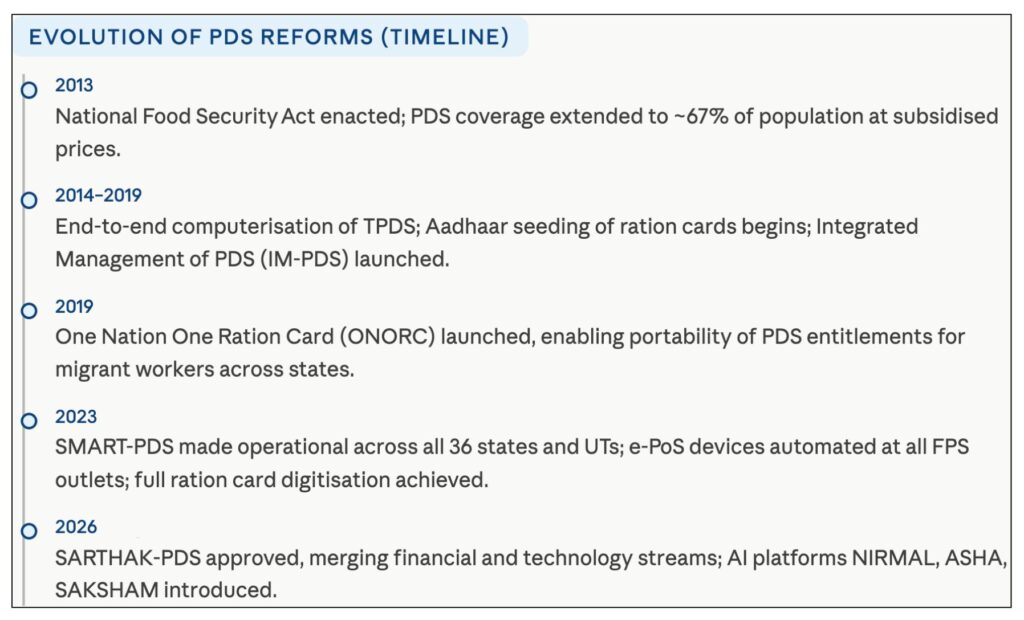
2. SMART-PDS (Scheme for Modernisation and Reforms through Technology in PDS), which drove end-to-end digitisation of ration cards, Aadhaar seeding, e-PoS automation, and supply-chain computerisation across all 36 states and UTs since April 1, 2023.
The merged scheme carries a dual mandate: assured financial support for intra-state movement and FPS dealer margins on one hand, and building a unified, citizen-centric, intelligent and interoperable PDS architecture on the other.
Key Features & Technology Architecture:
The scheme deploys AI, Machine Learning (ML), Natural Language Processing (NLP), and Blockchain across the entire PDS value chain. Three AI-powered platforms form its core:
- NIRMAL: AI-driven beneficiary registry that identifies and removes duplicate and ghost beneficiaries. Uses QR-coded grain bags for tamper-proof tracking from warehouses to FPS outlets.
- ASHA: Multilingual AI grievance assistant that handles beneficiary complaints in their preferred regional languages, leveraging NLP for accessible redressal.
- SAKSHAM: AI supply-chain platform providing vehicle GPS tracking, demand forecasting, and route optimisation to reduce logistical inefficiencies and transportation distances.
Other deliverables include State Command Control Centres for real-time data-driven oversight, standardised architectures with unified databases, and ISO-certified process frameworks for transparency and operational sustainability.
Significance & Rationale:
- Food security commitment: SARTHAK-PDS is anchored to the government’s legal obligation under the National Food Security Act, 2013 (NFSA), which guarantees subsidised foodgrains to 81.35 crore persons, covering about 67% of India’s population.
- Addressing systemic leakages: Approximately 28% of allocated food grains fail to reach intended beneficiaries under the existing PDS, translating to nearly 19.69 million metric tonnes annually. Ghost beneficiaries, diversion to black markets, and fraudulent ration cards remain pervasive, making AI-driven beneficiary management critical.
- Financial relief to states: State governments faced significant difficulty bearing intra-state transportation costs. SARTHAK-PDS provides assured central funding for these costs, and also enhances FPS dealers’ margins to improve last-mile engagement.
- Environmental dividend: Route optimisation through SAKSHAM is projected to reduce carbon emissions by 36% by shortening transportation distances, aligning PDS reform with India’s climate commitments.
- Administrative consolidation: Merging two schemes reduces fragmentation in governance, improves fund utilisation, and brings technology and financial assistance under a unified framework.
Concerns & Critical Dimensions:
- Technology exclusion: Aadhaar-based biometric authentication has historically led to exclusion errors: genuine beneficiaries denied rations due to biometric failures, network outages, or data mismatches. Technology-first reforms must account for digital exclusion.
- Nutritional adequacy: NFSA and PDS are predominantly calorie-focused (rice and wheat). Micronutrient needs and dietary diversity (pulses, fortified items) remain inadequately addressed by the current framework.
- Outdated beneficiary data: NFSA coverage remains capped at 2011 Census projections, meaning population growth since then leaves many genuinely food-insecure households outside the legal quota.
- Implementation risk: Past evidence suggests technology alone does not eliminate leakages: Tamil Nadu’s leakage rate rose from 12% (2011-12) to 25% (2022-23) despite Aadhaar integration, underscoring the need for institutional accountability alongside digital tools.
SARTHAK-PDS represents a structurally important leap in PDS governance, but its success will depend on three factors:
- First, ensuring that AI-driven exclusions do not deprive genuine beneficiaries
- Second, revisiting NFSA beneficiary ceilings in light of updated census data
- Third, expanding the nutritional mandate of PDS to address India’s ongoing challenges with hidden hunger and protein deficiency.
The NFSA’s legal framing of food as a right, combined with the scheme’s 81.35 crore coverage and its alignment with SDG 2 (Zero Hunger) and SDG 12 (Responsible Consumption), makes this a strong example of rights-based governance meeting techno-administrative reform.
Practice Question:
Q. Discuss how SARTHAK-PDS seeks to bridge the gap between the promise of the National Food Security Act and its last-mile delivery challenges.
Source: https://anantamias.com/current-affairs/cabinet-extends-sarthak-pds-scheme-for-5-years/