
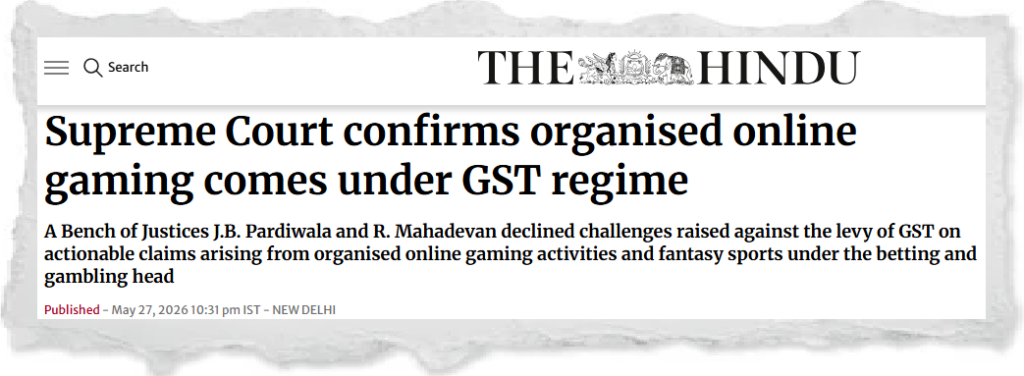
Why in News?
The Supreme Court recently upheld the constitutional validity of levying Goods and Services Tax (GST) on organised online gaming activities involving money stakes, including fantasy sports and online games played for wagers. The Court also upheld State laws regulating or prohibiting such activities, observing that online gaming involving uncertain outcomes and monetary stakes falls within the ambit of “betting and gambling” for the purposes of the GST framework.
UPSC Relevance
Prelims: GST, actionable claims, betting and gambling, online gaming, fantasy sports, State List.
Mains:
GS II – Judiciary, Centre-State legislative powers, constitutional interpretation;
GS III – Digital economy, taxation, online gaming regulation, public health and governance.
Background/Context
India’s online gaming industry has witnessed rapid expansion due to increasing smartphone penetration, affordable internet services and the growth of digital payment infrastructure. Fantasy sports, poker, rummy and various real-money gaming platforms have emerged as major components of the digital economy.
At the same time, the sector has generated intense legal and policy debates regarding taxation, regulation, addiction and public welfare. Several State governments attempted to regulate or prohibit online gaming involving wagers, leading to constitutional challenges before High Courts and ultimately the Supreme Court.
The recent judgment addresses two major issues:
- Whether online gaming involving stakes can be taxed as betting and gambling under the GST regime.
- Whether States possess constitutional competence to regulate or prohibit such activities in public interest.
What are Actionable Claims?
Actionable Claim refers to a claim to a debt or beneficial interest that can be enforced through legal action. Under the GST framework, actionable claims relating to betting, gambling and lottery are taxable.
The Supreme Court held that organised online gaming involving monetary stakes and uncertain outcomes also falls within this taxable category because such platforms involve financial stakes linked to uncertain results.
Supreme Court’s Key Observations
Online gaming involving stakes attracts GST
The Court observed that even where online games involve elements of skill, the presence of monetary stakes and uncertain outcomes brings them within the GST framework applicable to betting and gambling activities. According to the judgment, the core issue is not merely whether skill is involved, but whether the activity includes wagering upon uncertain outcomes with financial consequences.
Skill versus chance distinction is not absolute
Online gaming companies argued that games such as rummy, poker and fantasy sports are predominantly games of skill and therefore should not be treated similarly to gambling activities.
The Court, however, clarified that even games involving skill may attract regulation and taxation if played for wagers or stakes. It noted that the constitutional protection available to games of skill does not automatically extend to betting activities associated with such games.
Horse racing precedent distinguished
The petitioners relied on earlier Supreme Court decisions that treated horse racing as a game involving substantial skill. The Court distinguished horse racing from online gaming by observing that horse racing operates within a heavily regulated ecosystem under State supervision.
In contrast, online gaming platforms involve greater anonymity, wider accessibility and comparatively weaker regulatory oversight, thereby creating broader concerns relating to financial losses, addiction and public welfare.
Constitutional and Legal Dimensions
Distribution of legislative powers
The Constitution distributes legislative powers between the Union and States through the Seventh Schedule.
Entry 34 of State List empowers States to legislate on betting and gambling activities. At the same time, taxation powers under the GST regime operate through the constitutional framework introduced by the 101st Constitutional Amendment Act.
The judgment therefore reflects the intersection of:
- State powers over betting and gambling,
- Union taxation authority under GST,
- and constitutional freedoms relating to trade and profession.
Fundamental rights dimension
Earlier, High Courts such as the Madras High Court had struck down certain State gaming laws on grounds that they violated the freedom to practice any profession or trade under Article 19(1)(g).
The Supreme Court, however, upheld the validity of State restrictions by emphasising that reasonable restrictions may be imposed in the interests of public order, morality and public health.
GST and Online Gaming
The Goods and Services Tax Council had earlier recommended a 28% GST on online gaming, casinos and horse racing based on the full face value of bets or deposits.
The rationale behind taxation includes:
- Bringing clarity and uniformity within the taxation framework.
- Monitoring large-scale digital financial transactions.
- Preventing tax leakages.
- Expanding government revenues from rapidly growing digital sectors.
The judgment provides constitutional backing to this broader GST framework.
Public Health and Social Concerns
Gaming addiction
The Court acknowledged increasing concerns regarding gaming addiction, particularly among younger users. Excessive online gaming has been linked to psychological stress, compulsive behavioural patterns and social isolation. The reward-based structure of many gaming platforms may encourage repetitive engagement, sometimes resulting in serious mental health concerns.
Financial distress
Several instances of severe financial losses associated with online gaming have been reported across States. Individuals have incurred large debts, suffered family distress and in some cases experienced extreme psychological consequences due to repeated losses in wager-based gaming platforms. These concerns significantly influenced the Court’s approach towards regulation.
Public welfare considerations
The judgment emphasised that States possess a constitutional duty to protect public health and social order. The Court recognised that unrestricted online wagering activities may create broader societal harms extending beyond individual financial choices.
Economic Importance of the Online Gaming Industry
Despite regulatory concerns, India’s online gaming industry remains one of the fastest-growing digital sectors globally. It contributes to employment generation, technological innovation, digital entrepreneurship and foreign investment inflows.
The sector also supports:
- Growth of India’s digital economy,
- expansion of fintech ecosystems,
- and development of esports and interactive entertainment industries.
This creates the challenge of balancing economic growth with regulatory safeguards.
Challenges in Regulation
Distinguishing games of skill and chance
Many online games contain both skill and chance elements, making regulatory classification difficult. Courts and policymakers have often struggled to establish clear and uniform criteria for distinguishing legitimate gaming from gambling.
Regulatory fragmentation
Different States have adopted varying regulatory approaches, ranging from outright prohibition to partial regulation. This creates uncertainty for businesses operating across multiple jurisdictions.
Cross-border digital operations
Many gaming platforms operate digitally across borders, complicating enforcement, taxation and consumer protection efforts.
Consumer protection concerns
Issues relating to age verification, fraud prevention, data privacy and responsible gaming practices remain inadequately regulated in several segments of the industry.
Way Forward
Develop a comprehensive regulatory framework
India requires a balanced national framework that clearly distinguishes between legitimate online gaming, gambling and esports activities. Such a framework should reduce regulatory ambiguity while protecting public interests.
Strengthen responsible gaming safeguards
Gaming platforms should be required to implement safeguards such as spending limits, self-exclusion mechanisms, parental controls and mandatory warning systems regarding addiction risks.
Improve Centre-State coordination
Greater coordination between States and the Union government can help establish more uniform standards relating to taxation, regulation and enforcement.
Promote consumer awareness
Public awareness regarding financial risks, addiction concerns and responsible digital behaviour should become an integral part of online gaming regulation.
Instituting a National Gaming Grievance Redressal Mechanism
An independent ombudsman should be established to handle user grievances, investigate fraudulent digital algorithms, and monitor hidden platform fees. This will ensure that real-money gaming operations remain fair, transparent, and strictly within the boundaries of consumer safety laws.
Conclusion
The Supreme Court judgment represents a major development in India’s evolving digital economy jurisprudence. By upholding GST applicability and State regulatory powers, the Court has reinforced the principle that technological innovation cannot remain outside constitutional and regulatory oversight. Going forward, the central challenge will be to balance innovation, economic growth and public welfare within an increasingly digital and platform-driven economy.
Practice Questions
Prelims Question 1 (Inference-based)
Consider the following statements with reference to regulation of online gaming in India:
I. The Supreme Court held that online gaming involving monetary stakes and uncertain outcomes may fall within the ambit of betting and gambling under the GST framework.
II. Several State governments have justified restrictions on online gaming activities on grounds of public health and social welfare.
III. The Court distinguished online gaming from horse racing on the basis of differences in regulatory oversight and transparency.
Which of the following relationships among the above statements is/are correct?
- Statement II supports the broader regulatory rationale reflected in Statement I.
- Statement III explains one of the reasons why earlier judicial treatment of horse racing could not automatically apply to online gaming.
- Statement I contradicts Statement III because all activities involving skill must constitutionally receive identical treatment.
(a) 1 only
(b) 1 and 2
(c) 2 and 3
(d) 3 only
Answer: (b)
Explanation: Statement II reinforces the public welfare concerns underlying Statement I, while Statement III clarifies the Court’s reasoning for distinguishing horse racing from online gaming. Statement 3 is incorrect because constitutional treatment may differ depending on regulatory context and social impact.
Prelims Question 2
Assertion (A): States in India possess legislative competence to regulate betting and gambling activities.
Reason (R): Betting and gambling are included under the State List in the Seventh Schedule of the Constitution.
(a) Both A and R are correct and R is the correct explanation of A
(b) Both A and R are correct but R is not the correct explanation of A
(c) A is correct but R is incorrect
(d) A is incorrect but R is correct
Answer: (a)
Explanation: Betting and gambling fall under Entry 34 of the State List, thereby granting States legislative competence over such activities.
Mains Questions
- Discuss the constitutional and regulatory challenges associated with online gaming in India. How can India balance innovation with public welfare concerns?
- Examine the implications of the Supreme Court judgment upholding GST on online gaming for India’s digital economy and federal governance framework.
Tell Google you want more of this.
Add Anantam IAS as a preferred sourceOne tap, and this site shows up more often in your own Top Stories, AI Overviews and AI Mode. Remove it any time.