
Why in News?
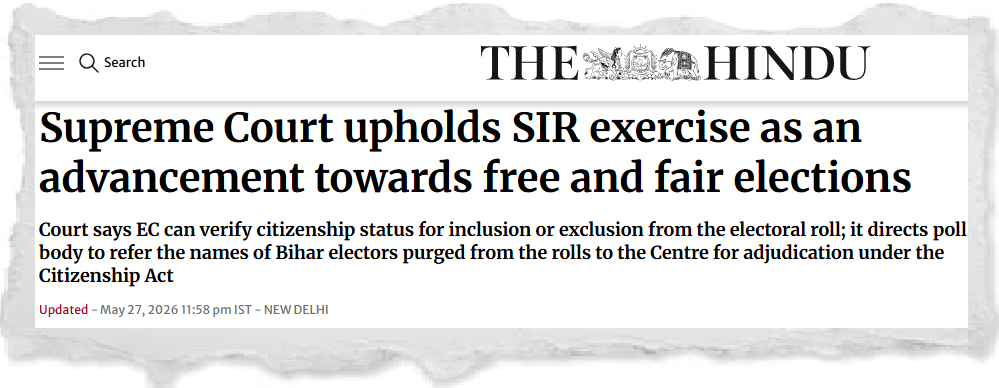
The Supreme Court recently upheld the constitutional validity of the Special Intensive Revision (SIR) of electoral rolls conducted by the Election Commission of India in Bihar. The Court held that the exercise was directly linked to the constitutional objective of ensuring free and fair elections by maintaining the integrity and accuracy of electoral rolls.
The judgment is significant because the second phase of the SIR exercise covering multiple States and Union Territories, including West Bengal and Tamil Nadu, is already underway.
UPSC Relevance
Prelims: Article 324, Representation of the People Act, 1950, Registration of Electors Rules, 1960, electoral rolls, anti-duplication measures, citizenship verification.
Mains:
GS II – Election Commission, electoral reforms, constitutional bodies, democracy and governance, free and fair elections, citizenship and voting rights.
Background/Context
The Special Intensive Revision (SIR) exercise was initiated by the Election Commission to update and verify electoral rolls comprehensively after more than two decades since the previous intensive revision.
The exercise gained political and constitutional significance because it involved:
- Verification of voter eligibility,
- Detection of duplicate or erroneous entries,
- Removal of deceased or shifted electors,
- and scrutiny of citizenship status for enrolment purposes.
Petitioners challenged the exercise before the Supreme Court, arguing that it amounted to indirect citizenship screening and risked arbitrary deletion of voters.
The Court, however, upheld the exercise as constitutionally valid.
What is the Special Intensive Revision (SIR)?
The Special Intensive Revision is a large-scale verification and updating exercise of electoral rolls conducted by the Election Commission of India.
Unlike ordinary revisions, SIR involves comprehensive field verification and scrutiny of electoral records to ensure that only eligible citizens remain enrolled.
The Bihar SIR exercise reduced the number of electors from approximately 7.89 crore to 7.42 crore after revisions.
Constitutional Basis of the Judgment
Article 324 and powers of the Election Commission
Article 324 vests the Election Commission with the power of superintendence, direction and control of elections.
The Supreme Court described this authority as a “continuous wellspring of power” extending across all stages of the electoral process to preserve democratic integrity.
According to the Court, accurate electoral rolls are foundational to free and fair elections because democracy depends not merely upon polling but also upon identifying eligible voters correctly.
Representation of the People Act framework
The Court held that the SIR exercise does not override the Representation of the People Act or the Registration of Electors Rules, 1960.
Instead, it supplements and operationalises the constitutional mandate by enabling systematic correction of electoral inaccuracies.
The Court particularly relied upon Section 21(3) of the RP Act, which permits revision of electoral rolls “in such manner as the Election Commission may deem fit”.
Key Observations of the Supreme Court
Electoral rolls are dynamic documents
The Court observed that electoral rolls cannot remain static because population patterns continuously change due to:
- migration, urbanisation, deaths, shifting of residence, and demographic mobility.
Therefore, periodic intensive revision is necessary to maintain the integrity of elections.
Citizenship verification is permissible
The petitioners argued that SIR amounted to a backdoor citizenship verification exercise.
The Court rejected this argument and clarified that citizenship is a condition precedent for voter enrolment. Therefore, the Election Commission may examine citizenship-related questions to the limited extent necessary for inclusion or exclusion from electoral rolls.
However, the Court also ensured procedural safeguards by directing that persons excluded on citizenship grounds must have their cases adjudicated under the Citizenship Act by competent authorities.
Administrative experience can justify revision
The Court rejected the contention that the SIR lacked empirical foundations. It held that large-scale migration, duplication of entries and non-reporting of deaths are matters of common administrative experience that justify electoral verification exercises.
Safeguards Emphasised by the Court
The Supreme Court highlighted several safeguards intended to prevent arbitrary exclusion of voters.
Notice and hearing requirements
The Court held that Rule 21A safeguards were followed because affected individuals received notice, enquiries were conducted and reasoned decisions were made before deletion.
Inclusion of Aadhaar as an indicative document
The Election Commission included Aadhaar as an indicative document to facilitate verification and reduce hardship for voters.
Judicial remedies available
The Court clarified that individuals wrongly excluded due to absence, duplication or shifting may challenge such decisions before courts.
Citizenship adjudication safeguards
Persons removed from electoral rolls on citizenship grounds must have their cases examined under the Citizenship Act before future elections.
Significance of the Judgment
Reinforcement of free and fair elections
The judgment strengthens the constitutional principle that electoral integrity requires not only free voting but also accurate voter identification.
Expansion of Article 324 interpretation
The ruling broadens the functional scope of Article 324 by recognising extensive supervisory powers of the Election Commission over electoral processes.
Institutional strengthening of ECI
The judgment reinforces the institutional authority of the Election Commission in maintaining electoral purity and administrative flexibility.
Impact on future electoral revisions
Since similar SIR exercises are ongoing in multiple States, the judgment will significantly influence future electoral roll verification exercises across India.
Concerns and Criticisms
Risk of wrongful exclusion
Critics argue that large-scale revision exercises may inadvertently exclude vulnerable populations such as:
- migrant workers, poor households, elderly citizens, and marginalised communities.
Citizenship-related anxieties
Linking electoral verification with citizenship scrutiny may generate fears among socially vulnerable groups.
Administrative burden
Comprehensive verification exercises require significant administrative capacity and coordination.
Potential politicisation
Electoral roll revisions often become politically contentious because of their implications for voting patterns and representation.
Electoral Rolls and Democracy
Electoral rolls form the foundation of representative democracy because they determine who is entitled to participate in elections.
An inaccurate roll may lead to:
- duplication, impersonation, exclusion of eligible voters, or inclusion of ineligible persons.
Thus, electoral roll management remains central to democratic legitimacy.
Way Forward
Ensure transparency in revision exercises
The Election Commission should maintain transparent procedures, public disclosure mechanisms and accessible grievance redressal systems.
Strengthen procedural safeguards
Notice, hearing and appeal mechanisms should be further strengthened to minimise wrongful exclusions.
Improve technological integration
Digitisation, inter-State coordination and database synchronisation may help reduce duplication and errors.
Protect vulnerable populations
Special attention should be given to migrants, elderly citizens and marginalised communities during verification exercises.
Conclusion
The Supreme Court judgment represents an important constitutional endorsement of the Election Commission’s authority to maintain accurate electoral rolls as part of free and fair elections. While the ruling strengthens institutional mechanisms for electoral integrity, its long-term success will depend upon balancing administrative efficiency with protection of democratic inclusion and procedural fairness. In a representative democracy, electoral legitimacy ultimately depends not only upon counting votes correctly, but also upon ensuring that every eligible citizen is fairly recognised within the electoral process.
Practice Questions
Prelims Question 1 (Inference-based)
Consider the following statements with reference to the Special Intensive Revision (SIR) of electoral rolls:
I. The Supreme Court held that accurate and updated electoral rolls are integral to the constitutional principle of free and fair elections.
II. The Election Commission may examine citizenship-related questions to the limited extent necessary for inclusion or exclusion from electoral rolls.
III. The Court emphasised procedural safeguards such as notice, enquiry and judicial remedies during electoral revision exercises.
Which of the following relationships among the above statements is/are correct?
- Statement II supports the constitutional objective reflected in Statement I by linking voter eligibility with electoral integrity.
- Statement III extends the rationale of Statement I by ensuring that electoral accuracy is balanced with procedural fairness.
- Statement I contradicts Statement III because intensive revision exercises necessarily prioritise administrative efficiency over individual rights.
(a) 1 only
(b) 1 and 2
(c) 2 and 3
(d) 3 only
Answer: (b)
Explanation: Statement II reinforces the principle that voter eligibility verification contributes to electoral integrity mentioned in Statement I. Statement III further extends this rationale by emphasising safeguards against arbitrary exclusion. Statement 3 is incorrect because the Court explicitly stressed procedural protections.
Prelims Question 2
Assertion (A): Article 324 of the Constitution provides the Election Commission with supervisory powers over the conduct of elections.
Reason (R): The Supreme Court interpreted Article 324 as a continuing source of authority encompassing various stages of the electoral process.
(a) Both A and R are correct and R is the correct explanation of A
(b) Both A and R are correct but R is not the correct explanation of A
(c) A is correct but R is incorrect
(d) A is incorrect but R is correct
Answer: (a)
Explanation: Article 324 grants the Election Commission powers of superintendence, direction and control over elections. The Supreme Court further interpreted this authority broadly to include supervision over electoral roll integrity and revision exercises.
Mains Questions
- Discuss the constitutional significance of electoral roll integrity in ensuring free and fair elections in India.
- Examine the scope of Article 324 in the light of the Supreme Court judgment upholding the Special Intensive Revision (SIR) exercise.
Tell Google you want more of this.
Add Anantam IAS as a preferred sourceOne tap, and this site shows up more often in your own Top Stories, AI Overviews and AI Mode. Remove it any time.