Daily Digest
UPSC · Civil Services Examination
Current Affairs · Thursday, 3 September 2026
Current affairs curated and edited by Anantam IAS faculty — pulled from The Hindu, PIB, IDSA, Foreign Affairs and the ministries. Read, annotate, revise.
Old Rajinder Nagar · Delhi 110005 · anantamias.com
Allahabad High Court Quashes NSA Detention
Why in News?
On September 2, 2026, the Allahabad High Court allowed a habeas corpus plea, quashed a law student’s NSA detention and ordered immediate release unless she was required in another case.
- The Hindu reported that the Bench found major inconsistencies in the State’s account of the arrest and detention.
- The court examined the arrest notice and general diary chronology, and asked the State for evidence supporting the alleged incitement.
- According to the report, the State did not submit the claimed video footage before the court.
- The detailed written judgment was awaited, so the confirmed development is the operative quashing and release order, not a complete statement of legal findings.
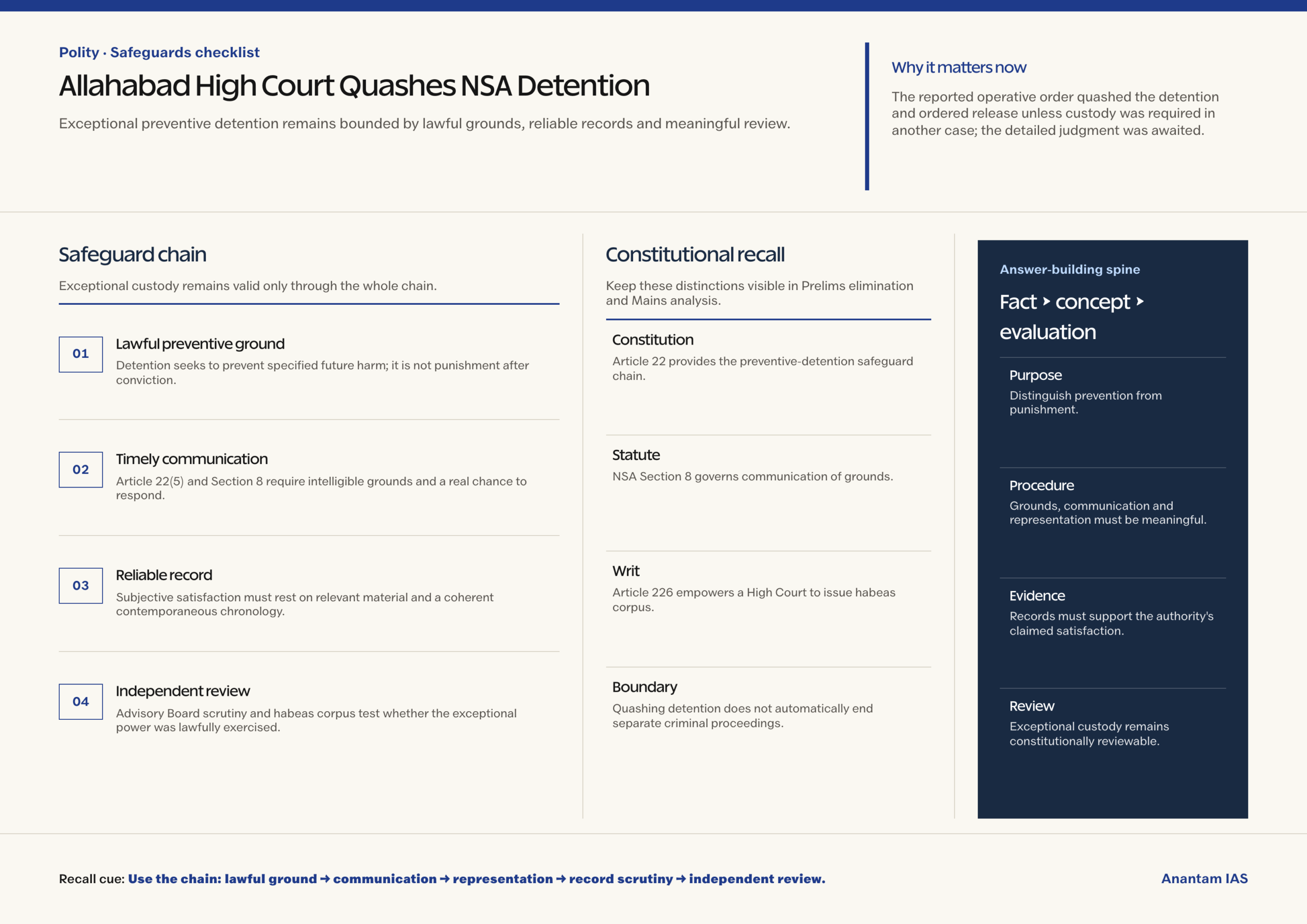
- Preventive detention restrains a person to avert anticipated harmful conduct; it is not punishment after a criminal conviction.
- Because ordinary trial safeguards operate differently, constitutional and statutory procedures become the principal checks against arbitrary executive detention.
- Quashing a detention order does not by itself terminate every separate criminal case arising from the same events.
UPSC Relevance
Prelims Relevance
- Article 22 contains specific constitutional safeguards and exceptions concerning preventive detention.
- Section 8 of the NSA governs communication of detention grounds and the earliest opportunity to make a representation.
- An Advisory Board reviews whether sufficient cause exists for preventive detention under the statutory process.
- A High Court may issue a writ of habeas corpus under Article 226 to test the legality of custody.
- Preventive detention is distinct from punitive imprisonment following investigation, trial and conviction.
Mains Relevance
GS Paper 2
- Personal liberty, procedural due process and judicial review of executive detention
- Constitutional and statutory safeguards governing preventive detention
GS Paper 3
- Balancing internal-security powers with accountable policing and reliable evidence
Essay
- Liberty is protected not only by declaring rights, but by requiring public power to justify every exceptional restraint.
Background and Context
What Preventive Detention Permits
Preventive detention addresses anticipated conduct, making its legal purpose different from prosecution for a completed offence.
- The National Security Act, 1980 authorises detention to prevent specified acts prejudicial to national security, State security, public order or essential supplies and services.
- The legal basis is prevention, not a judicial finding that the detainee committed the conduct alleged by the executive authority.
- The Central or State Government may make an order on statutory grounds; an empowered District Magistrate or Commissioner of Police may also exercise the power within authorised limits.
- A preventive order and a criminal prosecution can coexist because they serve different purposes and follow different legal tracks.
- For this reason, release from preventive custody does not automatically decide guilt, innocence, bail or continuation in a separate criminal case.
Communication and Representation Safeguards
The detention authority must give the detainee enough timely information to make the constitutional right of representation meaningful.
- Article 22(5) requires communication of the grounds of detention as soon as possible and the earliest opportunity to make a representation against the order.
- Section 8 ordinarily requires communication within five days; exceptional delay may extend to ten days only when reasons are recorded in writing.
- The grounds must be intelligible enough for an effective representation; a bare conclusion or an inaccessible factual basis can defeat the safeguard’s practical purpose.
- The statute permits withholding facts whose disclosure the authority considers contrary to public interest, but that exception cannot erase the basic duty to communicate grounds.
- These duties are not administrative courtesies. They form part of the legal conditions that make exceptional detention power valid.
Habeas Corpus and Evidentiary Scrutiny
Habeas corpus enables a constitutional court to require legal justification for custody and examine whether mandatory safeguards were observed.
- Under Article 226, a High Court can test the legality of detention, including jurisdiction, statutory purpose, procedural compliance and the existence of relevant material.
- Judicial review does not convert the writ court into a criminal trial; its task is to examine whether the detention power was lawfully exercised.
- Contemporaneous records matter because subjective satisfaction must rest on a real evidentiary basis, not a chronology contradicted by the authority’s own documents.
- In the reported case, the court called for the general diary and asked for evidence of incitement, while the claimed footage was not produced before it.
- Because the detailed judgment was awaited, broader propositions about the Bench’s reasoning should not be attributed to this order beyond the reported procedural and evidentiary concerns.
Way Forward
Make Exceptional Power Reviewable
Preventive detention should remain traceable from initial material to communication, representation and independent review.
- Record a coherent timeline and preserve the source material relied upon before issuing the detention order.
- Communicate specific and intelligible grounds promptly so the detainee can exercise the right to representation in substance.
- Place relevant records, representations and government decisions before the Advisory Board and reviewing court without selective omission.
- Keep preventive detention separate from ordinary policing shortcuts; investigate and prosecute alleged offences through the regular criminal process.
Conclusion
- The operative order reinforces a durable principle: exceptional preventive detention powers remain bounded by communicated grounds, reliable records, representation and habeas corpus review.
- In a Mains answer, distinguish prevention from punishment, then organise the safeguards as a chain: lawful grounds, timely communication, effective representation, Advisory Board scrutiny and judicial review.
- Treat the reported quashing narrowly: it ended the challenged NSA detention, subject to custody required in another case, without establishing that every separate proceeding had ended.
UPSC Practice Questions
Prelims MCQ 1
With reference to preventive detention under the National Security Act, 1980, consider the following statements:
- Grounds of detention must ordinarily be communicated within five days.
- The statutory Advisory Board examines whether sufficient cause exists for detention.
- A habeas corpus court is barred from examining compliance with mandatory detention procedure.
How many of the above statements are correct?
(a) Only one (b) Only two (c) All three (d) None
Answer: (b) Only two
Explanation:
Statements 1 and 2 are correct. Constitutional courts may examine the legality of custody and compliance with mandatory safeguards through habeas corpus jurisdiction.
Prelims MCQ 2
Which one of the following best describes the constitutional purpose of communicating preventive-detention grounds to the detainee?
(a) To substitute an executive order for a criminal conviction (b) To enable the earliest effective representation against detention (c) To prevent the Advisory Board from examining the detention (d) To terminate every criminal case concerning the same events
Answer: (b) To enable the earliest effective representation against detention
Explanation:
Article 22(5) connects communication of grounds with the detainee’s earliest opportunity to make a representation against the detention order.
UPSC Mains Questions
- Preventive detention is constitutionally exceptional because it restrains liberty without a criminal conviction. Explain the safeguards that make this power reviewable and accountable.
- How does habeas corpus review test the legality of preventive detention without turning the writ court into a criminal trial? Discuss with reference to evidentiary basis and procedural compliance.
Sources: The Hindu and Legislative Department, Constitution of India.
Frequently Asked Questions
What did the Allahabad High Court reportedly order?
It allowed the habeas corpus plea, quashed the challenged NSA detention and ordered immediate release unless the detainee was required in another case.
What is the difference between preventive and punitive detention?
Preventive detention seeks to avert anticipated conduct. Punitive imprisonment follows adjudication of an offence through the ordinary criminal process.
Why must detention grounds be communicated?
Communication enables the detainee to understand the basis of custody and make an effective representation, as required by Article 22(5) and Section 8 of the NSA.
Does quashing an NSA order end related criminal cases?
Not automatically. Preventive detention and criminal prosecution are separate legal tracks; each criminal case must proceed or end under its own orders and procedure.
Why is the detailed judgment important?
It supplies the court’s authoritative reasoning, findings and legal basis. Until available, reports of the operative order should not be expanded into unconfirmed holdings.
Source: https://anantamias.com/current-affairs/allahabad-hc-nsa-detention-safeguards/
Pichavaram Mangroves and Natural Capital Valuation
Why in News?
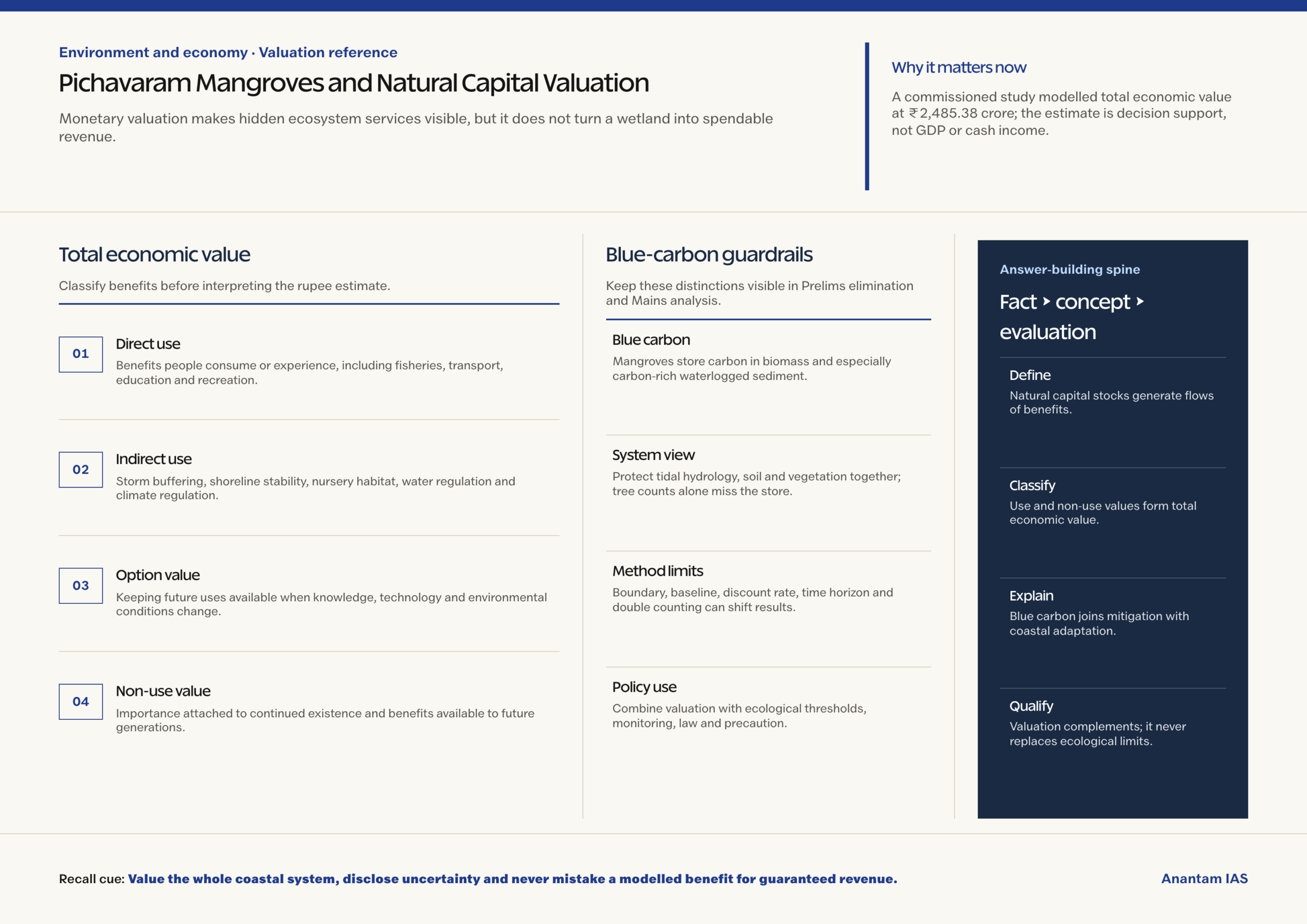
On September 3, The Hindu reported that a Tamil Nadu Forest Department-funded study led by ISEC researcher M. Balasubramanian modelled Pichavaram mangroves’ total economic value at ₹2,485.38 crore.
- The figure is a modelled valuation of ecosystem benefits, not cash revenue, GDP, a budget allocation or a guaranteed carbon-credit return.
- The study covers market and non-market services, including fisheries, coastal protection, climate regulation, biodiversity, recreation and carbon storage.
- Its blue carbon assessment found that mangrove sediments represent a substantially larger carbon reservoir than the vegetation above them.
- ISEC lists the project as funded by the Tamil Nadu Forest Department; The Hindu identifies the Forest Genetics Division in Coimbatore as the funding office.
- Conventional accounts often record marketed output while leaving flood buffering, erosion control, carbon storage and habitat support economically invisible.
- Valuation can make ecological losses visible in project appraisal, but the result changes with ecological data, valuation method, prices, time horizon and discount rate.
- Pichavaram is a Ramsar wetland in Cuddalore district between the Vellar and Coleroon estuarine systems.
UPSC Relevance
Prelims Relevance
- Natural capital means stocks of natural assets that generate flows of benefits to people and the economy.
- Total economic value combines use and non-use values; it is wider than the income earned from harvesting or tourism.
- Blue carbon is carbon captured and stored by coastal and marine ecosystems, including mangroves, salt marshes and seagrass meadows.
- Mangrove carbon occurs in living biomass and sediments; disturbing waterlogged soils can damage a major long-term store.
- Pichavaram is an intertidal forested wetland designated as Ramsar Site No. 2482 in 2022.
Mains Relevance
GS Paper 3
- How ecosystem-service valuation can improve coastal planning, climate adaptation and natural-capital accounting.
- Why blue-carbon policy must protect hydrology, vegetation and sediment together rather than focusing only on tree planting.
GS Paper 1
- The role of estuarine mangroves in shoreline stability, fisheries nurseries and protection from coastal hazards.
Essay
- What an economy does not count can still be essential to its security and resilience.
Background and Context
What Total Economic Value Captures
Total economic value is a framework for organising nature’s benefits across beneficiaries and time, not a market price for selling an ecosystem.
- Direct-use values arise from benefits people consume or experience, such as fish, fuelwood where permitted, transport, education and recreation.
- Indirect-use values come from ecological functions, including storm buffering, shoreline stabilisation, water regulation, nutrient cycling, nursery habitat and climate regulation.
- Option value reflects retaining an ecosystem for possible future uses, especially when future knowledge, technology or environmental conditions remain uncertain.
- Non-use values capture importance attached to an ecosystem’s continued existence or its availability to future generations, even without present consumption.
- Adding these categories prevents a mangrove from being judged only by visible market receipts while ignoring services that reduce risks or sustain other economic activity.
How Blue Carbon Strengthens the Case
Mangroves connect coastal adaptation with climate mitigation because their biological productivity and tidal setting build durable carbon-rich soils beneath living vegetation.
- Mangrove plants remove carbon dioxide through photosynthesis and store carbon in trunks, branches, leaves and roots as living biomass.
- Tides deposit organic material, while oxygen-poor waterlogged conditions slow decomposition and allow carbon to accumulate in mangrove sediments over long periods.
- The commissioned assessment found the economic value assigned to soil organic carbon was more than three times that assigned to vegetation carbon.
- This comparison shifts conservation from a tree-counting exercise to protection of hydrology, soils and vegetation as one connected coastal system.
- Drainage, excavation or conversion can weaken coastal protection and expose stored soil carbon, so restoration quality matters more than plantation numbers alone.
How to Read the Valuation Correctly
A monetary estimate supports transparent comparison between development choices, but it does not turn every ecological benefit into spendable income or a tradeable asset.
- Valuers combine different methods: observed market prices for traded goods, avoided or replacement costs for protective functions, and stated-preference methods for non-market benefits.
- Carbon values may depend on an assumed social cost of carbon, which estimates damage avoided by preventing an additional unit of emissions.
- Results are sensitive to the study boundary, ecological measurements, baseline, time horizon, discount rate and assumptions about beneficiaries and future risks.
- The same benefit must not be counted twice when ecological processes overlap, such as nursery habitat, fish production, biodiversity support and nutrient cycling.
- Natural-capital valuation can complement biophysical thresholds and legal protection, but it cannot justify destroying an irreplaceable wetland merely because a monetary trade-off appears favourable.
Way Forward
Use Valuation for Better Coastal Decisions
- Integrate ecosystem-service baselines into coastal plans and project appraisal before land-use decisions create irreversible losses.
- Monitor vegetation, sediment carbon, salinity, tidal exchange and shoreline change so natural-capital accounts rest on updated ecological evidence.
- Protect tidal hydrology and sediment integrity alongside mangrove cover; survival, ecological function and permanence should guide restoration evaluation.
- Publish assumptions, uncertainty ranges and safeguards whenever valuation informs climate finance or carbon markets, avoiding claims of automatic credit revenue.
Conclusion
- The Pichavaram estimate makes an important planning point: mangrove value extends beyond marketed output to risk reduction, habitat, recreation, climate regulation and carbon stored below ground.
- Its monetary total should be treated as a decision-support estimate, not revenue, GDP or a guaranteed carbon asset; ecological condition, uncertainty and methodological assumptions remain decisive.
- In a Mains answer, link natural-capital accounting with biophysical monitoring, legal protection and integrated coastal planning, while stating clearly that monetary valuation complements rather than replaces ecological limits and precaution.
UPSC Practice Questions
Prelims MCQ 1
With reference to blue carbon in mangrove ecosystems, consider the following statements:
- Mangroves store carbon in both living biomass and sediments.
- Waterlogged, oxygen-poor conditions can slow decomposition and promote carbon accumulation in sediments.
- Blue carbon refers exclusively to carbon held in the above-ground parts of mangrove trees.
How many of the above statements are correct?
(a) Only one (b) Only two (c) All three (d) None
Answer: (b) Only two
Explanation:
Statements 1 and 2 are correct. Blue carbon includes carbon stored by coastal ecosystems in biomass and soils or sediments, not only above-ground vegetation.
Prelims MCQ 2
Which statement best describes total economic value in ecosystem assessment?
(a) It records only revenue earned by commercial users of an ecosystem (b) It is identical to the ecosystem’s contribution already recorded in GDP (c) It organises direct, indirect, option and non-use values within one valuation framework (d) It guarantees that every estimated benefit can be sold as a carbon credit
Answer: (c) It organises direct, indirect, option and non-use values within one valuation framework
Explanation:
Total economic value extends beyond marketed output. It combines use and non-use values, but the resulting estimate is neither automatic revenue nor a guaranteed tradeable return.
UPSC Mains Questions
- Explain how ecosystem-service valuation can improve coastal planning. What methodological cautions should accompany the use of total economic value?
- Mangrove conservation is as much about sediments and hydrology as it is about trees. Discuss with reference to blue carbon and coastal resilience.
Sources: The Hindu and Institute for Social and Economic Change.
Frequently Asked Questions
What did the Pichavaram mangrove study estimate?
The commissioned study modelled the ecosystem’s total economic value at ₹2,485.38 crore by considering ecological, economic and social benefits. The figure is an estimate, not cash revenue.
Who commissioned the Pichavaram valuation study?
ISEC identifies it as a Tamil Nadu Forest Department-funded project led by M. Balasubramanian. The Hindu reports funding through the Deputy Conservator of Forests, Forest Genetics Division, Coimbatore.
What is blue carbon?
Blue carbon is carbon captured and stored by coastal and marine ecosystems such as mangroves, salt marshes and seagrass meadows, in both living biomass and carbon-rich soils or sediments.
Why are mangrove sediments important for climate policy?
Waterlogged mangrove sediments can retain large carbon stocks for long periods. Disturbing hydrology or soils can weaken this store, making sediment protection central to credible blue-carbon conservation.
Is total economic value the same as GDP contribution?
No. Total economic value is a valuation framework that includes market and non-market benefits. GDP records production under national-accounting rules and does not automatically include the full estimate.
Source: https://anantamias.com/current-affairs/pichavaram-mangrove-natural-capital-valuation/
Khagantak-243 Glide Bomb Drop Trial
Why in News?
On September 2, 2026, the Indian Air Force announced a successful drop trial of the indigenously designed and developed long-range glide bomb Khagantak-243, stating that the trial met all its objectives.
- The official announcement identifies Khagantak-243 as a long-range glide bomb and describes the event as a drop trial.
- The IAF said the weapon was indigenously designed and developed, linking the milestone to Indian industry.
- The phrase met all objectives applies to the objectives of this trial; it does not disclose the complete test plan or certify operational induction.
- The official post does not establish a public figure for range, warhead, order quantity, release platform, or service-entry status.
- The trial offers a useful case study in the difference between a gravity bomb, an unpowered guided glide bomb, and a powered missile.
- For policy analysis, the key issue is the evidence ladder from a successful test to a reliable, integrated, maintainable and authorised operational capability.
UPSC Relevance
Prelims Relevance
- A glide bomb is normally unpowered after release; it converts the aircraft’s altitude and speed into forward glide.
- Stand-off launch means releasing a weapon away from the target rather than requiring the aircraft to overfly it.
- Guidance estimates or corrects the path, while control surfaces generate aerodynamic forces that steer the weapon.
- A drop trial is evidence of tested objectives, not automatic proof of procurement, induction or combat readiness.
- A glide bomb differs from a cruise missile because the latter normally sustains flight through onboard propulsion.
Mains Relevance
GS Paper 3
- Explain how stand-off precision weapons can alter aircraft exposure, mission planning and the demands placed on targeting and guidance.
- Assess the difference between indigenous development claims and demonstrated lifecycle capability, including integration, production quality, maintenance and training.
GS Paper 3
- Use a trial-to-induction evidence ladder to evaluate defence-technology announcements without treating a successful test as operational deployment.
Essay
- Technological autonomy is strongest when design achievement is matched by repeatable testing, reliable production and accountable evaluation.
Background and Context
How an Unpowered Glide Bomb Flies
A glide bomb travels after release without relying on sustained onboard propulsion.
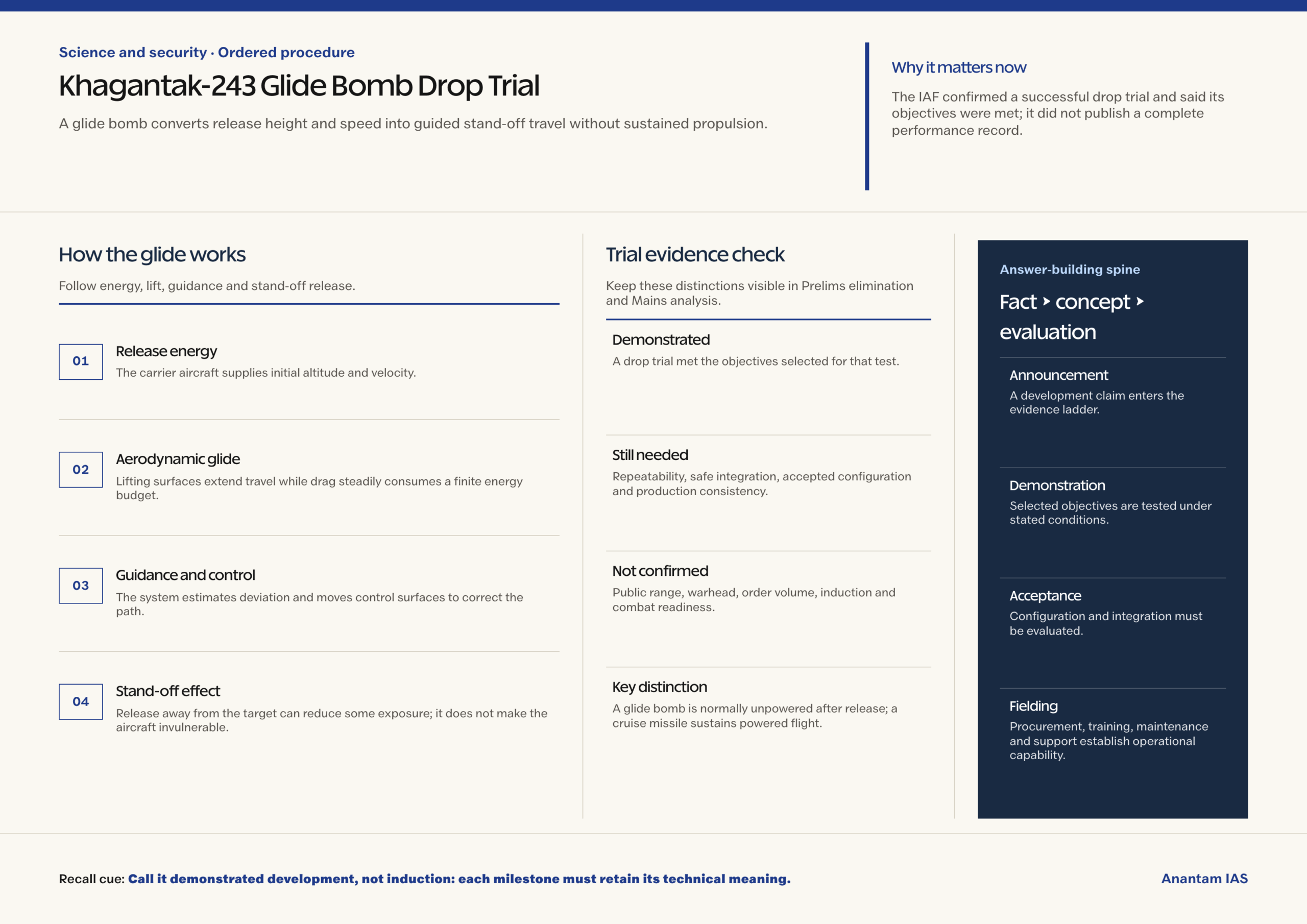
- The carrier aircraft gives the weapon its initial height and velocity; gravity supplies potential-energy loss while aerodynamic lift extends travel, rather than an engine fitted to the bomb.
- Wings or lifting surfaces create lift, while drag continually removes energy; the weapon must manage that finite energy budget throughout descent.
- Release altitude, release speed, wind, manoeuvres and target geometry all influence achievable reach, so a single public range claim cannot describe every mission.
- A conventional gravity bomb mainly follows a ballistic path after release; a glide bomb can reshape that path through aerodynamic lift and controlled corrections.
- A powered missile carries propulsion for sustained flight. Calling every long-reaching air-launched weapon a missile obscures this central propulsion distinction.
Guidance, Control and Stand-Off Launch
Precision requires more than gliding: the weapon must estimate its path and command physical corrections.
- A guidance system compares the estimated position or trajectory with the desired path and determines what correction is needed.
- The control system turns that command into motion through aerodynamic surfaces, changing lift and direction while respecting the remaining speed and altitude during the finite glide.
- The exact sensors used by Khagantak-243 were not specified in the IAF post; general guidance principles should not be presented as confirmed subsystem details.
- A stand-off release can reduce the need to fly directly over a target and may limit exposure to some threats, but it does not make an aircraft invulnerable.
- Effective precision also depends on target coordinates, navigation quality, mission planning, aircraft integration and rules governing target selection, not the munition alone.
From Drop Trial to Operational Capability
A test result should be read according to what was demonstrated, not what might follow later.
- The IAF confirmed a successful drop trial and said its objectives were met; it did not publish those objectives or a complete performance record.
- One trial can validate selected functions under stated conditions, but repeatability across environments, release conditions, weather and mission profiles requires a broader body of evidence.
- Aircraft compatibility involves carriage, safe separation, mission-computer interfaces and release procedures; public confirmation of one stage should not imply every integration stage is complete.
- Possible service use also depends on accepted evaluation, production consistency, storage, inspection, training and maintenance arrangements beyond a prototype’s demonstrated flight.
- For exam answers, apply an evidence ladder: announcement, demonstrated objective, repeated evaluation, accepted configuration, procurement, fielding and sustained operational support.
Way Forward
Build Verifiable Capability
The next steps should convert a successful demonstration into transparent, repeatable and supportable performance.
- Test across relevant release conditions and publish non-sensitive evidence that distinguishes demonstrated capability from projected capability.
- Validate safe aircraft integration, guidance resilience and production consistency before drawing conclusions about operational availability.
- Build quality assurance, storage, inspection, maintenance and training into acquisition decisions from the beginning.
- Use precise public language for trial, evaluation, procurement and induction so that each milestone retains its technical meaning.
Conclusion
- Khagantak-243 matters today because the IAF confirmed a successful indigenous drop trial, while leaving key specifications and operational status outside the public evidence.
- In a Mains answer, explain the unpowered glide-and-guidance mechanism, the value and limits of stand-off release, and the trial-to-induction evidence ladder.
- The defensible conclusion is progress in demonstrated development, not proof that the weapon has been inducted, ordered at scale or validated across all operational conditions and mission environments.
UPSC Practice Questions
Prelims MCQ 1
With reference to glide bombs, consider the following statements:
- They normally depend on sustained onboard propulsion throughout their flight after release.
- They can convert release altitude and speed into forward glide.
- Aerodynamic control surfaces can be used to correct their path.
How many of the above statements are correct?
(a) Only one (b) Only two (c) All three (d) None
Answer: (b) Only two
Explanation:
Statements 2 and 3 are correct. A glide bomb is normally unpowered after release; it uses release energy, lift and controlled aerodynamic corrections rather than sustained propulsion.
Prelims MCQ 2
Which one of the following is the most accurate inference from the IAF announcement on Khagantak-243?
(a) The weapon has entered operational service (b) Every aircraft-integration test is complete (c) A drop trial was completed and its stated trial objectives were met (d) A publicly verified range and warhead configuration has been certified
Answer: (c) A drop trial was completed and its stated trial objectives were met
Explanation:
The IAF confirmed the successful drop and that the trial met its objectives. Its post did not confirm induction, complete integration, range or warhead specifications.
UPSC Mains Questions
- Explain how an unpowered guided glide bomb enables stand-off precision strike. What technical and operational limitations should qualify claims about its effectiveness?
- A successful defence trial is a milestone, not the same as induction. Develop an evidence ladder for assessing the maturity of an indigenous weapon system.
Sources: Indian Air Force and The Hindu.
Frequently Asked Questions
What is Khagantak-243?
Khagantak-243 is the indigenously designed and developed long-range glide bomb whose successful drop trial was announced by the Indian Air Force on September 2, 2026.
How does an unpowered glide bomb travel after release?
It converts the aircraft’s release altitude and speed into forward glide. Aerodynamic lift extends travel, while guidance and control surfaces can correct the descending path.
What does stand-off launch mean?
It means releasing a weapon away from the target rather than directly overhead. This can reduce exposure to some threats, but does not guarantee aircraft safety.
Did the IAF announcement confirm that Khagantak-243 has been inducted?
No. The announcement confirmed a successful drop trial whose objectives were met. It did not state that the weapon had entered operational service.
Why should reported specifications be treated cautiously?
The official IAF post did not publish range, warhead, order quantity or platform details. Such claims should not be treated as officially verified specifications without stronger primary evidence.
Source: https://anantamias.com/current-affairs/khagantak-243-glide-bomb-trial/
India’s JCR Sovereign Rating Upgrade Explained
Why in News?
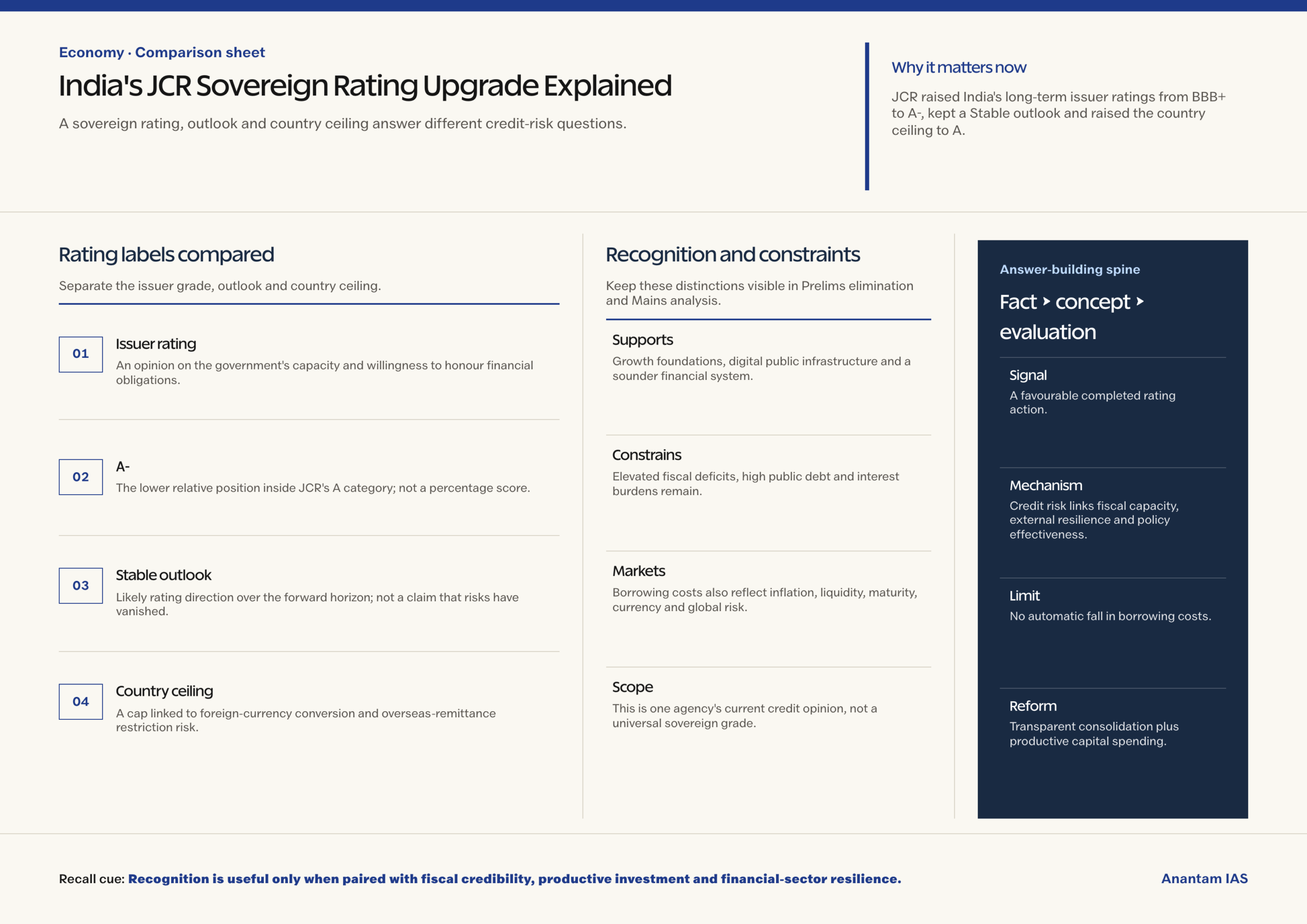
On September 2, 2026, Japan Credit Rating Agency upgraded India’s foreign- and local-currency long-term issuer ratings from BBB+ to A-, retained a Stable outlook, and raised the country ceiling to A.
- The move is a one-notch upgrade by JCR, not a common rating assigned by every global credit-rating agency.
- JCR places the new issuer ratings in its A category, which denotes high certainty that financial obligations will be honoured.
- The Stable outlook expresses JCR’s view that the rating is unlikely to change in the foreseeable future; it is not a guarantee.
- The separate country ceiling moved to A and concerns foreign-currency transaction restrictions affecting entities within India.
- Sovereign ratings compress an agency’s assessment of repayment capacity and willingness into a comparable symbol used by lenders, investors and regulated institutions.
- The upgrade recognises stronger economic and financial foundations, yet JCR still identifies elevated public debt, interest burdens and structurally persistent fiscal deficits as constraints.
- A higher rating can improve investor perception, but market yields also respond to inflation, liquidity, maturity, currency risk and global financial conditions.
UPSC Relevance
Prelims Relevance
- A sovereign issuer rating assesses a government’s overall capacity and willingness to honour its financial obligations.
- JCR may assign separate local-currency and foreign-currency ratings because access to domestic currency differs from access to foreign currency.
- Under JCR’s scale, A indicates high certainty of honouring financial obligations; plus and minus signs show relative standing within a category.
- A rating outlook indicates the likely rating direction over roughly one or two years; Stable does not make a future change impossible.
- A country ceiling normally limits the foreign-currency rating of domestic entities by reflecting conversion and overseas-remittance restriction risk.
Mains Relevance
GS Paper 3
- How sovereign ratings connect fiscal capacity, financial-sector resilience and external vulnerability to perceived credit risk.
- Why fiscal consolidation must protect productive public investment while reducing debt and interest burdens.
GS Paper 2
- How institutional credibility, transparent fiscal data and predictable policy affect assessments of state capacity.
Essay
- Credibility is accumulated through institutions and disciplined policy, not created by a single favourable assessment.
Background and Context
What a Sovereign Rating Measures
A sovereign rating is an agency’s reasoned opinion on government credit risk, not a certificate of overall economic performance.
- JCR evaluates the sovereign’s ability and willingness to pay, drawing on economic strength, fiscal capacity, external resilience, financial stability and policy effectiveness.
- An issuer rating concerns the government’s overall obligations; an individual bond can receive a different rating when contractual seniority or recovery prospects differ.
- Ratings are relative assessments. They help compare credit quality across issuers, but they do not predict an exact default probability or investment return.
- JCR describes a rating as an opinion, not a recommendation to buy, sell or hold securities; market liquidity and price fluctuations fall outside its core credit judgment.
- The reported Indian rating is agency-specific. Symbols with similar names should not be assumed to have identical meaning or methodology across rating agencies.
Rating, Outlook and Country Ceiling
Three connected labels answer different questions and should not be treated as interchangeable.
- The move from BBB+ to A- crosses into JCR’s A category, where the agency sees high certainty that the issuer will honour financial obligations.
- The minus sign places A- at the lower relative position within the A category; it does not convert the rating into a percentage score.
- A Stable outlook concerns likely rating direction over JCR’s forward horizon. It does not mean policy, fiscal or financial risks are absent.
- Foreign-currency obligations face an added constraint: a sovereign must obtain or convert into the currency needed for payment, unlike obligations payable in the currency it issues.
- JCR’s A country ceiling reflects the assessed risk of authorities restricting currency conversion or overseas remittance by domestic entities; it normally caps their foreign-currency ratings.
Why the Upgrade Is Not a Fiscal Clean Chit
The upgrade recognises improvement while leaving a clear reform agenda for public finance and financial stability.
- JCR cited durable growth foundations, digital public infrastructure, GST implementation and improved financial-system soundness among the factors supporting its decision.
- It also linked healthier bank asset quality to the Insolvency and Bankruptcy Code, public-bank recapitalisation and stronger RBI supervision and macroprudential policy.
- Better expenditure quality matters when budgets shift toward growth-supporting capital investment, but capital spending must generate productive assets and attract private investment.
- JCR still flagged structurally elevated fiscal deficits, high general-government debt and associated interest burdens. These constraints were not erased by the rating action.
- The upgrade does not mechanically lower borrowing costs. Bond yields also price monetary conditions, inflation expectations, market liquidity, maturity, currency exposure and global risk appetite.
Way Forward
Convert Recognition into Durable Credit Strength
- Continue credible fiscal consolidation through realistic assumptions, transparent off-budget liabilities and medium-term debt management rather than abrupt cuts to productive expenditure.
- Improve the quality of capital spending by selecting viable projects, controlling delays and measuring whether public investment crowds in private investment.
- Protect financial-sector resilience through early stress recognition, sound provisioning, supervision of banks and non-bank lenders, and effective insolvency resolution.
- Deepen domestic bond markets and predictable policy communication so financing becomes more diversified, liquid and resilient to shifts in external investor sentiment.
Conclusion
- JCR’s upgrade is a favourable credit signal based on stronger growth foundations, policy effectiveness and financial-system soundness, but it remains one agency’s current opinion.
- In a Mains answer, pair the recognition with the unresolved fiscal and debt constraints, then argue for transparent consolidation, productive investment and continued financial supervision.
- Remember the exam distinction: the rating assesses sovereign repayment capacity, the outlook signals likely direction, and the country ceiling addresses foreign-currency transfer restrictions.
UPSC Practice Questions
Prelims MCQ 1
With reference to sovereign credit ratings, consider the following statements:
- A sovereign issuer rating assesses a government’s overall capacity and willingness to honour financial obligations.
- A Stable outlook guarantees that the issuer rating will remain unchanged during the outlook period.
- A country ceiling may reflect the risk of restrictions on currency conversion and overseas remittance by domestic entities.
How many of the above statements are correct?
(a) Only one (b) Only two (c) All three (d) None
Answer: (b) Only two
Explanation:
Statements 1 and 3 are correct. A Stable outlook indicates that change is considered unlikely in the foreseeable future, but JCR states that a rating can still change without a prior outlook revision.
Prelims MCQ 2
What did Japan Credit Rating Agency announce for India in September 2026?
(a) It raised only the foreign-currency rating to A and assigned a Positive outlook (b) It raised both long-term issuer ratings to A- with a Stable outlook and the country ceiling to A (c) It kept both long-term issuer ratings at BBB+ and lowered the country ceiling (d) It assigned the same A- rating on behalf of all major global rating agencies
Answer: (b) It raised both long-term issuer ratings to A- with a Stable outlook and the country ceiling to A
Explanation:
JCR raised India’s foreign- and local-currency long-term issuer ratings by one notch from BBB+ to A-, retained a Stable outlook, and raised the country ceiling by one notch to A.
UPSC Mains Questions
- Explain the distinction between a sovereign issuer rating, a rating outlook and a country ceiling. Why does this distinction matter when interpreting India’s JCR upgrade?
- A sovereign rating upgrade is recognition, not a fiscal clean chit. Discuss with reference to India’s public-finance and financial-sector reform priorities.
Sources: Japan Credit Rating Agency and PIB, Ministry of Finance.
Frequently Asked Questions
What rating did JCR assign to India in September 2026?
JCR raised India’s foreign- and local-currency long-term issuer ratings from BBB+ to A-, kept the outlook Stable, and raised the country ceiling to A.
What does an A- rating mean on JCR’s scale?
It falls within JCR’s A category, signifying high certainty that financial obligations will be honoured. The minus sign indicates relative standing within that category.
What does a Stable outlook mean?
It means JCR considers a rating change unlikely in the foreseeable future, generally its one-to-two-year outlook horizon. It does not guarantee that the rating cannot change.
What is a country ceiling?
It reflects JCR’s assessment of restrictions on foreign-currency conversion and overseas remittance by domestic entities and normally limits the foreign-currency rating they can receive.
Will the upgrade automatically reduce India’s borrowing costs?
No. It may support credit perception, but borrowing costs also depend on inflation expectations, monetary conditions, liquidity, maturity, currency risk and global investor sentiment.
Source: https://anantamias.com/current-affairs/india-jcr-sovereign-rating-upgrade/
Climate Overshoot: The Peak-and-Decline Pathway
Why in News?
On 2 September 2026, UNEP released Limiting Overshoot, assessing a multi-year exceedance of 1.5°C as likely and mapping an urgent peak-and-decline pathway.
- UNEP identifies overshoot, peak and decline as the best remaining pathway for limiting the magnitude and duration of exceedance and attempting a return below 1.5°C.
- Its most optimistic assessed scenario peaks at 1.8°C above pre-industrial levels; most other scenarios produce higher peaks, including some above 2°C.
- The report links every additional fraction of warming and year of exceedance to intensifying impacts, harder adaptation and a greater chance of crossing irreversible thresholds.
- It calls for immediate emissions cuts, stronger adaptation and carefully governed carbon dioxide removal, while rejecting removal as a replacement for mitigation.
- Overshoot does not amend the Paris Agreement: its Article 2 temperature aim remains well below 2°C while pursuing efforts to limit warming to 1.5°C.
- Policy can still shape the curve’s peak, duration and decline, which determine cumulative exposure, adaptation needs and the risk of lasting losses.
UPSC Relevance
Prelims Relevance
- Climate overshoot: a period when long-term global warming exceeds a target before potentially declining below it.
- The pathway has four stages: exceedance, peak, decline and stabilization.
- A single warm calendar year is not identical to a long-term warming threshold, which climate science assesses over longer periods.
- Net-zero balances emissions with removals; net-negative emissions remove more greenhouse gases than are emitted.
- CDR removes carbon dioxide from the atmosphere and stores it in biological, geological or other reservoirs.
- Mitigation reduces the cause of warming; adaptation reduces vulnerability and exposure to its effects.
Mains Relevance
GS Paper 3
- Climate mitigation, adaptation limits and disaster-risk reduction under an overshoot pathway
- Carbon dioxide removal, land competition, permanence and environmental integrity
GS Paper 2
- Climate justice, international cooperation and differentiated responsibility for limiting overshoot
Essay
- Climate policy must manage both avoidable risks and irreversible losses without allowing an emergency pathway to weaken the original goal.
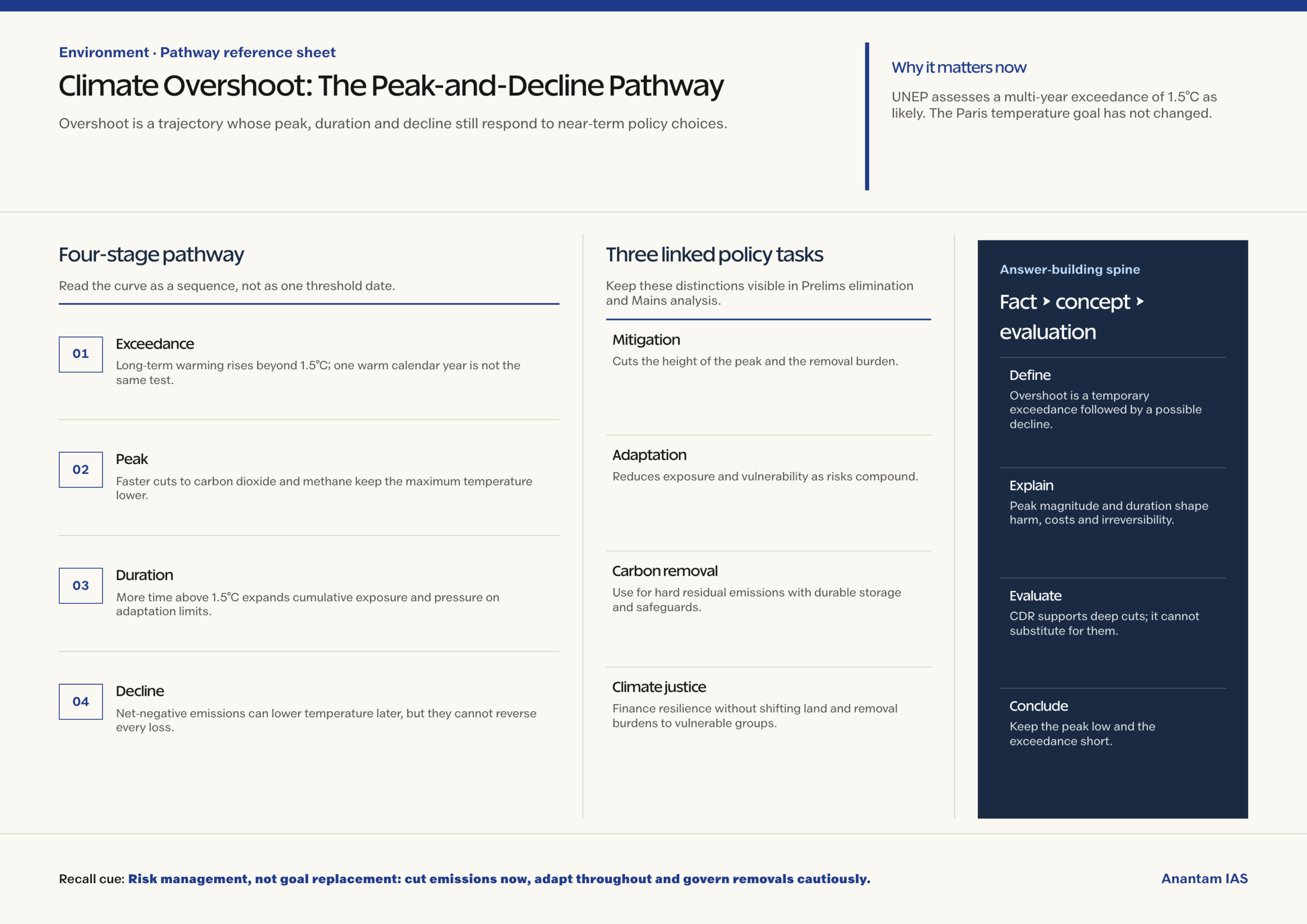
Background and Context
Reading the Overshoot Curve
Overshoot is a changing trajectory, not one date on which the climate system suddenly crosses a legal boundary; emissions and natural variability shape it over decades.
- The exceedance stage begins when long-term warming rises beyond 1.5°C; year-to-year natural variability can still produce individual calendar years above or below that level.
- The peak is the pathway’s highest warming level, shaped chiefly by how quickly and deeply carbon dioxide, methane and other greenhouse-gas emissions fall.
- The duration is time spent above 1.5°C; a longer stay expands cumulative exposure and raises the likelihood that ecosystems or communities reach hard adaptation limits.
- The decline requires sustained net-negative emissions after net-zero, while stabilization describes the later temperature level rather than restoration of every damaged natural and human system.
- Curve shape matters because a lower peak and shorter exceedance reduce severe impacts, adaptation costs, irreversible-loss risks and pressure on uncertain future removal capacity.
Three Linked Policy Tasks
Mitigation determines how high temperatures rise, adaptation manages unavoidable harm, and removals help create a later decline after net-zero is achieved.
- Rapid, sustained emissions reduction is the first lever: fossil-fuel transition, energy efficiency and methane cuts reduce both peak warming and the scale of future removal required.
- Adaptation must evolve with changing and compounding risks through heat action, resilient infrastructure, water security, early warning and social protection for exposed populations.
- Mitigation and adaptation reinforce each other: resilient energy, food, water and natural systems preserve society’s capacity to cut emissions as repeated climate shocks intensify.
- Reaching net-zero can halt further warming, but pushing temperatures downward requires net-negative emissions, meaning verified removals exceed the remaining emissions produced over time.
- Early adaptation cannot eliminate every loss; ice sheets, sea level, ecosystems, cultural heritage and livelihoods may respond slowly or irreversibly even after global temperature declines.
Carbon Removal Without Moral Hazard
CDR is a constrained residual tool whose credibility depends on deep emissions cuts, durable storage, fair burden-sharing and accountable long-term governance globally.
- Conventional CDR includes afforestation and soil management, but large land demand can compete with food, biodiversity and livelihoods, while drought or wildfire can reverse stored carbon.
- Novel methods such as direct air capture may offer more measurable storage, yet remain expensive, energy-intensive and unproven at the required global deployment scale.
- CDR should address residual emissions that are exceptionally difficult to eliminate, not preserve avoidable fossil-fuel use, inflate weak offsets or delay near-term mitigation.
- Governance must establish additionality, credible baselines, measurement, reporting, verification, storage permanence, liability and safeguards against ecological damage or unequal land burdens.
- Even a successful temperature decline cannot recreate the previous climate; delayed sea-level rise, displacement and ecosystem losses make loss and damage a continuing international justice issue.
Way Forward
Keep the Peak Low and the Exceedance Short
The pathway remains viable only if near-term action cuts warming and vulnerability before dependence on removals grows.
- Strengthen near-term national targets with credible sectoral delivery for power, transport, industry, buildings and methane, backed by transparent progress reviews.
- Integrate adaptation planning with observed and projected risk, including finance for vulnerable countries, locally led action and protection against non-linear hazards.
- Create robust CDR standards covering lifecycle emissions, land and water effects, storage duration, community consent, independent verification and responsibility for reversal.
- Preserve climate justice by requiring historically high emitters to move faster, finance resilience and avoid shifting removal or adaptation burdens onto vulnerable communities.
Conclusion
- Overshoot is risk management, not goal replacement: the Paris temperature aim remains, while immediate choices determine the peak, duration and feasibility of decline.
- A strong answer should connect deep emissions cuts, adaptive capacity, cautiously governed residual CDR and climate justice across the entire peak-and-decline pathway.
UPSC Practice Questions
Prelims MCQ 1
With reference to climate overshoot, consider the following statements:
- It describes a pathway in which long-term warming exceeds a target before potentially declining below it.
- One calendar year above 1.5°C by itself establishes that the Paris long-term threshold has permanently been breached.
- Returning temperature downward after a peak requires net-negative emissions.
How many of the above statements are correct?
(a) Only one (b) Only two (c) All three (d) None
Answer: (b) Only two
Explanation:
Statements 1 and 3 are correct. Long-term warming is assessed over longer periods, so an individual annual anomaly is not the same as permanently crossing the long-term threshold.
Prelims MCQ 2
Which one of the following best describes the appropriate role of carbon dioxide removal in an overshoot pathway?
(a) Replacing immediate emissions reductions (b) Offsetting all present fossil-fuel emissions indefinitely (c) Complementing deep cuts by addressing residual emissions and enabling net-negative emissions (d) Guaranteeing reversal of all climate impacts
Answer: (c) Complementing deep cuts by addressing residual emissions and enabling net-negative emissions
Explanation:
UNEP treats CDR as necessary alongside sustained emissions cuts. Its role is constrained by scale, cost, permanence, land, energy and governance concerns.
UPSC Mains Questions
- Climate overshoot is a pathway to be minimized and reversed, not a revision of the Paris Agreement’s temperature goal. Discuss.
- Examine why carbon dioxide removal can support a temperature decline but cannot substitute for rapid and sustained emissions reduction.
Sources: UN Environment Programme, Limiting Overshoot report and The Hindu.
Frequently Asked Questions
What is climate overshoot?
Climate overshoot is a period when long-term global warming exceeds a chosen threshold, reaches a peak and may later decline through sustained mitigation and net-negative emissions.
Has the Paris Agreement’s 1.5°C goal changed?
No. Overshoot describes a likely physical pathway under current trajectories; it does not amend Article 2 or convert warming above 1.5°C into an accepted destination.
Why is one year above 1.5°C not the same as long-term breach?
Annual temperatures fluctuate with natural variability. The Paris temperature threshold concerns long-term human-caused warming, which scientists assess over longer periods rather than one calendar year.
Why is carbon dioxide removal not a substitute for emissions cuts?
Removal faces limits involving scale, cost, energy, land, storage permanence and governance. Deep cuts reduce both peak warming and the amount of uncertain removal later required.
Can declining temperatures reverse every climate impact?
No. Sea-level rise, ecosystem loss, displacement and other changes can persist or become irreversible, so adaptation, loss-and-damage support and climate justice remain essential.
Source: https://anantamias.com/current-affairs/climate-overshoot-peak-decline-pathway/
Mental Health must Anchor India’s Public-Health Strategy
Context:
Mental health directly influences physical health, education, workforce productivity, family stability and social cohesion. Therefore, India’s goals of Healthcare for All and Viksit Bharat 2047 cannot be achieved without making mental well-being a core component of public health.
| UPSC Relevance: GS-2 Social Justice: Health Mains: Mental Healthcare in India: Challenges, Policies, Constitutional and Legal Framework |
Scale of the Challenge:
- A Lancet study estimated that nearly 197 million Indians (around one in seven) were living with mental disorders in 2017.
- The contribution of mental disorders to India’s total disease burden almost doubled from 2.5% in 1990 to 4.7% in 2017.
- The National Mental Health Survey, 2015-16 found mental disorders among 10.6% of adults, with a treatment gap of 70%-92% across different conditions.
- India also has only about 0.75 psychiatrists per lakh population, against the minimum requirement of around three.
Mental Health must Anchor Public Health as:
- Mental-physical health linkage: Depression and anxiety can worsen diabetes, hypertension, tuberculosis, HIV and cardiovascular diseases; chronic illness can similarly produce psychological distress.
- Human-capital impact: Untreated illness contributes to school dropout, absenteeism, unemployment, reduced productivity and family impoverishment.
- Economic case: A 2025 modelling study estimated that universal depression screening through primary healthcare could generate annual savings of ₹291-₹482 billion, equivalent to 0.19%-0.32% of GDP.
- Equity dimension: Women, adolescents, elderly persons, migrants, tribal communities, LGBTQ+ persons, disaster-affected populations and persons with disabilities face distinct risks and barriers.
Major Challenges:
- Invisible and complex nature: Unlike many physical illnesses, mental disorders may lack visible symptoms or simple diagnostic tests, resulting in under-recognition and delayed treatment.
- Stigma: Mental illness is frequently misunderstood as weakness, moral failure or a family problem, discouraging people from seeking help.
- Shortage of professionals: Psychiatrists, psychologists, psychiatric nurses and social workers remain scarce and concentrated in cities.
- Inadequate community infrastructure: Rural facilities often lack counselling, medicines, rehabilitation and reliable referral systems.
- Affordability: Much of mental healthcare is long-term and outpatient-based, while insurance coverage remains focused primarily on hospitalisation.
- Weak continuity of care: Screening, diagnosis, treatment, rehabilitation and social support frequently operate as disconnected services.
- Data limitations: India’s principal nationwide prevalence estimates still come from the 2015-16 survey, while mental-health outcomes are inherently difficult to measure over short periods.
Constitutional and Legal Framework:
- National Mental Health Policy, 2014: It adopted a rights-based and participatory approach aimed at universal access, reduction of stigma, development of skilled human resources and special support for vulnerable groups.
- Mental Healthcare Act, 2017: The Act provides:
- A statutory right to access mental healthcare
- Protection of dignity, confidentiality and informed consent
- Advance directives and nominated representatives
- Insurance for mental illness on the same basis as physical illness; and
- A presumption of severe stress in cases of attempted suicide, accompanied by a government duty to provide care and rehabilitation.
- Mental Health as a Fundamental Right: In Sukdeb Saha v. State of Andhra Pradesh (2025), the Supreme Court recognised mental health as an integral component of the right to life and dignity under Article 21. It also issued 15 binding interim guidelines for educational institutions and coaching centres.
| Saha Guidelines for Student Mental Health: Every educational institution must adopt a publicly accessible mental-health policy. Institutions having 100 or more students must engage at least one qualified counsellor, psychologist or social worker; smaller institutions must establish referral linkages. Performance-based segregation, public shaming and unrealistic academic targets should be avoided. Institutions must establish confidential grievance mechanisms, crisis-referral protocols and prominently display helpline numbers. Teaching and non-teaching staff must receive periodic training in psychological first aid and identification of warning signs. States and Union Territories were directed to frame rules for registration and regulation of private coaching centres. District-level committees headed by the District Magistrate or Collector must monitor compliance. These directions remain binding until an appropriate legislative or regulatory framework is established. |
Government Initiatives:
- National Mental Health Programme: Operating since 1982 to integrate mental-health knowledge and services with general healthcare.
- District Mental Health Programme: Introduced in 1996 and now sanctioned in 767 districts, providing counselling, medicines, outreach and referral services.
- Ayushman Arogya Mandirs: More than 1.8 lakh primary facilities have been upgraded, with mental, neurological and substance-use services included in comprehensive primary care.
- Tele-MANAS: Launched in 2022 as the digital arm of the District Mental Health Programme. By July 2026, 53 cells operating in all States and Union Territories had handled over 42 lakh calls in 20 languages through helpline 14416.
- KIRAN Helpline: Launched in 2020 and subsequently merged with Tele-MANAS to create an integrated national service.
- National Suicide Prevention Strategy, 2022: Aims to reduce suicide mortality by 10% by 2030.
Way Forward:
- Integrate mental health into primary care: Arogya Mandirs should provide early identification, basic counselling, medicines, referral and follow-up. Screening must be connected to treatment: screening without care merely identifies unmet need.
- Empower frontline workers: ASHAs and Community Health Officers can identify distress and provide basic support after appropriate training, incentives and specialist supervision. Community models such as India’s Atmiyata and Zimbabwe’s Friendship Bench demonstrate the potential of task-sharing.
- Build a stepped-care system: Mild conditions may be addressed through community and primary care, moderate cases through district teams, and severe disorders through specialists and hospitals. Tele-MANAS should complement, rather than replace, face-to-face care.
- Improve financial protection: Outpatient consultations, psychotherapy, medicines and rehabilitation should be covered under public insurance, including PM-JAY. Insurance parity under the Mental Healthcare Act must translate into actual and affordable access.
- Address social determinants: Mental-health policy must also address unemployment, academic pressure, workplace stress, gender-based violence, loneliness, substance abuse and climate-related disasters.
- Strengthen data and accountability: The ongoing National Mental Health Survey-2, covering all States and Union Territories, should guide district-level planning. Outcome indicators must measure recovery, functioning, continuity of care and patient satisfaction, not merely the number of consultations.
India already has the institutional foundations for reform; the challenge is to connect community workers, Arogya Mandirs, Tele-MANAS, district hospitals and specialist institutions into a continuous, rights-based system.
Mental healthcare must be treated simultaneously as a public-health necessity, constitutional obligation and human-capital investment.
Source: https://anantamias.com/current-affairs/mental-health-must-anchor-indias-public-health-strategy/
UNEP sets out Overshoot Pathway to manage Global Warming Limit breach
Why in News?
The United Nations Environment Programme’s (UNEP) report, Limiting Overshoot, warns that long-term global warming is likely to cross 1.5°C above pre-industrial levels within the next few years.
It proposes an “overshoot, peak and decline” pathway to minimise the extent and duration of this breach and eventually return temperatures below 1.5°C.
| UPSC Relevance: GS-3 Environment: Climate Change; International Agreements Prelims: Nationally Determined Contribution; Paris Climate deal; India’s climate commitments. Mains: Managing Climate change (Techniques, Challenges, Policies) |
Key Findings by UNEP:
- 1.5°C overshoot is increasingly unavoidable: UNEP projects that global warming will cross 1.5°C in the coming years. However, the magnitude and duration of the overshoot remain policy-dependent.
- Best-case scenario: Even if countries fully implement their current climate plans and net-zero commitments, peak warming could reach around 1.8°C.
- Current policies: Existing policies point towards approximately 2.6°C warming by 2100.
- The Paris Agreement’s 1.5°C target refers to long-term global warming, not a single year temporarily exceeding 1.5°C.
| Understanding the 1.5°C Threshold: Under the Paris Agreement 2015, countries agreed to hold warming well below 2°C and pursue efforts to limit it to 1.5°C. The threshold refers to a long-term global average, generally assessed over decades. Therefore, a single year above 1.5°C (as occurred in 2024) does not by itself constitute a formal breach of the Paris goal. |
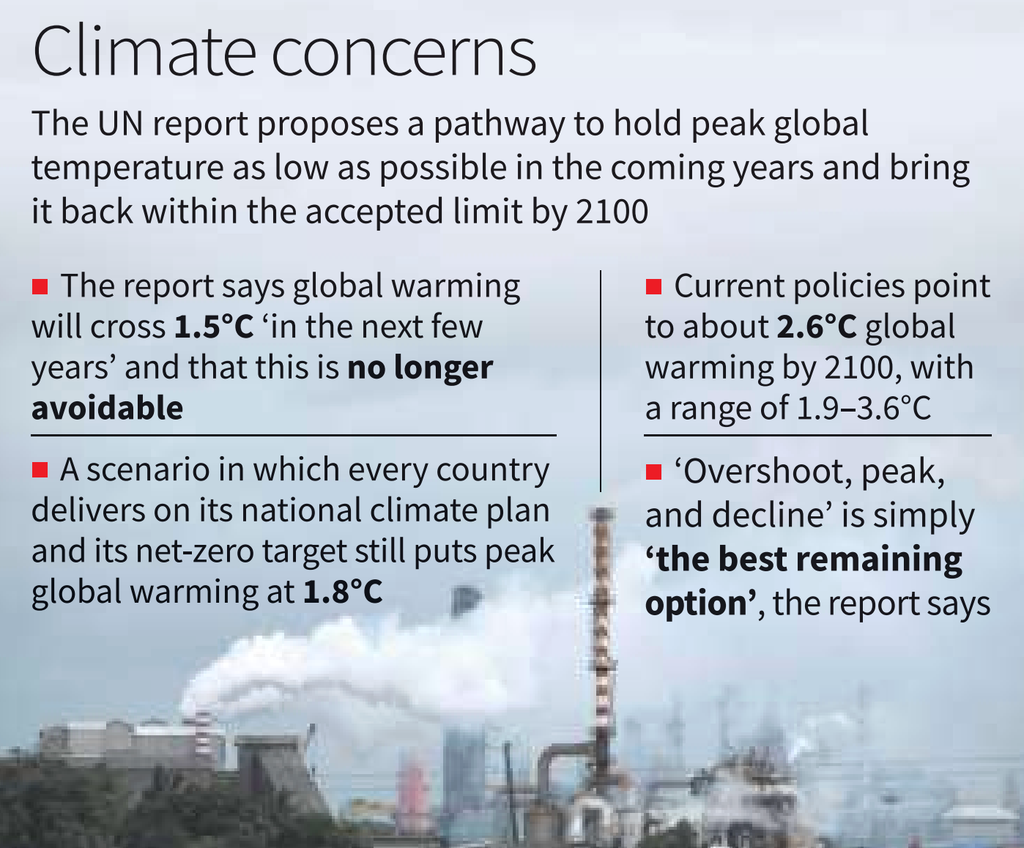
Understanding the Proposed Pathway:
UNEP proposes an “overshoot, peak and decline” pathway to minimise the extent and duration of this breach and eventually return temperatures below 1.5°C.
- Overshoot: Despite cutting emissions, the concentration of greenhouse gases already accumulated in the atmosphere means temperatures may temporarily rise above 1.5°C. This temporary period above 1.5°C is called overshoot.
- Peak: Once above 1.5°C, the next goal is to stop further warming as quickly as possible. The peak is the highest temperature reached. Immediate emission reductions keep the maximum temperature rise as low as possible (preferably well below 2°C).
- Decline: After reaching the peak, the world needs to achieve net-negative CO₂ emissions. This requires Carbon Dioxide Removal (CDR) along with continued emissions reductions.
Temperatures can be eventually brought back below 1.5°C. UNEP describes this not as a desirable pathway, but as the best remaining option.
Why does the Size and Duration of Overshoot Matter?
Every additional fraction of warming and every extra year above 1.5°C increases the risk of:
- accelerated sea-level rise and coastal inundation
- loss of glaciers and destabilisation of major ice sheets
- coral-reef collapse and irreversible biodiversity loss
- more intense heatwaves, floods, droughts and wildfires
- food and water insecurity
- displacement and loss of livelihoods
- climate tipping points involving the Amazon rainforest, Greenland, West Antarctica and Atlantic ocean circulation.
Without effective adaptation, global food production could decline by up to 14% by 2050. Some impacts (such as species extinction, glacier loss and long-term sea-level rise) will persist even if temperatures subsequently decline.
Four-Part Policy Response:
- Mitigation limits the peak: Rapidly reduce fossil-fuel dependence, expand renewables and storage, electrify transport and industry, improve energy efficiency and cut methane emissions.
- Adaptation limits the damage: Strengthen climate-resilient agriculture, heat action plans, early warning systems, coastal protection, water security and resilient infrastructure. However, adaptation cannot protect against every impact.
- Carbon removal enables the decline: Carbon Dioxide Removal (CDR) must supplement (not replace) deep emission reductions. Afforestation faces land, food security and biodiversity constraints, while technological removal remains expensive and inadequately proven.
- Loss-and-damage support addresses the irreversible: Vulnerable developing countries and Small Island Developing States require grants, technology and institutional support for losses that can neither be prevented nor adapted to.
COP30 and the shift towards Managing Overshoot:
- At COP30, Belém (2025), countries adopted the Global Mutirão decision, reaffirming the 1.5°C goal while recognising the need to limit both the magnitude and duration of any overshoot and close adaptation gaps.
- COP30 also launched initiatives such as the Global Implementation Accelerator and Belém Mission to 1.5 to accelerate the implementation of Nationally Determined Contributions (NDCs) and National Adaptation Plans.
Relevance for India:
- Overshoot would intensify India’s exposure to extreme heat, erratic monsoons, Himalayan glacier retreat, agricultural losses, water stress and coastal flooding.
- India’s NDC for 2031-2035 commits it to:
- reduce the emissions intensity of GDP by 47% from the 2005 level
- achieve about 60% of installed electricity capacity from non-fossil sources
- create a carbon sink of 3.5-4 billion tonnes of CO₂ equivalent through forest and tree cover
- strengthen adaptation in agriculture, water, health, coastal regions, the Himalayas and disaster management.
These commitments support India’s long-term objective of net-zero emissions by 2070.
Thus, every fraction of a degree avoided and every year by which the overshoot is shortened will save lives, ecosystems and adaptation costs.
UPSC Mains PYQs:
Q. Write a review on India’s climate commitments under the Paris Agreement (2015) and mention how these have been further strengthened in COP26 (2021). In this direction, how has the first Nationally Determined Contribution intended by India been updated in 2022? (2025)
Q. What is Carbon Capture, Utilization and Storage (CCUS)? What is the potential role of CCUS in tackling climate change? (2025)
Q. Describe the major outcomes of the 26th session of the Conference of the Parties (COP) to the United Nations Framework Convention on Climate Change (UNFCCC). What are the commitments made by India in this conference? (2021)
River Interlinking is not the solution for India’s Water Crisis
Context:
At the 31st Southern Zonal Council meeting, the Union Home Minister proposed linking rivers from the Brahmaputra to the Godavari and Cauvery as a long-term response to India’s water scarcity.
The proposal has revived debate over whether large inter-basin transfers can provide water security or merely redistribute existing ecological and political conflicts.
| UPSC Relevance: GS-1 Geography: Water resources, Drainage systems; GS-2 Polity and Governance: Cooperative federalism Mains: River Interlinking in India: Merits and Challenges |
India’s Water Paradox:
- India supports over 18% of the global population with only about 4.2% of the world’s freshwater resources. Water availability is also highly uneven across seasons and regions.
- India’s annual per-capita water availability was estimated at 1,486 cubic metres in 2021, below the internationally recognised water-stress threshold of 1,700 cubic metres. It may decline to 1,367 cubic metres by 2031.
This combination of monsoon concentration, recurrent floods, droughts and declining groundwater provides the rationale for river interlinking.
What is River Interlinking?
- River interlinking involves transferring water through reservoirs and canals from a basin assessed as having surplus water to another considered water-deficient.
- The National Perspective Plan, 1980 identifies 30 links:
- 14 under the Himalayan component
- 16 under the Peninsular component
- The National Water Development Agency, established in 1982, undertakes water-balance studies and prepares feasibility and detailed project reports.
- By December 2025, pre-feasibility reports had been completed for all 30 links, feasibility reports for 26 and detailed project reports for 13. However, the Ken-Betwa Link Project remains the only priority project to have entered implementation.
Potential Benefits of River Interlinking:
- Water Equity and Food Security: Transfer from flood-prone surplus basins (Brahmaputra, Ganga) to chronically water-deficient regions (Bundelkhand, Rajasthan, coastal Andhra) would reduce regional inequalities in agricultural productivity.
- Flood and Drought Mitigation: River-interlinking projects can simultaneously reduce peak flood discharges in surplus rivers by diverting excess monsoon runoff and recharge reservoirs in deficit areas before and after the monsoon.
- Hydropower and Renewable Energy: The dam infrastructure required for river-interlinking projects also creates significant hydropower potential. The NPP projects a total hydropower generation of approximately 34,000 MW across the complete programme, which is especially significant for states in the Himalayan component.
- Inland Navigation and Connectivity: The 14,900-km network of canals envisaged under the NPP could substantially expand India’s inland waterway network, reducing the burden on overburdened road and railway infrastructure for bulk commodity transport- particularly coal, fertilisers, and agricultural produce.
- Revival of Seasonal Rivers: Transfers can augment lean-season flows in seasonal rivers, improving groundwater recharge in adjoining aquifers, sustaining riparian ecosystems, and supporting municipal water supply for towns dependent on these rivers in non-monsoon months.
Existing inter-basin transfers such as the Indira Gandhi Canal and the Parambikulam-Aliyar Project demonstrate that carefully designed transfers can produce regional benefits.
Why River Linking Cannot be the Sole Solution?
- Questionable idea of surplus water: Surplus estimates are generally based on historical averages. They may not adequately account for climate-induced monsoon variability, future demands within the donor basin, groundwater interaction and the water required to sustain river ecosystems. A river carrying large monsoon flows is not necessarily surplus throughout the year.
- Ecological disruption: Reducing downstream flows can disturb sediment transport and nutrient cycles, damage wetlands, floodplains and fisheries, increase salinity intrusion in estuaries and deltas, fragment riverine habitats and affect groundwater recharge and coastal ecosystems. E.g., Kerala has opposed the Pamba-Achankovil-Vaippar link over its potential effects on the Vembanad wetland system.
- Limited capacity to control floods: Floods frequently result from intense local rainfall, floodplain encroachment, poor drainage and simultaneous high flows across tributaries. Long-distance canals cannot automatically absorb such short-duration flood peaks.
- Displacement and livelihood losses: Large reservoirs and canals require extensive land acquisition, affecting farmers, forest dwellers and tribal communities. Monetary compensation alone cannot replace community forests, cultural landscapes and livelihood networks.
- Federal and transboundary conflicts:
- Water falls under Entry 17 of the State List, subject to Parliament’s authority over inter-State rivers under Entry 56 of the Union List. Article 262 provides for adjudication of inter-State water disputes. This creates a framework of shared water governance, making inter-State cooperation and Centre-State coordination essential for river-linking projects.
- Disagreements over the Pennaiyar, Cauvery, Mekedatu and other projects show that even existing allocations are difficult to resolve. Linking multiple basins would multiply questions concerning surplus determination, compensation and distress-year sharing. Himalayan links also require cooperation with Nepal, Bhutan and Bangladesh.
- Supply-induced demand: Additional supplies may encourage water-intensive crops, inefficient irrigation and urban expansion. Without demand management, newly transferred water may soon generate fresh scarcity.
Way Forward: Better Water-Security Strategy
River links should be considered selectively (not as a uniform national grid) and only after:
- climate-responsive basin-level hydrological assessments
- guaranteed environmental flows in donor rivers
- cumulative environmental and social-impact assessments
- prior rehabilitation and recognition of rights under the Forest Rights Act, 2006, Panchayats Extension to Scheduled Areas Act, 1996, and Land Acquisition, Rehabilitation and Resettlement Act, 2013.
- transparent interstate benefit-sharing agreements
- independent post-project monitoring.
The larger priority must be demand-side management, including:
- crop diversification away from water-intensive rice and sugarcane
- micro-irrigation and scientific water budgeting
- groundwater regulation and aquifer management
- reform of electricity subsidies while protecting small farmers
- restoration of tanks, wetlands and floodplains
- rainwater harvesting and treated-wastewater reuse
- reduction of leakage in urban supply systems.
India’s water crisis arises not merely from inadequate supply but from ecological degradation, inefficient agriculture, groundwater over-extraction and fragmented governance. River interlinking may assist carefully selected water-deficient regions, but rivers are living ecological systems, not pipelines carrying unused water. Durable water security must begin with conservation, efficiency and cooperative river-basin governance.
SC orders oversight on Bar Council’s policy decisions
Why in News?
The Supreme Court has clarified that senior advocate Manan Kumar Mishra can function only as the pro tem Chairperson of the Bar Council of India (BCI) until a newly constituted Council elects its office-bearers.
Until then, the BCI must actively involve the Attorney-General for India and the Solicitor-General of India in every major policy decision. Its routine administration may continue under the interim leadership.
| UPSC Relevance: GS-2 Polity and Governance: Statutory bodies Prelims: Bar Council of India (Key Facts) |
About the Bar Council of India:
- The BCI is a statutory body established under the Advocates Act, 1961.
- It comprises the Attorney-General and Solicitor-General as ex officio members, along with one member elected by each State Bar Council.
- Its principal functions include:
- prescribing standards of professional conduct for advocates
- regulating legal education and recognising law degrees
- laying down disciplinary procedures
- conducting the All India Bar Examination
- promoting legal aid and advocates’ welfare.
The independence and credibility of the BCI are important because an autonomous Bar is integral to judicial independence and the rule of law.
What Triggered the Proceedings?
- Petitioners challenged the prolonged continuation of the existing leadership and a 2025 notification prescribing a five-year term for the Chairperson and Vice-Chairperson. They argued that the BCI Rules provide a two-year tenure for these offices.
- The Court observed that a transitional provision permitting an office-bearer to continue until a successor is elected cannot become a means of indefinitely postponing democratic renewal.
The petitioners also raised allegations concerning:
- concentration of power within the BCI
- large and inadequately disclosed expenditures
- transfer of BCI assets to the BCI-PEARL FIRST Trust
- elected office-bearers becoming permanent trustees even after completing their terms.
These allegations are yet to be finally adjudicated.
Supreme Court’s Directions:
- The existing Chairperson may handle only day-to-day affairs as a pro tem functionary.
- The Attorney-General and Solicitor-General must be associated with all policy decisions.
- State Bar Councils must complete their reconstitution and elect representatives to the BCI within a prescribed timeframe.
- High Court Chief Justices were asked to expedite the co-option of women members to State Bar Councils, facilitating early formation of a newly elected BCI.
The BCI should conduct timely elections, prescribe clear term limits, publish resolutions and audited accounts, disclose interests in affiliated entities and strengthen regional and gender representation.
However, judicial or executive oversight must remain temporary and narrowly tailored, so that accountability does not undermine the autonomy of the legal profession.
Source: https://anantamias.com/current-affairs/sc-orders-oversight-on-bar-councils-policy-decisions/
Constitutional faultlines in FCRA Amendment Bill 2026
Context:
The Foreign Contribution (Regulation) Amendment Bill, 2026 seeks to create a comprehensive framework for managing foreign contributions and assets when an organisation’s FCRA certificate is cancelled, surrendered, expires or is not renewed.
Introduced in the Lok Sabha on March 25, 2026, the Bill was referred to a Joint Parliamentary Committee on August 12, 2026.
| UPSC Relevance: GS-2 Polity and Governance: Regulation of NGOs and Civil society Prelims: Foreign Contribution (Regulation) Act, 2010; FCRA registration and renewal; Designated Authority Mains: Role and regulation of NGOs and civil society; balance between national security and freedom of association; proportionality of State restrictions |
About the Foreign Contribution Regulation Act:
- The Foreign Contribution (Regulation) Act, 2010, administered by the Ministry of Home Affairs, regulates the receipt and utilisation of foreign donations by individuals, associations and companies.
- Objective: To prevent foreign funds from being used in ways detrimental to India’s sovereignty, security, public order or national interest.
- The State, therefore, has a legitimate interest in ensuring transparency, traceability and accountability in foreign funding.
What does the Bill Propose?
- Designated Authority: When an organisation’s certificate is cancelled or surrendered, not renewed before expiry, refused renewal or otherwise deemed to have ceased, the Foreign contributions and assets created from them would provisionally vest in a government-appointed Designated Authority. The Authority may take possession of the assets, preserve them and, when considered necessary in the public interest, manage the organisation’s associated activities.
- Permanent vesting and disposal: If the certificate is not renewed, restored or freshly granted within the prescribed period, the assets may vest permanently in the Authority. It may then:
- use or transfer them for public purposes
- transfer them to government departments or agencies; or
- sell them and credit the proceeds to the Consolidated Fund of India.
Even an asset financed only partly through foreign contributions would initially vest wholly in the Authority. The organisation must apply for the return of any distinct portion financed from domestic sources.
- Other provisions include reduced maximum imprisonment for violations: from five years to one year and prior Central government approval before initiating an FCRA investigation.
Constitutional Fault Lines:
- Freedom of association and expression: Civil-society organisations enable collective action, advocacy and public participation, protected by Articles 19(1)(a) and 19(1)(c). Foreign funding itself may not be a fundamental right, but taking control of an organisation’s assets and activities could indirectly impair these freedoms.
- Proportionality: Preventing diversion of foreign funds is a legitimate objective. However, the means adopted must be rational, necessary and proportionate. Vesting assets merely because registration was not renewed (without establishing diversion or misuse) may impose consequences greater than necessary for achieving financial accountability.
- Equality and non-arbitrariness: Under Article 14, executive decisions must operate according to clear and non-arbitrary standards. Expressions such as “necessary or expedient in the public interest” grant wide discretion without clearly defining when institutional management may be taken over. The Bill may also create unequal consequences for assets financed under regular FCRA registration and those created through the prior-permission route.
- Property and institutional autonomy: Although the Right to Property is no longer a fundamental right, Article 300A requires deprivation of property to be authorised by law and accompanied by fair, non-arbitrary procedures. Formal ownership may remain disputed, but possession and management determine whether a hospital, school, research centre or charitable institution can continue functioning autonomously.
- Excessive delegation: Several important matters, including the period allowed for restoration, duration of management, disposal procedure and composition or functioning of the Authority are left to executive rule-making. Matters substantially affecting rights and property require clearer legislative guidance.
Existing Safeguards and the Remaining Gap:
The Bill provides that:
- vesting will initially be provisional
- unused funds and assets must be returned if registration is restored
- orders of the Designated Authority can be revised within 90 days
- appeals may be filed before a District Judge or specified judicial officer
- the religious character of a place of worship must be preserved.
However, there is no specific opportunity for a hearing or appeal against the Central government’s refusal to renew the certificate itself (the decision that can trigger asset vesting).
Judicial Position:
- In Noel Harper v. Union of India (2022), the Supreme Court upheld the restrictive 2020 FCRA amendments and held that no person has an absolute or vested right to receive foreign donations.
Nevertheless, the 2026 Bill raises a distinct issue: whether regulation of foreign funding can extend to executive control over institutional assets and activities without sufficiently robust safeguards.
Way Forward:
The Bill should provide:
- notice and a meaningful hearing before vesting
- independent and professionally qualified members in the Designated Authority
- objective grounds for assuming institutional management
- separate treatment of assets partly financed domestically
- strict statutory timelines for restoration
- independent valuation and transparent disposal
- direct judicial appeal against cancellation or non-renewal
- periodic parliamentary reporting and audit.
The central question is not whether foreign contributions should be regulated, but how far such regulation may extend into the property and management of civil-society institutions.
National security and financial integrity must be protected without turning regulatory supervision into disproportionate executive control.
Source: https://anantamias.com/current-affairs/constitutional-faultlines-in-fcra-amendment-bill-2026/
Regulating Purse-Seine Fishing
Context:
The Supreme Court has directed Tamil Nadu to notify a specified navigation channel under the Tamil Nadu Marine Fishing Regulation Rules, 2020. This would allow vessels carrying purse-seine nets to transit through the State’s territorial waters and reach the Exclusive Economic Zone (EEZ), where such fishing is regulated by the Union government.
| UPSC Relevance: GS-2 Polity and Governance: Centre-State relations, Cooperative federalism; GS-3 Economy: Fisheries, Blue Economy Prelims: EEZ, Territorial waters, UNCLOS, Purse-seine fishing |
What is Purse-Seine Fishing?
- A purse seine is a large vertical net used to encircle schools of pelagic fish, such as tuna, sardines and mackerel. The bottom of the net is then drawn together like a purse.
- Unlike bottom trawling, it normally does not scrape the seabed. However, poorly regulated purse-seine fishing can result in:
- Large and rapid extraction of fish stocks
- Capture of juvenile fish and non-target species
- Competition with artisanal and small-scale fishermen
- Conflicts over access to common marine resources
- Localised depletion of schooling fish.
Therefore, the issue is not simply whether the gear should be permitted, but where, when and under what ecological safeguards it may be used.
Constitutional and Maritime Framework:
- Tamil Nadu-controlled territorial waters (0-12 nautical miles): Purse-seine fishing is prohibited under Tamil Nadu’s rules.
- Union-controlled EEZ (beyond 12 and up to 200 nautical miles): Purse-seine fishing is permitted but regulated, not automatically allowed. A vessel needs an Access Pass and must comply with the Union’s EEZ Rules, 2025.
The Union regulates fishing beyond territorial waters under the Territorial Waters, Continental Shelf, Exclusive Economic Zone and Other Maritime Zones Act, 1976 and the Sustainable Harnessing of Fisheries in the EEZ Rules, 2025.
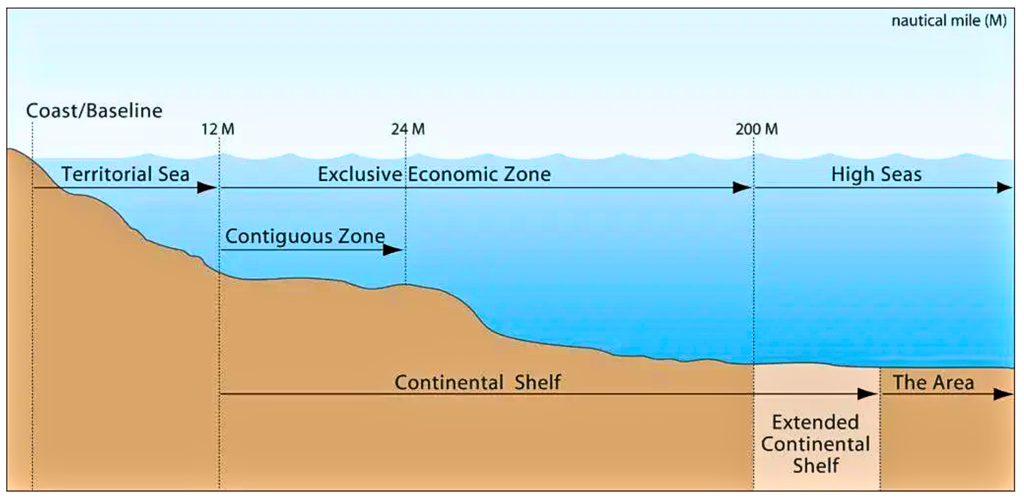
The Dispute:
- Tamil Nadu has prohibited purse-seine fishing within its territorial waters since 2000. The prohibition is presently enforced through the Tamil Nadu Marine Fishing Regulation Rules, 2020. The state argued that fishermen could carry purse-seine nets on their vessels and use them illegally within territorial waters while claiming that they were travelling to the EEZ. Monitoring such vessels would be difficult.
- Fishermen argued that Tamil Nadu was preventing them from even transporting the nets through territorial waters. Since fishing harbours are situated on the coast, vessels cannot reach the EEZ without first crossing the State-regulated 12-nautical-mile zone.
Consequently, the State’s prohibition was allegedly operating as a de facto ban on purse-seine fishing even in the Union-regulated EEZ.
Supreme Court’s Ruling:
- The Court upheld both regulatory regimes:
- Tamil Nadu’s prohibition on purse-seine fishing within territorial waters; and
- The Union’s framework permitting regulated fishing in the EEZ. It held that there was no conflict between them as they operated in different maritime zones.
- The Court directed Tamil Nadu to designate an official navigation corridor through which vessels carrying purse-seine nets could pass to the EEZ.
- Fishing in the EEZ would require an Access Pass under the Union rules. Applications for Access Passes must be processed efficiently and within a reasonable period. The Centre and Tamil Nadu must coordinate through the principle of cooperative federalism.
How the Transit System Would Work?
The Access Pass under the EEZ Rules, 2025 is a digital authorisation that enables vessel tracking, catch traceability, sustainable stock management and action against illegal, unreported and unregulated fishing.
Tamil Nadu is yet to frame the detailed rules. A workable arrangement could follow:
- Before Departure: The vessel must obtain an Access Pass, possess valid registration and provide details of its crew, gear and intended voyage. State officials would verify the documents, inspect the vessel and ensure that the tracking equipment is operational.
- Transit Through Territorial Waters: Within Tamil Nadu’s 12-nautical-mile zone, the vessel must follow the notified corridor with its purse-seine nets secured and tracking system active. Fishing, unauthorised stops or deviation from the corridor would attract regulatory action.
- Fishing in the EEZ: After crossing 12 nautical miles, purse-seine fishing may be undertaken subject to the Access Pass, permitted zones and seasons, and rules concerning catch limits, juvenile fish, mesh size and bycatch.
- Return and Catch Reporting: The vessel must secure its nets before re-entering territorial waters, return through the specified corridor and submit catch and fishing-location details. Tracking and catch records would help detect illegal fishing within State waters.
The Supreme Court’s judgment is jurisdictionally balanced: Tamil Nadu’s prohibition remains valid within 12 nautical miles, while regulated purse-seine fishing may continue in the Union-governed EEZ.
Source: https://anantamias.com/current-affairs/regulating-purse-seine-fishing/
Godavari Water Reaches North Andhra through Polavaram Canal
Context:
Godavari water has been released into the Polavaram Left Main Canal in Anakapalli district, Andhra Pradesh. It marks an important step towards supplying irrigation, drinking and industrial water to the relatively water-stressed Uttarandhra or North Coastal Andhra Pradesh region.
| UPSC Relevance: GS-1 Geography: Drainage systems, Water-resource management and infrastructure Prelims: Godavari river system, Polavaram Canal |
Godavari River:
- The Godavari originates at Trimbakeshwar in the Western Ghats, near Nashik in Maharashtra, and flows eastwards into the Bay of Bengal.
- At about 1465 km, it is India’s second-longest river and has the largest basin among the Peninsular rivers, hence the name “Dakshin Ganga.”
- Its important tributaries include the Manjira, Pranhita, Indravati and Sabari.
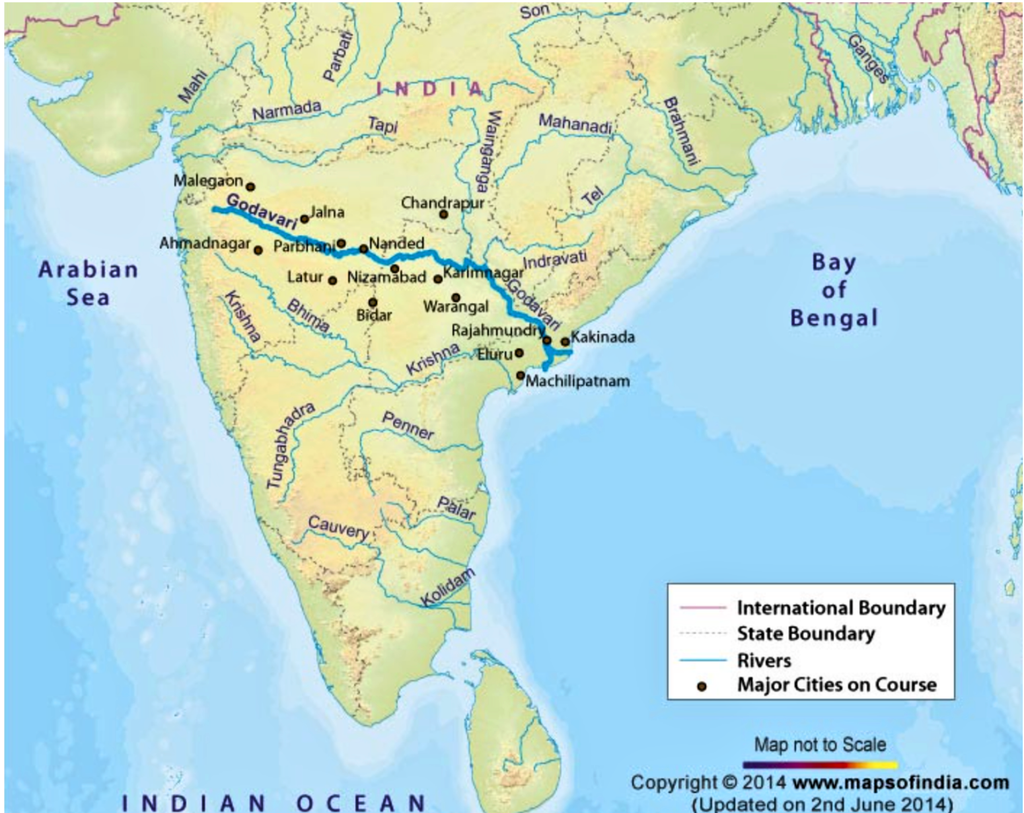
Polavaram Project:
- The Polavaram Irrigation Project is a multipurpose project on the Godavari in Andhra Pradesh, accorded National Project status under the Andhra Pradesh Reorganisation Act, 2014.
- It seeks to provide irrigation, drinking and industrial water, generate hydropower and facilitate transfer of Godavari water to other regions.
- It has two major canals:
- Right Main Canal: Facilitates transfer of Godavari water towards the Krishna basin.
- Left Main Canal: Carries water north-eastwards towards the Visakhapatnam and north Andhra region.
The current distribution arrangements are expected to benefit around 2.87 lakh acres and 9.23 lakh people. The canal traverses difficult terrain and crosses rivers such as the Pampa, Tandava, Varaha and Sarada before reaching Anakapalli.
Significance:
- Provides assured irrigation to drought-prone uplands of north Andhra.
- Strengthens drinking-water security for Anakapalli and the expanding Visakhapatnam urban region.
- Supports industrial demand, including the Visakhapatnam industrial belt.
- Enables filling of tanks and reservoirs, improving groundwater recharge.
- Could eventually support the proposed Godavari-Vamsadhara interlinking, extending water benefits towards Vizianagaram and Srikakulam.
The Polavaram Left Main Canal seeks to redistribute Godavari water from the relatively water-abundant lower basin to north Andhra.
However, the release of water into the canal does not signify completion of the entire Polavaram Project. Its long-term benefits depend on completing the dam, reservoirs, pipelines and distribution network, alongside fair rehabilitation of displaced communities and resolution of environmental and inter-State concerns.
Source: https://anantamias.com/current-affairs/godavari-water-reaches-north-andhra-through-polavaram-canal/
Pichavaram Mangroves valued at ₹2485 Crore
Context:
A recent study has estimated the Total Economic Value (TEV) of Tamil Nadu’s Pichavaram mangrove ecosystem at ₹2485.3 crore, or about ₹1.83 crore per hectare. The valuation captures its ecological, livelihood, climate-regulation and disaster-protection services.
| UPSC Relevance: GS-3 Environment: Biodiversity, Ecosystem services Prelims & Mains: Mangroves, wetlands, blue carbon, ecosystem services, climate adaptation. |
Pichavaram Mangroves:
- Located in Cuddalore district, between the Vellar estuary in the north and the Coleroon estuary in the south.
- Spread over about 1479 hectares and connected to the Bay of Bengal through tidal creeks.
- Designated a Ramsar Site in 2022 and protected as a Reserved Forest.
- It supports rich fish and bird diversity and acts as a nursery ground for commercially important fish and crustaceans.
What is Total Economic Value?
TEV measures both market and non-market benefits provided by an ecosystem, including:
- Provisioning services: Fish, prawns and other livelihood resources.
- Regulating services: Carbon sequestration, coastal protection and water purification.
- Supporting services: Nutrient cycling, breeding habitats and biodiversity.
- Cultural services: Tourism, recreation, education and aesthetic value.
- Non-use values: Value attached to conserving the ecosystem for future generations.
Thus, ₹2485 crore is not the mangroves’ “sale price”; it is an indicative estimate of the benefits society could lose if the ecosystem is degraded.
Blue Carbon Value:
- Blue carbon refers to carbon captured and stored by coastal ecosystems such as mangroves, seagrass beds and salt marshes.
- The study valued Pichavaram’s combined vegetation and soil carbon at ₹1612.4 crore, nearly 65% of its TEV. Mangrove sediments were the larger reservoir, holding an average of 251.14 tonnes of organic carbon per hectare, valued collectively at ₹1224.6 crore.
- Mangroves are particularly effective carbon sinks because waterlogged, oxygen-poor soils slow the decomposition of organic matter.
Wider Significance:
- Function as natural bio-shields against cyclones, storm surges and coastal erosion.
- Sustain fisheries and livelihoods of coastal communities.
- Support India’s climate commitments by strengthening natural carbon sinks.
- Provide a nature-based and often cheaper alternative to purely concrete coastal defences.
- Demonstrate why ecosystem losses must be included in environmental impact assessments and project appraisals.
Way Forward:
- Integrate ecosystem-service valuation into coastal land-use planning and cost-benefit analysis.
- Promote community-based conservation and Payment for Ecosystem Services.
- Develop credible blue-carbon credits with safeguards against double counting and community exclusion.
- Control aquaculture expansion, sewage, industrial pollution and plastic waste.
- Link restoration with the MISHTI initiative while prioritising native species and suitable tidal hydrology.
- Regularly monitor mangrove cover, carbon stocks and livelihood outcomes.
The Pichavaram study demonstrates that mangroves are not unproductive wastelands but valuable natural infrastructure. Economic valuation can strengthen the case for conservation, but it must complement and not replace their intrinsic ecological and cultural value.
Source: https://anantamias.com/current-affairs/pichavaram-mangroves-valued-at-%e2%82%b92485-crore/
Reducing India’s exposure to the U.S. Tariff Risks
Context:
The U.S. Senate has passed the Lindsey O. Graham Sanctioning Russia and Iran Act, 2026, which authorises tariffs of up to 100% on countries among the five largest importers of Russian crude oil or natural gas.
The Bill, however, is not yet law: it requires approval by the House of Representatives and presidential assent, while the final tariff rate would depend on executive implementation and possible waivers.
Reducing India’s Exposure to U.S. Tariff Risks:
India’s growing dependence on Russian oil and its simultaneous reliance on the U.S. export market create a significant geoeconomic vulnerability.
India’s growing dependence on Russian oil:
- Russia-Ukraine war has increased India’s dependence on Russian crude: Russian oil’s share in India’s crude imports rose from about 2% before the war to nearly 50%, helping India secure cheaper and diversified energy supplies.
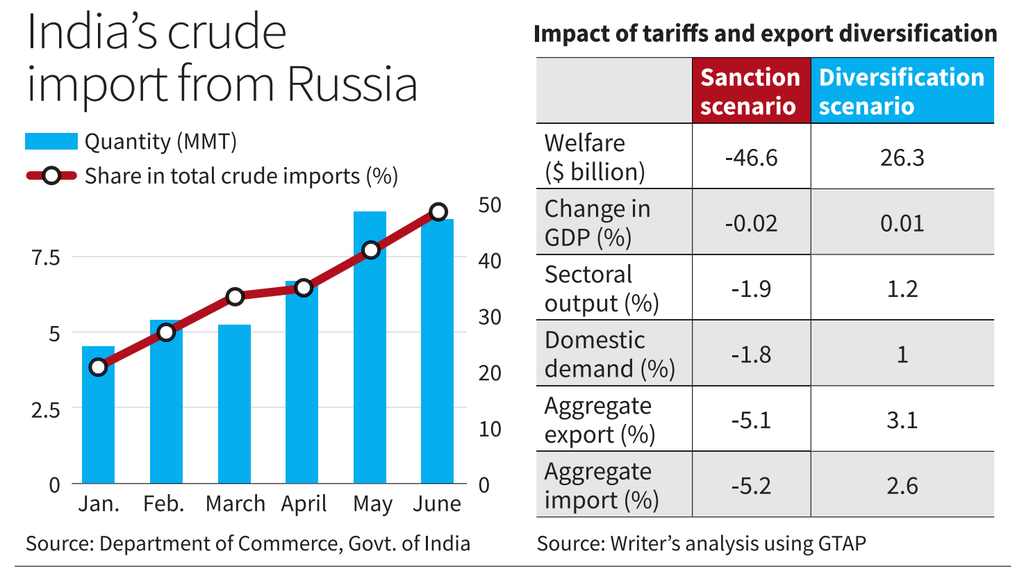
Growing U.S. Tariff Risk:
- The proposed Lindsey O. Graham Sanctioning Russia and Iran Act, 2026 could authorise tariffs of up to 100% on countries that continue purchasing Russian crude. Combined with existing U.S. tariffs, India could face cumulative tariffs of around 110%.
- Potential economic impact: It is estimated that a 110% U.S. tariff could:
- Reduce India’s economic welfare by nearly $47 billion.
- Lower exports by 5.1% and imports by 5.2%.
- Contract GDP, domestic demand and output.
Export Diversification as a solution:
- A functional India-EU FTA was used as a proxy for diversification. Under this scenario:
- Welfare could improve by $26.3 billion.
- Exports could rise by 3.1%.
- GDP, output and domestic demand could recover.
- Imports could increase by a moderate 2.6%.
Way Forward for India:
India should pursue export-market diversification while retaining energy-security flexibility in sourcing Russian crude. This should be complemented by:
- Reducing non-tariff barriers
- Improving trade facilitation and logistics
- Harmonising with international product standards
- Moving up the quality/value chain in exports
- Expanding FTAs and access to EU and other alternative markets.
India cannot eliminate geopolitical tariff risks, but greater export diversification and domestic competitiveness can substantially reduce its vulnerability to U.S. trade pressure.
Source: https://anantamias.com/current-affairs/reducing-indias-exposure-to-the-u-s-tariff-risks/
