Why in News?
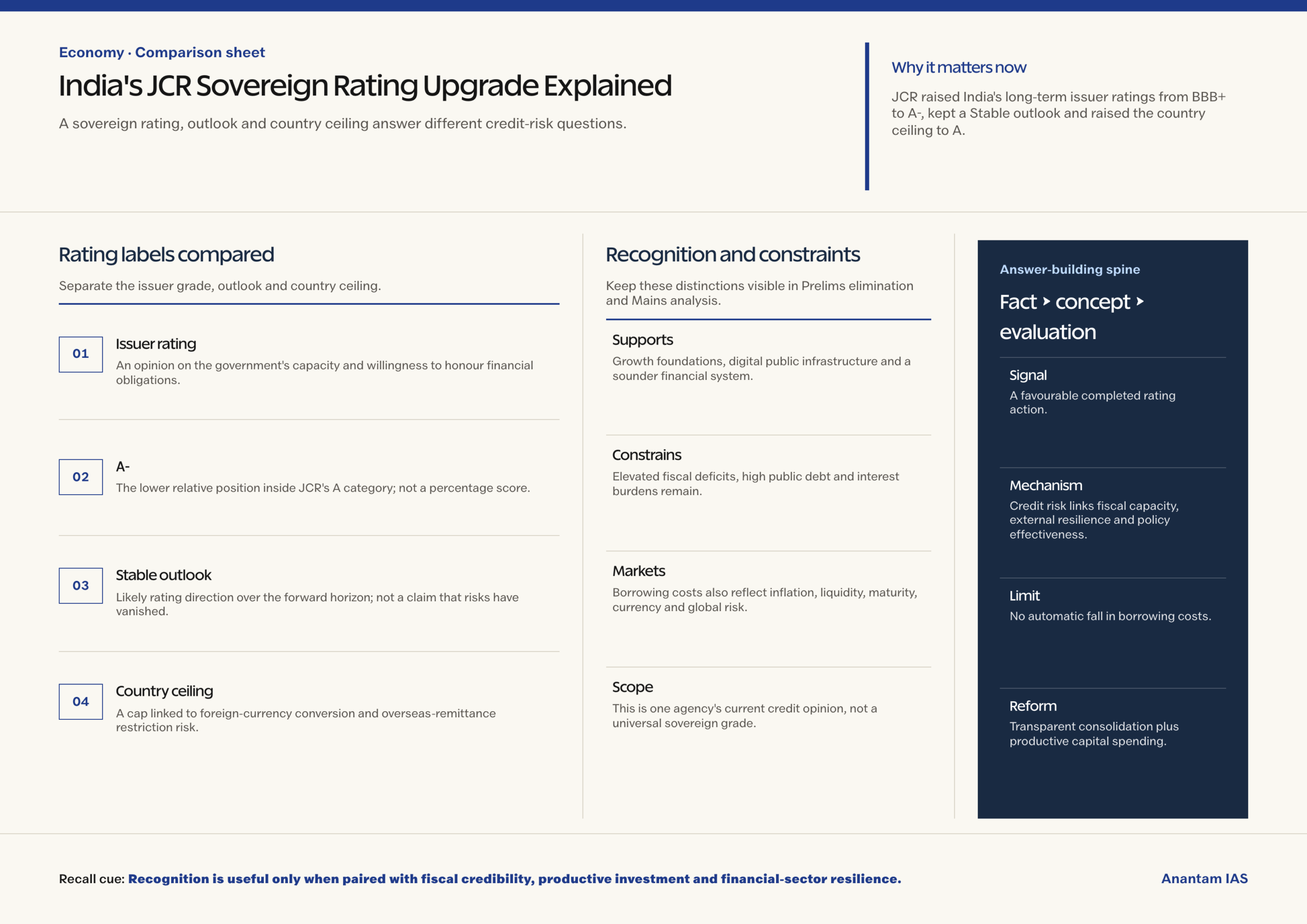
On September 2, 2026, Japan Credit Rating Agency upgraded India’s foreign- and local-currency long-term issuer ratings from BBB+ to A-, retained a Stable outlook, and raised the country ceiling to A.
- The move is a one-notch upgrade by JCR, not a common rating assigned by every global credit-rating agency.
- JCR places the new issuer ratings in its A category, which denotes high certainty that financial obligations will be honoured.
- The Stable outlook expresses JCR’s view that the rating is unlikely to change in the foreseeable future; it is not a guarantee.
- The separate country ceiling moved to A and concerns foreign-currency transaction restrictions affecting entities within India.
- Sovereign ratings compress an agency’s assessment of repayment capacity and willingness into a comparable symbol used by lenders, investors and regulated institutions.
- The upgrade recognises stronger economic and financial foundations, yet JCR still identifies elevated public debt, interest burdens and structurally persistent fiscal deficits as constraints.
- A higher rating can improve investor perception, but market yields also respond to inflation, liquidity, maturity, currency risk and global financial conditions.
UPSC Relevance
Prelims Relevance
- A sovereign issuer rating assesses a government’s overall capacity and willingness to honour its financial obligations.
- JCR may assign separate local-currency and foreign-currency ratings because access to domestic currency differs from access to foreign currency.
- Under JCR’s scale, A indicates high certainty of honouring financial obligations; plus and minus signs show relative standing within a category.
- A rating outlook indicates the likely rating direction over roughly one or two years; Stable does not make a future change impossible.
- A country ceiling normally limits the foreign-currency rating of domestic entities by reflecting conversion and overseas-remittance restriction risk.
Mains Relevance
GS Paper 3
- How sovereign ratings connect fiscal capacity, financial-sector resilience and external vulnerability to perceived credit risk.
- Why fiscal consolidation must protect productive public investment while reducing debt and interest burdens.
GS Paper 2
- How institutional credibility, transparent fiscal data and predictable policy affect assessments of state capacity.
Essay
- Credibility is accumulated through institutions and disciplined policy, not created by a single favourable assessment.
Background and Context
What a Sovereign Rating Measures
A sovereign rating is an agency’s reasoned opinion on government credit risk, not a certificate of overall economic performance.
- JCR evaluates the sovereign’s ability and willingness to pay, drawing on economic strength, fiscal capacity, external resilience, financial stability and policy effectiveness.
- An issuer rating concerns the government’s overall obligations; an individual bond can receive a different rating when contractual seniority or recovery prospects differ.
- Ratings are relative assessments. They help compare credit quality across issuers, but they do not predict an exact default probability or investment return.
- JCR describes a rating as an opinion, not a recommendation to buy, sell or hold securities; market liquidity and price fluctuations fall outside its core credit judgment.
- The reported Indian rating is agency-specific. Symbols with similar names should not be assumed to have identical meaning or methodology across rating agencies.
Rating, Outlook and Country Ceiling
Three connected labels answer different questions and should not be treated as interchangeable.
- The move from BBB+ to A- crosses into JCR’s A category, where the agency sees high certainty that the issuer will honour financial obligations.
- The minus sign places A- at the lower relative position within the A category; it does not convert the rating into a percentage score.
- A Stable outlook concerns likely rating direction over JCR’s forward horizon. It does not mean policy, fiscal or financial risks are absent.
- Foreign-currency obligations face an added constraint: a sovereign must obtain or convert into the currency needed for payment, unlike obligations payable in the currency it issues.
- JCR’s A country ceiling reflects the assessed risk of authorities restricting currency conversion or overseas remittance by domestic entities; it normally caps their foreign-currency ratings.
Why the Upgrade Is Not a Fiscal Clean Chit
The upgrade recognises improvement while leaving a clear reform agenda for public finance and financial stability.
- JCR cited durable growth foundations, digital public infrastructure, GST implementation and improved financial-system soundness among the factors supporting its decision.
- It also linked healthier bank asset quality to the Insolvency and Bankruptcy Code, public-bank recapitalisation and stronger RBI supervision and macroprudential policy.
- Better expenditure quality matters when budgets shift toward growth-supporting capital investment, but capital spending must generate productive assets and attract private investment.
- JCR still flagged structurally elevated fiscal deficits, high general-government debt and associated interest burdens. These constraints were not erased by the rating action.
- The upgrade does not mechanically lower borrowing costs. Bond yields also price monetary conditions, inflation expectations, market liquidity, maturity, currency exposure and global risk appetite.
Way Forward
Convert Recognition into Durable Credit Strength
- Continue credible fiscal consolidation through realistic assumptions, transparent off-budget liabilities and medium-term debt management rather than abrupt cuts to productive expenditure.
- Improve the quality of capital spending by selecting viable projects, controlling delays and measuring whether public investment crowds in private investment.
- Protect financial-sector resilience through early stress recognition, sound provisioning, supervision of banks and non-bank lenders, and effective insolvency resolution.
- Deepen domestic bond markets and predictable policy communication so financing becomes more diversified, liquid and resilient to shifts in external investor sentiment.
Conclusion
- JCR’s upgrade is a favourable credit signal based on stronger growth foundations, policy effectiveness and financial-system soundness, but it remains one agency’s current opinion.
- In a Mains answer, pair the recognition with the unresolved fiscal and debt constraints, then argue for transparent consolidation, productive investment and continued financial supervision.
- Remember the exam distinction: the rating assesses sovereign repayment capacity, the outlook signals likely direction, and the country ceiling addresses foreign-currency transfer restrictions.
UPSC Practice Questions
Prelims MCQ 1
With reference to sovereign credit ratings, consider the following statements:
- A sovereign issuer rating assesses a government’s overall capacity and willingness to honour financial obligations.
- A Stable outlook guarantees that the issuer rating will remain unchanged during the outlook period.
- A country ceiling may reflect the risk of restrictions on currency conversion and overseas remittance by domestic entities.
How many of the above statements are correct?
(a) Only one (b) Only two (c) All three (d) None
Answer: (b) Only two
Explanation:
Statements 1 and 3 are correct. A Stable outlook indicates that change is considered unlikely in the foreseeable future, but JCR states that a rating can still change without a prior outlook revision.
Prelims MCQ 2
What did Japan Credit Rating Agency announce for India in September 2026?
(a) It raised only the foreign-currency rating to A and assigned a Positive outlook (b) It raised both long-term issuer ratings to A- with a Stable outlook and the country ceiling to A (c) It kept both long-term issuer ratings at BBB+ and lowered the country ceiling (d) It assigned the same A- rating on behalf of all major global rating agencies
Answer: (b) It raised both long-term issuer ratings to A- with a Stable outlook and the country ceiling to A
Explanation:
JCR raised India’s foreign- and local-currency long-term issuer ratings by one notch from BBB+ to A-, retained a Stable outlook, and raised the country ceiling by one notch to A.
UPSC Mains Questions
- Explain the distinction between a sovereign issuer rating, a rating outlook and a country ceiling. Why does this distinction matter when interpreting India’s JCR upgrade?
- A sovereign rating upgrade is recognition, not a fiscal clean chit. Discuss with reference to India’s public-finance and financial-sector reform priorities.
Sources: Japan Credit Rating Agency and PIB, Ministry of Finance.
Frequently Asked Questions
What rating did JCR assign to India in September 2026?
JCR raised India’s foreign- and local-currency long-term issuer ratings from BBB+ to A-, kept the outlook Stable, and raised the country ceiling to A.
What does an A- rating mean on JCR’s scale?
It falls within JCR’s A category, signifying high certainty that financial obligations will be honoured. The minus sign indicates relative standing within that category.
What does a Stable outlook mean?
It means JCR considers a rating change unlikely in the foreseeable future, generally its one-to-two-year outlook horizon. It does not guarantee that the rating cannot change.
What is a country ceiling?
It reflects JCR’s assessment of restrictions on foreign-currency conversion and overseas remittance by domestic entities and normally limits the foreign-currency rating they can receive.
Will the upgrade automatically reduce India’s borrowing costs?
No. It may support credit perception, but borrowing costs also depend on inflation expectations, monetary conditions, liquidity, maturity, currency risk and global investor sentiment.
Tell Google you want more of this.
Add Anantam IAS as a preferred sourceOne tap, and this site shows up more often in your own Top Stories, AI Overviews and AI Mode. Remove it any time.