Why in News?
On September 3, The Hindu reported that a Tamil Nadu Forest Department-funded study led by ISEC researcher M. Balasubramanian modelled Pichavaram mangroves’ total economic value at ₹2,485.38 crore.
- The figure is a modelled valuation of ecosystem benefits, not cash revenue, GDP, a budget allocation or a guaranteed carbon-credit return.
- The study covers market and non-market services, including fisheries, coastal protection, climate regulation, biodiversity, recreation and carbon storage.
- Its blue carbon assessment found that mangrove sediments represent a substantially larger carbon reservoir than the vegetation above them.
- ISEC lists the project as funded by the Tamil Nadu Forest Department; The Hindu identifies the Forest Genetics Division in Coimbatore as the funding office.
- Conventional accounts often record marketed output while leaving flood buffering, erosion control, carbon storage and habitat support economically invisible.
- Valuation can make ecological losses visible in project appraisal, but the result changes with ecological data, valuation method, prices, time horizon and discount rate.
- Pichavaram is a Ramsar wetland in Cuddalore district between the Vellar and Coleroon estuarine systems.
UPSC Relevance
Prelims Relevance
- Natural capital means stocks of natural assets that generate flows of benefits to people and the economy.
- Total economic value combines use and non-use values; it is wider than the income earned from harvesting or tourism.
- Blue carbon is carbon captured and stored by coastal and marine ecosystems, including mangroves, salt marshes and seagrass meadows.
- Mangrove carbon occurs in living biomass and sediments; disturbing waterlogged soils can damage a major long-term store.
- Pichavaram is an intertidal forested wetland designated as Ramsar Site No. 2482 in 2022.
Mains Relevance
GS Paper 3
- How ecosystem-service valuation can improve coastal planning, climate adaptation and natural-capital accounting.
- Why blue-carbon policy must protect hydrology, vegetation and sediment together rather than focusing only on tree planting.
GS Paper 1
- The role of estuarine mangroves in shoreline stability, fisheries nurseries and protection from coastal hazards.
Essay
- What an economy does not count can still be essential to its security and resilience.
Background and Context
What Total Economic Value Captures
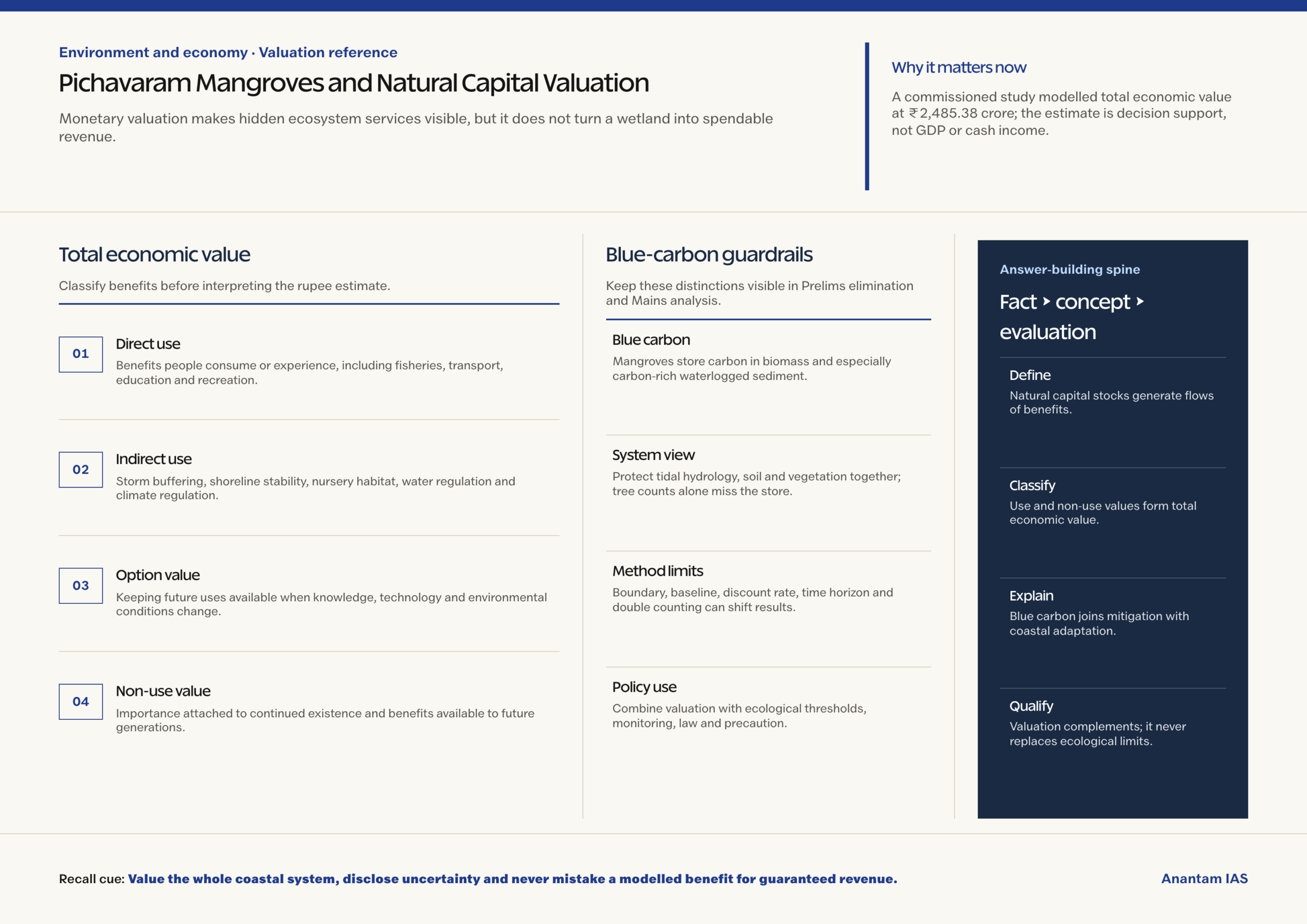
Total economic value is a framework for organising nature’s benefits across beneficiaries and time, not a market price for selling an ecosystem.
- Direct-use values arise from benefits people consume or experience, such as fish, fuelwood where permitted, transport, education and recreation.
- Indirect-use values come from ecological functions, including storm buffering, shoreline stabilisation, water regulation, nutrient cycling, nursery habitat and climate regulation.
- Option value reflects retaining an ecosystem for possible future uses, especially when future knowledge, technology or environmental conditions remain uncertain.
- Non-use values capture importance attached to an ecosystem’s continued existence or its availability to future generations, even without present consumption.
- Adding these categories prevents a mangrove from being judged only by visible market receipts while ignoring services that reduce risks or sustain other economic activity.
How Blue Carbon Strengthens the Case
Mangroves connect coastal adaptation with climate mitigation because their biological productivity and tidal setting build durable carbon-rich soils beneath living vegetation.
- Mangrove plants remove carbon dioxide through photosynthesis and store carbon in trunks, branches, leaves and roots as living biomass.
- Tides deposit organic material, while oxygen-poor waterlogged conditions slow decomposition and allow carbon to accumulate in mangrove sediments over long periods.
- The commissioned assessment found the economic value assigned to soil organic carbon was more than three times that assigned to vegetation carbon.
- This comparison shifts conservation from a tree-counting exercise to protection of hydrology, soils and vegetation as one connected coastal system.
- Drainage, excavation or conversion can weaken coastal protection and expose stored soil carbon, so restoration quality matters more than plantation numbers alone.
How to Read the Valuation Correctly
A monetary estimate supports transparent comparison between development choices, but it does not turn every ecological benefit into spendable income or a tradeable asset.
- Valuers combine different methods: observed market prices for traded goods, avoided or replacement costs for protective functions, and stated-preference methods for non-market benefits.
- Carbon values may depend on an assumed social cost of carbon, which estimates damage avoided by preventing an additional unit of emissions.
- Results are sensitive to the study boundary, ecological measurements, baseline, time horizon, discount rate and assumptions about beneficiaries and future risks.
- The same benefit must not be counted twice when ecological processes overlap, such as nursery habitat, fish production, biodiversity support and nutrient cycling.
- Natural-capital valuation can complement biophysical thresholds and legal protection, but it cannot justify destroying an irreplaceable wetland merely because a monetary trade-off appears favourable.
Way Forward
Use Valuation for Better Coastal Decisions
- Integrate ecosystem-service baselines into coastal plans and project appraisal before land-use decisions create irreversible losses.
- Monitor vegetation, sediment carbon, salinity, tidal exchange and shoreline change so natural-capital accounts rest on updated ecological evidence.
- Protect tidal hydrology and sediment integrity alongside mangrove cover; survival, ecological function and permanence should guide restoration evaluation.
- Publish assumptions, uncertainty ranges and safeguards whenever valuation informs climate finance or carbon markets, avoiding claims of automatic credit revenue.
Conclusion
- The Pichavaram estimate makes an important planning point: mangrove value extends beyond marketed output to risk reduction, habitat, recreation, climate regulation and carbon stored below ground.
- Its monetary total should be treated as a decision-support estimate, not revenue, GDP or a guaranteed carbon asset; ecological condition, uncertainty and methodological assumptions remain decisive.
- In a Mains answer, link natural-capital accounting with biophysical monitoring, legal protection and integrated coastal planning, while stating clearly that monetary valuation complements rather than replaces ecological limits and precaution.
UPSC Practice Questions
Prelims MCQ 1
With reference to blue carbon in mangrove ecosystems, consider the following statements:
- Mangroves store carbon in both living biomass and sediments.
- Waterlogged, oxygen-poor conditions can slow decomposition and promote carbon accumulation in sediments.
- Blue carbon refers exclusively to carbon held in the above-ground parts of mangrove trees.
How many of the above statements are correct?
(a) Only one (b) Only two (c) All three (d) None
Answer: (b) Only two
Explanation:
Statements 1 and 2 are correct. Blue carbon includes carbon stored by coastal ecosystems in biomass and soils or sediments, not only above-ground vegetation.
Prelims MCQ 2
Which statement best describes total economic value in ecosystem assessment?
(a) It records only revenue earned by commercial users of an ecosystem (b) It is identical to the ecosystem’s contribution already recorded in GDP (c) It organises direct, indirect, option and non-use values within one valuation framework (d) It guarantees that every estimated benefit can be sold as a carbon credit
Answer: (c) It organises direct, indirect, option and non-use values within one valuation framework
Explanation:
Total economic value extends beyond marketed output. It combines use and non-use values, but the resulting estimate is neither automatic revenue nor a guaranteed tradeable return.
UPSC Mains Questions
- Explain how ecosystem-service valuation can improve coastal planning. What methodological cautions should accompany the use of total economic value?
- Mangrove conservation is as much about sediments and hydrology as it is about trees. Discuss with reference to blue carbon and coastal resilience.
Sources: The Hindu and Institute for Social and Economic Change.
Frequently Asked Questions
What did the Pichavaram mangrove study estimate?
The commissioned study modelled the ecosystem’s total economic value at ₹2,485.38 crore by considering ecological, economic and social benefits. The figure is an estimate, not cash revenue.
Who commissioned the Pichavaram valuation study?
ISEC identifies it as a Tamil Nadu Forest Department-funded project led by M. Balasubramanian. The Hindu reports funding through the Deputy Conservator of Forests, Forest Genetics Division, Coimbatore.
What is blue carbon?
Blue carbon is carbon captured and stored by coastal and marine ecosystems such as mangroves, salt marshes and seagrass meadows, in both living biomass and carbon-rich soils or sediments.
Why are mangrove sediments important for climate policy?
Waterlogged mangrove sediments can retain large carbon stocks for long periods. Disturbing hydrology or soils can weaken this store, making sediment protection central to credible blue-carbon conservation.
Is total economic value the same as GDP contribution?
No. Total economic value is a valuation framework that includes market and non-market benefits. GDP records production under national-accounting rules and does not automatically include the full estimate.
Tell Google you want more of this.
Add Anantam IAS as a preferred sourceOne tap, and this site shows up more often in your own Top Stories, AI Overviews and AI Mode. Remove it any time.