Why in News?
On September 2, 2026, the Indian Air Force announced a successful drop trial of the indigenously designed and developed long-range glide bomb Khagantak-243, stating that the trial met all its objectives.
- The official announcement identifies Khagantak-243 as a long-range glide bomb and describes the event as a drop trial.
- The IAF said the weapon was indigenously designed and developed, linking the milestone to Indian industry.
- The phrase met all objectives applies to the objectives of this trial; it does not disclose the complete test plan or certify operational induction.
- The official post does not establish a public figure for range, warhead, order quantity, release platform, or service-entry status.
- The trial offers a useful case study in the difference between a gravity bomb, an unpowered guided glide bomb, and a powered missile.
- For policy analysis, the key issue is the evidence ladder from a successful test to a reliable, integrated, maintainable and authorised operational capability.
UPSC Relevance
Prelims Relevance
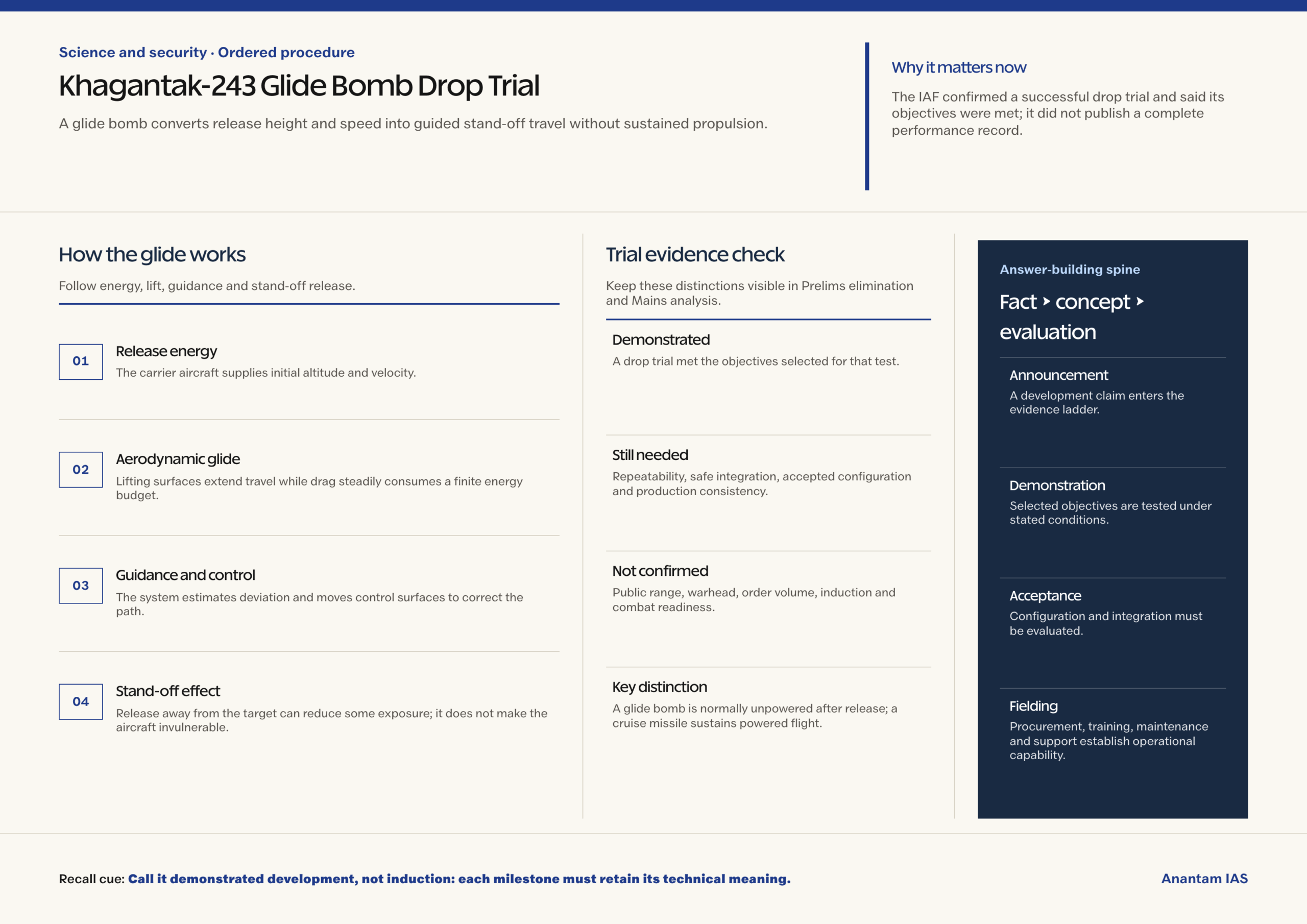
- A glide bomb is normally unpowered after release; it converts the aircraft’s altitude and speed into forward glide.
- Stand-off launch means releasing a weapon away from the target rather than requiring the aircraft to overfly it.
- Guidance estimates or corrects the path, while control surfaces generate aerodynamic forces that steer the weapon.
- A drop trial is evidence of tested objectives, not automatic proof of procurement, induction or combat readiness.
- A glide bomb differs from a cruise missile because the latter normally sustains flight through onboard propulsion.
Mains Relevance
GS Paper 3
- Explain how stand-off precision weapons can alter aircraft exposure, mission planning and the demands placed on targeting and guidance.
- Assess the difference between indigenous development claims and demonstrated lifecycle capability, including integration, production quality, maintenance and training.
GS Paper 3
- Use a trial-to-induction evidence ladder to evaluate defence-technology announcements without treating a successful test as operational deployment.
Essay
- Technological autonomy is strongest when design achievement is matched by repeatable testing, reliable production and accountable evaluation.
Background and Context
How an Unpowered Glide Bomb Flies
A glide bomb travels after release without relying on sustained onboard propulsion.
- The carrier aircraft gives the weapon its initial height and velocity; gravity supplies potential-energy loss while aerodynamic lift extends travel, rather than an engine fitted to the bomb.
- Wings or lifting surfaces create lift, while drag continually removes energy; the weapon must manage that finite energy budget throughout descent.
- Release altitude, release speed, wind, manoeuvres and target geometry all influence achievable reach, so a single public range claim cannot describe every mission.
- A conventional gravity bomb mainly follows a ballistic path after release; a glide bomb can reshape that path through aerodynamic lift and controlled corrections.
- A powered missile carries propulsion for sustained flight. Calling every long-reaching air-launched weapon a missile obscures this central propulsion distinction.
Guidance, Control and Stand-Off Launch
Precision requires more than gliding: the weapon must estimate its path and command physical corrections.
- A guidance system compares the estimated position or trajectory with the desired path and determines what correction is needed.
- The control system turns that command into motion through aerodynamic surfaces, changing lift and direction while respecting the remaining speed and altitude during the finite glide.
- The exact sensors used by Khagantak-243 were not specified in the IAF post; general guidance principles should not be presented as confirmed subsystem details.
- A stand-off release can reduce the need to fly directly over a target and may limit exposure to some threats, but it does not make an aircraft invulnerable.
- Effective precision also depends on target coordinates, navigation quality, mission planning, aircraft integration and rules governing target selection, not the munition alone.
From Drop Trial to Operational Capability
A test result should be read according to what was demonstrated, not what might follow later.
- The IAF confirmed a successful drop trial and said its objectives were met; it did not publish those objectives or a complete performance record.
- One trial can validate selected functions under stated conditions, but repeatability across environments, release conditions, weather and mission profiles requires a broader body of evidence.
- Aircraft compatibility involves carriage, safe separation, mission-computer interfaces and release procedures; public confirmation of one stage should not imply every integration stage is complete.
- Possible service use also depends on accepted evaluation, production consistency, storage, inspection, training and maintenance arrangements beyond a prototype’s demonstrated flight.
- For exam answers, apply an evidence ladder: announcement, demonstrated objective, repeated evaluation, accepted configuration, procurement, fielding and sustained operational support.
Way Forward
Build Verifiable Capability
The next steps should convert a successful demonstration into transparent, repeatable and supportable performance.
- Test across relevant release conditions and publish non-sensitive evidence that distinguishes demonstrated capability from projected capability.
- Validate safe aircraft integration, guidance resilience and production consistency before drawing conclusions about operational availability.
- Build quality assurance, storage, inspection, maintenance and training into acquisition decisions from the beginning.
- Use precise public language for trial, evaluation, procurement and induction so that each milestone retains its technical meaning.
Conclusion
- Khagantak-243 matters today because the IAF confirmed a successful indigenous drop trial, while leaving key specifications and operational status outside the public evidence.
- In a Mains answer, explain the unpowered glide-and-guidance mechanism, the value and limits of stand-off release, and the trial-to-induction evidence ladder.
- The defensible conclusion is progress in demonstrated development, not proof that the weapon has been inducted, ordered at scale or validated across all operational conditions and mission environments.
UPSC Practice Questions
Prelims MCQ 1
With reference to glide bombs, consider the following statements:
- They normally depend on sustained onboard propulsion throughout their flight after release.
- They can convert release altitude and speed into forward glide.
- Aerodynamic control surfaces can be used to correct their path.
How many of the above statements are correct?
(a) Only one (b) Only two (c) All three (d) None
Answer: (b) Only two
Explanation:
Statements 2 and 3 are correct. A glide bomb is normally unpowered after release; it uses release energy, lift and controlled aerodynamic corrections rather than sustained propulsion.
Prelims MCQ 2
Which one of the following is the most accurate inference from the IAF announcement on Khagantak-243?
(a) The weapon has entered operational service (b) Every aircraft-integration test is complete (c) A drop trial was completed and its stated trial objectives were met (d) A publicly verified range and warhead configuration has been certified
Answer: (c) A drop trial was completed and its stated trial objectives were met
Explanation:
The IAF confirmed the successful drop and that the trial met its objectives. Its post did not confirm induction, complete integration, range or warhead specifications.
UPSC Mains Questions
- Explain how an unpowered guided glide bomb enables stand-off precision strike. What technical and operational limitations should qualify claims about its effectiveness?
- A successful defence trial is a milestone, not the same as induction. Develop an evidence ladder for assessing the maturity of an indigenous weapon system.
Sources: Indian Air Force and The Hindu.
Frequently Asked Questions
What is Khagantak-243?
Khagantak-243 is the indigenously designed and developed long-range glide bomb whose successful drop trial was announced by the Indian Air Force on September 2, 2026.
How does an unpowered glide bomb travel after release?
It converts the aircraft’s release altitude and speed into forward glide. Aerodynamic lift extends travel, while guidance and control surfaces can correct the descending path.
What does stand-off launch mean?
It means releasing a weapon away from the target rather than directly overhead. This can reduce exposure to some threats, but does not guarantee aircraft safety.
Did the IAF announcement confirm that Khagantak-243 has been inducted?
No. The announcement confirmed a successful drop trial whose objectives were met. It did not state that the weapon had entered operational service.
Why should reported specifications be treated cautiously?
The official IAF post did not publish range, warhead, order quantity or platform details. Such claims should not be treated as officially verified specifications without stronger primary evidence.
Tell Google you want more of this.
Add Anantam IAS as a preferred sourceOne tap, and this site shows up more often in your own Top Stories, AI Overviews and AI Mode. Remove it any time.