Daily Digest
UPSC · Civil Services Examination
Current Affairs · Friday, 4 September 2026
Current affairs curated and edited by Anantam IAS faculty — pulled from The Hindu, PIB, IDSA, Foreign Affairs and the ministries. Read, annotate, revise.
Old Rajinder Nagar · Delhi 110005 · anantamias.com
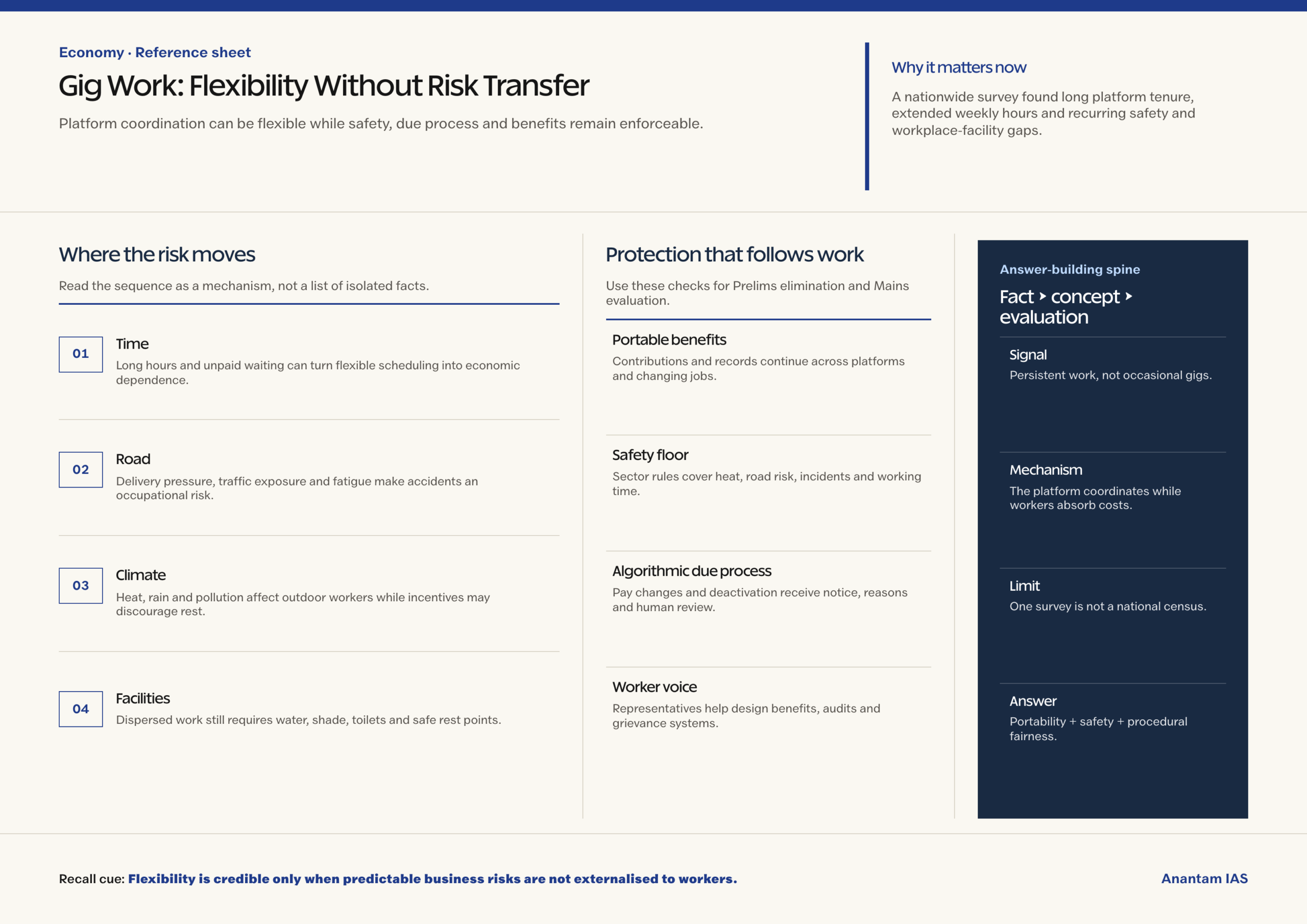
India’s Gig Work: Full-Time Labour Without Full Protection
Why in News?
A nationwide Janpahal survey reported on 4 September found that platform work is often long-term, while workers face long hours, unsafe conditions and weak social protection.
- The survey covered 1,000 workers across ten cities in delivery, ride-hailing, e-commerce and household or personal-care services.
- Nearly 57% reported working more than 49 hours weekly, while almost 23% worked beyond 70 hours.
- More than 72% had stayed on platforms for over one year, challenging the idea that gig work is only temporary or supplementary.
- The report linked road danger, heat and pollution exposure, harassment, fatigue and limited access to water, toilets and rest areas.
- Platform firms organise work through apps, ratings, pricing and task allocation, but workers often carry vehicle, fuel, waiting-time and accident risks.
- Policy must distinguish flexible scheduling from absence of enforceable safety, grievance and income-protection standards.
UPSC Relevance
Prelims Relevance
- Gig work is task-based work outside a traditional long-term employer-employee arrangement.
- Platform work is mediated through an online system that matches workers, clients or customers.
- The Code on Social Security, 2020 recognises gig workers and platform workers as distinct statutory categories.
- Occupational safety includes road risk, heat stress, sanitation, rest, protective equipment and work-related health.
- Portable benefits follow a worker across platforms and changing work arrangements.
Mains Relevance
GS Paper 3
- Employment quality and risk allocation in the platform economy
- Data-driven management and labour-market formalisation
GS Paper 2
- Social protection, occupational health and grievance redress for non-standard workers
Essay
- Flexibility is meaningful only when workers can exercise it without absorbing every economic and physical risk.
Background and Context
When Gig Work Becomes a Main Job
The survey matters because duration and hours show economic dependence, not occasional use of an app for spare income.
- More than seven in ten respondents had remained on platforms beyond one year, showing that platform work can become a persistent labour-market position.
- Long weekly hours weaken the claim that all workers freely choose short, supplementary shifts around another secure occupation.
- Workers may switch between platforms, yet ratings, incentive windows and demand peaks can still shape when and how long they remain online.
- Employment classification matters because access to minimum standards, injury support and collective voice often depends on whether law recognises a work relationship.
- Dependence can also be measured through income share, hours, duration and the platform’s influence over pricing, allocation, ratings and continued access to work.
Risk Is Shifted to the Worker
The app coordinates demand, but many costs and hazards remain individual even when the platform influences pace, routes and performance.
- Workers commonly supply vehicles and phones, purchase fuel and data, and absorb unpaid waiting time between tasks or during weak demand.
- Road accidents and near misses become occupational hazards when delivery targets, traffic exposure and long hours combine with income pressure.
- Heat, air pollution and rain affect outdoor workers directly, while algorithmic incentives may discourage rest during the busiest and most hazardous periods.
- Limited toilets, drinking water, shade and rest areas show that basic workplace protections can disappear when work has no fixed physical establishment.
- Women and care-service workers may face distinct harassment, sanitation and personal-security risks, so one uniform safety checklist cannot capture every platform occupation.
Protection Must Be Portable
A durable response should attach minimum protection to the work and worker rather than to one permanent employer or platform.
- Registration can identify eligible workers, but a database alone does not guarantee contributions, timely benefits or accessible claims and appeals.
- Portable social insurance can pool contributions across platforms and periods of work while protecting continuity when a worker changes apps.
- Safety standards should cover realistic delivery times, heat protocols, accident reporting, protective equipment and access to sanitation and rest facilities.
- Algorithmic accountability requires notice of pay changes, understandable ratings, human review of suspensions and protection against retaliatory deactivation.
- Financing can combine public support, platform contributions and worker contributions, but the formula should reflect unequal bargaining power and avoid reducing already volatile take-home income.
Evidence Limits and Policy Use
The survey reveals serious risks but should guide investigation and standards rather than be treated as a complete census of every platform worker.
- Its urban sample identifies patterns across several occupations, while national estimates still require representative official data and transparent platform records.
- Self-reported hours and injuries are valuable worker evidence, but administrative accident, earnings and deactivation data would strengthen causal assessment.
- Periodic surveys should track income after costs, multiple-platform use, unpaid waiting and benefit access across gender, city size and occupation.
Way Forward
Build a Worker-Centred Floor
Regulation should preserve genuine flexibility while preventing business models from externalising predictable costs and hazards.
- Create interoperable registration and contribution systems with simple claims, worker access to records and time-bound grievance appeals.
- Set sector-specific safety standards for road exposure, heat, working time, sanitation and incident reporting.
- Require transparent pay calculations, deactivation reasons and human review where automated systems affect livelihood.
- Include worker organisations in benefit design, safety audits and periodic evaluation of platform compliance.
Conclusion
- The survey’s durable lesson is that platform flexibility and labour protection are not opposites; protection must match economic dependence and actual control.
- A strong answer should trace how algorithmic coordination shifts risk, then connect portable benefits, safety standards and procedural fairness to decent work.
UPSC Practice Questions
Prelims MCQ 1
With reference to gig and platform work, consider the following statements:
- All gig work must be mediated by an online platform.
- Platform work uses an online system to connect workers with demand.
- Portable benefits can continue when workers move across platforms.
How many of the above statements are correct?
(a) Only one (b) Only two (c) All three (d) None
Answer: (b) Only two
Explanation:
Statements 2 and 3 are correct. Gig work is broader than platform-mediated work and can exist without an online matching platform.
Prelims MCQ 2
Which policy most directly addresses algorithmic livelihood decisions?
(a) A general advertising code (b) Human review of deactivation and transparent pay rules (c) A fixed platform market share (d) Removal of worker ratings from all services
Answer: (b) Human review of deactivation and transparent pay rules
Explanation:
These measures create notice, explanation and appeal when automated systems affect access to work or earnings.
UPSC Mains Questions
- Platform work combines labour-market flexibility with a systematic transfer of economic and occupational risk to workers. Discuss.
- Design a portable social-protection framework for gig workers without assuming a single permanent employer.
Source: The Hindu.
Frequently Asked Questions
What did the new gig-work survey find?
It found long platform tenure, extended weekly hours and recurring safety, health and workplace-facility gaps among surveyed workers across ten Indian cities.
Are gig work and platform work identical?
No. Gig work is the broader task-based category; platform work is organised through an online intermediary that matches workers with clients or customers.
Why are rest areas and toilets labour issues?
A dispersed workplace does not remove occupational needs. Long outdoor shifts without water, shade, sanitation or rest increase health risk and undermine dignified work.
What are portable benefits?
They are protections linked to the worker and accumulated across platforms or jobs, reducing benefit loss when work arrangements change.
Does regulation necessarily remove flexibility?
No. Minimum safety, contribution, transparency and appeal rules can protect workers while allowing genuine choice over schedules and platforms.
Source: https://anantamias.com/current-affairs/india-gig-work-full-time-social-protection-gap/
ESIC Reform Debate: Public Social Insurance and Privatisation Risks
Why in News?
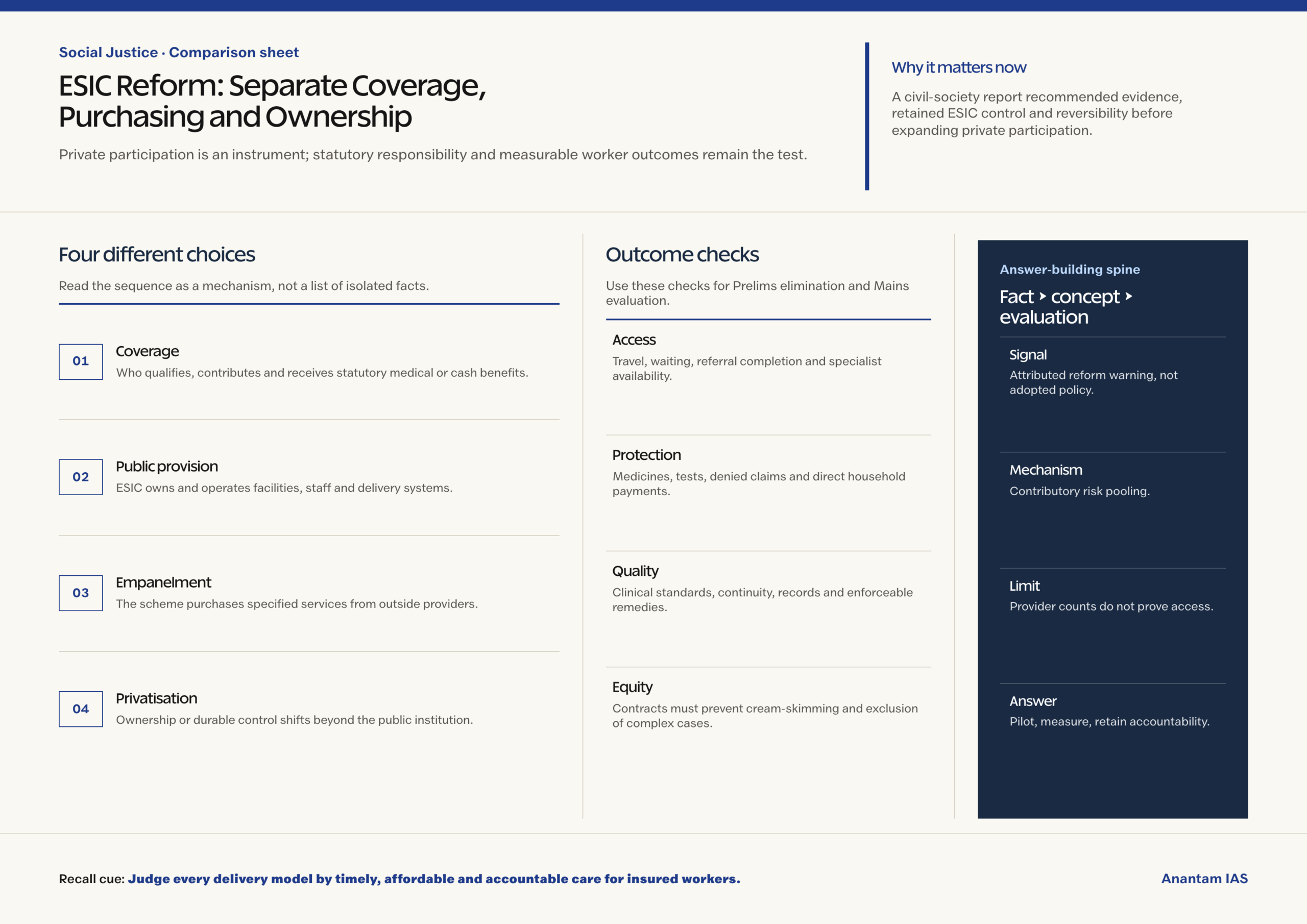
A Safe In India report released on 4 September warned against default privatisation of ESIC and called for evidence, retained public control and reversible private arrangements.
- The report proposed raising the ESIC coverage wage ceiling from ₹21,000 to ₹33,000; this is a recommendation, not an adopted rule.
- It argued that private participation should proceed only where worker, employer or institutional outcomes demonstrably improve.
- ESIC’s reported tie-ups with 2,836 hospitals expand treatment options but may also leave delays and out-of-pocket spending unresolved.
- ESIC’s Director General linked future coverage growth to the Code on Social Security and an upgraded digital benefits platform.
- Social insurance pools contributions and risks; it is different from tax-funded assistance and from purchasing an individual commercial policy.
- The central governance question is whether reform expands entitlement, provider capacity and accountability together.
UPSC Relevance
Prelims Relevance
- ESIC administers the Employees’ State Insurance scheme under the Employees’ State Insurance Act, 1948.
- ESI is a contributory social-insurance arrangement covering medical care and specified cash benefits.
- A wage ceiling determines coverage eligibility; changing it requires an official government decision.
- Empanelment purchases services from outside providers without automatically transferring ownership or statutory responsibility.
- Cream-skimming occurs when providers prefer lower-risk or more profitable patients.
Mains Relevance
GS Paper 2
- Social insurance, public health capacity and accountable service purchasing
- Regulatory capacity, universal access and grievance redress
GS Paper 3
- Formalisation and social protection amid changing employment arrangements
Essay
- Public purpose depends less on who delivers a service than on who guarantees access, bears risk and answers when delivery fails.
Background and Context
What ESIC Is Designed to Do
ESI pools contributions so illness, maternity, injury, disability or death does not leave an insured worker facing risk alone.
- The institution combines statutory entitlement, contribution collection, medical infrastructure, contracted care and cash benefits within one social-insurance system.
- Risk pooling works because contributions are shared across many insured persons rather than priced separately for each individual’s medical profile.
- Coverage expansion can protect more workers, but eligibility must be matched by clinics, hospitals, specialists, claims capacity and understandable grievance routes.
- Digital systems can reduce discretion and delays, yet exclusion, data errors and weak appeals can turn automation into a new access barrier.
- Medical and cash benefits require different delivery chains, so reform must coordinate clinical care, certification, contribution records and payment without forcing workers between disconnected offices.
Private Participation Is Not One Thing
Contracting a hospital, buying a diagnostic service and selling an institution are different choices with different accountability consequences.
- Empanelment can add specialist or geographic capacity when ESIC facilities cannot meet demand, while the public scheme remains responsible for entitlement.
- Purchasing fails when tariffs, referrals or reimbursements delay treatment or push insured persons toward costs that the statutory scheme should absorb.
- Private providers may select profitable services or lower-risk patients unless contracts, audits and payment design prevent cream-skimming.
- A reversible pilot with measurable outcomes is safer than permanent structural change justified only by assumed private-sector efficiency.
- Contract design matters because fee-for-service, bundled payments and capitation create different incentives for volume, prevention, referral and treatment of complex cases.
Test Reform Against Worker Outcomes
The report is advocacy evidence, not government policy, so its recommendations should be assessed through transparent outcome measures.
- Access should measure travel time, waiting time, referral completion and specialist availability, not merely the number of empanelled institutions.
- Financial protection should track medicines, diagnostics, informal payments and denied claims because nominal coverage can coexist with high out-of-pocket spending.
- Quality requires clinical standards, infection control, continuity of care, patient records and enforceable remedies across both ESIC and contracted facilities.
- Public reporting should compare outcomes before and after reform and disclose who bears cost, clinical risk and responsibility for failed delivery.
- Worker participation can reveal hidden barriers such as wage-record errors, employer non-registration, denied referrals and reimbursement delays that aggregate hospital statistics overlook.
Coverage Expansion Changes the Institution
Bringing new worker groups into ESI changes contribution flows, provider demand, administrative capacity and the meaning of a covered establishment.
- Gig and platform workers may lack one identifiable employer, requiring new contribution and record-sharing rules rather than simple extension of existing payroll processes.
- A higher wage ceiling can reduce coverage cliffs, but contribution affordability and health-system capacity must be assessed together.
- Transition rules should protect existing beneficiaries from longer queues or weaker services while new groups are enrolled.
Way Forward
Reform With Retained Accountability
Capacity gaps can justify contracting, but public authority must keep the rules, data, audit power and duty to secure treatment.
- Publish measurable access, quality and financial-protection indicators for ESIC facilities and empanelled providers.
- Use time-bound pilots with independent evaluation and clear exit clauses before scaling structural changes.
- Strengthen specialist recruitment, referral tracking, medicine availability and worker-facing grievance resolution.
- Expand coverage only with funded provider capacity and safeguards against digital or documentation exclusion.
Conclusion
- The core test is not a public-versus-private slogan; it is whether workers receive timely, affordable and accountable care under a guaranteed social-insurance entitlement.
- A strong answer should separate ownership, contracting and regulation, then judge each reform by access, quality, financial protection and reversibility.
UPSC Practice Questions
Prelims MCQ 1
With reference to Employees’ State Insurance, consider the following statements:
- It is a contributory social-insurance arrangement.
- Empanelling a private hospital necessarily transfers ESIC ownership to that hospital.
- A wage ceiling can affect eligibility for coverage.
How many of the above statements are correct?
(a) Only one (b) Only two (c) All three (d) None
Answer: (b) Only two
Explanation:
Statements 1 and 3 are correct. Empanelment is a purchasing arrangement and does not by itself transfer institutional ownership.
Prelims MCQ 2
Which safeguard most directly reduces cream-skimming by contracted health providers?
(a) Removing all reporting requirements (b) Paying only for profitable procedures (c) Risk-sensitive contracts, audits and enforceable access rules (d) Replacing statutory entitlement with voluntary charity
Answer: (c) Risk-sensitive contracts, audits and enforceable access rules
Explanation:
These tools discourage provider selection of only easier or more profitable patients and preserve equitable access.
UPSC Mains Questions
- Private participation in social insurance should be treated as a governed instrument, not an ideological default. Examine with reference to ESIC.
- How should India expand social-insurance coverage without creating nominal entitlements unsupported by provider capacity and grievance redress?
Source: The Hindu.
Frequently Asked Questions
What is ESIC?
The Employees’ State Insurance Corporation administers a statutory contributory social-insurance scheme providing medical care and specified cash benefits to covered workers and families.
Has the ESIC wage ceiling been raised to ₹33,000?
No. The reported figure is a recommendation in a non-government report; the current figure cited by the source is ₹21,000 unless officially changed.
Is hospital empanelment the same as privatisation?
No. Empanelment purchases services from an external provider while the public scheme can retain ownership, rules, financing and statutory responsibility.
What is cream-skimming?
It is provider selection of lower-risk or more profitable patients or services, which can leave costly or complex cases underserved.
How should ESIC reform be judged?
Use measurable access, clinical quality, out-of-pocket cost, claim resolution, equity and accountability outcomes rather than provider counts alone.
Source: https://anantamias.com/current-affairs/esic-public-social-insurance-privatisation-debate/
Courtroom Clips: Open Justice Meets Context Collapse
Why in News?
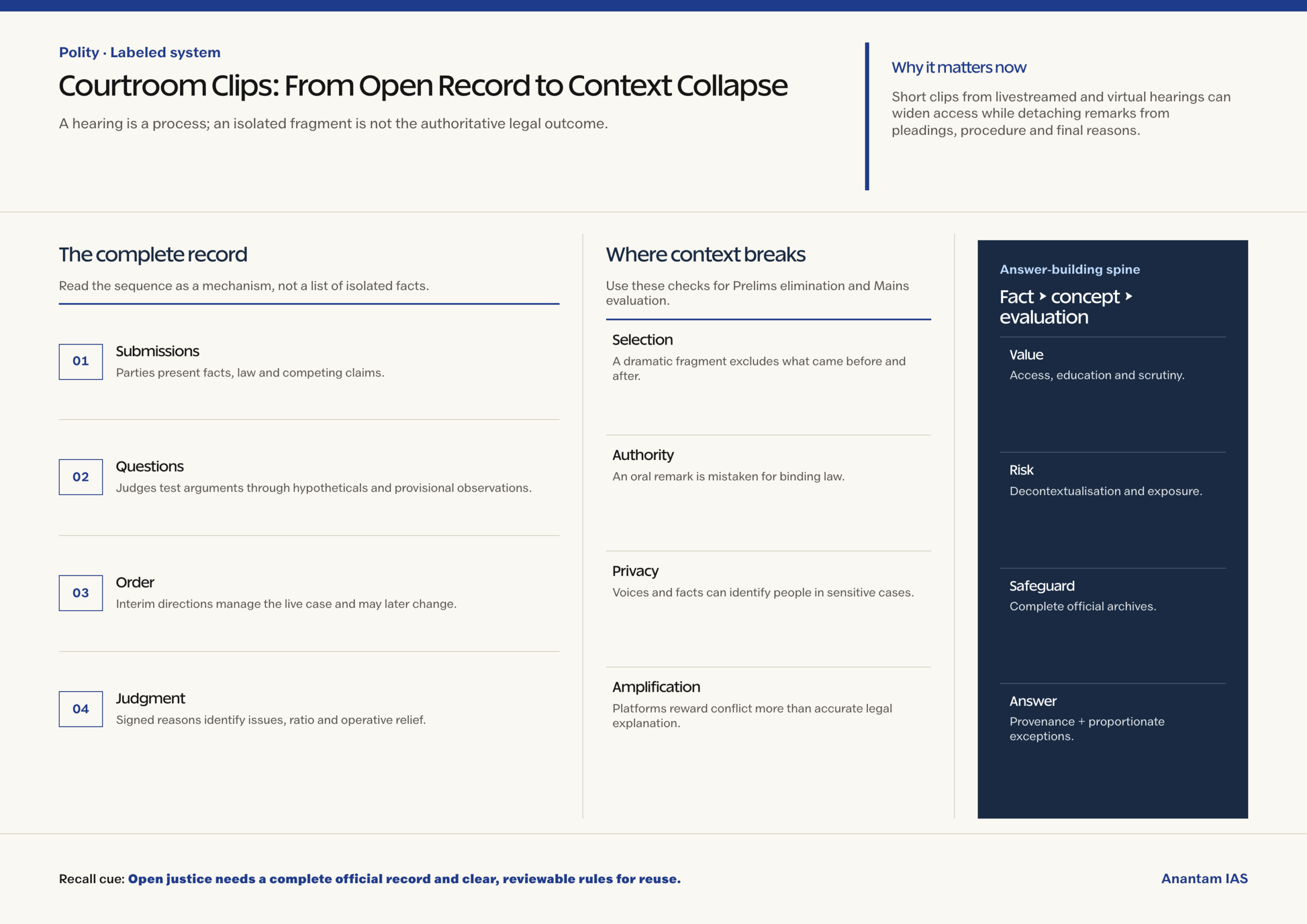
A 4 September report examined how short social-media clips from livestreamed and virtual court hearings expand access while stripping judicial exchanges of legal and procedural context.
- In July, the Supreme Court issued an interim restriction on circulating judicial audio or video clips without prior permission from court registrars.
- The Court later clarified that recognised news outlets may report proceedings but may not use the audio or video clips.
- The 2018 Swapnil Tripathi judgment recognised livestreaming of constitutionally important cases as part of access to justice under Article 21.
- The Supreme Court e-Committee’s 2021 Model Rules already restrict unauthorised dissemination and commercial or promotional use.
- Open justice lets citizens observe institutions, but a viral fragment can confuse a judge’s exploratory question with the binding reasoning of a final order.
- A workable protocol must protect sensitive parties and fair process without turning public access into opaque discretionary permission.
UPSC Relevance
Prelims Relevance
- Open justice supports public scrutiny of judicial proceedings and confidence in administration of justice.
- Article 21 has been connected with access to justice in the livestreaming context.
- Constitution Benches have five or more judges deciding substantial constitutional-interpretation questions.
- Oral observations test arguments but do not carry the binding force of the signed order or judgment.
- Sensitive matters may be excluded or delayed to protect privacy, children, victims or trial fairness.
Mains Relevance
GS Paper 2
- Open justice, institutional accountability and access to courts
- Privacy, fair trial and proportional regulation of courtroom footage
GS Paper 4
- Context, professional responsibility and ethical use of public records
Essay
- Transparency without context can illuminate institutions and distort them at the same time.
Background and Context
Why Livestreaming Serves Open Justice
Physical courtrooms have limited space, while distance and cost can exclude litigants, students, journalists and ordinary citizens from observing proceedings.
- Official livestreams widen access to constitutional hearings and allow the public to see arguments, questions and institutional procedure rather than rely only on summaries.
- Archives can strengthen legal education, enable accurate reporting and give litigants a record of how important public questions were heard.
- Visibility can improve professional accountability because judges and lawyers know that conduct may be observed beyond the courtroom.
- Access is not absolute: courts can restrict or delay transmission where privacy, child protection, sexual offences, national security or trial fairness require it.
- A public feed also creates accessibility duties, including reliable audio, captions, schedules and records that people with disabilities or limited bandwidth can use.
How Context Collapses
A hearing is an unfolding process, but social platforms reward brief, emotional and shareable fragments detached from pleadings and final reasons.
- Judges often ask hard hypothetical questions to test both sides; a question or preliminary view may change as evidence and argument develop.
- A short clip can omit the lawyer’s preceding submission, later clarification and final operative direction, creating a false account of the proceeding.
- Sensitive family, custody or sexual-offence hearings can expose parties even when names are removed because facts, voices or surrounding details remain identifying.
- Virality may encourage performative advocacy or cautious judging, weakening candid courtroom exchange and shifting attention from legal reasons to personalities.
- Platform ranking adds another layer: engagement systems can repeatedly amplify conflict while quieter explanations of jurisdiction, evidence and precedent receive little visibility.
From Blanket Control to Proportionate Rules
The policy challenge is to target harmful extraction and misuse without making the registrar an unexplained gatekeeper for ordinary public communication.
- An official complete archive provides a reference against which misleading fragments can be checked and corrected quickly.
- Rules should distinguish live access, downloading, editing, commercial reuse, reporting, research and accessibility because these uses create different risks.
- Permission systems need published criteria, response times and review mechanisms to prevent arbitrary treatment of independent journalists, researchers or citizens.
- Platform cooperation can prioritise provenance, links to the full record and rapid removal of privacy violations without suppressing accurate textual reporting.
- Media literacy remains essential because viewers must distinguish submissions, oral observations, interim directions, operative orders and precedential judgments when interpreting any hearing fragment.
Institutional Speech Needs Legal Context
Courts communicate through hearings, daily orders and final judgments, but these forms do not carry identical authority or completeness.
- An interim direction manages a live case and may change after further hearings, evidence or submissions from added parties.
- A final judgment explains facts, issues, reasons and relief, allowing readers to identify the ratio rather than infer law from a remark.
- Accurate reporting should link the spoken exchange to the case number, order date and procedural stage without implying that every observation creates precedent.
Way Forward
Protect the Record and the People
A layered protocol can preserve openness while reducing decontextualisation, privacy harm and unauthorised commercial exploitation.
- Maintain searchable official archives with stable links to full hearings, orders and corrections.
- Define excluded case categories and redaction standards through clear, public and reviewable rules.
- Require clips to preserve provenance and link viewers to the full official record where reuse is permitted.
- Build expedited remedies for manipulated footage, privacy breaches and false attribution while protecting fair reporting and criticism.
Conclusion
- Open justice works when the public can reach the complete and authoritative record, not only the most dramatic seconds selected by an algorithm.
- A strong answer should balance access, privacy and fair trial through differentiated uses, clear exceptions, official archives and reviewable safeguards.
UPSC Practice Questions
Prelims MCQ 1
With reference to livestreaming of court proceedings, consider the following statements:
- Oral observations always have the same binding force as a signed judgment.
- Constitution Benches comprise five or more judges.
- Sensitive proceedings may be excluded from livestreaming.
How many of the above statements are correct?
(a) Only one (b) Only two (c) All three (d) None
Answer: (b) Only two
Explanation:
Statements 2 and 3 are correct. Oral observations test arguments and are not equivalent to the binding reasons and directions in a final signed order.
Prelims MCQ 2
Which measure best counters misleading courtroom clips while preserving open justice?
(a) Deleting every official archive (b) Publishing a complete official record with provenance-linked permitted clips (c) Prohibiting all textual reporting (d) Allowing unrestricted recording in sensitive cases
Answer: (b) Publishing a complete official record with provenance-linked permitted clips
Explanation:
A complete authoritative record helps verify context while proportionate rules can address privacy and misuse.
UPSC Mains Questions
- Court livestreaming advances open justice, but platform-driven context collapse can damage privacy and legal understanding. Discuss.
- Design a proportionate governance framework for reuse of courtroom footage that protects transparency, fair trial and sensitive parties.
Source: The Hindu.
Frequently Asked Questions
What is open justice?
Open justice is the principle that judicial proceedings should ordinarily be observable and reportable, supporting public scrutiny, institutional accountability and confidence in adjudication.
Are a judge’s oral remarks binding law?
No. Oral questions and observations are part of testing arguments; binding reasons and directions appear in the court’s signed order or judgment.
Why can a short courtroom clip be misleading?
It may omit the underlying pleadings, preceding exchange, later clarification and final ruling, converting a provisional question into a false institutional conclusion.
Can sensitive cases be kept off livestreams?
Yes. Privacy, children, sexual offences, national security and fair-trial concerns can justify exclusion, delay, redaction or restricted access under clear rules.
What is the best response to decontextualised clips?
Maintain complete official archives, define permitted reuse, require provenance, protect sensitive identities and provide rapid remedies for manipulation or privacy breaches.
Source: https://anantamias.com/current-affairs/courtroom-clips-open-justice-context-collapse/
NEET-SS Vacant Seats: Federal Control and Public-Service Quotas
Why in News?
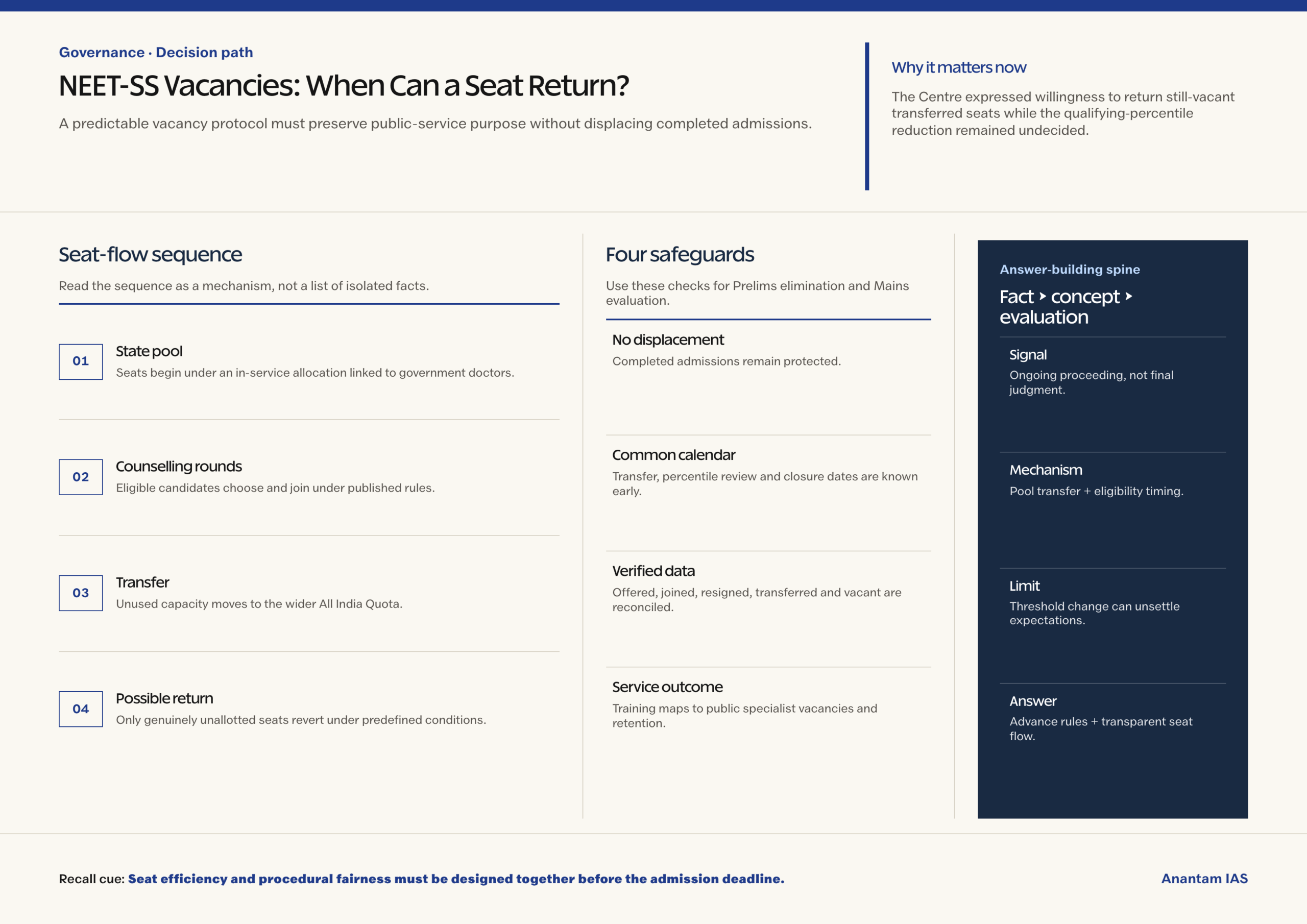
The Union government told the Supreme Court it was willing to return vacant NEET-SS seats to Tamil Nadu’s in-service pool, while the qualifying-percentile reduction remained undecided.
- Tamil Nadu had earmarked 219 super-speciality seats for in-service candidates in the 2025-26 academic year.
- After two counselling rounds, 68 candidates had joined and 152 vacant seats were diverted to the All India Quota.
- The Centre earlier said about 40 of those transferred seats remained vacant; Tamil Nadu’s medical officers sought their return.
- The Supreme Court listed the matter for 8 September to hear the extent of any qualifying-percentile reduction.
- The dispute is procedural and federal: it concerns when unused State-linked seats move to a national pool and whether they can return before the admission cycle closes.
- The Centre expressed willingness, but the report did not describe a final merits judgment or a settled percentile change.
UPSC Relevance
Prelims Relevance
- NEET-SS is the entrance examination for admission to super-speciality medical courses.
- A qualifying percentile is a relative threshold and differs from raw marks.
- The All India Quota pools seats for centralised counselling across participating institutions.
- In-service allocation can support retention of specialists in government health systems.
- Counselling rules must balance merit, equality, service needs and avoidance of seat wastage.
Mains Relevance
GS Paper 2
- Federal coordination in medical education and public-health workforce policy
- Judicial review of counselling design, equality and administrative timing
GS Paper 3
- Human-capital scarcity and efficient use of publicly funded specialist seats
Essay
- A scarce public seat has value only when selection rules remain fair and the trained specialist eventually serves a real health-system need.
Background and Context
Why States Reserve In-Service Seats
Government doctors often serve rural or difficult postings, and specialist training can strengthen the public system when return-of-service rules are credible.
- An in-service channel recognises prior public employment and can create a career path for doctors who remain within government facilities.
- The policy case is strongest where trained specialists return to mapped vacancies rather than leaving public service immediately after subsidised education.
- Transparent eligibility, service bonds and posting plans are needed so preference produces measurable public-health capacity rather than only individual benefit.
- National examination standards can coexist with State workforce policy, but counselling rules must specify how the two systems interact.
- States also need speciality-wise workforce evidence because reserving a seat has little public value if training does not correspond to vacancies, equipment and referral demand.
How Vacancies Move Between Pools
Admission calendars use successive rounds to prevent seats from remaining empty, yet transfers can collide with later eligibility changes or State claims.
- A State-linked seat may shift to the All India Quota after remaining unfilled, widening the candidate pool before the academic deadline.
- If the national pool also leaves seats vacant, returning them may preserve the original service purpose without displacing an already admitted candidate.
- The timing of a qualifying-percentile reduction matters because previously ineligible candidates may become eligible only after a transfer has occurred.
- Clear cut-off rules reduce litigation by stating when transfer becomes final, whether reversal is allowed and how candidates receive notice.
- A return mechanism should protect candidates who already secured seats through the receiving pool and identify only genuinely unallotted capacity for reversion.
Percentile Reduction Needs Guardrails
Lowering a threshold may prevent waste, but it must remain transparent, general and connected to training quality and patient safety.
- A percentile indicates a candidate’s position relative to the test population; lowering it expands eligibility without changing available seat capacity.
- The authority, evidence and timing for reduction should be published before the final counselling stages wherever practicable.
- Relaxation should not become an improvised response favouring one group after others relied on earlier rules and deadlines.
- Vacancy data must distinguish seats offered, joined, resigned, transferred and still available so courts and candidates assess the same factual position.
- Academic quality cannot be reduced to one threshold alone; curriculum, clinical exposure, supervision, assessment and hospital case mix also shape specialist competence.
The Health-System Test Comes After Admission
Counselling allocates training opportunity, but workforce policy succeeds only if specialist capacity reaches underserved public facilities after qualification.
- States should map seats to vacancy forecasts, referral burdens and infrastructure capable of supporting each super-speciality practice.
- Service obligations need fair duration, clear posting rules and working conditions that make retention feasible rather than punitive.
- Outcome review should track joining, course completion, public-service return and specialist retention, not only how many reserved seats were filled.
Way Forward
Use a Predictable Vacancy Protocol
The best design protects service objectives and merit through advance rules rather than emergency litigation near the academic deadline.
- Publish a common calendar for State pools, transfer, percentile review, mop-up rounds and final closure.
- Allow reversible transfers only under predefined conditions and without disturbing completed admissions.
- Link in-service preference to transparent public-service obligations and specialist workforce gaps.
- Release verified seat-flow dashboards that reconcile institutional, State and central counselling records.
Conclusion
- The dispute shows that seat efficiency and procedural fairness must be designed together; late changes can save capacity while unsettling legitimate expectations.
- A strong answer should connect federal roles, counselling timelines, percentile logic, public-service objectives and non-displacement safeguards.
UPSC Practice Questions
Prelims MCQ 1
With reference to medical counselling, consider the following statements:
- A qualifying percentile is identical to a fixed raw-mark threshold in every examination.
- The All India Quota uses a wider centralised counselling pool.
- An in-service channel can be linked to government workforce needs.
How many of the above statements are correct?
(a) Only one (b) Only two (c) All three (d) None
Answer: (b) Only two
Explanation:
Statements 2 and 3 are correct. A percentile describes relative position and is not inherently identical to a fixed raw score.
Prelims MCQ 2
Which vacancy rule best protects fairness?
(a) Unpublished case-by-case transfers (b) Predefined transfer and return conditions with verified seat data (c) Changing eligibility after every individual request (d) Keeping seats vacant regardless of eligible candidates
Answer: (b) Predefined transfer and return conditions with verified seat data
Explanation:
Advance, transparent rules reduce arbitrariness while allowing unused capacity to be managed without displacing completed admissions.
UPSC Mains Questions
- Medical-seat counselling is a problem of federal coordination as much as candidate selection. Examine with reference to vacant super-speciality seats.
- How can in-service medical reservations be designed to strengthen public-health capacity while preserving merit and procedural fairness?
Source: The Hindu.
Frequently Asked Questions
What did the Centre tell the Supreme Court?
It expressed willingness to return vacant transferred seats to Tamil Nadu’s in-service pool, while the extent of a qualifying-percentile reduction remained undecided.
Did the Court deliver a final judgment?
The report described an ongoing proceeding and a further hearing date, not a final merits judgment settling every counselling issue.
What is a qualifying percentile?
It is a relative performance threshold based on a candidate’s position within the test population, unlike a permanently fixed raw-mark cut-off.
Why have an in-service quota?
It can reward difficult public service and develop specialists for government facilities when eligibility, service obligations and posting plans are enforceable.
Why do vacant seats move to another pool?
Successive counselling rounds widen access and prevent scarce training capacity from being wasted before the academic cycle closes.
Source: https://anantamias.com/current-affairs/neet-ss-vacant-seats-federal-quota-control/
EOS-05: Imaging Earth From Geosynchronous Orbit
Why in News?
ISRO’s GSLV-F17 successfully launched EOS-05 at 2:55 a.m. on 4 September and placed it into the intended sub-geosynchronous transfer orbit.
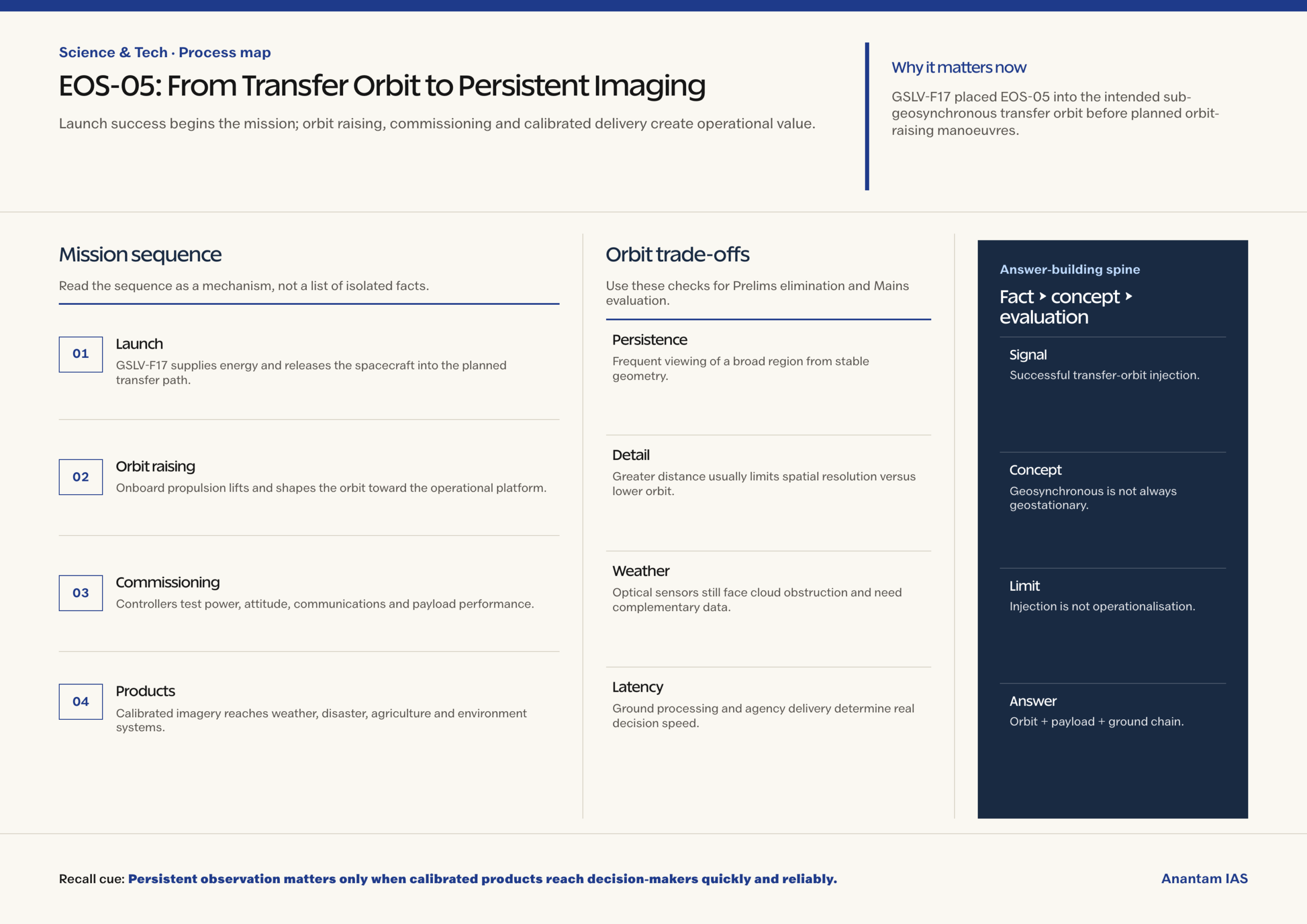
- EOS-05 is India’s first imaging satellite designed to observe Earth from geosynchronous orbit.
- The 2,367 kg spacecraft was injected about 18 minutes after launch from the second launch pad at Sriharikota.
- ISRO reported normal spacecraft health and solar-array deployment after injection.
- Further orbit-raising manoeuvres are required before the satellite reaches its operational geosynchronous platform.
- A transfer-orbit injection is a launch milestone, not the same as final operational positioning or commissioned data service.
- High-altitude persistence complements lower-orbit detail by allowing frequent observation of a broad region from a stable viewing geometry.
UPSC Relevance
Prelims Relevance
- Geosynchronous orbit has an orbital period matching Earth’s rotation.
- A geostationary orbit is a circular, equatorial geosynchronous orbit that appears fixed over one longitude.
- A transfer orbit is an intermediate elliptical path used before orbit raising.
- GSLV uses a cryogenic upper stage for high-energy missions.
- Earth-observation data support weather, agriculture, environment and disaster management.
Mains Relevance
GS Paper 3
- Space-based Earth observation for disaster response and strategic autonomy
- Launch reliability, orbital insertion and downstream data systems
GS Paper 1
- Remote sensing, spatial monitoring and geographic applications
Essay
- The value of a space mission lies not only in reaching orbit but in converting persistent observation into timely public decisions.
Background and Context
Why Geosynchronous Imaging Matters
A high-altitude satellite can repeatedly observe the same broad region, supporting persistence where lower-orbit satellites pass only at intervals.
- Geosynchronous means the satellite’s orbital period matches Earth’s rotation, allowing a recurring view relative to the planet.
- A geostationary satellite is the special circular and equatorial case that appears fixed above one longitude to a ground observer.
- Persistent viewing can track rapidly evolving cloud systems, fires, floods or other events without waiting for the next low-Earth-orbit pass.
- The tradeoff is spatial detail: greater distance usually reduces achievable ground resolution compared with many lower-orbit imaging systems.
- Viewing geometry also affects latitude coverage, cloud obstruction and sensor design, so high temporal frequency does not guarantee a usable image of every event.
Launch Is Only the First Orbital Step
GSLV-F17 inserted EOS-05 into an elliptical transfer orbit from which the spacecraft must raise and shape its final orbit.
- The launch vehicle supplies most initial energy and releases the spacecraft into a planned orbit with specific altitude, inclination and velocity conditions.
- Spacecraft propulsion then performs orbit-raising burns, progressively lifting the low point and adjusting the path toward the intended platform.
- Controllers verify power, communication, thermal behaviour, attitude control and propulsion before declaring the spacecraft ready for payload commissioning.
- Operational status follows calibration and validation; a successful injection does not itself prove that every imaging product is available.
- Station-keeping later preserves orbital position against perturbations, consuming onboard propellant and linking mission life to propulsion, mass and operational choices.
A Complementary Observation Architecture
No single orbit optimises persistence, resolution, coverage and latency, so resilient Earth observation combines platforms with different strengths.
- Low-Earth-orbit satellites can provide finer spatial detail but observe a given location intermittently as their ground track moves.
- Geosynchronous imaging can provide frequent regional updates, improving temporal continuity for changing hazards and strategic monitoring.
- Weather, radar, optical and multispectral instruments answer different questions and must be combined with ground observations and domain models.
- Useful data also require receiving stations, processing chains, secure archives, open standards and delivery systems that reach operational agencies quickly.
- Rapid products should be fused with field reports because remote sensing can detect patterns but may not reveal local exposure, damage or required relief by itself.
Limits of Persistent Observation
High revisit frequency improves situational awareness, but clouds, sensor resolution, calibration and downstream latency still determine whether imagery supports action.
- Optical imaging cannot see through dense cloud, making radar and meteorological observations important complements during monsoon hazards.
- Strategic imagery also raises questions of access, classification and civil-agency sharing, which can affect how quickly public applications receive products.
- Long mission value depends on fuel, radiation resilience, component health and ground control, not only the performance of the launch vehicle.
Way Forward
Convert Persistence Into Decisions
Mission value will depend on commissioning, calibrated products and dependable use by agencies rather than launch success alone.
- Complete orbit raising and publish commissioning milestones without treating transfer-orbit injection as full operationalisation.
- Validate imagery against ground truth and disclose resolution, revisit, latency and uncertainty for each product.
- Integrate rapid products with disaster, agriculture, environment and weather decision systems.
- Build continuity through complementary satellites, redundant ground infrastructure and clear data-access protocols.
Conclusion
- EOS-05’s distinctive value is persistent regional observation, while its mission sequence runs from launch and transfer orbit through raising, calibration and operational data delivery.
- A strong answer should compare orbital tradeoffs and connect spacecraft architecture with the ground systems that turn imagery into public value.
UPSC Practice Questions
Prelims MCQ 1
With reference to satellite orbits, consider the following statements:
- Every geosynchronous orbit must be circular and equatorial.
- A geostationary satellite appears fixed above one longitude.
- A transfer orbit can be used before reaching the operational orbit.
How many of the above statements are correct?
(a) Only one (b) Only two (c) All three (d) None
Answer: (b) Only two
Explanation:
Statements 2 and 3 are correct. Geostationary is the circular equatorial special case; geosynchronous orbits can have inclination or eccentricity.
Prelims MCQ 2
What is the main observational advantage of a geosynchronous imaging platform?
(a) Zero launch-energy requirement (b) Persistent or frequently repeated viewing of a broad region (c) Guaranteed finer detail than every low-orbit satellite (d) No need for ground processing
Answer: (b) Persistent or frequently repeated viewing of a broad region
Explanation:
Matching Earth’s rotation supports recurring regional viewing, though resolution and distance create tradeoffs.
UPSC Mains Questions
- Explain how geosynchronous imaging complements low-Earth-orbit observation for disaster management and environmental monitoring.
- A successful launch is only one stage in an Earth-observation mission. Discuss the chain from orbital insertion to public decision support.
Sources: ISRO and The Hindu.
Frequently Asked Questions
What happened in the EOS-05 mission?
GSLV-F17 launched EOS-05 and placed it into the intended sub-geosynchronous transfer orbit; later manoeuvres are needed for its operational platform.
Is geosynchronous the same as geostationary?
No. Geostationary is the circular, equatorial geosynchronous case that appears fixed above one longitude.
Why use a transfer orbit?
It lets the launch vehicle place a spacecraft on an energy-efficient intermediate path before onboard propulsion raises and shapes the final orbit.
What can persistent imaging support?
Frequent regional observations can help track evolving weather, fires, floods, agriculture, environmental change and strategic activity when combined with other data.
Was EOS-05 operational immediately after launch?
No. Successful injection and healthy systems are early milestones; orbit raising, payload commissioning, calibration and product validation still follow.
Source: https://anantamias.com/current-affairs/eos-05-geosynchronous-earth-imaging/
India-Belgium Partnership: Defence, Fintech and Semiconductor Cooperation
Why in News?
India and Belgium agreed on 3 September to deepen defence, intelligence, investment, fintech, semiconductor and renewable-energy cooperation during Belgian Prime Minister Bart De Wever’s visit.
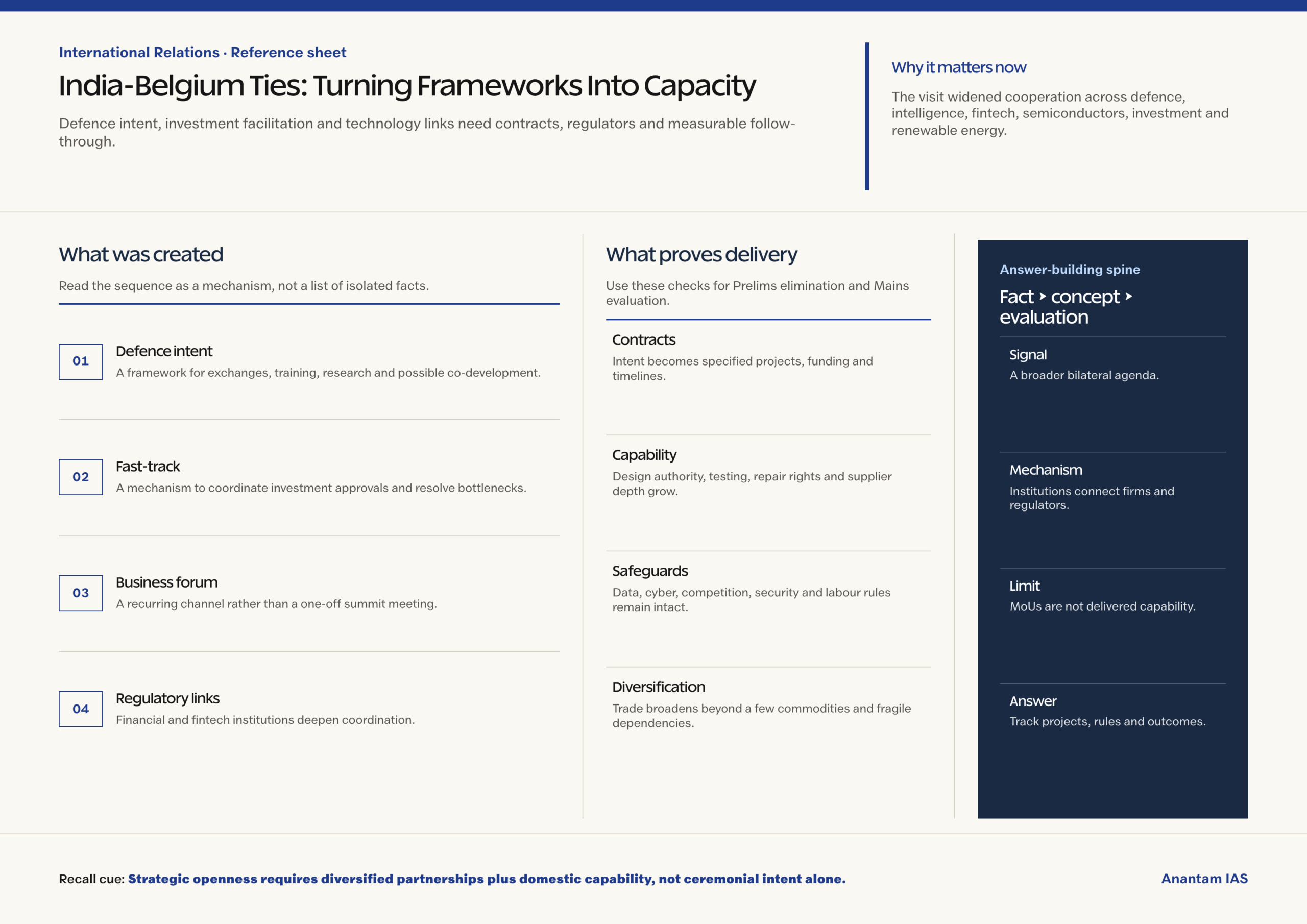
- A defence letter of intent created a framework for military exchanges, training, research, innovation, co-development and possible co-production.
- India established an investment fast-track mechanism for Belgian companies and both sides decided to regularise the bilateral business forum.
- The two governments set a goal of doubling bilateral trade over five years and strengthening coordination among financial and regulatory institutions.
- Reported cooperation also covered semiconductors, renewable energy, maritime-route security and dialogue on Ukraine and West Asia.
- Belgium is an EU member, a major logistics gateway and home to specialised industrial, semiconductor and financial capabilities.
- The visit produced frameworks and goals; implementation will depend on contracts, regulatory cooperation, investment decisions and follow-up institutions.
UPSC Relevance
Prelims Relevance
- Belgium is a federal state and a member of the European Union and NATO.
- Antwerp is a major global diamond-trading and European logistics centre.
- A letter of intent records planned cooperation but is not automatically a binding procurement contract.
- Co-development shares design or research work; co-production shares manufacturing activity.
- Investment fast-track mechanisms coordinate approvals and resolve investor bottlenecks.
Mains Relevance
GS Paper 2
- India-EU relations through bilateral partnerships with member states
- Defence, intelligence and maritime-security cooperation
GS Paper 3
- Semiconductor supply chains, investment facilitation and technology co-development
Essay
- Strategic openness seeks diversified partnerships without replacing one dangerous dependency with another.
Background and Context
Why Belgium Matters Beyond Trade
Belgium combines EU regulatory influence, North Sea logistics, specialised industry and diplomatic institutions concentrated around Brussels.
- Brussels hosts major European Union institutions, making bilateral cooperation relevant to India’s wider engagement with European rules, standards and markets.
- Antwerp links port logistics and diamond trade, while Belgian firms bring capabilities in advanced manufacturing, defence systems, life sciences and clean technology.
- The relationship can diversify India’s European partnerships beyond the continent’s largest economies and connect firms to wider EU value chains.
- Belgium also benefits from India’s scale, engineering base, digital public infrastructure and expanding demand for technology and industrial investment.
- As a smaller European power, Belgium can use focused industrial niches and EU market access while India gains partners that are not limited to great-power diplomacy.
Defence Intent Needs Project Discipline
The new framework broadens contact from exchanges toward research and production, but intent becomes capability only through defined programmes.
- Military exchanges and training build familiarity, while intelligence cooperation depends on secure channels, legal safeguards and clearly scoped threat priorities.
- Co-development can share technical risk and intellectual property, but requires aligned specifications, export controls, certification and procurement timelines.
- Co-production can strengthen supply resilience when manufacturing depth, quality assurance, maintenance and lifecycle support are located across both partners.
- Company memoranda create opportunities, yet they should not be reported as delivered equipment or operational capability before contracts and milestones exist.
- Technology transfer should be judged by design authority, source access, testing capacity, repair rights and domestic supplier development rather than final assembly alone.
Economic Cooperation Is Institutional
Trade goals become credible when recurring forums, regulatory links and investor problem-solving survive beyond a high-level visit.
- A fast-track mechanism can identify delayed approvals and coordinate agencies, but it cannot replace environmental, competition, security or labour safeguards.
- Fintech cooperation requires regulators to address payments, consumer protection, cyber risk, anti-money-laundering controls and cross-border data governance.
- Semiconductor partnerships may cover research, equipment, materials, design and manufacturing rather than only fabrication plants.
- Renewable-energy cooperation can combine technology, finance and standards while accounting for grid integration, critical minerals and circular supply chains.
- Trade diversification matters because a target driven mainly by diamonds or a few volatile commodities may grow in value without creating broad strategic resilience.
Europe-Level and Bilateral Tracks Interact
Belgium acts nationally in some fields while trade, competition, data and product rules may also operate through European Union institutions.
- A bilateral mechanism can solve project-level bottlenecks, but market access may still depend on compliance with EU-wide standards and regulation.
- India can use bilateral pilots to build trust and evidence before seeking wider interoperability or market arrangements at the European level.
- Policy coherence matters because defence security, investment screening, data governance and open trade can pull individual projects in different directions.
Way Forward
Turn Frameworks Into Verifiable Outcomes
Follow-up should define projects, responsible institutions, safeguards and public milestones across each cooperation pillar.
- Publish sectoral work plans distinguishing dialogue, memoranda, procurement, investment and commissioned capacity.
- Create joint industry-academic pathways for semiconductor and defence research with transparent intellectual-property rules.
- Use regulatory sandboxes only with consumer, cybersecurity and data-protection safeguards.
- Measure the trade goal through diversified goods, services and resilient supply chains rather than aggregate value alone.
Conclusion
- The visit’s significance lies in institutional diversification: defence, technology and finance now sit beside diamonds and conventional trade.
- A strong answer should distinguish diplomatic intent from implementation and trace how regulation, contracts and recurring mechanisms convert partnership into capacity.
UPSC Practice Questions
Prelims MCQ 1
With reference to India-Belgium cooperation, consider the following statements:
- Belgium is a member of the European Union.
- A letter of intent is automatically identical to a completed defence procurement contract.
- Antwerp is important to global diamond trade and European logistics.
How many of the above statements are correct?
(a) Only one (b) Only two (c) All three (d) None
Answer: (b) Only two
Explanation:
Statements 1 and 3 are correct. A letter of intent establishes direction or framework but does not itself prove completed procurement.
Prelims MCQ 2
Which description best distinguishes co-development from co-production?
(a) Co-development shares design work; co-production shares manufacturing (b) Both mean only importing finished goods (c) Co-production excludes quality assurance (d) Co-development requires no intellectual-property rules
Answer: (a) Co-development shares design work; co-production shares manufacturing
Explanation:
Projects may combine both, but their governance, intellectual-property and industrial-capacity implications differ.
UPSC Mains Questions
- India’s bilateral ties with individual EU member states can strengthen its wider European strategy. Discuss with reference to Belgium.
- How can defence and semiconductor partnerships move from diplomatic intent to resilient domestic capability?
Source: Indian Express.
Frequently Asked Questions
What changed in India-Belgium relations?
The visit widened cooperation through a defence intent framework, investment facilitation, regular business dialogue, fintech coordination and technology and energy partnerships.
Was a defence procurement contract announced?
The source reports a letter of intent and additional memoranda, which create frameworks and opportunities but do not by themselves prove completed procurement or delivery.
Why is Belgium strategically relevant?
It combines EU institutional access, Antwerp logistics, specialised industry, financial expertise and advanced technology capabilities.
What does an investment fast-track mechanism do?
It coordinates agencies and resolves investor bottlenecks while normal legal, security, environmental, competition and labour requirements continue to apply.
What is strategic openness?
It means maintaining open trade and investment while diversifying critical dependencies, strengthening trusted partnerships and protecting resilience.
Source: https://anantamias.com/current-affairs/india-belgium-defence-fintech-semiconductor-ties/
India’s Health-Care Missing Middle: Coverage Without Affordable Access
Why in News?
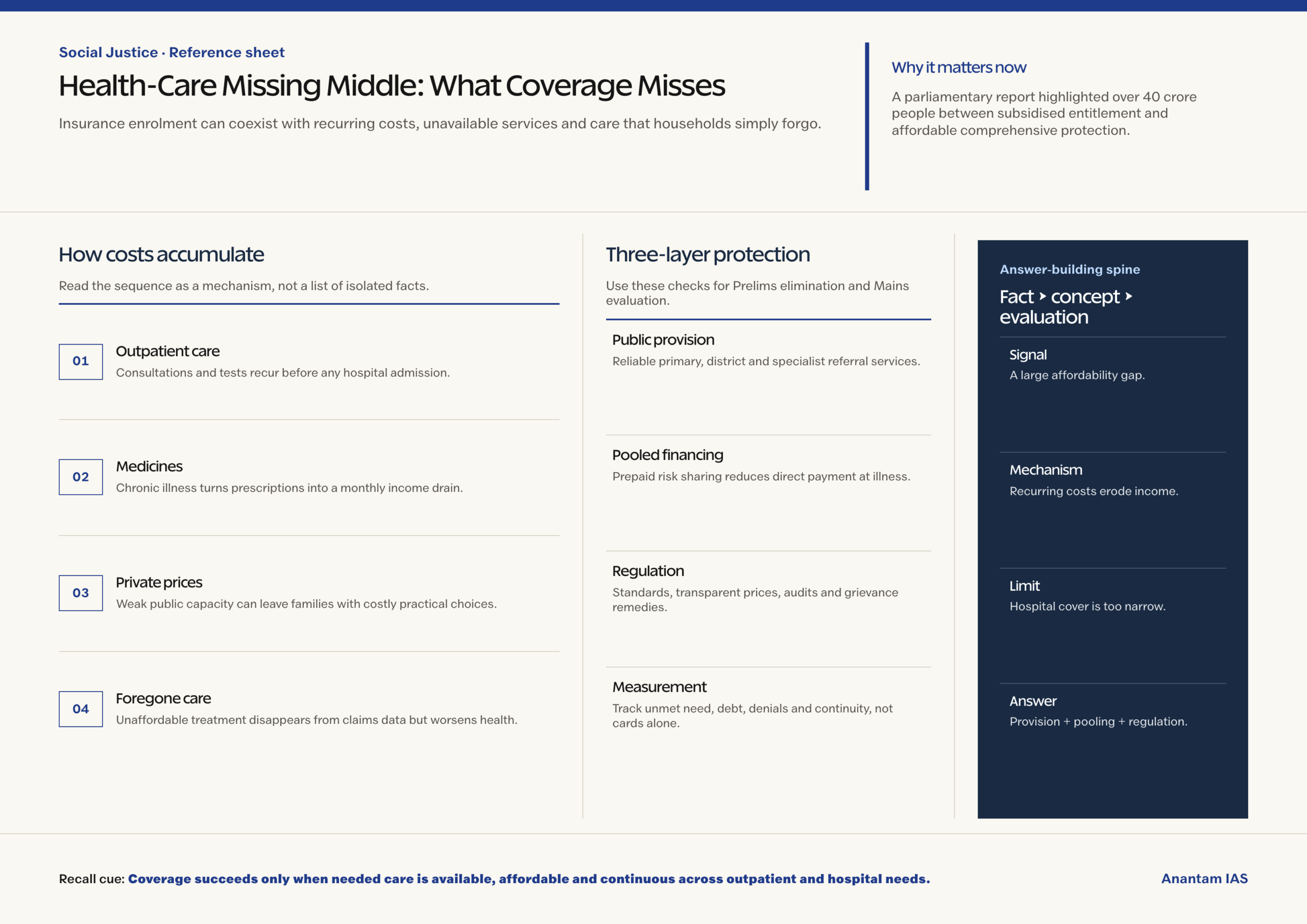
A parliamentary standing committee report highlighted more than 40 crore Indians in a health-care missing middle, exposed to recurring private costs without comprehensive financial protection.
- The committee linked vulnerability to private delivery of more than 60% of inpatient care and 70% of outpatient care.
- Medicines account for nearly 30% of current health expenditure, making chronic illness a repeated household cost rather than one hospital event.
- Government health expenditure was cited at 1.43% of GDP against the National Health Policy’s 2.5% target.
- The committee recommended stronger public infrastructure, national implementation of clinical-establishment regulation, quality standards and private-sector price transparency.
- Hospital insurance can reduce catastrophic cost but often leaves consultations, medicines, diagnostics, premiums, exclusions and co-payments outside effective protection.
- Affordability depends on public provision, pooled financing, price governance and primary care, not only possession of an insurance card.
UPSC Relevance
Prelims Relevance
- Out-of-pocket expenditure is paid directly by households at the point of receiving care.
- Current health expenditure covers recurring health goods and services rather than capital formation.
- PM-JAY primarily provides hospitalisation cover for eligible vulnerable households.
- The Clinical Establishments Act provides a framework for registration and minimum standards where adopted.
- Financial protection measures whether illness causes unaffordable spending or foregone care.
Mains Relevance
GS Paper 2
- Universal health coverage, public provision and equitable financial protection
- Regulation of private providers, medicines and diagnostic markets
GS Paper 3
- Household income erosion, productivity and health-related poverty
Essay
- A health system fails quietly when families avoid care or lose income month after month without ever appearing in catastrophic-spending statistics.
Background and Context
Who Forms the Missing Middle
These households may not qualify for fully subsidised protection, yet remain unable to absorb private premiums and repeated medical expenses safely.
- Income cut-offs create a boundary, but health vulnerability also depends on age, chronic disease, location, family size and available public facilities.
- Formal employment does not always guarantee comprehensive insurance, while informal workers may move between schemes, employers and uncovered periods.
- A family can appear above a poverty threshold before illness and fall into debt after medicines, tests, travel or repeated outpatient visits.
- The category is a policy lens rather than one permanent group; households can enter or leave it as work, health and eligibility change.
- Geography compounds income risk when public specialists are distant and transport, accommodation and lost wages become part of the real treatment cost.
Why Hospital Cover Is Not Enough
Many high-frequency costs occur before admission or without it, especially for non-communicable diseases requiring lifelong monitoring and treatment.
- Primary consultations, diagnostics and medicines determine whether disease is detected and controlled before expensive complications require hospital care.
- Insurance exclusions, waiting periods, co-payments and narrow networks can leave nominally covered households paying substantial amounts directly.
- Private hospitalisation can be far costlier than public care, but weak public capacity may leave families with little practical choice.
- Foregone care is another financial-protection failure: households may avoid tests or treatment because the expected cost is unaffordable.
- Late diagnosis then increases both medical severity and eventual spending, showing why prevention and primary care are fiscal protections as well as clinical services.
Coverage Has Three Layers
Effective protection combines service availability, pooled payment and regulation so an entitlement can translate into timely care at predictable cost.
- Public primary and district facilities provide a supply-side floor, reduce travel and create referral pathways for conditions needing specialist treatment.
- Pooled financing spreads risk across a population and protects households from paying the full cost when illness occurs.
- Price transparency and standard treatment rules can limit information asymmetry, unnecessary procedures and unpredictable billing in private facilities.
- Medicine policy must address procurement, generic quality, prescription practice, retail margins and antimicrobial stewardship together.
- Federal coordination is necessary because health delivery is primarily State-led while national schemes, standards, tax policy and pharmaceutical regulation influence household protection.
Why Better Data Changes Design
Income categories alone miss people who are formally covered but cannot reach a provider or afford exclusions and recurring outpatient care.
- Household surveys should separate unmet need, direct payments, borrowing, asset sales and income loss to reveal different forms of financial distress.
- Claims data can show denial and network gaps, while facility data reveals medicine shortages, waiting times and referral failure.
- Linking these sources helps target subsidy depth and public capacity without assuming every uncovered household faces the same risk.
Way Forward
Measure Protection, Not Cards
Reform should track whether people obtain needed care without debt, distress sales, skipped treatment or recurring income erosion.
- Expand dependable primary care, diagnostics and medicine availability near where people live.
- Design contributory or subsidised pooled options for uncovered households with simple continuity across jobs.
- Implement transparent provider standards, prices, audits and grievance redress across public and private care.
- Publish disaggregated data on unmet need, outpatient cost, medicine cost and claims denial alongside enrolment totals.
Conclusion
- The missing middle reveals that coverage is not the same as financial protection; care must be available, affordable and continuous across outpatient and hospital needs.
- A strong answer should connect public spending, primary care, pooled financing, provider regulation and medicine policy to household security.
UPSC Practice Questions
Prelims MCQ 1
With reference to health financing, consider the following statements:
- Out-of-pocket expenditure is paid directly by households when receiving care.
- Hospitalisation insurance necessarily covers every outpatient medicine and diagnostic expense.
- Financial protection includes preventing foregone care caused by unaffordable cost.
How many of the above statements are correct?
(a) Only one (b) Only two (c) All three (d) None
Answer: (b) Only two
Explanation:
Statements 1 and 3 are correct. Hospital policies can exclude or limit outpatient medicines, diagnostics and other recurring costs.
Prelims MCQ 2
Which intervention most directly addresses recurring chronic-disease costs?
(a) Hospital cover alone (b) Reliable primary care, diagnostics and essential medicines (c) More complex claim forms (d) Removing price disclosure
Answer: (b) Reliable primary care, diagnostics and essential medicines
Explanation:
Chronic disease requires repeated outpatient monitoring and medication, so accessible primary services directly reduce ongoing household expense.
UPSC Mains Questions
- India’s health-care missing middle is a problem of shallow financial protection rather than insurance enrolment alone. Discuss.
- Explain why universal health coverage requires public provision, pooled financing and private-provider regulation to work together.
Source: The Hindu.
Frequently Asked Questions
Who are the health-care missing middle?
They are households often outside fully subsidised entitlement but not financially secure enough to absorb private insurance premiums and repeated medical costs.
Why is hospital insurance insufficient?
Many costs arise from outpatient consultations, medicines, diagnostics, exclusions, co-payments and travel, while some families avoid care before hospitalisation occurs.
What is out-of-pocket health spending?
It is money households pay directly when receiving health goods or services rather than costs prepaid through taxation or pooled insurance.
Why do medicines matter so much?
Chronic diseases require repeated prescriptions, and medicine purchases can erode household income gradually even without one catastrophic hospital bill.
How should financial protection be measured?
Track needed care received, direct spending, debt, skipped treatment, medicine access, claim denial and continuity, not only scheme enrolment.
Source: https://anantamias.com/current-affairs/india-healthcare-missing-middle-affordability-gap/
Supersized El Niño to be strongest ever recorded: UN
Why in News?
The World Meteorological Organisation (WMO) has warned that the ongoing El Niño is likely to intensify into a “very strong” or even record-breaking event by the end of 2026, with its climatic effects extending into 2027.
WMO forecasts indicate a near 100% probability of El Niño persisting through February 2027, fuelled by exceptionally warm Pacific Ocean temperatures.
| UPSC Relevance: GS-1 Geography: Physical Geography; GS-3 Environment: Climate Change Prelims: ENSO, El Niño, WMO Mains: El Niño: Concept, Impacts and Climate Change |
Key Findings by WMO:
- El Niño is firmly established and will persist through February 2027. Exceptionally warm tropical Pacific Ocean conditions support further intensification.
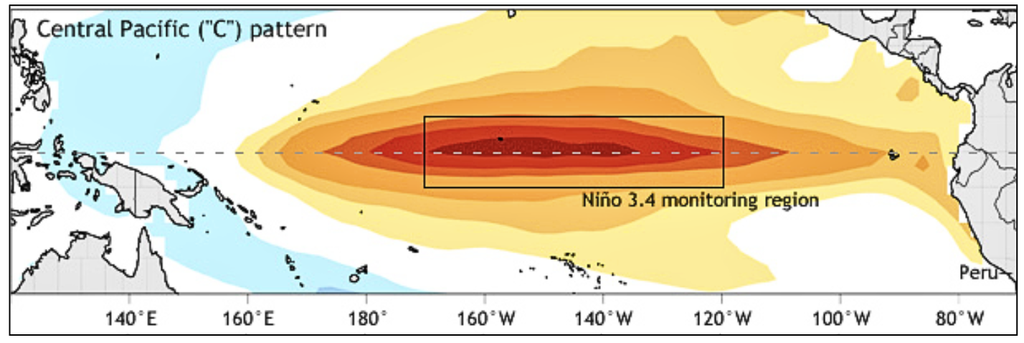
- Sea surface temperatures in the Niño 3.4 region ranged from about 2.2°C to 2.6°C above average and could reach 3.6°C.
- The Niño 3.4 region is a specific area in the central equatorial Pacific Ocean used by scientists to monitor and measure sea surface temperatures for El Niño and La Niña events.
- In some parts of the Pacific, subsurface ocean temperatures were more than 8°C above average during July and early August.
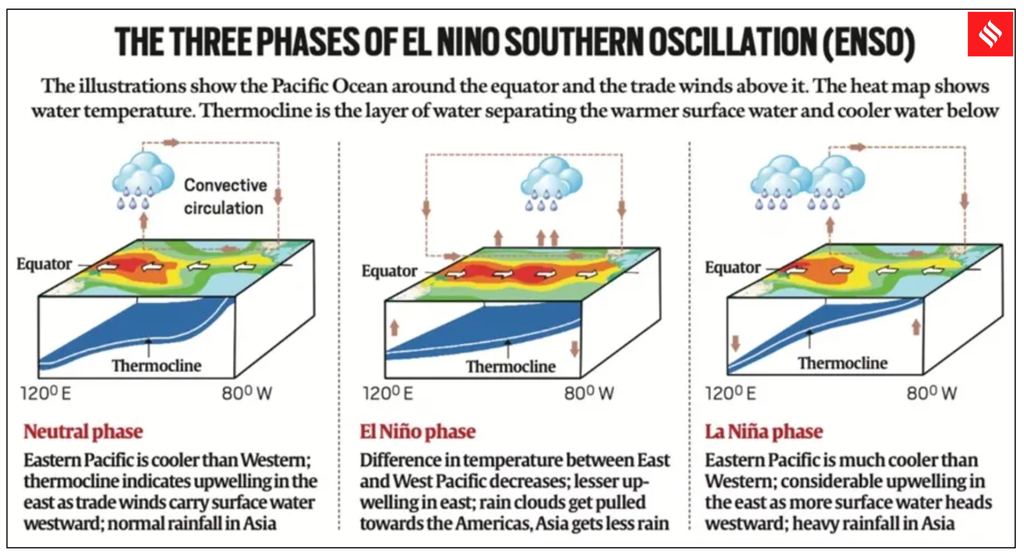
What is El Niño?
- El Niño is the warm phase of the El Niño–Southern Oscillation (ENSO), a coupled ocean-atmosphere phenomenon in the tropical Pacific.
- Under normal conditions:
- Easterly trade winds push warm surface water towards Indonesia and Australia
- Cold, nutrient-rich water rises along the South American coast
- Atmospheric convection and rainfall remain concentrated over the western Pacific.
- During El Niño:
- Trade winds weaken or occasionally reverse
- Warm water spreads towards the central and eastern equatorial Pacific
- Cold-water upwelling off Peru and Ecuador is suppressed
- Walker Circulation and global jet streams are altered.
It generally occurs every two to seven years, develops between March and June, peaks during November-February and lasts around nine to twelve months.
Likely Global Impacts:
A strong El Niño can reorganise rainfall, temperature and storm patterns across the world, increasing the probability of:
- floods and landslides along western South America
- drought and forest fires in Australia, Indonesia and parts of Southeast Asia
- drought-related food insecurity in parts of southern Africa
- intense rainfall in parts of East Africa
- shifts in tropical cyclone activity across the Pacific and Atlantic
- disruption of fisheries due to reduced nutrient-rich upwelling
- higher global average temperatures.
Its impacts are not uniform or automatic. Local outcomes depend upon season, geography and other climate drivers such as the Indian Ocean Dipole (IOD) and Atlantic Ocean temperatures.
Implications for India:
- Monsoon and agriculture: El Niño generally weakens the moisture-bearing circulation supporting India’s southwest monsoon and raises the probability of below-normal rainfall. The monsoon supplies roughly 70% of India’s annual rainfall, supports kharif cultivation and recharges reservoirs and groundwater. However, not every El Niño produces an Indian drought.
- Food inflation: Reduced production of cereals, pulses, oilseeds, vegetables and livestock fodder can raise food prices. Export restrictions, stock limits and ad hoc market interventions may then create additional uncertainty for farmers.
- Water and energy security: Weak rainfall could lower reservoir storage, groundwater recharge and hydropower generation. Simultaneously, higher temperatures may increase electricity demand for cooling, creating a water-energy stress cycle.
- Heat and health: El Niño releases additional oceanic heat into the atmosphere. When superimposed upon anthropogenic global warming, it can intensify heatwaves, occupational heat stress, vector-borne diseases and heat-related mortality. Rabi crops, particularly wheat, may also face terminal heat stress.
- Disaster risks: India could experience a combination of drought in some regions and short-duration extreme rainfall or urban flooding in others. This underlines the distinction between declining seasonal rainfall and increasing rainfall intensity.
El Niño and Climate Change:
- El Niño is a natural climate phenomenon and is not caused by climate change. However, it is now occurring over a warmer climatic baseline. Warmer oceans and atmosphere can amplify heat, heavy rainfall and cascading disasters. Thus, ENSO determines short-term variability, while greenhouse-gas-driven warming intensifies the background risk.
Way Forward:
- Translate IMD seasonal forecasts into district-level crop and water advisories.
- Activate contingency plans under the National Mission for Sustainable Agriculture.
- Promote drought-resilient millets, pulses and short-duration crop varieties.
- Ensure timely claims under the Pradhan Mantri Fasal Bima Yojana.
- Rationalise reservoir releases and prioritise drinking-water security.
- Strengthen grain and fodder buffers without unpredictable trade restrictions.
- Update Heat Action Plans, hospital preparedness and worker safety protocols.
- Expand impact-based forecasting and last-mile early-warning systems.
- Use anticipatory finance and social protection before droughts or floods become humanitarian crises.
A record-strength El Niño is a warning, not a predetermined disaster. Its precise effects will vary across regions and interact with the Indian Ocean Dipole and other climatic factors.
India must move from reactive relief to forecast-based, multi-sectoral preparedness, integrating climate information into agriculture, water, health, energy and disaster management decisions.
Source: https://anantamias.com/current-affairs/supersized-el-nino-to-be-strongest-ever-recorded-un/
Manipur’s Widening Ethnic Conflict: Naga-Kuki Fault Line
Why in News?
Fresh violence between Naga and Kuki communities in Manipur’s hill districts has added a new dimension to the State’s prolonged ethnic crisis. At least seven persons from both communities were reportedly killed in Kangpokpi district, alongside attacks and arson in several villages.
Deputy Chief Minister of Manipur has warned that continuing violence could make the 2027 Assembly election difficult in the hill districts. Naga legislators have demanded action against armed groups and may reconsider their support to the State government.
| UPSC Relevance: GS-3 Internal Security: Insurgency and linkages with organised crime. Prelims: Key Constitutional & Statutory Provisions. Mains: Internal Security issue in Manipur. |
Manipur’s Ethnic Geography:
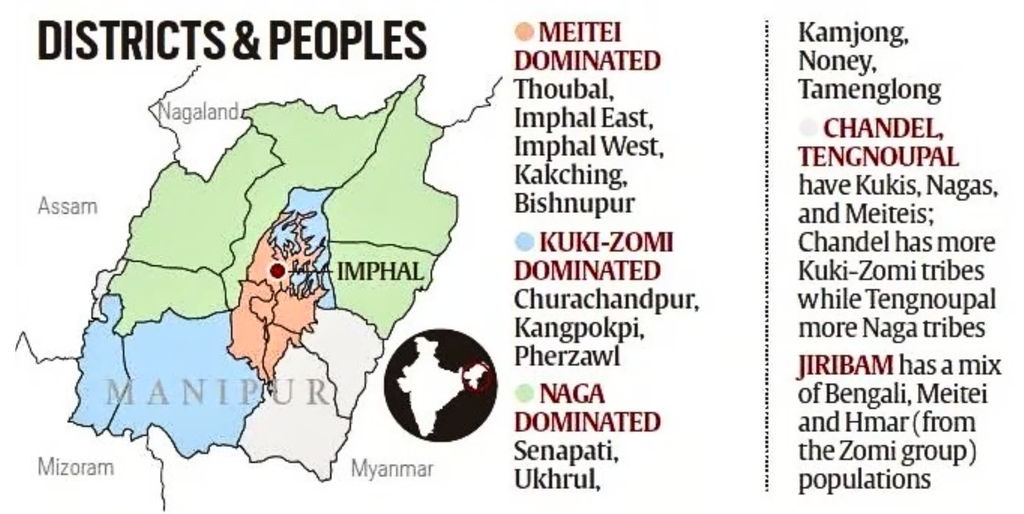
Manipur’s social geography broadly comprises:
- Meiteis: Constitute ~53% of the state’s population, largely Hindu and non-tribal. They inhabit the Imphal Valley and dominate the legislature and bureaucracy. They have long sought Scheduled Tribe (ST) status to access forest land and government benefits in hill areas.
- Kuki-Zo Tribals: A cluster of tribes (Kuki, Zo, Hmar, Mizo-related groups) with ethnic linkages extending into Mizoram and Myanmar’s Chin region. They inhabit the southern and western hill districts. Their demand for a separate Kukiland / Zomi homeland carved out of Manipur has intensified after the 2023 violence. Many allege they face existential threats from Meitei ST demands and state-backed evictions from “reserved forests.”
- Nagas: Comprising multiple tribes (Tangkhul, Mao, Maram, Zeme, etc.), Nagas dominate the northern and eastern hill districts. They have historically pursued Naga political sovereignty through bodies like NSCN (IM) and share contested border territory with both Meiteis and Kukis.
The valley accounts for only about one-tenth of Manipur’s territory but accommodates most of its population. The hills, inhabited predominantly by Scheduled Tribes, possess special land protections. This valley-hill divide has turned questions of land, representation and identity into zero-sum political contests.
Evolution of the Conflict:
- The 2023 High Court order on Scheduled Tribe status for Meiteis was the proximate trigger of violence in Manipur, as tribal groups feared loss of their protected reservations in jobs, education, and land.
- Presently, Manipur is no longer confronting only a bipolar Meitei-Kuki conflict, but an ongoing conflict between the Kuki and Naga communities in Manipur has escalated into a triangular ethnic-security crisis.
Structural Drivers behind the Conflict in Manipur:
- ST Status demand of Meiteis: The 2023 Manipur HC order on Meitei ST status shattered the post-independence compact that gave tribal communities exclusive land and job protections in the hills, while keeping Meiteis confined to the valley.
- Weak hill governance: Manipur’s hill areas are protected by Article 371C, which provides for a Hill Areas Committee and a special responsibility for the Governor. However, the State’s Autonomous District Councils do not enjoy the extensive constitutional powers available to Sixth Schedule councils.
- Proliferation of armed groups: Meitei, Naga and Kuki insurgent organisations coexist with village volunteers and armed civilian groups. Weapons looted since 2023, weak enforcement of ceasefire conditions and community-based mobilisation have blurred the line between insurgency and ethnic vigilantism.
- Land and demographic anxieties: Traditional landholding systems, protected forests, evictions and the absence of widely accepted land records have created rival narratives of encroachment and dispossession.
- Myanmar linkage: The civil war in Myanmar has generated refugee flows and facilitated the movement of arms, narcotics and insurgent cadres across a difficult border. Ethnic kinship across the border further complicates security management.
- Governance and trust deficit: Perceptions of partisan policing, segregated settlements and ineffective administration have reduced confidence in the State. Difficult terrain and poor road connectivity also delay the response of security forces.
NRC-Census Controversy:
Several organisations have demanded an updated National Register of Citizens before the Census, citing illegal immigration. However, the two exercises serve different purposes:
- The Census is a confidential enumeration of the population under the Census Act, 1948;
- Citizenship determination and the NRC operate under the Citizenship Act, 1955 and related rules.
Conflating them could deepen ethnic profiling and exclusion. Any citizenship-verification exercise must therefore follow transparent legal procedures, provide documentary flexibility and guarantee appeals and judicial review.
Implications of the conflict:
- Persistent violence may undermine free and fair elections in hill constituencies.
- Withdrawal of Naga political support could destabilise the governing coalition.
- Inter-community violence may derail the Naga peace process and Kuki-Zo dialogue.
- Territorial segregation could become permanent, weakening Manipur’s social and administrative unity.
- Displacement, road blockades and disruption of the Moreh trade corridor undermine India’s Act East Policy.
- Armed ethnic mobilisation creates opportunities for insurgency, narcotics trafficking and cross-border criminal networks.
Way Forward:
- Establish a neutral unified security command, recover illegal weapons and ensure equal protection for all communities.
- Independently investigate recent killings while avoiding collective attribution of crimes to entire communities.
- Conduct strict, transparent monitoring of all ceasefire and Suspension of Operations camps.
- Initiate a Centre-mediated dialogue involving Meitei, Naga and Kuki-Zo representatives, women’s groups and traditional institutions.
- Create an impartial commission for village boundaries, customary land and forest rights disputes.
- Strengthen Article 371C institutions and examine greater legislative, financial and administrative autonomy for hill councils through consensus.
- Ensure safe return or voluntary resettlement of internally displaced persons, accompanied by livelihood support and community reconciliation.
- Improve border surveillance and road connectivity while creating a humane, legally regulated mechanism for refugees from Myanmar.
- Consider negotiated power-sharing arrangements that guarantee meaningful participation of all major communities in the executive, legislature and security institutions.
Durable peace requires neutral enforcement of law, meaningful hill autonomy, inter-ethnic dialogue and constitutional power-sharing, turning Manipur’s diversity from a source of insecurity into a framework for coexistence.
Key Constitutional & Statutory Provisions:
| Article 355 mandates the Union to protect states from external aggression and internal disturbances. It serves as a directive obligation and forms a basis for Central intervention (such as sending paramilitary forces) without immediately imposing President’s Rule under Article 356. |
| Article 356 authorises the President to impose President’s Rule on a state if its government cannot function according to constitutional provisions. |
| 5th vs 6th Schedule: Tribal areas of Manipur’s hills are NOT under the 6th Schedule (unlike Assam, Meghalaya, Mizoram). This is a key grievance as Kuki-Zo tribals demand the 6th Schedule or equivalent autonomous council protection. |
| Article 371(C): Provides special provisions to preserve the cultural, social, and administrative identity of the tribal communities in the hilly parts of Manipur. The President is empowered to form the Hill Areas Committee (HAC) of MLAs from designated hill areas in Manipur to oversee policy and development, protecting tribal interests.The Governor is given special responsibility to ensure the proper functioning of this committee. The Governor is required to report annually (or as requested) to the President regarding the administration of the hill areas. |
| The Inner Line Permit (ILP) regime was officially extended to Manipur in 2019, primarily to regulate the entry of outsiders and protect the indigenous population. ILP does not resolve and is not designed to address the underlying conflicts between the indigenous communities. |
| AFSPA, 1958: The Armed Forces (Special Powers) Act remains in force in parts of Manipur to maintain security. It grants armed forces special powers but is seen by tribal groups as enabling impunity. |
UPSC PYQ 2025
Q. What are the major challenges to internal security and the peace process in the North-Eastern States? Map the various peace accords and agreements initiated by the government in the past decade. (15 M)
Source: https://anantamias.com/current-affairs/manipurs-widening-ethnic-conflict-naga-kuki-fault-line/
India and Belgium ramp up Bilateral Defence Cooperation
Why in News?
India and Belgium have significantly expanded their bilateral relationship during Belgian Prime Minister Bart De Wever’s visit to India, with new initiatives covering defence, trade, law enforcement, emerging technologies and maritime security.
The visit signals an attempt to transform a relationship historically centred on diamonds and commerce into a broader strategic and technology partnership anchored in the India-EU ties.
| UPSC Relevance: GS-2 International Relations: Bilateral relations Prelims: Location of Belgium; European Union Mains: India’s engagement with Belgium |
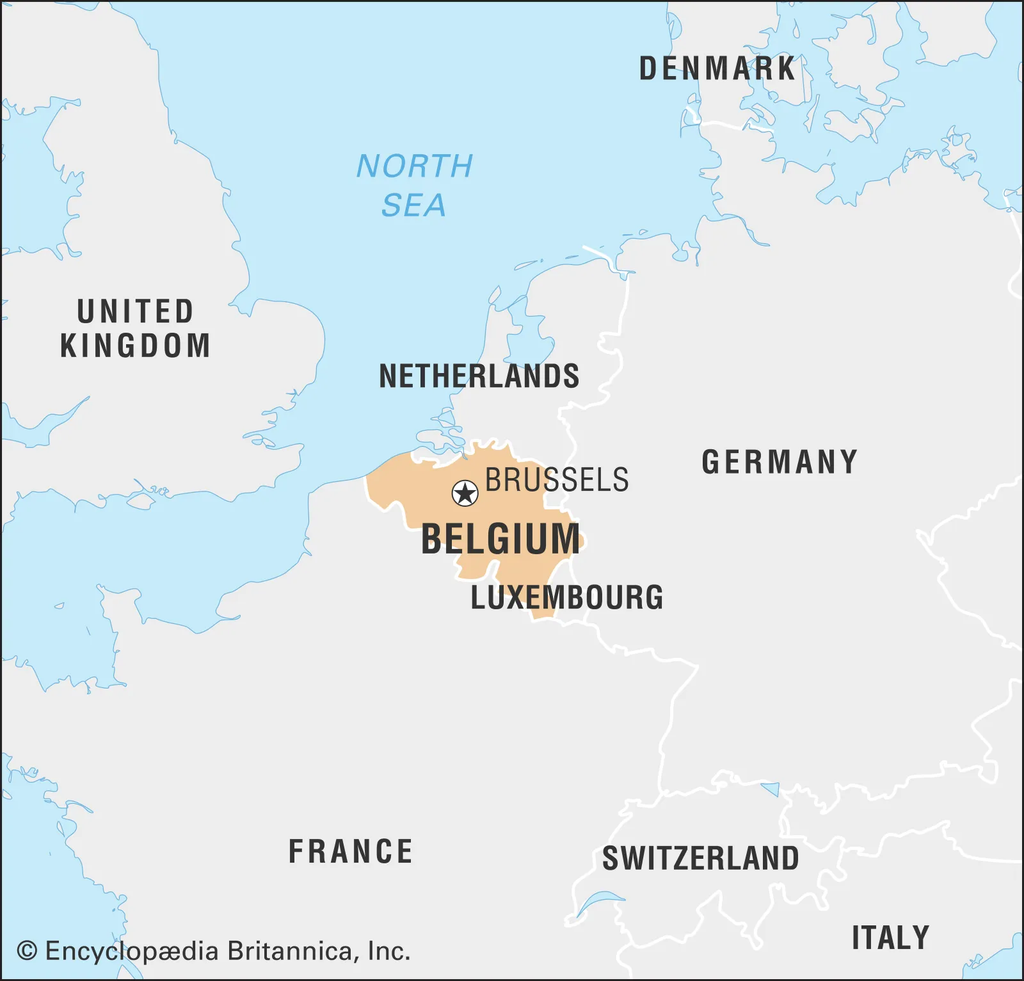
Major Outcomes:
1. Defence and Security:
- The two countries concluded:
- a Letter of Intent between their Defence Ministries, establishing a framework for staff talks, training, research and defence-industrial cooperation;
- an MoU between the Belgian Security and Defence Industry and the Society of Indian Defence Manufacturers; and
- an MoU between India’s CBI and Belgium’s Federal Police to combat cybercrime, transnational organised crime and track fugitives.
- Several business-level partnerships covering defence manufacturing (including the reported production of Belgian rocket systems in India) are also expected. These can support India’s objectives of defence indigenisation, co-production and integration into global supply chains.
- India will appoint a resident Defence Attaché in Brussels, while Belgium has appointed one in New Delhi. Cooperation will also include military education, high-level visits, emerging technologies and maritime security. A Belgian frigate is scheduled to visit India in late 2026.
- Belgium reportedly assured India that it would not extend defence technology or assistance to Pakistan. While politically significant, it is not a formal, legally binding restriction.
2. Trade and investment:
- India and Belgium set a target to double their current $13 billion bilateral trade over the next five years. The proposed collaboration between Belgium’s sovereign investment institution (SFPIM) and India’s NIIF could support an Indo-Belgian investment corridor.
- The two sides launched the India-Belgium Investment Fast-Track Mechanism, an investment-facilitation mechanism. It will help businesses resolve regulatory bottlenecks and facilitate two-way investments.
- The partnership will benefit from the India-EU Free Trade Agreement, whose negotiations were concluded in January 2026. However, early implementation and completion of the Investment Protection and Geographical Indications agreements remain important.
3. Counterterrorism and Global issues:
- Belgium condemned the 2025 Pahalgam terrorist attack and supported India’s campaign against cross-border terrorism. The two countries will explore a Joint Working Group on Counterterrorism, including cooperation through the UN sanctions regime and FATF.
- On Ukraine and West Asia, both sides favoured dialogue and diplomacy, adherence to international law and the UN Charter, and the protection of maritime routes and unimpeded commercial shipping.
Strategic Importance of Belgium for India:
- Gateway to the European Union: Brussels hosts the principal institutions of the European Union and NATO. Stronger relations with Belgium can therefore enhance India’s engagement with Europe on defence, technology, trade and global governance.
- Defence industrial capabilities: Belgium possesses specialised capabilities in ammunition, rockets, aerospace components, maritime systems and advanced manufacturing. Co-production in India can complement Make in India and Atmanirbhar Bharat, while giving Belgian firms access to India’s large defence market.
- Technology and green transition: Belgium is home to IMEC (Interuniversity MicroElectronics Centre), a globally important semiconductor research centre. The two countries intend to connect IMEC with Indian semiconductor firms, universities, C-DAC and the ChipIN Centre. The Cooperation can be extended to cover:
- green hydrogen and energy storage
- offshore wind and renewable energy
- pharmaceuticals and biotechnology
- critical-mineral refining and recycling
- artificial intelligence and start-ups; and
- space and astronomical research.
- Maritime and logistics cooperation: The Port of Antwerp-Bruges is one of Europe’s leading port and logistics hubs. Belgian expertise in ports, dredging and offshore infrastructure can support Sagarmala, port modernisation and India-Europe connectivity.
- Traditional economic links: Antwerp’s diamond industry has deep connections with Mumbai and Surat. The challenge is to preserve these traditional links while diversifying trade into technology-intensive and sustainable sectors.
Historical and Multilateral Dimensions:
- Belgium was among the first European countries to establish diplomatic relations with independent India in 1947. The two countries will mark the 80th anniversary of diplomatic relations in 2027.
- The leaders also honoured more than 9000 Indian soldiers who died in the Flanders Fields during the First World War, reflecting a significant but under-recognised historical connection.
- Belgium reiterated support for India’s permanent membership of a reformed UN Security Council. Both countries also agreed to support each other’s candidature for non-permanent UNSC membership: India for 2028-29 and Belgium for 2037-38.
Challenges:
- Defence announcements must translate into commercially viable technology transfer and production.
- Differences over intellectual property, export controls and localisation may constrain co-development.
- EU sustainability and regulatory requirements could affect Indian exports.
- Diamond-dominated trade needs greater diversification.
- India and Belgium may differ on the framing of the Ukraine conflict and relations with Russia.
- Reported private-sector agreements require clear timelines, procurement commitments and end-use safeguards.
The visit marks the transition of India-Belgium ties from a predominantly commercial relationship to a multi-dimensional strategic partnership. Defence co-production, semiconductors, green technologies, ports and law-enforcement cooperation offer substantial complementarities.
Effective implementation can also make Belgium an important pillar of India’s wider engagement with the European Union and its strategy of diversifying defence and technology partnerships.
Source: https://anantamias.com/current-affairs/india-and-belgium-ramp-up-bilateral-defence-cooperation/
India’s Youth Power: An Electoral Force Still in the Making
Context:
India’s youth have acquired unprecedented political visibility. Leaders are increasingly visiting campuses and adopting the vocabulary and digital platforms associated with Generation Z, those broadly aged 14-29 in 2026.
This engagement reflects both recognition of India’s demographic potential and political anxiety generated by recent youth-led protests over examinations, recruitment and employment. However, high visibility has not yet converted young people into a coherent electoral constituency.
| UPSC Relevance: GS-1 Indian Society: Demography; GS-2 Polity and Governance Mains: Essay: India’s Youth Power; Reaping Demographic Dividend |
India’s Demographic Advantage:
- India has one of the world’s largest youth populations, with nearly 65% of its population below 35 years. Around 23% of the electorate belongs to the 18-29 age group, giving young voters the numerical capacity to influence closely contested elections.
- The Union government describes them as the Amrit Peedhi, central to achieving Viksit Bharat by 2047. Major initiatives include:
- National Education Policy, 2020
- Skill India and PM Kaushal Vikas Yojana
- Startup India and MUDRA
- Apprenticeship and internship programmes
- National Service Scheme and MY Bharat; and
- the proposed National Youth Policy, 2026
The proposed National Youth Policy focuses on education, employment readiness, entrepreneurship, health, sports, environmental action, leadership and volunteerism.
The Persistent Youth Deficit:
- A considerable gap persists between educational credentials, employable skills and available opportunities.
- A NITI Aayog report estimates that about 8.7 crore people aged 15-29 are not in education, employment or training (NEET).
- NEET also includes people outside the labour force, particularly those engaged in unpaid domestic work. Indeed, around 88% of this NEET category is reportedly involved in domestic duties, revealing a strong gender dimension.
Other concerns include:
- unemployment among educated youth
- mismatch between academic courses and industry requirements
- repeated examination delays, cancellations and paper leaks
- dependence on precarious gig and informal employment
- regional disparities in access to education and jobs
- inadequate mental-health support; and
- automation and artificial intelligence disrupting entry-level employment.
Thus, India’s demographic dividend could become a source of democratic and social stress if youthful aspirations remain unfulfilled.
Why has a Unified Youth Vote not Emerged?
- Heterogeneous social identities: Unlike age, caste, community, religion and gender are embedded in family and local social structures. Young voters frequently vote as members of these established groups rather than primarily as “youth”. E.g., A young woman in rural Bihar, an engineering graduate in Bengaluru, a farmer’s son in Punjab and a tribal student in Manipur may share an age category but not the same political priorities.
- Absence of a common youth agenda: Employment and education are shared concerns, but their manifestations differ across States. Some young voters prioritise government recruitment, while others focus on entrepreneurship, reservation, migration, agricultural incomes, regional identity or cultural questions.
- Digital engagement does not ensure electoral mobilisation: Political discussion among young people increasingly occurs through social media. However, online visibility does not necessarily translate into voter registration, turnout, party membership, sustained collective organisation, or a common political preference. Digital politics can also produce echo chambers, misinformation, fleeting outrage and issue-based mobilisation that disappears before polling day.
- Lack of independent political organisation: Farmers, workers and caste groups possess unions, associations and established leadership structures. Young people lack comparable organisations capable of negotiating a common electoral agenda.
- Limited youth representation: Political parties court young voters but remain cautious about giving them tickets or decision-making positions. Family connections, financial resources and organisational seniority continue to influence candidate selection. Youth are therefore more visible as campaign workers and digital audiences than as political representatives.
- Women provide a useful contrast. Benefits such as housing, toilets, cooking gas, electricity and direct cash transfers create identifiable material gains capable of producing a cross-cutting “women’s vote”. Youth-oriented schemes have not yet generated an equally clear and universal experience.
Strengthening Youth Participation:
- Create sufficient productive and formal employment, rather than treating skilling as a substitute for job creation.
- Link colleges with apprenticeships, local industry and transparent placement outcomes.
- Provide childcare, safe transport and flexible employment to help young women move out of the NEET category.
- Ensure time-bound recruitment examinations through accountable testing institutions.
- Expand the Election Commission’s SVEEP, Electoral Literacy Clubs and campus enrolment drives.
- Promote digital and media literacy to counter misinformation and political manipulation.
- Institutionalise youth councils and consultations in local governments, legislatures and public-policy processes.
- Encourage internal democracy in political parties and greater youth candidature.
- Publish disaggregated data on youth turnout, employment and programme outcomes by gender, region and social group.
- Move from symbolic digital outreach to continuous, two-way political engagement.
India’s young population is already a major social and economic force, but it is not yet a stable electoral bloc.
The real test is whether political institutions treat young citizens merely as campaign audiences or as stakeholders entitled to jobs, representation and accountability. Only then can the Amrit Peedhi evolve from an elusive vote into an informed and constructive democratic force.
Source: https://anantamias.com/current-affairs/indias-youth-power-an-electoral-force-still-in-the-making/
Forging Consensus: India at 26th SCO Summit
Why in News?
Indian Prime Minister attended the 26th Shanghai Cooperation Organisation (SCO) Summit in Bishkek, Kyrgyzstan, held on September 1, 2026. The summit marked the organisation’s 25th anniversary and adopted the Bishkek Declaration along with 27 other documents.
The meeting took place amid the U.S.-Israel conflict with Iran, the continuing Ukraine war, sanctions on Russia, tariff tensions and disruption of maritime and energy routes. These developments have imposed considerable economic and strategic costs on SCO members.
| UPSC Relevance: GS-2 International Relations: International Institutions Prelims: Shanghai Cooperation Organisation Mains: India’s engagement with SCO: Opportunities & Challenges |
About the SCO- Genesis and Evolution:
- Precursor (Shanghai Five): Formed in 1996 by China, Russia, Kazakhstan, Kyrgyzstan, and Tajikistan to reduce border tensions, settle post-Soviet frontier disputes, and promote mutual demilitarisation.
- Established in 2001, the SCO is a Eurasian organisation concerned with regional security, economic cooperation and connectivity.
- Charter: Signed in 2002 and entered into force in 2003, providing the institutional and legal framework.
- Membership Expansion: India and Pakistan joined in 2017, Iran in 2023, and Belarus in 2024.
- Current Composition: 10 full members (China, Russia, India, Pakistan, Kazakhstan, Kyrgyzstan, Tajikistan, Uzbekistan, Iran, Belarus), 2 Observers (Afghanistan, Mongolia), alongside 15 Dialogue Partners.
- Guiding Doctrine (Shanghai Spirit): Emphasises mutual trust, mutual benefit, equality, consultation, respect for cultural diversity, and common development.
- Non-bloc character: SCO formally follows a non-aligned, non-confrontational approach and declares that it is not directed against any other state or organisation.
- Its principal counterterrorism body is the Regional Anti-Terrorist Structure (RATS), headquartered in Tashkent.
- Geographic & Demographic Weight: Represents over 3.4 billion people (~40% of the world population), spans over 80% of Eurasia, and accounts for around one-fourth of global GDP. It encompasses major energy exporters, manufacturing hubs, nuclear powers, and transit states.
Major Outcomes of the 26th SCO Summit:
Held on 1 September 2026, the summit marked the 25th anniversary of the SCO. Its theme was 25 Years of the SCO: Together for Sustainable Peace, Development and Prosperity.
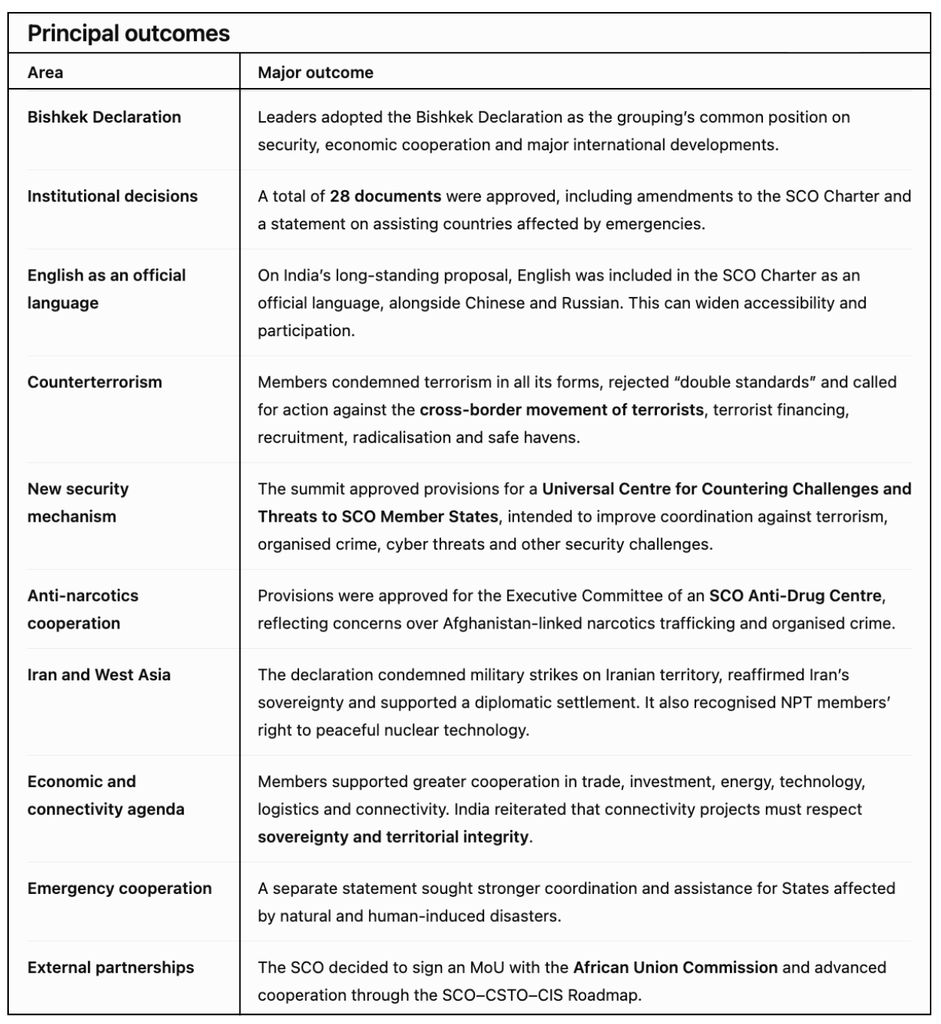
India’s Agenda at SCO: Security, Connectivity and Opportunity
PM Modi outlined India’s approach through three pillars:
- Security: India called for dismantling the entire terrorism ecosystem comprising financing, recruitment, radicalisation, safe havens and state support. India also stressed cooperation against narcotics trafficking, organised crime and instability in Afghanistan.
- Connectivity: India supported trade and transport corridors that facilitate economic integration but insisted that such projects must respect sovereignty and territorial integrity. This reiterates India’s objection to the China–Pakistan Economic Corridor passing through Pakistan-occupied Kashmir.
- Opportunity: India called for SCO cooperation to generate tangible benefits in trade and entrepreneurship, agriculture and technology, energy and critical minerals, start-ups and innovation, education and tourism, and people-to-people exchanges.
India-supported initiatives such as the SCO Start-up Forum, Young Scientists’ Forum, Young Authors’ Conclave and Civilisation Dialogue Forum were also highlighted.
Multi-Dimensional Challenges:
- Bilateral Frictions: Persistent India-China border standoffs and India-Pakistan cross-border terrorism limit deep consensus and obstruct meaningful security cooperation.
- China’s dominance: China possesses overwhelming economic influence within the organisation and uses the SCO to promote the Belt and Road Initiative. India must participate without endorsing projects that violate its sovereignty.
- Divergent definitions of terrorism: Members differ on the designation of terrorist organisations and frequently prioritise regime security or separatism over a universal, non-discriminatory approach to terrorism.
- Economic Integration Deficit: Despite massive resource potential, SCO has no free-trade area, common market or operational development bank. Economic activity is driven primarily by bilateral relationships rather than SCO-wide integration.
- Connectivity Bottlenecks: Pakistan’s denial of overland transit to India, instability in Afghanistan, sanctions affecting Iran and Russia, and underdeveloped transport infrastructure constrain continental corridors.
- Implementation deficit: The SCO frequently produces broad declarations, but lacks strong enforcement mechanisms. Its credibility depends upon translating commitments into measurable action.
- Anti-Western Perception: Inclusion of Russia, China, Iran and Belarus reinforces external perceptions of the SCO as an anti-Western grouping. This complicates India’s multi-aligned diplomacy.
- Central Asian Vulnerabilities: Water scarcity, glacier retreat, Aral Sea degradation, unemployment, radicalisation and transboundary water disputes threaten long-term regional stability.
Opportunities for India:
Reviving India-Central Asia Relations:
- The summit provided India an opportunity to revive engagement with the Central Asian Republics, which had received relatively limited attention amid other foreign-policy priorities. Central Asia is important for India because of its:
- hydrocarbons, uranium and critical minerals
- proximity to Afghanistan
- vulnerability to terrorism and narcotics trafficking
- strategic location at the centre of Eurasia
- potential as a market for pharmaceuticals, digital services and agricultural products.
- However, Pakistan’s denial of overland access remains a major constraint. India must therefore operationalise alternative routes through Iran’s Chabahar Port and the International North-South Transport Corridor.
Link with India’s BRICS Chairmanship:
- Several SCO members (including China, Russia and Iran) are also members of BRICS. Consultations in Bishkek were therefore significant for building consensus ahead of the BRICS Summit hosted by India. Consensus may prove difficult because of:
- Iran-UAE tensions
- differences over the Ukraine and West Asian conflicts
- varying relations with the United States
- disagreements over sanctions and global governance.
India can play the role of a bridge while preserving its strategic autonomy.
Way Forward for India:
- Maintain active engagement rather than leaving Eurasian institutions to China and Pakistan.
- Seek measurable cooperation through RATS on terrorist financing, safe havens and narcotics networks.
- Develop independent partnerships with individual Central Asian republics.
- Accelerate Chabahar Port and INSTC connectivity.
- Promote digital customs, air-freight corridors and resilient payment mechanisms.
- Expand cooperation in energy, critical minerals, pharmaceuticals and digital public infrastructure.
- Use the SCO, BRICS and India-Central Asia Dialogue in a complementary manner.
- Preserve principled positions on sovereignty, terrorism and strategic autonomy.
The Bishkek Summit reflected a Eurasian region under pressure from wars, sanctions, tariffs and disrupted connectivity. These divisions make consensus difficult, but they also increase the SCO’s importance for India.
Sustained SCO engagement can strengthen India’s Central Asian presence, diversify its partnerships and provide it with an important voice in the evolving Eurasian order.
Source: https://anantamias.com/current-affairs/forging-consensus-india-at-26th-sco-summit/
2026 Ramon Magsaysay Awards
Why in News?
The Ramon Magsaysay Award Foundation has announced three recipients for 2026: Tommy Koh of Singapore, Bo Kyi of Myanmar and Runa Khan of Bangladesh for their contributions to international law, human rights and inclusive development.
| UPSC Relevance: GS-1 Art and Culture: Awards and Honours; Miscellaneous Prelims: Ramon Magsaysay Award 2026 |

The 2026 Awardees:
1. Tommy Koh: Architect of the Constitution for the Oceans
- The Singaporean lawyer and diplomat was recognised for advancing international dialogue, cooperation and the rule of law. He presided over the Third UN Conference on the Law of the Sea, which resulted in the adoption of the UN Convention on the Law of the Sea (UNCLOS), 1982.
| UNCLOS establishes the legal framework governing oceans, including: Territorial sea extending up to 12 nautical miles Exclusive Economic Zone extending up to 200 nautical miles Navigation, marine resources and continental shelves; and Mechanisms for resolving maritime disputes. It is therefore described as the “Constitution for the Oceans.” |
2. Bo Kyi: Defending Myanmar’s Political Prisoners
- A former political prisoner, Bo Kyi spent around seven years in jail for resisting Myanmar’s military regime. In 2000, he co-founded the Assistance Association for Political Prisoners, which:
- documents political detentions and human-rights violations
- assists prisoners and their families; and
- keeps international attention focused on political repression in Myanmar.
- His work highlights the role of civil society in preserving evidence, supporting victims and demanding democratic accountability under authoritarian rule.
3. Runa Khan: Humanitarian Service in Climate-Vulnerable Bangladesh
- Runa Khan founded Friendship in 2002 to assist poor and geographically isolated communities, particularly those living in Bangladesh’s riverine and climate-vulnerable areas. The organisation combines healthcare, education, women’s empowerment, livelihood generation, disaster preparedness and climate adaptation.
- Her work demonstrates how humanitarian assistance can move beyond temporary relief towards community resilience and social inclusion.
About the Ramon Magsaysay Award:
- The Ramon Magsaysay Award Foundation was established in 1957 by the Rockefeller Brothers Fund with the concurrence of the Philippine government.
- The first awards were presented in 1958.
- It commemorates Ramon Magsaysay, the seventh President of the Philippines, known for integrity in public service.
- Often called Asia’s Nobel Prize, it recognises transformative leadership and selfless service to the peoples of Asia.
- Awardees receive a medallion and certificate at a ceremony held in Manila.
- Since 2009, the award has not followed fixed categories, except Emergent Leadership.
- Emergent Leadership recognises individuals aged 40 or below and young organisations engaged in exceptional social work; it is supported by the Ford Foundation.
The three awardees show how individuals and civil-society institutions can complement governments in addressing transnational and developmental challenges.
Source: https://anantamias.com/current-affairs/2026-ramon-magsaysay-awards/
