Why in News?
The Union government told the Supreme Court it was willing to return vacant NEET-SS seats to Tamil Nadu’s in-service pool, while the qualifying-percentile reduction remained undecided.
- Tamil Nadu had earmarked 219 super-speciality seats for in-service candidates in the 2025-26 academic year.
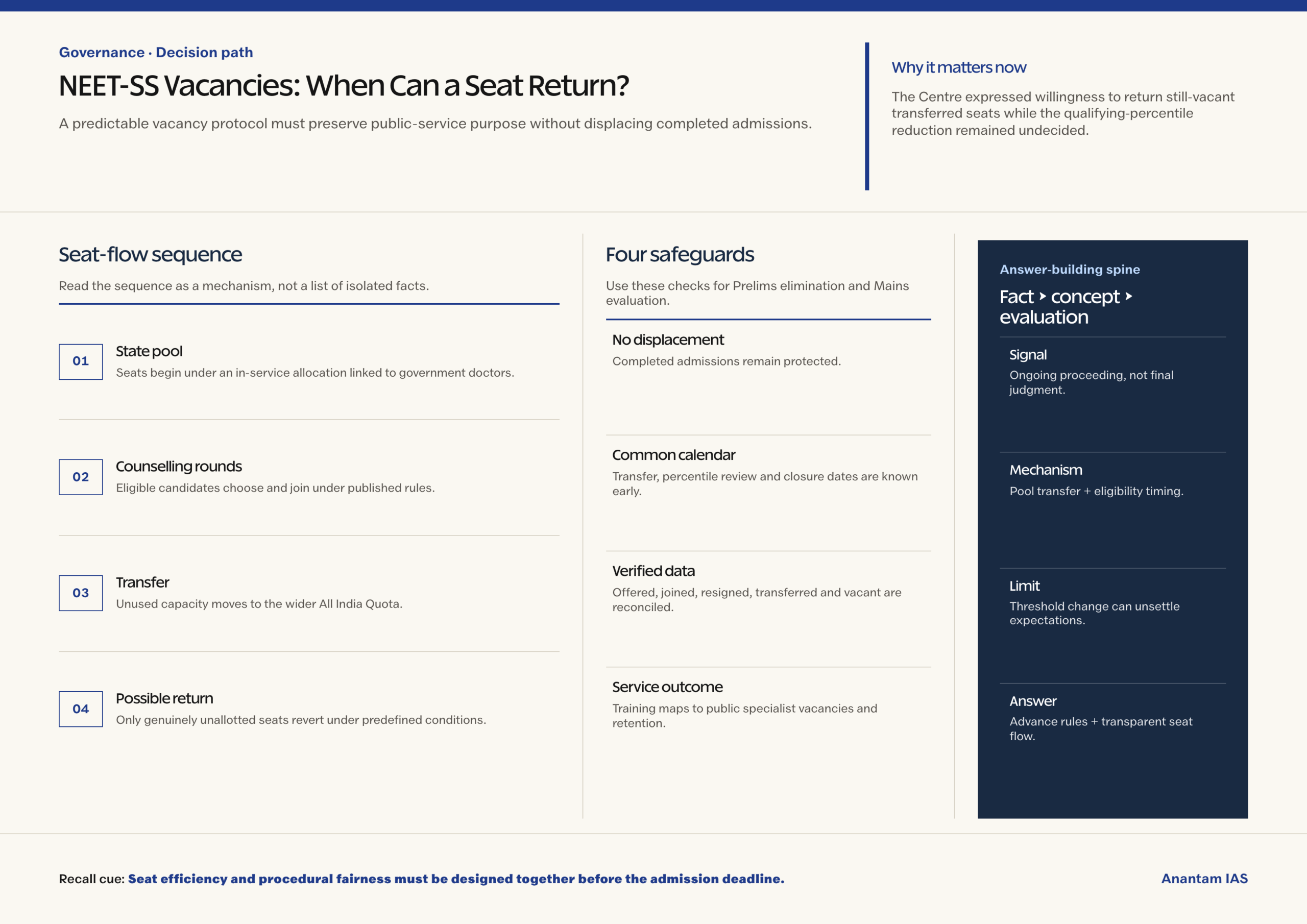
- After two counselling rounds, 68 candidates had joined and 152 vacant seats were diverted to the All India Quota.
- The Centre earlier said about 40 of those transferred seats remained vacant; Tamil Nadu’s medical officers sought their return.
- The Supreme Court listed the matter for 8 September to hear the extent of any qualifying-percentile reduction.
- The dispute is procedural and federal: it concerns when unused State-linked seats move to a national pool and whether they can return before the admission cycle closes.
- The Centre expressed willingness, but the report did not describe a final merits judgment or a settled percentile change.
UPSC Relevance
Prelims Relevance
- NEET-SS is the entrance examination for admission to super-speciality medical courses.
- A qualifying percentile is a relative threshold and differs from raw marks.
- The All India Quota pools seats for centralised counselling across participating institutions.
- In-service allocation can support retention of specialists in government health systems.
- Counselling rules must balance merit, equality, service needs and avoidance of seat wastage.
Mains Relevance
GS Paper 2
- Federal coordination in medical education and public-health workforce policy
- Judicial review of counselling design, equality and administrative timing
GS Paper 3
- Human-capital scarcity and efficient use of publicly funded specialist seats
Essay
- A scarce public seat has value only when selection rules remain fair and the trained specialist eventually serves a real health-system need.
Background and Context
Why States Reserve In-Service Seats
Government doctors often serve rural or difficult postings, and specialist training can strengthen the public system when return-of-service rules are credible.
- An in-service channel recognises prior public employment and can create a career path for doctors who remain within government facilities.
- The policy case is strongest where trained specialists return to mapped vacancies rather than leaving public service immediately after subsidised education.
- Transparent eligibility, service bonds and posting plans are needed so preference produces measurable public-health capacity rather than only individual benefit.
- National examination standards can coexist with State workforce policy, but counselling rules must specify how the two systems interact.
- States also need speciality-wise workforce evidence because reserving a seat has little public value if training does not correspond to vacancies, equipment and referral demand.
How Vacancies Move Between Pools
Admission calendars use successive rounds to prevent seats from remaining empty, yet transfers can collide with later eligibility changes or State claims.
- A State-linked seat may shift to the All India Quota after remaining unfilled, widening the candidate pool before the academic deadline.
- If the national pool also leaves seats vacant, returning them may preserve the original service purpose without displacing an already admitted candidate.
- The timing of a qualifying-percentile reduction matters because previously ineligible candidates may become eligible only after a transfer has occurred.
- Clear cut-off rules reduce litigation by stating when transfer becomes final, whether reversal is allowed and how candidates receive notice.
- A return mechanism should protect candidates who already secured seats through the receiving pool and identify only genuinely unallotted capacity for reversion.
Percentile Reduction Needs Guardrails
Lowering a threshold may prevent waste, but it must remain transparent, general and connected to training quality and patient safety.
- A percentile indicates a candidate’s position relative to the test population; lowering it expands eligibility without changing available seat capacity.
- The authority, evidence and timing for reduction should be published before the final counselling stages wherever practicable.
- Relaxation should not become an improvised response favouring one group after others relied on earlier rules and deadlines.
- Vacancy data must distinguish seats offered, joined, resigned, transferred and still available so courts and candidates assess the same factual position.
- Academic quality cannot be reduced to one threshold alone; curriculum, clinical exposure, supervision, assessment and hospital case mix also shape specialist competence.
The Health-System Test Comes After Admission
Counselling allocates training opportunity, but workforce policy succeeds only if specialist capacity reaches underserved public facilities after qualification.
- States should map seats to vacancy forecasts, referral burdens and infrastructure capable of supporting each super-speciality practice.
- Service obligations need fair duration, clear posting rules and working conditions that make retention feasible rather than punitive.
- Outcome review should track joining, course completion, public-service return and specialist retention, not only how many reserved seats were filled.
Way Forward
Use a Predictable Vacancy Protocol
The best design protects service objectives and merit through advance rules rather than emergency litigation near the academic deadline.
- Publish a common calendar for State pools, transfer, percentile review, mop-up rounds and final closure.
- Allow reversible transfers only under predefined conditions and without disturbing completed admissions.
- Link in-service preference to transparent public-service obligations and specialist workforce gaps.
- Release verified seat-flow dashboards that reconcile institutional, State and central counselling records.
Conclusion
- The dispute shows that seat efficiency and procedural fairness must be designed together; late changes can save capacity while unsettling legitimate expectations.
- A strong answer should connect federal roles, counselling timelines, percentile logic, public-service objectives and non-displacement safeguards.
UPSC Practice Questions
Prelims MCQ 1
With reference to medical counselling, consider the following statements:
- A qualifying percentile is identical to a fixed raw-mark threshold in every examination.
- The All India Quota uses a wider centralised counselling pool.
- An in-service channel can be linked to government workforce needs.
How many of the above statements are correct?
(a) Only one (b) Only two (c) All three (d) None
Answer: (b) Only two
Explanation:
Statements 2 and 3 are correct. A percentile describes relative position and is not inherently identical to a fixed raw score.
Prelims MCQ 2
Which vacancy rule best protects fairness?
(a) Unpublished case-by-case transfers (b) Predefined transfer and return conditions with verified seat data (c) Changing eligibility after every individual request (d) Keeping seats vacant regardless of eligible candidates
Answer: (b) Predefined transfer and return conditions with verified seat data
Explanation:
Advance, transparent rules reduce arbitrariness while allowing unused capacity to be managed without displacing completed admissions.
UPSC Mains Questions
- Medical-seat counselling is a problem of federal coordination as much as candidate selection. Examine with reference to vacant super-speciality seats.
- How can in-service medical reservations be designed to strengthen public-health capacity while preserving merit and procedural fairness?
Source: The Hindu.
Frequently Asked Questions
What did the Centre tell the Supreme Court?
It expressed willingness to return vacant transferred seats to Tamil Nadu’s in-service pool, while the extent of a qualifying-percentile reduction remained undecided.
Did the Court deliver a final judgment?
The report described an ongoing proceeding and a further hearing date, not a final merits judgment settling every counselling issue.
What is a qualifying percentile?
It is a relative performance threshold based on a candidate’s position within the test population, unlike a permanently fixed raw-mark cut-off.
Why have an in-service quota?
It can reward difficult public service and develop specialists for government facilities when eligibility, service obligations and posting plans are enforceable.
Why do vacant seats move to another pool?
Successive counselling rounds widen access and prevent scarce training capacity from being wasted before the academic cycle closes.
Tell Google you want more of this.
Add Anantam IAS as a preferred sourceOne tap, and this site shows up more often in your own Top Stories, AI Overviews and AI Mode. Remove it any time.