Why in News?
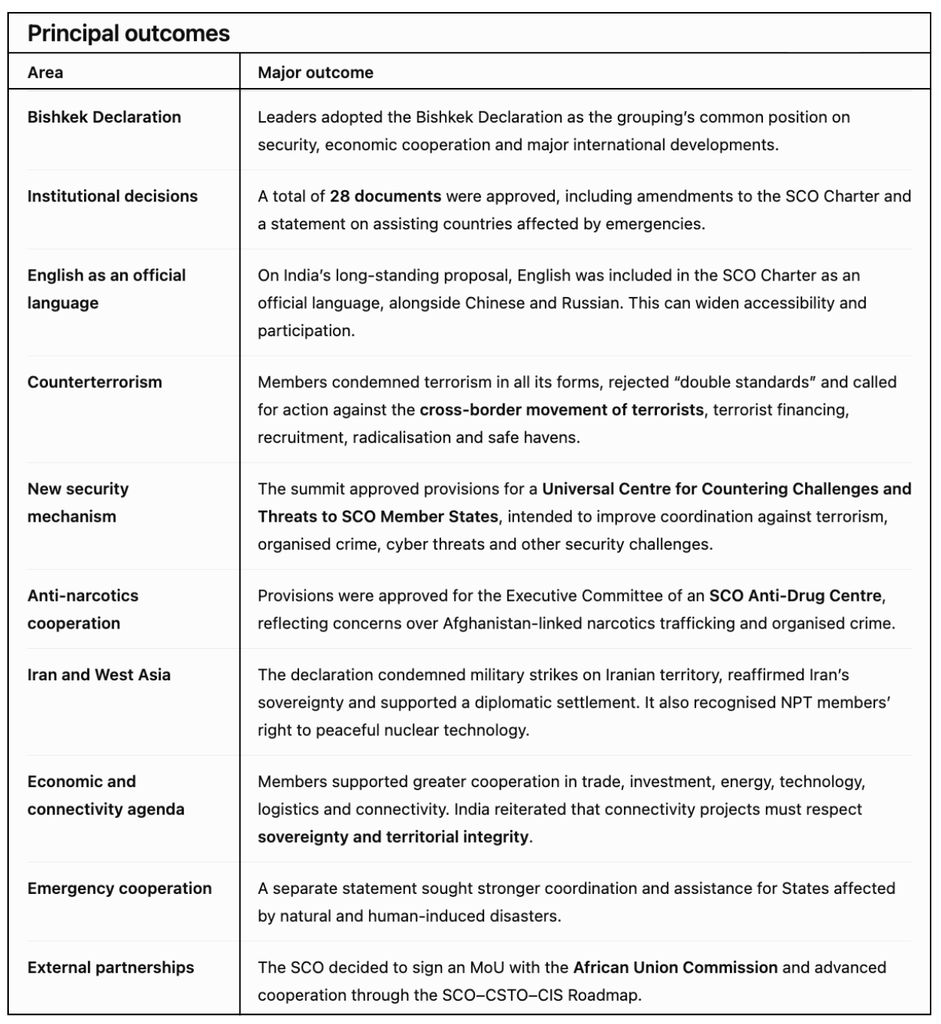
Indian Prime Minister attended the 26th Shanghai Cooperation Organisation (SCO) Summit in Bishkek, Kyrgyzstan, held on September 1, 2026. The summit marked the organisation’s 25th anniversary and adopted the Bishkek Declaration along with 27 other documents.
The meeting took place amid the U.S.-Israel conflict with Iran, the continuing Ukraine war, sanctions on Russia, tariff tensions and disruption of maritime and energy routes. These developments have imposed considerable economic and strategic costs on SCO members.
| UPSC Relevance: GS-2 International Relations: International Institutions Prelims: Shanghai Cooperation Organisation Mains: India’s engagement with SCO: Opportunities & Challenges |
About the SCO- Genesis and Evolution:
- Precursor (Shanghai Five): Formed in 1996 by China, Russia, Kazakhstan, Kyrgyzstan, and Tajikistan to reduce border tensions, settle post-Soviet frontier disputes, and promote mutual demilitarisation.
- Established in 2001, the SCO is a Eurasian organisation concerned with regional security, economic cooperation and connectivity.
- Charter: Signed in 2002 and entered into force in 2003, providing the institutional and legal framework.
- Membership Expansion: India and Pakistan joined in 2017, Iran in 2023, and Belarus in 2024.
- Current Composition: 10 full members (China, Russia, India, Pakistan, Kazakhstan, Kyrgyzstan, Tajikistan, Uzbekistan, Iran, Belarus), 2 Observers (Afghanistan, Mongolia), alongside 15 Dialogue Partners.
- Guiding Doctrine (Shanghai Spirit): Emphasises mutual trust, mutual benefit, equality, consultation, respect for cultural diversity, and common development.
- Non-bloc character: SCO formally follows a non-aligned, non-confrontational approach and declares that it is not directed against any other state or organisation.
- Its principal counterterrorism body is the Regional Anti-Terrorist Structure (RATS), headquartered in Tashkent.
- Geographic & Demographic Weight: Represents over 3.4 billion people (~40% of the world population), spans over 80% of Eurasia, and accounts for around one-fourth of global GDP. It encompasses major energy exporters, manufacturing hubs, nuclear powers, and transit states.
Major Outcomes of the 26th SCO Summit:
Held on 1 September 2026, the summit marked the 25th anniversary of the SCO. Its theme was 25 Years of the SCO: Together for Sustainable Peace, Development and Prosperity.
India’s Agenda at SCO: Security, Connectivity and Opportunity
PM Modi outlined India’s approach through three pillars:
- Security: India called for dismantling the entire terrorism ecosystem comprising financing, recruitment, radicalisation, safe havens and state support. India also stressed cooperation against narcotics trafficking, organised crime and instability in Afghanistan.
- Connectivity: India supported trade and transport corridors that facilitate economic integration but insisted that such projects must respect sovereignty and territorial integrity. This reiterates India’s objection to the China–Pakistan Economic Corridor passing through Pakistan-occupied Kashmir.
- Opportunity: India called for SCO cooperation to generate tangible benefits in trade and entrepreneurship, agriculture and technology, energy and critical minerals, start-ups and innovation, education and tourism, and people-to-people exchanges.
India-supported initiatives such as the SCO Start-up Forum, Young Scientists’ Forum, Young Authors’ Conclave and Civilisation Dialogue Forum were also highlighted.
Multi-Dimensional Challenges:
- Bilateral Frictions: Persistent India-China border standoffs and India-Pakistan cross-border terrorism limit deep consensus and obstruct meaningful security cooperation.
- China’s dominance: China possesses overwhelming economic influence within the organisation and uses the SCO to promote the Belt and Road Initiative. India must participate without endorsing projects that violate its sovereignty.
- Divergent definitions of terrorism: Members differ on the designation of terrorist organisations and frequently prioritise regime security or separatism over a universal, non-discriminatory approach to terrorism.
- Economic Integration Deficit: Despite massive resource potential, SCO has no free-trade area, common market or operational development bank. Economic activity is driven primarily by bilateral relationships rather than SCO-wide integration.
- Connectivity Bottlenecks: Pakistan’s denial of overland transit to India, instability in Afghanistan, sanctions affecting Iran and Russia, and underdeveloped transport infrastructure constrain continental corridors.
- Implementation deficit: The SCO frequently produces broad declarations, but lacks strong enforcement mechanisms. Its credibility depends upon translating commitments into measurable action.
- Anti-Western Perception: Inclusion of Russia, China, Iran and Belarus reinforces external perceptions of the SCO as an anti-Western grouping. This complicates India’s multi-aligned diplomacy.
- Central Asian Vulnerabilities: Water scarcity, glacier retreat, Aral Sea degradation, unemployment, radicalisation and transboundary water disputes threaten long-term regional stability.
Opportunities for India:
Reviving India-Central Asia Relations:
- The summit provided India an opportunity to revive engagement with the Central Asian Republics, which had received relatively limited attention amid other foreign-policy priorities. Central Asia is important for India because of its:
- hydrocarbons, uranium and critical minerals
- proximity to Afghanistan
- vulnerability to terrorism and narcotics trafficking
- strategic location at the centre of Eurasia
- potential as a market for pharmaceuticals, digital services and agricultural products.
- However, Pakistan’s denial of overland access remains a major constraint. India must therefore operationalise alternative routes through Iran’s Chabahar Port and the International North-South Transport Corridor.
Link with India’s BRICS Chairmanship:
- Several SCO members (including China, Russia and Iran) are also members of BRICS. Consultations in Bishkek were therefore significant for building consensus ahead of the BRICS Summit hosted by India. Consensus may prove difficult because of:
- Iran-UAE tensions
- differences over the Ukraine and West Asian conflicts
- varying relations with the United States
- disagreements over sanctions and global governance.
India can play the role of a bridge while preserving its strategic autonomy.
Way Forward for India:
- Maintain active engagement rather than leaving Eurasian institutions to China and Pakistan.
- Seek measurable cooperation through RATS on terrorist financing, safe havens and narcotics networks.
- Develop independent partnerships with individual Central Asian republics.
- Accelerate Chabahar Port and INSTC connectivity.
- Promote digital customs, air-freight corridors and resilient payment mechanisms.
- Expand cooperation in energy, critical minerals, pharmaceuticals and digital public infrastructure.
- Use the SCO, BRICS and India-Central Asia Dialogue in a complementary manner.
- Preserve principled positions on sovereignty, terrorism and strategic autonomy.
The Bishkek Summit reflected a Eurasian region under pressure from wars, sanctions, tariffs and disrupted connectivity. These divisions make consensus difficult, but they also increase the SCO’s importance for India.
Sustained SCO engagement can strengthen India’s Central Asian presence, diversify its partnerships and provide it with an important voice in the evolving Eurasian order.
Tell Google you want more of this.
Add Anantam IAS as a preferred sourceOne tap, and this site shows up more often in your own Top Stories, AI Overviews and AI Mode. Remove it any time.