Why in News?
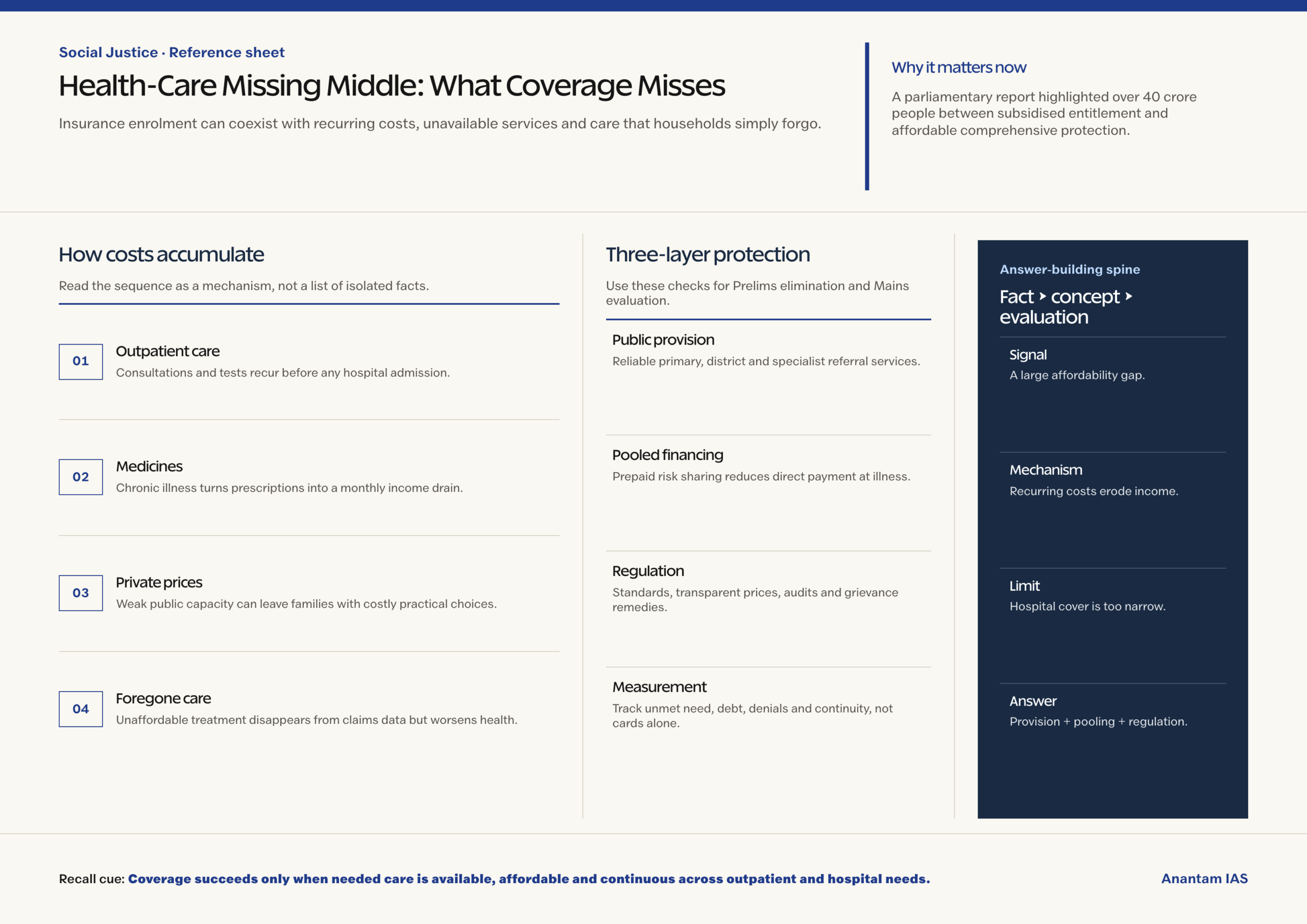
A parliamentary standing committee report highlighted more than 40 crore Indians in a health-care missing middle, exposed to recurring private costs without comprehensive financial protection.
- The committee linked vulnerability to private delivery of more than 60% of inpatient care and 70% of outpatient care.
- Medicines account for nearly 30% of current health expenditure, making chronic illness a repeated household cost rather than one hospital event.
- Government health expenditure was cited at 1.43% of GDP against the National Health Policy’s 2.5% target.
- The committee recommended stronger public infrastructure, national implementation of clinical-establishment regulation, quality standards and private-sector price transparency.
- Hospital insurance can reduce catastrophic cost but often leaves consultations, medicines, diagnostics, premiums, exclusions and co-payments outside effective protection.
- Affordability depends on public provision, pooled financing, price governance and primary care, not only possession of an insurance card.
UPSC Relevance
Prelims Relevance
- Out-of-pocket expenditure is paid directly by households at the point of receiving care.
- Current health expenditure covers recurring health goods and services rather than capital formation.
- PM-JAY primarily provides hospitalisation cover for eligible vulnerable households.
- The Clinical Establishments Act provides a framework for registration and minimum standards where adopted.
- Financial protection measures whether illness causes unaffordable spending or foregone care.
Mains Relevance
GS Paper 2
- Universal health coverage, public provision and equitable financial protection
- Regulation of private providers, medicines and diagnostic markets
GS Paper 3
- Household income erosion, productivity and health-related poverty
Essay
- A health system fails quietly when families avoid care or lose income month after month without ever appearing in catastrophic-spending statistics.
Background and Context
Who Forms the Missing Middle
These households may not qualify for fully subsidised protection, yet remain unable to absorb private premiums and repeated medical expenses safely.
- Income cut-offs create a boundary, but health vulnerability also depends on age, chronic disease, location, family size and available public facilities.
- Formal employment does not always guarantee comprehensive insurance, while informal workers may move between schemes, employers and uncovered periods.
- A family can appear above a poverty threshold before illness and fall into debt after medicines, tests, travel or repeated outpatient visits.
- The category is a policy lens rather than one permanent group; households can enter or leave it as work, health and eligibility change.
- Geography compounds income risk when public specialists are distant and transport, accommodation and lost wages become part of the real treatment cost.
Why Hospital Cover Is Not Enough
Many high-frequency costs occur before admission or without it, especially for non-communicable diseases requiring lifelong monitoring and treatment.
- Primary consultations, diagnostics and medicines determine whether disease is detected and controlled before expensive complications require hospital care.
- Insurance exclusions, waiting periods, co-payments and narrow networks can leave nominally covered households paying substantial amounts directly.
- Private hospitalisation can be far costlier than public care, but weak public capacity may leave families with little practical choice.
- Foregone care is another financial-protection failure: households may avoid tests or treatment because the expected cost is unaffordable.
- Late diagnosis then increases both medical severity and eventual spending, showing why prevention and primary care are fiscal protections as well as clinical services.
Coverage Has Three Layers
Effective protection combines service availability, pooled payment and regulation so an entitlement can translate into timely care at predictable cost.
- Public primary and district facilities provide a supply-side floor, reduce travel and create referral pathways for conditions needing specialist treatment.
- Pooled financing spreads risk across a population and protects households from paying the full cost when illness occurs.
- Price transparency and standard treatment rules can limit information asymmetry, unnecessary procedures and unpredictable billing in private facilities.
- Medicine policy must address procurement, generic quality, prescription practice, retail margins and antimicrobial stewardship together.
- Federal coordination is necessary because health delivery is primarily State-led while national schemes, standards, tax policy and pharmaceutical regulation influence household protection.
Why Better Data Changes Design
Income categories alone miss people who are formally covered but cannot reach a provider or afford exclusions and recurring outpatient care.
- Household surveys should separate unmet need, direct payments, borrowing, asset sales and income loss to reveal different forms of financial distress.
- Claims data can show denial and network gaps, while facility data reveals medicine shortages, waiting times and referral failure.
- Linking these sources helps target subsidy depth and public capacity without assuming every uncovered household faces the same risk.
Way Forward
Measure Protection, Not Cards
Reform should track whether people obtain needed care without debt, distress sales, skipped treatment or recurring income erosion.
- Expand dependable primary care, diagnostics and medicine availability near where people live.
- Design contributory or subsidised pooled options for uncovered households with simple continuity across jobs.
- Implement transparent provider standards, prices, audits and grievance redress across public and private care.
- Publish disaggregated data on unmet need, outpatient cost, medicine cost and claims denial alongside enrolment totals.
Conclusion
- The missing middle reveals that coverage is not the same as financial protection; care must be available, affordable and continuous across outpatient and hospital needs.
- A strong answer should connect public spending, primary care, pooled financing, provider regulation and medicine policy to household security.
UPSC Practice Questions
Prelims MCQ 1
With reference to health financing, consider the following statements:
- Out-of-pocket expenditure is paid directly by households when receiving care.
- Hospitalisation insurance necessarily covers every outpatient medicine and diagnostic expense.
- Financial protection includes preventing foregone care caused by unaffordable cost.
How many of the above statements are correct?
(a) Only one (b) Only two (c) All three (d) None
Answer: (b) Only two
Explanation:
Statements 1 and 3 are correct. Hospital policies can exclude or limit outpatient medicines, diagnostics and other recurring costs.
Prelims MCQ 2
Which intervention most directly addresses recurring chronic-disease costs?
(a) Hospital cover alone (b) Reliable primary care, diagnostics and essential medicines (c) More complex claim forms (d) Removing price disclosure
Answer: (b) Reliable primary care, diagnostics and essential medicines
Explanation:
Chronic disease requires repeated outpatient monitoring and medication, so accessible primary services directly reduce ongoing household expense.
UPSC Mains Questions
- India’s health-care missing middle is a problem of shallow financial protection rather than insurance enrolment alone. Discuss.
- Explain why universal health coverage requires public provision, pooled financing and private-provider regulation to work together.
Source: The Hindu.
Frequently Asked Questions
Who are the health-care missing middle?
They are households often outside fully subsidised entitlement but not financially secure enough to absorb private insurance premiums and repeated medical costs.
Why is hospital insurance insufficient?
Many costs arise from outpatient consultations, medicines, diagnostics, exclusions, co-payments and travel, while some families avoid care before hospitalisation occurs.
What is out-of-pocket health spending?
It is money households pay directly when receiving health goods or services rather than costs prepaid through taxation or pooled insurance.
Why do medicines matter so much?
Chronic diseases require repeated prescriptions, and medicine purchases can erode household income gradually even without one catastrophic hospital bill.
How should financial protection be measured?
Track needed care received, direct spending, debt, skipped treatment, medicine access, claim denial and continuity, not only scheme enrolment.
Tell Google you want more of this.
Add Anantam IAS as a preferred sourceOne tap, and this site shows up more often in your own Top Stories, AI Overviews and AI Mode. Remove it any time.