Daily Digest
UPSC · Civil Services Examination
Current Affairs · Thursday, 6 November 2025
Current affairs curated and edited by Anantam IAS faculty — pulled from The Hindu, PIB, IDSA, Foreign Affairs and the ministries. Read, annotate, revise.
Old Rajinder Nagar · Delhi 110005 · anantamias.com
Governance in AI

Why in News?
The Ministry of Electronics and Information Technology released the India AI Governance Guidelines on 5 November.
UPSC Relevance
Mains, GS2, Important Aspects of Governance, Transparency and Accountability, E-governance- applications, models, successes, limitations, and potential.
PYQ
2024 – 15 Marks
E-governance is not just about the routine application of digital technology in service delivery process. It is as much about multifarious interactions for ensuring transparency and accountability. In this context, evaluate the role of the “Interactive Service Model” of e-governance.
2025 – 10 Marks
E-governance projects have a built-in bias towards technology and back-end integration than user-centric designs. Examine.
Advancing AI and its Governance
- AI’s Rapid Pace and Potential: Artificial Intelligence, a general-purpose technology, is advancing rapidly, capable of synthesizing information, reasoning, planning, and self-improvement with minimal human supervision.
- Dual-Use Nature: Like technologies such as nuclear energy, AI is a dual-use innovation; it can drive economic growth, scientific progress, and inclusive development, but its probabilistic, generative, agentic, and adaptive nature can also augment existing harms or create new risks.
- Governance Goal: The primary objective of the governance guidelines is to balance technical progress with the mitigation of potential risks to society, aligning firmly with India’s national needs and aspirations.
India’s Vision and Framework Development
- India’s Goal: To harness AI’s transformative potential for inclusive development and global competitiveness while effectively addressing the risks to individuals and society.
- Drafting Committee: A committee (constituted by the Ministry of Electronics and Information Technology – MeitY in July 2025) developed the governance framework, drawing on literature, reviewing existing laws, and studying global developments.
Principles
- Seven guiding sutras adapted from the RBI’s FREE-AI Committee report.

Overview of current laws in India relevant to AI systems
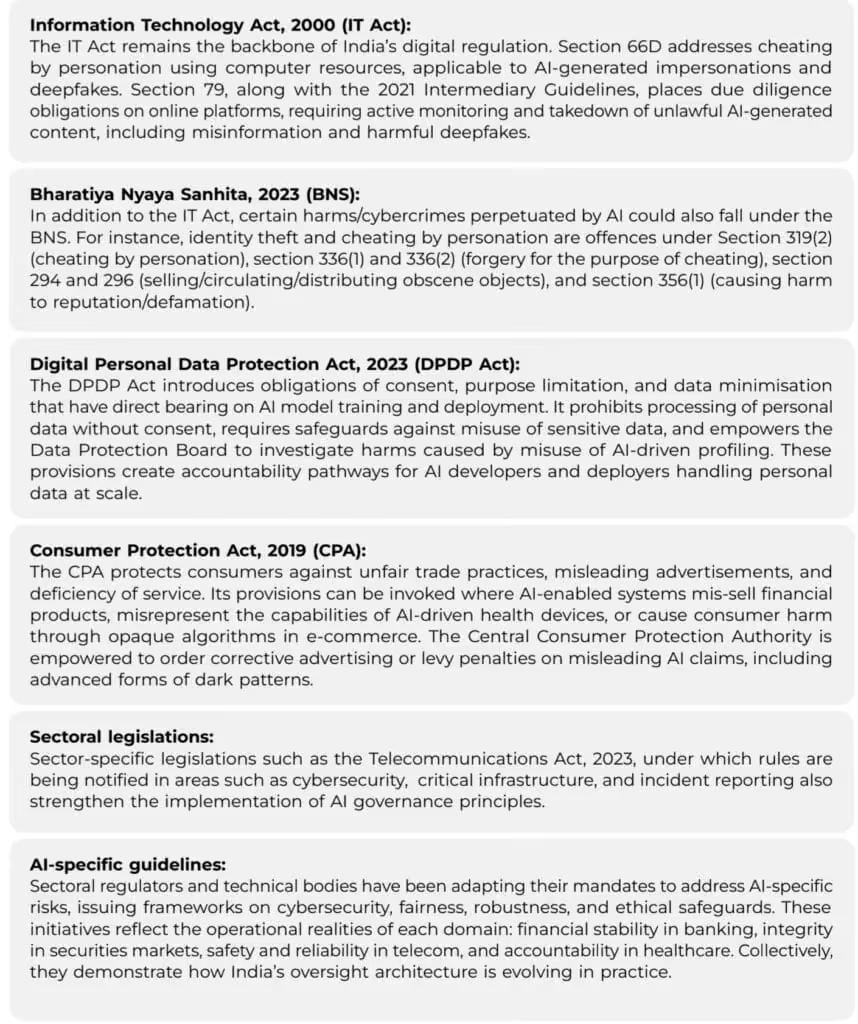
Risks in AI
The framework identifies several key risks posed by AI:
- Malicious Uses: Including misinformation/deepfakes, trojan attacks, model/data poisoning, and adversarial inputs in critical infrastructure.
- Bias and Discrimination: Using inaccurate data to make decisions (e.g., employment), leading to loss of opportunity or livelihood.
- Transparency Failures: Lack of adequate disclosures, such as using personal data to develop AI without consent.
- Systemic Risks: Disruptions in the AI value chain due to market concentration, geopolitical instability, and regulatory changes.
- Loss of Control: Potential disruption of public order and safety from unmanaged AI systems.
- National Security: AI-facilitated disinformation campaigns, cyberattacks on critical infrastructure, and the use of lethal autonomous weapons.
- Vulnerable Groups: A special need to protect groups like children (risks from recommendation engines exploiting developing brains) and women (risks from AI-generated deepfakes, revenge porns etc.).
Recommendations (Six Pillars)
- Infrastructure: Enable innovation by expanding access to foundational resources (data, compute), attracting investment, and leveraging Digital Public Infrastructure.
- Capacity Building: Initiate education, skilling, and training programs to empower people, build trust, and increase awareness of AI’s risks and opportunities.
- Policy & Regulation: Adopt balanced, agile, and flexible frameworks that support innovation and mitigate risks; review current laws and address gaps with targeted amendments.
- Risk Mitigation: Develop an India-specific risk assessment framework; encourage compliance through voluntary measures and techno-legal solutions; apply additional obligations in sensitive contexts.
- Accountability: Adopt a graded liability system based on function, risk level, and due diligence; enforce applicable laws and require greater transparency from actors in the AI value chain.
- Institutions: Adopt a whole-of-government approach; establish an AI Governance Group (AIGG) supported by a Technology & Policy Expert Committee (TPEC); resource the AI Safety Institute (AISI) for technical expertise.
Action Plan
- Time bound action plan.

Institutional Framework
The plan includes a suggested institutional structure to implement the guidelines:
- High-level body: AI Governance Group (AIGG).
- Government agencies: MeitY, MHA (Ministry of Home Affairs), MEA (Ministry of External Affairs), DoT (Department of Telecommunications), etc.
- Sectoral regulators: RBI (Reserve Bank of India), SEBI (Securities and Exchange Board of India), TRAI (Telecom Regulatory Authority of India), CCI (Competition Commission of India), etc.
- Advisory bodies: NITI Aayog, Office of the Principal Scientific Adviser (PSA), etc.
- Standards bodies: BIS (Bureau of Indian Standards), TEC (Telecommunication Engineering Centre), etc.
Global AI Governance Frameworks

Source: https://anantamias.com/current-affairs/governance-in-ai/
FATF(Financial Action Task Force)


Context:
The Financial Action Task Force (FATF) has released a new “Asset Recovery Guidance and Best Practices” framework. It strengthens global mechanisms for the recovery of assets derived from financial crimes such as money laundering and corruption.
UPSC Relevance:
International Organisation
UPSC PYQ:
Q. Discuss how emerging technologies and globalisation contribute to money laundering. Elaborate measures to tackle the problem of money laundering both at national and international levels. (2021)
About FATF:
- The Financial Action Task Force (FATF) is the global money laundering and terrorist financing watchdog. The inter-governmental body sets international standards that aim to prevent these illegal activities and the harm they cause to society.
- As a policy-making body, the FATF works to generate the necessary political will to bring about national legislative and regulatory reforms in these areas.
- The FATF was established in 1989 and is based in Paris.
The 40-member body sets international standards to ensure national authorities can effectively go after illicit funds linked to drugs trafficking, the illicit arms trade, cyber fraud and other serious crimes.
- The FATF’s decision-making body, the FATF Plenary, meets three times per year and holds countries to account if they do not comply with the Standards.
- If a country repeatedly fails to implement FATF Standards then it can be named a Jurisdiction under Increased Monitoring or a High Risk Jurisdiction. These are often externally referred to as “the grey and black lists”.
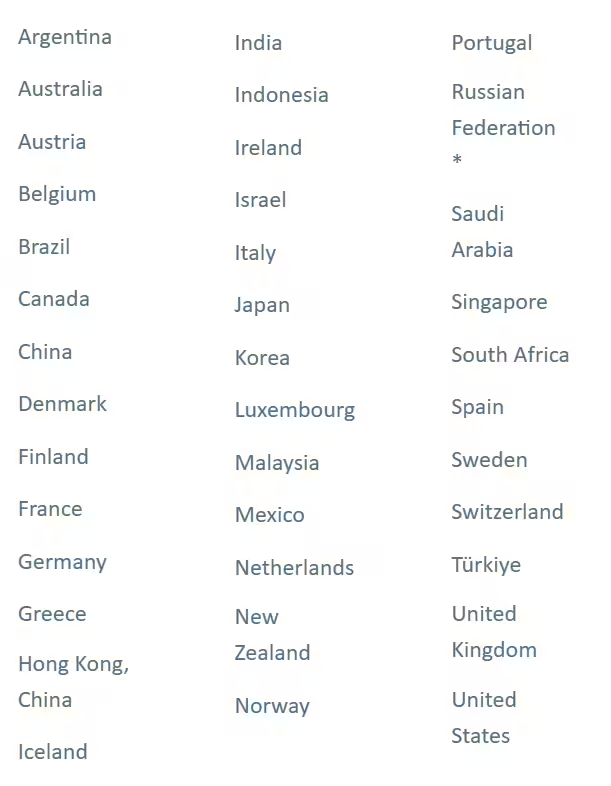
* FATF suspended membership of the Russian Federation on 24 February 2023.
Members:
Grey and Black Lists of the FATF?
- Grey List: The Grey List includes countries that are considered safe haven for supporting terror funding and money laundering.
- Black List: The Black List includes Non-Cooperative Countries or Territories (NCCTs) that support terror funding and money laundering activities.
- As of now, Iran, North Korea and Myanmar are the three black listed countries.
Source: https://anantamias.com/current-affairs/fatffinancial-action-task-force/
Special Economic Zone(SEZ)

Context:
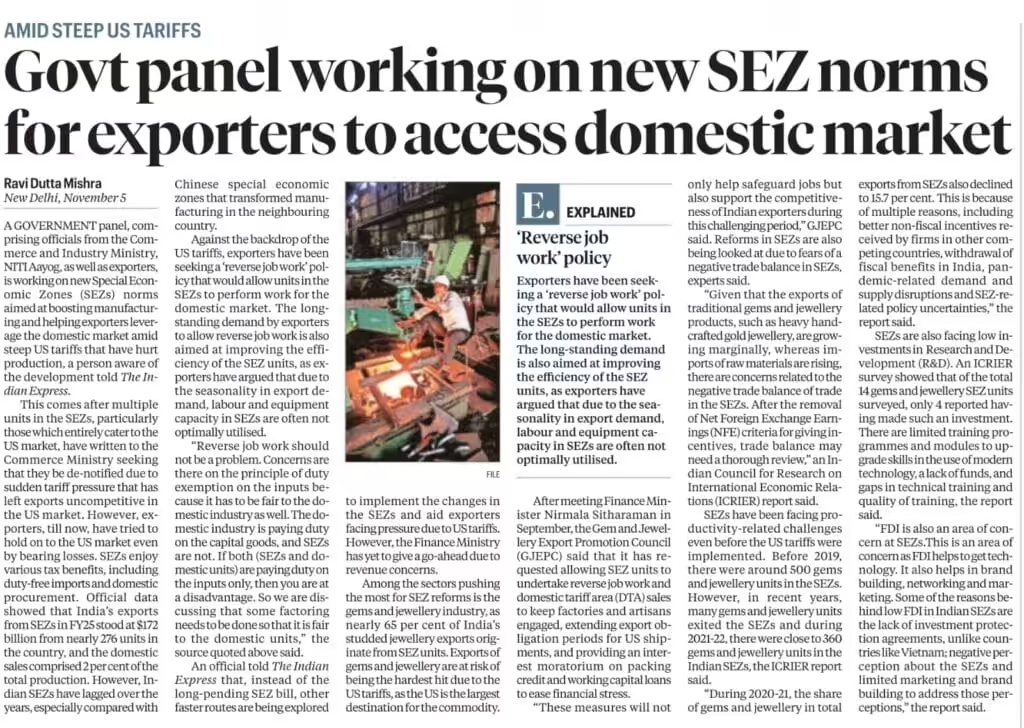
The Government of India has constituted a panel under the Ministry of Commerce and Industry (with members from NITI Aayog and others) to reform the Special Economic Zones (SEZ) framework. The move comes amid steep U.S. tariffs and a slowdown in global exports, which have hurt Indian exporters operating from SEZs.
UPSC Relevance:
Q. Justify the need for FDI for the development of the Indian economy. Why is there a gap between MOUs signed and actual FDIs? Suggest remedial steps to be taken for increasing actual FDIs in India. (2016).
About SEZ:
Special economic zones (SEZs) in India are areas that offer incentives to resident businesses. SEZs typically offer competitive infrastructure, duty free exports, tax incentives, and other measures designed to make it easier to conduct business. Accordingly, SEZs in India are a popular investment destination for many multinationals, particularly exporters.
- Currently, India has 276 operational SEZs with total employment of 3.19 million people as of March 31, 2024.
- Goods exports from Indian SEZs reached US$143.34 billion till January 31, 2025.
Objectives of the SEZ Act are:
- Generation of additional economic activity
- Promotion of exports of goods and services
- Promotion of investment from domestic and foreign sources
- Creation of employment opportunities
- Development of infrastructure facilities
Special Economic Zones (Amendment) Rules, 2025:
- One of the major revisions is the amendment to Rule 5 of SEZ Rules, 2006, which reduces the minimum land requirement for SEZs dedicated exclusively to semiconductors or electronic components from 50 hectares to 10 hectares.
- Additionally, Rule 18 has been amended to allow these SEZ units to sell their products in the domestic market, subject to payment of applicable duties. This marks a departure from the traditional export-only model for the manufacturers.
- Further, an amendment to Rule 7 empowers the SEZ Board of Approval to waive the requirement for land to be encumbrance-free in specific cases. This provision applies when the land is mortgaged or leased to central or state governments or their authorized agencies, offering greater flexibility in land acquisition and development.
Approval granted for two new high-tech SEZs:
Following the notification of these amendments, the SEZ Board of Approval sanctioned two critical proposals:
- Micron Semiconductor Technology India will set up an SEZ in Sanand, Gujarat, with an estimated investment of INR 130 billion (US$1.5 billion).
- Hubballi Durable Goods Cluster Private Ltd (part of the Aequs Group) received approval to establish an SEZ in Dharwad, Karnataka, involving an investment of INR 1 billion (US$11.61 million).
SEZ in India:
India was one of the first in Asia to recognize the effectiveness of the Export Processing Zone (EPZ) model in promoting exports, with Asia’s first EPZ set up in Kandla in 1965.
- The Special Economic Zone Act, 2005 amended India’s SEZ policy.
- Many EPZs have converted to SEZs, with notable zones in Noida (Uttar Pradesh state), Falta (West Bengal state), Visakhapatnam (Andhra Pradesh state), Chennai (Tamil Nadu state), Cochin (Kerala state), Santa Cruz (Maharashtra state), Indore (Madhya Pradesh), as well as Kandla and Surat (Gujarat).
- Consequently, the SEZ category encompasses various multiple zone types, such as free trade zones (FTZs), EPZs, industrial estates (IEs), free ports, free trade warehousing zones (FTWZz), and urban enterprise zones, among others.
Incentives for setting up in an Indian SEZ:
- Duty free import and domestic procurement of goods.
- 100 percent income tax exemption on export income for SEZ units under Section 10AA of the Income Tax Act for first five years.
- Income tax exemption on income derived from the business of development of the SEZ in a block of 10 years in 15 years under Section 80-IAB of the Income Tax Act.
- Dividend Distribution Tax abolished in February 2020.
Outcome:
According to the Ministry of Commerce and Industry:
- SEZ exports increased from INR 228.40 billion (US$3.07 billion) in 2005-06 to INR 7595.24 billion (US$102.24 billion) in 2020-21.
- Investment in SEZs increased from INR 40.355 billion (US$0.54 billion) in 2005-06 to INR 6174.99 billion (US$83.12 billion) (cumulative basis) by 2020-21.
- Operations in SEZ units provided jobs to 134,704 persons in 2005-06 – which increased to 2,358,136 persons (cumulative basis) by 2020-21.
Challenges:
Baba Kalyani Committee – Key Issues Identified in India’s SEZ Policy
- Global Competitiveness and Skill Gaps:
- Competing ASEAN nations have modernized their SEZ frameworks, offering more attractive incentives, simplified regulations, and robust skilling initiatives to attract global investors. India needs to recalibrate its SEZ policy to remain competitive.
- Withdrawal of Fiscal Incentives:
- The removal of tax incentives such as Minimum Alternate Tax (MAT) exemptions and the imposition of Income Tax on SEZ units have reduced their overall attractiveness for investors.
- Restrictions on Domestic Job Work:
- Current SEZ regulations prohibit units from undertaking job work for Domestic Tariff Area (DTA) entities. This limits the operational flexibility and optimal utilization of installed capacity within SEZs.
- Underutilization of Land Resources:
- Large tracts of land within SEZs remain unutilized as land parcels are often earmarked for specific sectors. The Committee suggested liberalizing land use norms to allow for diversified activities and multi-sectoral operations.
- Multiplicity of Economic Zone Models:
- There is significant overlap among various industrial and economic zone models — such as SEZs, Coastal Economic Zones (CEZs), the Delhi-Mumbai Industrial Corridor (DMIC), National Investment and Manufacturing Zones (NIMZs), Food Parks, and Textile Parks — leading to policy confusion and inefficiency. A unified and coordinated framework was recommended.
- High Duty on Domestic Sales:
- When SEZ units sell products in the domestic market, they are required to pay full import customs duty, which discourages domestic linkages and limits integration with the national manufacturing ecosystem.
- Environmental Concerns:
- SEZs have contributed to pollution through the discharge of untreated effluents, causing significant damage to mangroves and adversely affecting the fisheries and dairy sectors, particularly in Gujarat.
Recommendations by Baba Kalyani Committee:
The key recommendations of the Committee based on the above mentioned objectives and the inputs from various industry stakeholders can be categorised into the following maxtrix:
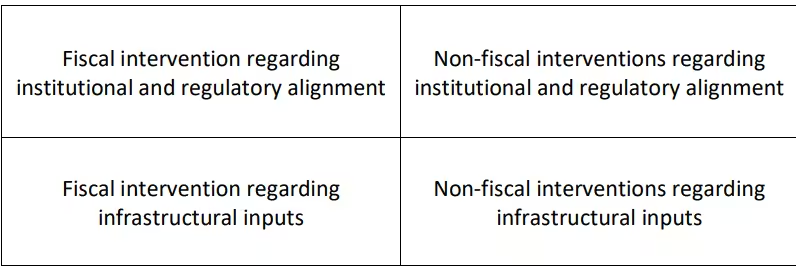
- The committee has proposed to rename SEZs in India as 3Es- Employment and Economic Enclave, with the objective of moving from island of exports to catalyst of economic and employment growth. The 3Es aims to bring together all categories of investors that enable economic activity or job creation and investment targeted towards leveraging domestic demand.
- Another key highlight of the recommendations was the review of requirements of manufacturing and services separately.
- Delink from Net Foreign Exchange (NFE) Performance: Allow domestic supplies and payments in Rupees
- Infrastructure Development: Develop high-quality infrastructure including high-speed rail, expressways, ports, warehouses, and airports.
- Ease of Doing Business (EoDB): Establish one integrated online portal for investment, operations, and exits
The establishment of SEZs in India has been a policy applied by the government to increase the country’s global competitiveness. These zones played a key role in drawing foreign direct investment, boosting exports, developing strong infrastructure and creating employment opportunities. The dominance of the IT/ITeS sector and geographical concentration of SEZs in a few industrialized states highlight the success of this policy in leveraging India’s strengths and catering to the needs of specific industries.
Source: https://anantamias.com/current-affairs/special-economic-zonesez/
Prelims Nuggets
Soyabean

- China’s cabinet (State Council tariff commission) confirmed the suspension of retaliatory tariffs on some US imports, including certain farm goods especially soyabean. USA has been particularly promoting it’s soyabean exports recently across trade deals.
- Traders note the remaining 13% in China tariff makes US soyabean shipments too expensive for commercial buyers compared to cheaper Brazilian alternatives.
| Category | Details |
| Key Facts | A Kharif (monsoon) oilseed crop and a legume. |
| It is a “miracle crop” and is known for its high nutritional value: approx. 40% protein and 20% oil. | |
| Like other legumes, it fixes atmospheric nitrogen into the soil through a symbiotic relationship with bacteria Bradyrhizobium japonicum. | |
| Growing Conditions | Climate: Prefers warm temperate climates with hot summers. Optimum mean temperature is 20°C to 30°C. |
| Rainfall/Water: Requires adequate rainfall or irrigation. Sensitive to both drought stress and waterlogging (especially at the seedling stage). | |
| Soil: Best suited to fertile, well-drained loam soils or Vertisols (black cotton soils) rich in organic content. | |
| MSP Status in India | Soyabean is one of the crops covered under the Minimum Support Price (MSP) scheme in India. |
| Largest Producer (World) | Brazil (Has recently surpassed the US in production).Other Major Producers: United States, Argentina, China. |
| Largest Producer (India) | Madhya Pradesh (Often called the ‘Soy State’ of India, accounting for nearly 50% of the country’s total production).Other Major Producers: Maharashtra, Rajasthan. |
Pradhan Mantri Kaushal Vikas Yojana
| Category | Details |
| Launched | July 15, 2015 (on World Youth Skills Day). |
| Type | Centrally Sponsored Scheme |
| Ministry | Ministry of Skill Development & Entrepreneurship (MSDE). |
| Implementing Agency | National Skill Development Corporation (NSDC). |
| Objective | To mobilize youth to take up industry-relevant skill training for better livelihoods and to increase the productivity of the workforce. |
| Key Feature | Free skill training and monetary rewards/certification upon successful completion of the course. |
| Standardization | Training is aligned with the National Skills Qualification Framework (NSQF). |
| Components | Short Term Training (STT), Recognition of Prior Learning (RPL), and Special Projects. |
| Current Phase | PMKVY 4.0 (Focusing on New-Age Skills, Industry 4.0, and decentralized implementation). |
Gravitational Waves and the GW250114 Discovery

- Gravitational Waves (GWs): According to General Relativity, GWs are ripples of gravitational energy set off when any sufficiently massive object accelerates through spacetime.
- Propagation: They travel uninterrupted across vast distances at the speed of light.
- Source Events: The “loudest” waves are produced by fierce cosmic events like colliding neutron stars and black holes.
- The Latest Groundbreaking Detection (GW250114) : Announced during the celebration of the 10th anniversary of the first GW detection.
- Detection Event: Named GW250114, as it was detected on January 14, 2025.
- Network: Detected by the global network of observatories: LIGO (US), Virgo (Italy), and KAGRA (Japan).
- Significance: It was the clearest gravitational wave signal detected to date, from a pair of merging black holes located about 1.3 billion light-years away.
LIGO

- Mechanism: LIGO detectors consist of two 4-km-long arms arranged in an L-shape with a vacuum inside.
- Principle: A highly stable laser beam is split and sent down the perpendicular arms, bouncing between mirrors.
- Detection: When a GW passes through, it distorts spacetime, slightly stretching one arm and compressing the other. This causes the laser beams to shift out of phase and produce a measurable flicker of light at a photodetector.
Operational Gravitational Wave Detectors
| Observatory Name | Type | Location | Number of Detectors |
| LIGO | Laser Interferometer | 1. LIGO Hanford, Washington, USA | 2 |
| 2. LIGO Livingston, Louisiana, USA | |||
| Virgo | Laser Interferometer | Near Pisa, Italy | 1 |
| KAGRA | Cryogenic Underground Laser Interferometer | Gifu Prefecture, Japan | 1 |
| GEO600 | Laser Interferometer ( smaller ) | Near Hanover, Germany | 1 |
LIGO-India (or IndIGO)
| Feature | Details |
| Status | Approved for construction (Cabinet approval granted in April 2023). Expected to be operational by 2030 |
| Location | Near Aundha Nagnath, Hingoli District, Maharashtra. |
| Significance | It will become the third Advanced LIGO detector and the fifth major node in the global network. Its unique geographical location will drastically improve the network’s ability to localize (pinpoint) the source of gravitational waves in the sky by a factor of 5-10 times. |
Nauradehi Wildlife Sanctuary

- Nauradehi Wildlife Sanctuary has been officially approved as the third site for cheetah reintroduction in Madhya Pradesh under Project Cheetah, following Kuno National Park and Gandhi Sagar Sanctuary.
- Location: It is the largest wildlife sanctuary in Madhya Pradesh. It is located across the trijunction of Sagar, Damoh, and Narsinghpur districts (and partly Raisen) established in 1975.
- The sanctuary is situated on a plateau that forms part of the Upper Vindhyan range.
- River Basins: It is a unique protected area that encompasses the catchment areas of two major river basins in India: the Ganges (Yamuna tributary) and the Narmada.
- The north flowing Kopra River, Bamner River, Bearma River, which are tributaries of the Ken River, are the major rivers of this protected area.
- Ecosystem: The forest is primarily a Tropical Dry Deciduous type, with Teak being the predominant species in many patches. It is known for its open grassland and scrub forest patches.
- Keystone Species: The Indian Wolf is considered the keystone species of the Nauradehi Wildlife Sanctuary.
- Major Fauna: The sanctuary is home to a variety of animals, including the Tiger, Leopard, Wild Dog (Dhole), Sloth Bear, Striped Hyena, Nilgai (Blue Bull), Chital (Spotted Deer), Sambhar, Black Buck, and Chinkara.
Source: https://anantamias.com/current-affairs/prelims-nuggets-2/
Model Code of Conduct in India: Ensuring Fair Elections, Key Challenges & Reforms Explained

Context: The editorial discusses how recent welfare announcements—like Bihar’s Mukhyamantri Mahila Rojgar Yojana launched just before the 2025 elections—violate the Model Code of Conduct (MCC) in spirit. It questions the effectiveness of the MCC, a non-statutory code enforced by the Election Commission under Article 324, and debates whether it should be given legal backing or reformed to prevent misuse of government schemes during elections.
“However good a Constitution may be, it is sure to turn out bad because those who are called to work it happen to be a bad lot”

What is the MCC?
- The MCC is a non-statutory code issued by the ECI to ensure a level playing field from the date of election announcement till results. Its force comes from Article 324 (superintendence, direction and control of elections) and decades of instructions/compendia the ECI issues and updates. Election Commission of India+1
Scope & Core Clauses
- General conduct: No communal/caste appeals; avoid corrupt practices; respect silence period. Chief Electoral Officer Delhi
- Party in power: No new schemes, grants, foundation stones, ad blitz using public money that can influence voters; no use of official machinery for campaign. Chief Electoral Officer Delhi
- Manifestos: Must avoid promises that vitiate equity & fiscal sustainability; 2015+ instructions consolidated in 2024 compendium. CEO Odisha
- Advertising & govt resources: Strict controls on gov’t ads, vehicles, transfers/postings once MCC is in force. CEO Odisha
Why it matters ?
- The MCC operationalises free & fair elections—a basic feature—by plugging gaps not expressly covered by statute (RP Act, 1951). ECI leverages Art. 324 to issue binding directions to stakeholders during the brief electoral window. PRS Legislative Research
Case-Studies & Precedents
1) “Freebies” & Manifesto Promises
- S. Subramaniam Balaji v. State of Tamil Nadu (2013): SC held that promises in party manifestos are not per se ‘corrupt practices’ under Section 123 RPA, though ECI can frame manifesto guidelines. This narrowed direct statutory attack on “freebies”. Supreme Court Observer
- 2022–24 developments: A series of petitions urged re-examination; SC issued notices to Centre/ECI and referred the freebies issue to a larger bench, flagging fiscal risks and democratic distortion. (Process ongoing). SCC Online+2Scroll.in+2
2) Bihar’s Mukhyamantri Mahila Rojgar Yojana (MMRY), 2025
- Timeline: Bihar Cabinet cleared the scheme in Sept 2025; ₹10,000 DBT per beneficiary; PM transferred ₹7,500 cr to 75 lakh women on Sept 26, 2025; additional support up to ₹2 lakh announced. Elections scheduled in early November. Reuters+3The Times of India+3Press Information Bureau+3
- MCC question: Government calls it an “ongoing scheme”; critics argue timing + scale tilt the level playing field. This is a textbook “letter vs spirit” friction in MCC enforcement.
3) Cinema & Campaign Influence: PM Biopic / NaMo TV, 2019
- ECI barred the release of a biopic on the sitting PM during MCC and said the restraint order applied to NaMo TV—to preserve neutrality. The Times of India+3Election Commission of India+3Business Today+3
4) Defence Imagery in Campaigns, 2019
- ECI advised parties not to use photographs/events of defence personnel for political propaganda—upholding the apolitical character of the armed forces. Election Commission of India+2www.ndtv.com+2
5) Transfers & “Level Field” Orders, 2024 LS Polls
- After MCC, ECI reassigned DMs/SPs and published suo motu enforcement reports (high disposal rate of complaints; focus on inducement-free, low-noise campaigns). Press Information Bureau+2Elections 24+2
Where the law actually bites?
Even though MCC isn’t a law, violations often map onto existing statutes:
- RP Act, 1951:
- S.123 (corrupt practices: bribery, undue influence etc.),
- S.126 (silence period—48 hours),
- S.127A (printing of pamphlets/handbills with publisher details). PRS Legislative Research
- IPC Chapter IX-A: 171B-E (bribery, undue influence, personation). (Explained in ECI compendia for field officers.) CEO Odisha
Persistent Pain-Points
- Letter vs Spirit gap: Welfare launches labelled “ongoing schemes” keep happening during MCC (Bihar 2025 example). PM India+1
- Speed vs Due Process: ECI needs swift compliance within ~45 days, while litigation drags on.
- Surrogate campaigning: Films, platforms, gov’t advertising, and social media require agile, tech-savvy enforcement. Business Today
- Uneven local enforcement: Civil society has flagged field-level laxity in some by-elections. The Times of India
Reform Menu
| Reform | What it means | Pros | Cons / Risks |
|---|---|---|---|
| Give MCC limited statutory teeth (select provisions into RPA/Rules) | Codify only enforceable parts (e.g., gov’t ads, transfers, manifesto disclaimers) | Clear penalties, deterrence | Court delays; over-legalisation may reduce ECI agility. Elections TN |
| Time-bound ECI quasi-judicial panels during polls | 24–72 hr disposal with speaking orders | Speed + transparency | Capacity constraints |
| Sharper manifesto rules | Fiscal disclosure, funding source, outcome metrics | Voter information improves | Constitutional free-speech concerns; Balaji precedent. Supreme Court Observer |
| Pre-notified “permitted list” for ongoing schemes | Publish a whitelist (purely routine/benefit cycles) | Cuts discretion & dispute | Complex to design across States |
| Tech-enabled ad & social monitoring | Central dashboard for gov’t ad stoppage, influencer disclosures | Limits surrogate influence | Platform compliance issues |
Note: A 2013 Parliamentary Standing Committee had favoured giving MCC legal backing; ECI historically prefers instruction-based flexibility citing the short poll window—hence the push-and-pull continues. (For legislative committee coverage and summaries, see PRS/committee documents.) PRS Legislative Research
Link to “Simultaneous Elections” debate
One argument for “One Nation, One Election” is to reduce MCC frequency and governance interruptions. The Law Commission (2018) examined feasibility pathways; still contested constitutionally/logistically. Even with fewer elections, MCC-spirit issues (timed welfare blitz, ad ethics) would persist unless addressed directly.