Context:
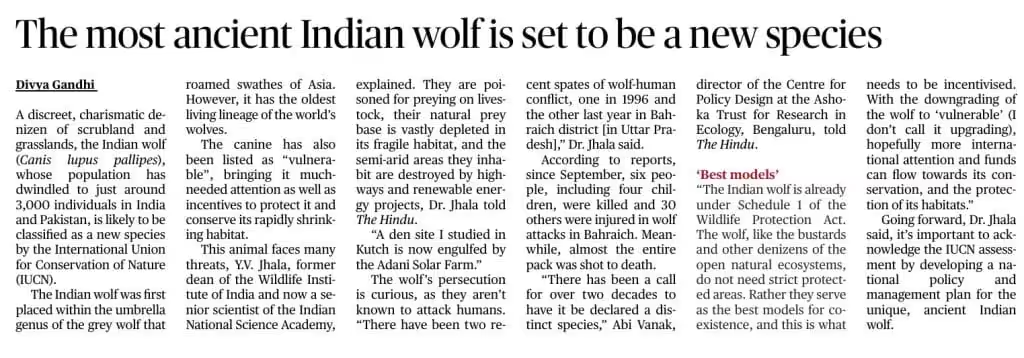
The Indian wolf (Canis lupus pallipes), a species found in India and Pakistan, is likely to be classified as a new distinct species by the International Union for Conservation of Nature (IUCN).
Its population is critically low — only about 3,000 individuals remain — and it has been listed as “Vulnerable” under the IUCN Red List.
UPSC Relevance:
Species in news(Environment)
UPSC PYQ:
Consider the following statements:
- Lions do not have a particular breeding season.
- Unlike most other big cats, cheetahs do not roar.
- Unlike male lions, male leopards do not proclaim their territory by scent marking.
Which of the statements given above are correct? [UPSC Civil Services Exam – 2024 Prelims]
a) 1 and 2 only
b) 2 and 3 only
c) 1 and 3 only
d) 1, 2 and 3
Indian Wolf:
| Attribute | Details |
|---|
| Scientific Name | Canis lupus pallipes |
| Common Name | Indian Wolf / Peninsular Wolf |
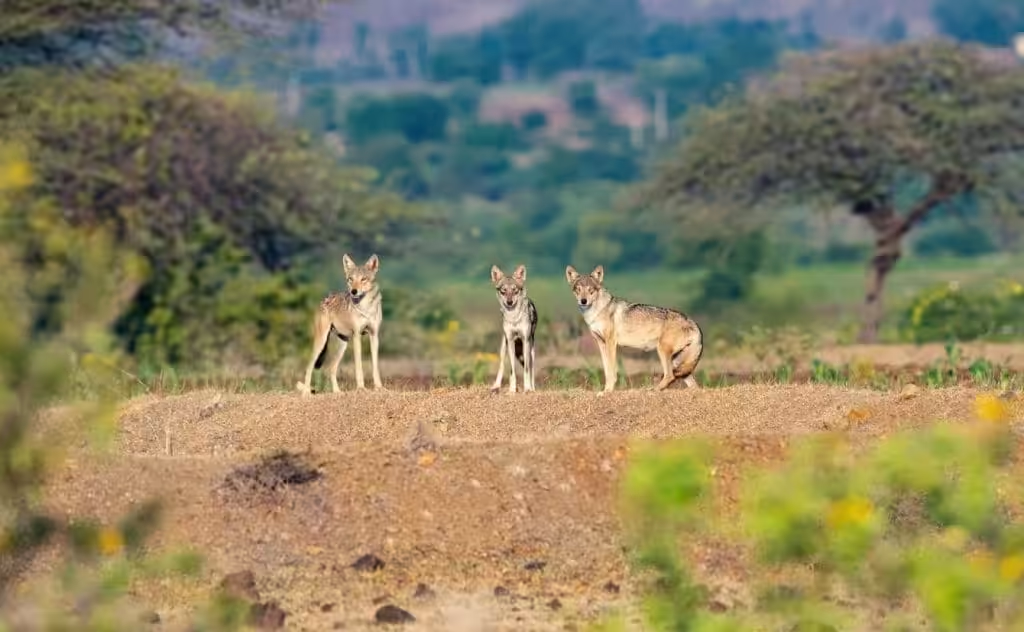
| Habitat | Scrublands and semi-arid grasslands of India and Pakistan |
| Current Distribution | Central and Western India — Gujarat, Rajasthan, Maharashtra, Madhya Pradesh, Uttar Pradesh |
| Population Estimate | ~3,000 individuals |
| Taxonomic Status | Previously a subspecies of Grey Wolf (Canis lupus); now considered a distinct lineage — the oldest living lineage of the world’s wolves. |
Threats:
- Semi-arid grasslands and scrublands are being destroyed by renewable energy projects, highways, and agriculture. Example: Adani Solar Farm engulfing wolf den sites in Kutch.
- Wolves are often poisoned or shot for preying on livestock. Recent cases in Bahraich (U.P.) led to retaliatory killings.
- Overgrazing and land degradation reduce small herbivore populations (blackbuck, chinkara).
- The species inhabits non-forest ecosystems, which receive less conservation priority compared to forests and tigers.
IUCN Reassessment and Its Importance:
- The downgrading to “Vulnerable” (from “Least Concern”) may not be negative — it helps draw international attention and funding.
- The IUCN species reclassification can catalyze:
- Better habitat management in semi-arid regions.
- National policy formulation for open ecosystems.
- Enhanced monitoring and research on species distribution and behavior.
Tell Google you want more of this.
Add Anantam IAS as a preferred sourceOne tap, and this site shows up more often in your own Top Stories, AI Overviews and AI Mode. Remove it any time.