

Why in News?
The Ministry of Electronics and Information Technology released the India AI Governance Guidelines on 5 November.
UPSC Relevance
Mains, GS2, Important Aspects of Governance, Transparency and Accountability, E-governance- applications, models, successes, limitations, and potential.
PYQ
2024 – 15 Marks
E-governance is not just about the routine application of digital technology in service delivery process. It is as much about multifarious interactions for ensuring transparency and accountability. In this context, evaluate the role of the “Interactive Service Model” of e-governance.
2025 – 10 Marks
E-governance projects have a built-in bias towards technology and back-end integration than user-centric designs. Examine.
Advancing AI and its Governance
- AI’s Rapid Pace and Potential: Artificial Intelligence, a general-purpose technology, is advancing rapidly, capable of synthesizing information, reasoning, planning, and self-improvement with minimal human supervision.
- Dual-Use Nature: Like technologies such as nuclear energy, AI is a dual-use innovation; it can drive economic growth, scientific progress, and inclusive development, but its probabilistic, generative, agentic, and adaptive nature can also augment existing harms or create new risks.
- Governance Goal: The primary objective of the governance guidelines is to balance technical progress with the mitigation of potential risks to society, aligning firmly with India’s national needs and aspirations.
India’s Vision and Framework Development
- India’s Goal: To harness AI’s transformative potential for inclusive development and global competitiveness while effectively addressing the risks to individuals and society.
- Drafting Committee: A committee (constituted by the Ministry of Electronics and Information Technology – MeitY in July 2025) developed the governance framework, drawing on literature, reviewing existing laws, and studying global developments.
Principles
- Seven guiding sutras adapted from the RBI’s FREE-AI Committee report.

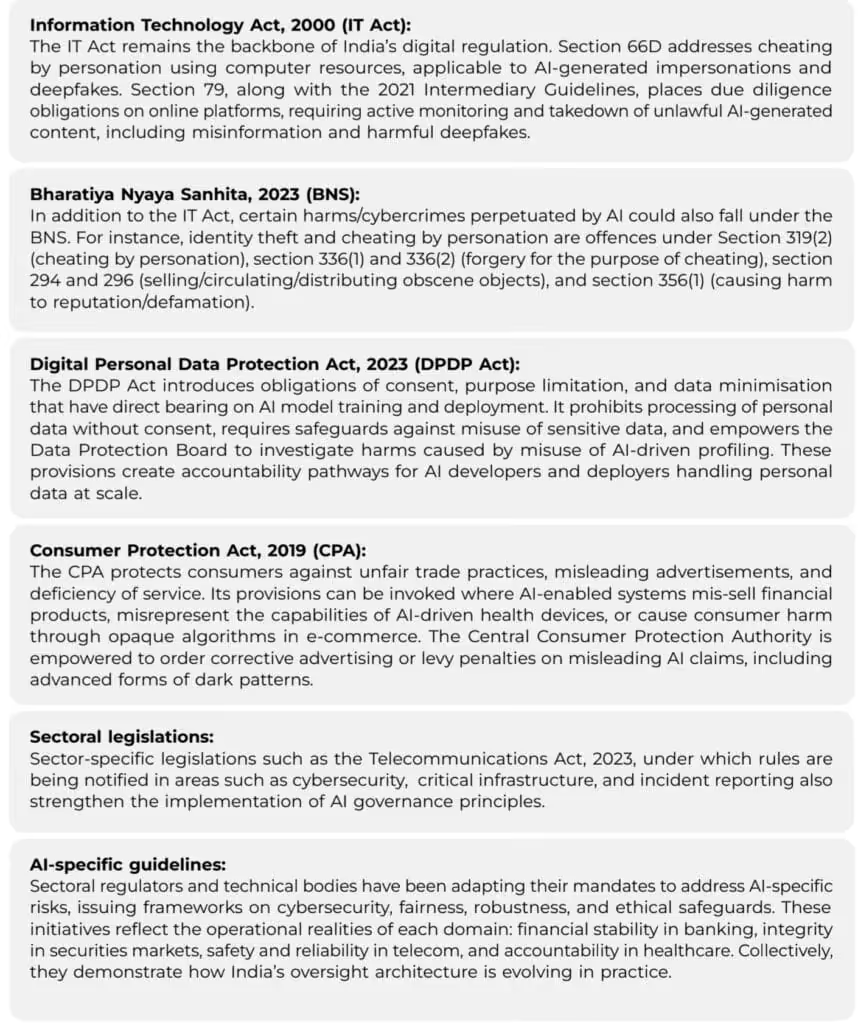
Overview of current laws in India relevant to AI systems
Risks in AI
The framework identifies several key risks posed by AI:
- Malicious Uses: Including misinformation/deepfakes, trojan attacks, model/data poisoning, and adversarial inputs in critical infrastructure.
- Bias and Discrimination: Using inaccurate data to make decisions (e.g., employment), leading to loss of opportunity or livelihood.
- Transparency Failures: Lack of adequate disclosures, such as using personal data to develop AI without consent.
- Systemic Risks: Disruptions in the AI value chain due to market concentration, geopolitical instability, and regulatory changes.
- Loss of Control: Potential disruption of public order and safety from unmanaged AI systems.
- National Security: AI-facilitated disinformation campaigns, cyberattacks on critical infrastructure, and the use of lethal autonomous weapons.
- Vulnerable Groups: A special need to protect groups like children (risks from recommendation engines exploiting developing brains) and women (risks from AI-generated deepfakes, revenge porns etc.).
Recommendations (Six Pillars)
- Infrastructure: Enable innovation by expanding access to foundational resources (data, compute), attracting investment, and leveraging Digital Public Infrastructure.
- Capacity Building: Initiate education, skilling, and training programs to empower people, build trust, and increase awareness of AI’s risks and opportunities.
- Policy & Regulation: Adopt balanced, agile, and flexible frameworks that support innovation and mitigate risks; review current laws and address gaps with targeted amendments.
- Risk Mitigation: Develop an India-specific risk assessment framework; encourage compliance through voluntary measures and techno-legal solutions; apply additional obligations in sensitive contexts.
- Accountability: Adopt a graded liability system based on function, risk level, and due diligence; enforce applicable laws and require greater transparency from actors in the AI value chain.
- Institutions: Adopt a whole-of-government approach; establish an AI Governance Group (AIGG) supported by a Technology & Policy Expert Committee (TPEC); resource the AI Safety Institute (AISI) for technical expertise.
Action Plan
- Time bound action plan.

Institutional Framework
The plan includes a suggested institutional structure to implement the guidelines:
- High-level body: AI Governance Group (AIGG).
- Government agencies: MeitY, MHA (Ministry of Home Affairs), MEA (Ministry of External Affairs), DoT (Department of Telecommunications), etc.
- Sectoral regulators: RBI (Reserve Bank of India), SEBI (Securities and Exchange Board of India), TRAI (Telecom Regulatory Authority of India), CCI (Competition Commission of India), etc.
- Advisory bodies: NITI Aayog, Office of the Principal Scientific Adviser (PSA), etc.
- Standards bodies: BIS (Bureau of Indian Standards), TEC (Telecommunication Engineering Centre), etc.
Global AI Governance Frameworks

Tell Google you want more of this.
Add Anantam IAS as a preferred sourceOne tap, and this site shows up more often in your own Top Stories, AI Overviews and AI Mode. Remove it any time.