Agnipath Scheme Review: Armed Forces Seek Larger Retention of Agniveers
Why in News?
The Indian Express reported on July 6, 2026 that the Armed Forces are seeking a larger share of Agniveers to be retained as regular soldiers after their four-year tenure, well beyond the 25 per cent cap approved under the Agnipath scheme.
The timing is significant: the first batches of Agniveers, who began training in early 2023, complete their four-year tenure later in 2026. The retention question — how many stay, how many exit — moves from policy design to lived reality this year, making it the first big course-correction signal on Agnipath since its 2022 launch.
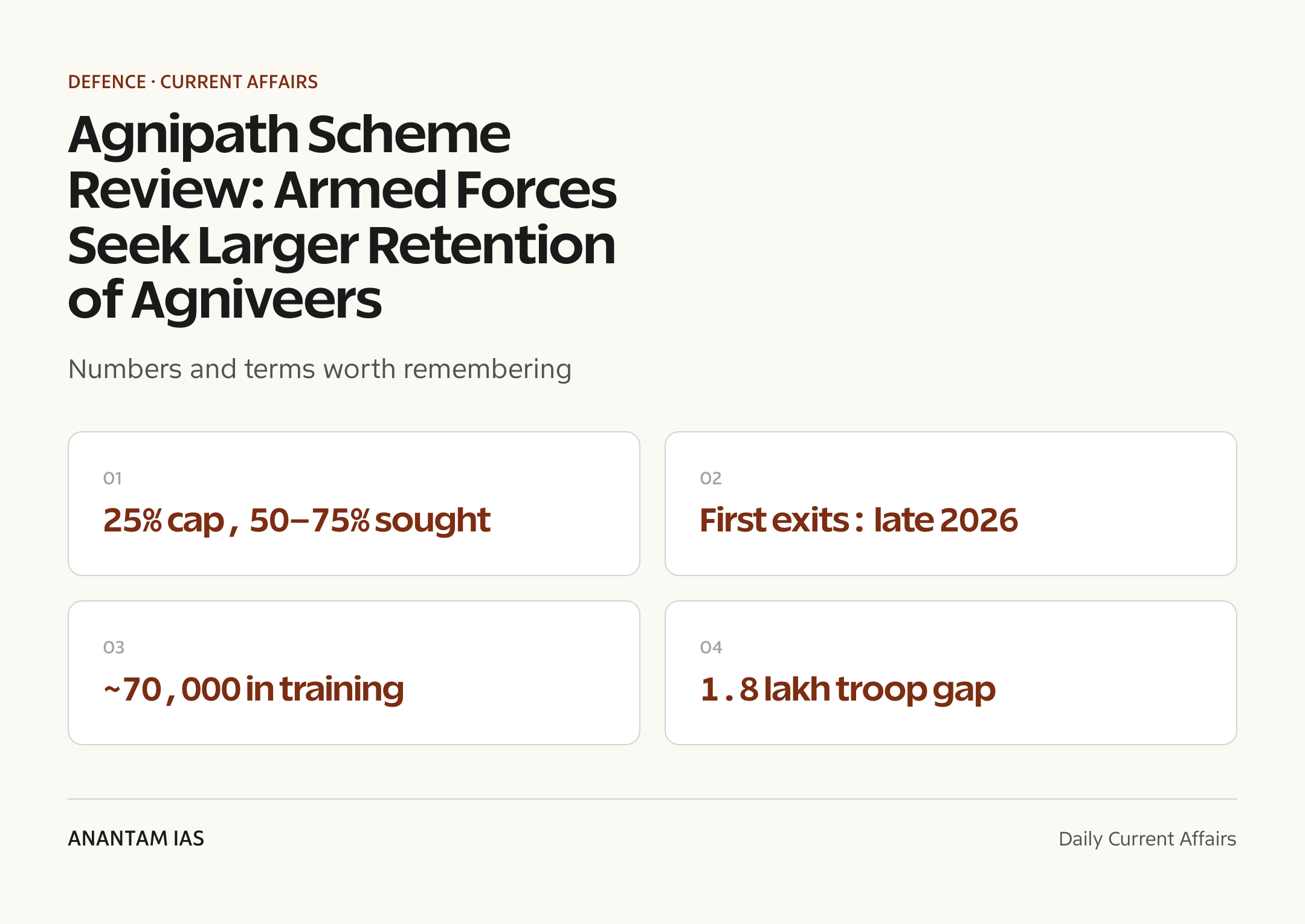
- The Navy is likely to seek retention of around 75 per cent of its Agniveer sailors; the Army and the IAF may seek an increase to around 50 per cent — against the currently approved 25 per cent for each service.
- Under existing policy, all Agniveers are first released at the end of four years; up to 25 per cent of those who volunteer are then re-enrolled as regular soldiers on merit.
- The demand will be discussed between the three services and the Department of Military Affairs (DMA); an earlier proposal for higher retention was returned by the DMA for re-evaluation.
- The push draws on lessons from Operation Sindoor: experienced troops reacted faster and more effectively in operational situations, and new platforms procured since then need longer specialised training.
- Around 70,000 Agniveers were under training in the Army alone in the last training year; about 90,000 vacancies are likely in the next, as the Army works to close a shortfall of roughly 1.8 lakh troops.
The development matters in the context of:
- This is the first structural stress-test of India’s biggest military manpower reform since Independence — the answer will shape recruitment, training economics and force structure for decades.
- The retention debate sits at the intersection of three GS3 themes: a youthful force profile, the ballooning defence pension bill the scheme was designed to contain, and combat effectiveness in an era of high-technology warfare.
- It also has a governance and youth-employment dimension: the 75 per cent who exit each cycle enter the civilian job market with four years of service and a Seva Nidhi corpus, testing the promised resettlement architecture.
UPSC Relevance
Prelims Relevance
- Agnipath scheme — announced June 14, 2022 by the Ministry of Defence; recruits soldiers, sailors and airmen (below officer rank) called Agniveers for a 4-year tenure.
- Entry age band 17.5–21 years (relaxed one-time to 23 for the first cycle); recruitment through all three services with common terms of service.
- Retention rule: up to 25 per cent of each batch re-enrolled as regular cadre on merit and organisational need, after first being released; regular soldiers then serve a further 15 years.
- Seva Nidhi package: about ₹11.71 lakh tax-exempt at exit, built from 30 per cent of monthly emoluments matched by an equal government contribution.
- Exiting Agniveers get no pension or gratuity but carry a non-contributory ₹48 lakh life-insurance cover during service.
- Post-exit reservations: 10 per cent of vacancies in CAPFs and Assam Rifles (MHA), plus quotas in the Indian Coast Guard, defence civilian posts and defence PSUs, with age relaxations.
- Department of Military Affairs (DMA) — created in 2019 under the Ministry of Defence, headed by the Chief of Defence Staff; the nodal department for the retention decision.
- Bhairav battalions — the Army’s newly raised agile light units, which may induct a higher share of retained (more experienced) Agniveers than regular infantry battalions.
- Operation Sindoor (May 2025) — India’s tri-service response to the Pahalgam terror attack; its operational lessons are driving the retention demand.
- First Agniveer batches complete their tenure in late 2026 — the scheme’s first full exit-retention cycle.
Mains Relevance
GS Paper 3
- Defence reforms and force modernisation: evaluating Agnipath as a manpower reform — the trade-off between a youthful profile, fiscal savings on pensions, and the operational need for experienced, technology-trained soldiers.
- Security implications of the 25 per cent retention cap: unit cohesion, regimental ethos, specialised trades (Navy sailors, technical airmen) and lessons from Operation Sindoor.
- Defence economics: the pension burden (over ₹1.4 lakh crore a year) versus the hidden costs of high turnover — repeated recruitment, training and exit management.
GS Paper 2
- Governance and policy design: Agnipath as a case study in policy iteration — piloting, feedback from field commanders, and mid-course correction through institutional channels like the DMA.
- Government schemes for skilling and resettlement of exiting Agniveers — credibility of the CAPF reservation and lateral-absorption promises.
Essay
- Reform is a process, not an event — institutional learning in Indian governance.
- Youth, employment and the state: when public recruitment doubles as social policy.
- Technology changes war; but wars are still won by trained humans.
Background and Context
Agnipath in Brief: The Design Being Tested
Announced on June 14, 2022, Agnipath replaced the legacy long-service recruitment model for personnel below officer rank with a short-tenure, tour-of-duty format. Read the full scheme explainer in our Agnipath scheme guide.
- All recruits — Agniveers — join for exactly four years, including about six months of training, across the Army, Navy and Air Force.
- At the end of tenure, the entire batch is released; up to 25 per cent who volunteer are re-enrolled as regular soldiers on merit, serving a further 15 years with pension benefits.
- The exiting 75 per cent receive the Seva Nidhi corpus of about ₹11.71 lakh (tax-free), a skill certificate, and reservation windows in CAPFs, the Coast Guard and defence PSUs — but no pension or gratuity.
- The scheme’s twin declared aims: a younger force (average age projected to fall from around 32 towards 26 over time) and containment of the defence pension bill, which exceeds ₹1.4 lakh crore a year.
- Monthly pay rises from about ₹30,000 in year one to about ₹40,000 in year four; allowances such as leave are at par with regular soldiers, and MoUs with banks have been signed for Agniveer-specific financial schemes.
What the Services Are Now Asking For
The Indian Express reported that all three services want the retention ceiling raised well above the approved 25 per cent — each to a different level.
- The Navy is likely to seek retention of around 75 per cent of its Agniveer sailors — the highest demand, reflecting the long training cycles for technical naval trades.
- The Army and the IAF may each seek an increase to around 50 per cent, double the current cap.
- The services and the Department of Military Affairs are expected to discuss feasible options; a similar proposal sent earlier was returned for re-evaluation, so approval is not a given.
- The Indian Express sent formal queries to the three services on July 1; none had responded, and the forces have so far publicly maintained that the retention figure remains 25 per cent.
- Former Army chief General Upendra Dwivedi has called Agnipath an evolutionary process — any tweak, he said, will rest on time, experience, operational feedback and institutional assessment, since the first full cycle is not yet complete.
Why the Retention Pressure Is Building
Three converging pressures — operational experience, new technology, and manpower arithmetic — are driving the demand.
- Operation Sindoor lessons: Agniveers performed well, but troops with multiple field tenures and exercises reacted faster and more effectively in operational situations — experience proved a force multiplier.
- Post-Sindoor procurement of new platforms and weapon systems demands longer specialised training; releasing a soldier just as he becomes proficient wastes the training investment, especially for Navy sailors and technical airmen.
- Manpower arithmetic: with a fixed number of retirements every year, retaining only 25 per cent risks a manpower shortfall in the immediate future — the Army is already about 1.8 lakh troops short of sanctioned strength.
- Longer initial tenures also build camaraderie — soldiers who endure hard postings together develop the cohesion that regiments have historically relied on.
- The counter-consideration: higher retention dilutes the scheme’s core promise of a younger age profile and revives the pension liability the reform was built to control.
The Workaround: Differential Retention Within the 25 Per Cent
Even if the overall cap stays, the services have a fallback — distribute experience unevenly across units.
- Certain specialised units could induct a higher proportion of retained (experienced) Agniveers, while other units absorb more soldiers still serving their four-year tenure — keeping the aggregate at 25 per cent.
- The Army’s newly raised Bhairav battalions — light, agile strike units — could carry a larger share of retained soldiers than regular infantry battalions.
- This mirrors a wider trend in force design: matching experience density to mission criticality rather than spreading it thin, a theme that also runs through the theaterisation debate.
- The approach buys time for a fuller review after the first exit cycle generates real data on attrition, performance and resettlement.
The Recruitment Pipeline: Numbers That Matter
Training under Agnipath is running at full scale even as the retention debate plays out.
- Around 70,000 Agniveers were undergoing training in the Army alone in the last training year, across all regimental centres.
- About 90,000 vacancies are likely to be released in the next training year as the Army progressively raises intake.
- The Army plans to close its shortfall of roughly 1.8 lakh troops by stepping up Agniveer recruitment over the next two years.
- The first batches — recruited after the 2022 launch, in training from early 2023 — complete their tenure in late 2026, triggering the scheme’s first release-and-retention cycle.
The Institutional Route: Where the Decision Sits
The retention call is not the services’ alone — it runs through the post-2019 higher defence management architecture.
- The Department of Military Affairs, created in 2019 and headed by the Chief of Defence Staff, is the nodal department for service matters like retention percentages; our CDS explainer maps this architecture.
- Any change to the 25 per cent cap would need government approval, since it alters the scheme’s fiscal maths — more retained soldiers means more 15-year regulars earning pensions, the liability discussed in our pension debate explainer.
- In October 2025, when reports suggested Army Commanders would discuss retention at their conference, the Army clarified the item was not on the official agenda — a sign of how carefully the issue is being handled.
- The government has consistently framed Agnipath as open to refinement based on feedback, so a calibrated revision (rather than a rollback) is the likeliest path.
Way Forward
Evidence-Based Retention Review
- Let the first full exit cycle in late 2026 generate hard data — performance of retained versus fresh Agniveers, attrition, resettlement outcomes — before fixing new percentages.
- Consider service-specific caps instead of a uniform 25 per cent: the Navy’s technical trades and the infantry’s manpower needs are structurally different problems.
Protect the Training Investment
- Map retention to skill criticality: retain a higher share in trades with long proficiency curves (naval systems, air defence, signals) and use differential unit-level induction, as planned for the Bhairav battalions.
- Extend specialised training windows on newly procured platforms so tenure length matches the technology absorption cycle.
Strengthen the Exit Pipeline
- Make the 10 per cent CAPF reservation and defence-PSU absorption visibly deliver for the first exiting batch — the scheme’s social legitimacy depends on what happens to the 75 per cent who leave.
- Publish transparent data on Agniveer re-employment outcomes, and deepen bank, state-government and industry partnerships for lateral entry.
Conclusion
The services’ push to retain 50–75 per cent of Agniveers is the strongest institutional signal yet that the Agnipath scheme‘s original 25 per cent cap sits uneasily with operational reality. Experience, Operation Sindoor showed, is not a luxury — it is combat power.
But the cap was never arbitrary: it is what makes the scheme’s fiscal and demographic promise work. Raising it re-imports the pension liability and ages the force. The likely landing zone is a calibrated middle path — higher, service-differentiated retention with experience concentrated in specialised units.
For aspirants, the takeaway is the process as much as the numbers: a major reform being tested against evidence, contested within institutions like the DMA, and refined rather than abandoned. That is how policy matures.
UPSC Practice Questions
Prelims MCQ 1
With reference to the Agnipath scheme, consider the following statements:
- Under the scheme, up to 25 per cent of Agniveers in each batch can be enrolled as regular soldiers after their four-year tenure.
- Agniveers who exit after four years are entitled to a pension but not gratuity.
- The Department of Military Affairs, headed by the Chief of Defence Staff, deals with service matters such as Agniveer retention.
How many of the above statements are correct?
(a) Only one (b) Only two (c) All three (d) None
Answer: (b) Only two
Explanation:
Statements 1 and 3 are correct. Statement 2 is wrong — exiting Agniveers get the tax-free Seva Nidhi package (about ₹11.71 lakh), not a pension or gratuity.
Prelims MCQ 2
The ‘Bhairav battalions’, recently seen in the news in the context of Agniveer retention, are:
(a) Counter-insurgency units of the Assam Rifles deployed in the Northeast (b) Newly raised agile light units of the Indian Army that may induct a higher share of retained Agniveers (c) Marine commando units of the Indian Navy trained for amphibious operations (d) Rapid-action battalions of the CRPF earmarked for Left-Wing Extremism areas
Answer: (b) Newly raised agile light units of the Indian Army that may induct a higher share of retained Agniveers
Explanation:
Bhairav battalions are the Army’s newly raised light, agile units. Reports indicate they may carry a larger proportion of retained (experienced) Agniveers than regular infantry battalions, even if the overall 25 per cent retention cap stays.
UPSC Mains Questions
- The Agnipath scheme was designed to make the armed forces younger and fiscally sustainable, yet the services now seek retention of 50–75 per cent of Agniveers. Examine the tension between a youthful force profile and the operational need for experienced manpower. (250 words)
- Discuss how lessons from recent military operations and the induction of new technology platforms are reshaping India’s military manpower policy. What should a calibrated revision of the Agnipath scheme look like? (250 words)
- Major reforms succeed when institutions learn and iterate. Using the Agnipath scheme’s evolution since 2022, evaluate the role of feedback mechanisms — field commanders, the Department of Military Affairs and public scrutiny — in refining defence policy. (150 words)
Sources: Indian Express and Indian Express Explained.
Frequently Asked Questions
What retention increase are the armed forces seeking?
The Navy is likely to seek retention of around 75 per cent of its Agniveers, while the Army and IAF may seek about 50 per cent, according to the Indian Express. The currently approved cap is 25 per cent for each of the three services.
What happens to Agniveers after four years?
All Agniveers are first released at the end of their tenure. Up to 25 per cent who volunteer are re-enrolled as regular soldiers on merit. The rest exit with the tax-free Seva Nidhi package of about ₹11.71 lakh, a skill certificate, and reservation windows in CAPFs, the Coast Guard and defence PSUs.
Why do the services want higher retention?
Operational lessons from Operation Sindoor showed experienced troops react faster and more effectively; new platforms procured since then need longer specialised training; and with fixed annual retirements, retaining only 25 per cent risks a manpower shortfall — the Army is already about 1.8 lakh troops short.
When does the first Agniveer batch complete its tenure?
The initial batches of Agniveers began training in early 2023 and complete their four-year tenure later in 2026. This makes 2026 the scheme’s first full release-and-retention cycle, which is why the retention question has become urgent now.
Who decides whether the retention cap changes?
The Department of Military Affairs (DMA) under the Ministry of Defence, headed by the Chief of Defence Staff, is the nodal department. The services’ demand will be discussed with the DMA; an earlier proposal for higher retention was returned for re-evaluation.
Can experience be increased without raising the 25 per cent cap?
Yes. Specialised units — such as the Army’s newly raised Bhairav battalions — could induct a higher proportion of retained, experienced Agniveers, while other units take more soldiers still in their four-year tenure, keeping the overall retention at 25 per cent.