Hidden Black Holes: IIA-backed radio study finds faint black hole activity in nearby galaxies
Why in News?
PIB confirmed on 6 July 2026 that an international team of astronomers — including Dr Aru Beri of the Indian Institute of Astrophysics (IIA), an autonomous institution under the Department of Science and Technology (DST) — has detected a hidden population of weakly active black holes in the local Universe using high-resolution radio observations.
The team used the e-MERLIN radio array in the United Kingdom to observe 280 nearby galaxies drawn from the Palomar sample, and found compact radio emission from the centres of nearly one-quarter of them — the signature of supermassive black holes that are quietly feeding at very low rates.
- The survey probed galaxy centres on parsec scales (1 parsec ≈ 3.26 light years), fine enough to separate a faint black-hole signal from surrounding starlight and gas.
- Most detected sources are extremely compact; a smaller fraction shows jet-like radio structures extending over several parsecs.
- Radio results were cross-checked with X-ray data from NASA’s Chandra X-ray Observatory to rule out star formation, supernova remnants, and X-ray binaries as the source of the emission.
- PIB describes it as one of the first statistically complete high-resolution radio surveys able to isolate faint black hole activity in nearby galaxies.
- The study, led by D. R. A. Williams-Baldwin, was published in the Monthly Notices of the Royal Astronomical Society (MNRAS).
The development matters in the context of:
- The finding suggests that faint, low-level accretion — not spectacular quasar-like feeding — may be the dominant mode of black hole growth in the present-day Universe.
- It showcases Indian participation in frontline international astronomy, an area UPSC repeatedly tests through questions on black holes, gravitational waves, and space observatories.
- It lands in the same season as reports, carried by The Hindu, of the ESA Euclid telescope finding the oldest quasars yet — the loud, bright opposite of these quiet local black holes.

UPSC Relevance
Prelims Relevance
- e-MERLIN — an array of 7 radio telescopes spread across the UK, working together as a single interferometer; its hub is the Jodrell Bank Observatory.
- Radio interferometry — combining signals from widely separated antennas to mimic the resolving power of one giant dish.
- Supermassive black hole (SMBH) — a black hole of millions to billions of solar masses; nearly every large galaxy hosts one at its centre (the Milky Way’s is Sagittarius A*).
- Accretion — matter spiralling onto a black hole through a hot accretion disc; the process that makes black holes detectable.
- Active Galactic Nucleus (AGN) — a galaxy centre that shines brightly because its black hole is accreting; quasars are the most luminous AGN.
- Indian Institute of Astrophysics (IIA), Bengaluru — autonomous institute under DST; operates the Kodaikanal Solar Observatory, Vainu Bappu Observatory (Kavalur) and the Indian Astronomical Observatory at Hanle, Ladakh.
- Chandra X-ray Observatory — NASA’s flagship X-ray space telescope, used here to confirm the black-hole origin of the radio emission.
- Palomar sample — a well-studied catalogue of bright nearby galaxies from which the 280 survey targets were selected.
- Parsec — astronomical distance unit equal to about 3.26 light years.
Mains Relevance
GS Paper 3
- Achievements of Indians in science and technology: IIA’s role in an international radio survey published in MNRAS.
- Big-science instrumentation: how interferometric arrays (e-MERLIN, GMRT, the Square Kilometre Array) push observational limits and where India fits in.
- Basic research pays off indirectly — radio astronomy has historically seeded technologies in imaging, signal processing, and communications.
GS Paper 2
- International scientific collaboration as soft power: Indian researchers embedded in UK-led facilities, and India’s membership of the Square Kilometre Array Observatory (SKAO).
Essay
- The invisible shapes the visible: what quiet black holes teach us about slow, unseen forces of change.
- Basic science as a long-term national investment — from telescopes to technology.
Background and Context
What the Study Actually Found
The survey turned high-resolution radio eyes on ordinary neighbourhood galaxies and found many of their central black holes quietly switched on.
- Astronomers observed 280 nearby galaxies selected from the Palomar sample using the e-MERLIN array, imaging their central regions on parsec scales.
- Compact radio emission was detected from the centres of nearly one-quarter of the galaxies — evidence of weakly accreting supermassive black holes that conventional surveys usually miss.
- Most detections are point-like and extremely compact; a smaller fraction shows parsec-scale jets — narrow beams of plasma launched from near the black hole.
- Earlier surveys either lacked the sensitivity and angular resolution to separate weak nuclear emission from surrounding stellar activity, or relied on smaller, potentially biased samples.
- Complementary Chandra X-ray data confirmed the emission is powered by accreting black holes rather than by star formation, supernova remnants, or X-ray binary systems.

Black Holes and Accretion: The Concepts UPSC Tests
A black hole itself emits no light — everything we detect comes from matter falling towards it.
- A black hole is a region where gravity is so strong that nothing, not even light, escapes past its event horizon.
- They come in classes: stellar-mass black holes (formed when massive stars collapse) and supermassive black holes of millions to billions of solar masses at galaxy centres; our galaxy hosts Sagittarius A*, about 4 million solar masses.
- Infalling gas forms a hot, spinning accretion disc; friction heats it until it glows across radio, optical, and X-ray bands — this is how an invisible object becomes observable.
- When accretion is vigorous, the galaxy centre becomes an Active Galactic Nucleus (AGN); the most luminous AGN are quasars, outshining a trillion suns.
- The black holes in this study sit at the other extreme — weak accretors, sipping rather than gorging, and so faint that only parsec-scale radio imaging can pick them out.
- For the full concept map — event horizon, singularity, Chandrasekhar limit, Hawking radiation — see our explainer on black holes and related concepts and the life cycle of a star.
e-MERLIN and the Power of Radio Interferometry
The instrument matters as much as the result — this survey was possible only because of how radio telescopes can be networked.
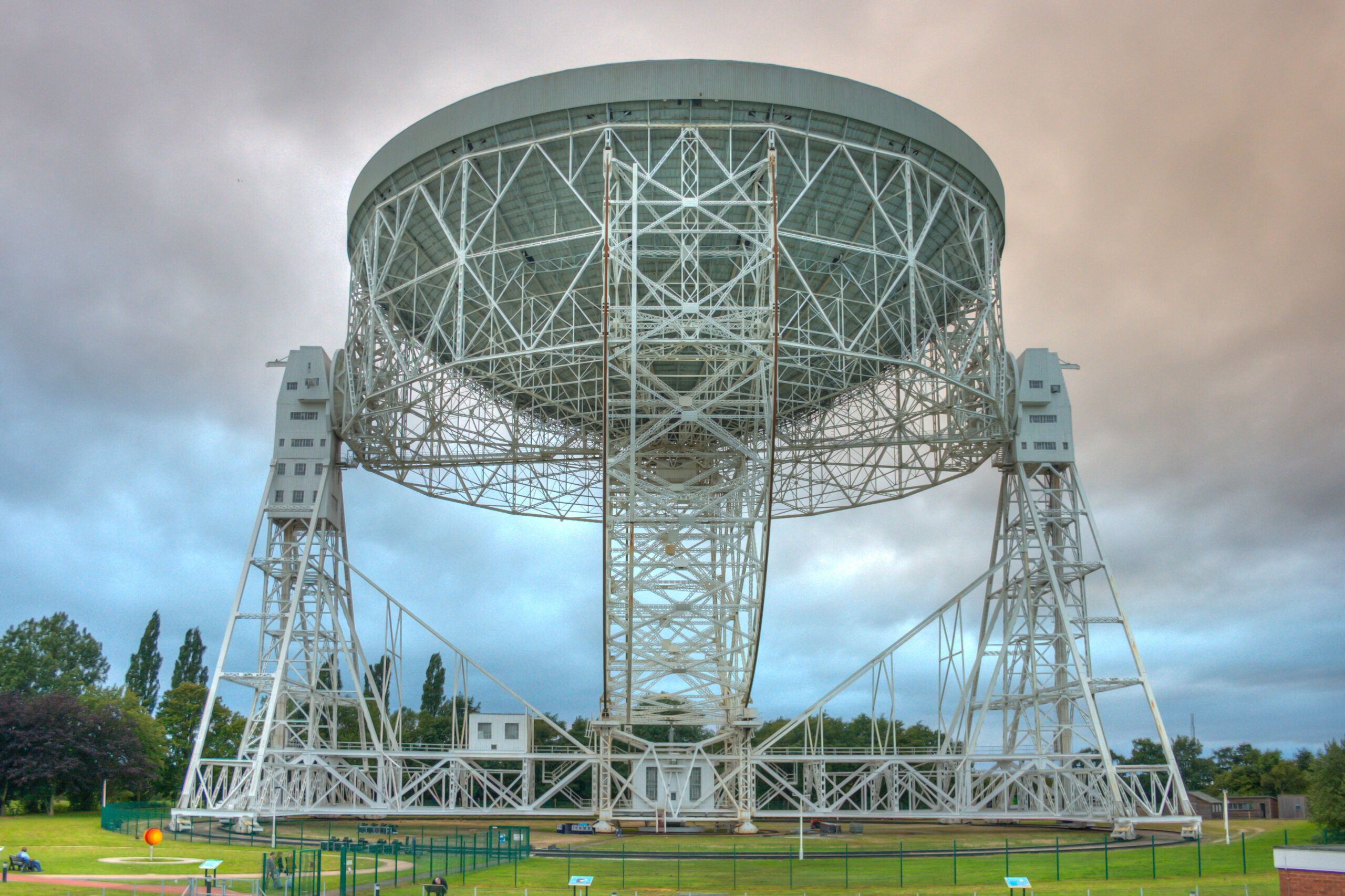
- e-MERLIN links 7 radio telescopes spread across the United Kingdom, anchored at the Jodrell Bank Observatory, into a single virtual instrument.
- The technique, interferometry, combines signals from separated dishes so the array resolves detail as if it were one telescope hundreds of kilometres wide.
- That is what enables parsec-scale imaging — sharp enough to isolate the tiny radio core of a galaxy from the star-forming regions around it.
- Radio waves also pass through the gas and dust that hide galaxy centres from optical telescopes, making radio the natural hunting band for buried black holes.
- India runs its own world-class facility on the same principle — the Giant Metrewave Radio Telescope (GMRT) near Pune, operated by NCRA-TIFR — and has joined the Square Kilometre Array Observatory (SKAO), the next-generation global radio telescope.
IIA and India's Astronomy Footprint
The Indian connection here is institutional, and it is worth knowing the institution.
- The Indian Institute of Astrophysics (IIA), Bengaluru, is an autonomous research institute under the Department of Science and Technology; Dr Aru Beri of IIA is part of the survey team.
- IIA traces its lineage to the Madras Observatory (1786) and today runs the Kodaikanal Solar Observatory, the Vainu Bappu Observatory at Kavalur, and the Indian Astronomical Observatory at Hanle, Ladakh — one of the world’s highest optical telescope sites.
- IIA built the Visible Emission Line Coronagraph (VELC), the primary payload on ISRO’s Aditya-L1 solar mission.
- Indian space astronomy assets include AstroSat (multi-wavelength observatory) and XPoSat (X-ray polarimetry, useful for black hole and neutron star studies).
- This study is a template for how Indian researchers plug into international facilities — a theme that recurs from LIGO-India to SKAO. Broader context sits in our space technology explainer.
Why Faint Black Holes Matter for Galaxy Evolution
Quiet does not mean unimportant — low-level black hole activity may quietly steer how galaxies evolve.
- Even weakly accreting black holes inject energy into their host galaxies through jets and outflows — a process astronomers call AGN feedback.
- This feedback can heat or expel gas, throttling star formation rates and shaping the long-term evolution of the galaxy.
- PIB notes the results suggest faint, low-level activity may be the dominant mode of black hole growth in the present-day Universe — most local black holes grow by trickle, not by feast.
- A statistically complete census matters because it tells us how common such activity is in ordinary galaxies, not just in the rare, bright ones that dominate older catalogues.
- The result reframes the local Universe: galaxy centres that looked dormant are, in large numbers, gently active.
The Other Extreme: Euclid's Ancient Quasars
The same week’s science news offers a striking contrast from the early Universe.
- The Hindu reported that ESA’s Euclid space telescope discovered 31 quasars, including the two oldest yet — shining when the Universe was roughly 670 million years old, about 5% of its current age of 13.8 billion years.
- Those quasars date to the epoch of reionisation, when the first stars and galaxies ended the cosmic dark ages.
- They deepen a standing puzzle: black holes of billions of solar masses already existed in the Universe’s infancy, and astronomers can’t yet explain how they grew so fast.
- Read together, the two studies bracket the black hole story — furious growth in the young Universe, and slow, faint feeding in the mature one.
- The James Webb Space Telescope has also observed the new quasars, with data analysis under way.
Way Forward
Deepening India's Radio Astronomy Play
- Convert SKAO membership into leadership niches — signal processing, data pipelines, and receiver technology — where Indian institutions already have GMRT-honed strengths.
- Expand fellowships and joint-PhD channels so more Indian scientists embed in surveys on facilities like e-MERLIN, Chandra, and Euclid.
- Keep investing in home instruments — the uGMRT upgrade path, Hanle’s dark-sky reserve, and follow-on X-ray missions after XPoSat — so collaboration flows both ways.
For aspirants, the durable takeaway is conceptual: master the physics vocabulary — accretion, AGN, jets, interferometry — and the Indian institutional map (IIA, NCRA-TIFR, ISRO’s observatory missions). Prelims questions on black holes recur, and this study supplies fresh, concrete pegs for both papers.
Conclusion
The e-MERLIN survey of 280 Palomar galaxies converts a long-held belief — that nearly every galaxy hides a central black hole — into measured statistics: about a quarter of ordinary nearby galaxies show detectable, weakly accreting supermassive black holes. The local Universe is not asleep; it is murmuring.
For India, the study is a quiet credential. An IIA scientist on a statistically complete international radio census, published in MNRAS, reflects the growing reach of Indian astrophysics from Kodaikanal to SKAO.
For the exam, the peg is double-edged: a Prelims-friendly bundle of facts (e-MERLIN, Chandra, parsec, one-in-four) and a Mains-friendly argument about basic research, international collaboration, and the payoff of patient, precise instruments.
UPSC Practice Questions
Prelims MCQ 1
With reference to the recent high-resolution radio survey of nearby galaxies that found widespread faint black hole activity, consider the following statements:
- The survey used the e-MERLIN facility, an array of radio telescopes located in the United Kingdom.
- Compact radio emission from weakly accreting supermassive black holes was detected in nearly one-quarter of the roughly 280 galaxies surveyed.
- The radio findings were confirmed using X-ray data from the European Space Agency’s XMM-Newton observatory.
How many of the above statements are correct?
(a) Only one (b) Only two (c) All three (d) None
Answer: (b) Only two
Explanation:
Statements 1 and 2 are correct: e-MERLIN links 7 radio telescopes across the UK, and the survey of 280 Palomar-sample galaxies detected compact radio emission in nearly a quarter of them. Statement 3 is wrong — the confirming X-ray data came from NASA’s Chandra X-ray Observatory, not XMM-Newton.
Prelims MCQ 2
In astrophysics, the term ‘accretion disc’ is best described as:
(a) The spherical shell of dark matter surrounding a galaxy (b) A rotating disc of hot gas and matter spiralling into a compact object such as a black hole, emitting radiation as it falls (c) The boundary around a black hole beyond which light cannot escape (d) A ring of asteroids and icy debris left over from planet formation
Answer: (b) A rotating disc of hot gas and matter spiralling into a compact object such as a black hole, emitting radiation as it falls
Explanation:
Infalling matter forms a spinning disc around the black hole; friction heats it until it radiates across the spectrum. Option (c) describes the event horizon, and (d) describes a debris disc — different concepts.
UPSC Mains Questions
- Nearly every large galaxy is believed to host a supermassive black hole, yet most remain undetected. Explain how radio interferometry helps uncover such faint objects, and discuss the significance of Indian participation in international astronomy collaborations. (250 words)
- Basic research in astronomy delivers no immediate product, yet nations keep funding telescopes and space observatories. Critically examine the scientific, technological, and strategic returns of India’s investments in facilities such as GMRT, AstroSat, Aditya-L1, and SKAO membership. (250 words)
Sources: PIB, Ministry of Science & Technology and The Hindu.
Frequently Asked Questions
What did the new black hole study find?
Using the e-MERLIN radio array, astronomers surveyed 280 nearby galaxies from the Palomar sample and detected compact radio emission from nearly one-quarter of them — the signature of weakly accreting supermassive black holes that ordinary surveys miss. The study was published in the Monthly Notices of the Royal Astronomical Society.
What is India’s connection to the study?
Dr Aru Beri of the Indian Institute of Astrophysics (IIA), Bengaluru — an autonomous institution under the Department of Science and Technology — was part of the international team, as PIB highlighted. It reflects Indian researchers’ growing role in frontline global astronomy collaborations.
What is e-MERLIN?
e-MERLIN is an array of seven radio telescopes spread across the United Kingdom, anchored at Jodrell Bank Observatory. Working as an interferometer, the linked dishes act like one giant telescope, achieving the parsec-scale resolution needed to isolate faint radio emission from galaxy centres.
Why are these black holes called ‘weakly accreting’?
They are pulling in matter at very low rates. Instead of blazing like quasars, they emit only a faint, compact radio glow. The study suggests this slow, low-level feeding may be the dominant way black holes grow in today’s Universe.
How was star formation ruled out as the source?
The team combined the radio maps with X-ray observations from NASA’s Chandra X-ray Observatory. The joint data confirmed the central emission comes from accreting supermassive black holes, not from star formation, supernova remnants, or X-ray binary systems in the host galaxies.
Why do faint black holes matter for galaxies?
Even weak black hole activity launches jets and outflows that inject energy into the host galaxy — a process called AGN feedback. This can heat or expel gas, regulate star formation, and shape how galaxies evolve over billions of years.