
A star is not eternal. It begins as cold gas, ignites under the weight of its own gravity, burns for tens of millions to tens of billions of years, and ends in one of three very different fates depending on how heavy it was at birth. The lightest of these fates is a quiet cooling of the surviving core. The heaviest is a black hole, an object so dense that no light can escape it. The path between birth and death is the subject of stellar astrophysics, and the broad outline is now well enough understood that it features in undergraduate textbooks and, increasingly, in UPSC science questions.
For an aspirant, the topic delivers two payoffs. The first is conceptual range, since the life cycle ties together gravity, nuclear fusion, thermodynamics, and general relativity. The second is current-affairs leverage, since most major space missions, including the James Webb Space Telescope, the Aditya-L1 solar observatory, and the Euclid mission, are working at one stage or another of the stellar story.
Quick Facts on Stellar Life Cycle
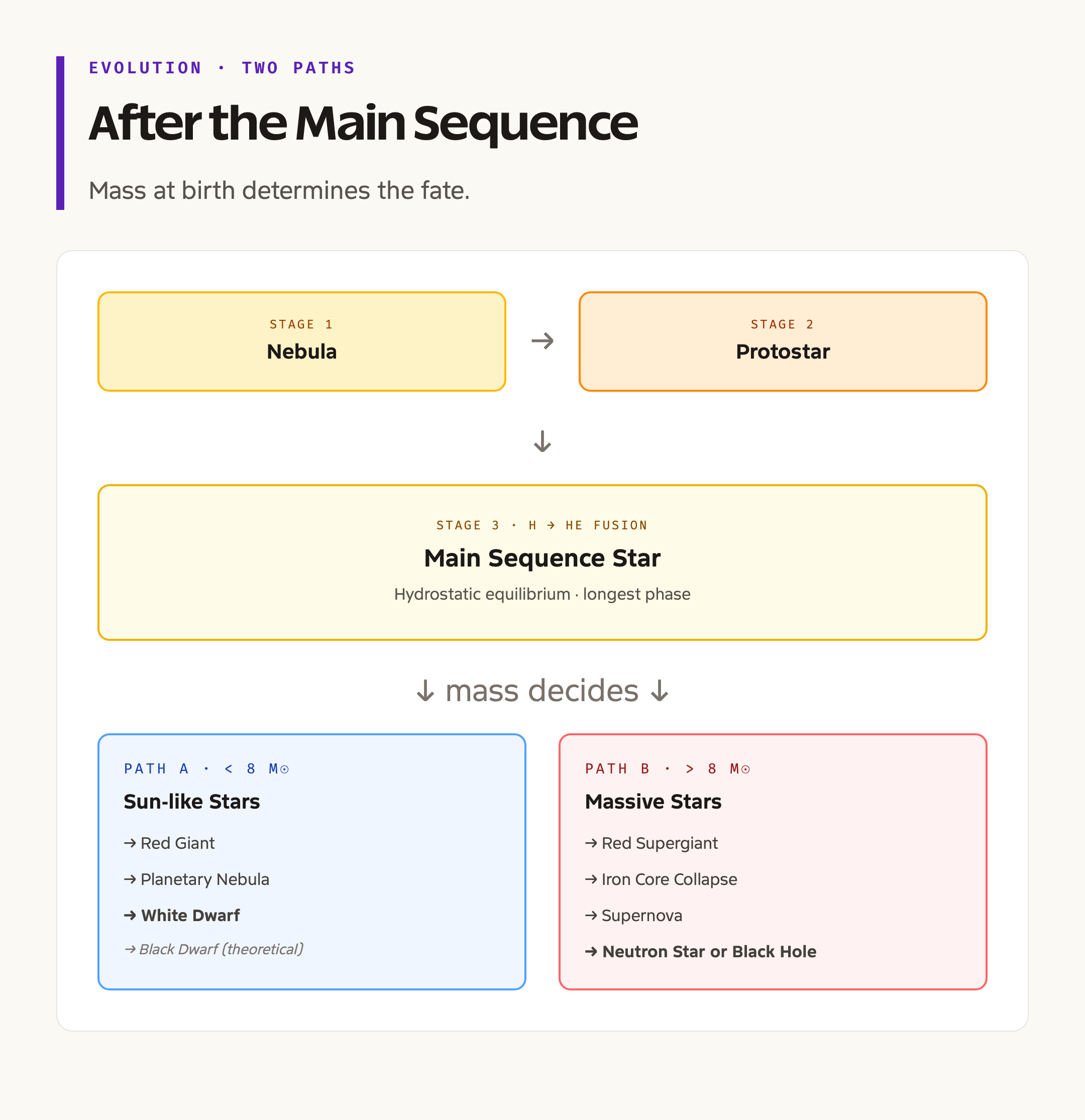
Stars are born in vast clouds of gas and dust called nebulae. They spend most of their lives on the main sequence, fusing hydrogen into helium in their cores. They die in one of three end states. Stars below roughly eight solar masses end as white dwarfs. Stars above roughly eight solar masses explode as supernovae and leave behind either a neutron star or, if heavy enough, a black hole. The Sun is a low-mass main-sequence star and will end as a white dwarf.
Two thresholds matter. The Chandrasekhar limit, roughly 1.4 solar masses, is the maximum mass a white dwarf can have before electron degeneracy pressure can no longer hold it up. The Tolman-Oppenheimer-Volkoff limit, roughly 2 to 3 solar masses, is the analogous upper bound for a neutron star. Beyond this, gravitational collapse to a black hole is the only outcome.
What a Star Actually Is
A star is a gravitationally bound ball of plasma in which thermonuclear fusion in the core releases enough energy to balance the inward pull of gravity. The balance is called hydrostatic equilibrium. Every other property of a star, including its luminosity, surface temperature, lifetime, and eventual fate, follows from how this balance is established and how it changes as the fuel is consumed.
Hydrogen fusion is the dominant power source for almost every star during the longest phase of its life. Four hydrogen nuclei combine through a chain of reactions to form a helium nucleus, releasing energy in the process. The fusion happens only in the core, where temperature and pressure are high enough. The outer layers transport the energy outward by radiation and convection until it leaves the star’s surface as light.
Background and Historical Context
The understanding of stellar evolution as a structured cycle developed through the early twentieth century. Eddington and others established the basic theory of stellar structure in the 1920s. Subrahmanyan Chandrasekhar, working in the early 1930s, derived the mass limit for white dwarfs that now bears his name. Hans Bethe in 1939 worked out the detailed nuclear reactions that power main-sequence stars. The classification of stars by spectral type and luminosity, plotted on the Hertzsprung-Russell diagram, gave observers a single picture in which the theoretical predictions could be tested.
The end states of massive stars took longer to understand. Walter Baade and Fritz Zwicky proposed in 1934 that supernovae were the explosions of massive stars and that they could leave behind neutron stars. The first observational confirmation came in 1967 when Jocelyn Bell Burnell discovered pulsars, rapidly rotating neutron stars detected by their radio emission. Black holes, predicted by general relativity in the early twentieth century, were not observationally established until later in the century, and direct imaging of black hole shadows arrived only with the Event Horizon Telescope results of 2019 and 2022. The picture connects back to the Indian contribution, including Chandrasekhar’s Nobel-winning work on stellar collapse and the broader astrophysics tradition that the Aditya-L1 solar observatory continues today.
Stage One: Nebula and Protostar
Stars are born in nebulae, vast and cold clouds of molecular gas, mostly hydrogen, with traces of dust. The Eagle Nebula, the Orion Nebula, and the Crab Nebula are well-known examples, although the Crab Nebula is the remnant of a stellar death rather than a stellar birth. A star formation event begins when a region of the nebula becomes dense enough that its self-gravity overcomes the outward pressure of gas and turbulence. The region begins to collapse.
As the collapsing region contracts, it heats up. The kinetic energy of infalling gas converts to thermal energy. The dense, hot lump that forms at the centre of the collapse is called a protostar. A protostar is not yet a true star because nuclear fusion has not begun. The energy radiated by a protostar comes from gravitational contraction, not from fusion.
When the core temperature reaches roughly ten million Kelvin, hydrogen fusion ignites. The protostar becomes a main-sequence star. The duration of the protostar phase ranges from a few hundred thousand years for massive stars to tens of millions of years for very low-mass stars.
Stage Two: Main Sequence
The main sequence is the long, stable phase in which a star fuses hydrogen into helium in its core. Most stars in the observable universe at any moment are on the main sequence. The Sun, at roughly 4.6 billion years old, is about halfway through its main-sequence lifetime, which is expected to last another five billion years or so.
The main-sequence lifetime depends sharply on mass. A star ten times the mass of the Sun has roughly a thousand times the luminosity but only ten times the fuel, so it burns through its hydrogen in a few tens of millions of years rather than ten billion. The most massive stars, around fifty to a hundred solar masses, may complete their main-sequence phase in only a few million years. The lowest-mass stars, red dwarfs, have main-sequence lifetimes longer than the current age of the universe, so none of them has yet died.
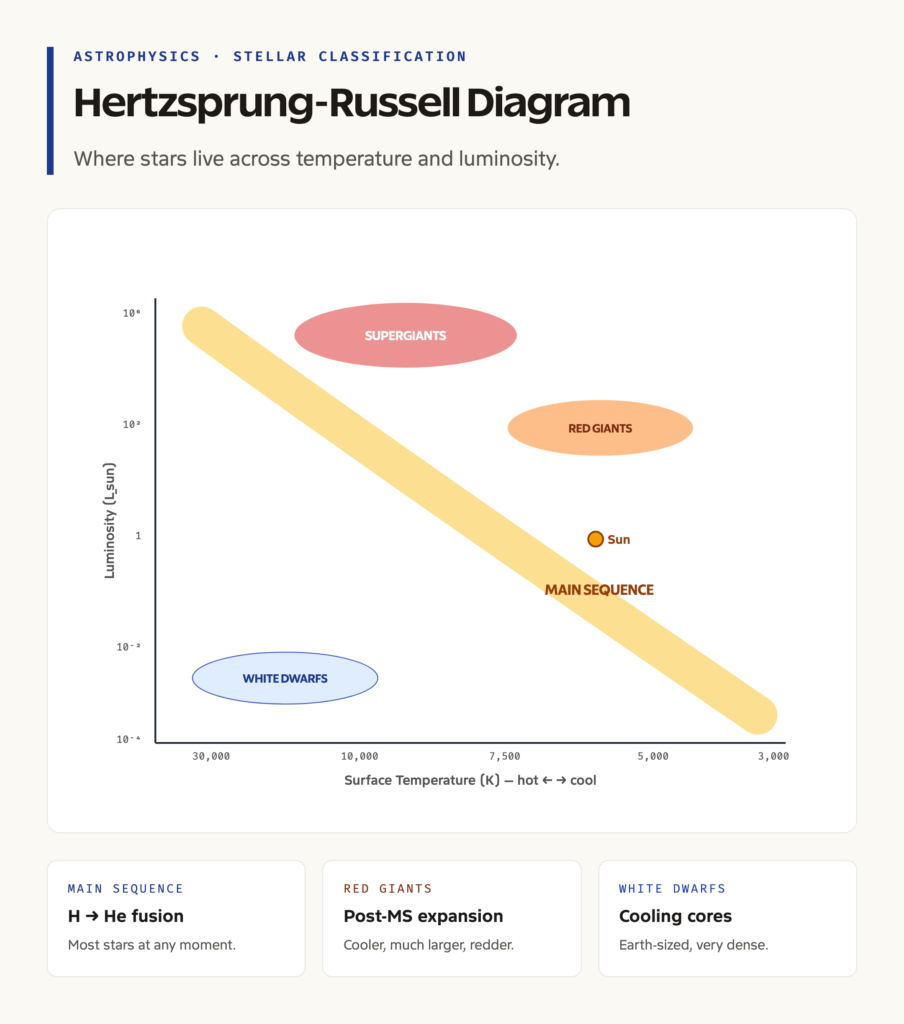
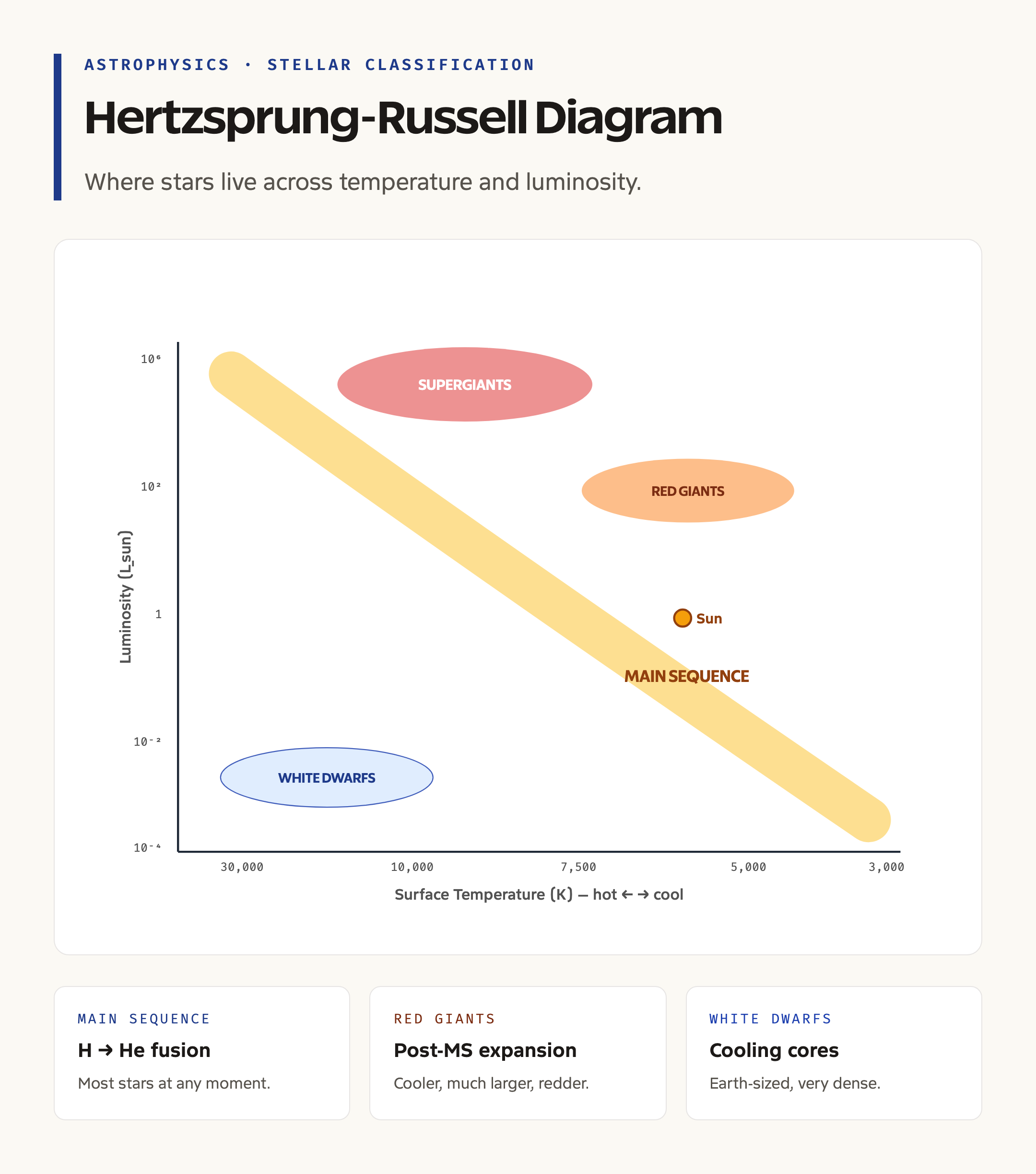
The Hertzsprung-Russell diagram is the standard graphical tool for thinking about main-sequence stars. The horizontal axis is surface temperature, plotted with hot blue stars on the left and cool red stars on the right. The vertical axis is luminosity. The main sequence appears as a band running diagonally from upper-left, the hot luminous blue stars, to lower-right, the cool dim red dwarfs. Stars off the main sequence are either younger pre-main-sequence stars, evolved stars in later phases, or compact remnants.
Stage Three: Two Paths after Main Sequence
When core hydrogen runs out, the star leaves the main sequence. What happens next depends on the star’s mass.
For a star of low to intermediate mass, similar to the Sun, the core contracts under gravity while the outer layers expand and cool. The star becomes a red giant, with a much larger radius than its main-sequence form and a redder colour. Helium fusion eventually ignites in the core, producing carbon and oxygen. Once helium is exhausted, the core cannot reach the temperatures needed to fuse heavier elements. The outer layers drift away into space as a planetary nebula, leaving behind a hot, dense core called a white dwarf.
A white dwarf is roughly the size of the Earth but has a substantial fraction of the Sun’s mass, giving it enormous density. It does not generate energy by fusion. It glows from residual heat, slowly fading over billions of years. In the very long run, a white dwarf cools to a hypothetical state called a black dwarf, which is theoretical only because the universe is not yet old enough for any white dwarf to have cooled to that point.
For a star of high mass, more than roughly eight solar masses, the post-main-sequence path is different. The star becomes a red supergiant rather than a red giant and runs through successive stages of nuclear burning, fusing helium to carbon, carbon to neon, neon to oxygen, oxygen to silicon, and silicon to iron. Iron is the end of the line because fusing iron into heavier elements absorbs energy rather than releasing it. The core, no longer supported by fusion energy, collapses catastrophically.
Stage Four: Supernova and Compact Remnants
The collapse of the core of a massive star happens in less than a second. The core compresses until electrons are squeezed into protons to form neutrons, releasing a torrent of neutrinos. The outer layers, no longer supported by the core, fall inward, hit a wall of resistance, and rebound outward in a shock wave. The result is a supernova explosion, briefly outshining an entire galaxy and ejecting most of the star’s mass into space.
The remnant left behind depends on the mass of the core after collapse. If the remnant is below the Tolman-Oppenheimer-Volkoff limit, around two to three solar masses, the result is a neutron star. A neutron star is incredibly dense, with a typical radius of around ten kilometres and a mass somewhat above that of the Sun. It is supported against further collapse by neutron degeneracy pressure. Many neutron stars are observed as pulsars, beaming radiation that sweeps across Earth as the star rotates.
If the remnant is above the limit, gravity overwhelms even neutron degeneracy. The collapse continues to a singularity, surrounded by an event horizon from which not even light can escape. The result is a stellar-mass black hole, a topic explored in more detail under black holes related concepts and in observational work such as the Euclid mission.
Comparative End States
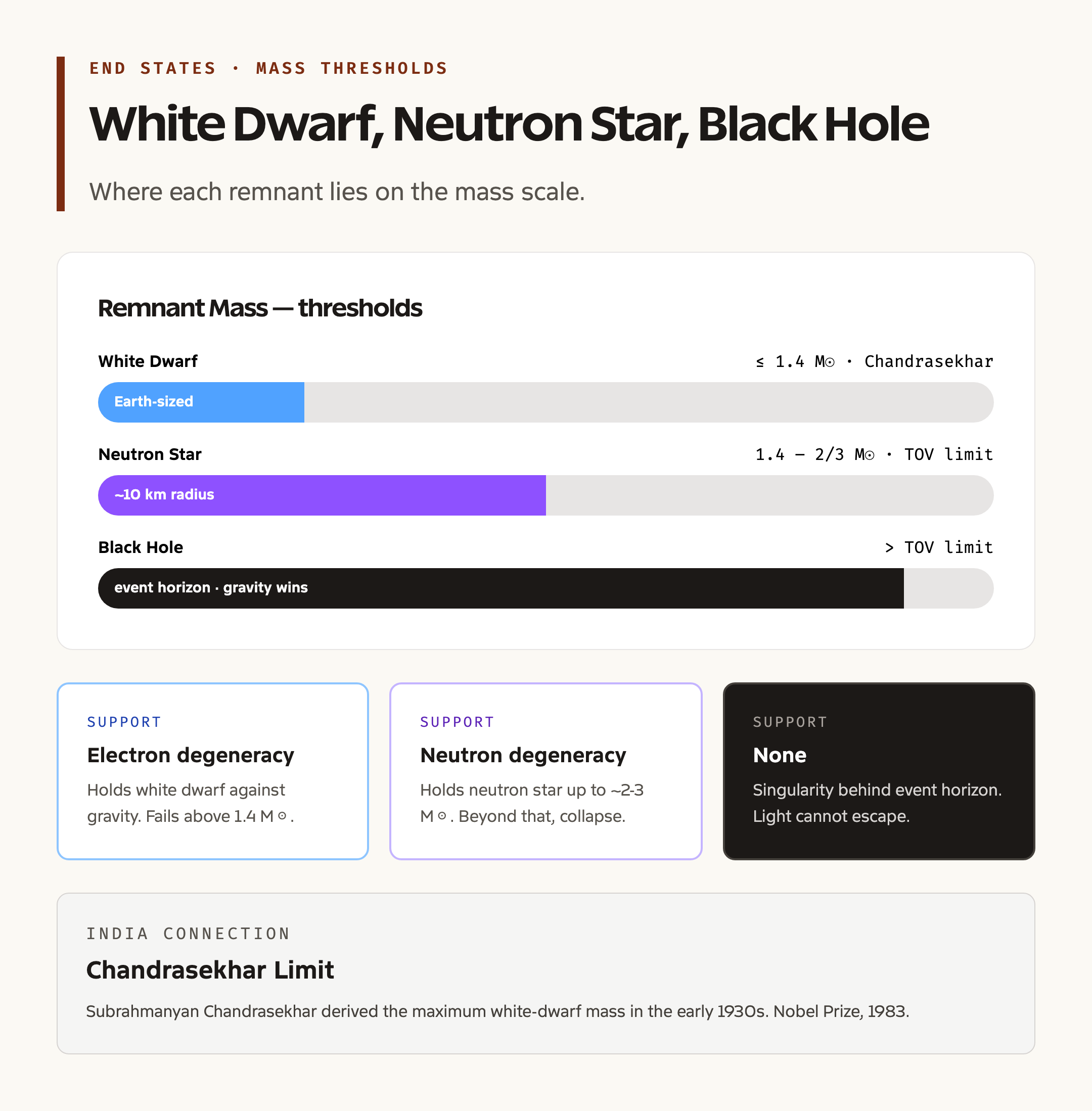
A clean comparison of the three end states helps in revision.
| Property | White Dwarf | Neutron Star | Black Hole |
|---|---|---|---|
| Progenitor mass | Below roughly 8 solar masses | 8 to roughly 25 solar masses | Above roughly 25 solar masses |
| Remnant mass | Below 1.4 solar masses | 1.4 to roughly 2 to 3 solar masses | Above the TOV limit |
| Typical radius | Earth-sized | About 10 km | Defined by event horizon |
| Support mechanism | Electron degeneracy pressure | Neutron degeneracy pressure | None, gravitational collapse |
| Energy source | Residual heat | Residual heat, magnetic fields | Accretion, Hawking radiation |
| Observed as | Hot dim point sources | Pulsars, X-ray binaries | X-ray binaries, gravitational waves |
The mass thresholds are approximate and depend on metallicity, rotation, and binary interactions. The qualitative picture, however, is well established.
Why the Life Cycle Matters
The life cycle of stars matters for three reasons that go beyond stellar physics. The first is cosmic chemistry. Almost every element heavier than helium in the universe was made in the cores of stars or in supernova explosions. Carbon, oxygen, and nitrogen, the elements of life, are produced in the late stages of intermediate and massive stars. Iron and the elements lighter than it are produced through stellar nucleosynthesis. Heavier elements like gold, uranium, and most lanthanides are made in supernovae and in mergers of neutron stars. Every atom in a human body heavier than hydrogen was once inside a star.
The second is observational astronomy. Most of what is observed in the universe, from the brightness of distant galaxies to the gravitational waves detected by LIGO and the Indian-led LIGO India project, is interpreted through the lens of stellar evolution. The third is technological spinoff. Detector technologies developed for stellar astrophysics, including X-ray detectors, gravitational-wave interferometers, and large-format CCDs, find their way into medical imaging, semiconductor manufacturing, and other practical fields, building on the broader story of gravitational waves.
Challenges and Frontiers
Several open questions remain. The behaviour of matter at the densities found inside neutron stars is not fully understood and is an active area of nuclear physics research. The progenitors of certain types of supernovae are still debated. The role of binary star interactions in shaping stellar evolution is a major frontier. Whether some stellar collapses produce black holes directly without an explosion, in so-called failed supernovae, is observationally under investigation.
The link between stellar mergers and the production of heavy elements has been opened up by the detection in 2017 of a kilonova, the electromagnetic counterpart of a neutron-star merger detected in gravitational waves and across the electromagnetic spectrum. Continued multi-messenger astronomy, combining gravitational-wave detectors with optical, infrared, and X-ray telescopes, is likely to reshape the understanding of stellar end-states over the next decade.
Prelims Pointers
- A nebula is a cloud of gas and dust in which star formation can occur.
- A protostar is the dense, hot lump formed by gravitational collapse before nuclear fusion begins.
- A main-sequence star fuses hydrogen into helium in its core.
- The Hertzsprung-Russell diagram plots stars by surface temperature and luminosity.
- The Sun is a main-sequence star roughly halfway through its expected lifetime.
- A red giant is the post-main-sequence form of a low or intermediate-mass star.
- A planetary nebula is the shell of expelled outer material left around the dying core of a Sun-like star.
- A white dwarf is the remnant of a star with mass below roughly eight solar masses.
- A supernova is the explosive death of a massive star.
- A neutron star is the remnant of a supernova where the core mass is below the TOV limit.
- A black hole is the remnant where the core mass exceeds the TOV limit.
- The Chandrasekhar limit is roughly 1.4 solar masses, the maximum mass of a white dwarf.
Mains Practice Questions
- Outline the life cycle of a star and explain how stellar mass determines the eventual fate of a star. Discuss the significance of stellar nucleosynthesis for the chemical evolution of the universe.
- Compare the structure, formation, and observational signatures of white dwarfs, neutron stars, and black holes. Highlight the role of Indian astronomers in the development of stellar evolution theory.
- Discuss the contribution of multi-messenger astronomy, including gravitational-wave detection, to the understanding of stellar end-states.
Way Forward
The frontier in stellar astrophysics is moving in three directions. The first is multi-messenger detection, combining gravitational-wave observatories with electromagnetic telescopes to study events like neutron-star mergers in detail. The second is large-survey astronomy, with telescopes like the Vera Rubin Observatory and Euclid producing catalogues of billions of stars and galaxies that can be used to map stellar populations across cosmic time. The third is high-resolution imaging, with the James Webb Space Telescope opening up the early stages of star formation in nearby and distant galaxies.
For India, the participation in LIGO India, the operation of Aditya-L1, the development of the Thirty Meter Telescope partnership, and the planned Disha and other space missions all sit within this broader programme. The country has historically punched above its weight in stellar astrophysics, beginning with Chandrasekhar, and the next generation of facilities should keep that tradition active.
For the aspirant, the take-away is that the life cycle is a single coherent story. Birth in a nebula, ignition into a protostar, long stable burning on the main sequence, post-main-sequence expansion, and one of three end states. The mass at birth determines almost everything that follows. Holding that single thread makes the rest of the detail much easier to retain.
Frequently Asked Questions
Where are stars born?
Stars are born in nebulae, large cold clouds of molecular gas and dust. Gravitational collapse of dense regions within these clouds produces protostars, which become true stars when nuclear fusion ignites in their cores.
What is the main sequence?
The main sequence is the long, stable phase in a star’s life when it fuses hydrogen into helium in its core. Most stars in the observable universe at any moment are on the main sequence.
Why do stars eventually leave the main sequence?
A main-sequence star leaves the sequence when the hydrogen in its core has been substantially depleted. The core contracts and heats, while the outer layers expand and cool, taking the star into the red giant or red supergiant phase.
What is a white dwarf?
A white dwarf is the remnant of a star with mass less than roughly eight solar masses. It is roughly Earth-sized, very dense, and supported by electron degeneracy pressure rather than by ongoing fusion. It cools slowly over billions of years.
What is a supernova?
A supernova is the explosive death of a massive star, triggered by the collapse of its iron core. The explosion ejects most of the star’s mass into space and briefly outshines its host galaxy.
What is the difference between a neutron star and a black hole?
A neutron star is a collapsed stellar core supported by neutron degeneracy pressure. A black hole forms when the core mass exceeds the limit at which neutron degeneracy pressure can resist gravity, leading to collapse into a singularity surrounded by an event horizon.
What is the Chandrasekhar limit?
The Chandrasekhar limit is the maximum mass that a white dwarf can have, roughly 1.4 solar masses, beyond which electron degeneracy pressure cannot support the star against gravity. The limit was derived by Subrahmanyan Chandrasekhar in the early 1930s.
Will the Sun become a black hole?
No. The Sun is too low in mass. After leaving the main sequence in roughly five billion years, the Sun will pass through a red giant phase, shed its outer layers as a planetary nebula, and end as a white dwarf.
What is the Hertzsprung-Russell diagram?
The Hertzsprung-Russell diagram is a plot of stellar luminosity against surface temperature, used to classify stars and to visualize stellar evolution. The main sequence appears as a diagonal band, with red giants, supergiants, and white dwarfs occupying distinct regions of the diagram.
Where do heavy elements come from?
Most elements heavier than hydrogen and helium are produced in stars. Elements up to iron are made by fusion in the cores of massive stars during their lives. Heavier elements are made in supernova explosions and in mergers of neutron stars.
Tell Google you want more of this.
Add Anantam IAS as a preferred sourceOne tap, and this site shows up more often in your own Top Stories, AI Overviews and AI Mode. Remove it any time.





